
2018届上海市闵行区高三下学期质量调研(二模)英语试题
2018届上海市闵行区高三下学期质量调研(二模)英语试题考生注意:1.考试时间120分钟, 试卷满分140分。
2.本考试设试卷和答题纸两部分, 试卷共12页。
所有答题必须涂(选择题)或写(非选择题)在答题纸上, 做在试卷上一律不得分。
3.答题前, 务必在答题纸上填写考生号和姓名。
I. Listening ComprehensionSection ADirections: In Section A, you will hear ten short conversations between two speakers. At the end of each conversation, a question will be asked about what was said. The conversations and the questions will be spoken only once. After you hear a conversation and the question about it, read the four possible answers on your paper, and decide which one is the best answer to the question you have heard.1. A. He will review 2 more lessons. B. He will study the other 20 lessons.C. He will go over the 13 lessons.D. He will study all the 15 lessons.2. A. His injury kept him at home. B. He didn’t think it necessary.C. He was too weak to see the doctor.D. He failed to make an appointment.3. A. The post office. B. Monroe Street.C. The courthouse.D. Fourth Avenue.4. A. Disappointed. B. Approving. C. Concerned. D. Doubtful.5. A. He played his part quite well. B. He was not dramatic enough.C. He performed better than the secretary.D. He exaggerated his part.6. A. He wrote a book about great restaurants.B. He always makes reservations for dinner.C. He read a book while he was eating dinner.D. He always finds good places to eat.7. A. He is afraid he won’t be chosen for the trip.B. The boss has not decided where to go.C. Such a trip is necessary for the company.D. It’s not certain whether the trip will take place.8. A. It’s too expensive to get the apartment furnished.B. The furniture he bought was very cheap.C. The apartment was provided with some old furniture.D. It’s hard to find proper furniture for his apartment.9. A. She is intended to work for the school newspaper.B. The man can spare some time reading school newspaper.C. The man has a very tight schedule.D. The man should have taken more than five classes.10. A. Whether the meeting is certainly to be held on Monday.B. What bad news will be talked about at the meeting.C. What they are going to discuss at the meeting.D. Where the meeting is to be held.Section BDirections: In Section B, you will hear two passages and a longer conversation, and you will be asked several questions on each of the passages and the conversation. The passages and conversation will be read twice, but the questions will be spoken only once. When you hear a question, read the four possible answers on your paper and decide which one is the best answer to the question you have heard.Questions 11 through 13 are based on the following passage.11. A. Appropriateness of the programs. B. The operation of national programs.C. The incomes of the corporation.D. The welfare of the staff.12. A. By donations from the public. B. By selling its programs.C. By selling broadcasting devices.D. By getting support from the royals.13. A. Its humorous styles. B. The richness of its programs.C. Famous news announcers.D. Its neutral views on news.Questions 14 through 16 are based on the following passage.14. A. Social progress and individual development.B. Human behaviors and social changes.C. General concepts about psychology and sociology.D. Relationship between cultures and human behaviors.15. A. What is the role of religion or art in a society?B. What is the main reason for revolution in a society?C. What are the causes of antisocial behavior?D. Why does one society progress more rapidly than another?16. A. Both psychology and sociology study human behavior.B. Mental problems should be dealt with by a sociologist.C. Sociology is the study of group behavior.D. Psychology pays more attention to individuals than to groups.Questions 17 through 20 are based on the following conversation.17. A. It looks into opinions that people hold about old age.B. It is about how to keep healthy in old age.C. It investigates causes of old people’s unhappiness.D. It reveals the secret of living longer.18. A. Arise people’s awareness of caring for the old.B. Encourage people to be more responsible for the old.C. Help people change their feelings about old age.D. Ease people’s fear and anxiety about mental illness of the old.19. A. They are mostly among the 60-70 age group.B. They are mostly abandoned by their families.C. People do not become more lonely because of old age.D. People among any age group are not lonely at all.20. A. They are changing suddenly and completely at a particular age.B. It’s hard to recognize a person when he is turning old.C. Old people can’t deal with events and problems properly.D. People do not change in old age a lot more than in middle age.II. Grammar and VocabularySection ADirections:After reading the passage below, fill in the blanks to make the passages coherent and grammatically correct. For the blanks with a given word, fill in each blank with the proper form of the given word; for the other blanks, use one word that best fits each blank.Aunt Jane is now well over seventy, but she is still a great cinema-goer. The cinema in our town closed down years ago and sometimes she has to travel twenty miles or more to see a good film. And once a month at least she goes up to London to see (21)________(late) foreign films. Of course she could see most of these films on television, but the idea does not attract her. “It isn’t the same,” she says. “For one thing, the screen’s too small. Besides, I like going to the cinema!”However, one thing which has always puzzled us is that (22)________ Aunt Jane has lots of friends and enjoys company, she always goes to the cinema alone. We discovered the reason for this only recently—from Mother. “It may surprise you to learn that Aunt Jane wanted to be an actress when she was young,” she told us. “She used to wait outside film studios all day, just (23)________(appear) in crowd scenes. Your aunt has probably appeared in dozens of films. Sometimes she did not even know the name of the film they (24)________(make). Therefore, she couldn’t go to see (25)________ in the film at the cinema!“All the time, of course, she was looking for a small part in a film. Her big chance came (26)________ they started to make a film in our town. Jane managed to meet the director at a party and he offered her (27)________ role as a shopkeeper. It really was a very small part, but it was an important moment for Jane. Before the great event, she rehearsed for days. In fact, she turned the sitting-room into a shop! We all had to help, going to and out of the shop (28)_______ she could remember her words perfectly. And (29)________ the actual day she was marvelous. Jane thought that this was the beginning of her film career!“Unfortunately, in the end, they did not include the shop scene in the film. But nobody told Jane! When the film first appeared in London, she took all her friends to see it. And of course she wasn’t in it! It was a terrible blow! She stopped (30)________(go) to film studios and gave up the idea of becoming an actress. She still loves the cinema, as you all know, but from that day she has always gone alone!”Section BDirections: Complete the following passage by using the words in the box. Each word can only be used once.(班卓琴) song, you’re probabl y 31 following the age-old advice that practice makes perfect. However, contrary to popular belief, doing the same thing over and over again might not be the most efficient way to learn foreign concepts.Traditionally, we’re taught using the “blocking” strategy. This instructs us to go over a single idea again and again until we’ve mastered it, before32 to the next concept. But several new neurological(神经学的) 33 show that an up and coming learning method called “interleaving” improves our ability to keep and perform new skills over any traditional means by leaps and bounds.What interleaving does is to space out learning over a longer period of time, and it 34the information we encounter when learning a new skill. So, for example, instead of learning one banjo chord at a time until you 35 it, you train in several at once and in shorter bursts.One of the practical ways you can use interleaving to train your brain to pick up new skills quickly and effectively is to practice multiple 36 skills at once.Whether you’re trying to improve your motor skills or cognitive (认知的) learning abilities, the key to 37 how your brain processes new information is to break out of the habit of learning one part of a skill at a time.The advantage of this method is that your brain doesn’t get comfortable or store information in your short-term memory. Instead, interleaving causes your brain to 38 focus and problem-solve every step of the way, resulting in information getting stored in your long-term memory instead.Interleaving doesn’t cut any corners, so your brain is always on39 . Think of the difference between blocking and interleaving like a boxer who practices one 40 over and over again versus a boxer who practices by sparring in the ring. In the ring, you have to be ready for anything. It makes you faster and sharper.III. Reading ComprehensionSection ADirections: For each blank in the following passage there are four words or phrases marked A, B, C and D. Fill in each blank with the word or phrase that best fits the context.Since 1960, considerable scientific researches have been done on chimps in their natural habitats. Astonishingly, scientists have found out that the social 41 of Chimps are very similar to humans. Chimps will 42 in certain ways, like gathering in war parties to protect their territory. But beyond the minimum requirements as social beings, they have little instinct to 43 one another. Chimps in the wild seek food for themselves. Even chimp mothers regularly 44 to share food with their children. Who are able from a young age to gather their own food?In the laboratory, chimps don’t 45 share food either. If a chimp is put in a cage where he can pull in one plate of food for himself or, with no greater effort, a plate that also provides food for a neighbor to the next cage, he will pull 46 —he just doesn’t care whether his neighbor gets fed or not. Chimps are truly selfish. Human children, 47 , are extremely cooperative. From the earliest ages, they decide to help others, to share information and to participate in achieving common goals. The psychologist Michael Tomasello has studied this 48 in a series of experiments with very young children. He finds that if babies aged 18 months see a worried adult with hands full trying to open a door, almost all will immediately try to help.There are several reasons to believe that the urges to help, inform and share are not taught, but naturally 49 in young children. One is that these 50 appear at a very young age before most parents have started to train their children to behave 51 . Another is that the helping behaviors are not improved if the children are rewarded. A third reason is that social intelligence 52 in children before their general cognitive skills, at least when compared with chimps. In tests conducted by Tomasello, the human children did no better than the chimps on the 53 world tests but were considerably better at understanding the social world.The core of what children’s minds have and chimps’ don’t is what Tomasello calls shared intentionality. Part of this ability is that they can 54 what others know or are thinking. But beyond that, even very young children want to be part of a shared purpose. They actively seek to be part of a “we”, a group that intends to work toward a(n) 55 goal.41. A. structures B. policies C. behaviors D. responsibilities42. A. conflict B. cooperate C. offend D. negotiate43. A. trust B. contact C. isolate D. help44. A. decline B. manage C. attempt D. oblige45. A. curiously B. reluctantly C. naturally D. carelessly46. A. in turn B. at random C. with care D. in advance47. A. all in all B. as a result C. in no case D. on the other hand48. A. cooperativeness B. availability C. interrelationship D. attractiveness49. A. cultivated B. motivated C. possessed D. stimulated50. A. attitudes B. instincts C. experiences D. coincidences51. A. creatively B. formally C. socially D. competitively52. A. develops B. decreases C. changes D. disappears53. A. abstract B. invisible C. imaginary D. physical54. A. infer B. adapt C. absorb D. balance55. A. realistic B. shared C. specific D. ambitiousSection BDirections: Read the following passages. Each passage is followed by several questions or unfinished statements. For each of them there are four choices marked A, B, C and D. Choose the one that fits best according to the information given in the passage you have just read.(A)If a diver surfaces too quickly, he may suffer the bends. Nitrogen(氮)dissolved in his blood is suddenly liberated by the reduction of pressure.The consequence, if the bubbles accumulate (累积) in a joint, is sharp painand a bent body—thus the name. If the bubbles form in his lungs or hisbrain, the consequence can be death.Other air-breathing animals also suffer this decompression (减压) sickness ifthey surface too fast: whales, for example. And so, long ago, didichthyosaurs. That these ancient sea animals got the bends can be seenfrom their bones. If bubbles of nitrogen form inside the bone they can cutoff its blood supply. This kills the cells in the bone, and consequentlyweakens it, sometimes to the point of collapse. Fossil bones that have caved in on themselves are thus a sign that the animal once had the bends.Bruce Rothschild of the University of Kansas knew all this when he began a study of ichthyosaur bones to find out how widespread the problem was in the past. What he particularly wanted to investigate was how ichthyosaurs adapted to the problem of decompression over the 150 million years. To this end, he and his colleagues traveled the world’s natural-history museums, looking at hundreds of ichthyosaurs from the Triassic period and from the later Jurassic and Cretaceous periods.When he started, he assumed that signs of the bends would be rarer in younger fossils, reflecting their gradual evolution of measures to deal with decompression. Instead, he was astonished to discover the opposite. More than 15% of Jurassic and Cretaceous ichthyosaurs had suffered the bends before they died, but not a single Triassic specimen (标本) showed evidence of that sort of injury.If ichthyosaurs did evolve an anti-decompression means, they clearly did so quickly—and, most strangely, they lost it afterwards. But that is not what Dr. Rothschild thinks happened. He suspects it was evolution in other animals that caused the change.Whales that suffer the bends often do so because they have surfaced to escape a predator (掠食性动物) such as a large shark. One of the features of Jurassic oceans was an abundance of large sharks and crocodiles, both of which were fond of ichthyosaur lunches. Triassic oceans, by contrast, were mercifully shark and crocodile-free. In the Triassic, then, ichthyosaurs were top of the food chain. In the Jurassic and Cretaceous, they were prey (猎物) as well as predator—and often had to make a speedy exit as a result.56. Which of the following is a typical symptom of the bends?A. A twisted body.B. A gradual decrease in blood supply.C. A sudden release of nitrogen in blood.D. A drop in blood pressure.57. The purpose of Rothschild’s study is to see ________.A. how often ichthyosaurs caught the bendsB. how ichthyosaurs adapted to decompressionC. why ichthyosaurs bent their bodiesD. when ichthyosaurs broke their bones58. Rothsch ild’s finding stated in Paragraph 4 ________.A. confirmed his assumptionB. speeded up his research processC. disagreed with his assumptionD. changed his research objectives59. Rothschild might have concluded that ichthyosaurs ________.A. failed to evolve an anti-decompression meansB. gradually developed measures against the bendsC. died out because of large sharks and crocodilesD. evolved an anti-decompression means but soon lost it(B)However wealthy we may be, we can never find enough hours in the day to do everything we want. Economics deals with this problem through the concept of opportunity cost, which simply refers to whether someone’s time or money could be better spent on something else.Every hour of our time has a value. For every hour we work at one job we could quite easily be doing another, or be sleeping or watching a film. Each of these options has a different opportunity cost—namely, what they cost us in missed opportunities.Say you intend to watch a football match but the tickets are expensive and it will take you a couple of hours to get to and from the stadium. Why not, you might reason, watch the game from home and use the leftover money and time to have dinner with friends? This—the alternative use of your cash and time—is the opportunity cost.For economists, every decision is made by knowledge of what one must forgo—in terms of money and enjoyment—in order to take it up. By knowing precisely what you are receiving and what you are missing out on, you ought to be able to make better-informed, more reasonable decisions. Consider that most famous economic rule of all: there’s no such thing as a free lunch. Even if someone offers to take you out to lunch for free, the time you will spend in the restaurant still costs you something in terms of forgone opportunities.Some people find the idea of opportunity cost extremely discouraging: imagine spending your entire life calculating whether your time would be better spent elsewhere doing something more profitable or enjoyable. Yet, in a sense it’s human nature to do precisely that we assess the advantages and disadvantages of decisions all the time.In the business world, a popular phrase is “value for money.”People want their cash to go as far as possible. However, another is fast obtaining an advantage: “value for time.” The biggest restriction on our resources is the number of hours we can devote to something, so we look to maximize the return we get on our investment of time. By reading this passage you are giving over a bit of your time which could be spent doing other activities, such as sleeping and eating. In return, however, this passage will help you to think like an economist, closely considering the opportunity cost of each of your decisions.60. According to the passage, the concept of “opportunity cost” is applied to ________.A. making more moneyB. taking more opportunitiesC. reducing missed opportunitiesD. weighing the choice of opportunities61. The “leftover money and time” in Paragraph 3 probably refers to the time ________.A. spared for watching the match at homeB. taken to have dinner with friendsC. spent on the way to and from the matchD. saved from not going to watch the match62. What are forgone opportunities?A. Opportunities you forget in decision-making.B. Opportunities you give up for better ones.C. Opportunities you miss accidentally.D. Opportunities you make up for.(C)Of all the components of a good night’s sleep, dreams seem to be least within our control. In dreams, awindow opens into a world where logic is suspended and dead people speak. A century ago, Freud stated his revolutionary theory that dreams were the disguised (伪装的) shadows of our unconscious desires and fears; by the late 1970s, neurologists had switch ed to thinking of them as just “mental noise” — the random byproducts of the neural-repair work that goes on during sleep. Now researchers suspect that dreams are part of the mind’s emotional thermostat, regulating moods while the brain is “off-line”. And one leading authority says that these intensely powerful mental events can be not only influenced but actually brought under conscious control, to help us sleep and feel better. “It’s your dream,” says Rosalind Cartwright, chair of psychology at Chicago’s Medical Center. “If you don’t like it, change it.”The link between dreams and emotions shows up among the patients in Cartwright’s clinic. Most people seem to have more bad dreams early in the night, progressing toward happier ones before awakening, suggesting that they are working through negative feelings generated(产生) during the day. Because our conscious mind is occupied with daily life, we don’t always think about the emotional significance of the day’s events — until, it appears, we begin to dream.And this process need not be left to the unconscious. Cartwright believes one can exercise conscious control over repeated bad dreams. As soon as you awaken, identify what is upsetting about the dream. Visualize how you would like it to end instead; the next time it occurs, try to wake up just enough to control its course. With much practice people can learn to, literally, do it in their sleep.At the end of the day, there’s probably little reason to pay attention to our dreams at all unless they keep us from sleeping or “we wake up in a panic,” Cartwright says. Terrorism, economic uncertainties and general feelings of insecurity have increased people’s anxiety. Those suffering from persistent nightmares should seek help from a therapist. For the rest of us, the brain has its ways of working through bad feeling. Sleep — or rather dream —on it and you’ll feel better in the morning.63. By saying that “dreams are part of the mind’s emotional thermostat” in paragraph 1, the researchers mean that __________.A. dreams can help us keep our mood comparatively stableB. dreams can be brought under conscious controlC. dreams represent our unconscious desires and fearsD. we can think logically in the dreams too64. The negative feelings generated during the day tend to __________.A. become worse in our unconscious mindB. develop into happy dreamsC. persist till the time we fall asleepD. show up in dreams early at night65. Cartwright believed with much practice, we can learn to __________.A. control what dreams to dreamB. sleep well without any dreamsC. wake up in time to stop the bad dreamsD. identify what is upsetting about the dreams66. Cartwright might advise those who sometimes have bad dreams to __________.A. lead their life as usualB. seek professional helpC. exercise conscious controlD. avoid anxiety in the daytimeSection CDirections: Read the following passage carefully. Fill in each blank with a proper sentence given in the box. Each sentence can be used only once. Note that there are two more sentences than you need.Rhythm of LifeChoosing the right time to sleep, the correct moment to make decisions, the best hour to eat—and even go into hospital—could be your key to perfect health.Centuries after man discovered the rhythms of the planets and the cycles of crops, scientists have learned that we too live by precise rhythms that govern everything from our basic bodily functions to mental skills. Man is a prisoner of time.But it’s not just the experts who are switching on to the way our bodies work. 67Prince Charles consults a chart which tells him when he will be at his peak on a physical, emotional and intellectual level. Boxer Frank Bruno is another who charts his bio-rhythms to plan for big fights.68 Sleep, blood pressure, hormone levels and heartbeat all follow their own clocks, which may bear only slight relation to our man-made 24-hour cycle.Research shows that in laboratory experiments when social signals and, most importantly, light indicators such as dawn are taken away, people lose touch with the 24-hour clock and sleeping patterns change. Temperature and heartbeat cycles lengthen and settle into “days” lasting about 25 hours.In the real world, light and dark keep adjusting internal clock to the 24-hour day. But the best indicator ofperformance is body temperature. As it falls from a 10 p.m. high of 37.2°C to a pre-dawn low of 36.1°C, mentalfunctions fall too. 69The most famous example is the nuclear accident at Three Mile Island in the US. The three operators in the control room worked alternating weeks of day, evening and night shifts.70 Investigators believe this caused the workers to overlook a warning light and fail to close an open valve.Finding the secret of what makes us tick has long fascinated scientists and work done over the last decade has yielded important clues. The aim is to help us become more efficient. For example, the time we eat may be important if we want to maximize intellectual or sporting performance. There is already evidence suggesting that the time when medicine is given to patients affects how well it works.IV. Summary WritingDirections: Read the following passage. Summarize the main idea and the main points of the passage in no more than 60 words. Use your own words as far as possible.Quiet Virtue: The ConscientiousThe everyday signs of conscientiousness (认真尽责)—being punctual, careful in doing work, self-disciplined, and scrupulous (一丝不苟的) in attending to responsibilities—are typical characteristics of the model organizationalcitizen, the people who keep things running as they should. They follow the rules, help out, and are concerned about the people they work with. It’s the conscientious worker who helps newcomers or updates people who return after an absence, who gets to work on time and never abuses sick leaves, who always gets things done on deadline.Conscientiousness is a key to success in any field. In studies of job performance, outstanding effectiveness for almost all jobs, from semi-skilled labor to sales and management, depends on conscientiousness. Among sales representatives for a large American car manufacturer, those who were most conscientious had the largest volume of sales.Conscientiousness also offers a buffer (缓冲) against the threat of job loss in today’s constantly changing market, because employees with this quality are among the most valued. For the sales representatives, their level of conscientiousness mattered almost as much as their sales in determining who stayed on.But conscientiousness in the absence of social skills can lead to problems. Since conscientious people demand so much of themselves, they can hold other people to their own standards, and so be overly judgmental when others don’t show the same high levels of model behavior. Factory workers who were extremely conscientious, for example, tended to criticize co-workers even about failures that seemed unimportant to those they criticized, which damaged their relationships.When conscientiousness takes the form of living up to expectations, it can discourage creativity. Success in creative professions like art or advertising calls for a balance between wild ideas and conscientiousness. Without enough conscientiousness to follow through, people become mere dreamers, with nothing to show for their imaginativeness.V. TranslationDirections: Translate the following sentences into English, using the words given in the brackets.72. 请把这封信寄给负责售后服务的人。
2018届松江(闵行)高三英语二模答案
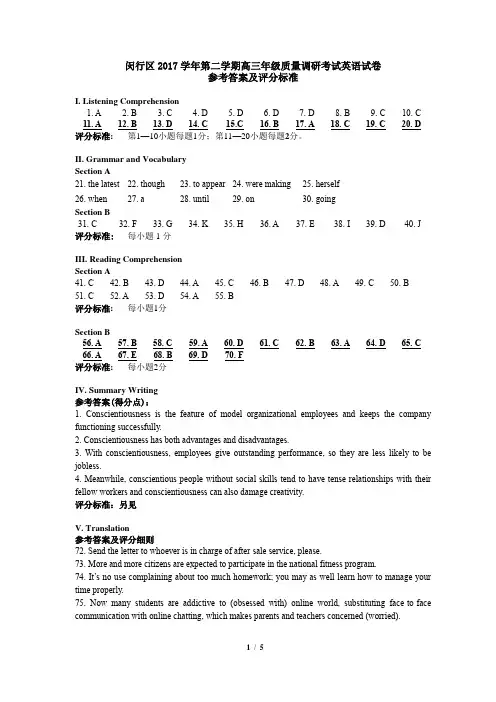
闵行区2017学年第二学期高三年级质量调研考试英语试卷参考答案及评分标准I. Listening Comprehension1. A2. B3. C4. D5. D6. D7. D8. B9. C10. C 11. A12. B13. D14. C15.C16. B17. A18. C19. C20. D评分标准: 第1—10小题每题1分;第11—20小题每题2分。
II. Grammar and VocabularySection A21. the latest22. though23. to appear24. were making25. herself26. when27. a28. until29. on30. goingSection B31. C32. F33. G34. K35. H36. A37. E38. I39. D40. J评分标准:每小题1分III. Reading ComprehensionSection A41. C42. B43. D44. A45. C46. B47. D48. A49. C50. B51. C52. A53. D54. A55. B评分标准: 每小题1分Section B56. A57. B58. C59. A60. D61. C62. B63. A64. D65. C 66. A67. E68. B69. D70. F评分标准: 每小题2分IV. Summary Writing参考答案(得分点):1. Conscientiousness is the feature of model organizational employees and keeps the company functioning successfully.2. Conscientiousness has both advantages and disadvantages.3. With conscientiousness, employees give outstanding performance, so they are less likely to be jobless.4. Meanwhile, conscientious people without social skills tend to have tense relationships with their fellow workers and conscientiousness can also damage creativity.评分标准:另见V. Translation参考答案及评分细则72. Send the letter to whoever is in charge of after-sale service, please.73. More and more citizens are expected to participate in the national fitness program.74. It’s no use complaining about too much homework; you may as well learn how to manage your time properly.75. Now many students are addictive to (obsessed with) online world, substituting face-to-face communication with online chatting, which makes parents and teachers concerned (worried).评分标准1、第72-73题3分;第74题每题4分;第75题5分。
英语_2018年上海市闵行区中考英语二模试卷(含答案)

2018年上海市闵行区中考英语二模试卷二、选择题1. Which of the following underlined parts is different in pronunciation from the others?()A I need d ou ble milk for my coffee.B We are pr ou d to be Chinese.C The women sh ou ted loudly for helpD They are going to buy a new h ou se.2. Take a look at____booklet on the shelf. It tells you how to use then new cooker.()A aB anC theD /3. Linda came back home_____half past ten last night. That's really too late.()A atB onC inD for4. It's important for________ to know that honesty is the best solution when in trouble.()A weB usC ourD ours5. The government says that they are going to build the third____road in the town.()A wideB widerC widestD the widest6. The audience was surprised_______the result of the singing contest.()A fromB withC atD about7. Though it was very dangerous, _____hesitated when entering the burning lab.()A everybodyB nobodyC anybodyD somebody8. He's put on so much weight that his clothes aren't_____any more.()A wonderfullyB beautifullyC expensiveD fit9. Alice would rather_____in an air﹣conditioned room in such hot weather.()A stayB to stayC staysD staying10. Tracey suggested ______ basketball in Sports Club after school.A playsB to playC payD playing11. The writer_____his new book in the hall of our university at the moment.()A introducesB is introducingC introducedD would introduce12. So far, the little boy_____to 21 countries with his parents and two sisters.()A was travellingB had travelledC has travelledD is traveling13. Workers____the construction of Underground Line 23 by the year of 2025.()A completedB will completeC completeD had completed14. Work really hard, ______you can realize your dream of becoming a pilot.()A butB soC orD and15. We will have to cancel the baseball match_____the weather improves.()A unlessB becauseC has soon asD if16. _______amazing the latest Disney animation cartoon is!()A WhatB What aC What anD How17. Jack and his friends sometimes take a walk along the beach after dinner,_______?()A did theyB didn't theyC do theyD don't they18. According to the law, traffic________keep to the left in England.()A mayB mustC needD can19. ﹣Jiang, an oversea student, was killed at her own home in Japan.﹣___________.()A I don't agree.B I hope so, but I don't think so.C I'm sorry to hearthat D That's very kind of you.20. ﹣We're going hiking this weekend. Would you like to join us?﹣___________.()A Yes, I'd like to.B Never mind.C I am busy now.D I'll take your advice.三、填空题21. A.managed to B.showed off C.products D.death E.researchWhat can you do with nuts? A scientist named George Washington Carver answered that question, over and over again. We should say thanks to him for more than 300 (1)_______. When Carver was born in 1864, he was a slave(奴隶) one farm in Missouri. Later, he got freedom. As a teenager, he worked on a farm and.(2)_______finish high school. At the age of 30, he became the first back student at the collegein Iowa. In 1896, he became the first black teacher working at another college in Iowa Several years later, he took a job at a college in Alabama, where he worked until his(3)_______in 1943.Carver studied agriculture, the science off arming. His (4)_______made huge improvements in farming in the southern United States.22. A.remained B.embarrassed C.similar D.material E.gainedCarver studied peanuts. He knew that the south couldn't grow just cotton. Plantingcotton year after year wore out the soil and made it useless Carver learned that if farmers planted cotton one year and peanuts the next, the soil(1)_______healthy.To encourage this practice, Carver thought of new uses for the peanut. Would you like to try peanut and raisin ice cream? How about using peanuts as a kind of (2)_______to make shampoo? Perhaps you would prefer to make paint from peanuts, or maybe you wouldlike to bake with peanut flour. Glue? Paper? Rubber? The list goes on and on. He also thought of (3)_______uses for pecans(山核桃) and other nuts.Carver (4)_______little from most of his inventions. He didn't feel that it was right to sell his ideas. He gave them freely to help farmers and fellow scientists. Carver's life is onethat we could all use as an example.四、填空题23. Chinese people started to open to the western world________ ago.(century)24. The recording will be played________to make sure you can understand each word.(two)25. A friend of________ got the first prize for the high jump in the sports meeting.(me)26. Mr Zhang has________a large of stamps since he is a big an of them.(collect)27. The firemen decided to cut the iron fence________so as to save the girl.(immediate)28. In the old mountain village,people learned a________way to make paper.(tradition)29. The well known restaurant will________ 10 new dishes next month(service)30. It is________of my mother to lose her purse on the way to the market.(happy)五、句型转换31. Dad waters his favourite flowers in the garden regularly.(改为一般疑问句)________dad________ his favourite flowers in the garden regularly?32. Wendy had learnt ________ languages by the end of last year.(对划线部分提问)________languages had Wendy learnt by the end of last year?33. We should keep bananas in a cool place before they go bad.(改为被动语态)Bananas should________ in a cool place before they go bad.34. The flight was delayed until the next day because of the fog.(保持句意基本不变)The flight was________ until the next day because of the fog.35. "How can I improve my English?" The boy asked the teacher.(改为宾语从句)The boy asked the teacher________he________ improve his English.36. The superstar is very kind. He helps poor villages to set up schools.(保持句意基本不变)The superstar is________ kind________ he helps poor villages to set up schools.37. online education, students, are used to, more and more(连词成句)________六、阅读理解38. Choose the best answerA nationwide survey released carlier this year said an average Chinese adult read less than eight books in 2015, among which 4.58were paper books and 3.26e﹣books. With digital books becoming more popular, many people would find it hard to remember the last time they sat down in a bookstore and enjoyed a quiet moment.But this does not mean that bookstores are losing their customers. To ________ more readers, bookstores are now bigger, more beautiful and grander.Here are some of them. ZhongshugeWalking into a Zhongshuge bookstore is like entering a sea of books, above the ceiling overhead, beneath the floor under your feet, on the walls, and under the steps of the staircases. Zhongshuge is known for its beautiful designs.The brand now has chains in Shanghai, Hangzhou, and Yangzhou.The Book wormThe bookworm is a bookshop, bar and cafe all in one. Hidden in downtown Beijing's Sanlitun bar area, the place is among the most popular for foreigners looking for some international experiences in the Chinese capital.In addition to a larger variety of books, the European﹣style shop also holds lectures and cultural events. It's often possible for visitors to meet famous authors unexpectedly in the comfortable place.Paradise Time Travel BookstoreTibet(西藏) is a must﹣visit on many people's travel lists. You can find the beauty of the ancient Tibetan style. Paradise Time Travel Bookstore is decorated in this way. But if you look closely, you will find it is a foreignlanguage bookshop, This kind of mixture is a great surprise,isn't it?The Paradise Time Travel Bookstore is located near the princess Wencheng Theater in Lhasa(拉萨).Poplar Kid's RepublicThe Poplar Kid's Republic, sitting in Beijing's CBD area, is a fairyland of picture books for children. The bookshop was selected among one of the most beautiful bookshops in the world by Flavorwire, a popular US news website about art and culture, in 2012.The colorful designs inside are aimed at encouraging kids to explore books. Pushing the glass doors open, you will see children's drawings and craftworks(工艺) hanging on the pink walls, leading you into a world full of imagination.(1)According to the survey, an average Chinese adult read less thanin 2015________.A 3.B 4.C 8.D 9.(2)We can find Zhongshuge in________.A Yangzhou.B Beijing.C Suzhou.D Lhasa.(3)The underlined word 'lure' in paragraph 2most probably means________.A contact.B attract.C observe.D choose.(4)Flavorwire in the passage is________.A a beautiful bookshop.B a recent survey.C a news website.D a noisy bar.(5)Which of the following is wrong according to the passage________?A Chinese adults don't read enough books on average.B We can meet some famous book writers in the Bookworm.C The Paradise Time Travel Bookstore is located in Beijing.D You will see children's drawings in the Poplar Kid's Republic.(6)The article is mainly about________.A the importance of reading books.B some popular E﹣books.C the fun of travelling around.D some beautiful bookstores in China.39. Emily was an eighth grader.To pass her Civics course, she had to do some volunteer services in a nursing home for a week.One Monday, Emily went to the nursing home after school. When she arrived, she was told she would spend an hour every weekday with an elderly lady, MrsBlair. She was then led into a room, where an old lady in a flowery dress was sitting on a sofa.Emily stood awkwardly(别扭地) in front of the lady. She cleared her throat andsaid, 'Good afternoon. I'm Emily.'‘Good afternoon, Emily. Take a seat, please.'Mrs. Blair replied.Then, (1)_______filled the space between them. Emily wondered what to say.‘Tell me about yourself, Emily, ' MrsBlair said suddenly.‘ Well, ' Emily started, ‘I don't have any grandparents, so I don't know how toget on well with elderly people. I love the performing arts. I'm here mainly because I have to volunteer here to get a good grade for my Civics class.'MrsBlair didn't seem to mind.‘Many people, especially teens, don't seem to (2)_______old people like me. Now you are here, and I'm going to change that about you. Ask me anything.Emily thought for a moment, and finally decided, ‘What was your job? '‘I was a Broadway star in the 1950s.' MrsBlair answered.‘Cool! Can you tell me about it? ' Emily asked, amazed.MrsBlair smiled.‘Back then,(3)_______the lead actress had the honor to wear a spccial bracelet, I was the lead in almost all of the plays, so I always wore the bracelet. Till this day, I still have it.'Emily smiled along with MrsBlair and listened to the other stories attentively. She had become very (4)_______MrsBlair's stories. She decided to come earlier the next day.Tuesday, Wednesday, and Thursday passed by quickly. Then came Friday. As she was leaving, Emily was really upset to say goodbye.‘Don't be sad. You can still visit me, ' MrsBlair comforted her. She then handed a small box to Emily, ‘It's my gift to you.Emily (5)_______opened the box and was surprised to see what was inside.‘It's the bracelet that you wore. Thank you!' Emily said, with tears in her eyes.' I'm sure to visit you whenever I'm free.'On the way home, Emily thought of her own love for the performing arts. She touchedthe bracelet and (6)_______that she would keep her word to MrsBlair.(1)A happinessB friendshipC silenceD humour(2)A care forB agree withC depend onD worry about(3)A evenB maybeC yetD only(4)A afraid ofB interested inC pleased withD familiar with(5)A angrilyB easilyC carefullyD suddenly(6)A promisedB deniedC introducedD lied40. C. Something changed a few years ago. Around 2012, teens started to spend their time much differently from the generation before. I started to notice big difference in teen's b(1)________and attitudes in the yearly survey of 11million young people.A 2017survey found that two out of three U.S. teens owned an iphone. For this reason,I call them iGen (iphone generation).What makes iGen different?Growing up with a smart phone has affected nearly every aspect of their lives. They spendso much time on the internet, texting friends and on social media, an average of about six hours per day, so they have less free time for everything else. That (2)________going to parties, shopping at the mall or watching movies with their friends. These were o(3)________the favorite activities of most teens. But now iGcn teens are taking part in these social activities at lower rate than others.A link that should be noticedI wondered if these changes might be c(4)________to their deteriorating(退化) mental health. Sure enough, I found that teens who spend more time on screens are less happy and more disappointed. Meanwhile, a 2017study asked some adults to give up Facebook felt happier, less l(5)________and less disappointed during the week as they had morefree time for social activities like meeting friends, watching movies, etc.What else is lost?Spending less time with friends means less time to develop social abilities. A 2016study showed that the sixth graders who spent just five days at a camp w(6)________using screens ended time better at reading expressions on others' faces.That isn't to say that iGen teens don't have a(7)________. They are physically safer and more tolerant(宽容). They also seem to have a stronger work spirit and more realistic expectations. To my surprise, the iGien teens I interviewed said they preferred seeing their friends in person to communicating with them using their phones.But it might be just what iGen needs.41. Answer the questionsAndrew Carnegie was born in 1835in Scotland. He was from a poor family. When he was twelve, his family moved to the USA. They wanted a better life. There, Andrew started to work right away, He got a job in a factory. He was a good worker, but he didn't likethe job. Later, he changed his job. He worked at the Railroad Company where everybody liked him. He did many different jobs. His salary got higher every year.In his fiee time, Andrew loved to read. But in those days, the United States didn't have free public libraries. Luckily, he lived with a rich man with many books, who let young boys use his library for free, so Andrew could read as much as possible. He read throughout his life.Andrew learned a lot at the railroad company. He realized that the railroad was very important for big countries. He had a idea to start a business with railroads. He saved all his money and opened a business at the age of thirty years.First, his company made bridges for the railroads. Ten years later, it made steel for bridges, machines, and many other things. Soon he was the richest man in the world.Andrew liked to make money. But he believed it was very important to help other people. In 1901, he sold his company for 480million. He started to give away his money to make new libraries and colleges all over the United States. He built28111ibraries. Andrew also gave a lot of money to people who worked for peace. In 1903,he gave 1.5million to build a Peace Palace in the Netherlands.Andrew Carnegie died in 1919. He was eighty﹣four years old. During his life, he gave away nearly all of his money. He gave away over $350million for education andpeace. There are colleges, libraries, hospitals, and parks named after Andrew Carnegie. He helped millions of people all over the world to study and learn.(1)Andrew Carnegie used to work in a factory, didn't he?________(2)Why could Andrew Carnegie read as much as possible in those days?________(3)How old was Andrew Carnegie when he opened a business?________(4)What did Andrew Carnegie company do?________(5)How did Andrew Carnegie help others after he sold his company?________(6)What can you learn from Andrew Carnegie?________七、书面表达42. Write an e﹣mail in at least 60words according to the given situation(根据所合情景子一寸不少于60 词的电子邮件,邮件开头已给.)假如你是Sunny,你们班级将要在教室里举行一次毕业派对,班主任 Susan 正在征求大家的金点子.请给Susan 写一封电子邮件,介绍你设计的一个或几个有意义的毕业派对活动.(注意:文中不得出现任何姓名、校名及其他相关信息,否则不予评分.)Subject Graduation PartyTo classteachersusan@163.comDear Susan,I am really excited about the coming graduationparty.________________________________________________________________Yours,Sunny2018年上海市闵行区中考英语二模试卷答案1. A2. C3. A4. B5. C6. C7. B8. D9. A10. D11. B12. C13. B14. D15. A16. D17. D18. B19. C20. A21. C,A,D,E22. A,D,C,E23. centuries24. twice25. mine26. collected27. immediately28. traditional29. be served30. unhappy31. Does,water32. five,How many33. bekept34. putoff35. how,could36. so,that37. More and more students are used to online education.38. CABCCD39. CADBCA40. ehaviors,includes,nce,onnected,onely,ithout,dvantages41. Yes,he did.,Becauseshelivedwitharichmanwithmanybooks,wholetyoungboysusehislibraryforfree,When he was thirty years old,First,hiscompanymadebridgesfortherailroadsTenyearslater,itmadesteelforbridges,machines,andmanyotherthings,He started to give away his money,built 2811 libraries,gave a lot of money to people who worked for peace,gave 1.5million to build a Peace Palace in the Netherlands.,Try to work hard and be kind.42. I have a plan for the party that divides into three parts.They're Picture show,Talent show and Senior high message.,Part 1.Picture show,We bring some photos taken with our teachers or classmates and describe the photos with a good story about our school lives.,Part 2.Talent show,We can share our hobbies with our classmates.We can show what we can do in music,art or sport. We can also show other special abilities like playing magic and so on.,Part 3.Junior high message,Eachofuspreparesabigcard,andthenwritesdownamessageforseniorhighonthecardforeachotherSoeveryonecanexchanget hebestwisheswithhisorherclassmates,Inthisparty,allofuscanshareourwonderfulexperienceinthepastthreeyearsWecanpresentwhatwe''velearnt andhowmuchprogresswe'vemade,tooAndfinallywemaylookforwardtothefuturewithlotsofencouragementoradvice。
上海市闵行区2018届高三英语二模试卷及答案
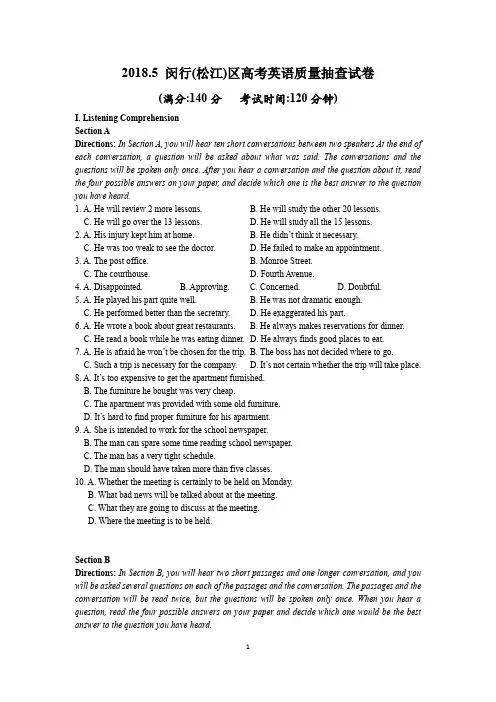
2018.5 闵行(松江)区高考英语质量抽查试卷(满分:140分考试时间:120分钟)I. Listening ComprehensionSection ADirections: In Section A, you will hear ten short conversations between two speakers At the end of each conversation, a question will be asked about what was said. The conversations and the questions will be spoken only once. After you hear a conversation and the question about it, read the four possible answers on your paper, and decide which one is the best answer to the question you have heard.1. A. He will review 2 more lessons. B. He will study the other 20 lessons.C. He will go over the 13 lessons.D. He will study all the 15 lessons.2. A. His injury kept him at home. B. He didn’t think it necessary.C. He was too weak to see the doctor.D. He failed to make an appointment.3. A. The post office. B. Monroe Street.C. The courthouse.D. Fourth Avenue.4. A. Disappointed. B. Approving. C. Concerned. D. Doubtful.5. A. He played his part quite well. B. He was not dramatic enough.C. He performed better than the secretary.D. He exaggerated his part.6. A. He wrote a book about great restaurants. B. He always makes reservations for dinner.C. He read a book while he was eating dinner.D. He always finds good places to eat.7. A. He is afraid he won’t be chosen for the trip.B. The boss has not decided where to go.C. Such a trip is necessary for the company.D. It’s not certain whether the trip will take place.8. A. It’s too expensive to get the apartment furnished.B. The furniture he bought was very cheap.C. The apartment was provided with some old furniture.D. It’s hard to find proper furniture for his apartment.9. A. She is intended to work for the school newspaper.B. The man can spare some time reading school newspaper.C. The man has a very tight schedule.D. The man should have taken more than five classes.10. A. Whether the meeting is certainly to be held on Monday.B. What bad news will be talked about at the meeting.C. What they are going to discuss at the meeting.D. Where the meeting is to be held.Section BDirections: In Section B, you will hear two short passages and one longer conversation, and you will be asked several questions on each of the passages and the conversation. The passages and the conversation will be read twice, but the questions will be spoken only once. When you hear a question, read the four possible answers on your paper and decide which one would be the best answer to the question you have heard.Questions 11 through 13 are based on the following passage.11. A. Appropriateness of the programs. B. The operation of national programs.C. The incomes of the corporation.D. The welfare of the staff.12. A. By donations from the public. B. By selling its programs.C. By selling broadcasting devices.D. By getting support from the royals.13. A. Its humorous styles. B. The richness of its programs.C. Famous news announcers.D. Its neutral views on news.Questions 14 through 16 are based on the following passage.14. A. Social progress and individual development.B. Human behaviors and social changes.C. General concepts about psychology and sociology.D. Relationship between cultures and human behaviors.15. A. What is the role of religion or art in a society?B. What is the main reason for revolution in a society?C. What are the causes of antisocial behavior?D. Why does one society progress more rapidly than another?16. A. Both psychology and sociology study human behavior.B. Mental problems should be dealt with by a sociologist.C. Sociology is the study of group behavior.D. Psychology pays more attention to individuals than to groups.Questions 17 through 20 are based on the following conversation.17. A. It looks into opinions that people hold about old age.B. It is about how to keep healthy in old age.C. It investigates causes of old people’s unhappiness.D. It reveals the secret of living longer.18. A. Arise people’s awareness of caring for the old.B. Encourage people to be more responsible for the old.C. Help people change their feelings about old age.D. Ease people’s fear and anxiety about mental illness of the old.19. A. They are mostly among the 60-70 age group.B. They are mostly abandoned by their families.C. People do not become more lonely because of old age.D. People among any age group are not lonely at all.20. A. They are changing suddenly and completely at a particular age.B. It’s hard to recognize a person when he is turning old.C. Old people can’t deal with events and problems properly.D. People do not change in old age a lot more than in middle age.II. Grammar and VocabularySection ADirections:After reading the passage below, fill in the blanks to make the passage coherent and grammatically correct. For the blanks with a given word, fill in each blank with the proper form ofthe given word; for the other blanks, use one word that best fits each blank.Aunt Jane is now well over seventy, but she is still a great cinema-goer. The cinema in our town closed down years ago and sometimes she has to travel twenty miles or more to see a good film. And once a month at least she goes up to London to see (21)________(late) foreign films. Of course she could see most of these films on television, but the idea does not attract her. “It isn’t the same,” she says. “For one thing, the screen’s too small. Besides, I like going to the cinema!”However, one thing which has always puzzled us is that (22)________ Aunt Jane has lots of friends and enjoys company, she always goes to the cinema alone. We discovered the reason for this only recently—from Mother. “It may surprise you to learn that Aunt Jane wanted to be an actress when she was young,” she told us. “She used to wait outside film studios all day, just (23)________(appear) in crowd scenes. Your aunt has probably appeared in dozens of films. Sometimes she did not even know the name of the film they (24)________(make). Therefore, she couldn’t go to see (25)________ in the film at the cinema!“All the time, of course, she was looking for a small part in a film. Her big chance came (26)________ they started to make a film in our town. Jane managed to meet the director at a party and he offered her (27)________ role as a shopkeeper. It really was a very small part, but it was an important moment for Jane. Before the great event, she rehearsed for days. In fact, she turned the sitting-room into a shop! We all had to help, going to and out of the shop (28)_______ she could remember her words perfectly. And (29)________ the actual day she was marvelous. Jane thought that this was the beginning of her film career!“Unfortunately, in the end, they did not include the shop scene in the film. But nobody told Jane! When the film first appeared in London, she took all her friends to see it. And of course she wasn’t in it! It was a terrible blow! She stopped (30)________ (go) to film studios and gave up the idea of becoming an actress. She still loves the cinema, as you all know, but from that day she has always gone alone!”Section BDirections: Complete the following passage by using the words in the box. Each word can only be(班卓琴) song, you’re probably (31)______ following the age-old advice that practice makes perfect. However, contrary to popular belief, doing the same thing over and over again might not be the most efficient way to learn foreign concepts.Traditionally, we’re taught using the “blocking” strategy. This instructs us to go over a single idea again and again until we’ve mastered it, before (32)______ to the next concept. But several new neurological (神经学的) (33)______ show that an up and coming learning method called “interleaving” improves our ability to keep and perform new skills over any traditional means by leaps and bounds.What interleaving does is to space out learning over a longer period of time, and it (34)______ the information we encounter when learning a new skill. So, for example, instead of learning one banjo chord at a time until you (35)______ it, you train in several at once and in shorter bursts.One of the practical ways you can use interleaving to train your brain to pick up new skillsquickly and effectively is to practice multiple (36)______ skills at once.Whether you’re trying to improve your motor skills or cognitive (认知的) learning abilities, the key to (37)______ how your brain processes new information is to break out of the habit of learning one part of a skill at a time. The advantage of this method is that your brain doesn’t get comfortable or store information in your short-term memory. Instead, interleaving causes your brain to (38)______ focus and problem-solve every step of the way, resulting in information getting stored in your long-term memory instead.Interleaving doesn’t cut any corners, so your brain is always on (39)______. Think of the difference between blocking and interleaving like a boxer who practices one (40)______ over and over again versus a boxer who practices by sparring in the ring. In the ring, you have to be ready for anything. It makes you faster and sharper.III. Reading ComprehensionSection ADirections: For each blank in the following passage there are four words or phrases marked A, B, C and D. Fill in each blank with the word or phrase that best fits the context.Since 1960, considerable scientific researches have been done on chimps in their natural habitats. Astonishingly, scientists have found out that the social 41 of Chimps are very similar to humans. Chimps will 42 in certain ways, like gathering in war parties to protect their territory. But beyond the minimum requirements as social beings, they have little instinct to 43 one another. Chimps in the wild seek food for themselves. Even chimp mothers regularly 44 to share food with their children. Who are able from a young age to gather their own food?In the laboratory, chimps don’t 45 share food either. If a chimp is put in a cage where he can pull in one plate of food for himself or, with no greater effort, a plate that also provides food for a neighbor to the next cage, he will pull 46 -- he just doesn’t care whether his neighbor gets fed or not. Chimps are truly selfish.Human children, 47 , are extremely cooperative. From the earliest ages, they decide to help others, to share information and to participate in achieving common goals. The psychologist Michael Tomasello has studied this 48 in a series of experiments with very young children. He finds that if babies aged 18 months see a worried adult with hands full trying to open a door, almost all will immediately try to help.There are several reasons to believe that the urges to help, inform and share are not taught, but naturally 49 in young children. One is that these 50 appear at a very young age before most parents have started to train their children to behave 51 . Another is that the helping behaviors are not improved if the children are rewarded. A third reason is that social intelligence 52 in children before their general cognitive skills, at least when compared with chimps. In tests conducted by Tomasello, the human children did no better than the chimps on the 53 world tests but were considerably better at understanding the social world.The core of what children’s minds have and chimps’ don’t is what Tomasello calls shared intentionality. Part of this ability is that they can 54 what others know or are thinking. But beyond that, even very young children want to be part of a shared purpose. They actively seek to be part of a “we”, a group that intends to work toward a(n) 55 goal.41. A. structures B. policies C. behaviors D. responsibilities42. A. conflict B. cooperate C. offend D. negotiate43. A. trust B. contact C. isolate D. help44. A. decline B. manage C. attempt D. oblige45. A. curiously B. reluctantly C. naturally D. carelessly46. A. in turn B. at random C. with care D. in advance47. A. all in all B. as a result C. in no case D. on the other hand48. A. cooperativeness B. availability C. interrelationship D. attractiveness49. A. cultivated B. motivated C. possessed D. stimulated50. A. attitudes B. instincts C. experiences D. coincidences51. A. creatively B. formally C. socially D. competitively52. A. develops B. decreases C. changes D. disappears53. A. abstract B. invisible C. imaginary D. physical54. A. infer B. adapt C. absorb D. balance55. A. realistic B. shared C. specific D. ambitiousSection BDirections:Read the following three passages. Each passage is followed by several questions or unfinished statements. For each of them there are four choices marked A. B. C and D. Choose the one that fits best according to the information given in the passage you have just read.(A)If a diver surfaces too quickly, he may suffer the bends.Nitrogen (氮) dissolved in his blood is suddenly liberated bythe reduction of pressure. The consequence, if the bubblesaccumulate (累积) in a joint, is sharp pain and a bent body—thus the name. If the bubbles form in his lungs or his brain, theconsequence can be death.Other air-breathing animals also suffer thisdecompression (减压) sickness if they surface too fast: whales,for example. And so, long ago, did ichthyosaurs. That theseancient sea animals got the bends can be seen from their bones. If bubbles of nitrogen form inside the bone they can cut off its blood supply. This kills the cells in the bone, and consequently weakens it, sometimes to the point of collapse. Fossil bones that have caved in on themselves are thus a sign that the animal once had the bends.Bruce Rothschild of the University of Kansas knew all this when he began a study of ichthyosaur bones to find out how widespread the problem was in the past. What he particularly wanted to investigate was how ichthyosaurs adapted to the problem of decompression over the 150 million years. To this end, he and his colleagues traveled the world’s natural-history museums, looking at hundreds of ichthyosaurs from the Triassic period and from the later Jurassic and Cretaceous periods.When he started, he assumed that signs of the bends would be rarer in younger fossils, reflecting their gradual evolution of measures to deal with decompression. Instead, he was astonished to discover the opposite. More than 15% of Jurassic and Cretaceous ichthyosaurs had suffered the bends before they died, but not a single Triassic specimen (标本) showed evidence of that sort of injury.If ichthyosaurs did evolve an anti-decompression means, they clearly did so quickly—and,most strangely, they lost it afterwards. But that is not what Dr. Rothschild thinks happened. He suspects it was evolution in other animals that caused the change.Whales that suffer the bends often do so because they have surfaced to escape a predator (掠食性动物) such as a large shark. One of the features of Jurassic oceans was an abundance of large sharks and crocodiles, both of which were fond of ichthyosaur lunches. Triassic oceans, by contrast, were mercifully shark and crocodile-free. In the Triassic, then, ichthyosaurs were top of the food chain. In the Jurassic and Cretaceous, they were prey (猎物) as well as predator—and often had to make a speedy exit as a result.56. Which of the following is a typical symptom of the bends?A. A twisted body.B. A gradual decrease in blood supply.C. A sudden release of nitrogen in blood.D. A drop in blood pressure.57. The purpose of Rothschild’s study is to see ________.A. how often ichthyosaurs caught the bendsB. how ichthyosaurs adapted to decompressionC. why ichthyosaurs bent their bodiesD. when ichthyosaurs broke their bones58. Rothschild’s finding stated in Paragraph 4 ________.A. confirmed his assumptionB. speeded up his research processC. disagreed with his assumptionD. changed his research objectives59. Rothschild might have concluded that ichthyosaurs ________.A. failed to evolve an anti-decompression meansB. gradually developed measures against the bendsC. died out because of large sharks and crocodilesD. evolved an anti-decompression means but soon lost it(B)However wealthy we may be, we can never find enough hours in the day to do everything we want. Economics deals with this problem through the concept of opportunity cost, which simply refers to whether someone’s time or money could be better spent on something else.Every hour of our time has a value. For every hour we work at one job we could quite easily be doing another, or be sleeping or watching a film. Each of these options has a different opportunity cost—namely, what they cost us in missed opportunities.Say you intend to watch a football match but the tickets are expensive and it will take you a couple of hours to get to and from the stadium. Why not, you might reason, watch the game from home and use the leftover money and time to have dinner with friends? This—the alternative use of your cash and time—is the opportunity cost.For economists, every decision is made by knowledge of what one must forgo—in terms of money and enjoyment—in order to take it up. By knowing precisely what you are receiving and what you are missing out on, you ought to be able to make better-informed, more reasonable decisions. Consider that most famous economic rule of all: there’s no such thing as a free lunch. Even if someone offers to take you out to lunch for free, the time you will spend in the restaurant still costs you something in terms of forgone opportunities.Some people find the idea of opportunity cost extremely discouraging: imagine spending your entire life calculating whether your time would be better spent elsewhere doing something more profitable or enjoyable. Yet, in a sense it’s human nature to do precisely that we assess theadvantages and disadvantages of decisions all the time.In the business world, a popular phrase is “value for money.” People want their cash to go as far as possible. However, another is fast obtaining an advantage: “value for time.” The biggest restriction on our resources is the number of hours we can devote to something, so we look to maximize the return we get on our investment of time. By reading this passage you are giving over a bit of your time which could be spent doing other activities, such as sleeping and eating. In return, however, this passage will help you to think like an economist, closely considering the opportunity cost of each of your decisions.60. According to the passage, the concept of “opportunity cost” is applied to ______.A. making more moneyB. taking more opportunitiesC. reducing missed opportunitiesD. weighing the choice of opportunities61. The “leftover money and time” in Paragraph 3 probably refers to the time ______.A. spared for watching the match at homeB. taken to have dinner with friendsC. spent on the way to and from the matchD. saved from not going to watch the match62. What are forgone opportunities?A. Opportunities you forget in decision-making.B. Opportunities you give up for better ones.C. Opportunities you miss accidentally.D. Opportunities you make up for.(C)Of all the components of a good night’s sleep, dreams seem to be least within our control. In dreams, a window opens into a world where logic is suspended and dead people speak. A century ago, Freud stated his revolutionary theory that dreams were the disguised (伪装的) shadows of our unconscious desires and fears; by the late 1970s, neurologists had switched to thinking of them as just “mental noise” — the random byproducts of the neural-repair work that goes on during sleep. Now researchers suspect that dreams are part of the mind’s emotional thermostat, regulating moods while the brain is “off-line”. And one leading authority says that these intensely powerful mental events can be not only influenced but actually brought under conscious control, to help us sleep and feel better. “It’s your dream,” says Rosalind Cartwright, chair of psychology at Chicago’s Medical Center. “If you don’t like it, change it.”The link between dreams and emotions shows up among the patients in Cartwright’s clinic. Most people seem to have more bad dreams early in the night, progressing toward happier ones before awakening, suggesting that they are working through negative feelings generated (产生) during the day. Because our conscious mind is occupied with daily life, we don’t always think about the emotional significance of the day’s events — until, it appears, we begin to dream.And this process need not be left to the unconscious. Cartwright believes one can exercise conscious control over repeated bad dreams. As soon as you awaken, identify what is upsetting about the dream. Visualize how you would like it to end instead; the next time it occurs, try to wake up just enough to control its course. With much practice people can learn to, literally, do it in their sleep.At the end of the day, there’s probably little reason to pay attention to our dreams at all unless they keep us from sleeping or “we wake up in a panic,” Cartwright says. Terrorism, economic uncertainties and general feelings of insecurity have increased people’s anxiety. Those suffering from persistent nightmares should seek help from a therapist. For the rest of us, the brain has itsways of working through bad feeling. Sleep — or rather dream — on it and you’ll feel better in the morning.63. By saying that “dreams are part of the mind’s emotional thermostat” in paragraph 1, theresearchers mean that ______.A. dreams can help us keep our mood comparatively stableB. dreams can be brought under conscious controlC. dreams represent our unconscious desires and fearsD. we can think logically in the dreams too64. The negative feelings generated during the day tend to ______.A. become worse in our unconscious mindB. develop into happy dreamsC. persist till the time we fall asleepD. show up in dreams early at night65. Cartwright believed with much practice, we can learn to ______.A. control what dreams to dreamB. sleep well without any dreamsC. wake up in time to stop the bad dreamsD. identify what is upsetting about the dreams66. Cartwright might advise those who sometimes have bad dreams to ______.A. lead their life as usualB. seek professional helpC. exercise conscious controlD. avoid anxiety in the daytimeSection CDirections: Read the following passage. Fill in each blank with a proper sentence given in the box.Choosing the right time to sleep, the correct moment to make decisions, the best hour to eat—and even go into hospital—could be your key to perfect health.Centuries after man discovered the rhythms of the planets and the cycles of crops, scientists have learned that we too live by precise rhythms that govern everything from our basic bodily functions to mental skills. Man is a prisoner of time.But it’s not just the experts who are switching on to the way our bodies work. 67 Prince Charles consults a chart which tells him when he will be at his peak on a physical, emotional and intellectual level. Boxer Frank Bruno is another who charts his bio-rhythms to plan for big fights.68 Sleep, blood pressure, hormone levels and heartbeat all follow their own clocks, which may bear only slight relation to our man-made 24-hour cycle.Research shows that in laboratory experiments when social signals and, most importantly, light indicators such as dawn are taken away, people lose touch with the 24-hour clock and sleeping patterns change. Temperature and heartbeat cycles lengthen and settle into “days” lasting about 25 hours.In the real world, light and dark keep adjusting internal clock to the 24-hour day. But the best indicator of performance is body temperature. As it falls from a 10 p.m. high of 37.2°C to a pre-dawn low of 36.1°C, mental functions fall too. 69The most famous example is the nuclear accident at Three Mile Island in the US. The three operators in the control room worked alternating weeks of day, evening and night shifts.70 Investigators believe this caused the workers to overlook a warning light and fail to close an open valve.Finding the secret of what makes us tick has long fascinated scientists and work done over the last decade has yielded important clues. The aim is to help us become more efficient. For example, the time we eat may be important if we want to maximize intellectual or sporting performance. There is already evidence suggesting that the time when medicine is given to patients affects how well it works.IV. Summary WritingDirections:Read the following passage. Summarize the main idea and the main point(s) of the passage in no more than 60 words. Use your own words as far as possible.Quiet Virtue: The ConscientiousThe everyday signs of conscientiousness (认真尽责)—being punctual, careful in doing work, self-disciplined, and scrupulous (一丝不苟的) in attending to responsibilities—are typical characteristics of the model organizational citizen, the people who keep things running as they should. They follow the rules, help out, and are concerned about the people they work with. It’s the conscientious worker who helps newcomers or updates people who return after an absence, who gets to work on time and never abuses sick leaves, who always gets things done on deadline. Conscientiousness is a key to success in any field. In studies of job performance, outstanding effectiveness for almost all jobs, from semi-skilled labor to sales and management, depends on conscientiousness. Among sales representatives for a large American car manufacturer, those who were most conscientious had the largest volume of sales.Conscientiousness also offers a buffer (缓冲) against the threat of job loss in today’s constantly changing market, because employees with this quality are among the most valued. For the sales representatives, their level of conscientiousness mattered almost as much as their sales in determining who stayed on.But conscientiousness in the absence of social skills can lead to problems. Since conscientious people demand so much of themselves, they can hold other people to their own standards, and so be overly judgmental when others don’t show the same high levels of model behavior. Factory workers who were extremely conscientious, for example, tended to criticize co-workers even about failures that seemed unimportant to those they criticized, which damaged their relationships.When conscientiousness takes the form of living up to expectations, it can discourage creativity. Success in creative professions like art or advertising calls for a balance between wild ideas and conscientiousness. Without enough conscientiousness to follow through, people become mere dreamers, with nothing to show for their imaginativeness.V. TranslationDirections:Translate the following sentences into English, using the words given in the brackets.72. 请把这封信寄给负责售后服务的人。
2018届上海市闵行区高三下学期质量调研(二模)英语试题

2018届上海市闵行区高三下学期质量调研(二模)英语试题考生注意:1.考试时间120分钟, 试卷满分140分。
2.本考试设试卷和答题纸两部分, 试卷共12页。
所有答题必须涂(选择题)或写(非选择题)在答题纸上, 做在试卷上一律不得分。
3.答题前, 务必在答题纸上填写考生号和姓名。
I. Listening ComprehensionSection ADirections: In Section A, you will hear ten short conversations between two speakers. At the end of each conversation, a question will be asked about what was said. The conversations and the questions will be spoken only once. After you hear a conversation and the question about it, read the four possible answers on your paper, and decide which one is the best answer to the question you have heard.1. A. He will review 2 more lessons. B. He will study the other 20 lessons.C. He will go over the 13 lessons.D. He will study all the 15 lessons.2. A. His injury kept him at home. B. He didn’t think it necessary.C. He was too weak to see the doctor.D. He failed to make an appointment.3. A. The post office. B. Monroe Street.C. The courthouse.D. Fourth Avenue.4. A. Disappointed. B. Approving. C. Concerned. D. Doubtful.5. A. He played his part quite well. B. He was not dramatic enough.C. He performed better than the secretary.D. He exaggerated his part.6. A. He wrote a book about great restaurants.B. He always makes reservations for dinner.C. He read a book while he was eating dinner.D. He always finds good places to eat.7. A. He is afraid he won’t be chosen for the trip.B. The boss has not decided where to go.C. Such a trip is necessary for the company.D. It’s not certain whether the trip will take place.8. A. It’s too expensive to get the apartment furnished.B. The furniture he bought was very cheap.C. The apartment was provided with some old furniture.D. It’s hard to find proper furniture for his apartment.9. A. She is intended to work for the school newspaper.B. The man can spare some time reading school newspaper.C. The man has a very tight schedule.D. The man should have taken more than five classes.10. A. Whether the meeting is certainly to be held on Monday.B. What bad news will be talked about at the meeting.C. What they are going to discuss at the meeting.D. Where the meeting is to be held.Section BDirections: In Section B, you will hear two passages and a longer conversation, and you will be asked several questions on each of the passages and the conversation. The passages and conversation will be read twice, but the questions will be spoken only once. When you hear a question, read the four possible answers on your paper and decide which one is the best answer to the question you have heard.Questions 11 through 13 are based on the following passage.11. A. Appropriateness of the programs. B. The operation of national programs.C. The incomes of the corporation.D. The welfare of the staff.12. A. By donations from the public. B. By selling its programs.C. By selling broadcasting devices.D. By getting support from the royals.13. A. Its humorous styles. B. The richness of its programs.C. Famous news announcers.D. Its neutral views on news.Questions 14 through 16 are based on the following passage.14. A. Social progress and individual development.B. Human behaviors and social changes.C. General concepts about psychology and sociology.D. Relationship between cultures and human behaviors.15. A. What is the role of religion or art in a society?B. What is the main reason for revolution in a society?C. What are the causes of antisocial behavior?D. Why does one society progress more rapidly than another?16. A. Both psychology and sociology study human behavior.B. Mental problems should be dealt with by a sociologist.C. Sociology is the study of group behavior.D. Psychology pays more attention to individuals than to groups.Questions 17 through 20 are based on the following conversation.17. A. It looks into opinions that people hold about old age.B. It is about how to keep healthy in old age.C. It investigates causes of old people’s unhappiness.D. It reveals the secret of living longer.18. A. Arise people’s awareness of caring for the old.B. Encourage people to be more responsible for the old.C. Help people change their feelings about old age.D. Ease people’s fear and anxiety about mental illness of the old.19. A. They are mostly among the 60-70 age group.B. They are mostly abandoned by their families.C. People do not become more lonely because of old age.D. People among any age group are not lonely at all.20. A. They are changing suddenly and completely at a particular age.B. It’s hard to recognize a person when he is turning old.C. Old people can’t deal with events and problems properly.D. People do not change in old age a lot more than in middle age.II. Grammar and VocabularySection ADirections:After reading the passage below, fill in the blanks to make the passages coherent and grammatically correct. For the blanks with a given word, fill in each blank with the proper form of the given word; for the other blanks, use one word that best fits each blank.Aunt Jane is now well over seventy, but she is still a great cinema-goer. The cinema in our town closed down years ago and sometimes she has to travel twenty miles or more to see a good film. And once a month at least she goes up to London to see (21)________(late) foreign films. Of course she could see most of these films on television, but the idea does not attract her. “It isn’t the same,” she says. “For one thing, the screen’s too small. Besides, I like going to the cinema!”However, one thing which has always puzzled us is that (22)________ Aunt Jane has lots of friends and enjoys company, she always goes to the cinema alone. We discovered the reason for this only recently—from Mother. “It may surprise you to learn that Aunt Jane wanted to be an actress when she was young,” she told us. “She used to wait outside film studios all day, just (23)________(appear) in crowd scenes. Your aunt has probably appeared in dozens of films. Sometimes she did not even know the name of the film they (24)________(make). Therefore, she couldn’t go to see (25)________ in the film at the cinema!“All the time, of course, she was looking for a small part in a film. Her big chance came (26)________ they started to make a film in our town. Jane managed to meet the director at a party and he offered her (27)________ role as a shopkeeper. It really was a very small part, but it was an important moment for Jane. Before the great event, she rehearsed for days. In fact, she turned the sitting-room into a shop! We all had to help, going to and out of the shop (28)_______ she could remember her words perfectly. And (29)________ the actual day she was marvelous. Jane thought that this was the beginning of her film career!“Unfortunately, in the end, they did not include the shop scene in the film. But nobody told Jane! When the film first appeared in London, she took all her friends to see it. And of course she wasn’t in it! It was a terrible blow! She stopped (30)________(go) to film studios and gave up the idea of becoming an actress. She still loves the cinema, as you all know, but from that day she has always gone alone!”Section BDirections: Complete the following passage by using the words in the box. Each word can only be used once.(班卓琴) song, you’re probabl y 31 following the age-old advice that practice makes perfect. However, contrary to popular belief, doing the same thing over and over again might not be the most efficient way to learn foreign concepts.Traditionally, we’re taught using the “blocking” strategy. This instructs us to go over a single idea again and again until we’ve mastered it, before32 to the next concept. But several new neurological(神经学的) 33 show that an up and coming learning method called “interleaving” improves our ability to keep and perform new skills over any traditional means by leaps and bounds.What interleaving does is to space out learning over a longer period of time, and it 34the information we encounter when learning a new skill. So, for example, instead of learning one banjo chord at a time until you 35 it, you train in several at once and in shorter bursts.One of the practical ways you can use interleaving to train your brain to pick up new skills quickly and effectively is to practice multiple 36 skills at once.Whether you’re trying to improve your motor skills or cognitive (认知的) learning abilities, the key to 37 how your brain processes new information is to break out of the habit of learning one part of a skill at a time.The advantage of this method is that your brain doesn’t get comfortable or store information in your short-term memory. Instead, interleaving causes your brain to 38 focus and problem-solve every step of the way, resulting in information getting stored in your long-term memory instead.Interleaving doesn’t cut any corners, so your brain is always on39 . Think of the difference between blocking and interleaving like a boxer who practices one 40 over and over again versus a boxer who practices by sparring in the ring. In the ring, you have to be ready for anything. It makes you faster and sharper.III. Reading ComprehensionSection ADirections: For each blank in the following passage there are four words or phrases marked A, B, C and D. Fill in each blank with the word or phrase that best fits the context.Since 1960, considerable scientific researches have been done on chimps in their natural habitats. Astonishingly, scientists have found out that the social 41 of Chimps are very similar to humans. Chimps will 42 in certain ways, like gathering in war parties to protect their territory. But beyond the minimum requirements as social beings, they have little instinct to 43 one another. Chimps in the wild seek food for themselves. Even chimp mothers regularly 44 to share food with their children. Who are able from a young age to gather their own food?In the laboratory, chimps don’t 45 share food either. If a chimp is put in a cage where he can pull in one plate of food for himself or, with no greater effort, a plate that also provides food for a neighbor to the next cage, he will pull 46 —he just doesn’t care whether his neighbor gets fed or not. Chimps are truly selfish. Human children, 47 , are extremely cooperative. From the earliest ages, they decide to help others, to share information and to participate in achieving common goals. The psychologist Michael Tomasello has studied this 48 in a series of experiments with very young children. He finds that if babies aged 18 months see a worried adult with hands full trying to open a door, almost all will immediately try to help.There are several reasons to believe that the urges to help, inform and share are not taught, but naturally 49 in young children. One is that these 50 appear at a very young age before most parents have started to train their children to behave 51 . Another is that the helping behaviors are not improved if the children are rewarded. A third reason is that social intelligence 52 in children before their general cognitive skills, at least when compared with chimps. In tests conducted by Tomasello, the human children did no better than the chimps on the 53 world tests but were considerably better at understanding the social world.The core of what children’s minds have and chimps’ don’t is what Tomasello calls shared intentionality. Part of this ability is that they can 54 what others know or are thinking. But beyond that, even very young children want to be part of a shared purpose. They actively seek to be part of a “we”, a group that intends to work toward a(n) 55 goal.41. A. structures B. policies C. behaviors D. responsibilities42. A. conflict B. cooperate C. offend D. negotiate43. A. trust B. contact C. isolate D. help44. A. decline B. manage C. attempt D. oblige45. A. curiously B. reluctantly C. naturally D. carelessly46. A. in turn B. at random C. with care D. in advance47. A. all in all B. as a result C. in no case D. on the other hand48. A. cooperativeness B. availability C. interrelationship D. attractiveness49. A. cultivated B. motivated C. possessed D. stimulated50. A. attitudes B. instincts C. experiences D. coincidences51. A. creatively B. formally C. socially D. competitively52. A. develops B. decreases C. changes D. disappears53. A. abstract B. invisible C. imaginary D. physical54. A. infer B. adapt C. absorb D. balance55. A. realistic B. shared C. specific D. ambitiousSection BDirections: Read the following passages. Each passage is followed by several questions or unfinished statements. For each of them there are four choices marked A, B, C and D. Choose the one that fits best according to the information given in the passage you have just read.(A)If a diver surfaces too quickly, he may suffer the bends. Nitrogen(氮)dissolved in his blood is suddenly liberated by the reduction of pressure.The consequence, if the bubbles accumulate (累积) in a joint, is sharp painand a bent body—thus the name. If the bubbles form in his lungs or hisbrain, the consequence can be death.Other air-breathing animals also suffer this decompression (减压) sickness ifthey surface too fast: whales, for example. And so, long ago, didichthyosaurs. That these ancient sea animals got the bends can be seenfrom their bones. If bubbles of nitrogen form inside the bone they can cutoff its blood supply. This kills the cells in the bone, and consequentlyweakens it, sometimes to the point of collapse. Fossil bones that have caved in on themselves are thus a sign that the animal once had the bends.Bruce Rothschild of the University of Kansas knew all this when he began a study of ichthyosaur bones to find out how widespread the problem was in the past. What he particularly wanted to investigate was how ichthyosaurs adapted to the problem of decompression over the 150 million years. To this end, he and his colleagues traveled the world’s natural-history museums, looking at hundreds of ichthyosaurs from the Triassic period and from the later Jurassic and Cretaceous periods.When he started, he assumed that signs of the bends would be rarer in younger fossils, reflecting their gradual evolution of measures to deal with decompression. Instead, he was astonished to discover the opposite. More than 15% of Jurassic and Cretaceous ichthyosaurs had suffered the bends before they died, but not a single Triassic specimen (标本) showed evidence of that sort of injury.If ichthyosaurs did evolve an anti-decompression means, they clearly did so quickly—and, most strangely, they lost it afterwards. But that is not what Dr. Rothschild thinks happened. He suspects it was evolution in other animals that caused the change.Whales that suffer the bends often do so because they have surfaced to escape a predator (掠食性动物) such as a large shark. One of the features of Jurassic oceans was an abundance of large sharks and crocodiles, both of which were fond of ichthyosaur lunches. Triassic oceans, by contrast, were mercifully shark and crocodile-free. In the Triassic, then, ichthyosaurs were top of the food chain. In the Jurassic and Cretaceous, they were prey (猎物) as well as predator—and often had to make a speedy exit as a result.56. Which of the following is a typical symptom of the bends?A. A twisted body.B. A gradual decrease in blood supply.C. A sudden release of nitrogen in blood.D. A drop in blood pressure.57. The purpose of Rothschild’s study is to see ________.A. how often ichthyosaurs caught the bendsB. how ichthyosaurs adapted to decompressionC. why ichthyosaurs bent their bodiesD. when ichthyosaurs broke their bones58. Rothsch ild’s finding stated in Paragraph 4 ________.A. confirmed his assumptionB. speeded up his research processC. disagreed with his assumptionD. changed his research objectives59. Rothschild might have concluded that ichthyosaurs ________.A. failed to evolve an anti-decompression meansB. gradually developed measures against the bendsC. died out because of large sharks and crocodilesD. evolved an anti-decompression means but soon lost it(B)However wealthy we may be, we can never find enough hours in the day to do everything we want. Economics deals with this problem through the concept of opportunity cost, which simply refers to whether someone’s time or money could be better spent on something else.Every hour of our time has a value. For every hour we work at one job we could quite easily be doing another, or be sleeping or watching a film. Each of these options has a different opportunity cost—namely, what they cost us in missed opportunities.Say you intend to watch a football match but the tickets are expensive and it will take you a couple of hours to get to and from the stadium. Why not, you might reason, watch the game from home and use the leftover money and time to have dinner with friends? This—the alternative use of your cash and time—is the opportunity cost.For economists, every decision is made by knowledge of what one must forgo—in terms of money and enjoyment—in order to take it up. By knowing precisely what you are receiving and what you are missing out on, you ought to be able to make better-informed, more reasonable decisions. Consider that most famous economic rule of all: there’s no such thing as a free lunch. Even if someone offers to take you out to lunch for free, the time you will spend in the restaurant still costs you something in terms of forgone opportunities.Some people find the idea of opportunity cost extremely discouraging: imagine spending your entire life calculating whether your time would be better spent elsewhere doing something more profitable or enjoyable. Yet, in a sense it’s human nature to do precisely that we assess the advantages and disadvantages of decisions all the time.In the business world, a popular phrase is “value for money.”People want their cash to go as far as possible. However, another is fast obtaining an advantage: “value for time.” The biggest restriction on our resources is the number of hours we can devote to something, so we look to maximize the return we get on our investment of time. By reading this passage you are giving over a bit of your time which could be spent doing other activities, such as sleeping and eating. In return, however, this passage will help you to think like an economist, closely considering the opportunity cost of each of your decisions.60. According to the passage, the concept of “opportunity cost” is applied to ________.A. making more moneyB. taking more opportunitiesC. reducing missed opportunitiesD. weighing the choice of opportunities61. The “leftover money and time” in Paragraph 3 probably refers to the time ________.A. spared for watching the match at homeB. taken to have dinner with friendsC. spent on the way to and from the matchD. saved from not going to watch the match62. What are forgone opportunities?A. Opportunities you forget in decision-making.B. Opportunities you give up for better ones.C. Opportunities you miss accidentally.D. Opportunities you make up for.(C)Of all the components of a good night’s sleep, dreams seem to be least within our control. In dreams, awindow opens into a world where logic is suspended and dead people speak. A century ago, Freud stated his revolutionary theory that dreams were the disguised (伪装的) shadows of our unconscious desires and fears; by the late 1970s, neurologists had switch ed to thinking of them as just “mental noise” — the random byproducts of the neural-repair work that goes on during sleep. Now researchers suspect that dreams are part of the mind’s emotional thermostat, regulating moods while the brain is “off-line”. And one leading authority says that these intensely powerful mental events can be not only influenced but actually brought under conscious control, to help us sleep and feel better. “It’s your dream,” says Rosalind Cartwright, chair of psychology at Chicago’s Medical Center. “If you don’t like it, change it.”The link between dreams and emotions shows up among the patients in Cartwright’s clinic. Most people seem to have more bad dreams early in the night, progressing toward happier ones before awakening, suggesting that they are working through negative feelings generated(产生) during the day. Because our conscious mind is occupied with daily life, we don’t always think about the emotional significance of the day’s events — until, it appears, we begin to dream.And this process need not be left to the unconscious. Cartwright believes one can exercise conscious control over repeated bad dreams. As soon as you awaken, identify what is upsetting about the dream. Visualize how you would like it to end instead; the next time it occurs, try to wake up just enough to control its course. With much practice people can learn to, literally, do it in their sleep.At the end of the day, there’s probably little reason to pay attention to our dreams at all unless they keep us from sleeping or “we wake up in a panic,” Cartwright says. Terrorism, economic uncertainties and general feelings of insecurity have increased people’s anxiety. Those suffering from persistent nightmares should seek help from a therapist. For the rest of us, the brain has its ways of working through bad feeling. Sleep — or rather dream —on it and you’ll feel better in the morning.63. By saying that “dreams are part of the mind’s emotional thermostat” in paragraph 1, the researchers mean that __________.A. dreams can help us keep our mood comparatively stableB. dreams can be brought under conscious controlC. dreams represent our unconscious desires and fearsD. we can think logically in the dreams too64. The negative feelings generated during the day tend to __________.A. become worse in our unconscious mindB. develop into happy dreamsC. persist till the time we fall asleepD. show up in dreams early at night65. Cartwright believed with much practice, we can learn to __________.A. control what dreams to dreamB. sleep well without any dreamsC. wake up in time to stop the bad dreamsD. identify what is upsetting about the dreams66. Cartwright might advise those who sometimes have bad dreams to __________.A. lead their life as usualB. seek professional helpC. exercise conscious controlD. avoid anxiety in the daytimeSection CDirections: Read the following passage carefully. Fill in each blank with a proper sentence given in the box. Each sentence can be used only once. Note that there are two more sentences than you need.Rhythm of LifeChoosing the right time to sleep, the correct moment to make decisions, the best hour to eat—and even go into hospital—could be your key to perfect health.Centuries after man discovered the rhythms of the planets and the cycles of crops, scientists have learned that we too live by precise rhythms that govern everything from our basic bodily functions to mental skills. Man is a prisoner of time.But it’s not just the experts who are switching on to the way our bodies work. 67Prince Charles consults a chart which tells him when he will be at his peak on a physical, emotional and intellectual level. Boxer Frank Bruno is another who charts his bio-rhythms to plan for big fights.68 Sleep, blood pressure, hormone levels and heartbeat all follow their own clocks, which may bear only slight relation to our man-made 24-hour cycle.Research shows that in laboratory experiments when social signals and, most importantly, light indicators such as dawn are taken away, people lose touch with the 24-hour clock and sleeping patterns change. Temperature and heartbeat cycles lengthen and settle into “days” lasting about 25 hours.In the real world, light and dark keep adjusting internal clock to the 24-hour day. But the best indicator ofperformance is body temperature. As it falls from a 10 p.m. high of 37.2°C to a pre-dawn low of 36.1°C, mentalfunctions fall too. 69The most famous example is the nuclear accident at Three Mile Island in the US. The three operators in the control room worked alternating weeks of day, evening and night shifts.70 Investigators believe this caused the workers to overlook a warning light and fail to close an open valve.Finding the secret of what makes us tick has long fascinated scientists and work done over the last decade has yielded important clues. The aim is to help us become more efficient. For example, the time we eat may be important if we want to maximize intellectual or sporting performance. There is already evidence suggesting that the time when medicine is given to patients affects how well it works.IV. Summary WritingDirections: Read the following passage. Summarize the main idea and the main points of the passage in no more than 60 words. Use your own words as far as possible.Quiet Virtue: The ConscientiousThe everyday signs of conscientiousness (认真尽责)—being punctual, careful in doing work, self-disciplined, and scrupulous (一丝不苟的) in attending to responsibilities—are typical characteristics of the model organizationalcitizen, the people who keep things running as they should. They follow the rules, help out, and are concerned about the people they work with. It’s the conscientious worker who helps newcomers or updates people who return after an absence, who gets to work on time and never abuses sick leaves, who always gets things done on deadline.Conscientiousness is a key to success in any field. In studies of job performance, outstanding effectiveness for almost all jobs, from semi-skilled labor to sales and management, depends on conscientiousness. Among sales representatives for a large American car manufacturer, those who were most conscientious had the largest volume of sales.Conscientiousness also offers a buffer (缓冲) against the threat of job loss in today’s constantly changing market, because employees with this quality are among the most valued. For the sales representatives, their level of conscientiousness mattered almost as much as their sales in determining who stayed on.But conscientiousness in the absence of social skills can lead to problems. Since conscientious people demand so much of themselves, they can hold other people to their own standards, and so be overly judgmental when others don’t show the same high levels of model behavior. Factory workers who were extremely conscientious, for example, tended to criticize co-workers even about failures that seemed unimportant to those they criticized, which damaged their relationships.When conscientiousness takes the form of living up to expectations, it can discourage creativity. Success in creative professions like art or advertising calls for a balance between wild ideas and conscientiousness. Without enough conscientiousness to follow through, people become mere dreamers, with nothing to show for their imaginativeness.V. TranslationDirections: Translate the following sentences into English, using the words given in the brackets.72. 请把这封信寄给负责售后服务的人。
5.-2018闵行初三英语二模卷

2018.4 闵行区中考英语质量抽查试卷(满分150分,完卷时间100分钟)考生注意:本卷有7大题,共94小题。
试题均采用连续编号,所有答案务必按照规定在答题卡上完成,做在试卷上不给分。
Part 1 Listening (第一部分听力)I. Listening comprehension (听力理解) (共30 分)A. Listen and choose the right picture (根据你听到的内容,选出相应的图片) (6分)1. ______2. ______3. ______4. ______5. ______6. ______B. Listen to the dialogue and choose the best answer to the question you hear (根据你听到的对话和问题,选出最恰当的答案):(8分)7. A) Rainy. B) Sunny. C) Windy. D) Cloudy.8. A) A week. B) Two weeks. C) A month. D) Two months.9. A) She will attend a book show. B) She will be busy working.C) She has to see the doctor. D) She has terrible toothache.10. A) Lucy. B) Judy. C) Tom. D) Linda.11. A) $450. B) $500. C) $505. D) $550.12, A) Australia. B) Homework. C) Holiday. D) Family.13. A) In a hotel. B) At the airport. C) In the supermarket. D) On a ship.14. A) Jack likes his job very much. B) Jack'sjob is to sell clothes.C) Jack often asks his customers for advice. D) Jack has some trouble with his design.C. Listen to the passage and tell whether the following statements are true or false (判断下列句子是否符合你听到的内容, 符合的用“T”表示,不符合的用“F”表示) (6分)15. Smith and Steve came from different countries and spoke different languages.16. Smith was a member of a very successful pop song group.17. Steve was bom blind, so he couldn't play the piano well.18. In 1982, Steve wrote a song and performed it with Smith.19. Unluckily, we can not hear or see Smith and Steve on the screen any more.20. The story tells us people with different skin colours can live together.D. Listen to the passage and complete the following sentences(听短文,完成下列内容。
上海市初三英语2018届闵行区中考英语二模 含答案
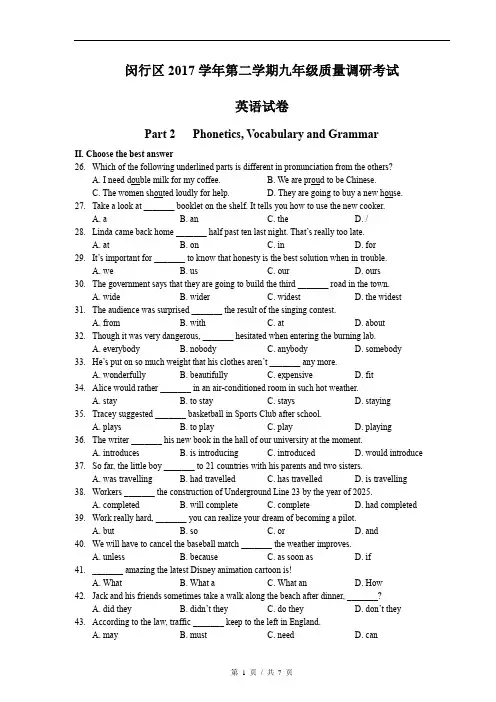
闵行区2017学年第二学期九年级质量调研考试英语试卷Part 2 Phonetics, Vocabulary and GrammarII. Choose the best answer26.Which of the following underlined parts is different in pronunciation from the others?A. I need double milk for my coffee.B. We are proud to be Chinese.C. The women shouted loudly for help.D. They are going to buy a new house.27.Take a look at _______ booklet on the shelf. It tells you how to use the new cooker.A. aB. anC. theD. /28.Linda came back home _______ half past ten last night. That’s really too late.A. atB. onC. inD. for29.It’s important for _______ to know that honesty is the best solution when in trouble.A. weB. usC. ourD. ours30.The government says that they are going to build the third _______ road in the town.A. wideB. widerC. widestD. the widest31.The audience was surprised _______ the result of the singing contest.A. fromB. withC. atD. about32.Though it was very dangerous, _______ hesitated when entering the burning lab.A. everybodyB. nobodyC. anybodyD. somebody33.He’s put on so much weight that his clothes aren’t _______ any more.A. wonderfullyB. beautifullyC. expensiveD. fit34.Alice would rather _______ in an air-conditioned room in such hot weather.A. stayB. to stayC. staysD. staying35.Tracey suggested _______ basketball in Sports Club after school.A. playsB. to playC. playD. playing36.The writer _______ his new book in the hall of our university at the moment.A. introducesB. is introducingC. introducedD. would introduce37.So far, the little boy _______ to 21 countries with his parents and two sisters.A. was travellingB. had travelledC. has travelledD. is travelling38.Workers _______ the construction of Underground Line 23 by the year of 2025.A. completedB. will completeC. completeD. had completed39.Work really hard, _______ you can realize your dream of becoming a pilot.A. butB. soC. orD. and40.We will have to cancel the baseball match _______ the weather improves.A. unlessB. becauseC. as soon asD. if41._______ amazing the latest Disney animation cartoon is!A. WhatB. What aC. What anD. How42.Jack and his friends sometimes take a walk along the beach after dinner, _______?A. did theyB. didn’t theyC. do theyD. don’t they43.According to the law, traffic _______ keep to the left in England.A. mayB. mustC. needD. can44.-- Jiang, an oversea student, was killed at her own home in Japan.-- _______A. I don’t agree.B. I hope so, but I don’t think so.C. I’m sorry to hear that.D. That’s very kind of you.45.-- We’re going hiking this weekend. Would you like to join us?-- _______A. Yes, I’d like to.B. Never mind.C. I’ll take your adviceD. I am busy now.III. Complete the following passages with the words or phrases in the box. Each can only be used onceA. managed toB. showed offC. productsD. deathE. researchWhat can you do with nuts? A scientist named George Washington Carveranswered that question, over and over again. We should say thanks to him formore than 300 __46__.When Carver was born in 1864, he was a slave(奴隶) on a farm in Missouri.Later, he got freedom. As a teenager, he worked on a farm and __47__ finishhigh school. At the age of 30, he became the first black student at the college inlowa. Several years later, he took a job at a college in Alabama, where he worked until his __48__ in 1943.Carver studied agriculture, the science of farming. His __49__ made huge improvements in farming in the southern United States.A. remainedB. embarrassedC. similarD. materialE. gainedCarver studied peanuts. He knew that the south couldn’t grow just cotton.Planting cotton year after year wore out the soil and made it useless. Carver learnedthat if farmers planted cotton one year and peanuts the next, the soil __50__healthy.To encourage this practice, Carver thought of new uses for the peanut. Wouldyou like to try peanut and raisin ice cream? How about using peanuts as a kind of__51__ to make shampoo? Perhaps you would prefer to make paint from peanuts, or maybe you would like to bake with peanut flour. Glue? Paper? Rubber? The list goes on and on. He also thought of __52__ uses for pecans(山核桃) and other nuts.Carver __53__ little from most of his inventions. He didn’t feel that it was right to sell his ideas. He gave them freely to help farmers and fellow scientists. Carver’s life is one that we could all use as an example.IV. Complete the sentences with the given words in their proper forms54.Chinese people started to open to the western world _______ ago. (century)55.The recording will be played _______ to make sure you can understand each word. (two)56. A friend of _______ got the first prize for the high jump in the sports meeting. (me)57.Mr. Zhang has a large ______ of stamps since he is a big fan of them. (collect)58.The firemen decided to cut the iron fence ______ so as to save the girl. (immediate)59.In the old mountain village, people learned a ______ way to make paper. (tradition)60.The well-known restaurant will ______ 10 new dishes next month. (service)61.It is _______ of my mother to lose her purse on the way to the market. (happy)V. Rewrite the following sentences as required62.Dad waters his favourite flowers in the garden regularly. (改为一般疑问句)_______ Dad _______ his favourite flowers in the garden regularly?63.Wendy had learnt five languages by the end of last year. (对划线部分提问)_______ ______ languages had Wendy learnt by the end of last year?64.We should keep bananas in a cool place before they go bad. (改为被动语态)Bananas should ______ ______ in a cool place before they go bad.65.The flight was delayed until the next day because of the fog. (保持句意基本不变)The flight was ______ ______ until the next day because of the fog.66.‘How can I improve my English?’ The boy asked the teacher. (改为宾语从句)The boy asked the teacher ______ he ______ improve his English.67.The superstar is very kind. He helps poor villages to set up schools. (保持句意基本不变)The superstar is ______ kind ______ he helps poor villages to set up schools.68.online education, students, are used to, more and more (连词成句)________________________________________________________.Part 3 Reading and WritingVI. Reading comprehensionA. Choose the best answerA nationwide survey released earlier this year said an average Chineseadult read less than eight books in 2015, among which 4.58 were paper booksand 3.26 e-books. With digital books becoming more popular, many peoplewould find it hard to remember the last time they sat down in a bookstore andenjoyed a quiet moment.But this does not mean that bookstores are losing their customers. To luremore readers, bookstores are now bigger, more beautiful and grander. Here aresome of them.ZhongshugeWalking into a Zhongshuge bookstore is like entering a sea of books, above the ceiling overhead, beneath the floor under your feet, on the walls, and under the steps of the staircases. Zhongshuge is known for its beautiful designs. The brand now has chains in Shanghai, Hangzhou, and Yangzhou.The BookwormThe Bookworm is bookshop, bar and café all in one. Hidden in downtown Beijing’s Sanlitun bar area, the place is among the most popular for foreigners looking for some international experience in the Chinese capital.In addition to a large variety of books, the European-style shop also holds lectures and cultural events. It’s often possible for visitors to meet famous authors unexpectedly in the comfortable place.Paradise Time Travel BookstoreTibet(西藏) is a must-visit on many people’s travel lists. You can find the beauty of the ancient Tibetan style. Paradise Time Travel Bookstore is decorated in this way. But if you look closely, you will find it is a foreign language bookshop. This kind of mixture is a great surprise, isn’t it?The Paradise Time Travel Bookstore is located near the Princess Wencheng Theater in Lhasa(拉萨). Poplar Kid’s RepublicThe Poplar Kid’s Republic, sitting in Beijing’s CBD area, is a fairyland of picture books for children. The bookshop was selected among one of the most beautiful bookshops in the world by Flavorwire, a popular US news website about art and culture, in 2012.The colorful designs inside are aimed at encouraging kids to explore books. Pushing the glass doors open, you will see children’s drawings and craftworks(工艺) hanging on the pink walls, leading you into aworld full of imagination.69.According to the survey, an average Chinese adult read less than ______ books in 2015.A. 3.26B. 4.5C. 8D. 970.We can find Zhongshuge in _______.A. YangzhouB. BeijingC. SuzhouD. Lhasa71.The underlined word ‘lure’ in paragraph 2 most probably means ______.A. contactB. attractC. observeD. choose72.Flavorwire in the passage is ______.A. a beautiful bookshopB. a recent surveyC. a news websiteD. a noisy bar73.Which of the following is wrong according to the passage?A. Chinese adults don’t read enough books on average.B. We can meet some famous book writers in the Bookworm.C. The Paradise Time Travel Bookstore is located in Beijing.D. You will see children’s drawings in the Poplar Kid’s Republic.74.The article is mainly about _______.A. the importance of reading booksB. some popular E-booksC. the fun of travelling aroundD. some beautiful bookstores in ChinaB. Choose the words or expressions and complete the passageEmily was an eighth grader. To pass her Civics course, she had to do some volunteer services in a nursing home for a week.One Monday, Emily went to the nursing home after school. When she arrived, she was told she would spent an hour every weekday with an elderly lady, Mrs. Blair. She was then led into a room, where an old lady in a flowery dress was sitting on a sofa.Emily stood awkwardly(别扭地)in front of the lady. She cleared her throat and said, “Good afternoon I’m Emily.”“Good afternoon, Emily. Take a seat, please.” Mrs. Blair replied.Then, __75__ filled the space between them. Emily wondered what to say.“Tell me about yourself, Emily,” Mrs. Blair said suddenly.“Well,” Emily started, “I don’t have any grandparents, so I don’t know how to get on well with elderly people. I love the performing arts. I’m here mainly because I have to volunteer here to get a good grade for my Civics class.”Mrs. Blair didn’t seem to mind. “Many people, especially teens, don’t seem to __76__ old people like me. Now you are here, and I’m going to change that about you. Ask me anything.”Emily thought for a moment, and finally decided, “What was your job?”“I was a Broadway star in the 1950s.” Mrs. Blair answered.“Cool! Can you tell me about it!” Emily asked, amazed.Mrs. Blair smiled. “Back then, __77__ the lead actress had the honor to wear a special bracelet. I was the lead in almost all of the plays, so I always wore the bracelet. Till this day, I still have it.”Emily smiled along with Mrs. Blair and listened to the other stories, attentively. She had become very __78__ Mrs. Blair’s stories. She decided to come earlier the next day.Tuesday, Wednesday, and Thursday passed by quickly. Then came Friday. As she was leaving, Emily was really upset to say goodbye.“Don’t be sad. You can still visit me,” Mrs. Blair comforted her. She then handed a small box to Emily, “It’s my gift to you.”Emily __79__ opened the box and was surprised to see what was inside. “It’s the bracelet that you wore. Thank you!” Emily said, with tears in her eyes. “I’m sure to visit youwhenever I’m free.”On the way home, Emily thought of her own love for the performing arts. She touched the bracelet and__80__ that she would keep her word to Mrs. Blair.75. A. happiness B. friendship C.silence D. humour76. A. care for B. agree with C. depend on D. worry about77. A. even B. maybe C. yet D. only78. A. afraid of B. easily C. carefully D. suddenly79. A. angrily B. easily C. carefully D. suddenly80. A. promised B. denied C. introduced D. liedC. Read the passage and fill in the blanks with proper wordsSomething changed a few years ago. Around 2012, teens started to spend their time much differently from the generations before. I started to notice big differences in teens’ b___81___ and attitudes in the yearly survey of 11 million young people.A 2017 survey found that two out of three U.S. teens owned an iphone. For this reason, Icall them iGen (iphone generation).What makes iGen different?Growing up with a smart phone has affected nearly every aspect of their lives. They spend so much time on the internet, texting friends and on social media, an average of about six hours per day, so they have less free time for everything else. That i___82___ going to parties, shopping at the mall or watching movies with their friends. These were o___83___ the favorite activities of most teens. But now iGen teens are taking part in these social activities at a lower rate than others.A link that should be noticedI wondered if these changes might be c___84___ to their deteriorating(退化)mental health. Sure enough, I found that teens who spend more time on screens are less happy and more disappointed. Meanwhile, a 2017 study asked some adults to give up Facebook for a week and others to continue using it. Those who gave up Facebook felt happier, less l___85__ and less disappointed during the week as they had more free time for social activities like meeting friends, watching movies, etc.What else is lost?Spending less time with friends means less time to develop social abilities. A 2016 study showed that the sixth graders who spent just five days at a camp w___86___ using screens ended time better at reading expression on others’ faces.That isn’t to say that iGen teens don’t have a___87___. They are physically safer and more tolerant(宽容). They also seem to have a stronger work spirit and more realistic expectations. To my surprise, the iGen teens I interviewed said they preferred seeing their friends in person to communicating with them using their phones.But it might be just what iGen needs.D. Answer the question(根据短文内容回答下列问题)Andrew Carnegie was born in 1835 in Scotland. He was from a poor family. When he was twelve, his family moved to the U.S.A. They wanted a better life. There, Andrew started to work right away. He got ajob in a factory. He was a good worker, but he didn’t like the job. Later, he changed his job. He worked at the Railroad Company where everybody liked him. He did many different jobs. His salary got higher every year.In his free time, Andrew loved to read. But in those days, the United States didn’t have free public libraries. Luckily, he lived near a rich man with many books, who let young boys use his library for free, so Andrew could read as much as possible. He read throughout his life.Andrew learned a lot at the railroad company. He realized that the railroad was vey important for big countries. He had an idea to start a business with railroads. He saved all his money and opened a business at the age of thirty years.First, his company made bridges for the railroads. Ten years later, it made steel for bridges, machines, and many other things. Soon he was the richest man in the world.Andrew liked to make money. But he believed it was very important to help other people. In 1901, he sold his company for $480 million. He started to give away his money to make new libraries and colleges all over the United States. He built 2,811 libraries. Andrew also gave a lot of money to people who worked for peace. In 1903, he gave $1.5 million to build a Peace Palace in the Netherlands.Andrew Carnegie died in 1919. He was eighty-four years old. During his life, he gave away nearly all of his money. He gave away over $350 million for education and peace. There are colleges, libraries, hospitals, and parks named after Andrew Carnegie. He helped millions of people all over the world to study and learn.88. Andrew Carnegie used to work in a factory, didn’t he?89. Why could Andrew Carnegie read as much as possible in those days?90. How old was Andrew Carnegie when he opened a business?91. What did Andrew Carnegie’s company do?92. How did Andrew Carnegie help others after he sold his company?93. What can you learn from Andrew Carnegie?VII. Writing94.Write an e-mail in at least 60 words according to the given situation加入你是Sunny,你们班级将要在教室里举行一次毕业派对,班主任Susan正在征集大家的金点子。
上海市2018年中考英语二模汇编(五选四篇)
2018年宝山(嘉定区)二模Ⅲ. Complete the following passage with the words or phrases in the box. Each can only be used once(将下列单词或词组填入空格。
每空格限填一词,每词只能填一次)A. In the endB. thankfulC. reduceD. uncomfortableE.HoweverFew of us have heard of Nils Bohlin, but whenever we take a car journey, his invention is important to us. Found in almost every modern car, the three-point seat belt can ___1___ our chances of death or injury by at least 50%. While feeling ___2___ to this engineer from Volvo, you may also wonder how he came up with such a great idea.Having worked as a plane designer before, Nils knew clearly that the pilots were willing to put on anything to keep them safe in an accident, but to his surprise, most people in the cars didn’t want to be ___3___ for even a minute.To improve the safety for people in the car, he decided to find a perfect system which should be simple, effective and convenient. ___4___, he invented the three-point seat belt, which has been considered as one of the greatest inventions in history.A. produceB. importanceC. slow downD. protectE. suddenlySeat belts prevent people in the cars from serious injury in the following ways:To keep people inside. People who are thrown out from a car are four times more likely to be killed than those who stay inside.To ___5___ the strongest parts of the body. Seat belts are designed to fix your body at its strongest parts. For an older child and adult, these parts are the hips (臀部)and shoulders.To spread out the force in an accident. Seat belts spread the force of the accidentover a wide area of the body. Seat belts also help keep your upper body away from the hard parts of the car if you stop ___6___, or are hit by another car.To help the body to avoid a fast and deadly hit. With the help of the seat belts, your body can have more time to ___7___, the speed in an accident.Therefore, it’s of great ___8___ to help both the drivers and the passengers. It takes only a few seconds to buckle up(系好)once you get in the car, but this simple action could save your life. Why wouldn’t you?Keys:2018年宝山(嘉定区)二模:1-4 CBDA 5-8 DECB2018年闵行区二模III. Complete the following passages with the words or phrases in the box. Each can only be used onceA. managed toB. showed offC. productsD. deathE.researchWhat can you do with nuts? A scientist named GeorgeWashington Carver answered that question, over and over again.We should say thanks to him for more than 300 __1__.When Carver was born in 1864, he was a slave(奴隶) on afarm in Missouri. Later, he got freedom. As a teenager, he worked on a farm and __2__ finish high school. At the age of 30, he became the first black student at the college in lowa. Several years later, he took a job at a college in Alabama, where he worked until his __3__ in 1943.Carver studied agriculture, the science of farming. His __4__ made huge improvements in farming in the southern United States.A. remainedB. embarrassedC. similarD. materialE.gainedCarver studied peanuts. He knew that the south couldn’t grow just cotton. Planting cotton year after year wore out the soil and made it useless. Carver learned that if farmers planted cotton one year and peanuts the next, the soil __5__ healthy.To encourage this practice, Carver thought of new uses for the peanut. Would you like to try peanut and raisin ice cream? How about usingpeanuts as a kind of __6__ to make shampoo? Perhaps you wouldprefer to make paint from peanuts, or maybe you would like tobake with peanut flour. Glue? Paper? Rubber? The list goes onand on. He also thought of __7__ uses for pecans(山核桃) and othernuts.Carver __8__ little from most of his inventions. He didn’t feel that it was right to sell his ideas. He gave them freely to help farmers and fellow scientists. Carver’s life is one that we could all use as an example.Keys:2018年闵行区二模:1-8 CADEADCE2018年浦东新区二模III. Complete the following passage with the words or phrases in the box. Each can be used only once (将下列单词或词组填入空格。
上海市2018年中考英语二模汇编C篇【word版】.doc
2018年二模首字母1.奉贤区:【难度】☆☆C. Fill in the blanks with proper words(在短文的空格内填入适当的词,使其内容通顺。
每空格限填一词,首字母已给)(14分)Zhang Ming, a college graduate from Shandong, created a 9-page “WeChat guide”. With drawings and simple words, the step-by-step guide e 81 how to send messages, take pictures and make video calls. Zhang made the guide for his parents. “My parents are getting old. They need an easy way to learn how to use technology,” he said.Zhang’s experience is c82 nowadays. Worldwide, 40 percent of parents learn about new technologies, including computers, mobile Internet and social media, fromtheir children, according to a study from the International Communication Association in 2017.Parents u 83 to teach their kids about almost everything. Now for the first time, the teachers become the students, and the students turn into the teachers.The c 84 of the roles comes from the rapid development of society and technology, says Zhou Xiaohong, a sociology professor from Nanjing University. Zhou said the Internet and otherforms of media give children ways to get information b 85 from asking older generations. Therefore, in the age of information, it’s possible that children know more than their parents do.According to the China Internet Network Information Center, 56.7 percent of Internet users and67.2 percent of social media users in China are under the age of 30. The younger generationu 86 acts as a link between their family and the new environment. But when they teach theirparents new technologies, parents can connect to the new world by themselves, noted Zhou.In Zhang Ming’s eyes, teaching his parents about WeChat brings him c87 to his parents. “People can communicate more by using new technology. Why should we keep our parents out?” said Zhang.Keys:81. explained mon 83. used 84.change 85. besides 86. usually 87. closer2.黄浦区:【难度】☆☆☆C. Read the passage and fill in the blanks with proper words(在短文的空格内填入适当的词,使其内容通顺,每空格限填一词,首字母已给):(14分)Grades are important, but they are not the only measure.I have come to understand that exam grades are not the only purpose of schools, and grades a81 are not enough.Studies show that some of the high-flying students have troubled lives, finding it difficult to getgood jobs or become great parents or partners. A 82 graduation, students come to realize whatthey have learned at school has not really prepared them for the next step.Increasingly, teachers are getting to know the idea of “learning from our failures.” If you’v failed at anything, you’ve certainly never t83 anything new. Exam grades are important and we84encourage all students to aim high and to do well. But they don’t msuccess.I once asked my students to consider the chef Gordon Ramsay, and how he became sosuccessful. They were surprised to find that he didn’t have a good performance at school and hedidn’t s85 become a great chef. In an interview, he explained that he worked long hours for verylittle money, learning everything he could. He took chances even if they seemed i 86 . He mademistakes but he cheered himself up and moved forward. His success didn’t come from grades, itcame from his character: courage, effort and confidence.We should develop social skills through the whole school as an important p 87 of learning.This is why there is a focus on performance, sport and other activities. These life skills will workhand-in-hand with knowledge to enable students to do well in their future life.Keys:81. alone 82.After 83.tried 84.mean 85.suddenly 86.impossible 87.part3.金山区:【难度】☆☆☆C. Read the passage and fill in the blanks with proper words(在短文的空格内填入适当的词,使其内容通顺。
2018年上海市闵行区英语二模试卷(含答案)
2018学年第二学期闵行区初三模拟考英语试卷 2018.4Part 2 Phonetics, Vocabulary and Grammar(第二部分语音、词汇和语法)26. Which of the following underlined parts is different in pronunciation from others ? A. Smoking is harmful to our health. B. There is a warning a sign on the wall . C. Tom is a big fan of cartoon films D. My mother bought some fish in the market .27. Kitty is _______honest girl . She never tells lies and we like her very much .A. aB. an Some Chinese tourists lost _________lives in Malasin‟s boat accident.B. themselvesC. theirD. theirsMany young people enjoy drinking coffee while _________prefer to drink tea.A. others C. another D. the others 30. Look , there are so many ________on the farm in the countryside .A. duckB. sheepC. horseD. pigAll students must wear summer uniforms ________September , early October , late April , May and June .C. theD. /28. A. them 29. B.other31. A. in 32. B. by Sam‟s father travels to Tokyo , the capital of Japan , ________business once a month .B. aboutC. toD. on C. at D. ofA. from33. ---_________is fifteen minus five ?----Fifteen minus five is ten .A. How long _________interesting it is to welcome the first snow in the Year of the Rooster!A. WhatB. How D. What 35. The young dancer from France looks ________in the long skirt .A. happilyB. gentlyC. beautifullyD. lovely36. The two men used to argue with each other to prove who is ________.A. strongB. strongerC. strongestD. the strongestThe plan ________be discussed any more . We have made our decision .A. musn‟tB. can‟tC. needn‟tD. oughtn‟tBeijing has made history in winning the bids to host both the summer ________winter Olympic games.A. butB. or 39. ___________the training in the wilderness is not easy , I still want to have a try .B. How soonC. How muchD. How often34. C.What a an37. 38. C. so B. Although D. andC. When A. IfD. Until 1。
2018闵行高考二模英语听力答案
2018闵行高考二模英语听力答案1. It's alovely house and we' ve been very happy here.(F)2.To keep fit, my grandparents take exercise every day.(A)ck has made model planes since eight o' clock this morning.(C)4.Peter was invited to have dinner with his little friends yesterday.(H)5.Nowadays people keep different kinds of animals as their pets.(B)6.Our English teacher has given us some advice on how to use dictionaries.(E7.M: Is your pen-friend from Canada, Linda?W: No, he comes from Australia.Q: Where is Linda's pen-friend from?(B)8.M: Shall we go and see Tommy this weekend, Rose? He has been ill for several days.W: Oh, sorry to hear that. Shall we go there by bike? It's only twenty minutes' ride from here.M:I haven't got a bike.I think we have to go there by bus. W: All right.Q: How will they go to see Tommy?(C)9.M: What lovely Teddy Bearsl Do you like the red one or the yellow one, Jane?W: Neither.I prefer the blue one.Q: Which Teddy Bear does lane prefer?(B)10.M: You look so tired, Helen. What's wrong with you? W: Ihave just finished cleaning my bedroom.I worked for nearly the whole afternoon.Q: Why does Helen look so tired?(D)11.W: Where will your family spend your summer holidays, Sandy?M: To Europe. We will stay in Italy for three days, France for five days and Switzerland for two days.Q: How long will Sandy's family spend their summer holidays in Europe?(D)12.M: How nice these tomatoes arel The vegetables are both fresh and cheap. Get some in the basket, Li W: OK. Dad,I want a bottle of orange juice.M: Take one from the shelf.W: We' ve got enough,I think. Let's go to the checkout. Q: Where does the dialogue most probably take place?(A)13.W: What's your hobby?M: Playing the guitar. When I play the guitar,I feel very much relaxed. How about you?W:I go jogging in the park twice a week. It helps me keep fit.Q: What are they talking about?(C)14.W:I'm moving to a new place tomorrow. Could you possibly give me a hand?M: Sure. Why not ask some more people in the office if they are free, too?Q: What does the man mean?(C)Richard and his friends had a picnic in a cool village this summer. They all got up early that mor They took a bus and it took them about an hour to get to the quiet place. They swam in the river when felit hot and cooked some food when they were hungry. In the afternoon, they climbed a hil. There w forest on it. The girls began to pick flowers and the boys looked for some fruits there. Richard sa beautiful bird in a tree. He liked it very much and wanted to catch it. But it flew to another tree as soon saw him. He ran there but it flew away again. And soon he couldn't see his friends. He shouted, but nol answered him. He was afraid and walked through the forest. At last he saw a farmer cutting a tree quickly came up to him along the narrow road."Hi,"shouted the boy."What place is it here?""A forest,"came the answer."Iknow it's a forest. But how can I find the nearest village?""Along the roads.""How foolish you arel There are several roads here. Which of them must Igo along?""Yes,I'm foolish,"answered the farmer."But at least I haven't lost my wayl"15.T16. F17.T18. F19.F20.T D.W: Let's go to get some appliances for our new house, John.M: For the new house? What do you want to buy?W: We need a fridge,a dish-washer,a washing machine, and two air-conditioners.M: We won't move in there until March. Why are you in such a hurry?W: But we' ll need them sooner or later.M: That's true, but we don't need them now, do we? Why are you so eager to buy them, Helen?W: The appliances store in this area is on sale. It's said that the prices will be reduced by 30 percent. Don't you think it's a chance to do shopping?M:I know, but we don't have much money left this month. Yesterday you said that we needed some new furniture for the living-room. We can't afford all these things at a time.W: Then what do you think we should buy first?M: Let's buy something that doesn't cost much first, such as a sheif for the study and a bed for Paul.W: You' re right. Let's go and see if there's something we can buy.21fridge, washing22.move, March23.by 3024.new furniture25.cost much。