
unit1 friends教案
牛津初中英语8A Unit 1 Friends
Comic Strip & Welcome to the unit 教案
Ⅰ. About teaching material
本课是初中英语8A第一单元的第一课时,内容为Comic Strip和Welcome to the unit。
这是一个单元的导入部分,主要通过轻松愉快的方式导入本单元主题。
本单元的主题为朋友,Comic Strip部分通过Eddie和Hobo两只小狗的对话,激发学生对本单元的兴趣,引出友谊与分享的主题;Welcome to the unit中介绍了朋友的一些品质,旨在提前教授一些新的单词和短语。
Ⅱ. Teaching aims
1. Knowledge objective
To let the students grasp the new words and phrases to describe friends.
2. Ability objective
Enable the students to learn to describe their friends.
Enable the students to improve their skills of listening, reading and speaking.
3. Emotion objective
To form good relationship of cooperation between students or teachers and students through group activities
Ⅲ. Key points and difficult points
Key points:To learn to use adjectives to describe friends and their characteristic Difficult points:To grasp the new words correctly and use them properly
Ⅳ. Teaching aids
Multimedia and blackboard
Ⅴ. Teaching methods
Cooperation-learning, discussion and task-based teaching
Ⅵ. Teaching procedures
Step 1 Lead in[5 min]
Ask students these questions to lead to the topic: friends.
1. Do you have friends? What does your good friend look like?
2. Can everyone be your friend?
3. When you choose a friend, how do you want he is like?
Step 2 Listen and answer [3 min]
Listen to the Comic Strip without opening books, and answer these questions.
1. Who is hungry?
2. What food does Eddie give Hobo?
3. What does Hobo want at last?
Step 3 Read and answer [6 min]
Read after the tape. Explain the new words in the text of Comic Strip.
more 更多的;nothing 没有东西;bowl 碗
Then, discuss these questions.
1. If you are Eddie, will you give the pizza to Hobo? Why?
2. Do you think Hobo is his true friend?
Step 4 Discussion [5 min]
Ask students to do the discussion in group of four.
Topic: Do you like Eddie or Hobo? Why? How is your friend like?
Step 5 Words learning [16 min]
1. Finish the matching exercise on P7. A. Explain the new words. (4 min)
2. Discuss the qualities a good friend should have. List some related adjectives.
Such as: helpful, clean and tidy, brave, friendly, funny, polite, musical, kind, clever, good-looking. Explain them briefly. (4 min)
3. According to these words, finish the tick exercise on P7 B. Then ask students to
make sentences with the structure: It is (very/quite/not) important for my friend to be+ adj. Work in pairs. Then report it to class. (8 min)
Step 6 Proverb [3 min]
Add some proverbs about friends.
1.需要之时方知友A friend is never known till a man needs .
2.患难见真情A friend in need is a friend indeed .
3.得朋友难,失朋友易A friend is easier lost than found .
4.没有十全十美的朋友A friend without faults will never be found. Step 7 Exercise [5 min]
Finish the translation with the words in this lesson.
1、一个诚实的男孩
2、分享我的喜悦
3、看广告
4、一位八年级的学生
5、在冰箱里
6、保密
7、使我快乐
8、一个长得好看的女孩
9、对某人友好
10、再买一些食物
Step 8 Homework [2 min]
Describe a good friend of yours with the words and phrases learnt in this lesson.
Collect some proverbs about friend.
Ⅶ.. On the blackboard。
八年级英语上册 Unit1 Unit 1 Friends教案 牛津版

江苏省淮北中学英语学科教案
初二年级教案活页纸主备人:陈小军审核人:初二英语组全体老师
初二年级教案活页纸主备人:陈小军审核人:初二英语组全体老师
初二年级教案活页纸主备人:陈小军审核人:初二英语组全体老师
江苏省淮北中学英语学科教案
江苏省淮北中学英语学科教案
初二年级教案活页纸主备人:陈小军审核人:初二英语组全体老师
江苏省淮北中学英语学科教案
初二年级教案活页纸主备人:陈小军审核人:初二英语组全体老师
江苏省淮北中学英语学科教案
初二年级教案活页纸主备人:陈小军审核人:初二英语组全体老师
江苏省淮北中学英语学科教案
初二年级教案活页纸主备人:陈小军审核人:初二英语组全体老师。
牛津版八年级英语上册册unit1教案.doc

牛津8A Unit 1 Friends 教案(教材分析)Language functions and focus1. Use an adjective before a noun or after a linking verb to describe someone/ somethinge.g.: She has short hair.Her hair is short.2. Use comparatives to compare two people /thingse.g.: Sandy’s hair is longer than Millie’s hair.3. Use superlatives to compare three or more people thingse.g.: He is the tallest boy in my class.4. Use ‘as’+ adjective+ ‘as’ to compare people / thingse.g.: Millie is as tall as Kitty.5. Use adj ectives to describe someone’s physical features and appearancee.g.: Sandy is tall and has long hair.Language skillsListening1. Identify main ideas to obtain information about a friend2. Interpret information to obtain a general understanding of the people in a conversation3. Identify specific and relevant information to complete letters about teenagers’ future plansSpeaking1. Use questions and answers to talk about people’s appearance and personality2. Use everyday expressions to show agreement and confirm informationReading1. Guess general meaning from keywords and context2. Skim text for overall meaning and scan for details3. Identify specific information about different people from their friends’ descriptionsWriting1. Collect information and organize ideas to describe the appearance and personality of a friend2. Produce a particular text-type for an audience using a given modelStudy skillsLook for main points and keywords to help understand and remember a passage more easilyBackground informationBook 8A continues the story about the lives and experiences of the six central characters introduced in Book 7A. Here, the characters are Grade 8 students. Yourstudents will be able to identify with the different situations and contexts. Language is presented through real-life experiences, exposing students to real communication. Overview of the unitThe main topic of this unit is describing the appearance and the qualities of a good friend. Students learn to talk about their friends and their future plans.Unit openingBackground informationThe opening page arouses students’ interest in the topic of the unit through the funny interactions of two cartoon characters (Eddie and Hobo). This opening page introduces the idea of friendship and sharing.Warm-up activities1. Read the conversation between Eddie and Hobo. Check understanding of ‘kind’ and ‘share’. Ask,e.g.: What does Eddie give Hobo? (He gives him some cake and milk.)Is there anything else in the fridge? (No, there isn’t.)What does Hobo want? (He wants to share Eddie’s pizza in the bowl.)2. Introduce the idea of sharing and friendship. Ask,e.g.: Are Eddie and Hobo good friends? (Yes, they are. They share things.)Who do you like more? Why? ( I like Eddie because he shares his food with Hobo.)Ask two more able students to role-play the conversation in front of the class.牛津8A Unit1 教案(1课时)Welcome to the unitObjectives1. To revise vocabulary and expressions to describe people2. To guess meaning from context3. To generate ideas about people’s appearance and personalities4. To categorize adjectives to describe important qualities of a friend according to personal preferencesBackground informationThis section introduces students to the unit topic about different personalities of friends. Students answer some questions in a magazine about the qualities of a best friend. It also preteaches some useful words and expressions.Teaching procedures1. Ask more able studentse.g.: Do you have a special friend? What makes him/her special?Accept all reasonable answers. (He/She helps me with my homework. I can always talk to him/her about my problems, etc.)2. Ask students to look at Part A and explain that they will be reading an advertisement in “Teenagers’ magazine. They have to match the qualities with thequestions. For weaker classes, go through the words and phrases on the left. Then ask each question at a time and invite students to say the correct word or phrase. Then ask the class to write the correct letters on their own.3. Go around the class to check that students have written the correct letters.4. Ask more able students to think of other qualities of a good friend, e.g., generous, clever, kind, understands my problems, makes me laugh. Write the words and phrases on the board.5. Read the list of words in Part B and chick that students understand their meanings. Check also understanding of ‘quite important’ and ‘very important’.6. On the board, write ‘What qualities of a good friend are important to you?’. Ask the class to think carefully about what qualities they appreciate in friends and put ticks under the correct headings in the table. Encourage students to work on their own. Then ask them to compare their answers with a partner. Ask individual students to tell the rest of the class about their own choice and their partner’s choice of qualities. Write some structures on the board to enable students to focus on the choice of adjectives and to maintain a fluent oral performance.Extension activityYou can copy the table. More able students can add more adjectives describing qualities of a good friend. Students can also interview several classmates using this table. They should write tally marks instead of ticks in the table. Then they can compare their results with a partner or in class to find out which qualities are the most popular.GameAsk each student to write three adjectives or phrases to describe a classmate on a piece of paper. Remind students to write his or her name as well. Encourage them to work on their own and not to show their choice of words to other students. Then collect the pieces of paper and put them together. Draw one at a time and read each description. Invite the class to guess whom it describes.牛津8A Unit1 教案(2课时)ReadingObjectives1. To guess general meanings from keywords and context2. To skim text for overall meanings and scan for details3. To identify specific information about different people form their friends’ descriptions4. To use adjectives to descr ibe people’s appearance and characteristics5. To recognize the use of comparatives and superlativesPart ABackground informationThis section presents three letters about ‘best friends’ for a writing competition held by ‘Teenagers’ magazine. The context invites students to think about qualities in their friends.Teaching procedures1. Review key vocabulary according to the general ability of the class. Tell the class about a friend or relative. If possible, show his/her photo. Say,e.g.: My best friend is small and thin with long hair. She is very smart and helpful. Then ask questions to check understanding. (Is my friend tall? Is her hair short or long? Is she willing to help?)2. Divide the class into three groups and allocate one article to each group. While students skim the text on their own, ask them to underline the words they do not know. Then go through the words students have underlined.3. On the board, write the headings ‘Appearance’ and ‘Personality’. Ask each group to go through their letter again and find words or expressions to match each heading. Invite students from each group to come forward and write their words and expressions under the correct heading.4. Write the following questions on the board for students to copy in their books. What does he/she look like? (For appearance)What kind of person is he/she? (For personality)What does he/she do or want to do in the future? (For future plan)Invite students from each group to ask and answer these questions and describe the teenager in each article.Part BTeaching procedure1. Explain the context and check that students understand what an editor of magazine or newspaper does. Then review the adjectives and nouns in the box in Part B1. Ask students to find the words in the articles on page4.2. Ask students to do Part B1 on their own. Tell them that they need to look for specific details, which fit each of the persons described in the articles. Encourage students to check their answers with a partner. Then ask students to read out the completed captions one at a time.3. Explain the context of Part B2 and ask students to find each description in the corresponding letter. Point to the photos in Part B2 and ask more able students to briefly describe each person. For weaker classes, read the sentences to the students and ask them to match them with the correct photos. Students could work individually or in pairs.Game1. Cut out some pictures of people of different height and appearance. Number the pictures or give familiar names to each person in the pictures (Mary, Tom, Peter, ect.). Stick the pictures on the board. Describe one of the people without pointing or even liking at his/her photo. Invite students to guess the person you have described. (That’s picture number five./That’s Mary.) Then ask individual students to do the same while the rest of the class guess the person.2. Alternatively, you can divide the class into three or four competing teams. Each team can work out description for the other teams to guess. Give a score only for the first correct guess.Part CTeaching procedures1. Explain the context of Part C1 and read the six sentences for weaker classes. Depending on students’ abilities, set this activity either as an individual activity or asa quiz.2. If you use it as a quiz, divide the class into teams of 4-5 students. Set a time limit. The team who gets all the correct answers first is the winner.3. Alternatively, you can ask students to close their books while you are reading each sentence. Give a score to the team who gives the first correct answer.4. Ask students to correct the false sentences.5. Ask more able students to do the extra sentences in Part C1. You can also ask them to correct the false sentences.6. Explain the context of Part C2 and check that students understand the idea of voting for somebody or something. If time allows, organize a class vote. Name a job, e.g., a class monitor, a student representative, etc. ask stronger classes to make a list of qualities required for the job. Write all the qualities suggested by the students on the board. For weaker classes, provide this table with the adjectives.Then ask the students to vote for each quality. Before each vote, invite more able students to explain why they will vote or not vote for that particular quality. Accept all reasonable answers, e.g.: I will vote for ‘clever’ because it’s important that a class monitor learns and understands things quickly.7. For weaker classes, read the sentences in the speech bubbles before you ask the students to find out who each of the characters will vote for and fill in the blanks. Then ask ‘Who will Amy/ Simon/ Sandy vote for?’ to check the answers.8. Divide students into pairs and ask them to vote for one of the ‘best friends’ described in the articles on page4. Write down the number of votes for each person on the board.Extension activityOrganize a class vote for a ‘best friend’. On a piece of paper, ask students to write a brief description about a person they consider to be a best friend. Invite 6-7 students to put up their descriptions on the board. Then read the descriptions one at a timeand ask the class to vote for one of them. Ask individual students why they have voted for that particular person.牛津8A Unit1 教案(3课时)VocabularyObjectives1. To use adjectives to describe people’s physical features2. To use adjectives to describe general appearance of people3. To select and use adjectives that are appropriate to describe the appearance of boys and girlsBackground informationThis section develops the use of adjectives to describe people’s appearance. Students should be encouraged to develop their range of adjectives as much as possible using the tasks on the page as a starting point.As students become more and more able to understand the subtle meanings of words, they will be able to develop ways of accessing imaginative and creative texts to foster genuine interest and pleasure in what they read. In turn, they will gradually be able to use adjectives to write more interesting and creative texts themselves. Teaching procedures1. Explain the context of the tasks. Ask students to study the pictures and words. For weaker classes, go through the words and preteach unknown words. Ask students to do Part A on their own first and then compare answers with a partner. Ask several students to read their answers to check correct use of adjectives.2. Go through the words in the box in Part B. less able students are not likely to know the adjectives which are only suitable to describe males or females. You may need to give them some hints. Ask students to use the words in sentences to check that they understand the meanings and use of words. Then ask students to complete the lists in groups of 4-5. Check answers orally with the class.Extension activities1. Ask students to find more adjectives for each category of the adjectives used in Part A. draw this table on the board and brainstorm as many words as possible.Go through the adjectives and ask students to draw simple illustrations of the adjectives on pieces of paper. Invite some students to show their illustrations to the rest of the class.Provide pictures of people either pinned up on the board or cut out of magazines to groups of four students. Fay an adjective and ask students to find a picture illustrating it.2. Ask students to select and write suitable adjectives to describe themselves on a piece of paper. Invite some students to come forward and read the adjectives. Makesure that the atmosphere is supportive and that the rest of the class do not make any unpleasant comments.3. Ask students to describe their friends, classmates, relatives or pop/sports stars using the adjectives they have learned. For stronger classes, encourage them to use any adjectives.Game1. Bring some pictures of people into the classroom or ask students to being pictures. These can be magazine or newspaper cuttings or photos. Divide students into groups of five. Give a picture to only one student in each group and ask him/her not to show it to the other students. Give blank pieces of paper to the other students. The student with the picture describes the features of the person in the picture while the other students draw the person. On the board, display the drawings together with the original picture. For stronger classes, invite students to find out the mistakes. For weaker classes, ask students to vote for the best drawing which resembles the picture.2. Alternatively, tell students who are drawing the pictures to ask as many questions as possible to get inform ation about the person they are drawing, e.g., ‘Is your person a boy/ a man/ a woman/ tall /small /fat /thin? Is his/ her face square/ round?’ The student looking at the picture is only allowed to say ‘Yes.’ or ‘No.’.牛津8A Unit1 教案(4课时)GrammarObjectives1. To use an adjective before a noun or after a linking verb to describe someone/ something2. To use comparatives to compare two people/ things3. To use superlatives to compare three or more people/ things4. To compare two people/ things using ‘(not) as’+ adjective+ ‘as’Background informationThis section further develops the use of adjectives already introduced in the reading and vocabulary sections. The story moves on from describing best friends for a magazine competition to describing classmates at Beijing Sunshine Secondary School. Daniel wants to write to his e-friends about his classmates. We already know some students’ features from earlier passages but we will learn more about their physical appearance and abilities in this section. Most adjectives are familiar so that students are able to focus on using them accurately in sentences. The use of‘(not) as’+ adjective+ ‘as’ is introduced in the context of a survey about outdoor activities.Part ATeaching procedures1. Tell students that we use adjectives to describe people and things. Explain that we can put an adjective before a noun or after a linking verb. Read the examples on the page and invite students to think of more examples. Prompt students by giving an example with an adjective, e.g., placed before a noun, and ask students to put the adjective, e.g., after a linking verb and make another sentence.2. For weaker classes, read the linking verbs in the tip box and check understanding. For stronger lasses, elicit the verbs.3. For less able students, go through the words in Part A to check understanding. Ask students to rearrange the words on their own. Then invite several students to read out their complete sentences to check the answers.4. Give less able students some extra words to rearrange and form complete sentences. You can use the additional items on the page. For stronger classes, divide the students onto pairs and ask each student to think of some jumbled words forhis/her partner to rearrange into a complete sentence. Make sure students include adjectives in their sentences. To make the activity meaningful, tell students to describe friends, classmates or other familiar people.Part BTeaching procedures1. It is a good idea to use pictures of people, animals or things to teach comparatives and superlatives. For example, use pictures of two pop/sports stars, to elicit examples with comparative forms, e.g., ‘Jacky is taller than Andy. Andy is thinner than Jacky. Andy is more handsome than Jacky.’ Make sure you use both short and long adjectives. Write the comparative forms on the board in two columns (short and long adjectives) and try to elicit the rule form the students, e.g., we add ‘-er’ to short adjectives and use ‘more’ for long adjectives. Then we add ‘than’ after the comparatives.2. Add one or two more pictures of pop/sports stars to elicit examples with superlative forms. Write the superlative forms on the board in two columns (short and long adjectives) and try to elicit the rule form students, e.g., we add ‘-est’ to short a djectives and use ‘most’ for long adjectives. Then we add ‘the’ before the superlatives.3. For stronger classes, point out the exceptions, e.g., ‘more pleased’, ‘the most pleased’; ‘more real’, ‘the most real’.4. The table shows the change of form of adj ectives when ‘-er’/ ‘-est’ or ‘more’/‘most’ are added. It also includes some irregular forms. Go through it with students. Check understanding by asking students to form comparatives and superlatives with other adjectives. You can use the additional examples on the page. Invite students to write the examples on the board to check the correct spelling.5. For stronger classes, ask students to close their books and elicit the spelling rules from the examples you have written on the board. Then ask them to look at the tableto check if they have formulated the correct rules. Give more able students the irregular forms of ‘old’ and ‘far’.6. Ask students to complete the table in Part B1 on their own. Remind less able students to refer to the table at the top of the page. Then invite students to compare answers in pairs. Go through the exercise again with the whole class.7. Ask students to complete ‘Work out the rule!’ at the top of page 10. For less able students, ask them to refer to the rules on page8 and the table on page9.Part B2Background informationPart B2 is a problem-solving task. Students must work out the answers form the information given in the table. Although this is a cognitively demanding task, as it requires comparing numbers, the vocabulary and language structures used in the activity are within students’ linguistic abilities.Teaching procedures1. For more able students, ask them to complete the sentences on their own and compare answers with a partner.2. For less able students, go through the words and numbers in the table and ask questions. revise the adjectives in brackets before starting this task.3. Check answers orally with the class.Extension activityDivide students into groups of 5-6. ask students to collect information about their own group and present it in a similar table. Students can include ‘Height’, ‘Weight’, ‘Running’, ‘Maths test’, etc. Tell students not to worry about the accuracy of their scores but to include approximate figures. Then ask them to write a group profile using sentences 1-9 as models.Part CTeaching procedures1. Use the information collected by students to introduce the new structures in Part C. If you have not done the extension activity, use the information in the table in PartB2. prompt the students to complete the sentence to elicit the new structure.2. Invite students to make their own sentences based on the information in their table or the table on the page. Write the sentences on the board. Elicit the rule form more able students. For less able students, read the explanation at the bottom of the page.3. Before starting Part C1, revise the meaning of the nouns used in this activity ---- ‘hiking’, ‘swimming’, ‘camping’, ‘cycling’, ‘diving’ and ‘skiing’. Elicit the nouns by pointing at the pictures in the table. Invite students to think of other outdoor activities.4. Elicit the meanings of the two key adjectives ---- ‘interesting’ and ‘dangerous’. List things, people, phenomena or activities and ask whether they can be dangerous or interesting, e.g., a fire, a favourite book, a lesson, a typhoon, ice-skating, etc.5. Explain the context to students. Point out that the table in Part C1 is another way of presenting information of a survey. Encourage students to use this as a model for presenting survey results about their own classmates.6. Give students enough time to study the table carefully. Encourage students to ask questions to clarify or confirm meanings of specific details.7. For weaker classes, read the conversation together with the students and explain any unfamiliar words/phrases first. Remind students not to use comparatives and superlatives, but only ‘(not) as…as’.8. Remind students that they need to pay attention to who is speaking in the conversation in order to refer to the correct column in the table for information.9. Ask students to work in pairs to complete the conversation. As this is aproblem-solving task engaging students’ general knowledge as well as linguistic knowledge, you must allocate sufficient time to do this task. Check answers orally with the whole class.10. If time allows, role-play the conversation. Check for correct pronunciation.11. In part C2, ask students to complete the last column of Part C1 expressing their own opinions about the different outdoor activities included in the table.12. In pairs, invite students to compare their answers and talk about what they think about the activities using ‘(not) as… as’. For less able students, tell them to use the conversation on the page as a model. Ask pairs of more able students to come forward and talk about what they think about the activities.Extension activityIf there is time and interest, divide students into groups of 5-6 and ask them to do a similar survey of the classmates in their group using the table on the page as a model. Encourage more able students to include other activities in the survey and compare the activities using other criteria, e.g., popular, exciting, ect. Then make a display of the group surveys.You can also draw the table without the information about Millie, Sandy, Daniel and Simon for students’ use. Students can add the names of the students in their group to the table.牛津8A Unit1 教案(5课时)Integrated skillsPart AObjectives1. To listen for and identify specific information2. To interpret information and obtain a general understanding of the people involved in a conversation.3. To respond to written text and information obtained from listening.4. To select specific and relevant details, to consolidate information and complete two letters to the editor of a magazine.Background informationIn this section, Millie and Sandy are each writing about their own hopes for the future to Mr. Zhou, the editor of ‘Teenagers’ magazine. Before writing their respective letters, they discuss their future plans with their friends, Amy and Kitty. Teaching procedures1. Ask less able students to read the list of future plans before playing the recording. Check understanding. Encourage more able students to guess the meaning of phrases.2. Invite stude nts to talk about their own and their partners’ future hopes.3. Play the recording. Students listen to the recording and put a tick next to each correct phrase as they hear it. Ask them to read the phrases they have ticked to check the correct answers.4. If many students have got wrong answers, play the recording again. Stop the recording after each phrase listed in Part A1 if necessary.5. For stronger classes, ask students to read Millie’s letter addressed to Mr. Zhou, the editor, on their own. For weaker classes, read the letter together with the students. Check general understanding of the letter and explain words and phrases if necessary. Ask students to read the list of phrases in Part A1 again and use the information to complete the letter.6. Read the completed letter or ask a student to read it to check the correct answers.7. For stronger classes, play the recording for Part A3 and ask students to complete Sandy’s letter on page 13 on their own. For weaker classes, go through the list of phrases in the table on page 12 again before playing the recording. Read the incomplete letter and check that students understand all the words.8. For weaker classes, you may want to ask students to close their books and listento the recording. Then check general comprehension of the conversation by asking questions such as “Are Sandy and Kitty going shopping this weekend? Why not? What’s Sandy doing to do next month? What does she love doing? What does she hope to become when she grows up?” Then play the recordin g again and ask students to complete Sandy’s letter. Allow less able students to check spelling of words in the table on page 12.9. Read the completed letter or ask a student to read it to check the correct answers. Extension activities1. Divide students into pairs and invite them to talk about their own future hopes and/ or plans. Write down some useful questions for students to ask each other, e.g., ‘What would you like to be/do?’, ‘What do you hope to become when you grow up?’, ‘What kind of person wo uld you like to be?, ect.2. If time allows, ask students to write a letter about their own future hopes and/ or plans using one of the letters as a model. Add the letters to the display of group survey.Pat BObjectives1. To use adjectives to describe friends and young people2. To formulate questions about people’s personalities3. To respond to questions about people’s appearance and personalities4. To show agreement and confirm information5. To interact with others in a familiar contextBackground informationExplain the common context of introducing and describing friends to other people while showing their photos. Sandy and her cousin Helen are looking at Sandy’s photo album with photos of her friends. Helen is asking Sandy questions about her friends and Sandy is describing them.Teaching procedures1. For stronger classes, tell students to close their books and listen to you while you read the conversation. For weaker classes, allow students to follow the conversation in the book. Read the conversation line by line focusing on intonation and sentence stress. Ask students to underline words that are stressed.2. Ask students to repeat the sentences as thy hear them. Make sure they so not sound monotonous or mechanical. If they have problems pronouncing particular words, practice the words separately first.3. Ask students to practice the conversation in pairs and then change roles. Ask more able students to role-play the conversation in front of the class.4. Ask students to bring photos of their friends. Invite more able students to show their photos while you ask them questions such as ‘Who is the boy/ girl on the left/ right/ in the middle/ next to…? What’s he/ she like? What would he/ she like to be when he/ she grows up?’ Students who do not have any photos to show can draw simple pictures to their friends.5. Divide students in to pairs and invite them to ask each other questions about the people in their photos. Ask students to make up their own conversations based on the model. For less able students, allow them to write down their conversations first before role-playing them.6. While students are practicing the conversation in pairs, move around the classroom providing help with correct pronunciation and fluency.牛津8A Unit1 教案(6课时)Study skillsObjectives。
译林版八年级上Unit1-Friends-教案
译林版八年级上Unit1 Friends 教案Background informationStudents: 40 middle school students grade 2Lesson duration:45 minutesTeaching objectivesBy the end of the lesson,students should be able to:1:describe their own friends2:use the knowledge and the methods to express the qualities of friends3:know the knowledge and methods to express the qualities of friends4:enhance the understanding of friends after classTeaching contentsReading of FRIENDSWhat qualities do your friends have? My friend is generous/beautiful/humorous......Teaching aids: blackboard, chalk, tapesType of the lesson: reading speakingTeaching proceduresStep1:Lead inT:Good morning,welcome to my class,do you have friends?S:Yes.........T;What does she/he looks like?S:She/He is tall/thin/fat/......She/He has long legs..........T:What qualities does she/he have?S:She/He is generous/beautiful........T:Ok,Today let’s talk about our friends.Step2:Fast reading1:T:Teenagers’ magazine is holding a writing competition about good friends,some students have written some notes on page9 b2,please read and find out whether the following statements are true or false.(play the record)2:check the answerRead the article again and finish page9b1,then check the answer.3:read it again and find the main qualities of them.----gengrous helpful----humorous funny----true kindStep3:Read in detailsT:Read the article carefully and then complete the table on the blackboard.Step5;Retell1:T:So,we have got a table about them,and you have known a lot about them.can you say something about them according to the information in the table2:Give Ss 3 minutes to prepare3:Ask 3—4 students to retell the three articlesHome work1:list the words we have learned to describe friends2:write a article about your friend.。
教学设计 八年级上 Unit 1 Friends Task My best friend
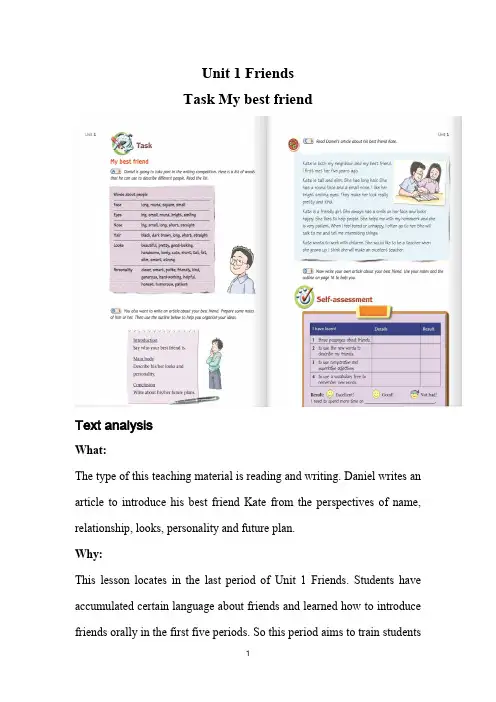
Unit 1 FriendsTask My best friendText analysisWhat:The type of this teaching material is reading and writing. Daniel writes an article to introduce his best friend Kate from the perspectives of name, relationship, looks, personality and future plan.Why:This lesson locates in the last period of Unit 1 Friends. Students have accumulated certain language about friends and learned how to introduce friends orally in the first five periods. So this period aims to train studentsto use and organize language correctly and properly, treasure friendship and learn from each other.How:The discourse is about introducing best friends, which belongs to the theme of “People and society”. It can be logically divided into three parts: introduction (Para.1), main body (Para.2 & Para.3) and conclusion (Para.4). The first part shows the basic information of Daniel’s best friend Kate from her name and their relationship. And the second part covers the looks and personality of Kate. Moreover, the writer introduces the future plan of Kate and shows his hope at last.Teaching goalsBy the end of this lesson, students are able to:1. Read and extract the theme and structure with some knowledge points and writing skills.2. Build a useful outline and then write about best friends with the theme and structure.3. Use the checklist to do the self-evaluation and the peer evaluation and further polish the composition.Teaching proceduresTeaching goals Activities Effect evaluation1. Read and extract the theme and structure with some knowledge points and writing skills.(学习理解)1. The teacher introduces her best friendfrom the perspectives of looks, personalityand future plan.2. Encourage students to introduce theirbest friends from the perspectives of looks,personality and future plan.3. Students read the passage and answersome questions about Daniel’s best friend.4. Students match the key words with eachparagraph and think of other aspects whichcan be used to talk about best friends.5. Guided by the guiding questions, studentsread and sort out the useful language andsome writing skills.(1) The first part is used to....(2) How does the writer introduce Kate'slooks?(3) Which discourse is more persuasive?Why?(4) If a girl is very helpful but not verybeautiful, will you make friends with her?(5) What can we write about the futureplan?Students can orallyintroduce their best friendsand know how to maketheir introduction moreclear, organized andpersuasive after series ofreading and thinkingactivities.Purpose:By encouraging students to say and think through activities on spiral levels, students can practice reading skills and get ready for the following writing task from the perspectives of content, structure and language.Teaching goals Activities Effect evaluation2. Build a useful outline and then write about best friends with the theme and structure.(应用实践)6. The teacher shows the theme of writing,and then the students make the outline ofwriting by asking and answering questionsin pairs.7. Invite some students to orally introducetheir best friends with the help of theoutlines they make.8. Students finish the compositionaccording to the outline they make.During the free talk,students can orally practiseusing the key points ofintroducing best friends andlearn to organize language.Purpose:Build the real situation for students to apply what they’ve learned from the book to practice and guide students to develop good and sufficient writing habits to improve writing quality.Teaching goals Activities Effect evaluation3. Use the checklist to do self-evaluation and peer evaluation and further polish the composition.(迁移创新)9. The teacher guides students to build thechecklist together by setting one writing ofthe students as an example.10. Students give marks on their ownwritings.11. Students work in groups of six andchoose the “Writing star”.12.The teacher guides students to reviewthe key points of this lesson.Students can know how togive evaluation andconduct self-evaluation andpeer evaluation from theperspectives the fourelements in the checklist.Purpose:By building the checklist, students can exactly know what should be paid attention to when they write this type of compositions. After evaluating by themselves and in groups, they practise the evaluation skills so that they can check and revise by themselves after class.Homework:Need to do: Polish your writing & share it with your best friend.Choose to do: Write a passage to introduce one of your family members.。
2.《Unit1_Friends_Reading1》教案
8(上)Unit1 Friends《Reading I》教案南通市通州区金郊初级中学曹群Learning objectives:●Ss can guess and understand the meanings of some new words accordingto the context;●Ss can improve the ability of using different strategies to help themselvesto know about three best friends;●Ss can learn to use adjectives to describe people’s looks andpersonalities;●Ss are expected to be imaginative and creative, cherish their friendshipand learn how to get more friends.Learning focuses:Guide Ss to get information from the entries by reading.Encourage Ss to describe their own best friends.Methods:Problem-Based Learning methodClassroom aid:An overhead projectorTeaching Procedures:StepⅠ Engage1. Lead-inEnjoy a poem about friendship and present new words ‘voice and straight’.2. BrainstormingEncourage students to recall the words about friends learned in the firstperiod by answering the open question “W hat do you think friendsshould be like?”StepⅡ Read1. Fast readingGet Ss to go through the entries as quickly as possible and answer:Can you name the best friends?2. Reading for detailsA. BettyActivity oneGet Ss to predict something about Betty with the following questions,then read and check. Also the new words “generous” and “singer” arepresented while reading.1) What does Betty look like?2) What is she like?3) What is her future plan?Activity twoMake Ss aware of the structure of describing a friend by summarizing the first entry.Activity threeGet the students to complete the missing words and compare the text with the first entry.B. MaxActivity oneGet SS to read the second entry and fill the table.Activity twoGet Ss to read it again and guess what Max’s future plan is to train Ss’divergent thinking.C. MayGet Ss to read the third entry and try to answer “Who can be May in ourclass?”3. Further reading1) Ss follow with the tape and tell T or F.2) Ss try to find words about looks and personalities.3) Get Ss to work in pairs using the conversation on page 10 as a model. Step Ⅲ ActivateActivity oneSs listen to and talk about “Friends wanted”. A good friend should _______Activity twoSs work in groups to describe their best friend.Activity threeGet Ss to cherish their friendship by sharing the meaningful questions.1) What will you do if you are unhappy with your friends?2) How can we better ourselves?Step Ⅳ Assignment and self-evaluation1. Finish your writing “My best Friends”.2. Make a poster about your best friend.。
江苏省徐州市黄山外国语学校牛津版八年级英语上册Unit1Friends教案10

19.give advice
20.wear a smile on one's face
Step 4.Check out
1.What a __________ (please) trip we had last week!
2.These clothes are their ________ (wife).
3.He_____ (not go) to the market until he ______ (finish) their work.
4.It is important _____ (not feed) your goldfish too much food.
5.They _________ (come) to our city two years ago. They ____________ (live) here for two years.
Moral Aims:What kind of friends is a friend indeed.
教学重点
. learn the proper and easy ways to write something, Identify keywords
review what they have learnt in this unit
教学难点
. learn the proper and easy ways to write something, Identify keywords
review what they have learnt in this unit
教学准备
黑板,多媒体
教 学 过 程
修注栏
8A Unit1 Friends Reading(1)教学案
主备人李书平上课时间课题 8A Unit1 Friends Reading(1)学习目标知识目标:初步理解与本单元主题相关词汇能力目标:通过阅读了解文中所出现的三个好友的基本情况;理解用形容词来描述朋友外貌和个性品质的语篇。
情感目标:学会欣赏别人, 学会珍爱友谊。
学习重点学会使用正确的阅读技巧进行文本解读,获取关于文中三个好友外貌与个性特征的主要信息。
学习难点学会使用正确的阅读技巧进行文本解读,获取关于文中三个好友外貌与个性特征的主要信息。
自学质疑一、找出重要的语言知识点(单词、短语、句型和语法),查词典和有关资料解释其意义及用法,举例句或例题。
重点预习并记住下列单词generous 大方的willing 乐意的 ready 乐意的 round 圆形的smart 聪明的sense 意识 humour 幽默 bored 无聊的 true 忠实的二、根据首字母和句意写出单词1. He’d like to share everything with his friends. He is g____________.2. She never tells lies(说谎). I believe what she says. We all think she is very h________.3. He can always help me with my problems. I can go to him when I am in trouble. He is very h_________.4. She does well in singing and dancing. She is a m _________ girl.5. I can tell her anything and she keeps my secrets. She is a t__________ friend.6. He is good at telling jokes. He often makes us laugh. He has a good sense of h__________三、预习课文内容,尝试着判断下面的几句话是否正确1.Betty is generous to old people only.2.Betty wants to be a singer and travel around the world.3.Max does a lot of computer work.4.Max is very good at telling jokes.5.May is a true friend.6.May likes to tell others her friends’ secrets.课堂交流展示一、对课前自学中的重要的语言知识点(单词、短语、句型和语法)在组内和班内展示。
牛津译林版八年级上册Unit 1《Friends》(Grammar)教学设计
牛津译林版八年级上册Unit 1《Friends》(Grammar)教学设计一. 教材分析《Friends》是牛津译林版八年级上册Unit 1的教学内容,本节课主要讨论朋友和友谊这一主题。
教材通过描述不同人物的性格特点和他们的友谊,引导学生学习一般现在时态的肯定句和疑问句以及一般现在时态的被动语态。
本节课的内容与学生的生活紧密相连,有利于激发他们的学习兴趣和积极性。
二. 学情分析八年级的学生已经具备了一定的英语基础,能够听懂并运用一般现在时态。
但他们在语言表达方面还存在一定困难,需要通过大量的操练来提高他们的语言运用能力。
此外,学生的学习动机和学习态度对他们的学习效果有重要影响,因此,教师需要设计有趣且富有挑战性的教学活动来激发他们的学习兴趣。
三. 教学目标1.知识目标:学生能够掌握一般现在时态的肯定句、疑问句和被动语态,并能够运用所学知识进行简单的交流。
2.能力目标:学生能够通过听力、口语、阅读和写作等多种方式,运用一般现在时态进行表达和交流。
3.情感目标:学生能够理解友谊的重要性,学会珍惜和维护友谊。
四. 教学重难点1.重点:学生能够掌握一般现在时态的肯定句、疑问句和被动语态。
2.难点:学生能够运用一般现在时态进行流畅的口语表达和交流。
五. 教学方法1.任务型教学法:通过设计各种真实且有意义的任务,引导学生参与课堂活动,提高他们的语言运用能力。
2.交际法:通过模拟真实场景,让学生在实际交流中学会运用一般现在时态。
3.情境教学法:通过创设各种情境,激发学生的学习兴趣和积极性。
六. 教学准备1.教学课件:制作含有动画、图片和例句的教学课件,帮助学生更好地理解和记忆。
2.练习册:准备与本节课内容相关的练习册,用于巩固所学知识。
3.听力材料:准备与本节课主题相关的听力材料,帮助学生提高听力技能。
七. 教学过程1.导入(5分钟)通过向学生提问“你的朋友是什么样的人?”等问题,引导学生谈论朋友和友谊,激发他们的学习兴趣。
译林版英语八年级上册Unit1friends教案
3. Ask 2-3 Ss to retell the three articles.
教学过程
(教学环节、教师活动、学生活动)
集体讨
论记录
个人修改记录
Name
Betty
Max
May
Appearance
Slim, short hair
Tall, poor eyesight (wear glasses)
教学过程
(教学环节、教师活动、学生活动)
集体讨
论记录
个人修改记录
Step 1 Revision.
1.What are the most important qualities of a good friend?
2.What are the very important qualities of a good friend?
3.Explain some important words.
Step 6 Brain-storming
T: Do you have any other ideas of a good friend?Can you use some words to describe your best friend?
To learn how to use adjectives to describe people’s appearance and characteristics.
重点、
难点
To learn how to use adjectives to describe people’s appearance and characteristics.
Eyes, nose: big, small
8A Unit1 Friends教案
8AUnit1Friends教案Period1ComicStripandWelcometotheunit TeachingAims:KnowledgeAims:Teachingcontents:Words:honest,joy,sad,believe,teenager,good-looking,musica lPhrases:havesomethingtodrink,makesomebodyhappy/special,keepsecrets,shareone'sjoy,believewhatsomebodysays,talktosomebodyaboutanything,cleanandtidySentences:DoyouwantsomeCanIhavesomethingtodrink WhataboutsomemilkCanIhavesomemorefoodtooThere'snothingelseinthefridge.AbilityAims:1.Tolearnaboutthenewadjectivesandexpressions2.Todescribetheappearanceandcharacterofafriendwithadjectiv es3.TotalkabouttheappearanceandcharacterMoralAims:Letthestudentstalkabouttheirfriendshappily. Focalpointanddifficulty:somemorewhatabout=howaboutnothingelsemakesb.+形容词somethingtodrink/eatnumbers+moreelseTeachingsteps:Step1Warm-upT:Helloeveryone,gladtoseeyouagain!DidyouhaveanicesummerholidayAr eyouhappytobebacktoschoolandseeallyourfriends Sstalkabouttheirsummerholidays.T:ThissummerholidayIwenttoAustraliawithsomeofyourclassmatesandfri ends.Wetookalotofphotos.Wouldyouliketohavealook ShowthepicturesandintroducesomeplacesofinterestandanimalsinAustrali a.T:Look,wetookaphotowiththisfamousman---Batman.He'saheroandpeopl e'sgoodfriendbecausehehelpspeopleindanger.DoyouagreeWhatdoyouthin kofhim SstalkaboutBatmanwiththeadjectivesdescribingappearanceandpersonalit y,suchas friendly,helpful,kind,polite,clever,brave,etc.Step2PresentationT:Therearesomemorewordstodescribepeople.Forexample,wecansayBatm anisgood-looking.Butweneversayhe'sbeautiful!Wedon'tusebeautifultodescribeaboyoraman.Ifsomeonelikesmusicorisgoodatmusic,wesayheorsheis musical.Teach"good-looking"Step3Practice1.Playaguessinggame.Ssdescribetheirbestfriendsintheclassandguesswhoa retalkedabout.2.T:Justnowweheardsomeofthestudentstalkabouttheirbestfriends.Couldy outellmewhichwordsareusedmostoftenSs:friendly,helpful,polite…T:Sotheseareveryimportantqualitiesofabestfriend,doyouthinksoWhatothe rqualitiesareimportanttoyouSscompletethetableinPartB,P7.Thenworkinpairstoexchangetheirideasand haveadebate.Sentencesmaybeused:Ithinkmygoodfriendshould bevery…because…Iagree./Idon'tagreewithyoubecause…It'squiteimportantforafriendtobe…DoyouthinksoIdon'tthinkmygoodfriendmustbevery…3.T:Whydoyouthinkhe/sheisyourbestfriendWhatmakeshim/hersospecialt oyouCanyoutalktohim/heraboutanythingDoyoutalktohim/herwhenyouhaveproblemsDoyoubelievewhathe/shesaysWhenyouarehappyorsad,doyou talktohim/herWhy Teach"sad","believe","honest"and"joy".SscompletePartA,P7andreportindividually.4.Texplainssomelanguagepoints.Step4Presentation1.T:HowoldisyourbestfriendWhataboutyouSs:15/16…T:Soyouareteenagers.Wecallchildrenbetween13and19teenagers. Teach"teenager".T:Wehaveagoodfriend,Eddie.IsheateenagerSs:No.2.T:Who'sEddie'sgoodfriendWhy TplaysthetapeoftheComicstripandSstrytofindouttheanswertothequestion. (HoboisEddie'sgoodfriendbecausetheyalwayssharethingswitheachother.)3.SsreadtheComicstripandanswerthequestions:(1)WhatdoesEddiegiveHobo(2)WhatdoesHobowant(3)DoyouthinkEddieisatruefriendWhy4.Ssreadthedialogueinpairs.5.Texplainssomelanguagepoints.Step5Practice1.Ssactoutthedialogueandtheyareencouragedtoaddinsomethingtheylike.2.Discuss:Whodoyoulikebetterasafriend,EddieorHoboWhy3.Ssworkinpairstoaskandanswerabouttheirgoodfriends. Amodeldialogue:A:Who'syourgoodfriendB:…A:What'she/shelikeB:…A:WhatdoyouthinkofyourfriendB:…A:Whatmakeshim/hersospecialtoyou B:…CanyoutellmesomethingaboutyourgoodfriendStep6SummarizeT:Todaywehavelearnedsomeimportantqualitiesaboutagoodfriend.Itseem sthatweallthinkappearanceisnotsoimportant,butafriendshouldbehelpfulan dhonest.AndIhopeeveryonecanbelikethatandyouwillhavemorefriends. Step7Homework1.Describeagoodfriendofyourswiththewordsandphraseslearntinthislesson .2.Finishtheexercises.板书设计:Unit1Friends Welcometotheunit1somemorefood再一些食物2whatabout=howabout.....怎么样?3nothingelse再没有东西4makesomebodyhappy使某人开心5shareone'sjoy分享某人的欢乐sharesth.withsb.与某人分享某物6makesb.+形容词7CanIhavesomethingtodrink,please请问,我可以喝些东西吗?somethingtodrink/eat一些喝/吃的东西8There'snothingelseinthefridge.冰箱里面再没有东西了.这是一个therebe句型,不可用therehave/has来表示有else接在something和nothing的后面,表示“还,再”的意思。