
book2 unit3 Learning about language
Moon and Mars.
Homework
Try to remember the grammar
rules and do exercises 1, 2 and
3 on page 21.
Ex.请将下列主动语态变成被动语态。
1.The farmer made the horses work the whole day. were made to ____ The horses____ _____ ___ work the whole day. 2.Mum asks the twins not to swim in the lake. The twinsare asked___ ___ ____ in the lake. ___ ___ not to swim 3.I saw a mouse run into the room. A mouse was ____ ____ ____ into the room. ____ seen to run 4.I often hear him sing English songs. is heard to ____ He ____ often _____ ____ sing English songs.
World Wide _____ and Web
used the Internet to communicate with
computer programmers all over the world.
When he went to university he studied IT
technology (information __________) and developed a
computers and enjoyed writing programs
of his own. He used to download information from the Internet and made
good use of it. He liked to explore the _______
2.某些动词形式是主动,但含有被动的意思。 这书很好卖。 The book sells well. 这书卖完了。 The book is sold out.
这种布很好洗。 This kind of cloth washes very well. 这支笔好写 尼龙容易清洁
The pen writes smoothly. Nylon cleans easily.
can /could / must / should / may /need + be given
ቤተ መጻሕፍቲ ባይዱ
Make sentences.
A calculating machine; replace
A calculating machine has been replaced with the laptop.
5. _______ can be moved easily from place mobile to place 6.________ to work out the answer to a solve problem 7._______ to travel around an area to find explore out about it 8. ______ completely totally 9. _______ anyway anyhow 10. _______ activity of managing money finance
2. 并不是所有动词都有被动语态 1) happen, take place, break out, belong to, cost, last等不及物动词或词组无被动语
态。如:
[误] Great changes have been taken
place in China since 1978. [正] Great changes have taken place in China since 1978.
4. I have also ___________(put) into been put
robots and used to make mobile phones
as well as _________(help) with medical help operations.
5. I ____________________(put) into have even been put
注意:
1.副词的位置
often, usually, always, never, hardly, seldom等副词置于have/has和been中间。 如: [误] Such a man has been hardly believed. [正] Such a man has hardly been believed.
6. 情态动词 can /could / must / should / may /need + be done
I.被动语态的构成:
give
be done
一般现在时 一般过去时 一般将来时 现在进行时 现在完成时 情态动词
is/ am / are + given was / were + given will / shall + be + given is / am / are+ being + given has / have + been + given
Unit 3
Computers
Learning about language
Discovering useful words and expressions 1 Find the word or expression for each of the following meanings from the text. 1. _________ complete change in ways revolution of thinking, working, etc. 2. ________ connected computer system network 3. ________ to make things easier simplify 4. ________ to find the answer using calculate numbers
special interest in ________ intelligence. After artificial
developing special applications of the computer, __________ he hopes to design an _________ robot which intelligent can think ________ and look like a human logically being, but in ______ he has a long way to go. reality
3. 短语动词不可分割或省略其中的介词或副
词。如:
The SARS patients have been taken good care of.
4. 使役动词和感官动词的被动语态:
一感(feel),二听(hear, listen to),三让(let, make, have),四看(see, watch, look at, notice) 等动词后边接省略to 的不定式作宾补,变为被动语态时, 必须加上to。
wrist-worn/wearable PC
WW PC
A wrist-worn PC has been invented recently.
A pen-like computer has already been developed.
The houses have been destroyed by the storm.
Grammar
The Present Perfect Passive Voice
I.被动语态的构成:
be done
1.一般现在时 am /is /are + done 2. 一般过去时 were / was + done 3. 一般将来时 will /be going to+ be done 4. 现在完成时 has / have + been done 5. 现在进行时 is/ are + being done
三、用动词正确形式填空。
1. First as a PC and then as a laptop, I have been used _______________ (use) in offices and homes since the 1970s. 2. Over time my memory ______________ has developed (develop) so much that, like an elephant, I never forget anything I have been told __________________(told). 3. Since the 1970s many new applications have been found __________________ (find) for me.
2 Complete the passage with the words below. artificial technology intelligent Web applications explore reality
logically
Book2 Unit1Learning about language
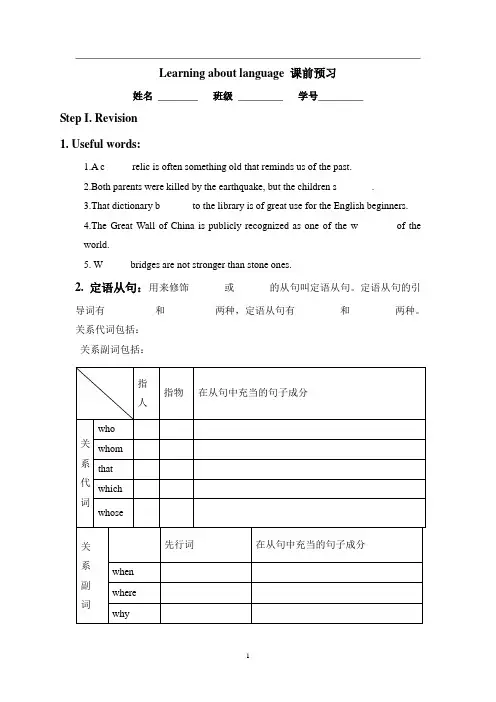
Learning about language 课前预习姓名________ 班级_________ 学号_________Step I. Revision1. Useful words:1.A c_____ relic is often something old that reminds us of the past.2.Both parents were killed by the earthquake, but the children s_______.3.That dictionary b______ to the library is of great use for the English beginners.4.The Great Wall of China is publicly recognized as one of the w_______ of theworld.5. W_____ bridges are not stronger than stone ones.2. 定语从句:用来修饰_______或_______的从句叫定语从句。
定语从句的引导词有__________和__________两种,定语从句有_________和_________两种。
关系代词包括:__________________________________________关系副词包括:__________________________________________指人指物在从句中充当的句子成分关系代词who whom that which whose关系副词先行词在从句中充当的句子成分whenwherewhy3. Fill in the blanks with proper relative pronouns关系代词or adverbs副词.1. Look at the girl ________ is singing so beautifully.2. Do you know the woman to ______ our teacher is talking?3. Jim is the boy ______ hat is red.4. He gave me a pen ___________ he bought last week.5. Mary has read all the books _________ I lent her.6. Is it the reason _____ you were late?7. October 1st is the date _____ China celebrates its National Day.8. We walked in a garden _____ many trees and flowers had been planted.9. This is the island _____ I lived for two years.10. 2001-2005 are the years _____ I studied in the university.Learning about language 课内探究一、限定与非限定性定语从句1、定义限制性定语从句是先行词在意义上不可缺少的定语,如果去掉,主句的意思就不完整或失去意义。
2020年高中英语(人教版 选修7)教师用书:Unit 2 Section_Ⅲ Learning_a
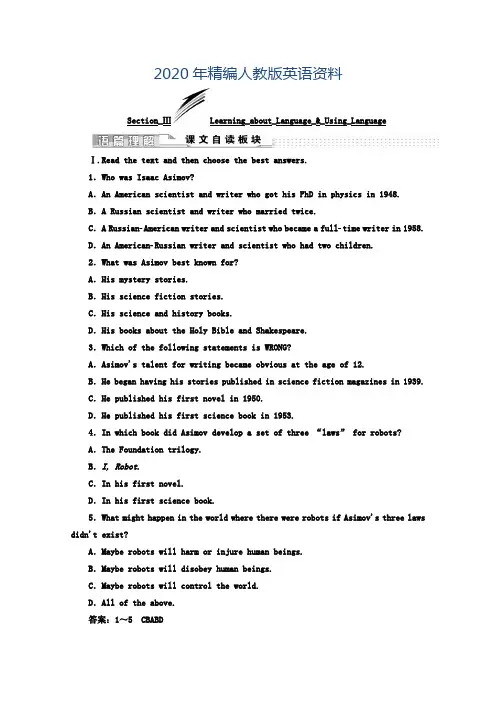
2020年精编人教版英语资料Section_ⅢLearning_about_Language_&_Using_LanguageⅠ.Read the text and then choose the best answers.1.Who was Isaac Asimov?A.An American scientist and writer who got his PhD in physics in 1948.B.A Russian scientist and writer who married twice.C.A RussianAmerican writer and scientist who became a fulltime writer in 1958.D.An AmericanRussian writer and scientist who had two children.2.What was Asimov best known for?A.His mystery stories.B.His science fiction stories.C.His science and history books.D.His books about the Holy Bible and Shakespeare.3.Which of the following statements is WRONG?A.Asimov's talent for writing became obvious at the age of 12.B.He began having his stories published in science fiction magazines in 1939.C.He published his first novel in 1950.D.He published his first science book in 1953.4.In which book did Asimov develop a set of three “laws” for robots?A.The Foundation trilogy.B.I, Robot.C.In his first novel.D.In his first science book.5.What might happen in the world where there were robots if Asimov's three laws didn't exist?A.Maybe robots will harm or injure human beings.B.Maybe robots will disobey human beings.C.Maybe robots will control the world.D.All of the above.答案:1~5 CBABDⅡ.Read th e text carefully and fill in the form.A BIOGRAPHY OF ISAAC ASIMOVBirth and death •born on 2 January, 1920 in Russia •died on 6 April, 1992 in1.New_YorkWorkBeforeworkingas a writer•worked in his parents' 2.candy store•worked as a(n) 3.junior chemist at the PhiladelphiaNavy Yard•4.taught biochemistry at Boston University School ofMedicineAs a writer•wrote many mystery stories, 5.science_and_historybooks, and books about the Holy Bible and Shakespeare•works of 6.science_fiction:_the Foundation trilogy &I, Robot(一)词义匹配1.digital A.using a system in which information is recorded or sent out electronically in the form of number, usually ones and zeros2.talent B.a feeling of liking and caring about someone or something3.affection C.the story of a person's life written by sb. else4.staff D.the people who work for an organization, especially a school or business 5.biography E.to end your marriage to sb. legally6.divorce F.a natural ability to do sth. well7.bound G.certain or likely to happen, to do or be sth.答案:1~5 AFBDC 6~7 EG(二)根据词性和汉语意思写出单词8.receiver n.收件人;接收机;电话听筒→receive vt.收到9.obey vt.& vi.服从;顺从→disobey vt.& vi.(反义词)不服从;违抗10.imagination n.想象(力);创造力→imagine vt.想象;料想;猜想11.theoretical adj.理论(上)的;假设的→theory n.理论12.assessment n.评价;评定→assess v.评价;评定13.junior adj.较年幼的;资历较浅的;地位较低的n.年少者;晚辈;等级较低者→senior (反义词) adj.资格较老的;地位较高的n.较年长者1.bound[教材原句] Who said that making a robot so much like a man was bound to cause trouble?谁说把机器人造得这么像人一定会引起麻烦?(1)adj.一定的;密切相关的;有义务的;受约束的be/feel bound to do sth.一定会做某事;有义务做某事be bound by sth. 受某事约束be bound up with/in sth.与某事密切相关/忙于某事①If you can't get on well with your classmates, it's bound to affect your study.如果你和同学们相处不好,这肯定会影响你的学习。
人教版 高中英语 必修二 unit 3 computersLearning about language

5) 现在完成时的被动语态 (have/has +been
+ 过去分词)
如: The radio has been repaired when
we phoned the shop. 6) 带情态动词的被动语态 (情态动词 + be +
过去分词) 如: This can be done in a few minutes.
高一人教新课标版必修二
Unit 3
Computers
Learning about language
Discovering useful words and expressions 1 Find the word or expression for each of the following meanings from the text. 1. _________ complete change in ways revolution of thinking, working, etc. 2. ________ connected computer system network 3. ________ to make things easier simplify 4. ________ to find the answer using calculate numbers
注意:
1.副词的位置
often, usually, always, never, hardly, seldom等副词置于have/has和been中间。 如: [误] Such a man has been hardly believed. [正] Such a man has hardly been believed.
脏衣服都已经洗了。
必修2 Unit 3 语法
Ⅳ. 用法:
1. 表示一个被动的动作发生在说话之前,强调对现在 造成的影响和结果。(注:动词为短暂动词,可与already或yet 连用,但不能与for或since引导一段时间状语连用。) The door has been locked. The classroom has been cleaned.(结果是现在不用清扫教室了) 2. 表示一个被动的动作或状态开始于过去,持续到现 在,并可能持续下去,常与for 或since引导的时间状语 连用,或用于How long...?句型中。
注意
1. 只有及物动词才有被动语态,不及物动词(词组)没有 被动语态。 例如: happen, take place, die, appear, disappear, fail, remain, lie, last, sit, stand, break out, come true, belong to等。 What has happened to your brother?
3. 现在完成时被动语态一般疑问句句型: Have/Has +主语 + been+ 过去分词 ...? Has a new computer been bought ? Have they been sent abroad to study English? 4. 现在完成时被动语态特殊疑问句句型: 疑问词+ have/has + 主语+ been+过去分词 ...? Where has the car been repaired? Who have been helped by the new computer? How many buildings have been built in this school?
高中英语(人教版选修7)教师用书:Unit 2 Section_Ⅲ Learning_about_Language_-_Using_Language(含答案)
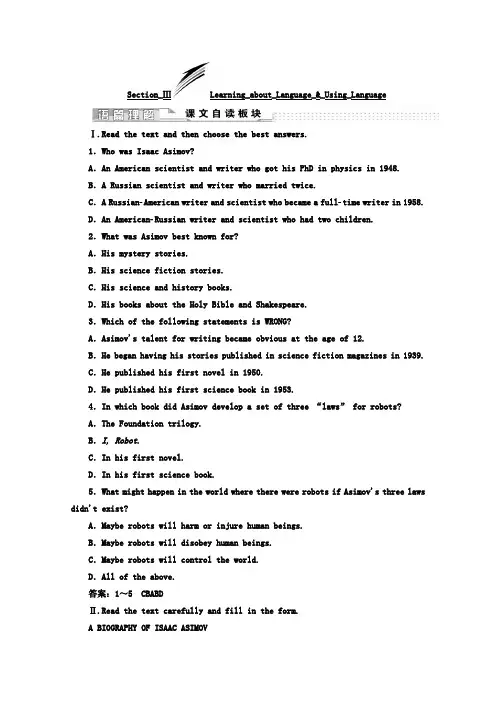
Section_ⅢLearning_about_Language_&_Using_LanguageⅠ.Read the text and then choose the best answers.1.Who was Isaac Asimov?A.An American scientist and writer who got his PhD in physics in 1948.B.A Russian scientist and writer who married twice.C.A Ru ssianAmerican writer and scientist who became a fulltime writer in 1958.D.An AmericanRussian writer and scientist who had two children.2.What was Asimov best known for?A.His mystery stories.B.His science fiction stories.C.His science and history books.D.His books about the Holy Bible and Shakespeare.3.Which of the following statements is WRONG?A.Asimov's talent for writing became obvious at the age of 12.B.He began having his stories published in science fiction magazines in 1939.C.He published his first novel in 1950.D.He published his first science book in 1953.4.In which book did Asimov develop a set of three “laws” for robots?A.The Foundation trilogy.B.I, Robot.C.In his first novel.D.In his first science book.5.What might happen in the world where there were robots if Asimov's three laws didn't exist?A.Maybe robots will harm or injure human beings.B.Maybe robots will disobey human beings.C.Maybe robots will control the world.D.All of the above.答案:1~5 CBABDⅡ.Read the text carefull y and fill in the form.A BIOGRAPHY OF ISAAC ASIMOVBirth and death•born on 2 January, 1920 in Russia•died on 6 April, 1992 in 1.New_YorkWorkBeforeworkingas a writer•worked in his parents' 2.candy store•worked as a(n) 3.junior chemist at the PhiladelphiaNavy Yard•4.taught biochemistry at Boston University School ofMedicineAs a writer•wrote many mystery stories, 5.science_and_historybooks, and books about the Holy Bible and Shakespeare•works of 6.science_fiction:_the Foundation trilogy &I, Robot(一)词义匹配1.digital A.using a system in which information is recorded or sent out electronically in the form of number, usually ones and zeros2.talent B.a feeling of liking and caring about someone or something3.affection C.the story of a person's life written by sb. else4.staff D.the people who work for an organization, especially a school or business 5.biography E.to end your marriage to sb. legally6.divorce F.a natural ability to do sth. well7.bound G.certain or likely to happen, to do or be sth.答案:1~5 AFBDC 6~7 EG(二)根据词性和汉语意思写出单词8.receiver n.收件人;接收机;电话听筒→receive vt.收到9.obey vt.& vi.服从;顺从→disobey vt.& vi.(反义词)不服从;违抗10.imagination n.想象(力);创造力→imagine vt.想象;料想;猜想11.theoretical adj.理论(上)的;假设的→theory n.理论12.assessment n.评价;评定→assess v.评价;评定13.junior adj.较年幼的;资历较浅的;地位较低的n.年少者;晚辈;等级较低者→senior (反义词) adj.资格较老的;地位较高的n.较年长者1.bound[教材原句] Who said that making a robot so much like a man was bound to cause trouble?谁说把机器人造得这么像人一定会引起麻烦?(1)adj.一定的;密切相关的;有义务的;受约束的be/feel bound to do sth.一定会做某事;有义务做某事be bound by sth. 受某事约束be bound up with/in sth.与某事密切相关/忙于某事如果你和同学们相处不好,这肯定会影响你的学习。
2019新人教高中英语选择性必修四Unit3Learning about Language公开课学案
2019新人教高中英语选择性必修四Unit3 Sea ExplorationLearning about Language公开课学案学习目标:1.To identify the functions of infinitives.2.To practise using infinitives in different contexts.3.To express your own ideas using infinitives.Part Ⅰ Observe and analyseFind all the sentences containing infinitives in the reading passage. Then mark their functions._____________________________________________________________________ _____________________________________________________________________ _____________________________________________________________________ _____________________________________________________________________ _____________________________________________________________________ _____________________________________________________________________ _____________________________________________________________________ _____________________________________________________________________ PartⅡPractise using the infinitiveActivity1Join the words to make sentences using infinitives.Then decide the function of each infinitive.1.He/encouraged me/participate in the surfing competition.2.The storm/seems/be getting closer.3.Magellan/was the first person/sail around the world.4.The UN peacekeeping force/aims/maintain peace and prevent armed conflicts.5.The crowd/stood/applaud/scientists/for their important ocean research work.6.It is a good idea/tax/plastic bottles/so that people use them less.7.The Jiaolong manned submersible/is said/be able/reach 7 km underwater.8.It remains/be seen/whether or not his capsule can work._____________________________________________________________________ _____________________________________________________________________ _____________________________________________________________________ _____________________________________________________________________ _____________________________________________________________________ _____________________________________________________________________ _____________________________________________________________________ _____________________________________________________________________ Activity2Read the beginning of The Little Mermaid and use the proper forms of the verbs in brackets to fill in the blanks.Far out in the ocean,where the water is as clear as glass,lives the Sea King. The ocean is too deep (measure).We may imagine there is nothing except yellow sand under the sea,but actually it is not rare(see) the most unique flowers and plants(dance) in the fast-moving water.In the deepest spot of all stands the Sea King’s castle,which has walls of coral and a roof(form) of beautiful shells.The mother of the king,a wise woman who is proud(be) born into the royal family,takes care of his six daughters.Among the six sea-princesses,the youngest is the prettiest.Although she has delicate skin like a rose-leaf and eyes as blue as the deepest sea,she has no feet but a fish tail just like her sisters.The most common way for the princesses(play) all day long is (swim) in the halls of the castle or among the flowers growing out of the walls,feeding and touching the fish(swim) up to their hands through the windows.They seem(not worry) about anything,except for the youngest,who...Activity3Read the beginning of The Little Mermaid once again and continueto write what will happen next.They seem not to worry about anything except for the youngest, who_________________________________________________________________ _____________________________________________________________________ Activity4Complete the news report below with the appropriate forms of the verbs in brackets.Across northern Africa, the desert is steadily growing. Dry lands are spreading. But a bold project known as the Great Green Wall aims 1.(stop) the growth of the desert. The ambitious program includes plans 2.(help) protect and maintain resources and fight poverty.Farmers are learning 3.(care) for their land and use water wisely. They are also planting millions of trees and crops. The Great Green Wall would cover 4.area more than 4,000 miles wide. The program receives support from the United Nations, the World Bank and other groups.The Great Green Wall’s trees provide a barrier 5.desert winds and help hold moisture in the air and soil, allowing crops 6.(grow).More resources will bring more jobs. “The goal is to create sustainable land management,” said Nora Berrahmouni, a forestry officer 7.works with the Food and Agriculture Organisation of the United Nations.Trees and crops have been planted in Senegal and Niger. An 8.(add) benefit of the Great Green Wall is 9.countries in the region are sharing information about which programs work and which don’t. Now, along with trees, 10._(idea) are taking root.PartⅡLanguage useWrite a paragraph with any topic using infinitives and v.-ing form._____________________________________________________________________ _____________________________________________________________________ _____________________________________________________________________ _____________________________________________________________________ __________________________________________________________________________________________________________________________________________ _____________________________________________________________________ _____________________________________________________________________ PartⅡConsolidationⅠ.Rewrite the underlined parts using infinitives.Ⅱ.单句语法填空1.Fascinated by the structural beauty of the Forbidden City as a painter, she is equally interested (learn) more about Chinese philosophy.2.Von Wong hopes that his work will also help pressure big companies (reduce) their plastic footprint.lions of acres of wetlands were dried (feed) and house the ever-increasing populations, greatly reducing waterfowl habitat.4.Our aim was(see) if we could live, in some way, like real Parisians.参考答案:Part Ⅰ Observe and analyse1.To complete the great map of the world(As the subject) was a strong passionfor the people of early civilisations.2.Marco Polo’s tales inspired European explorers to search for sea routes (As the object complement) from west to east.3.Here, merchants from China and many other places met to negotiate trade deals (As the adverbial), which also led to more awareness of each other’s cultures.4.To reach out across the sea (As the subject) remains a strong desire today.5.The aim of this initiative is to encourage cooperation and trade(As the predicative) across the historic Silk Road areas, and strengthen the bonds between China and the rest of the world.6.Trading has grown greatly in recent years, and will continue to do so (As the object) in years to come.7.In recent years,China has joined other nations on several expeditions to explore the Arctic(As the attributive).8.From a scientific point of view, there is an urgent need to study the Arctic(As the attributive) in order to understand climate change and its effects.9.... the need to trade(As the attributive) and the desire to enhance relationships(As the attributive) will drive China to reach out (As the object complement) across the sea far into the future.Part Ⅰ Practise using the infinitiveActivity11.He encouraged me to participate in the surfing competition. (OC)2.The storm seems to be getting closer. (P)3.Magellan was the first person to sail around the world. (Attr)4.The UN peacekeeping force aims to maintain peace and prevent armed conflicts. (O)5.The crowd stood to applaud scientists for their important ocean research work. (Ad)6.It is a good idea to tax plastic bottles so that people use them less. (S)7.The Jiaolong manned submersible is said to be able to reach 7 km underwater. (O;O)8.It remains to be seen whether or not his capsule can work. (P)Activity2to measure; to see; dancing; formed; to have been;to play; swimming/to swim; swimming; not to worryActivity3They seem not to worry about anything except for the youngest, who wants to see what life is like on land. She swims all the way to the surface and sees a large ship. It travels towards her at great speed and terrifies her. She swims below the surface of the water and just manages to swim away from the big ship. She now realises that it is a scary world outside of the ocean, and she decides to stay with her family and friends under the sea.Activity41.to stop2.to help3.to care4.an5.against6.to grow7.who/that8.added9.that10.ideasPartⅡLanguage useRecently, I have managed to become a more active learner. When I am reading a book or listening to my teacher, I try to forget what I have learnt before or what I think about the book or the person giving me the information and practise concentrating on the information itself. At the beginning, it was difficult to do so and I couldn’t help questioning the ideas I was reading or hearing. But now I have learnt to avoid listening to my inner voice all the time and sometimes I even argue with it. On the other hand, I also attempt to ask as many questions as I can. I have noticed that the answers to the questions have really helped me understand the topic a lot better.PartⅡConsolidationⅠ.1.to help you keep track of2.to record your steps, speed and distance3.to enable you to stay hands-free4.to make it comfortable to wearⅠ.1.to learn2.to reduce3.to feed4.to see。
人教版英语选择性必修一:3.3 Learning about language 练习(解析版)
人教版英语选择性必修一:3.3 Learning about language 练习(解析版)1、Unit3FascinatingParksPeriod3Learningaboutlanguage〔练习解析版〕I:单词拼写1.The governmenthasmadelaws to_________(禁止) tobacco advertisements onTV.【答案】prohibit2.Whenyou_________(打喷嚏), air andoften small drops of liquid suddenly comeoutof y our nose and mouth inawayyoucannot control.【答案】sneeze3.He seems tobe stuck withthe_________(标签)oft2、roublemaker.【答案】label4.Shedecidedto_________(伸出)outher hand and help theoldmanupfromhis chair.【答案】stretch5.Textbookwritingcanbeanintellectually_________(有益的) activity.【答案】rewarding6.The _________(茶壶) camewith a stand tocatch the dripsofwater.【答案】teapot7.He peeled the paper top off a little white tuband p oured the _________3、(奶油) into his coffee. 【答案】cream8.Werequiregrammarandspellingtobe_________(精确的).【答案】accurate9.It’sk nowntousthatsmokingdomuchdamagetothe_________(肺部).【答案】lung10.We saw amother_________(豹子)sleepingunderthe treeswithhercubs.【答案】leopardII:单句语法填空1.Thelocalgovernmenthas announced a_________(prohibit) on smokingon buses.【答案】prohibition4、2.Hissmallsizeprohibitshis_________(become)apoliceman.【答案】becomingn【解析】prohibitsb(sb’s)doingsth,故使用动名词作宾语。
Unit 3 Fascinating Parks Learning About Language课件
派生:是通过添加前缀或后缀构成另一个词,例如 patient (adj.)加否定意义的前缀im-构成important (adj.), 或者改变词性的后缀-ly构成patiently (adv.)。 合成:是由两个或两个以上的词合成一个词,例如 everyday, handshake。
Why did the number of Siberian tigers decrease? What resulted in a visible population increase of the species? How many tigers and leopards are in the area now? What was the problem facing a growing number of the species? Do you think it is worth setting up the new park? Why?
Learning about Language
Learning aims
1. Learn V-ing form used as subject in context. 2. Get more information about the theme and get better understanding about it.
Regretting him was like wishing you never found out that love could be that strong
转化 指一个词从一种词类转化为另一种词类而词性 不变。 Examples:water, book, hand, present
I wake up to the sound of the wind buffeting the cloth of my tent. I leave my tent and walk over to the mountain edge. I'm in the remote far north of Sweden in Sarek National Park, a place with no roads or towns. Though the Sami are allowed to continue their traditional way of life in the park, no one else can live here, and all new development is banned within park boundaries.
全新版大学英语综合教程第二册教案Unit3Book2
全新版⼤学英语综合教程第⼆册教案Unit3Book2Unit 3 The Generation GapI. Teaching ObjectivesStudents will be able to:Students will be able to:1understand the main idea (Father meddled in children?s affairs with good intentions, but only to find his efforts unwelcome) and structure ( three settings, three scenes) of the text;2 appreciate the basic elements of a play;3 grasp the key language points and grammatical structures in the text;4 conduct a series of reading, listening, speaking and writing activities related to the theme of the unit.II. Key Points: The structure, the writing skill, and the main idea ofthe text will be the focus. Only a few words and sentences, which will be the obstacles for students? understanding of the text, will be explained in class.III. Difficult Points:Some sentences whose meanings are difficult to understand and whose structures are hard to analyze:1. Line 43: Sean and I will have a man to man talk.2. Line 45-47: And I just wanted you to know that I?ll do anything I can to help him through life?s dangero us sea.3. Line 103: My treat, I told him. And of course, he was glad to accept..IV. Teaching Materials: Power point and materialsV. Teaching Methods: Lecturing, practicing and discussing.VI. Teaching Timing: 8 sessions of classVII. Teaching Process:1st -2nd periods:Pre-reading; Teacher?s Introductory Remarks and Students? Discussion related to the topic.3rd -4th periods: While-Reading (Understanding the title of text A; Analyzing the organization of the text; Explaining Difficult sentences and language points in the text; Summing up the main idea of the text)5th-6th periods: Dealing with the exercises after Text A. Check on Ss? home reading (Text B); Post-Reading Task: Theme-Related Language Learning Tasks7th-8th periods: Listening and speaking tasks.A. Pre-reading tasks1 T asks Ss the following questions on the song The Times They Are A-changing?: ( 5 minutes)---Who should be sitting up and taking notice?Why? (parents, politicians, writers and critics should listen up, because the times are changing so fast that one can?t be content with one?s old way of life)---What does the singer think of his parents? way of doing things? ( outdated)2 Pair interview ( 23 minutes)1)T dictates to Ss the following list of questions:---When are your parents? birthdays and their wedding anniversary?---Do your parents celebrate your birthday? How about their own birthday celebration?---In your parents? eyes, what are you interested in?---In your eyes, what are your parents interested in?---In what areas do your parents want you to improve?---In what ways do you want your parents to improve?---Tell of an instance when your parents and you disagree over something.2)Ss form pairs to interview each other. If there is an odd number of Ss in theclass, one group may consist of 3 Ss. The interviewer must note down the answer from the interviewee.3)Some Ss report interview results to class.3 T may lead in to Text A by saying: As we find from our interviews, parents and children do not often see eye to eye. When parents interfere with their children?s affairs, they believe that they are doing so in the interest of their children. However, the children may not be grateful, as is the case in the play we are going to study, Father Knows Better. When you read on, I want you to bear this questionin mind: despite their complaints, the Thompson children actually love their father very much. Do you yourself show similar attitudes towards your own parents?( 2 minutes)B. While-reading tasks1 A brief introduction to play ( 25 minutes)1)T writes down on the blackboard the major components of a play: characters,settings, stage directions, language, conflicts, climax, and theme.2)Ss identify the characters in this play.3)Ss read the directions for Text Organization Exercises 1 and 2, then scan theplay to divide it into three parts. T may drop a hint: just read the stagedirections put in brackets.4)T explains the functions of stage directions: to set up stage properties in theproper place; to indicate a change in setting; to direct actors? movements, gesture, facial expression, tone of voice, etc. Then T draws the followingillustration on the blackboard:5)T invites one S to read aloud Heidi?s speech to the audience at the verybeginning of the play, then ask another S to re-create Heidi?s words into a complete and grammatical paragraph. They may refer to Writing Strategy to see the stylistic differences between speech and writing.6)T defines conflicts as the essence of a play, a clash of actions, ideas, desires orwills. It may happen in three forms: man against man, man againstenvironment, man against himself. When a conflict develops to the mostintensified point, it becomes a climax. T asks Ss to find out the form(s) of conflict in this play as they later go through the text.7)T explains that, unlike a novelist or short-story writer, a playwright can notcome forward, interrupt the action, and tell the audience what he/she means by a certain scene or explain to them what is going on in the minds of the characters. The audience must conclude by themselves what theme of the play is. T tells Ss that they will do so at the end of reading this play.2 T explains language points in Part I and gives Ss practice ( see Language Study).( 15 minutes)3 Ss sum up the main conflict in Part I. ( 3 minutes)4 T explains language points in Part II and gives Ss practice ( see Language Study).( 25 minutes)5 Ss sum up the main conflict in Part II.( 3 minutes)6 T explains language points in Part III and gives Ss practice ( see Language Study). ( 15 minutes)7 Ss sum up the main conflict in Part III.( 3 minutes)8 Ss sum up the theme of the play. ( 6 minutes)C. Post-reading tasks1. The way they are (25minutes)1)Ss form groups of 3-4, re-read Part Ⅱ. Based on it, they will come up with abrief summary of the characteristics of Mother, Father, and the children (see Text Analysis). T may give Ss the following model:“Father shows great respect for Mother. He pulled the chair for her before dinner, and obeyed her commands like …do go on?, …do get on with it?, …don?t keep us in suspense?. Besides, although Father was pleased with what he had done for Diane, he had learned from experience that his efforts were not always welcome. That way why he could quickly realize his blunder, as made clear by sentence …I do? Yes, I guess I do. I?ve…done it again, haven?tI ??2)When Ss discuss within the group, the following questions might help:---- How did Mother address Father and her children?---- How many do?s and don?ts did she use? What do they tell about her character?---- On whose side Heidi and Sean stage whisper to each other?---- What did Sean tell Father that “I do believe Diane would like to know the surprise?”---- How did Diane feel when she said “Thank you, Sean. I owe you one”?---- What were Diane?s reactions during the scene?3)Several groups report their summaries to the class.2. T guides Ss through some after-text exercises. (25 minutes)3. T checks on Ss? home reading (Text B) (3 minutes)4. Ss so Part Ⅳ: Theme-Related Language Learning Tasks. (1 period)5. T asks Ss to prepare for the next unit: (2 minutes)1)do the pre-reading task;2)preview Text A.VIII. Assignments:Assignments for 1st and 2nd periods:Vocabulary Exercises I, II, III in Text A●Listen to the recording of the textAssignments for 3rd and 4th periods:●Review what have been learned in class●Comprehensive Exercises, I, II in Text A●Read the text fluently and imitate the pronunciation and intonation of therecordingAssignments for 5th and 6th periods:●Review what have been learned in class●Language Practice in Text B●Preparations for paragraph recitation and dictation of new words andexpressions in Unit 3Assignments for 7th and 8th periods:●Review what have been learned in class●Home listening: Task 1, 2 and 3●Previewing text A in Unit 4IX. Teaching Reflection:Try to listen to the feedback of the students during and after the course, analyze the weaknesses in teaching and improve the methods as much as possible.The feedback from the students:The methods taken to improve the teaching and learning:X. Appendix: Teaching Contents:A. Text AnalysisAlthough a playwright can?t come forward to speak directly readers, we may still form a mental picture of what each character is like.Let?s take Part Ⅱfor example. From the way they speak, their tone of voice, their facial expressions and their actions, we find Father, Mother and the three Thompson children life-like.Since a brief discussion of Father?s characteristics is given as a model in the Suggested Teaching Plan, here we will focus on Mother and the children.As we notice, in her speech Mother uses quite a number of do’s and don’ts, pleases, dears, and sweetheart’s. She is the real head of the Thompson household, giving out commands to her children as well as her husband. Moreover, most times her orders are respected. On the other hand, knowing her children?s attitude towards Father?s meddling, she tries to maintain the peace, as in the in stance when she maintains Father?s dignity by telling the children “Don?t interrupt”, “Don?t distract your father”, and “give your father the respect he deserves”, or when she tries to divert the conversation by talking about her dessert.The Thompson chil dren respect Mother, as shown by their frequent “Yes, Mother” and “Sorry, Mom”. On the other hand, they are used to Father?s meddling with their affairs. When Sean and Heidi find out that this time the bad luck had befallen Diane, they can afford to stand back and poke a few bemused comments. Diane?s feelings are entirely different, though. She is put on guard when Father tells her “I have a surprise for you.” Then she is embarrassed as Father mentions her feelings toward young Kyle. Later, as Father goes on delaying telling the truth, she becomes hysterical. Finally, when she learns the truth, she loses her temper.Isn?t it a wonder that words can tell so much about people?B. Cultural Notes1.Family life: Some families are very child-centered. The closest families eat meals at the same time and spend their free time together. Some families, however, only see each other for a short time in the evening, and though the children are still considered important, they have to fit in the lives of their parents.The average day for many families begins with getting the children up and ready for school. There is usually a rush for everyone to use the bathroom, find clean clothes, eat breakfast, and catch the bus. In the meantime the parents have to get ready for work themselves. Early mornings are a scramble for many families.The school day usually ends at about 3 p.m. in the US and 4 p.m. in Britain, and the working day at 5 p.m. or later, so many parents have to make arrangements for their children after school. They may go to an after-school center or stay with a neighbor?s children. Older children often do activities like sports or music at their school, or go home and do their homework. Children often also have to do chores.In many families, the children eat when they get home and their parents eat later. In the evenings the children play or go and see friends. If everyone is staying in they may watch television together. Many parents make an efforts t spend quality time with their children, an hour or so each day when they give them the full attention.American families are often criticized for the way they do things separately, though many people believe that it is good for children to learn to be independent. From an early age children are encouraged to decide what they want to do, eat or wear, and their parents try to respect their opinions.2. Part-time job: Many American teenagers earn a good portion of their college expenses by working during the summer as waiters or waitress, construction workers, mother? h elpers, gas station attendants, telephone operators or messengers. They are not concerned with status. Being unskilled, they try to find jobs at whatever level they can. They seek not only money, but also experience. They learn work habits, responsibility, the ability to take orders and to get along with a boss and different kinds of people.C. Language Study1. location n. a place or position 场所;位置e.g. With nesses showed the police the exact location of the accident.The school is going to move to a new location2. dine vi. eat dinner 进餐dine out having an evening meal away from home 外出进餐e.g. It?s Jan?s birthday, so we are dining out tonight at a special little restaurant we know.3. embarrass vt. make (Sib.) feel awkward or ashamed 使窘迫;使不好意思e.g. I chose my words carefully in order to avoid embarrassing anyone.It embarrassed him that he had to give a talk in front of a lot of people. adj. embarrassed: (sb.) shy, guilty or ashamed about sth.e.g. I was really embarrassed when I knocked the cup of tea over my teacher.4. dumb a. foolish; unable to speak 愚蠢的;哑的e.g. He was so dumb that he left his keys at home again.Don?t be dumb. You can?t get a loan from the bank if you are laid-off.Children born deaf and dumb can nowadays be taught to speak and lip-read.Martin was born dumb, but he has still managed to get a good job.5. unison n. ⼀致;齐唱;齐奏in unison acting in the same way at the same time ⼀致地;⼀起e.g. The children find it difficult to play their instruments in union.The international community is ready to work in unison against terrorism.6.consist vi. 组成,构成consist of be made up of 由…组成e.g. The book consists of essays written over the last twenty years.The committee consists of scientists and engineers.7. palm n. (1)⼿掌;掌状物(2)棕榈树vt. 把---藏于⼿(掌)中palm off to persuade someone to accept sth. because you do not want it and it has no value⽤欺骗⼿段把---卖掉e.g. She tried to palm her old car off on me.她设法骗我买下她那辆旧车。
2020学年高中英语Unit3AtasteofEnglishhumour3SectionⅢLearningaboutLanguage (1)
Section ⅢLearning about Language & Using Language重点单词写作词汇1.occasion n. 时刻;场合2.actress n. 女演员3.slide vt.& vi.(slid,slid) (使)滑动;(使)滑行n. 滑;滑动;幻灯片4.whisper n. 耳语;低语vt. & vi. 低语;小声说5.drunk adj. 醉的拓展词汇6.particular adj.特殊的;特别的n.细节;细目→particularly adv.特殊地;特别地7.amuse vt.使发笑;使愉快→amusing adj.好笑的;有趣的→amused adj.愉快的→amusement n.愉快,快乐8.explanation n.解释;讲解;说明→explain vt.解释;说明9.react vi.作出反应;回应→reaction n.反应;回应阅读词汇10.budget n. 预算;开支11.pancake n. 烙饼;薄饼12.detective n. 侦探13.mountainous adj. 多山的;山一般的14.vast adj. 巨大的;辽阔的15.rhythm n. 节奏16.porridge n. 粥;麦片粥重点短语1.burst__into__laughter 放声大笑2.treat...as 把……当作……3.pick__up 拾起,捡起4.keep__to__sth. 遵守5.look__up 向上看;查阅6.bring__out 使……清楚明白重点句型1.as引导方式状语从句:In the 1990s, Mr Bean became a star using mime to highlight difficult social situations much as__Charlie__Chaplin__had__done(像查理·卓别林那样做).2.do you think作插入语:How__do__you__think__John(你认为约翰怎样) will react to her?3.whenever引导让步状语从句:Whenever__you__finish__your__story(不管你何时完成你的故事),you will feel a sense of success.Read the text carefully and choose the best answer.1.In the first dialogue the customer in fact means that__________.A.he doesn’t know what it is nowB.he doesn’t hear clearly what the waiter saysC.he is not content with the soupD.he mistakes “bean” for “been”2.In the third dialogue the customer really wants to know________.A.the length of the pancakeB.how soon the pancake will be readyC.the size of the pancakeD.the shape of the pancake3.The passage mainly tells us________.A.a joke made by a famous detective and his friendB.a dialogue between Sherlock Holmes and Doctor WatsonC.a misunderstanding between Sherlock Holmes and Doctor WatsonD.a story told by two famous detectives4.From the story we can know that________.A.Doctor Watson was quite honestB.Sherlock Holmes was cleverer than Doctor WatsonC.Doctor Watson was cleverer than Sherlock HolmesD.Doctor Watson thought in an ordinary way while Sherlock Holmes in a funny way答案:1-4.CBADENGLISH JOKESThere are thousands of jokes which use “play on words” to amuse us. One person asks a question which expects a particular reply. Instead, what he gets is another kind of answer which makes the situation funny. Now read some of these customer and waiter jokes. Can you match the joke with the explanation?1C:What’s that fly doing in my soup?W:Swimming, I think!①2C:What’s that?W:It’s bean soup.C:I don’t want to know what it’s been.I want to know what it is now.②3C:Waiter,will the pancakes be long?W:No, sir.Round.③英语笑话有成千上万的笑话是以玩文字游戏的方式来逗我们发笑的。