
初中英语八年级下goforit说课稿Unit9
初中英语八年级下goforit说课稿Unit9各位读友大家好,此文档由网络收集而来,欢迎您下载,谢谢教案设计一.设计思想本节教学主要内容为Unit9sectionB 部分,教学目的是:在学习了SectionA 基础上对“Haveyouever......?”句式结构的巩固、扩展及综合运用,并使学生在活动(完成任务)的过程中能够创造性活用所学语言——谈论过去的经历。
我在设计教学中,从内容安排来说基本按照SectionB的顺序,所不同的是全部通过任务的形式,并以对话、听力、阅读、写作为载体,把整节内容贯穿始终。
第一步,以任务形式复习已学过的SectionA部分,导入新课。
即在小组内完成调查表格,并做汇报。
第二步,以Pairwork展开讨论并做汇报的任务形式学习1a、1b。
第三步,以听力练习为基础,完成汇报任务。
第四步,采取小组竞赛得分的游戏形式,调动学生阅读积极性,使其积极参与到阅读和回答问题的活动中。
同时,在竞赛过程中注意对学生参与意识及遵守课堂纪律的态度、情感方面的培养。
第五步,以Groupwork 形式在小组内完成调查表格的任务,进一步巩固、扩展知识,使学生在活动中活用语言。
另外,本节在设计上还采取“学案导学”模式,即每个学生手中有一份与教师教案同步,但内容是更好的帮助学生完成任务的学案,以辅助学生学习。
总之,本课的设计宗旨即是采用任务型教学模式,使学生在完成任务的过程中学会用语言,发展学生的综合语言运用能力。
二.教案Unit9Haveyoueverbeentoanamusementpark?TeachingAims:’pastexperienceandreasons.TeachingEmpha sis:R eviewandenlargetheusingof“Haveyoueve rbeento……?”andtalkaboutthepastexperie nceTeachingAids:taperecorder&paperstudying Teachingcontent:Step1通过完成task,复习SectionA 部分的基本句型,为进一步学习SectionB 做铺垫。
Task:小组活动。
根据所给表格,在各小组范围内了解同学们过去是否有过这些经历,并至少说出一个自己曾经有过的其它经历,完成表格,然后请一名小组成员做report.NamesHaveyouever.…..yesNoTheotherexperiencebeentoanaquarium?traveledtoanothercity?helpedsomeoneyoudidnotknow?studiedEnglish?beentoanaquarium?traveledtoanothercity?helpedsomeoneyoudidnotknow?studiedEnglish?beentoanaquarium?traveledtoanothercity?helpedsomeoneyoudidnotknow?studiedEnglish?beentoanaquarium?traveledtoanothercity?helpedsomeoneyoudidnotknow? studiedEnglish?Report:Inourgroup,_______studentshavebeentoanaquarium,_______studentshavetra veledtoanothercity,______studentshelpeds omeonetheydidnotknow,______studentsha veeverstudiedEnglish,andwehavebeenstud yingEnglish.Step2PairworkTask:同学们都学习英语,请同学们在组内自述whydoyoustudyEnglish?,并参看P71--1a,向全班说whichreasonsareimportanttoyou,andwhichr easonsarenotimportanttoyou.Step3Listenin gjustnowthestudentstoldaboutwhytheystudy English,Task1:Trytotellthewordsyoucan’tguessthemeaningorunderstand.Task2:Listenagain,andcirclethequestionsyo uhear.Task3:Listenthethirdtimeoronceagain,andfi llinthequestionnaire.Task4:Pairwork Lookatthequestionsinactivity2aandroleplay theinterview. Answerwiththeinformationthatistrueforyou .Task5:writeasummaryandreportReport:mynameis (I)mfrom...,IwanttostudyEnglishbecause...Ste p4Reading在规定的时间内读课文,以小组竞赛的形式回答课下8个问题,看哪组回答的问题最多,并且快而准确。
(1)在规定的时间内,分小组读课文,并探讨问题如何回答。
(2)强答问题,并记分。
(回答正确加十分,错误减十分,由教师记分)同时教师讲解同学们把握不准的问题。
(3)以Pairwork形式,让学生熟练掌握问题及答句,并站起来对答。
(4)大声朗读课文一遍。
(有时间可多一遍)(5)根据问题,简要复述课文Step5Task在本组内调查,通过对话完成P88表格,并每组请一名同学做最后汇报。
Haveyouever…NamesVisitedanEnglish-sp eakingcountry?SpokentoanativespeakerofEnglish?writtenaletterinEnglish?watchedamovieinEnglishwithoutsubtitles?Readanewspaper,magazineorwebpageinEn glish? UsedEnglishontheInternet?Step6Homewor kwriteanjafsaboutoneselffortheschoolmaga zine。
(注:下次课上前5分钟请同学读作文。
)Unit9Haveyoueverbeentoanamusementpar k学习目标2. Learntoasktheothers’pastexperienceandreasons.学习向导FunctionTalkaboutpastexperienceTargetLanguage Haveyoueverbeentoanamusementpark?No,I’veneverbeentoanamusementpark.yes,Structures(1)Haveyoueverbeento…?yes,Ihave./yes,Ihaveeverbeento…No,Ihaven’t./No,Ihaveneverbeento…(2)whendidyougothere?Iwenttherelastyear.(3)Ihaveneverbeentoawaterpark.NeitherhaveI.Ihaveeverbeentoanamusementpark.SohaveI.(4)HowlonghaveyoubeenstudyingEnglish?I’vebeenstudyingEnglishsincenineo’clock.I’vebeenstudyingEnglishsinceIcamebackho me.I’vebeenstudyingEnglishforfivehours.(5)what’sthat?It’sanamusementparkinjapan.I’veneverbeentoanamusementparklikeitbefor e.It’sfuntolearnanotherlanguage.Let’sgotonight.Isn’tthisgreat?keyV ocabularykeyPhrasesspacemuseum,amusementpark,waterpark,SouthAmerica,Peru,Holland,Europeancultur e,tourguide,flightattendant,musicalinstrum ent,morethan,befrom,getto,takelessons,neit her,discover,graduate,change学习策略思维技巧Listeningtospecificinformationcooperating多元智能1.Disneyland了解相关文化背景。
2.世界地理知识。
Recycling复习相关的词汇:zoohotelrestaurantbusboat教学过程TeachingstepsThefirstperiod:Aim:Topracticelisteningskills;tostudynew wordsandtoknowhowtogiveadvice.Practicethesentences:Haveyoueverbeento…?---------------------------------精选公文范文-------------------------- yes,Ihave./yes,Ih aveeverbeento…No,Ihaven’t./No,Ihaveneverbeento…StepsTeacher’sactivitiesStudents’activitiesStep1Lead-inLookatthepicture,andaskthestudents,“what canyouseefromthepicture?”Lookatthepictureandbrainstormthewordsth eycanthinkof,suchasspacemuseum,amuse mentpark,waterpark,zoo,aquarimStep2wordstudy各位读友大家好,此文档由网络收集而来,欢迎您下载,谢谢----------------精选公文范文---------------- 11。
新目标八年级英语下第九单元说课稿

新目标八年级英语下第九单元说课稿各位读友大家好,此文档由网络收集而来,欢迎您下载,谢谢新目标八年级英语下册第九单元说课稿说课稿GoforitUnit9 Haveyoueverbeentoanamusementpark?长春市四十五中学林姝华一、教材分析:、教学内容:本单元是GoforitUnit9。
主要围绕“Haveyoueverbeentoanamusementpark?”这一主题展开各种教学活动,并以这一主题引出现在完成时的一般疑问句,否定句以及特殊疑问句等语言功能。
本单元旨在创造一个轻松、愉快的学习、交流环境,通过听、说、读、写来培养学生综合运用这些知识的能力。
并让学生能在“做中学”(learningbydoing),通过有限的课堂实践活动,拓展以往的经历,能准确地用英语来表达。
2、教材的地位和作用:八年级下九单元Haveyoueverbeentoanamusementpark?讲述的是现在完成时的用法,这是初中非常重要的时态之一。
学生们能够用现在完成时来表达自己的经历,来体会别人的感受是很重要的。
这个单元一定要体会现在完成时的真正含义和用法。
要避免混淆几个重点词组的使用。
我们更要使学生不仅理解枯燥的语法,还要让学生们会用新学的语法知识来表达思想。
3、教材的处理:根据《英语课程标准》(实验稿)关于总目标的具体描述,结合本单元这部分的教学内容及基于对教材的分析,我对本单元的内容进行如下处理,目的是突出重点,使课堂节奏紧凑,衔贯。
本单元分为四课时,第一课时是SectionA,第二课时是SectionB,第三课时是Selfcheck,第四课时是Reading,最后一部分是做练习,以学生的自测为主,然后予以校对。
二、教学目标:根据以上我对本单元教材内容的分析,我确定以下几个为本单元的教学目标:语言知识、语言技能、学习策略、情感态度和文化意识五个方面。
.语言知识:本单元要求学生掌握以下词汇(neither,theme,endup,especially,discover, population,simply,fear,whenever)语言功能:学习和增加阅读技巧和阅读策略。
八年级英语下册(人教新目标GoForIt!)Unit9第4课时SectionB(1a1d)教学设计

4.学生在团队合作方面,具有一定的合作意识,但分工和协作能力仍有待提高。教师应引导学生在小组活动中,学会相互尊重、支持和沟通。
5.在情感态度与价值观方面,学生正处于青春期,关注自身和他人的健康问题。本章节内容有助于引导学生树立正确的健康观念,培养良好的生活习惯。
2.教师提问:引导学生思考短片中的健康问题,询问学生在生活中遇到的健康问题,如:“Have you ever been sick? What did you do when you were sick? How do you keep healthy?”
3.学生分享:鼓励学生分享自己的经历和感受,为接下来的新课学习做好铺垫。
b.拍摄一段关于健康生活方式的小视频,展示给全班同学,激发大家关注健康问题。
3.预习作业:
a.预习下一课的内容,提前了解与疾病和健康状况相关的词汇和句型。
b.搜集有关健康生活的小贴士,与同学们分享。
4.拓展作业:
a.阅读英文健康类文章,了解更多的健康知识。
b.参观医院或诊所,了解医疗设施和就医流程,以加深对健康问题的认识。
作业布置注意事项:
1.作业难度要适中,既要巩固所学知识,又要激发学生的学习兴趣。
2.鼓励学生发挥创意,将所学知识应用到实际生活中。
3.注重作业的实践性,培养学生的动手能力和团队合作精神。
4.教师要及时批改作业,给予反馈,指导学生改进学习方法。
5.针对不同学生的学习需求,适当调整作业内容,关注学生的个体差异。
b.学生自主阅读课文,找出与疾病和健康状况相关的词汇和句子。
c.教师针对学生的发现进行讲解,重点讲解一般现在时和一般过去时的运用。
Go for it 8A Unit9教案
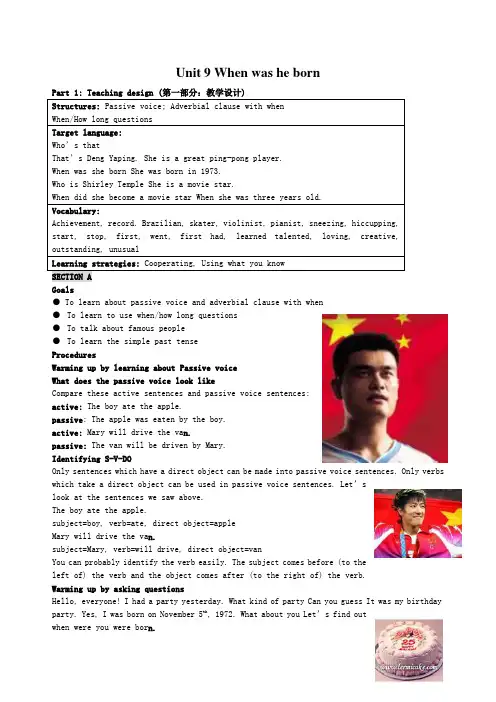
Unit 9 When was he bornStructures: Passive voice; Adverbial clause with whenWhen/How long questionsTarget language:Who’s thatThat’s Deng Yaping. She is a great ping-pong player.When was she born She was born in 1973.Who is Shirley Temple She is a movie star.When did she become a movie star When she was three years old.Vocabulary:Achievement, record. Brazilian, skater, violinist, pianist, sneezing, hiccupping,start, stop, first, went, first had, learned talented, loving, creative, outstanding, unusualLearning strategies: Cooperating, Using what you knowSECTION AGoals● To learn about passive voice and adverbial clause with when●To learn to use when/how long questions●To talk about famous people●To learn the simple past tenseProceduresWarming up by learning about Passive voiceWhat does the passive voice look likeCompare these active sentences and passive voice sentences:active: The boy ate the apple.passive: The apple was eaten by the boy.active: Mary will drive the va n.passive: The van will be driven by Mary.Identifying S-V-DOOnly sentences which have a direct object can be made into passive voice sentences. Only verbs which take a direct object can be used in passive voice s entences. Let’slook at the sentences we saw above.The boy ate the apple.subject=boy, verb=ate, direct object=appleMary will drive the va n.subject=Mary, verb=will drive, direct object=vanYou can probably identify the verb easily. The subject comes before (to theleft of) the verb and the object comes after (to the right of) the verb.Warming up by asking questionsHello, everyone! I had a party yesterday. What kind of party Can you guess It was my birthday party. Yes, I was born on November 5th, 1972. What about you Let’s find out Arraywhen were you were bor n.T: When is your birthdayS: April 22T: When were you bornS:19—Sb + was/were + born + in + year 出生于xxxx年I was born on October 25th, 1975.1a Talking about international sports starsT: Do you like sport I think many of you like it. What sport do you likeS: football, volleyball, tennis, table tennis, basketball and so on.T:Ok! I know you are sports fans. You must know the famous sports stars. I have some pictures of them .Do you know them. Let’s make a list.International Sports Stars What kind of sport Do you like him or her WhyMichael Jordan Basketball supermanDeng Yaping Table tennis PertinacityMartina Hingis Tennis resourcefulDavid Beckham football Handsomeor why not1b Listening and writingListen to the tape and write the year when the sports star were bor n. I will play it twice.TapescriptConversation 1Boy: Who's thatGirl:That's Deng Yaping. She's a great Chinese ping-pong player.Boy: When was she bornGirl: She was born in 1973Conversation 2Girl: Who's thatBoy:That’s Michael Jorda n.He’s a great American basketballplayer.Girl: When was he bornBoy: He was born in 1963.Conversation 3Boy: Who's thatGirl:That's Martina Hingis. She's a great Swiss tennis player.Boy: When was she bornGirl: She was born in 1980.Conversation 4Girl: Who's thatBoy: That's David Beckham. He's a great British soccer player.Girl: When was he bornBoy: He was born in 1975.Deng Yaping:1973Michael Jordan:1963David Beckham:1975MartinaHingis:1980Read the tapescript and try to underline the expressions and shadow the when/how long questions 1c Doing pairworkFirst let’s look at the dialogue about Deng Yaping. Please read it after me. When you readA:Who’s thatB:That’s Deng Yaping. She is a great Chinese ping-pongplayer.A: When was she bornB: She was born in 1973.Now make the similar dialogue about other people with your partners. I’d like to ask some pair to act it out. For example:A:Who’s thatB:That’s Michael Jorda n.He is a great Americanbasketball player.A: When was he bornB: He was born in 1963.2a Listening and filling the chartHiccup 打嗝sneeze 打喷嚏world record means the best in theworldLet’s listen to the tape carefully and fill in the chart.TapescriptGirl: Who's thatBoy:Charles Smith. He holds the world record for hiccupping. He hiccupped for 69 years and 5 months.Girl: When did he start hiccuppingBoy: He started hiccupping in 1922.Girl: And when did he stopBoy: He stopped in 1990.Girl: How could he hiccup for that longBoy: I don't know. Oh, look, this is Donna Gree n.Girl: What's she famous forBoy: Sneezing. She sneezed for 978 days.Girl: Really When did she start sneezingBoy: Let's see. It says she started sneezing on January 13, 1981, and she sneezeduntil September 16, 1983.Girl: Wow! That's a long time.How long Started StoppedWho hold worldrecordCharles hiccupping69 years and 5monthsDanna Green sneezing978 days2b Listening and filling in the chart.How long Started StoppedWho holds worldrecord19221990Charles hiccupping69years and5 monthsDanna Green sneezing978days January13,9811983Read the tapescript and try to underline the expressions and shadow the when/how long questions 2c Filling the chart and speakingFirst let’s fill in the blank with the information from the chart in last part.A: How long did Charles Smith hiccupB: He hiccupped for 69 years and 5 months.A: When did he start hiccuppingB: He started in 1922A: When did he stop hiccuppingB: He stopped in 1990.Please practice the conversation with your partner.Make the same kind of conversation about Donna Gree n.The students’ conversation may be like this.A:How long did Donna Green sneezingB: She sneezing for978 days.A: When did she start her sneezingB: She started on January 13,1981.A: When did she stop sneezingB:She stopped on September16, 1983.Grammar FocusPlease go over this part by yourselves. Put your questions to me if you have any. Please pay attention to the tense and the past forms of verbs. When we talk about things in the past,we should use the past tense. The past form of “be” is “was” or “were”. To the regular verbs, “ed” should be added after them. And as for the irregul ar verbs we should remember their past forms.3a Doing pairworkFirst you read and fill in the chart with your partner.The word achievement means “the important thing each person did in life.Achievement AgeTiger Woods Started golf10 months oldShirley Temple Movie star Three year oldWolfgang Amadeus Mozart Writing music Four years oldTenMei Lanfang First performed BeijingOperaRonaldo Played for his nationalSeventeenteamLiu xuan Won a gold medal at theseventeenWorld Championship3b Doing pairworkSince you have finished reading the chart and filling in your answers, please work in pairs as is the examples in the book.A: Who is MozartB:He’s a musicia n.A: When did he start writing musicB: When he was four years old yearsold.4a InterviewingBoys and girls, let’s play a game, an interview.Look at the chart and interview you partners by asking the questio n.How old were you when…Name Achievement Age More informationLearned to ride a bicycleStarted learning EnglishStarted playing sportsFirst went to a movieFirst had a party4b SpeakingWho would like to tell us his report about his interviewJohn started things early. He learned to ride a bicycle when he was only three yearsold. Sometimes he fell off the bike, but he never gave up. He was a brave boy.Closing down by having a free conversationSome students may be interested in sports stars, but some are not. If you don’t like this topic, you can talk about your favorite persons, instead.SECTION BGoals●To write about occupations●To introduce one’s experienceProceduresWarming up by describing a personI know you have lots of good friends in your class. Can you describe them and let your partnersMy friend is a boy. He is twelve years old. He lives near the school. He comes to school on foot. He has a round face with short hair. He likes playing Ping-Pong… Can you guess1a Looking at these people and describing with the wordstalented loving outstanding unusualbeautiful creative kind famousmeans “ very clever in a special way”. means “very good, much better than others”.Creative means “having the ability or power to create, productive. ”1b SpeakingTony is an outstanding pianist. He is creative and loves music very much. He spendsall his free time on it.Listen, two people are talking about people they admire. Please circle the words you hear.talented loving outstanding unusual beautiful creative kind famousTapescriptBoy: Who do you admireGirl: I admire Midori.Boy: Midori Who's thatGirl: She's a famous violinist.Boy: Oh, yeah. She's Japanese, isn't sheGirl: Yes, she was born in Osaka in 1971. When she was eight, she was already atalented violinist. When she was fourteen, she toured the United States. I saw herplay when I was eight.Boy: Wow. Do you have any of her CDsGirl: Yes, I do. I play them all the time. But how about you Who do you admireBoy: I admire my grandmother, Laura.Girl: Really WhyBoy:Well, she was born in Russia in 1932. She was an unusual girl because she startedice skating when she was four, and she became a skating champion when she was te n.Girl: A skating champion Did she have to work hardBoy: Yes, very hard. But that was a long time ago. Now she's a kind and loving grandmother.talented loving outstanding unusual beautiful creative kind famous2b Listening and writing “M” or “L” on the lines.1. M She is a famous violinist.2. M She was born in 1971.3. L She started ice skating when she was four.4. M I saw her play when I was eight.5. L She’s a kind and lovi ng grandmother.6. L She was born in 1932.7. L She became a skating champion when she wasfourtee n.8. M She toured the . when she was fourtee n.Read the tapescript in order to underline the expressions and shadow the connectives.Copy the expressions into your Expression Book after school.2c Doing pairworkA:Who’s MidoriB:She’s a famous violinist.A: When was she bornB: She was born in 1971.A: When did she tour the .B:When she was fourteen, shetoured the United States.A:Who’s LauraB:She’s a skating champio n.A: When was she bornB: She was born in Russia in 1932.A: When did she become a skating championB: She became a skating champion when she waste n.3a Reading and filling the chart.Li Yundi, the well-known Chinese pianist, always loved music. He was born in 1982in Chongqing. When he was a small boy, he could hum songs anddifficult pieces of music. He began to learn the accordion atthe age of four, and he started to learn the piano when he wasseve n. In October 2000, Li Yundi took part in the 14th ChopinInternational Piano Competition in Poland. He won the firstprize in his group. He was also the first Chinese pianist inthe 70-year history of the competition to win this prize.Accordion is a portable instrument with a small keyboard and free metal reeds that sound when air is forced past them by pleated bellows operated by the player.When What1982Was bornWhen he was a small boy Could hum songs and difficult pieces of musicAt the age of four Began to learn the accordionWhen he was seven Started to learn the pianoIn October, 2000.Took part in the 14th Chopin International PianoCompetition3b WritingSay something about Laura. Write an article.Laura was born in 1932. She started ice skating when she was four and becamea skating champion when she was te n. She worked very hard. Now she’s akind and loving grandmother.3c WritingI think you must have someone you admire. Can write something about him or her. Introduce him or her to your classmates.My English teacher is a person I admire. He is medium build. He can make hislesson fu n. He often teaches us English songs and play games with us afterclass. He loves teaching and loves his students.4 Asking and guessingYour classmates have to guess the name of a person you admire.They can ask you ten questions like this:A: Is the person a man or a womanB: He is a ma n.C: Is he aliveB:No, he isn’t.D: Was he an athleteB:No, he wasn’t.Closing down by writing your autobiographySuppose you are a famous person, for example, a scientist or pianist. Anewspaper reporter wants to write a brief biography for you. Can you writeone for yourself, tooMy name is Li Ping. I come from Taiyua n. When I was young I loved music very much. I studied playing the violin from Professor Hu when I was six. Professor Hu was very strictwith me. I played very hard. I won the first prize at the City Competition in 1998. Iwill go on with my career. I shall never give up.SELF CHECKGoals●To learn to use the past forms of verbs●To write a short biography of someoneProcedures1Filling in the blanks with the words givenWhen you do this exercise you should pay attention to the forms of the words. You should change tour start stop win becomeold were you when you started learning Englishcan I do to become famousstopped playing football because of his sore back.Chinese football team toured Asia last year.won the first prize in the speech competitio n.2 Reading and writingHere is the information about Deng Yaping. Please write an article about her. You can say something about her personal information and why you like her and so o n.Name: Deng YapingDate of birth: 02/06/19731978: Starts to play table tennis1983: Joins the Henan table tennis team1988: Joins the national table tennis team1997: Goes to Tsinghua University, majors inEnglish and management1993-1998: Numbe r 1 women’s singles player in the ITTF.Deng Yaping was born on the 2nd of June, 1973. She started to play table tennis in when she was five. She joined the Henan table tennis team at the age of te n.In 1988, she became a member of the National Table Tennis Team. She was still number 1 women’s singles player in IFTF from 1993-1998. She went to Tsinghua University, majoring in English and management in 1997. Just for fun!Sing a song in English.Baa, baa, black sheep,Baa, baa, black sheep,Have you any woolYes,marry, have I,Three bags full:One for my master,And one for my dame,And one for the little boyThat lives in the lane!Part 2: Teaching resources (第二部分:教学资源)I. Background readings (背景阅读)YapingDeng Yaping Internationally famous table tennis player. Twice elected member ofthe Athlete Commission of the IOC. Winner of 18 world champions, including fourOlympic titles. women's table tennis player for seven consecutive years. Deng isstudying at Notingham University in Britai n.2. Michael JordanMany people think Michael Jordan was the greatest basketball player ever. He ledthe Chicago Bulls to six National Basketball Association (NBA) championships. Heearned the nickname “Air Jordan” because he ofte n seemed to defy gravity on leaps toward the basket. Fans adored his smiling face and his determination to succeed. During his playing career, Michael Jordan became the most famous athlete in the world.EARLY LIFEMichael Jordan was born on February 17, 1963, in Brooklyn, New York. His family later moved to Wilmington, North Carolina.Young Michael’s best sport was baseball. He didn’t make his high school basketball team as a sophomore. Later, he played well enough to be noticed by Coach Dean Smith at the University of North Carolina (UNC). Jordan won a scholarship to UNC.As a freshman at UNC, Jordan scored the winning basket in the 1982 national college tournament championship game. He played two more seasons at UNC. He also played for the United States team in the 1984 Olympic Games.In 1984, Jordan entered the NBA player draft. He was chosen by the Chicago Bulls. NBA LEGENDJordan was a star from his first season with the Bulls. He was a scoring machine. The Bulls were not one of the NBA’s better teams, b ut they gradually improved. They made the NBA playoffs in their first five seasons with Jorda n. However, they failed to make the NBA championship finals.In 1989, Phil Jackson became the Bulls’ head coach. Under Jackson, Jordan became more of a team playe r, although he remained the NBA’s leading scorer. Jordan developed an incredible “court sense.” He knew where every player was on the basketball court, and what was the best play for the circumstances. In the 1990-1991 season, the Bulls won their first of three straight NBA championships.In 1993, Jordan retired from basketball. He tried to make it in professional baseball, but he had little success. He rejoined the Bulls in 1995. In the 1995-1996 season, the Bulls started another run of three straight championships.Jordan retired for a second time in 1998. He became part owner of the NBA’s Washington Wizards. The Wizards were not a good team. Jordan grew frustrated watching them lose. So in 2001, he came out of retirement again and played two seasons with the Wizards.JORDAN’S RECORDJordan retired for good in 2003. He was third on the all-time NBA scoring list, with 32,292 points. He had the highest scoring average in league history: he scored an average of points per game during his career. He led the NBA in scoring a record ten times. He won five NBA most valuable player awards. In addition, Jordan created millions of new fans for professional basketball around the world.II. Word studies1. bear(bearing, bore, borne, born)n.1.熊 big wild animal with thick fur: the Great Little Bear大小熊星座2.粗鲁之人 a man who is rough and rude in speech and manner: He is a bear. 他是一个粗鲁的人。
新目标英语八年级下册Unit9-1课时 上课详细教案
Go for it! 8BUnit 9 Have you ever been toan amusement park?Period 1【教案背景】以“英语新课程标准”为宗旨,适应新课程改革的需要,面向全体学生,提高学生的人文素养,增强实践能力和创新精神。
正确把握英语学科特点,积极倡导合作探究的学习方式。
培养学生积极地情感态度和正确的人生价值观,提高学生综合素质,为学生全面发展和终身发展奠定基础。
采用师生互动,倡导学生亲自体验参与,即采用任务型的教学模式,让学生在老师的指导下通过感知、体验、实践、参与和合作等方式,实现完成学习任务的目标,感受学习过程的成功;注重学生学习过程评价,促进学生发展,建立能激励学生学习兴趣和自主学习能力发展的评价体系。
【教学课题】新目标八2下Unit 9 SectionA:1a,1b,1c【教材分析】本单元以谈论过去的经历为话题,主要学习现在完成时的用法。
通过丰富多彩的语言情景实践对Have/Has… ever been to…? 的句型进行充分的操练,作为第一课时要让学生正确运用Have you ever been to…?的句型及相关回答Yes, I have./No, I haven’t.本课时教材中提供的所有活动都以现在完成时态为中心,通过一系列的听、说、读、写的训练,来加深学生对现在完成时态的理解,明白英汉两种语言在结构及表达方法的一些异同点。
从而提高他们运用所学语言的综合能力。
学生已经在在Go for it! 8B U-6学过现在完成进行时态,因而对现在完成时态并不陌生。
通过对学生们喜闻乐见的一些娱乐场所(fun places)的描述,反复运用句型Have you ever been to…? I’ve never been to…. 来激发他们使用本单元所学单词的兴趣。
【教学方法】1、师生互动、生生互动教学法;2、图片采用CAI课件展示;3、课文录音采用MP4音频播放;4、作业采用学生人手一份纸质作业和大屏幕课件展示答案的方法;5、学生课堂活动评价采用小组和个人得小红旗竞赛的方法。
八年级英语说课稿Unit9AHaveyoueverbeentoamuseum-
八年级英语说课稿Unit9AHaveyoueverbeentoamuseum?八年级英语说课稿Unit9AHaveyoueverbeentoamuseum?八年级英语说课稿Unit9AHaveyoueverbeentoamuseum?我说课的内容是人教版义务教育新目标Goforit八年级第9单元Haveyoueverbeentoamuseum?SectionA的1a-2c部分。
下面我将从资源分析、学法指导、教材教法和教学设计四个方面简述我对本节课的理解与处理。
一、资源分析首先是学情分析。
本节课的教学对象是八年级学生,这个年龄段的学生具有很强的记忆力和模仿力,也具有一定的听说读写技能和表达能力,同时也积累了一定量的词汇。
但对英语学习普遍缺乏信心与方法,致使他们在学习中不敢大胆表现。
学生已经在第8单元学过现在完成时态,已经掌握了现在完成时态的基本用法,所以本节课的内容学生易于接受。
在本节课里我主要引导学生以小组为单位进行合作学习,共同完成任务。
此外,引导学生通过观察、比较、分析,自己主动发现、探究,找出一般过去时与现在完成时之间的区别与联系,从而突破难点。
这样的学法指导,符合新课程所倡导的培养学生合作学习、探究的学习方式。
因此我觉得这节课对他们来说不会太难。
其次是教材分析,此环节包括三个方面。
1、知识的前后联系、地位和作用:本节课的教学内容是人教版新目标初中英语第八册(下册)第九单元的第一课时,即1a---2c.本单元核心教学内容是以去过的有趣的地方为题材,学习如何谈论过去的经历,谈论曾经去过的地方。
其语法项目主要是学习现在完成时的用法。
该时态是初中英语教学大纲中要求学生掌握的一个主要时态之一。
而在这之前,学生已经学习了一般过去时态。
这个时态与现在完成时既有联系又有区别。
因此,学生是否能够准确运用这个时态表达自己的思想,既可对前面学过的一般过去时做一个检测,又可对学生后面学习完本单元内容及往后进一步学习过去完成时做一个良好的铺垫。
《Goforit》八年级上Unit9教案(:如何帮助学生通过阅读挖掘文本深层次的思想

《Goforit》八年级上Unit9教案(:如何帮助学生通过阅读挖掘文本深层次的思想。
随着教育形式不断创新,教学方法的改进也越来越多元化。
对于如何提高学生的阅读能力,深入挖掘文本深层次的思想,我们也需要不断进步并不断探究。
下面将介绍我在教授《Go for it》八年级上Unit 9教案(4)时,如何帮助学生通过阅读来挖掘文本深层次的思想。
1.培养学生的阅读习惯我们需要培养学生的阅读习惯。
一个好的读者需要热爱阅读,需要把阅读变成一种习惯。
学生需要花时间去阅读,因为阅读能够让他们去探究一个新世界。
在教学中,鼓励学生多读书,可以让他们体验到阅读的乐趣,并且能够慢慢地培养他们剖析文本和分析文本的能力。
2.教授阅读技巧教授学生阅读技巧也非常重要。
阅读是一种技巧活动,需要一些特定的思考方式去进行。
在读文本时,学生需要注意到文章的结构、语言的表达以及作者的用词等等。
让学生通过阅读不同的文本,了解如何评估和分析不同的文字,并从中发现深层次的思想。
在教学中,教授学生不同的阅读技巧、深入挖掘文本的思路,如主题、内在动机、人物特点、环境描写等等,都是非常有益的。
通过反复的练习和模拟,让学生更好地掌握这些技巧,对于学生的阅读能力提高也非常有帮助。
3.多样化学习材料在教学中注重多样化的学习材料也非常重要。
学生不同的兴趣和爱好会影响他们对于学习的态度,因此在选择教材时需要注重多样性。
例如,让学生阅读新闻报道、小说、传记等,以帮助他们对于不同类型的文章进行挖掘和分析。
4.引导学生思维方式引导学生正确的思维方式,以帮助他们更好地掌握阅读的技巧。
学生需要知道如何去思考问题,如何提出问题,并从中发现问题的本质。
同时需要注重梳理思路,将文本的信息进行分类以及寻找与主题相关的内容等。
通过以上的几种方法可以帮助学生更好地通过阅读挖掘文本深层次的思想。
在阅读教学中,教师们需要注意培养学生的阅读习惯,掌握有效的阅读技巧、注重多样化的学习材料以及引导学生正确的思维方式,这样才能帮助学生更好地掌握阅读技能并深入挖掘文本深层次的思想。
go for it英语 八年级下 unit9
Unit9 Have you ever been to an amusement park?New words and expressionsamusement 娱乐,消遣neither二者都不Disneyland迪斯尼乐园Mickey Mouse米老鼠Donald Duck唐老鸭seen(see的过去分词) theme主题attraction有吸引力的事物或人roller coaster过山车cruise n.巡游,巡航board甲板on board在船上route路线end up以…结束;结果是island岛屿especially特别;尤其exchange student交换生attendant服务生flight attendant空中服务员discover发现;发觉requirement要求,必要条件guide n.导游,向导tour guide导游wonderful极好的brave勇敢的fear害怕,担心quarter四分之一, 一刻钟three quarters四分之三simply adv. 仅仅,简单地Putonghua普通话population人口excellent卓越的, 极好的Indian印度的,印度人的daytime白天,日间dark黄昏,黑暗wake up醒来,唤醒fox狐狸natural自然的,自然界的equator赤道environment环境temperature温度all year round终年,一年到头whenever无论何时type类型awake醒着的Grammar Focus: 现在完成时的用法总结现在完成时的构成:肯定式have / has + 过去分词否定式have / has not + 过去分词疑问式have / has + 主语+ 过去分词现在完成时的基本用法①表示动作发生在过去某个不确定的时间,但对现在留下了某种影响和结果。
常被just、already、yet 等副词修饰。
《Goforit》八年级上Unit9教案(——课堂互动
作为教育者,我们需要为学生们创造一个积极、活跃、互动的课堂氛围。
这可以激发学生们学习兴趣和学习动力,从而促进学生的学习效果。
在《Go for it》八年级上Unit 9教案(5)的课堂教学中,课堂互动成为了教学重点。
在这篇文章中,我们将介绍和探讨如何为学生们创造一个能够激发他们兴趣和积极性的课堂互动。
教师可以通过一些互动性强的教学方法来引导学生们参与课堂互动。
例如,教师可以采用角色扮演、集体讨论、小组合作等方式,让学生们参与到课堂中来。
通过这些互动性强的教学方式,学生们可以发挥自己的创造力、想象力和表达能力,同时也能够锻炼他们的合作与沟通能力。
教师可以采用一些游戏化的方式来增强课堂互动的吸引力。
例如,教师可以设立一些游戏环节,例如在课堂上设计一些有奖学问、抢答比赛、问题排行榜等等,通过这些游戏性强的环节,能够增强学生们的学习积极性,从而提高他们的学习效果。
此外,在整个课堂教学中,教师还需要切实加强个性化教学与互动。
老师可以在授课过程中,通过教学任务、学习资源等方面,针对不同学生的特点,设计不同的教学策略,鼓励不同学生的自我表达,使得所有学生都能参与其中。
同时,教师还需要不断加强对学生的评估与反馈。
在课堂上,老师可以利用一些课堂评估工具,例如投票、反馈表、问卷调查等,来及时评估学生的学习情况和反馈。
通过这种及时、准确的评估和反馈机制,能够促进教学质量的不断提升,也能够鼓励学生主动参与课堂互动。
我们需要认识到,在八年级上Unit 9教学过程中,这些课堂互动是不断发生和发展的。
因此,教师需要不断调整自己的教学策略,不断创新教学环节,以满足学生的需要。
只有这样,才能更好地提高学生的学习效果,让学生在课堂上更积极地参与,更愉悦地学习。
课堂互动是学生学习的关键之一,为了让学生更好地发挥自己的学习潜力,教师需要采取一系列措施来营造活跃的课堂氛围。
希望教育工作者在教学中能够借鉴本文所述的方法,促进学生的全面发展。
人教版新目标(go for it)英语八年级下册英语全册教案
人教版新目标八年级下册英语教学计划Co ntents(教案目录)Unit 1 What's the matter?......................................................1(6课时)Unit 2 I'll help to clean up the city park...............................25(6课时)Unit 3 Could you please clean your room?.........................48(6课时)Unit 4 Why don't you talk to your parents? ........................70(6课时)Unit 5 What were you doing when the rainstorm came? ...94(6课时)Unit 6 An old man tried to move the mountains. ...............117(6课时)Unit 7 What's the highest mountain in the world? ...........139(6课时)Unit 8 Have you read Treasure Island yet? .......................156(6课时)Unit 9 Have you ever been to a museum? ..........................173(6课时)Unit 10 I've had this bike for three years. ..........................187(6课时)周星期2015年_月__日第周星期总第__课时2015年__月__日第周星期总第__课时2015年_月__日第周星期总第__课时2015年_月__日第周星期总第__课时2015年_月__日第周星期总第__课时2015年_月__日第周星期总第__课时2015年_月__日第周星期总第__课时2015年_月__日第周星期总第__课时2015年_月__日第周星期总第__课时2015年_月__日第周星期总第__课时2015年_月__日第周星期总第__课时2015年_月__日第周星期总第__课时。
说课稿3(八下九中英结合)
Unit 9 Reading: Have you ever been to Singapore? 教学设计一、教材分析1. 教材的地位及作用本节课为人教社出版的《Go for it!》八年级下第九单元的reading,本单元围绕阅读中有关新加坡介绍的文章开展多种教学活动,让学生学会使用Have you ever been to ....? 这个句型。
本节课是一堂读写课,它通过前几节课学习的句型,进一步加深对目标语言的理解和运用,从而能够运用文章中的好词好句介绍自己去过的地方。
2. 教学目标(知识目标、能力目标、情感目标、学习策略目标)知识目标:掌握重点句型Have you ever been to ...? It is a wonderful place to ...能力目标:提高学生阅读文章,提炼文章主旨大意的能力,提高写作短文的能力。
情感目标:①通过形象、生动的网络英语教材使学生掌握如何去介绍具体的地点,增强学生对美好事物的追求和向往。
②培养学生学习英语的强烈兴趣,乐于参加各种活动的积极情感。
确立教学目标的依据:根据英语课程标准规定,通过听、说、读、写的训练,使学生获得英语基础知识和为交际初步运用英语的能力,激发学生的学习兴趣,为进一步学习打好初步的基础。
此外,根据我国国情和外语教学大纲的要求,现阶段外语教学的素质教育主要包括思想素质教育、目的语素质教育、潜在外语能力的培养、非智力因素的培养等四方面。
3. 重点与难点在教师的引导下, 理解文章结构, 寻找好词好句, 从而使学生在自己的写作过程中能够注重结构, 运用好词好句来丰富自己的文章。
二、教学过程1. 总体设计及依据课前学生图片导入,新加坡图片展示(3分钟)——整体阅读(5分钟)———细节阅读(5分钟)——写作(15分钟)——展示修改(10分钟)——作业布置(2分钟)依据:(1)遵循人类认识过程的普遍规律和学生认识活动的特点。
(2)教师为主导,学生为主体。