
人教版九年级英语unit3 sectionB-
a good way to keep both teachers and students
happy
一个使学生和老师都高兴的方法
(keep sb. adj. 使某人……)
probably 大概 learn … from … 向 …… 学习 at present = now 此刻/现在 give us time to do sth 给我们时间去做…… have an opportunity to do sth 有机会做……
1. get to class late
play
2. study with friends
3. finish a test early
4. worry that you’ll fail a test
2b Listen again and match the sentences.
play
1.Peter is going to …
the other day = a few days ago 前些天
(用于一般过去时)
talk about
谈论
would like to do sth 想要做某事
look smart
看起来漂亮
our own clothes
我们自己的衣服
concentrate … on
全神贯注于……
that is good for studying 那对学习有好处
“S” (for sometimes) and “N” (for never).
Do you ever …
1. get to class late? 2. study with friends? 3. finish a test early? 4. worry that you’ll fail a test?
b d. take the test later. d e. get to class late.
2c
Discus s
Do you agree these? Why or why
not? Give your advice.
1. Peter should be allowed to take the test later.
for studying. A: How about you? C: I don’t think so. I think we should go to school in
uniform. A: …
___S__ ___S__ ___N__ ___U__
1b PAIRWORK
Talk about your answers in 1a.
Example: A: Do you ever get to class
late? B: Yes, I sometimes get to
class late.
2a Listen and circle the things.
vacations should be longer
learn a lot from should not
each other
be allowed
too short
would concentrate more on our clothes than our studies
get noisy
3b In groups ,talk about our school rules.
Is our uniform beautiful? Is our uniform comfortable? Do you like to wear uniform?
Explain the article, do you know
3a the meaning of the underlines Read
Read the article and fill in the chart.
Things Ss think reasons
T&Ps reasons think
Wearing
school should uniforms not wear
ugly
should wear
Studying should be in groups allowed
It’s also probably a good idea for parents to allow teenagers to study in groups during the evening. I know we get noisy sometimes, but we learn a lot from each other. We also think that vacations should be longer. At present they’re too short. Longer vacations would give us time to do things like volunteering. Last summer I had an opportunity to volunteer at the local hospital, but I couldn’t because I had to go back to school. It would be a good experience for me because I want to be a doctor when I’m older.
A: What school rules do you think should be changed?
B: Well, I think we should be allowed to wear our own clothes.
A: What’s the reason? B: We would feel more comfortable and that is good
2. Students need strict rules.
3. Parents should not be too strict with teenagers.
List some rules in school.
Example:
I can’t drink beer in school. …
Discussion
2.He isn’t allowed to …
3.Peter wasn’t allowed to …
4.He could …
5.He should be allowed to …
c a. take the test.
e b. pass the test. a c. fail a math test.
We think young people should look smart
and so we would like to wear our own clothes.
Our teachers believe that if we did that, we would concentrate more on our clothes than our studies. We disagree. We would feel more comfortable and that is good for studying. If we can’t do that, we should be allowed to design our own uniforms. That would be a good way to keep both teachers and students happy.
Unit 3 Teenagers should be allowed to choose their
own clothes.
Section B
What happened?
Do you ever … ? How often do you … ?
1a
How often do you do these things? Write “A” (for always), “U” (for usually),
words.
The other day, my friends and I talked about the
rules that we have in school. At our school, we
have to wear uniforms every day. The problem is
that all my classmates think the uniforms are ugly.
人教版英语九年级上册 Unit 3 Section B (3a-Self Check)
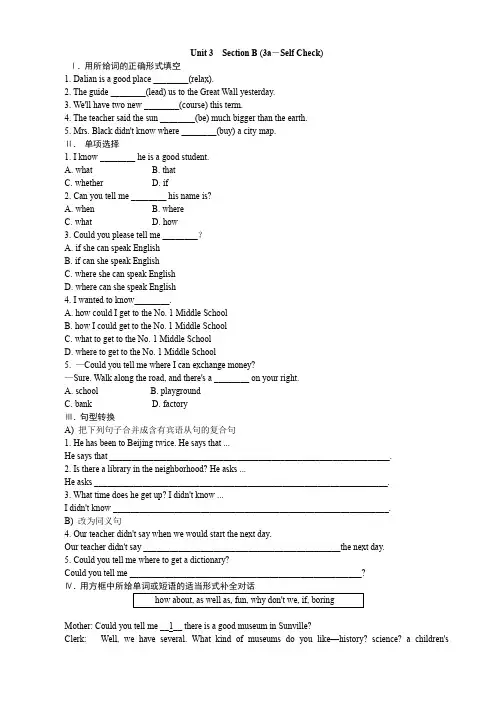
Unit 3 Section B (3a-Self Check)Ⅰ. 用所给词的正确形式填空1. Dalian is a good place ________(relax).2. The guide ________(lead) us to the Great Wall yesterday.3. We'll have two new ________(course) this term.4. The teacher said the sun ________(be) much bigger than the earth.5. Mrs. Black didn't know where ________(buy) a city map.Ⅱ. 单项选择1. I know ________ he is a good student.A. whatB. thatC. whetherD. if2. Can you tell me ________ his name is?A. whenB. whereC. whatD. how3. Could you please tell me ________?A. if she can speak EnglishB. if can she speak EnglishC. where she can speak EnglishD. where can she speak English4. I wanted to know________.A. how could I get to the No. 1 Middle SchoolB. how I could get to the No. 1 Middle SchoolC. what to get to the No. 1 Middle SchoolD. where to get to the No. 1 Middle School5. —Could you tell me where I can exchange money?—Sure. Walk along the road, and there's a ________ on your right.A. schoolB. playgroundC. bankD. factoryⅢ. 句型转换A) 把下列句子合并成含有宾语从句的复合句1. He has been to Beijing twice. He says that ...He says that ________________________________________________________________.2. Is there a library in the neighborhood? He asks ...He asks ___________________________________________________________________.3. What time does he get up? I didn't know ...I didn't know _______________________________________________________________.B) 改为同义句4. Our teacher didn't say when we would start the next day.Our teacher didn't say _____________________________________________the next day.5. Could you tell me where to get a dictionary?Could you tell me _____________________________________________________?Ⅳ.Mother: Could you tell me __1__ there is a good museum in Sunville?Clerk: Well, we have several. What kind of museums do you like—history? science? a children'smuseum?Father: __2__ history? I like history museums. They're fascinating.Girl 1: Oh, Dad! History museums are __3__. Let's go to a science museum.Boy: Science? We always go to science museums. I don't like science museums. I want to go to a children's museum. They're more __4__.Girl 2: Well. I'm too old for a children's museum.__5__ go to an art museum?Clerk: Why don't you go to the computer museum? There are a lot of fun things for children there. You can learn all about the history of computers, __6__ learn about science.Family: That's a great idea! Let's go to the computer museum.1. ________2. ________3. ________4. ________5. ________6. ________Ⅴ. 阅读理解Eating out is more popular in Britain today than it has ever been. It is reported that British people spend more eating out than cooking for themselves and eating at home. It seems that many British people are becoming more and more interested in how good their food tastes, and also how healthy it is.However, eating out can also be expensive, so British people do not eat out every night. When having a date with friends or celebrating a birthday, many people like to go to a restaurant, and people also often eat in a restaurant before going to the cinema or the theater.As in all cultures, there are many rules of manners about eating. The knife and fork should be used in the correct way. It is also impolite to speak with your mouth full when you are eating.Most British cities have a large collection of food as well as British food, from the very cheap to the very expensive—French, Italian, Indian, Chinese, Thai, Japanese and many, many more.When people are too tired to cook after work, they often get a “takeaway”. This means that they order from a takeout restaurant by telephone, and then go to get it. Many takeout restaurants also send it to your house. All you have to do is to open the door, pay and eat!1. When do British people often eat in a restaurant?A. After celebrating a birthday.B. Before watching a movie.C. When they feel tired.D. If they want to have natural food.2. Many people prefer to eat out nowadays because ________.A. eating out is cheaper than cooking at homeB. they can learn more manners in the restaurantC. people care more about their food than beforeD. people don't like to stay at home after work3. From the fourth paragraph,we can learn that ________.A. British dishes are very expensiveB. Japanese dishes are the most expensiveC. British people like foreign foodD. French food is the most popular4. The “takeaway”is the food ________.A. you order and take out of the restaurantB. that is left when you are eating in a restaurantC. you order but don't need to pay at onceD. that is sold and ordered only on the phone5. What is the best title of the passage?A. British Restaurant CultureB. British Table MannersC. Best Restaurants in BritainD. Best Food in Britain参考答案及解析Ⅰ. 1. to relax 2. led 3. courses 4. is 5. to buyⅡ. 1—5 BCABCⅢ. 1. he has been to Beijing twice2. if/whether there is a library in the neighborhood3. what time he got up4. when to start5. where I can get a dictionaryⅣ. 1. if 2. How about 3. boring 4. fun 5. Why don't we 6. as well asⅤ. 1. B细节理解题。
人教版英语九年级unit3 SectionB知识点讲解

eg:He requested some hot water from me.
b.request sb. to do sth.要求/请求某人做某事
eg:I request her to go alone.
c.request+that从句(用虚拟语气,(should)+do)
eg:I request that she (should) go alone.
价格的高低用high/low.
eg:The price of the car is high.
英语中常见的否定前缀有: 1)dis-"不;非"
like→dislike agree→disagree 2)in-(im-,ir-)" 不;非”
expensive→inexpensive polite→impolite possible→impossible 3)un-"不;非" crowded→uncrowded happy→unhappy healthy→unhealthy
everyone__p_o_li_te_ly___.
• request n.&v.要求;请求
1) n.[C] the request for.... ......的要求/请求
eg:We must make a request for help.
2) v.
(提出请求)
a.request sth (from sb.) (向某人)要求某物
(在建筑物内部)
eg:I found a boy crying in the corner of the room.
2)at/on the corner of... 在......拐角处 (在建筑物外部)
人教版英语九年级上册 Unit 3 Section B (3a-self check)

4. Where you will stay Q: Excuse me, do you know where I will stay?
3. A: I want to buy some winter clothes. Could you tell me which place would be a good choice for me to go to?
B: I __su_g_g_e_s_t__ Jenny’s Clothes Store in Century Shopping Mall. It’s convenient to get to. 4. In many countries, it is often not __p_o_l_it_e__ to ask very __d_i_re_c_t___ questions when you meet someone for the first time.
➢To learn to write a letter to ask for information politely you want to know.
What would you say in this situation?
get some money
park a car
buy some stamps
3. shopping center opens / 10:00 a.m. Q: _C_o_u_l_d_y_o_u__t_el_l_m__e_w_h_a_t_t_im__e_t_h_e_s_h_o_p_p_i_n_g_c_e_n_t_er__o_p_en_s_?____ A: __It_o_p_e_n_s_a_t_1_0_:_0_0_a_._m_._.______________________________ 4. get to the Japanese restaurant / go along Main Street and turn right on Lake Street Q: __M_a_y__I_a_s_k_h_o_w__t_o_g_e_t_t_o_t_h_e_J_a_p_a_n_e_se__re_s_t_au_r_a_n_t_?__________ A: _J_u_s_t _g_o_a_l_o_n_g_M__a_in__S_t_re_e_t_a_n_d__tu_r_n_r_ig_h_t_o_n__L_a_k_e_s_t_r_ee_t_._____
人教版英语九年级上Unit 3Section B 单词讲解
12.speaker[可数名词]讲(某种语言)的人;发言者 那个演讲者作了一场精彩的演讲。
The speaker gave a wonderful speech. singer (歌手) writer (作者;作家) inventor (发明家 ) artist(艺术家)
13.whom 是who的宾格形式,作动词或介词的宾语, 在口语或非正式文体中常用who来代替, 但如果紧跟在介词后作宾语时则只能用whom。
②in- (im- , ir-)“不、无” impossible (不可能的) impoite (不礼貌的)
③un-"不、非” unable unlike uncrowded unhappy unhealthy.
3. uncrowded adj. 不拥挤的;人少的 crowded. adi. 拥挤的 crowd v.拥挤
刚才你在和谁说话? Whom/Who were you talking to just now?
= To whom were you talking just now?
14.address 地址
I’ll tell you my address and phone number.
15.underground①.[ 形容词]地下的
8.request 1)n.要求,请求
多指对某事物所提出的礼貌或正式的恳请。 当该词之后接具体内容表示哪方面的请求时,常用介词for与之搭配。
这是有关问路的类似的请求。
These are similar requests for directions. 2)[及物动词]要求;请求常 见用法有: ① request sth. ( from sb.) ( 向某人)请求某事/某物
人教版英语九年级全册Unit3SectionB2a2d优秀教学案例

4.教师根据评价结果,调整教学策略,以满足学生的不同需求,提高教学质量。
四、教学内容与过程
(一)导入新课
1.利用图片、视频等多媒体教学资源,展示与本节课相关的情景,激发学生的学习兴趣,引发学生的思考。
2.学生认真完成作业,检查自己的学习成果,发现不足,及时进行调整。
3.教师批改作业,及时给予反馈和评价,帮助学生提高作业质量。
4.教师根据学生的作业完成情况,了解学生的学习状况,调整教学策略,提高教学质量。
五、案例亮点
1.情景创设:本节课通过展示图片、视频等多媒体教学资源,创建了真实且生动的情景,让学生身临其境。这样的情景创设不仅激发了学生的学习兴趣,还提高了学生的参与度,使得学生能够更好地理解和运用所学知识。
2.学生围绕讨论主题,积极发表自己的观点,进行互动交流,培养团队合作能力。
3.教师巡回指导,关注学生的讨论情况,及时给予反馈和指导,帮助学生解决问题。
4.各小组汇报讨论成果,教师对各组的讨论情况进行评价,给予肯定和鼓励。
(四)总结归纳
1.教师引导学生对所学知识进行总结归纳,梳理知识体系,提高学生的理解能力。
2.学生通过总结归纳,巩固所学知识,形成系统化的认知结构。
3.教师通过提问、讨论等方式,检查学生对所学知识的掌握情况,及时发现并解决学生的学习问题。
4.教师对本节课的学习内容进行简要回顾,强调重点和难点,为学生的复习和巩固提供指导。
(五)作业小结
1.教师布置作业,要求学生运用所学知识,完成相关练习,巩固所学内容。
3.学生通过学习英语,拓宽视野,了解不同的文化,培养跨文化交际的能力。
英语人教版九年级全册Unit 3 Section B
九年级 Unit3第三课时Section B 1a — 2b教学目标1.记忆单词convenient,corner,politely,request,direction,correct,polite,direct,sp eaker,whom,impolite,address,underground。
2.通过听说训练,学习正确地描述地点和指路。
3.运用适当的阅读策略,理解如何礼貌和得体地使用语言。
教学重难点1.掌握描述场所特征的词汇,并能够给理想的场所提建议。
2.学会在不同的语言环境中能够礼貌得体地使用语言。
教具教师提前准备设计教学PPT,电子书等StepⅠ.Lead inLeading in 【情景1】T:Sometimes we may want to go to different places.Because they have different qualities.What kind of places do you like?S1:I like beautiful places.S2:I like interesting and fascinating places.S3:…T:What qualities are important for each place?S4:Safe.S5:…T:Different places have different qualities.[设计意图] 创设真实的语言交际环境,师生交流互动,以对话的方式导入新课,为接下来的训练奠定基础。
Leading in 【情景2】教师提供常见的地点或场所的图片,让学生猜测地点或场所对应的英文名称,引导学生想象可以用于描述这些地点或场所的形容词,然后展开关于地点或场所的对话,导入新课。
T:Look at the first picture.Is it a restaurant?S:No,it isn’t.I think it is …T:What do you think of it?S:I think it is …[设计意图] 利用直观的图片,调动学生的学习积极性,帮助学生复习关于地点或场所的词汇,进行简短的对话,导入新课。
人教版九年级英语全册教学设计:Unit 3 Section B
人教版九年级英语全册教学设计:Unit 3 Section B学情分析教学目标1. 语言知识目标词汇:visit a foreign country, be similar to, spend time doing sthIt’s enough to do sth, It seems adj. to do sth 等重点句型:It is important to know how to ask for help politely.Good speakers change the way they speak in different situations.2. 技能目标: (1)能运用快速略读技巧,了解文章概貌( 2 )能了解在不同场合下如何选择使用适当的语言表达3. 情感目标: 培养学生尊重他人,对人有礼貌,热爱生活。
重难点:1. 教学重点:(1)礼貌的向他人寻求帮助。
(2)正确使用宾语从句。
2. 教学难点:运用宾语从句礼貌的寻求帮助。
教学方法根据本课教学目标和重点内容,教师可采用听,读,小组讨论,角色扮演等活动来引导学生进行学习。
教学资源PPT, handouts, MP3, video …教学过程教学环节教师活动学生活动设计意图Step 1 情景导入上一节课我们学习如何礼Make aconvers在情境中呈现貌地打听信息、问路,你能用英语正确说出从你家到学校的路线吗?请一个同学用英语作一个介绍。
ationaboutaskinginformationpolitely.和操练生词和短语,并在竞赛中进行巩固和练习Step 2 完成教材1a-1e的任务1.要求学生翻开课本P21,迅速浏览1a部分方框中的单词及右边的表格内容。
看一看对每一个地方要有什么重要的品质并把相应的单词写在表格中每个地方相对应的表格中。
Places Qualities1)restroomclean, big2)museuminteresting,beautiful3)restaurantinexpensive,delicious学生尽可能多的用形容词描述一个地点将听、说、读、写的任务结合起来不4)park beautiful,fascinating5)subw ay safe, convenient6)mall big,uncrowded2.先让两位学生分角色朗读1b方框中的对话。
人教版英语九年级全册Unit3 SectionB(2a-2e)优质课教案
Unit3 SectionB(2a-2e)优质课教案requests?While ReadingSkimming:1. How many paragraphs are there in this passage?2. Please underline the topic sentence of each paragraph.Scanning:1. Read the first paragraph and choose the right answer.____sound less polite than ___. (A: Where are the restrooms? B: Could you please tell me where the restrooms are?)2. Guess the Chinese meaning of “direct”?3.引出思维导图:教师引导学生划分段落,画出每段的中心句。
教师引导学生抓关键信息,选择正确选项。
师引导学生猜出“direct”的意思。
教师引导学生理出思维导图的呈现过程。
学生根据阅读提示,划分段落,画出每段的中心句。
学生扫读第一自然段然后选择正确答案。
学生根据教师提示说出答案。
学生理清思维导图的思路。
Tip: The topicsentence isusually the______ orthe______sentence ofeach paragraph.Sometimes it isalso in the____ of theparagraph.目的是引出下面的思维导图。
Tip: Guess fromthe context.思维导图可以帮助学生理清文章思路和结构。
4. Read Para.2 and fill the table. Requests To whomWhen is theschool trip?Excuse me, MrWest. Do youknow when theschool trip is?5. Read Para.2 again and fill in the blanks: Good speakers change the way they speak in different situations. The expressions good speakers use might depend on ______or______.6.进一步完善思维导图:7. Watch a video What polite questions can you hear? 教师引导学生填表格。
英语人教版九年级全册Unit3 Section B Activity2a~2d
英语学科教学设计课题Unit3 Section B Activity2a~2d设计人付玉平教学过程一、课前导入1.学习目标:1)掌握词汇和短语2)整体阅读短文完成2c,2d3) 通过阅读学会如何“礼貌”和“得体”的使用语言2.学习重难点:1)词汇:politely, request, direction, correct, polite, direct, speaker, whom, impolite, address, underground, parking lot, course2)通过阅读学会如何“礼貌”和“得体”的使用语言二、自主学习Find out the phrases from Page21.1.参观外国_________________________2.有礼貌的求助_________________________3.类似问方向的请求________________________4. 听起来不那么礼貌_________________5. 一个很直接的问题_____________________6.正确地提问_______________________7. 在不同场合______________________8. 改变他们说话的方式______________________9.他们使用的表达方式________________________ 10. 取决于,依靠_________________ 11. 向某人直接提问__________________________12.听起来不礼貌___________________ 13.电子邮箱地址____________________14.引入、导入_________________________ 15.有礼貌地说话__________________ 16. 使用恰当的语言________________________ 17.与某人更好的交流__________________________ 18. 打扰一下__________________ 19.地下停车______________________ 20.去乡村学校的路__________________________三、导学释疑1. politely (adv.) “礼貌地;客气地”反义词: ______________polite (adj.) “有礼貌的;客气的;有教养的”反义词:______________我们应该有礼貌地和老人说话。
人教版九年级英语全册优秀教学案例:Unit3SectionB
三、教学策略
(一)情景创设
1.利用多媒体展示杰出人物的事迹,如宇航员、体操运动员等,让学生感受到他们的伟大和励志。
2.创设情境,让学生模拟杰出人物的经历,如模仿宇航员的太空行走、模仿体操运动员的动作等,增强学生的参与感和体验感。
3.通过展示图片、视频等视觉资源,营造生动、直观的学习氛围,激发学生的学习兴趣和想象力。
3.教师简要介绍本节课的主题和目标,为新课的讲授做铺垫。
(二)讲授新知
1.教师引导学生学习本节课的主要词汇和短语,如“Amazing People”, "world-class", "astronaut", "gymnastics", "gold medal"等。
2.通过示例和练习,让学生掌握表示过去时间的状语从句,如"When he was young, he...", "By the time he was..., he..."等。
3.鼓励学生主动寻找答案,通过自主学习、合作讨论等方式,提高解决问题的能力。
4.教师给予及时反馈和引导,帮助学生建立正确的思维模式和价值观。
(三)小组合作
1.划分学习小组,鼓励学生互相合作、互相学习,培养团队精神和集体荣誉感。
2.设计小组讨论任务,如共同完成一篇关于杰出人物的短文、进行角色扮演等,让学生在合作中提高英语运用能力。
人教版九年级英语全册优秀教学案例本案例背景针对人教版九年级英语全册Unit 3 Section B进行设计。该章节以“Amazing People”为主题,通过讲述不同领域杰出人物的事迹,引导学生学习英语语言知识,同时激发学生对榜样人物的敬仰之情,培养他们积极进取的精神风貌。本节课主要内容涉及:1.学习描述人物的基本句型;2.掌握表示过去时间的状语从句;3.提高听力理解能力;4.培养合作、探究学习精神。