
课件:《Unit-4-Why-don't-you-talk-to-your-parents》-7
Pair work
make a dialogue to talk about: If you are Peter, which advice will you choose? Why?
1.You could write him a letter. 2. You should call him up. 3. You should talk to him so that you can
A: Kimi, you look tired. W__h_a_t_’_s_w__r_o_n_g__?
Kimi: I__d_o_n_’t__g_e_t_e_n_o_u_g_h_s_l_e_e_p________. What should I do?
A: W__h_y__d_o_n_’t_y_o_u____ go to bed earlier?
Write a conversation of at least 60 words about your problem and advice
Thank you!
Problem: too much homework Advice: 1)take a break
2)talk to your teacher
A: You look tired.__W__h_a_t_’s__w_r_o_n_g__?
Shi Tou:I have__to_o__m_u_c_h__h_o_m_e_w__o_rk___.
A: Hi , Cindy. You look sad. WW__hh_aa_tt_’’ss__tw_hr_eo_n_mg_a_t_t_e_r__?
[rɒŋ]
Cindy: I have_to_o__m__an_y__a_f_t_e_r_-_s_c_h_o_o_l _c_la_s_s_e_s_.
Problem: don’t get enough sleep Advice: go to bed earlier
Listen and answer
What’s wrong with Peter?
Peter
What’s wrong with Peter? He had a fight with his best friend.
2b. Listen again and circle What advice did Peter’s friend give?
2)eat dumplings 3)try again
A:
_W_h_a_t’_s_w_r_o_n_g________, Angela?
Angela: I don’t like noodles.
A:
_W_h_y_d_o_n_’_t _y_ou__ta_l_k_to__y_ou_r_p_a_r_en_t_s_____?
…… A: _______________.
When we have probems, Please:
Face the problem, solve the problem
Homework
Basic: Do more exercises to practice
how to give some advice. Extensive:
Talk about: 1)What problems do you have? 2)What should you do?
go to the party
A: _____________? B: I ____________. A: Why don’t you____? C: You should ____. D: You could______.
B: _Y_o_u_c_o_u_ld___ eat dumplings.
C:
_Y_o_u_s_h_o_u_ld__ try again.
Problem: had a fight Advice: 1) say sorry
2) call …up 3)go to a movie
……
A: ______________________________ Tian: ______________________________ A: ______________________________ B: ______________________________ C: ______________________________ …….
A:
W__h_y__d_o_n_’_t _y_o_u_ take a break?
B:
W__h_y__d_o_n_’_t_y_o_u__ta_l_k_t_o__y_o_u_r_t_e_a_ch__er_?
Problem: don’t like noodles Advice: 1)talk to your parents
say you’re sorry. 4. You could go to his house. 5. You could take him to the ball game. 6. You should call him up.
Group work ---make a conversation in each group
Unit 4
Why don’t talk to your parents?
Section A 1A-2C
Do you Know them? Cindy Kimi Tian Tian Shi Tou Angela
Think and complete
Problems: too many after-school classes
1. You could write him a letter. 2. Why don’t you forget about it? 3. You should talk to him so that you can say
you’re sorry. 4. You could go to his house. 5. Why don’t you invite him to the party? 6. You should call him up. 7. You could take him to the ball game.
Unit_4_Why_don't_you_talk_to_your_parents___Section_B_2 - 副本
11. stress n.精神压力 Good grades bring stress and pressure to most kids. 12. continue v. 持续 He continued his speech although no one listened to him. 13. compare … with v.比较 It is not right to compare yourself with others.
2. Who gives their opinions about the problems? Linda, Miller and Dr. Alice Green.
Read and circle again, judge T or F. 1. Chinese children have to take so many after-school classes on weekends these days. T 2. Cathy Taylor really wants her three children to be successful, so she believes these after-school activities are important for them. T
1. football n. 美式足球
2. soccer ball 英式足球
4. opinion n. 意见;想法;看法
In my opinion, it’s better not to go. 以我的看法,还是不去好。 5. skill n. 技巧;技艺 Do you have the skill to ski such a difficult slope? 你有沿着这样陡的坡滑雪 的技巧吗?
Unit4why-don't-you-talk-to-your-parents-sectionA-Grammar-Focus-4c
___________better, we need to talk more with our parents. A. Communicate B. Communicating C. To communicate D. Communicated
我起得早,以便于赶公交车
I got up early so that I can catch the bus. I got up early in order that I can catch the bus. I got up early in order to catch the bus.
--It’s to late. I have to go now. -- Oh, it’s raining outside. Don’t leave ________ it stops. A. since B. until C. while D. so ________he has little knowledge, the old worker has a lot of experience. A. Although B. Because C. If D. so
允许某人做某事 allow doing sth 允许做某事 sb be allow to do sth 某人被允许做某事 be allowed 被允许
1.My parents don't allow me _______TV _____school nights. A. watch, in B. to watch, in C. watching, on D. to watch, on
although 表示“虽然,尽管”
unit4-Why-don't-you-talk-to-your-parents全单元知识点和练习
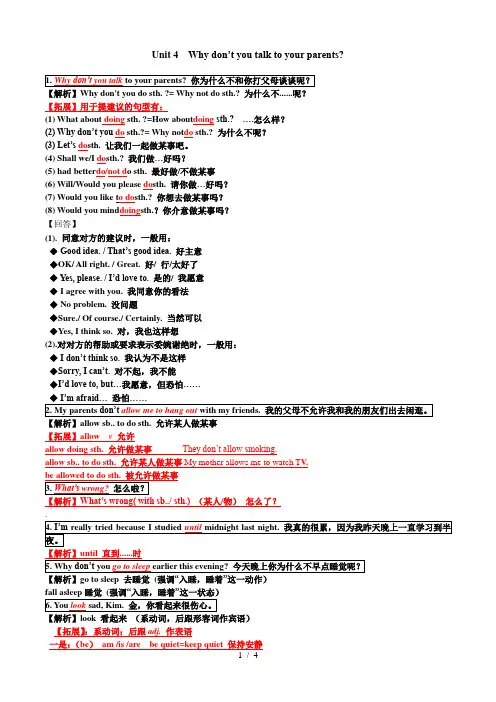
Unit 4 Why don’t you talk to your parents?1.Why don’t you talk to your parents? 你为什么不和你打父母谈谈呢?【解析】Why don't you do sth. ?= Why not do sth.? 为什么不......呢?【拓展】用于提建议的句型有:(1) What about doing sth. ?=How about doing sth.? ….怎么样?(2) Why don’t you do sth.?= Why not do sth.? 为什么不呢?(3) Let’s do sth. 让我们一起做某事吧。
(4) Shall we/I do sth.? 我们做…好吗?(5) had better do/not d o sth. 最好做/不做某事(6) Will/Would you please do sth. 请你做…好吗?(7) Would you like t o do sth.? 你想去做某事吗?(8) Would you mind doing sth.?你介意做某事吗?【回答】(1). 同意对方的建议时,一般用:◆ Good idea. / That’s good idea. 好主意◆OK/ All right. / Great. 好/ 行/太好了◆ Y es, please. / I’d love to. 是的/ 我愿意◆ I agree with you. 我同意你的看法◆ No problem. 没问题◆Sure./ Of course./ Certainly. 当然可以◆Yes, I think so. 对,我也这样想(2).对对方的帮助或要求表示委婉谢绝时,一般用:◆ I don’t think so. 我认为不是这样◆Sorry, I can’t. 对不起,我不能◆I’d love to, but…我愿意,但恐怕……◆ I’m afraid… 恐怕……2.My parents don’t allow me to hang out with my friends. 我的父母不允许我和我的朋友们出去闲逛。
Unit4-Why-don't-you-talk-to-your-parents优质课课件

第二十九页,编辑于星期四:九点 三十八分。
1b Listen and circle the
problems you hear in 1a.
第三十页,编辑于星期四:九点 三十八分。
1. I have to study too much so I don’t get enough sleep.
2. I have too much homework so I don’t have any free time to do things I like.
your parents?
I have too many after-school classes.
第十一页,编辑于星期四:九点 三十八分。
What’s wrong with you?
第十二页,编辑于星期四:九点 三十八分。
Why don’t you talk to your teachers?
I had a fight with my best friend. What should I do?
Well, you …
第三十七页,编辑于星期四:九点 三十八分。
2d Role-play the conversation.
You look sad, Kim What’s wrong?
Well, I found my sister
3. My parents don’t allow me to hang out with my friends.
4. I have too many after-school classes.
5. I got into a fight with my best friend.
第三十一页,编辑于星期四:九点 三十八分。
unit4-Why-don27t-you-talk-to-your-parents全单元知识点和练习

Unit 4 Why don’t you talk to your parents【解析】Why don't you do sth. = Why not do sth. 为什么不......呢【拓展】用于提建议的句型有:(1) What about doing sth. =How about doing sth. ….怎么样(2) Why don’t you do sth.= Why not do sth. 为什么不呢(3) Let’s do sth. 让我们一起做某事吧。
(4) Shall we/I do sth. 我们做…好吗(5) had better do/not d o sth. 最好做/不做某事(6) Will/Would you please do sth. 请你做…好吗(7) Would you like t o do sth. 你想去做某事吗(8) Would you mind doing sth.你介意做某事吗【回答】(1). 同意对方的建议时,一般用:◆ Goo d idea. / That’s good idea. 好主意◆OK/ All right. / Great. 好/ 行/太好了◆ Yes, please. / I’d love to. 是的/ 我愿意◆ I agree with you. 我同意你的看法◆ No problem. 没问题◆Sure./ Of course./ Certainly. 当然可以◆Yes, I think so. 对,我也这样想(2).对对方的帮助或要求表示委婉谢绝时,一般用:◆ I don’t think so. 我认为不是这样◆Sorry, I can’t. 对不起,我不能◆I’d love to, but…我愿意,但恐怕……【解析】allow sb.. to do sth. 允许某人做某事【拓展】allow v 允许allow doing sth. 允许做某事They don’t allow smoking.allow sb.. to do sth. 允许某人做某事My mother allows me to watch T V.【解析】What’s wrong( with sb../ sth.) (某人/物)怎么了【解析】go to sleep 去睡觉(强调“入睡,睡着”这一动作)这一状态)【解析】look 看起来(系动词,后跟形容词作宾语)【拓展】:系动词:后跟adj.作表语一是:(be)am /is /are be quiet=keep quiet 保持安静二保持:stay/keep (表示持续状态)stay healthy=keep healthy 保持健康三变化:become/get/turn (表示状态变化)【解析】call up (v + adv) call on 拜访;号召【解析】find sb.. doing sth. 发现某人正在做某事Mr. Wang found Li Dong reading a storybook in the class.类似动词:hear,watch, see, feel【解析】be angry with sb.. 生某人的气【拓展】angry adj.生气的→ angrily adv. 生气地(1)be angry with sb.. =be mad at sb.. 对某人生气【with后接人】(2)be angry at/about sth.对某事感到生气【at后接事】(3)be angry to do sth. 做某事感到生气10. It’s not a bi g deal. 没什么大不了;不是什么大事(常用于口语中)You left your homework at home. 你把作业忘在家里了。
Unit-4-Why-don't-you-talk-to-your-parents--sectionA-4课时教案

Unit 4 Why don’t you talk to your parents?Analysis of the Teaching MaterialThe topic of this unit is about advice. In this unit, students will learn how to talkabout problems and give advice. The teaching in this unit is divided into two parts.Section A and Section B. the former part intends to make students involved in thelearning activities while the later focuses on deepening the learning result.Teaching aims:Knowledge aims:1.Master the key words and phrases:allow,wrong,guess,deal,work out, get on with, relation,communication,argue,cloud,elder,instead,whatever,nervous,offer,proper,secondly,explain,clear,copy,return,anymore, member,pressure,compete,opinion,skill,typical,cut out,continue,compare,compare…with,crazy,push,development,cause,usual, perhaps2. Master the key sentences:①---What’s wrong?---I’m really tried because I studied until midnight last night.②You could give him a ticket to a ball game.③I think you should ask your parents for some money.④Why don’t you talk to him about it?Ability aims:1.Be able to talk about problems and give advice using “Why don’tyou…”.2.To improve students’ ability of listening, speaking, reading andwriting.3.To improve students’ ability of communication.4.To improve students’ ability of integrating skills.Moral aim:To be able to realize other people’s feeling in communication. Teaching important points:1.To master the key vocabulary and target language in this unit.2.Be able to talk about problems and give advice using “Why don’tyou…”.Teaching difficult points:1.Be able to talk about problems and give advice using “Why don’tyou…”.2.To improve students’ ability of listening, speaking, reading andwriting.Teaching methods:Multimedia method, groupwork, cooperative discussion.The first periodSection A (1a-1c)Teaching Aims:Knowledge aims:1)Master the key words and phrase:allow, wrong, What’s wrong?, midnight.2) Master the target language:①—What’s wrong?—I’m really tried because I studied until midnight last night.②Why don’t you go to sleep earlier this evening?Ability aims:1.Learn to talk about problems and give advice.2.Cultivate students’ listening and speaking skills.Moral aim:Learn to work with others; learn to face the problems in our life. Help others.Teaching important points:1) Talk about the problems.2) Learn the new language points.Teaching difficult point:Talk about the problems and give advice.Teaching methods:Practice, speaking and listening methodTeaching aids:A tape recorder, a projectorTeaching procedures:Step 1. Warming upShow some pictures on the screen and ask:What’s the matter / What’s wrong?S:He has too much homework to do.T:Does he like to do it?S1:No,he doesn’t. Because he doesn’t have any free time to dothings he likes.…Step 2. PresentationShow the new words on the screen, read the new words and ask students to repeat. Make sure that students understand the meanings of them.Step 3. TalkingSay:In our daily life there are always many problems. Look atthese problems. Do you think they are serious or not?Students discuss with their partners and try giving some advice,they can usethe words could, should and shouldn’t.①I have to study too much so I don’t get enough sleep.②I have too much homework so I don’t have any free time to do things I like.③My parents don’t allow me to hang out with my friends.④I have too many after-school classes.⑤I got into a fight with my best friend.Point out the heading in the box to the class. Tell students serious problem is a very bad problem.Ask students to write the problems in the serious or not serious columns.Finally, check the answers.Step 4. ListeningTell students to read the sentences in 1a again. Make sure they know the meaning of the sentences.Play the recording for the students to listen and circle the problems you hear in 1a.Play the recording again. Check the answers with the students.Step 5. Pair work1. Let students read the conversation in the box.2. Have students work in pairs, use the information in 1a to make otherconversations.3. In the end, ask several pairs of students to act out their conversations.e.g. A: What’s wrong?B: I’m really tied because I studied until midnight last night.A: Why don’t you go to sleep earlier this evening?Step 6. Language pointsShow some language points on the screen, explain to the class.1) allow v. 允许;准许allow sb. (not)to do sth. (不)允许某人做某事e.g. My parents don’t allow me to stay up late.我父母不允许我熬夜。
Unit4-Why-don't-you-talk-to-your-parents课件
1. I have to study too much so I don’t get enough sleep. 得到足够的睡眠
2. I have too much homework so I don’t have any free time to do things I like.
3. My有p空ar闲e时nt间s d干o某n事’t allow me to hang out
8.Today Tom has too ____ homework to do.
much
第15页,共49页。
Unit 4 Why don’ t you talk to
your parents?
第16页,共49页。
1.关系,联系 relation 2.交流 communicate
3.和睦相处 get on with
第20页,共49页。
Problems
Advice
1.I can’t get on well with 1. Why don’t you talk
my family
about these feelings
2.Parents fight a lot. with your family?
3.My elder brother is not
4.云朵 cloud
5.争吵 argue
6.年级较长的 elder
7.代替 instead 8.任何,每一 whatever
9.焦虑的
nervous
11.恰当的
proper
13.解释,说明
10.主动提供
12.第二,其次 14.清楚的
offer
secondly
15.浏览
新目标人教版英语八年级下册《Unit 4 Why do not you talk to your parents?》单元主题阅读与写作课件
relax ourselves. Fourthly, we should try our best to study hard and learn to face our grades bravely. Fifthly, if we have too much stress, we'd better see a doctor.
How to deal with our stress
Advice
Effect
Take more part in
Help us to (1)_h_a_v_e_a__h_e_a_lt_h_i_er__b_o_d_y
exercise.
and study better.
Talk with(2)_o_u_r_t_e_a_c_h_e_r_s, We can (3)_g_e_t _s_o_m_e__u_s_ef_u_l_a_d_v_i_c_e _p_a_r_e_n_ts__o_r_f_r_ie_n_d_s______ from them.
about our trouble.
(4)_L__is_t_e_n_t_o_m__u_s_i_c_o_r___ Help us relax ourselves. ___r_e_a_d_b_o_o_k_s_.________ Try our best to study hard and (5)_le_a_r_n__to__fa_c_e__o_u_r_g_r_a_d_e_s_b_r_a_v_e_l_y__.
列纲
①I'm not tall and I'm not good-looking. ②My parents can't understand what I do and say. 提出问题 I have few friends at school. ③I have too much pressure in study. I have few afterschool activities.
Unit-4-Why-don’t-you-talk-to-your-parents教材分析
Unit 4 Why don’t you talk to your parents?教材分析I.单元教材分析:本单元的话题(Topic)是“Interpersonal communication(人际交往)”。
功能项目(Functions)是“Talk about problems (谈论困难);Give advice (提出建议)。
本单元主要探讨当代中小学生所面临的种种压力和困境。
学会询问、陈述自己或他人的困难和麻烦;并针对别人的困境,使用情态动词could,should 以及Why don’t you...?句型提出解决的办法和建议;阅读文章Maybe You Should Learn to Relax,通过学习比较了东西方家长对子女教育的态度和做法,通过该部分学习,让学生学会换位思考,帮助他们逐步建立正确、积极的生活态度和价值观。
II.学情分析:本单元话题是人际交往,这个话题与学生实际生活紧密相关,主要探讨当代中小学生所面临的种种压力和困境,并针对针对这些问题给予合理地建议。
重点学习用What’s wrong?询问他人的麻烦;学习用What should I do?征求别人的建议;学习使用情态动词could,should以及Why don’t you...?句型提出解决的办法和建议;学习使用连词until,so that,although。
在Unit1已经学习力用What’s the matter with...?询问病情,其中也涉及了What’s wrong的学习,对于学生来说,已是比较熟悉的句型;而在前几个单元中,逐步学习了情态动词should,could表示建议,相信学生掌握起来也很容易;学习连词until,so that,although的用法,是本单元的重点也是难点,教师要多举例子,让学生真正明白状语从句的使用。
III.教学目标1.知识目标:A.掌握以下词汇:allow,wrong,midnight ,guess,deal,relation,communication,argue,cloud,elder,instead,whatever,nervous,offer,proper,secondly,communicate,explain,clear,copy,return,anymore,member,pressure,compete,opinion,skill,typical,football,quick,continue,compare,crazy,push,development,cause,usual,perhaps。
unit4-Why-don't-you-talk-to-your-parents公开课教案
Unit 4 Why don’t you talk to your parentsSection A 1a—1c一、教学目标:1. 语言知识目标:1) 能掌握以下单词:allow, wrong能掌握以下句型:①—What’s wrong?—I have to study too much so I don’t get enough sleep.②I have too much homework so I don’t have any free time to do things I like. ③My parents don’t allow me to hang out with my friends.④Why don’t you talk to him about it……2. 能力目标(1)能够运用所学知识谈论问题和困难、提出建议并做出选择;(2)能根据对方所提出的问题,给出一些合理的建议。
3. 情感态度价值观目标:培养学生良好的合作意识,鼓励学生大胆表达自己的想法和意愿。
正确认识生活中的一些困难,能采用正确的方式解决生活中的问题。
二、教学重难点1) Talk about the problems.2) Learn the new language points.2. 教学难点:能根据对方所提出的问题,给出一些合理的建议。
学会表达建议的一些方式。
三、教学过程Step 1 Revision复习上单元的内容,老师可适当带出句型why don’t you…/What’s the matter?Step 2 Presentation1. 导入学生们平时在学校和生活中存在的问题。
T: What’s the matter/ What’s wrong?S: He has too much homework to do.hat'sT: Does he like to do it?S1:No, he doesn’t. Because he doesn’t have any free time to do things he likes.Step 3 Talking1. Look at these problems. Do you think they are serious or not? Ss discuss with their partners and give some advice.①I have to study too much so I don’t get enough sleep.②I have too much homework so I don’t have any free time to do things I like. ③My parents don’t allow me to hang out with my friends.④I have too many after-school classes.⑤I got into a fight with my best friend.Step 4 PracticeShow them some pictures about the problems,then ask some students to read them,and give someadvice.T: What’s the matter/ What’s wrong?S: He has too much homework to do.T:What should he do?S: He should talk to his parents.Step 5 ListeningStep 6 Pair work1. Show them some pictures then ask them to make some sentences..2. Let some pairs act out their conversations.eg. A: What’s wrong?B: I have to study too much, so I don’t get enough sleep.A: Why don’t you go to sleep earlier this evening?Step 7 Make a survey;Ask your classmates about his or her problems and what kind of advice can you give,then complete the chart.Step8 SummaryStep9 HomeworkWrite three conversations about your problems and your friends’ suggestions.A: I have too many after-school classes.What should I do?B: You should …。