
2020中考英语语法专题复习延续性和短暂性动词
用法:
1、它们可以用于完成时态,说明某个动作的结
果还存在.
e.g. He has come back.
The film has begun.
2、这类动词不能和表示一段时间的状语连
用,如for,since和how long短语。但在否 定句中,非延续性动词也可以用表示一段时间 的状语来修饰.
e.g. I haven’t heard from Uncle Wang for a long
4.open ------ be open
close ------ be closed
5.join ------ be in leave (…) ------ be away (from)
6.fall asleep ------ be asleep die ------ be dead
巩固练习:(同义转换,每空一词)
非延续性动词可以转换成延续性动词,主要
有以下几种:
1.buy ------ have
borrow ----- keep
e here ------ be here go there ------be there
3.begin/start ------ be on
finish ------ be over
8.Tom borrowed this book four days ago.
Tom _h__a_s_ _k_e_p__t_ this book _f_o__r_ four days. Tom __h_a__s _k__e_p_t_ this book s_i_n_c__efour days ago.
My father has been awGuacyheng My father hfarsombeen awGauycheng 3.The factoryfroopmened in 1996.
The factory has been otpeennyefaorrs. The factory has beesninocep1e9n96.
last wseinekc.e a weekf.or
4. His grandfather died five years ago.
His grandfather has beesnince
fi.ve years ago
His grandfather dhaesadbeen dfievaedyefaorsr.
My son _h_a_s__b_e_e_n__a_s_l_e_e_pfor _h_a__lf_ _a_n___h_o_u__r_. My son _h_a_s__b_e_e_n__a_s_l_e_e_psince _h_a__lf_ _a_n___h_o_u_r__a_g__o__.
The dog has died for 3 years. 错 The dog has been dead for 3 years. He has come here since 2 hours ago.错 He has been here since 2 hours ago. He has borrowed the book for 2 years.错 He has kept the book for 2 years
time.
We haven’t seen him since 1992.
3、还可改用一般过去时来表达.
e.g. He came back a week ago.
4、也可用“It is ﹢一段时间﹢since…”句型 来表达.
e.g. It is a week since he came back.
9. Jim joined the League last year.
Jim __h_a_s_ _b_e__e_n__in___ the League _s_i_n_c_elast year. Jim _h_a__s_ _____ a League member __f_o_r_ a year.
10.
The film has befeonr on The film has beseincoe n
. ten mtie.nnutmesinutes
ago
7. My father bought a new car two years ago.
My father _h__a_s_ _h_a_d__ a new car _f_o_r__ two years. My father __h__a_s_h__a_d_ a new cars_i_n_c_e_ two years ago.
5. Mr. Wang reached Beijing five days ago.
Mr. Wang has beeBneiinjing fivesdinacyseago. Mr. Wang has beeBneiinjing five dfoayrs.
6. The film began ten minutes ago.
1.Li Lei joined the Party three years ago.
Li Lei has betheenPainrty three yseianrcseago. Li Lei has betheenPainrty three yefaorsr.
2.My father left Gucheng last week.
TTThhheeebyyyeh__ce__haan__mav__eve__et__ob__Cb__e__hee__ienn__an__it__nei__nn__yCCehhaiirnnsaaas__gfi__noo__.cr__e__
ten ten
yearБайду номын сангаас. years ago.
11. My son fell asleep half an hour ago.
短暂性动词 和
延续性动词
短暂性动词也称做终止性动词、非延续性动词 或瞬间动词,表示动作不能延续,只是一瞬间就 结束的动作.
常见的短暂性动词有:come, go, arrive, reach, see, hear, close, open, leave, begin, start, lose, buy, fall, join, die, become, borrow, get up等.
延续性动词和短暂性动词笔记

延续性动词表示能够延续的动作,这种动作可以延续下去或产生持久影响。
如:learn, work, stand, lie, know, walk, keep, have, wait, watch, sing, read, sleep, live, stay等。
终止性动词也称非延续性动词、瞬间动词或短暂性动词,表示不能延续的动作,这种动作发生后立即结束。
如open, close, finish, begin, come, go, arrive, reach, get to, leave, move, borrow,buy等。
Come-be hereGo – be thereleave→be away,borrow→keep,buy→have,begin/start→be on,die→be dead,move to→live in,finish→be over,join→be in/be a member of,open sth.→keep sth. open,fee l ill→be ill,get up→be up,catch a cold→have a col dcome here --- be here,go there --- be there,become --- be,come back --- be back,fall asleep --- be asleep,get to/ arrive/reach --- be (in),leave --- be away from,get to know --- know,go (get) out →be out,put on→ wear;例:The old man died 4 years ago.----The old man has been dead for 4 years.---- It is 4 years since the old man died.---Four years has passed since the old man died.He joined the Party 2 years ago.-----He has been in the Party for 2 years.I bought the book 5 days ago.---- I have had the book for 5 days.补充练习:1. When he arrived at the bus stop, the bus ________ for 20 minutes.A. has leftB. had leftC. has been awayD. had been away2. I ______ the League for 5 years so far.A. joinedB. have joinedC. have been in3. The factory ________ since the February of 1988.A . has been open B. has opened C. was open D. opened4. Mary and Rose _______friends since they met in 2000.A. have madeB. have beenC. madeD. have become5.You mustn't ________ until he comes back.A. be awayB. leaveC. be left6.The meeting _______ for a week now.A. has finishedB. has endedC. has been over7.Miss Gao ______ this school for nearly 5 years.A. has been inB. has come toC. has taught8.Ben ______ a teacher for 4 years .A. has beenB. has becomeC. wasD. became9. I ______ home for a week.A. have returnedB. have been backC. returned10. How long _______ he ________ ?A. diedB. has, diedC. has, been dead11. ----- How long can I ______ the book? ------ Two weeks.A. borrowB. lendC. getD. keep12.He ________ the car for a week.A. boughtB. has boughtC. has had13.-----How long _____ you _____ ill ? -----Two weeks.A. did fallB. have, fellC. have, been14.Since 2000, he _____ his hometown.A. has leftB. has moved awayC. has been away from15.I'll lend you the book , but you can only _____ it for 2 days.A. borrowB. keepC. take16.The bus ______ on the road for 2 hours so far.A. has stoppedB. stoppedC. has been17.Are you _____ the jacket these days?A. wearingB. putting onC. dressingD. on18.He ________ for 2 hours.A. got upB. has got upC. has been up19. Tom is ill in hospital. He _______ a cold for several days.A. isB. catchesC. has caughtD. has had。
延续性动词与短暂性动词讲解与练习
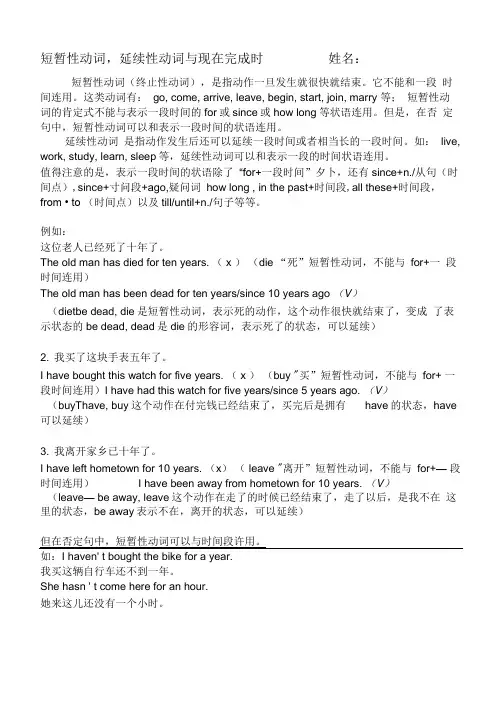
短暂性动词,延续性动词与现在完成时姓名:短暂性动词(终止性动词),是指动作一旦发生就很快就结束。
它不能和一段时间连用。
这类动词有:go, come, arrive, leave, begin, start, join, marry 等;短暂性动词的肯定式不能与表示一段时间的for或since或how long等状语连用。
但是,在否定句中,短暂性动词可以和表示一段时间的状语连用。
延续性动词是指动作发生后还可以延续一段时间或者相当长的一段时间。
如:live, work, study, learn, sleep等,延续性动词可以和表示一段的时间状语连用。
值得注意的是,表示一段时间的状语除了“for+一段时间”夕卜,还有since+n./从句(时间点),since+寸问段+ago,疑问词how long , in the past+时间段,all these+时间段,from • to (时间点)以及till/until+n./句子等等。
例如:这位老人已经死了十年了。
The old man has died for ten years. ( x )(die “死”短暂性动词,不能与for+一段时间连用)The old man has been dead for ten years/since 10 years ago (V)(dietbe dead, die是短暂性动词,表示死的动作,这个动作很快就结束了,变成了表示状态的be dead, dead是die的形容词,表示死了的状态,可以延续)2. 我买了这块手表五年了。
I have bought this watch for five years. ( x )(buy "买”短暂性动词,不能与for+ 一段时间连用)I have had this watch for five years/since 5 years ago. (V)(buyThave, buy这个动作在付完钱已经结束了,买完后是拥有have的状态,have 可以延续)3. 我离开家乡已十年了。
延续与短暂动词
一、延续性动词和终止性动词的概念英语中,动词按其动作发生的方式、动作发生过程的长短,可分为延续性动词和终止性动词。
延续性动词表示能够延续的动作,这种动作可以延续下去或产生持久影响。
如:learn, work, stand, lie, know, walk, keep, have, wait, watch, sing, read, sleep, live, stay等。
终止性动词也称非延续性动词、瞬间动词或短暂性动词,表示不能延续的动作,这种动作发生后立即结束。
如open, close, finish, begin, come, go, arrive, reach, get to, leave, move, borrow, buy等。
二、延续性动词的用法特征1.延续性动词可以用于现在完成时,其完成时态可与表示"段时间"的状语连用。
表示"段时间"的短语有:for two years, during the past three years, since last year, how long 等。
如:I have learned English since I came here.自从我来到这儿就学英语了。
2.延续性动词不能与表示短暂时间的"点时间"状语连用。
如:It rained at eight yesterday morning.(误) rain为延续性动词,而at eight表示"点时间",前后显然矛盾。
如果用延续性动词表示一瞬间的动作,可以借助come, begin, get等终止性动词来表示。
上句可改为:It began to rain at eight yesterday morning.(正)又如:-When did you get to know Jack?-Two years ago.-Then you've known each other for more than two years.-That's right.三、终止性动词的用法特征1.终止性动词可用来表示某一动作完成,因此可用于现在完成时。
短暂性动词和延续性动词

巩固练习:(同义转换,每空一词)
1.Li Lei joined the Party three years ago.
Li Lei has been in the Party since three years ago.
Li Lei has been in the Party for three years. It’s three years since Li Lei joined the Party. Three years has passed since Li Lei joined the Party.
用法: 1、它们可以用于完成时态,说明某个动 作的结果还存在. He has come back. The film has begun. 2、这类动词不能和表示一段时间的状语 连用,但在否定句中,非延续性动词也 可以用表示一段时间的状语来修饰. I haven’t heard from Uncle Wang for a long time. We haven’t seen him since 1992.
7. My father bought a new car two years ago. for My father _____ has _____ had a new car _____ two years. My father _____ since has _____ had a new car _____ two years ago. 8.Tom borrowed this book four days ago. Tom _____ this book _____ for four has ______ kept days. since four Tom _____ ______ this book _____ has kept days ago.
延续性动词和短暂性动词笔记
延续性动词表示能够延续的动作,这种动作能够延续下去或产生持久影响。
如:learn, work, stand, lie, know, walk, keep, have, wait, watch, sing, read, sleep, live, stay等。
终止性动词也称非延续性动词、瞬间动词或短暂性动词,表示不能延续的动作,这种动作发生后立即结束。
如open, close, finish, begin, come, go, arrive, reach, get to, leave, move, borrow,buy等。
Come-be hereGo – be thereleave→be away,borrow→keep,buy→have,begin/start→be on,die→be dead,move to→live in,finish→be over,join→be in/be a member of,open sth.→keep sth. open,fee l ill→be ill,get up→be up,catch a cold→have a col dcome here --- be here,go there --- be there,become --- be,come back --- be back,fall asleep --- be asleep,get to/ arrive/reach --- be (in),leave --- be away from,get to know --- know,go (get) out →be out,put on→ wear;例:The old man died 4 years ago.----The old man has been dead for 4 years.---- It is 4 years since the old man died.---Four years has passed since the old man died.He joined the Party 2 years ago.-----He has been in the Party for 2 years.I bought the book 5 days ago.---- I have had the book for 5 days.补充练习:1. When he arrived at the bus stop, the bus ________ for 20 minutes.A. has leftB. had leftC. has been awayD. had been away2. I ______ the League for 5 years so far.A. joinedB. have joinedC. have been in3. The factory ________ since the February of 1988.A . has been open B. has opened C. was open D. opened4. Mary and Rose _______friends since they met in 2000.A. have madeB. have beenC. madeD. have become5.You mustn't ________ until he comes back.A. be awayB. leaveC. be left6.The meeting _______ for a week now.A. has finishedB. has endedC. has been over7.Miss Gao ______ this school for nearly 5 years.A. has been inB. has come toC. has taught8.Ben ______ a teacher for 4 years .A. has beenB. has becomeC. wasD. became9. I ______ home for a week.A. have returnedB. have been backC. returned10. How long _______ he ________ ?A. diedB. has, diedC. has, been dead11. ----- How long can I ______ the book? ------ Two weeks.A. borrowB. lendC. getD. keep12.He ________ the car for a week.A. boughtB. has boughtC. has had13.-----How long _____ you _____ ill ? -----Two weeks.A. did fallB. have, fellC. have, been14.Since 2000, he _____ his hometown.A. has leftB. has moved awayC. has been away from15.I'll lend you the book , but you can only _____ it for 2 days.A. borrowB. keepC. take16.The bus ______ on the road for 2 hours so far.A. has stoppedB. stoppedC. has been17.Are you _____ the jacket these days?A. wearingB. putting onC. dressingD. on18.He ________ for 2 hours.A. got upB. has got upC. has been up19. Tom is ill in hospital. He _______ a cold for several days.A. isB. catchesC. has caughtD. has had。
短暂动词与延续性动词
短暂(duǎnzàn)动词与延续性动词短暂(duǎnzàn)动词与延续性动词1.现在(xiànzài)完成时的构成:have / has + 动词(dòngcí)的过去分词2.现在(xiànzài)完成时的用法:(1)表示某一动作或状态开始(kāishǐ)于过去并持续到现在现在。
(此种用法适用于延续性动词)I have been in Nanyang for around 5 years.我在南阳(nán yánɡ)大约有五年了。
(2)表示过去发生或已经完成的某一动作对现在造成的影响或结果(此种用法适用非延续性动词)。
I can’t go to see the movie now, because I have lost the ticket.现在我看不成电影了,因为我把票弄丢了。
3.现在完成时的标志:just, already, yet, ever, never,recently 近来 = in recent weeks (months, years)在最近的几周(月,年)里,nowadays, for + 一段时间,before (用于句子末尾); so far = up to now = till now; since + 过去某一具体时间点,since + 过去的一段时间 + ago, since + 一般过去时从句,ever since then = ever since = since then = since (自从那时起);in / over /during + the + past(last) + 一段时间。
Eg.On January 11,1998, Dr. Kataria organized the first “World Laughter Day” celebration in Mumbai, India. It was a huge success.The date was later changed to the first Sunday in May and it has been celebrated every year since.4.现在完成时中的特殊用法:短暂动词(dòngcí)的各种时态(包括现在完成时在内)不能和时间段连用(liányòng),当它需要与时间段连用时需转换为延续性动词。
英语知识 _ 初中英语,延续性动词和瞬间性动词的用法
一、延续性动词延续性动词,表示的动作不但可以延续,而且可以产生持久的影响。
常见的这类动词有:b e,h a v e,ke e p,k n o w,l e a r n,l i e,l i v e,re a d,s i n g,s l e e p,s t a n d,s t a y,w a i t,w a l k,w a tc h等。
延续性动词的用法很广,但常见于现在完成时中的句子中,且常与f o r,h o w,l o n g,s i n c e 等引导的表示一段时间的状语或状语从句连用。
例如:I h a v e l e a r n e d m o re t h a n1000C h i n e s e w o rd s s i n c e I c a m e t o C h i n a.自从来到中国,我已经学会了l千多个汉字。
I h a v e ke p t t h e p i c t u re f o r a b o u t t h re e y e a r s.。
这张画我保存了大约三年二、瞬间性动词瞬间性动词,又称为终止性动词或非延续性动词,它表示的动作不能延续,也就是说动作一旦发生就立即结束,并产生某种结果。
常见的这类动词有:a c c e p t,a r r i v e,b ec o m e,b e g i n,b o r ro w,b re a k,b u y,c a tc h,c l o s e,c o m e,d i e,e n d,f a l l,f i n i s h,g e t,g i v e,g o,j o i n,l e a v e,p u t,re a c h,re c e i v e,sh u t,s t a r t,s t o p等。
用在现在完成时要注意下面三点:①瞬间性动词可直接用来表示某一动作的完成。
例如:T h e y h a v e re a c h e d S h a n g h a i.他们已经到达了上海。
初中英语中短暂性动词与延续性动词的用法
初中英语中短暂性动词与延续性动词的用法英语中,按动词延续的时间长短,可将动词分为延续性动词和短暂性动词。
延续性动词如learn, study, work, play, wait等。
短暂性动词是非延续性动词,即动作一开始便结束的动词,又可称结束性动词,瞬间动词,如come, go, begin, start, become, join, end, die, buy, arrive, reach, borrow, lend, get to know等。
一.短暂性动词与延续性动词在现在完成时中的用法:现在完成时中用法(一):表示发生在过去,迄今已经完成,并对现在产生影响或产生结果的动作,常用ever, yet, already, just等状语,谓语动词既可是延续性动词,也可是短暂性动词。
如:She has just borrowed the book from the library.(borrow是短暂性动词)I have learned a little about Japanese. (learn 是延续性动词)现在完成时中用法(二):表示始于过去某时并一直延续到现在的动作或状态,常与表示始于过去某一时刻并一直延续到现在的时间状语连用。
如:They have lived in Nantong since 1990. (live 是延续性动词)Mr. Black has worked here since he came to China.(work 是延续性动词)I have learned English for two and a half years.(learn 是延续性动词)所以,在现在完成时中用法(二)中,在表示持续一段时间的句子中,应将短暂性动词转化为相同意义的延续性动词或状态动词。
初中英语中常见的有:例如:1. His grandfather has died for ten years.(F)His grandfather has been dead for ten years.(T)2. My brother has joined the army for five years.(F)My brother has been in the army for five years.(T)My brother has been an armyman for ten years.(F)3. He has gone away for a week.(F) He has been away for a week.(T)4. The film has begun for fifteen minutes.(F)The film has been on for fifteen minutes.(T)但是,短暂性动词的现在完成时的否定形式可以表示一种延续的状态,因此可以和表示一段的状语连用。
延续性动词和短暂性动词
例子
学习
需要一段时间来掌握知识和技能 。
工作
通常指一段时间内从事某种职业或 任务。
等待
表示在一段时间内保持某种状态或 期望某事发生。
与短暂性动词的区别
短暂性动词表示的动作或状态持续时 间较短,如“看”、“听”、“摸” 等。
例如,“看”是一个短暂性动词,表 示瞬间完成的动作,而“学习”是一 个延续性动词,表示需要一段时间来 完成的动作。
延续性动词和短暂 性动词
contents
目录
• 延续性动词 • 短暂性动词 • 延续性动词和短暂性动词的使用场景 • 延续性动词和短暂性动词的转换 • 练习与巩固
01
CATALOGUE
延续性动词
定义
01
延续性动词表示的动作或状态持 续时间较长,如“学习”、“工 作”、“等待”等。
02
延续性动词强调动作或状态在一 段时间内的持续性,而不是瞬间 的完成。
延续性动词转换为短暂性动词
睡觉:醒来
抽烟:抽一口 写作:写完
学习:学会 游泳:游过
延续性动词转换为短暂性动词
开车:开一下
唱歌:唱一段
01
02
03
看书:看一眼
喝咖啡:喝一口
04
05
穿衣服:穿一下
短暂性动词转换为延续性动词
离开:逗留 来/去:停留在
结婚:与某人相处
短暂性动词转换为延续性动词
死亡:生活过 到达:在某地待一段时间
示例
我喜欢(看/看过)电影。在这个句子 中,正确的动词形式是“看”,因为 它是一个表示动作的延续性动词。
造句练习
造句练习
根据给定的主题或提示,使用正确的动词形式造句。
示例
英语语法专题——短暂性动词与延续性动词
常用短暂性动词与延续性动词的转换1. borrow keep have kept2. get to know know have known3. catch a cold have a cold have had a cold4. buy / get have have had5. die be dead have been dead6. open be open have been open7. close be closed have been closed8. get married be married have been married9. fall ill be ill have been ill 10. fall asleep be asleep have been asleep 11. leave sp. be away from sp. have been away from sp. 12. return be back have been back 13. go to bed be in bed have been in bed 14. go to sp./come to sp. Be in sp. have been in sp. 15. come here be here have been here 16. go there be there have been there 17. go out be out have been out 18. get upbe uphave been up19. start/ begin be on have been on20. finish/ end be over have been over21. become be have been22. join be a member of have been a member ofbe in have been in23.begin / start be on have been on24.arrive be here/there/in ... have been here/there/in...25.put on wear 或be on have worn / have been on瞬时动词语法要点:我们以最常用的瞬时动词go为例,将相关知识点进行梳理如下。