
新目标七年级上册Unit1 Section B 2
写作指导: 注意人称代词要用his, his first name,… 信息中有他所在的学校, 你能表达出这个 信息吗?挑战一下自己吧!
示例: His first name is ____________________ Harry. His last name __________________________________ is Potter. His phone number is __________________________________ 88142010. He is in No. 1 Middle _________________________________. School.
It’s 678-3215.
10. 你姓什么? 我姓布朗。
What’s your last name? Brown.
4. 写出句子。注意标点和大写字母。 1) is, what, his, name, last, (?) What is his first name? ____________________________________ 2) name, is, her, Grace, first, (.) Her first name is Bruce. ___________________________________ 3) her, what, phone, is, number, (?) What is her phone number? __________________________________ 4) is, your, this, number (?) Is this your number? _________________________________ 5) Brown, her, is, friend, Eric(.) Her friend is Eric Brown. _________________________________ is, friend, Bill, your (?) Is your friend Bill?/Is Bill your friend? _________________________________
first name last name 6. 名字 ________ 5. 姓氏 __________ in China 7. 在中国 __________ phone number 8. 电话号码 __________ 9. 你的电话号码是多少? 是678-3215。 What’s your phone number?
1. Write out the numbers. two zero 120 one ____________ 114 one ____________ one four 119 _____________ one one nine 10086 ______________________ one zero zero eight six 12315 ______________________ one two three one five 17951 ______________________ one seven nine five one
七、完成句子,每空一词(10分) 八.根据图片和上下文补全下列对话, 每空一词。(10分) 九. 读写综合(本大题分AB两部分,共 15分) A)归纳信息 仔细阅读下面的短文,按 信息卡内容填入相关信息.(本部分共5 小题,每小题1分,共5分) B).书面表达(10分)
Jack Bush 397-4391
Bill Smith 328-6731
3a 用学生卡上的信息完成句子。
PEP Middle School First Name: Alice . . Last Name: Green
Phone Number: 951-3397.
Alice Her first name is ________. Her last name is ________. Green Her phone number is ____________. 951-3397
写作指导: 根据提示信息,可以介绍一下自己的名字, 姓氏,及电话号码,如果有性别的可以写 出性别。 还可以说一下自己朋友的名字。可以用 *** is my friend. 的句子结构。 示例:
My first name is ____________________ Zhuangzhuang. __________________________________ My last name is Li. My phone number __________________________________. is 345-789. Wu Dong is my friend.
用英语说出下列电话号码及词组 或句子。
1. 357-9231________________________ three five seven nine two three one eight six zero two one five seven 2. 860-2157________________________ four seven nine three six eight 3. 479-3683 _______________________ three nine six one two seven three six 4. 961-2736 _______________________
第四课时
测标 1-5 C C A B B 6-8 C C C B 课后巩固提升 2)1-5 C E A B D
考试题型
一. 听力理解(20分) 二.单项填空 (15分) 三. 完形填空 (10分) 四.阅读理解 (30分) 五. 单词辨音(请选出划线部分字母读音 不同的一个单词)(5分) 六. 根据音标写单词,将句子补充完整。 (5分)
5. 看图完成对话。
A: ______________________? What’s your first name B: My first name’s Francisco. A: _____________________? What’s your last name B: Miller. What’s your telephone number A:___________________________? B: It's 3344668.
第三课时
前测 1. My name is Jim Green. 2. Nice to meet you, too. 3. What is her name? 4. The ruler is red. 5. What’s this in English.
测标: 1.What 2.I 3.meet 4.her 5.first,last 6.His st 课后巩固提升 1-4 A A C D 5-8 B A A A
Gina Brown 234-1679
Mary Miller 763-8623
2) I’m Jack Bush. My phone ______ _______ is 397number
4391. My friend _______ is Bill Smith. ___ast name ____ is ________. Smith His phone number is ___________. 3286731
3b
填写你的学生卡并写几句 话介绍自己。
(照片)
First Name: __________ Last Name: __________ Phone Number: __________
My first name is _____________________ _______________________________________ _______________________________.
6. 介绍照片中的你和你的朋友。 1) My name’s Mary Miller. My _______ phone number is 763-8623. My friend is Gina Brown. _____ Her _____ first name is Gina. Her _____name ____ last is Brown. Her ______ ______ is 234-1679. phone number
2. 将句子配对,组成对话。
1. Hello. I’m Cindy. C A. I’m Chen Kang. 2. What’s your name? A B. It’s 876-9548. 3. Hello. I’m Grace. E C. Nice to meet you, Cindy. 4. My name’s Eric. D D. Nice to meet you, Eric. 5. What’s his I’m Bill. telephone number? B E. Hi, Grace. I’m Alice.
人教版人教新目标七年级英语上册课件 Unit1 section B (共47张)
My name's Gina
Section B
Goals 学习目标
1.复习并熟练掌握数字0-9的英文表述。
2.掌握一些常用数字(如 110,121,119,114,
120等)的实际意义。
3.填写通讯录。
one
two
three
four
five
0
six
seven
eight
nine
zero
Eric Brown Gina Smith Dale Miller Zhang Mingming Jenny Green Mary Brown
2c Match the names with the telephone numbers. Then find three pairs of friends.
563-2945
794-5862
027-6461
779-1649
228-8649
— What’s your phone number?
—It’s ...
62350889
学缘网:
学缘网:
1c
询问和回答电话号码。
Group work
Motorbike number
No.01688
What’s the car number?
It’s B-1-2-3-4-5.
card number? What’s the ID ______
330 302 1987 0804 6521
姓名
性别
李**
男
住址 **市高新区 ** 路22号
编号 330302198708046521
A: What's the number? B: The number is...
Unit 1 Section B(2a-2c)教案2022-2023学年人教版英语七年级上册
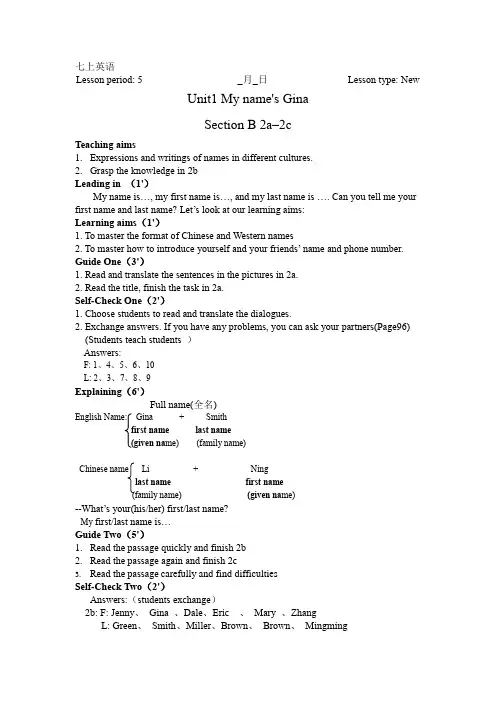
七上英语Lesson period: 5 _月_日Lesson type: NewUnit1 My name's GinaSection B 2a–2cTeaching aims1.Expressions and writings of names in different cultures.2.Grasp the knowledge in 2bLeading in (1')My name is…, my first name is…, and my last name is …. Can you tell me your first name and last name? Let’s look at our learning aims:Learning aims(1')1. To master the format of Chinese and Western names2. To master how to introduce yourself and your friends’ name and phone number. Guide One(3')1. Read and translate the sentences in the pictures in 2a.2. Read the title, finish the task in 2a.Self-Check One(2')1. Choose students to read and translate the dialogues.2. Exchange answers. If you have any problems, you can ask your partners(Page96) (Students teach students )Answers:F: 1、4、5、6、10L: 2、3、7、8、9Explaining(6')Full name(全名)English Name: Gina + Smithfirst name last name(given na me) (family name)Chinese name Li + Ninglast name first name(family name) (given na me)--What’s your(his/her) first/last name?--My first/last name is…Guide Two(5')1.Read the passage quickly and finish 2b2.Read the passage again and finish 2c3.Read the passage carefully and find difficultiesSelf-Check Two(2')Answers:(students exchange)2b: F: Jenny、Gina 、Dale、Eric 、Mary 、ZhangL: Green、Smith、Miller、Brown、Brown、Mingming2c: FriendsJenny Green and Gina SmithDale Miller and Eric BrownMary Brown and Zhang MingmingExplaining(1')in+China (国家名首字母大写)Guide Three(4')Read the passage aloud, find the sentence structureSelf-Check Three(3')1. Show chinese meaning in 2b on the screen,let some students say in English2. Ask some students to summarize sentence structure3. Fast students try to reciteSummary(1')1. the format of Chinese and Western names2. 4 sentencesBlackboard DesignUnit1 My name's GinaSection B 2a–2cFull name(全名)1、English Name: Gina + Smithfirst name last name(given na me) (family name)Chinese name Li + Ninglast name first name(family name) (given na me)2、in+China (国家名首字母大写)Test(10')练习册P10Ⅰ-ⅣIntrospection。
人教新目标英语七年级上册unit1全单元导学案(无答案)

人教新目标英语七年级上册导学案课型:New(1) 课题:Unit 1 My name's Gina. Section A:(1a—1c)一、教学目标: 掌握介绍自己和问候他人的句型:What’s your name?My name’s Gina.Nice to meet you! Nice to meet you, too.二.教学重难点:1. 如何询问别人的姓名及向别人作自我介绍。
2.my 与I 的区别。
三.课前预习练习:(一).写出所缺的字母:1. n i __ e2. wh __ t3. y __ u r4. na __ e5. h __ l __ o6. c __ p7. j __ __ k __ t8. r __ l __ r9. o __ __ n __ e 10. k __ y(二). 翻译:1.我的_________ 2. 名字_________ 3. 你们的___________ 4. 遇见_________ 5. 令人愉快的__________ 6. 什么__________ 7. 我___________ 8.你的名字_______________9. 你的名字叫什么?_________________________10. 我的名字叫辛蒂。
_________________________11.见到你很高兴。
___________________________12. 你好,我是戴尔。
_________________________四.课堂合作与研讨:1.根据要求完成1a.2.听录音独立完成1b.3.根据要求完成1c.五.归纳总结1.my 与I 的区别:my 意为“我的”,是形容词性的物主代词,在句子中充当定语,修饰名词;I意为“我”,是主格代词,在句中充当主语,其后面的be动词用am.如:I am a boy. My name is Bob. 我是一个男孩,我的名字叫鲍勃。
人教版英语七年级上册教案:Unit1SectionB(1a-1f)
T: Good morning, everyone. My name is Peter. What’s your name, please?
S1: My name is Lily.
T: Hello, Lily. Nice to meet you!
—It's…
②—What's your first/last name?
—My first/last name is…
③—What's his/her first/last name?
—His/Her first/last name is…
3) 能辨别英文中的姓氏与名字,了解中英文中姓名之间的区别。
S1: Nice to meet you, too.
T: And what’s your name?
S2: My name is…
2. Revision
Part one:
T: S1, what's his name?
S1: His name is …
T: S2, what’s her name?
S2: Her name is …
Let the Ss look at 1a, then play the tape.
Ss listen and repeat the numbers.
2.听中的活动设计遵循语言规律,由易到难逐层递进,充分体现语言输入到语言输出的完整过程。
3.听后的活动设计体现对文本内容的深度挖掘和文本再构,体现了对学生思维品格的训练与培养。
附:教学活动设计
步骤
过程
措施(教师活动与学生活动)
人教版新目标英语七年级上册unit1全单元课件(共89张PPT)
Grammar
人称代词:
I you
he she it we they
我 你\你们 他
她 它 我们
他们
形容词性物主代词:
My your his her its our their
我的 你、你们的 他的 她的 它的 我们的 他们 的
人称代词主格做主语 ,常用于句首。
形容词性物主代词 形容词性物主代词起形容词作用,它后
Hello! My name is Bingo. Nice to meet
you!
Hello, I’m Jack. What’s your name?
My name is Jane.
询问别人名字的时候可以说: What’s your name?
介绍自己姓名的时候既可以用 I’m…也可以用My name is …。 I’m Gina. = My name is Gina.
Well begun is half done. Go for it, boys and girls! You can do it
Gramm一般疑问句)
Yes, he is.
(肯定回答)
No, he isn't.
(否定回答)
His name's Mary. (补充说明)
Are you Ms. Miller? Yes, I am. / No, I'm not. 4. This is a ruler.
Is this a ruler? Yes, it is. / No, it isn't.
Exercises: 对划线部分提问
1. My name's Gina. __W_h_a__t'_s __y_o_u_r_ name?
七年级英语上册Unit1《Myname’sGina》教案人教新目标版

Unit 1 My name is Gina.Language goals:In this unit students learn to introduce themselves, greet people and ask for andgive telephone number.New languages:What’s your name? My name is /I’m …Hello! I’m … /Hi! I’m …Nice to meet you!What’s his name? His name is …What’s her name? Her name is …What’s her family name?What’s her first name?What’s your phone number?Difficult points:1. How to introduce yourself and greet people in the right way.2. I mprove the students’ reading, listening, speaking a nd writing skills.3. The difference between Chinese names and English names. Teaching aids:computer, recorder, colorful chalkTeaching periods:Period 1: Section A 1a /1b /1c /2a /2b /2c/ Grammar FocusPeriod 2: Section A 3a /3b /4Period 3: Section B 1a /1b /2a /2b /2cPeriod 4: Section B 3a /3b /3c /4 / Self checkPeriod 1Teaching aims:1. Memorize the words on page1and page2.2. Learn the target languages:My name is Gina.What’s your name?Hello! I’m Mary.Hi! I’m Jim.What’s his name?What’s her name?3. Train the listening and speaking skills.Teaching procedure:Step 1 Free talkLet students talk in pairs using the sentences they’ve learned in Starter or ask some questions in Starter, have students answer them. For example: Good morning/afternoon/evening!How are you?What’s this in English?What color is it?Step 2 Section A 1aThis activity tests students’ vocabulary.1. Draw student’s attention to the pictures. Point to an object in it andask what it is. Say, now look at the pictures and write down as many words as you can2. Ask two students to write the words on the blackboard.3. Check the students’ answers. Ask some students to call out their wordsand spell them. Write down the words on the board.Step 3 Section A 1bThis activity gives students practice in understanding the target language in spoken conversation.Read the instruction to the students. Make sure the students understand how to do it. Say, now listen and number the conversations 1-3.(1) Play the recording for the first time. Students only listen.(2) Play the recording a second time. Students number the conversations.(3) Check the answers together.Step 4 Section A 1cThis activity provides guided oral practice using the target language.(1) Ask three pairs to read the conversations in 1b. If necessary, ask studentsto repeat the names after the teacher.(2) Have students work in pairs to practice the conversations.(3) Say, Now use your own names when you have conversations .Move around theroom monitoring their work. Offer language or pronunciation support asneeded.(4) Let several pairs come to the front of the class and act out theirconversations.Step 5 Section A 2aThis activity gives students practice in understanding the key words andtarget languages.1. Point to a boy and a girl. Say, His name is---, her name is--- Have studentsunderstand the meaning of his and her.2. Read the instruction to the students.3. Play the recording for the first time. Students only listen.4. Play the recording a second time. Students number the pictures 1-4.5. Check the answers.Step 6 Section A 2bThis activity provides listening practice.(1) Have one student read the names in the box.(2) Say, listen to the four conversations again.This time circle the names you hear.(3) Students listen and circle the names.(4) Check the answers.Step 7 Section A 2cThis activity provides guided oral practice using the target language.(1) Call attention to the two conversations in the box.Ask one pair to act out the first one. Tell them to use their own names.Ask another pair to act out the second one.Have them point to a boy or a girl when they ask the questions:What’s his name/What’s her name?(2) Let students work in pairs to practice the two conversations. As studentswork, move around the classroom, monitoring the conversations andoffering assistance if necessary.(3) Have several pairs of students present their conversations to the class. Step 8 Grammar Focus(1) Divide the class into two groups to say the questions and responses.(2) Write down the full forms and contractions of the words on the right.Have students compare them. Then ask them to say the sentences in two ways. Step 9 Conclusion(1) Learn the words and phrases.(2) Master the target languages:My name is Gina.What’s your name?Hello! I’m Mary.Hi! I’m Jim.What’s his name?What’s her name?Step 10 Homework(1) Learn the words by heart.(2) Practice the conversations in 1b and Grammar Focus.(3) Do some preparing.Period 2Teaching aims:1. Memorize the words and phrases: first, first name, last, last name, boy, girl2. Learn about first name and last name.3. Train writing and speaking skills.Teaching procedure:Step 1 Revision1. Go over the words in last class. (Play a game. Divide the class into twogroups: boys and girls. Give them three minutes to read and write the words.Then look at the Chinese meaning on the cards. See which group can say andspell the words more quickly and correctly. )2. Ask students to make conversations about introduction and greeting. Step 2 Section A 3aThis activity introduces the western concept of first name and last name.1. Write down a Chinese name and an English name on the board. For example:Deng Yaping and Jim Smith.2. Ask students to discuss the names. Encourage them to tell the differencebetween them. (English names are listed with the given name first and thefamily name or surname second. While Chinese names are listed with thefamily name first and given name second.)3. Ask some students to say their family names and first names.4. Have two students read the list of names in the box. Say, Guess, whichnames are first names and which are last names?5. Ask students to write F for first name and L for last name next to thewords. Students do the exercise by themselves.6. Check the answers.Step 3 Work in pairs(1) Call attention to the picture on the right. Students look at the pictureand the sentences carefully. Have them pay attention to what the teacherwrites.(2) Have two students read the conversations in the picture aloud.(3) Ask students to work in pairs.Ask and answer about their first names and last names.Step 4 Section A 3bThis activity provides guided oral practice using the target language.(1) Point to the names in 3a.( You can write more names on the board.)(2) Say, Which names would you like to choose as your first name and lastname? Now choose your names.(3) Have students take turns to ask and answer the questions (using theirnew names):What’s your first name?What’s your last name?Students make a list of names.Then exchange their lists to correct any mistake they make.Step 5 Section A 4 (Game)This activity gives students an opportunity to practice target language in an interesting way.1. Demonstrate the game with three students.2. Say, Now in groups of four, play the game. As they work, move around theclassroom making sure students understand the procedure and correcting anymistake.3. Ask two groups to present their games to the class.Step 6 Conclusion(1) Learn the words and phrases in this class.(2) Grasp the target languages:What’s your first name?What’s your last name?Step 7 Homework(1) Memorize the words and phrases.(2) Make a conversation about asking for first name and last name.(3) Prepare next lesson.Period 3Teaching aims:1. Memorize the words on page4.2. Target languages:What’s your phone number?It’s …3. Train the listening and speaking skills.Teaching procedure:Step 1 Free talkLet students work in pairs. Make conversations using the target languages they’ve learned. For example:What’s your name? My name is …What’s his name? His name is …What’s her name? Her name is …What’s your first name?What’s your last name?Step 2 Section B 1aThis activity learns the numbers from 0 to nine.(1) Write the numbers 0-9 on the board. Ask who can say them in English.Encourage more students to read them.(2) Play the recording for the first time. Students only listen.(3) Play the recording a second time. Have students repeat the numbers.(4) Give students two or three minutes to read and write the mummers. Thenhave some students say them quickly and ask if anybody can spell them.Cheer for the students who do best.Step 3 Section B 1bThis activity gives students practice recognizing the numbers 0-9 in spoken telephone numbers.Say, Now listen to the conversation, and write down the telephone number you hear.(1) Play the recording for the first time. Students only listen.(2) Play the recording a second time.Have students write the numbers in the blank.(3) Check the answers.(4) Work in pairs and practice the conversation.Step 4 Section B 1cThis activity gives students speaking practice using the target language.(1) Call attention to the conversation on the right. Have two students read it.(2) Practice the conversation in pairs.(3) Say,Now in groups of three or four, make up conversations using any phonenumber you like .As they work, move around the room monitoring their work.Offer language or pronunciation support as needed.(4) Let several pairs come to the front of the class to perform theirconversations for the class.Step 5 Section B 2aThis activity provides listening practice with the target language.1. Call attention to the names and the numbers in the box.2. Read each one to the class or ask some students to read them.3. Point to the blanks in the four telephone numbers. Say, The phone numbersaren’t finished. You need to write the last two numbers later. Now listenand match the names with the telephone numbers.4. Play the recording for the first time. Students only listen.5. Play the recording a second time Students write the letter of the person’stelephone number in the space after that person’s name.6. Check the answers.Step 6 Section B 2bThis activity gives students practice recognizing the spoken numbers 0-9.(1) Say, Now let’s listen to the conversations again and finish each telephonenumber.(2) Students listen and fill in the missing numbers.(3) Check the answers.(4) If have time, have students repeat the telephone number after the recording.(5) Practice the four conversations in pairs.Step 7 Section B 2cThis activity provides guided oral practice using the target language.(1) Call attention to the address book. Ask one student,“What’s your phone number?” Write his/her name and phone number inthe address book.Make sure all the students understand how to fill in the address book.(2) Say, Now ask your four classmates their phone numbers and fill in theform.Step 8 Conclusion(1) Learn the numbers 0-9.(2) How to asking for phone number:What’s your phone number?It’s …Step 9 Homework(1) Remember the numbers from 0 to 9.(2) Make two conversations.(3) Do some preparing.Period 4Teaching aims:1. Memorize the words and phrases on page2. How to ask for first names/last names/phone numbers.3. Train speaking and writing skills.Teaching procedure:Step 1 Revision1. Go over the numbers in last class.Ask the students to read and spell numbers from 0-9.2. Talk about phone numbers.Step 2 Section B 3aThis activity reviews about first name and last name.1. Say, Look at the picture. How many cards can you see?Can you read the names on the card?2. Ask four students to read the names on each card. Then say,“Which is first name and which is last name? Do you know?”3. Point out the blank line following each first name in the exercise.Say, Write each person’s last name in the blank after the first name.4. Students finish the exercise individually.5. Check the answers.Step 3 Section B 3b & 3cThis activity provides speaking and writing practice using the target language.(1) Point to the ID card. Say, Look at the girl on the card. What’s hertelephone number? What’s her family name? What’s her first name?(2) Have students work in pairs and answer the three questions.(3) Check the answers.(4) Say, Look at the ID card in 3c. This is your card. Write your own firstname, last name, and telephone number on it.(5) As students work, move around the room checking progress.Step 4 Section B 4This activity gives students an opportunity to practice target language ina game.Read the instruction to the class. Make sure all the students know how to do it. Move around the room monitoring their work. Offer language or pronunciation support as needed.。
人教新目标英语七年级上册Unit 1 Section B随堂练习题(有答案)
人教新目标英语七年级上册Unit 1 Section B(20分钟50分)Ⅰ. 根据句意及首字母提示完成单词(5分)1. Four and four is e_______ .2. Cindy Brown is my f_______ .3. My p_______ number is 382-4767.4. His f_______ name is Bob.5. Beijing is in C_______ .Ⅱ. 单项选择(5分)1. _______ is a last name.A. EricB. MaryC. GreenD. Helen2. This is_______ ID number.A. aB. anC. /D. you3. Frank Smith_______ his name.A. amB. areC. /D. is4. —_______ ? —It’s 436-5859.A. What’s thisB. How are youC. What’s your telephone numberD. What color is it5. Her name is Mary Brown. Brown is her_______ name.A. lastB. firstC. fullD. middle Ⅲ. 完成句子(10分)1. 你好!我是迈克。
_______ !_______ Mike.2. 见到你很高兴。
Nice_______ _______ you.3. 他姓史密斯。
_______ _______ name is Smith.4. 他的电话号码是498-3697。
His_______ _______ is 498-3697.5. 我朋友上中学。
My_______ is in a_______ school.Ⅳ. 句型转换(10分)1. My name’s Jenny. (改为同义句)_______ _______ Jenny.2. Her first name is Mary. (对画线部分提问)_______ _______ first name?3. is, what, phone, his, number(? )(连词成句)_______ _______ _______ _______ _______ _______4. He is my friend. (改为一般疑问句并作否定回答)_______ he_______ friend? _______ , he_______ .5. My last name is Green. My first name is Mary. (连成一句话)My name is _______ _______ .Ⅴ. 看图完成对话(10分)1. A: Hello! I’m Cindy.B: _______ _______ .2. A: Hi! _______________?B: My name’s Mary.3. A: Nice to meet you!B: _______ _______ .4. A: What’s her name?B: _______ _______ .5. A: Is he Jack?B: _______ _______ .Ⅵ. 阅读理解(10分)Hello, boys and girls! My name is Alice Brown. Alice is my first name. Brown is my last name. I’m from the U. S. A. . Now I’m in a middle school in Beijing. Look at this picture of me. I have brown hair (头发) and I’m in red.My telephone number is 010-********. I have a good friend. Her name is Linda.1. ___2. ___3. ___4. ___5.___人教新目标英语七年级上册Unit 1 Section B答案(20分钟50分)Ⅰ. 根据句意及首字母提示完成单词(5分)1. eight2. father3. phone4. first5. ChinaⅡ. 单项选择(5分)1-5 CBDCAⅢ. 完成句子(10分)1. Hello I’m2. to see3. His family4. phone number5. friend middleⅣ. 句型转换(10分)1. I am2. What’s her3. What is his phone number4. Is your No isn’t5. Mary Green Ⅴ. 看图完成对话(10分)1. I’m Eric2. What’s your name?3. Me too4. He’s Mike.5. Yes, he is.Ⅵ. 阅读理解(10分)1. girl2. 010-********3. red4. brown5. Linda。
人教版新目标英语七年级上册 __Unit1_My_name’s_Gina_Section B 2
2b
Read the message and match them with the pictures.
Circle the first names and underline the last names.
A.
B.
C.
1. My name is Jenny Green. My phone number is 281-9176. My B friend is Gina Smith. Her phone number is 232-4672. 2. I’m Dale Miller and my friend is Eric Brown. His telephone C number is 357-5689. My telephone number is 358-6344. 3. My name is Mary Brown. My friend is in China. Her name is A Zhang Mingming. My phone number is 257-8900 and her number is 929-3155.
2a
Read the list of names.Write F for first name and L for last name.
1.Alan F 2.Green L
6.Jack F 7.Smith L
ler L
8.Brown L
4.Mingming F 9.Zhang L 5.Gina F 10.Mary F
first name
last name
first name
Mr Green Mrs Green Helen Green
____Green Jim
人教版英语七年级上册Unit1 SectionB(2a-2c)优质课教案
Unit1 SectionB〔2a-2c〕优质课教案Analysis of the teaching material:This unit’s language goal is to let students learn how to introduce yourself, greet people and ask for and give telephone numbers. This period serves as the reading of the unit. In this part, Students are presented with first names and last names and they should be able to tell the difference between English names and Chinese names. And for the telephone number, they should be able to read them correctly and quickly. Besides the material on the book, I will present some more pictures to attract them. Analysis of the students:Students are quite familiar with most names and it won't be difficult for them to say them aloud. They will be presented with more names and numbers to consolidate their knowledge. Guided properly, they should also be able to write a piece of composition about their friends including their first name, last name, telephone number and so on. Teaching method:Communicative teaching method;Task-based teaching methodTeaching aid:A multi-media classroom will be employed to help improve the teaching efficiency and make the learning more interesting.Teaching aims:1.Know ledge aimsStudents are expected to identify first names and last names;2.Ability aimsStudents will practice their spoken English by talking about their friends.Students are expected to use scanning to finish activity 2b and 2c on page 5.3. Emotional aimsStudents' team spirit will be improved through the pair work and group work. Important points:Help students know and tell first name and last name and master the method of reading—scanning.Difficult points:Get students to tell the difference of names between English and Chinese.Teaching procedures:Step 1 Greetings and revisionGreet students and revise the numbers we have learnt last period.Intention:课前跟学生进展日常的口语问候并且复习已经学过的数字,通过“Can you say?〞这个小游戏来活泼课堂的气氛,带动学生的学习热情。
初中英语新人教版七年级上册Unit 1 Section B 知识点(2024秋)
七年级英语上册Unit1 SB知识点1.She even speaks some Chinese! 她甚至会说一些中文!【用法详解】(1) speak为动词,译为“会说(某种语言);说话;发言;演讲;谈话”;后面可以接某种语言,也可以用“speak to sB.”的结构表示“和某人谈话”Eg: She can speak English. 她会说英语。
The baby can’t speak. 这个婴儿不会说话。
I want to speak to your father.我想要和你父亲谈话。
(2) some通常用于肯定句中,在否定句和疑问句中则用any。
【知识拓展】(1)Speak可以用“May/ Can I speak to ..., please?”句式来表示电话用语,译为“请让...接电话好吗?”Eg: -- Hello! Can I speak to Mary, please? 你好!请让玛丽接电话好吗?-- This is Mary speaking. 我就是玛丽。
\(2)some可以作形容词,译为“一些;某些”,用来修饰可数名词复数或不可数名词。
Some也可作代词,译为“有些;有的”,用来指代可数名词复数或不可数名词。
Eg: I have some books. 我有一些书。
-- I don’t have any books.我没有书。
I have a few pencils.Some are black and some are reD. 我有一些铅笔,一些时黑的,一些是红的。
【易混辨析】speak、tell、say与talk区别:Say“讲;说”,指用语言表达思想,侧重于所说的具体内容Speak“讲;说;发言”,侧重讲话的动作,后面常接某种语言Talk“谈话”,指双方之间的相互交谈,后面常接介词to/with/about常见结构:talk with/ to sB. “和某人交谈”;Talk about sth. “谈论某事”Tell“告诉”,既注重说话的内容,又有告诉的对象。