
外研版七年级英语下册模块1知识点归纳
10.get on the bus 上公交车 11.in a hurry 匆忙地 12.hundreds of 成百的 13.leave sth +地点把某物留在某地 14.every day每天 15.at the moment 在此刻 16.such as例如 17.help sb. to do sth 帮助某人做某事
5. how far 距离多远 例如: how far is it from here? 距离这多远?
努力学习
2
报效祖国
学校:
年级:
班级:
姓名:
注意: it is a 5 minutes ’s walkhferorem. -------how far is it from here? 6. how soon 多久之后 用于将来时,常有 in+ 时间段 作为时间状语 例如: I will be back in 3 days -----------how soon will you be back?
上,火车上,公交车上和出租车上。
1) leave 当 “离开 ”讲, leave A for B 离开 A 地动身前往 B 地。
2) leave 当 “落下 ”讲。例如: I left my homework at home. 我把作业落在家 了。
3) on planes 乘“飞机 ”还有其他的说法。 “ by plane=take a plane=on a plane
努力学习
1
报效祖国
学校:
年级:
班级:
姓名:
2.Pleasebe careful withyour things from now on. 从现在开始 请 仔细 看管你的东 西。
1)be careful with 小心对待 例如: Be careful with your baby when you are traveling. 当你旅行的时候,小心照 顾好你的小孩。 2) from now on 从现在开始 作为时间状语,一般用在现在时和将来时态中。 例如: He will work hard from now on. 从现在开始,他将努力工作。 from then on 从那时开始 作为时间状语 一般用在过去时态中 例如: He lived alone from then on. 从那时起,他就独自居住。
theirs 他们的
物主代词的用法: (1)形容词性物主代词放在名词前作定语。例如:
His pencil box is on the desk.
This is our school. (2)名词性物主代词作名词用
本身就相当于“形容词性物主代词 +名词”,因此,后面不可再加名词。 作主语: Richard ’ s school bag is blue anmdine is black. 里查德的书包是蓝色的,我的书包是黑色的。 (mine=my school bag )
5.look at 看 6.from now on 从现在开始 7.be careful with sth 小心对待某物
欢迎使用本资料,祝您身体健康、万事如意,阖家欢乐。愿同学们健康快乐的成长。早日为祖国的繁荣昌盛奉献自己的力量
8.talk to sb 与某人交谈 9.look for 寻找 欢迎使用本资料,祝您身体健康、万事如意,阖家欢乐。愿同学们健康快乐的成长。早日为祖国的繁荣昌盛奉献自己的力量
7. how often 表示动作的频率 例如: I take the medicine 3 times a day. ---------how often do you take the medicine.
(二 )名词性物主代词 物主代词分为形容词性物主代词和名词性物主代词两种。 形容词性物主代词 放在名词前作定语,相当于形容词; 名词性物主代词 相当于“形容词性 物主代词 +名词”,相当于名词,可以作主语、表语或宾语。
Who do you want to meet ? 你想遇到谁?
3. when and where 对时间和地点提问, “何时何地 ” 例如: when and where shall we meet? 我们何时何地见面?
4. how long 时间多久 例如: how long will you stay in Beijing? 你将在北京待多久?
3. People often lose things when they
’ re trawvehleinngthoer y ’ rien a hurry. 当人
们在旅行或是Biblioteka 匆忙的时候,他们经常会丢东西。1) when 当…时候,用于引导时间状语从句,表示主从句的动作同时发生。 例如: We have lessons when it is September.九月份的时候我们开学。
学校:
年级:
班级:
姓名:
基础义务教育资料
欢迎使用本资料,祝您身体健康、万事如意,阖家欢乐!愿同学们健康快乐的成长。早日为祖国的繁荣昌盛奉献自己的力量。
外研社七年级英语下册 模块 1 Lost and found 知识点归纳
知识点一:模块 1 的 短语
1. lost and found 失物招领 2.welcome back to school欢迎回校 3.first of all 首先 4.a lot of=lots of 许多 欢迎使用本资料,祝您身体健康、万事如意,阖家欢乐。愿同学们健康快乐的成长。早日为祖国的繁荣昌盛奉献自己的力量
知识点三: 重点词语解释 1.Welcomeback to school, everyone欢. 迎 大家回到学校。
v. 欢迎 welcome to school 欢迎来到学校 welcome home 欢 迎 回 家 Welcome back! 欢迎回来
adj. 受欢迎的。例如: He is a kind boy, so he is welcome.他是个和蔼的男孩, 所以他很受欢迎。
数 人称
单数
复数
物主代词形容词性
第一人称 第二人称
my 我的 your 你的
our 我们的 your 你们的
第三人称 his 他的, her 她的, its 它的
their 他们的
数 人称
单数
复数
物主代词名词性
第一人称 第二人称
mine 我的 yours 你的
ours 我们的 yours 你们的
第三人称 his 他的, hers 她的, its 它的
试比较下面两句句子:
This is a photo of mine. 这是我的一张照片。 (照片是我拥有的,但不一定照的是我本人) This is a photo of me. 这是一张我本人的照片。 (照片上是我本人)
努力学习
3
报效祖国
18.many other things 许多其他东西
知识点二:模块 1 的 句型
1.Welcome back to school, everyone欢. 迎大家回到学校。 2.Pleasebe careful with your things from now on. 从现在开始请仔细看管你的东 西。 3.Whose gloves are they?它们是谁的手套? People often lose things when they ’ rteraveling or when they ’ rien a hurry. They leave things on planes, on trains, on buses and in taxis. 4.That ’ s why there are lost and found office at airports and stations.
”
5.That ’ s why there are lost and found office at airports and stations.那就是为何在 飞机场和车站设有失物招领处的原因。 1) that ’ s wh是y …固定句型,后面引导表语从句 例如: that ’s why he is late for clas那s.就是他为何迟到的原因。 2) at airports 在飞机场。 airport 是小地点,常用介词 “ at ”
知识点四: 语法点:
(一 )特殊疑问词引导的特殊疑问句:
1. whose 谁的 例如: this is Lily
’s---b--a-g--.whose bag is this?
This bag is Lily -------’----s-whose is this bag?
2. who 谁 (对主格和宾格提问) 例如: who runs fastest? 谁跑得最快?
作表语: It ’hsis. 这是他的(东西) 。
作宾语: He borrows your dictionary and you may borrow mine. 物动词的宾语)
他借你的字典,你可以借我的。 (作及
“ of+名词性物主代词”可以放在名词后作定语,表示强调:
He is a friend of mine. 他是我的一个朋友。 ·注意:
2) in a hurry 匆忙地,做状语。常用于句尾。
“ hurry ”匆V忙. 。 例如: Hurry up 快点。
He hurried to come into the room. = He came into the room in a hurry.他快速进入房 间。
4.They leave things on planes, on trains, on buses and in taxis他. 们把东西落在飞机
外研版七年级下册module1模块知识点归纳.docx
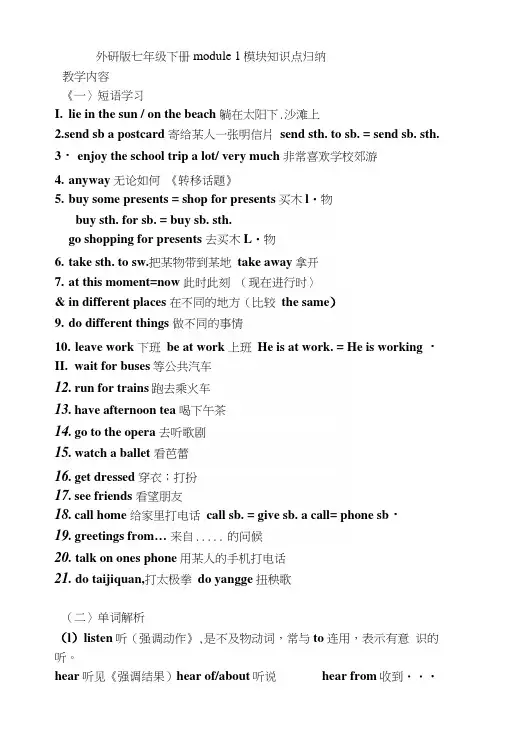
外研版七年级下册module 1模块知识点归纳教学内容《一〉短语学习I.lie in the sun / on the beach 躺在太阳下.沙滩上2.s end sb a postcard 寄给某人一张明信片send sth. to sb. = send sb. sth. 3・ enjoy the school trip a lot/ very much 非常喜欢学校郊游4.anyway无论如何《转移话题》5.buy some presents = shop for presents 买木l•物buy sth. for sb. = buy sb. sth.go shopping for presents 去买木L•物6.take sth. to sw.把某物带到某地take away拿开7.at this moment=now 此时此刻(现在进行时〉& in different places 在不同的地方(比较the same)9.do different things 做不同的事情10.leave work 下班be at work 上班He is at work. = He is working ・II.wait for buses等公共汽车12.run for trains跑去乘火车13.have afternoon tea 喝下午茶14.go to the opera 去听歌剧15.watch a ballet 看芭蕾16.get dressed 穿衣;打扮17.see friends 看望朋友18.call home 给家里打电话call sb. = give sb. a call= phone sb・19.greetings from… 来自..... 的问候20.talk on ones phone用某人的手机打电话21.do taijiquan,打太极拳do yangge 扭秧歌(二〉单词解析(l)listen听(强调动作》,是不及物动词,常与to连用,表示有意识的听。
外研社七年级下英语Module1-3知识点总结
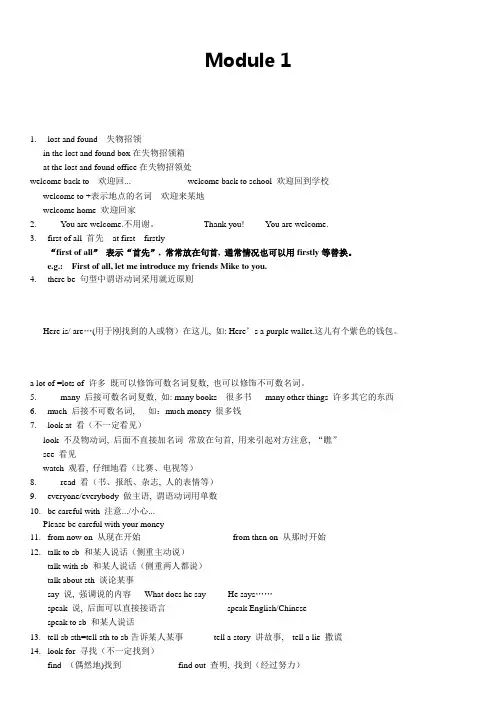
Module 11.lost and found 失物招领in the lost and found box在失物招领箱at the lost and found office在失物招领处welcome back to 欢迎回... welcome back to school 欢迎回到学校welcome to +表示地点的名词欢迎来某地welcome home 欢迎回家2.You are welcome.不用谢。
--Thank you! -- You are welcome.3.first of all 首先at first firstly“first of all”表示“首先”, 常常放在句首, 通常情况也可以用firstly等替换。
e.g.: First of all, let me introduce my friends Mike to you.4.there be 句型中谓语动词采用就近原则Here is/ are…(用于刚找到的人或物)在这儿, 如: Here’s a purple wallet.这儿有个紫色的钱包。
a lot of =lots of 许多既可以修饰可数名词复数, 也可以修饰不可数名词。
5.many 后接可数名词复数, 如: many books 很多书many other things 许多其它的东西6.much 后接不可数名词, 如:much money 很多钱7.look at 看(不一定看见)look 不及物动词, 后面不直接加名词常放在句首, 用来引起对方注意, “瞧”see 看见watch 观看, 仔细地看(比赛、电视等)8.read 看(书、报纸、杂志, 人的表情等)9.everyone/everybody 做主语, 谓语动词用单数10.be careful with 注意.../小心...Please be careful with your money11.from now on 从现在开始from then on 从那时开始12.talk to sb 和某人说话(侧重主动说)talk with sb 和某人说话(侧重两人都说)talk about sth 谈论某事say 说, 强调说的内容What does he say He says……speak 说, 后面可以直接接语言speak English/Chinesespeak to sb 和某人说话13.tell sb sth=tell sth to sb告诉某人某事tell a story 讲故事, tell a lie 撒谎14.look for 寻找(不一定找到)find (偶然地)找到find out 查明, 找到(经过努力)search 搜索, 调查look over检查look after =take care of 照顾look forward to 期盼,期待look forward to sth./doing sth.期待某事或做某事15.get on the bus 上公交车get off the bus 下公交车16.in a hurry 匆忙地hurry up=come on 快点儿hurry to do sth 匆忙做某事hundreds of 几百的, 成百上千的(大约数加s, 加of)two hundred (具体数不加s, 不加of)同样用法还有thousand、million、billion17.every day 每天everyday 每天的(形容词, 后面接名词)16.at the moment=at this moment=now 此时此刻, 现在at that moment=then 在那时such as 例如, 后面不加逗号后接名词或v.ing形式for example 例如, 后面加逗号后接句子17、帮助某人做某事help sb (to)do sth =help sb with sthleave sth.+地点把某物忘记或落在某地18、by bus/train/plane/bike = on a bus/train/plane/bike(buses/trains/planes/bikes)by car\taxi = in a car/taxi(cars/taxis)这是由疑问词whose引导的一个特殊疑问句。
外研版英语七年级下册模块知识点归纳
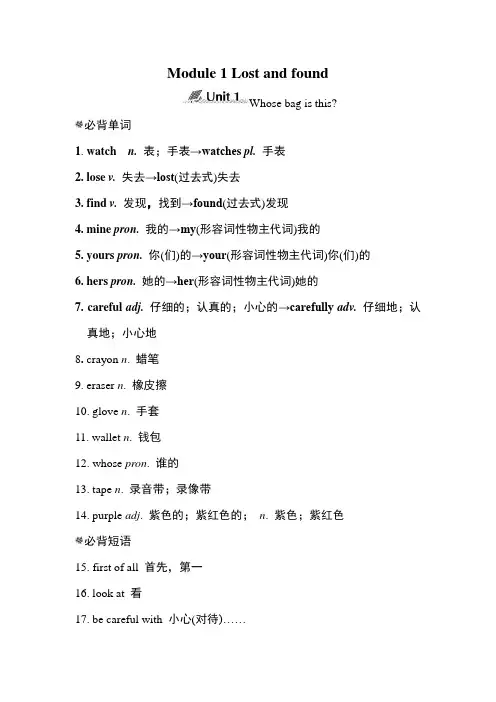
Module 1 Lost and foundWhose bag is this?必背单词1. watch n.表;手表→watche s pl.手表2. lose v.失去→lost(过去式)失去3. find v.发现,找到→found(过去式)发现4. mine pron.我的→my(形容词性物主代词)我的5. yours pron.你(们)的→your(形容词性物主代词)你(们)的6. hers pron.她的→her(形容词性物主代词)她的7. careful adj.仔细的;认真的;小心的→carefully adv.仔细地;认真地;小心地8. crayon n. 蜡笔9. eraser n. 橡皮擦10. glove n. 手套11. wallet n. 钱包12. whose pron. 谁的13. tape n. 录音带;录像带14. purple adj. 紫色的;紫红色的;n. 紫色;紫红色必背短语15. first of all 首先,第一16. look at 看17. be careful with 小心(对待)……18. from now on 从现在开始19. a lot of 许多,大量20. lost and found box 失物招领箱必背句子21. Welcome back to school, everyone!欢迎大家返校!22. Whose bag is this?这是谁的书包?23. Here's a purple wallet!这里有一个紫色的钱包!24. Let me see...让我看看……Are they yours? 必背单词1. leave v.丢下;遗忘→left(过去式)丢下;遗忘2. strange adj.奇怪的→stranger n.陌生人3. camera n. 照相机4. phone n. 电话;电话机5. plane n. 飞机6. taxi n. 出租车7. why adv. 为什么8. airport n. 机场;航空港9. hundred num. 百10. thousand num. 千11. boat n. 船12. duck n. 鸭13. pig n. 猪14. sausage n. 香肠;腊肠必背短语15. mobile phone 移动电话;手机16. lost and found office 失物招领处17. in a hurry 匆匆忙忙18. hundreds of 几百;成百上千19. look for 寻找20. at the moment 目前;此时必背句子21. Welcome to the New York City Lost and found office.欢迎来到纽约市的失物招领处。
七年级下册英语外研版module1知识点
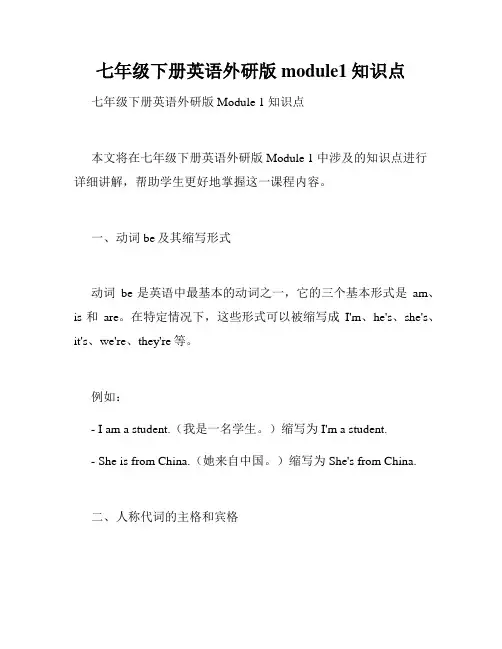
七年级下册英语外研版module1知识点七年级下册英语外研版 Module 1 知识点本文将在七年级下册英语外研版 Module 1 中涉及的知识点进行详细讲解,帮助学生更好地掌握这一课程内容。
一、动词be及其缩写形式动词be是英语中最基本的动词之一,它的三个基本形式是am、is和are。
在特定情况下,这些形式可以被缩写成I'm、he's、she's、it's、we're、they're等。
例如:- I am a student.(我是一名学生。
)缩写为I'm a student.- She is from China.(她来自中国。
)缩写为She's from China.二、人称代词的主格和宾格人称代词是代替人或事物的名词的词语。
根据在句中作主语还是宾语,人称代词可以分为主格和宾格。
主格包括I、you、he、she、it、we、they等,宾格包括me、you、him、her、it、us、them等。
例如:- She gave me a present.(她给了我一份礼物。
)- They invited us to the party.(他们邀请我们参加派对。
)三、物主代词和物主形容词物主代词和物主形容词是用来表示所有关系的。
物主代词包括mine、yours、his、hers、its、ours、theirs等,用在独立的名词后面,表明这个名词属于谁。
例如:- This is my book. That one is yours.(这是我的书,那一个是你的。
)物主形容词则放在名词前面,表示这个名词所属的人或物。
例如:- This is my book.(这是我的书。
)- That is her dog.(那是她的狗。
)四、数词数词是表示数量的词语。
它们可以分为基数词和序数词两种。
基数词表示数量的大小,例如one、two、three等,而序数词表示数量的顺序,例如first、second、third等。
外研社七年级下册Module1语法知识汇总
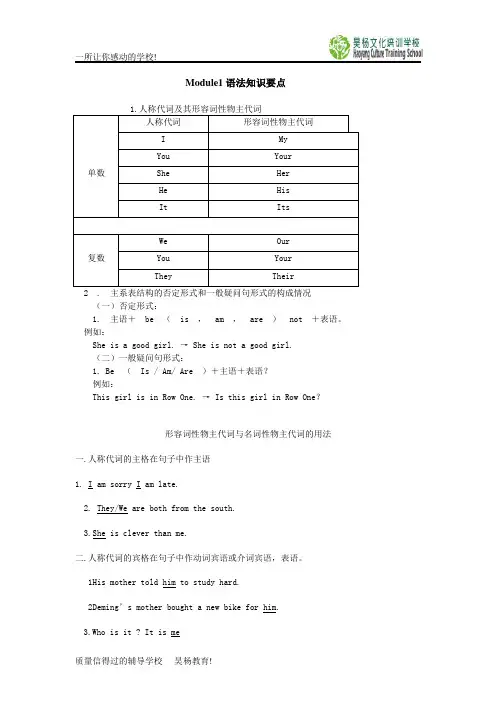
Module1语法知识要点人称代词形容词性物主代词I MyYou Your 单数She HerHe HisIt ItsWe Our 复数You YourThey Their2 . 主系表结构的否定形式和一般疑问句形式的构成情况(一)否定形式:1. 主语+be (is ,am ,are )not +表语。
例如:She is a good girl. → She is not a good girl.(二)一般疑问句形式:1. Be (Is / Am/ Are )+主语+表语?例如:This girl is in Row One. → Is this girl in Row One?形容词性物主代词与名词性物主代词的用法一.人称代词的主格在句子中作主语1. I am sorry I am late.2. They/We are both from the south.3.She is clever than me.二.人称代词的宾格在句子中作动词宾语或介词宾语,表语。
1His mother told him to study hard.2Deming’s mother bought a new bike for him.3.Who is it ? It is me三.形容词性物主代词一般位于名词前,用作定语。
1 My name is John Green. 我叫约翰·格林。
2Excuse me, is this your car? 对不起,这是您的车吗?3 His parents are in England. 他的父母在英国。
4They wash their faces every day. 他们每天都洗脸。
英语人称代词和物主代词一、人称代词表示“我”、“你”、“他”、“她”、“它”、“我们”、“你们”、“他们”的词,叫人称单数复数主格宾格主格宾格第一人称I me we us 第二人称you you you you第三人称he himthey them she herit it人称代词主格:作主语,表示谁怎么样了、干什么了。
外研版七年级下册Module 1模块知识点总结

Module 1 重要短语、句型及知识点1.first of all2.welcome back to +地点名词;welcome back+地点副词3. here is/are4. be careful with5. let sb. do sth.6. Lost and found office7. talk to sb. 8. look for9.get on 10. in a hurry11.at airports 12. hundreds of13. at the moment 14. at the New York City Lost and Found Office 15. a lot of 16. fifteen kilos of sausages17.leave sth. +地点18. on planes19. in taxis 20 on a train 21.such as21. help sb. (to)do sth. 22. that’s why知识点1.welcome 的用法2.there be 句型用法3.物主代词的用法4. be careful with 的用法5.here is/are的用法6.let sb. Do sth.7.get 的相关用法8.look的相关用法9.乘坐交通工具的相关表达方式10. leave sth. +地点11.hundred和thousand的用法12. that’s why 的用法重要句型1.Welcome back to school, everyone.2. Whose bag is this?3.Here’s a purple wallet.4. Everyone, please be careful with your things from now on.5. Let me see...6. They leave things on planes, on trains, on buses and in taxis.7.That’s why there are lost and found offices at airports and stations.8.Hundreds of people come here every day.9. We usually have about two thousand mobile phones and one thousand cameras.。
七年级下册MODULE 1知识点汇总
外研版七年级下册知识点汇总MODULE 11. listen 听(强调动作)hear 听见(强调结果)I listened carefully but I heard nothing. 我仔细听但什么也没听到。
2. We are on a school trip. 我们在参加学校郊游。
3. What are the others doing? 其他人在干什么?4. lie in the sun / on the beach躺在沙滩上5. send sb a postcard 寄给某人一张明信片send sth. to sb. = send sb. sth.6. enjoy the school trip a lot/ very much 非常喜欢学校郊游7. anyway 无论如何(转移话题)8. buy some presents = shop for presents 买礼物go shopping for presents 去买礼物buy sth. for sb. = buy sb. sth.9. enjoy sth. 喜欢某物enjoy oneself = have a good=have a great timeenjoy doing sth=like doing sth喜欢做某事10. take sth. to sw. 把某物带到某地take away11. at this moment=now 此时此刻(现在进行时)12. in different places 在不同的地方(比较the same)13. do different things 做不同的事情14. leave work 下班be at work 上班He is at work. = He is working.15. wait for buses 等公共汽车16. run for trains 跑去乘火车17. have afternoon tea 喝下午茶18. go to the opera 去听歌剧19. watch a ballet 看芭蕾20. get dressed 穿衣;打扮see friends 看望朋友21. call home 给家里打电话call sb. = give sb. a call= phone sb.22. greetings from… 来自……的问候23. talk on one’s phone 用某人的手机打电话24. do taijiquan,打太极拳do yangge 扭秧歌25. 现在进行时的构成:be动词+ 动词的现在分词外研版七年级下册知识点汇总MODULE 21. What traditions do you have at the Spring Festival? 在春节你们有什么传统?2. lots of traditions 许多传统3. clean the house 打扫房子do some cleaning4. sweep away bad luck 扫走坏运5. paint ……red 把……涂成红色6. It means 它意味着…… What does it mean?(meaning n.)7. decorate …with … 用……装饰……8. have a haircut 剪头发9. everyone 后面谓语动词用单数:everyone has a haircut10. visit our family and friends 看望亲戚朋友11. at miday 在中午(at noon= in the middle of day)12.fireworks 用复数13.bring sb. sth. =bring sth to sb. 给某人带来……14. at night ,in the evening 在晚上15. get ready for sth. (be ready for sth.)get ready for doing sth. 为……做准备16. sweep the floor 扫地17. learn a dragon dance 学舞龙18. make lanterns 做灯笼19.cook the meal 做饭do some cooking20. be interested in sth 对某物感兴趣be interested in doing sth. 对做某事感兴趣外研版七年级下册知识点汇总MODULE 31. check my email 查收我的邮件get up early 起早have a picnic 郊游go to a party 去参加聚会at the partyrevise / review for my test 复习准备考试do some revisionstay in bed 呆在床上at a friend’s home 在朋友家take the plane to…=go to sw. by plane乘飞机去……/ take the plane from…to…乘飞机从……到……walk up the Great Wall 爬长城make friends 交朋友stay in a hotel呆在酒店里2. What are your plans? (同义句)What are you going to do?3. look forward to doing sth.We are looking forward to going to Guilin.4. cook 厨师(名词)它还可以当动词: cook sth for sb cook sb sth5. How do you get (from)灵川to 桂林? By bus.6. Why + 一般疑问句?用because来回答.7 in the morningon Sunday morning具体到某一天用onon a hot afternoon 有描述词用on8. be going to +动词原形I’m going to do my homework this evening.There is going to be rain/ snow/wind(名词)……外研版七年级下册知识点汇总MODULE 41. study at home 在家学习do the dull jobs 做枯燥的工作do heavy work 干重活three days a week 一周三天long holidays 长假free time空闲时间be free to do sth. 随意做某事get warm 变暖2. everyone every one of …3. by email 通过电子邮件的方式on the computer on TV on the radio5. I’m not sure. 我不确信。
外研社七下Module1 Unit1 Whose bag is this知识精讲
外研社七年级下册M1U1Whose bag is this?知识点精讲知识点一welcome /'welkəm/ int. 欢迎eg:Welcome back! It's nice to see you again.欢迎回来!很高兴又见到你了。
考向一【重点】“welcome to+地点名词”意为“欢迎来到某地”。
但当后接副词here,there,home, back时,介词to要省略。
eg:Hello, welcome home!嗨,欢迎回家!拓展welcome的其他词性及用法:例题Welcome ________ back ________ home.A.to; /B./; toC.to; to D./; /考向二You are welcome意为“不用谢,不客气”,用于回答别人的感谢,另外回答感谢的常用语还有:It's my pleasure. Not at all.知识点二everyone /'evriwʌn/ pron.每个人,人人eg:Is everyone here today? 今天大家都到了吗?考向一【重点】everyone的同义词是everybody,作主语时,谓语动词用单数形式。
eg:Everyone wants to attend the concert.每个人都想参加音乐会。
考向二【易错点】辨析everyone与every one例题1 Water is important to ________,so there are many water festivals around the world. (临沂)A.everyone B.nobodyC.somebody D.something例题二Look! Everyone in the group ________ talking about their dreams.A.is B.areC.have D.has知识点三first of all首先;第一eg:First of all, I think he is a good student.首先,我认为他是一个好学生。
外研版七年级下册Module 1 词汇和语法知识点归纳及练习题(附答案)
外研版七年级下册Module 1 词汇和语法知识点归纳词汇知识点1. 辨析 every day 和 everydayevery day 是副词词组,在句子中间做状语,表示“每天,天天”。
e.g.: We speak English every day.everyday是形容词,在句子中只做定语,表示“日常的,每天的”。
e.g.: Let’s learn some everyday English.2.People often lose things when they’re traveling or when they’re in a hurry.人们在旅行中或匆忙时常丢东西。
in a hurry的意思是“匆匆忙忙地”,是一个介词短语,hurry动词短语用“hurry up”来表示“赶快,赶紧”,还有“(there’s) no hurry”,意思是“不忙,不必着急,有充裕时间……”。
例:We must hurry up if we want to be there on time.如果想准时到那里的话,我们就必须动作快点。
There is no hurry, so do it slowly and carefully.不必赶时间,要慢慢地,认真地完成任务。
in a hurry 匆忙 = hurriedlyhurry to + 地点匆忙去……hurry to do sth. 匆忙去做……Hurry up! 快点3.a lot of 许多(后跟可数名词复数或不可数名词)a lot of =lots ofmany 后跟可数名词复数much 后跟不可数名词4. find 过去式是 foundlook for 强调寻找的过程 I am looking for your gloves.我正在找你的手套。
find 强调寻找的结果 I find your gloves.我找到你的手套。
5. hundred 是一个确数,表示“一百”hundreds of 是一个概数,表示“好几百,许许多多”当 hundred 前面有一个具体的数词时,hundred 不变为复数。
外研版英语七下Module1知识梳理
外研版英语七下Module 1知识梳理Moudle 1 单词crayon n.蜡笔eraser n.橡皮擦glove n.手套wallet n.钱包watch n.表;(通常指)手表whose pron.谁的firstof all 首先;第一lose v.失去find v.发现;找到lost and found box 失物招领箱mine pron.我的yours pron.你(们)的tape n.录音带;录像带purple adj.紫色的;紫红色的n.紫色;紫红色hers pron.她的careful adj.仔细的;认真的;小心的be careful with 小心(对待)……on adv.从某时刻起from now on 从现在起here is/are…(用于刚找到某人或某物时)在这儿camera n.照相机phone n.电话;电话机mobile phone 移动电话;手机lost and found office 失物招领箱in a hurry 匆匆忙忙leave v.丢下;遗忘plane n.飞机taxi n.出租车why adv.为什么airplane n.机场;航空港hundred num.百hundreds of 几百;成百上千look for 寻找thousand num.千strange adj.奇怪的boat n.船duck n.鸭pig n.猪sausage n.香肠;腊肠Moudle 1 知识梳理【重点短语】1. lost and found 失物招领2. welcome back to school 欢迎回校3. first of all 首先4. a lot of=lots of 许多5. look at 看6. from now on 从现在开始7. be careful with sth 小心对待某物8. talk to sb 与某人交谈9. look for 寻找10. get on the bus 上公交车11. in a hurry 匆忙地12. hundreds of 成百的13. leave sth + 地点把某物留在某地14. every day 每天15. at the moment 在此刻16. such as 例如17. help sb. to do sth 帮助某人做某事18. many other things 许多其他东西【重点句型】1. Welcome back to school, everyone.欢迎大家回到学校。