
牛津译林版英语八年级下册 Unit7 Reading 1
How kind!
Read for feelings
During my last visit, 150 patients were operated on.
How hard-working!
I'm proud to help people see again and improve their lives.
treat people with__e_ye__p_r_o_b_l_e_m_s__
a hospital
a _t_r_a_in_i_n_g__ce_n__tr_e_
do _e_y_e_o_p__e_r_a_ti_o_n_s_ on the plane help more people_s_e_e__a_g_a_in__
How great!
Analyze the interview
1. Why is Dr Ma chosen as the interviewee?
➢ excellent; professional; experienced ➢ great achievements ➢ work for ORBIS for years
Problem 3: ___________O_x_f_a_m_____________ The factory he worked in bankrupted (破产) last
month. He and his workmates have lost their jobs and they have no money to support their families.
Q2. What is needed to carry on with the work? More money.
Q3. What does Dr Ma hope?
He hopes more people will sr thinking
What else can we do to support ORBIS?
Problem 2: __________U_N__IC__E_F_____________
Nancy is a 12-year-old girl. She lives in a poor family in a far-away village in Africa. She has two younger sisters and a little brother. Her family is so poor that she has to work on the farm all day.
• Donate our pocket money to ORBIS. • Tell people to take good care of eyes. • Ask local governments for help. • Introduce ORBIS to more people. • Be volunteers for ORBIS. • Work for ORBIS when we grow up. • Hold charity shows to raise money. •…
Who is this doctor? What is the plane used as?
Dr Ma
interviewer
a hospital a training centre
How many questions does the interviewer ask? What are they?
What does the logo look like?
ORBIS
an eye
A charity that helps people with eye problems.
a plane
Why is there a plane in the logo?
a special plane
An interview with an ORBIS doctor
Further thinking
If you were a doctor, would you like to work in a common hospital or on a flying hospital?
Why?
in a hospital
on a plane
stay with your family
I’m proud to help people see again and improve their lives.
Dr Ma is very _b_u_s_y_. Dr Ma’s work is very _i_m__p_o_r_t_a_n_t_. Dr Ma feels very _p_r_o_u__d_.
What do people think of the work of ORIBS?
“ You’re doing a really important job.”
“ I’m proud to help people see again and improve their lives.”
readers
invite l_o_c_a_l_d_o_c_t_o_r_s_a_n_d__n_u_r_s_e_s on board
teach them _n_e_w__s_k_il_ls_
Further thinking
Is it necessary to train local doctors and nurses?
meaningful helpful necessary important ...
Read for feelings
About 285 million people around the world are blind or have other eye problems.
How terrible!
Analyze the interview
2. How does the lady interview Dr Ma?
rude excited professional
polite
respectful
casual
Analyze the interview
3. Who else can she interview to know more about ORBIS ?
Unit 7
Reading I
Different charities
Oxfam
poor people
Helpful!
World Wide Fund for Nature
the environment and animals
WWF
ORBIS
people with eye problems / blindness
UNICEF
poor children all over the world
Problem 1: __W__o_r_ld__W__id__e_F_u_n_d__f_o_r_N_a_t_u_r_e___
Some restaurants sell dishes made in rare animals. The animals are protected by laws.
Patient:
…
Interviewer: I’m sorry to hear that. Did you know ORBIS before?
Can you say something about the charity?
Patient:
…
Interviewer: I know Dr Ma is your doctor, how did he help you?
A. have money to …
B. be afraid to …
training centre laoncWadlnhduoor?csteosrs
learn new skills
help more people
introduce!
ORBIS, a charity
use its _F_l_y_in_g__E_y_e_H__o_s_p_i_ta_l_ to visit poor areas
blindness
the condition of being unable to see
285 million people are blind or have other eye problems.
mostly in poor areas
80 per cent of these cases can be prevented or cured.
Dr Ma, please tell us something about blindness. How does OBRIS help? Why don’t you work in a hospital? How many operations do you do during a visit? Is there anything else you’d like to say to our readers?
However, many people don't have money for medical treatment.
How poor!
Read for feelings
Many of our patients can’t afford to go to hospital, so we have to go to them.
patients
nurses
volunteers
Make up an interview
牛津英语译林版八年级下册 8下 单元评价 Unit 1 (含答案)

牛津英语译林版八年级下册8下单元评价Unit 1 (含答案)一、听力 (共20小题;每小题1分, 满分20分)第一部分听对话回答问题, 录音读两遍。
1. How did Mr Black use to go to school?2. What does Jessica look like now?3. What time is it now?4. What is the building now?5. How old is the girl?A. 6.B. 10.C. 16.6. What is in the town centre now?A. A school.B. A theatre.C. A shop7. How often does Grandpa keep in touch with his friends now?A. Once a month.B. Once a week.C. Every day.8. How does the girl become brave?A. By talking to others.B. By listening to talks.C. By practicing giving talks.9. How many times has Joe seen the movie?A. Once.B. Twice.C. Three times.10. Who wants to read the newspaper?A. The girl.B. The girl's father.C. The girl's grandfather.第二部分听对话和短文回答问题, 录音读两遍。
听一段对话, 回答第11-12小题。
11. When did Danny move to London?A. At the age of 10.B. At the age of 11.C. At the age of 12.12. What does Danny enjoy doing on weekends now?A. Going camping.B. Going rock climbing.C. Going cycling.听第一篇短文, 回答第13-15小题。
2020-2021学年牛津译林版八年级英语下册Unit 7单元错题整理2
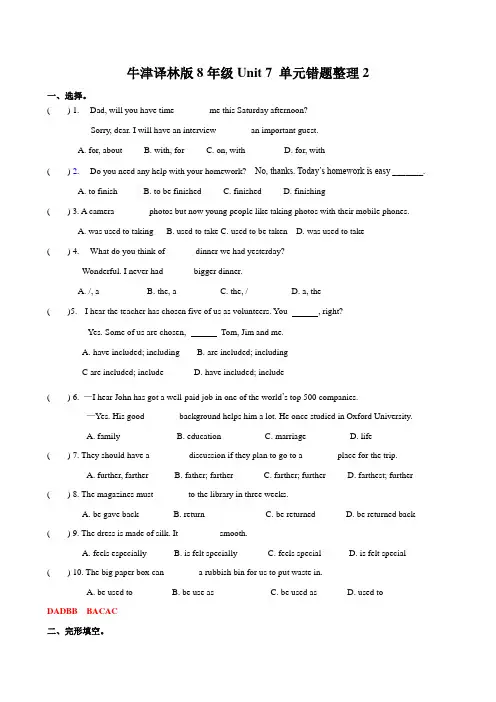
牛津译林版8年级Unit 7 单元错题整理2一、选择。
( ) 1. ---Dad, will you have time _______ me this Saturday afternoon?---Sorry, dear. I will have an interview _______ an important guest.A. for, aboutB. with, forC. on, withD. for, with( ) 2. ---Do you need any help with your homework?---No, thanks. Today’s homework is easy _______.A. to finishB. to be finishedC. finishedD. finishing( ) 3. A camera _______ photos but now young people like taking photos with their mobile phones.A. was used to takingB. used to takeC. used to be takenD. was used to take( ) 4. ---What do you think of ______ dinner we had yesterday?---Wonderful. I never had ______ bigger dinner.A. /, aB. the, aC. the, /D. a, the( )5. --I hear the teacher has chosen five of us as volunteers. You , right?--Yes. Some of us are chosen, Tom, Jim and me.A.have included; includingB. are included; includingC are included; include D. have included; include( ) 6. —I hear John has got a well-paid job in one of the world’s top 500 companies.—Yes. His good _______ background helps him a lot. He once studied in Oxford University.A. familyB. educationC. marriageD. life( ) 7. They should have a ________ discussion if they plan to go to a _______ place for the trip.A. further, fartherB. father; fartherC. farther; furtherD. farthest; further ( ) 8. The magazines must _______ to the library in three weeks.A. be gave backB. returnC. be returnedD. be returned back ( ) 9. The dress is made of silk. It_________ smooth.A. feels especiallyB. is felt speciallyC. feels specialD. is felt special ( ) 10. The big paper box can _______ a rubbish bin for us to put waste in.A. be used toB. be use asC. be used asD. used toDADBB BACAC二、完形填空。
牛津译林版八年级英语下册Unit 7Reading课件

I’m proud to be the host of the English Festival.
Can we afford a car? 我们买得起新车吗?
We cannot afford a new house. 我们买不起新房子。
2. Also, local doctors and nurses are invited on board to learn about eye operations. on board 在飞机(船、火车)上 e.g. Have the passengers gone on board yet? 乘客们登机了吗?
译林出版社
授课教师:
八年级下册 · 课文
精品教学课件
学校:
1. Many of our patients can’t afford to go to hospitals, so we have to go to them. 句中的afford意思是 “买得起; (有时 间)做” 通常与can, could, be able to连 用,多用于否定lanks. 1. 80 percent of the cases of _b_li_n_d_n_e_s_s_
(blind) can be cured or prevented. 2. At present, Mr. Li is in hospital receiving
Last summer, he went to a p_o_o_r_ village. There he saw many children who weren’t able to go to school because their families were too poor.
牛津译林版八年级英语下册unit7课件 (共28张PPT)

Revision
Reading
•Complete the information about ORBIS, using the knowledge you have learned.
ORBIS is a __c_h_a_r_i_ty__ that helps _b_l_in__d___ people. Most __e_y_e__ problems can be_c_u_e_d__ or prevented.
collect - vcv.o.l-+leeic+otniot→inonn.a→ttracnt-.-- attraction
act-----d--onaacteti-o--n donation pinrvoetenct-et--dcpianrtveoe-t-en-ctitoionenducation
However, many people do not have enough money
to go to __h_o_sp__it_a_l_. The __d_o_c_to_r_s_ on the ORBIS plane fly to poor areas to _t_r_ea_t___ people with eye problems and to _t_e_a_ch___ local doctors and nurses
1.The doctor will _o_p__e_ra_t_e__ on the patient. 2.He will perform an _o_p__e_ra_t_i_o_n____.
v. + ment → n.
advertise---- advertisement develop---- development agree---- agreement improve---- improvement treat--------- treatment excite------- excitement punish------ punishment arrange----- arrangement move------- movement
牛津译林版英语八年级下册课件Unit 7 International cha Reading2 课件

15.All we need is enough money to carry on with our work.
carry on with sth = carry on doing sth. =go on with/doing sth.
我不在时你接着干。
Carry on with your work while I’m away.
13.modern medicine 14.develop quickly
developing 发展中的, developed 发达的
developing vs developed
developing 发展中的, developed 发达的 美国是发达国家,中国是发展中国家。 America is a developed country, and China is a developing one.
80 per cent of these cases
3. 有钱医治
have money for medical treatment
4. 一架飞行的眼科医院 a flying eye hospital 5. 在飞机上 on the plane / on board 6. 志愿者医生 volunteer doctors
afford sth. 负担得起某物 afford to do sth. 负担得起做某事
1. 我们买得起新车吗? Can we afford a car?
2. 我们买不起新房子。
We cannot afford a new house.
3. 贫困地区孩子没钱上学。
Children in poor areas can’t afford to go to school.
Unit 7 知识点 2022-2023学年牛津译林版八年级英语下册

U7 International charities【comic & welcome】1.You have some pocket money left.have sth left剩下某物2.Hobo, let me have lunch first.first adv.首先常和next,then,finally等表顺序的副词一起使用,用来描述某件事情的先后顺序3.It helps build a better world for everyone, especially children all over the world. [especially] adv.特别,尤其修饰动词、形容词或整个句子;especial adj.特别的,特殊的4.It provides basic education for children in poor areas.[basic] adj.基础的,基本的basic education基础教育basic needs基本需求[education]不可数名词“教育” get/receive education接受教育educational adj.教育的;有教育意义的educate vt.教育;培养educate sb to do sth教育某人做某事educator n.教育家;教育工作者5.It works for the equal rights of girls and women too.[equal] adj.平等的,相等的,能胜任的equal rights平等的权利be equal to....等于,等同,能胜任[right] n.权利the right of sb某人的权利the right to... ... 的权利6.It also works to prevent the spread of some serious diseases, like AIDS, among young people. [prevent] vt.阻止,预防prevent sb (from) doing sth = stop / keep sb from doing sth阻止某人做某事prevent the spread of some serious diseases阻止一些严重疾病的传播[spread] ①n.扩散;分布;展开the spread of.... .... 的扩散①v.展开,传播;散布spread the news传播消息【reading】1.tell us something about blindness告诉我们有关失明的一些事情[blindness]不可数名词“失明”blind + ness adj+ness →n.类似的:kindness善良illness疾病happiness幸福carelessness粗心sadness悲伤business商业2.....mostly in poor areas , and about 80 per cent of these cases can be prevented or cured. [mostly] adv.主要地;大部分地;多半地≈mainly[cure] vt.治愈,治好cure sb of one’s illness治好某人的疾病3.However, many people don’t have money for medical treatment.[treatment] 可数名词或不可数名词“治疗” treat+ment medical treatment医学治疗4.The plane is also used as a training centre.be used as +工具、方式、手段被用作...be used for + 用途被用来...be used by sb 被某人使用be used in... 被用于....方面5.Many of our patients can’t afford to go to hospital.[patient] ①可数名词“病人,病患”①adj.能忍耐的,有耐心的be patient with sb 对某人有耐心[afford] vt.买得起;能做;承担+名词、代词、to do多用于否定句或疑问句中常与can、could、be able to连用afford to do sth承担得起做某事6.During my last visit,150 patients were operated on.[operate] vi.做手术,开刀operate on sb. = do an operation on sb给某人做某事7.I’m proud to help people see again and improve their lives.[proud] adj.自豪的,骄傲的be proud to do sth为做某事而自豪be proud of... 为...感到自豪be / feel proud that+从句很自豪....[pride]n.自豪,骄傲take pride in... = be proud of...8.Modern medicine is developing quickly and now most eye problems and diseases can be treated and cured.●[medicine] n.医学,药Modern medicine现代医学take the medicine吃药[medical] adj.医学的,医药的●[develop]v. 发展;加强develop into... 发展成...[developing]adj.发展中的[developed]adj.发达的[development]n.发展●[treat] vt. ①治疗treat sb/sth with sth 用某物治疗某人/某物treat sb for... 为某人治...病①对待;看待treat ... as.... 把...看作...carry on with sth继续做某事= carry on doing sth= go on doing sth= continue doing sth【grammar】1.[ hand out ] ①分发;发出= give out反义词:hand in 上交①提出(建议等)hand out advice提出建议2.[hold] vt. (held , held)①举行=have hold / have the sports meeting举行运动会①容纳The classroom can hold over 100students.这间教室能容纳100多名学生①握住,抓住hold one’s hand握住某人的手3.With its help, millions of poor children all over the country were given basic education. with one’s help = with the help of sb.在某人的帮助下without one’s help没有某人的帮助【integrated skills & study skills & task】1.What’s the matter?怎么了?what’s the matter (with sb?)= What’s wrong (with sb)?= What’s the trouble (with sb)?= What’s happened (to sb)?2.You’ll be all right in a few days.in a few days几天后in +一段时间→ How soon 提问3.I could not sleep at all that night.not ...at all一点儿也不;根本不not 通常与主语后面的连系动词be,情态动词或助动词等连用4.help poor people with eye problem帮助有眼部疾病的穷人5.learn about the conditions of the local people了解当地人的情况enter a school进入学校。
Unit7Reading课件牛津译林版英语八年级上册(1)
A.shout
B.shouting
C.to shout
知识概要
课时讲练
知识清单
12
四、根据汉语意思完成英语句子。每空一词。
1.在那些女孩当中,你能找到你的妹妹吗? Can you find your sister ___am__o_n_g___t_h_o_se___g_i_rls 2.夏天的傍晚,孩子们喜欢在宁静的小溪边玩耍。 Kids like to play __b_y_ the __q_u_ie_t_ stream in late summer afternoon. 3.看,这条河里满是鱼。 Look, the river _i_s_ __fu_l_l_ _o_f_ fish.
知识概要
课时讲练
知识清单
8
4.Short _s_h_o_w_e_r_s_(阵雨) in spring are good for crops to grow strong quickly. 5.—How did you break the cup —I tried to hold it but it was too hot, so it _____d_r_o_p(pe落d 下) onto the floor and broke.
3.The students are busy _p_r_e_p_a_ri_n_g_(prepare)for the English test
tomorrow.
4.Jim _h_i_d_(hide) the broken plate behind the table yesterday evening.
开始变绿。
知识概要
课时讲练
知识清单
4
4.As the days are shorter and the temperature drops. 随着白天变短, 气温也下降。
牛津译林版英语八年级下册Unit7Reading优秀教学案例
4.能够通过小组讨论、复述课文等方式,运用所学知识进行口语表达,提高英语口语交流能力。
(二)过程与方法
1.采用任务型教学法,引导学生通过小组合作、讨论等形式,主动参与课堂活动,提高学生的课堂参与度和合作意识。
2.运用多媒体教学资源,如图片、视频等,丰富教学手段,激发学生的学习兴趣,增强他们对英语学习的热情。
3.激发学生探索世界的热情,让他们了解不同国家的文化差异,拓展国际视野。
4.培养学生合作、互助的精神,使他们学会倾听他人意见,尊重他人,形成良好的人际关系。
在本节课的教学过程中,我们将关注学生在知识与技能、过程与方法、情感态度与价值观三个方面的全面发展,以实现英语教育的真正价值。通过精心设计的教学活动,让学生在轻松愉快的氛围中学习英语,不断提高他们的语言运用能力和综合素质。
2.教师提出问题:“How do you usually go to school? What transportation do you like best? Why?”,让学生自由发言,讨论各自喜欢的交通方式及原因。
3.教师简要介绍本节课的主题——“变化的交通”,并告诉学生将通过本节课的学习,了解交通工具的演变及其对生活的影响。
3.教师收集学生的作业,进行批改和评价,针对学生的错误和不足给予指导和建议。
五、案例亮点
1.创设真实语境,提升语言实践能力
本教学案例的最大亮点在于充分创设了真实语境,让学生在实际场景中运用所学知识。通过展示丰富的图片、视频等多媒体资源,引导学生关注交通工具的特点和变化,激发他们的学习兴趣。同时,设计生活化的场景和角色扮演活动,使学生将所学词汇和句型内化为自己的语言能力,提高他们的语言实践能力。
Units 1-8重要短语归纳2022-2023学年牛津译林版英语八年级下册
Unit 1 Past and presentWelcome to the unit1. past and present 过去和现在2. in the bowl 在碗里3. an hour ago 一小时前4. —Have you seen my food? 你见过我的食物吗?—Yes, I’ve just eaten it. 是的,我刚把它吃了。
5. used to share food with me 过去常常和我分享食物6. be so kind to me 对我那么好7. transport at different times 不同时代的交通工具8. by bike/ bus/ underground/ car/ taxi/ coach/ train/ plane骑自行车/乘公交车/地铁/汽车/出租车/长途汽车/火车/飞机9. Why didn’t you take a bus? 你为什么不乘公交车呢?10. too many people 太多人11. It took a long time to wait for the next bus. 花费很长时间等到下一班公交车。
12. It’s easy and fast (to go to school by bus). (乘公交车去上学)既简便又快捷。
Reading1. I’ve lived here since I was born. 我自出生就住在这里。
2. move house 搬家3. in the northern part of town 在城镇的北部4. get married 结婚5. move two blocks away 搬离两个街区6. We’ve lived in this area since then. 从那时起我们就住在这个地区了。
7. over the years 在这几年中8. turn part of the town centre into a new park 将镇中心的部分变为一个新公园9. a steel factory 一个钢厂10. put the waste into the river 将废物投入河中11. realize the problem 意识到这个问题12. take action to improve the situation 采取措施改善情况13. in some ways 在某种程度上14. move away 搬离15. know little about… 对……知道很少know nothing about…对……一无所知16. It has become impossible for us to see each other as often as before.我们已经不可能像以前那样经常见到彼此了。
牛津译林版八年级上册Unit 7《Seasons》(Reading 1)教学设计
牛津译林版八年级上册Unit 7《Seasons》(Reading 1)教学设计一. 教材分析《Seasons》是一篇关于四季的文章,介绍了春夏秋冬的特点以及人们在不同季节里的活动。
文章内容丰富,语言简单易懂,适合八年级学生学习。
本篇文章旨在让学生了解和掌握季节相关的词汇和表达方式,提高学生的阅读理解能力,培养学生用英语进行交流的能力。
二. 学情分析八年级的学生已经掌握了基本的英语语法和词汇,具备一定的阅读理解能力。
但是,学生在学习过程中仍然存在以下问题:1. 对季节词汇的掌握不够熟练;2. 英语口语表达能力较弱;3. 学习积极性有待提高。
三. 教学目标1.知识目标:让学生掌握与季节相关的词汇和表达方式,如spring,summer, autumn, winter, bloom, fade, etc.;2.能力目标:提高学生的阅读理解能力,使学生能够熟练运用所学知识进行口语交流;3.情感目标:培养学生热爱生活、珍惜时间的积极情感。
四. 教学重难点1.重点:季节词汇和与季节相关的表达方式;2.难点:正确运用季节词汇进行口语交流。
五. 教学方法1.情境教学法:通过设定现实情境,让学生在实际语境中学习和运用季节词汇;2.交际教学法:采用两人一组或小组合作的形式,让学生进行实际的语言交流;3.任务型教学法:通过完成各种任务,激发学生的学习兴趣,提高学生的参与度。
六. 教学准备1.准备四季的图片,用于展示和引导学生讨论;2.准备季节词汇卡片,用于操练和巩固;3.准备与季节相关的活动材料,如春游、夏季游泳等,用于拓展和巩固。
七. 教学过程1.导入(5分钟)a.向学生问候,了解学生上一节课的学习情况;b.引导学生谈论各自喜欢的季节,并简要说明原因。
2.呈现(10分钟)a.向学生展示四季的图片,引导学生用英语描述图片内容;b.呈现季节词汇卡片,让学生朗读并模仿发音;c.教师用英语简要介绍文章内容,激发学生的阅读兴趣。