
仁爱版 八年级英语上 unit3知识点、语法及练习
Unit3 Our HobbiesTopic 1 What hobbies did you use to have ?1 . by mistake ____________2 . in the old days____________3 . get lost ____________4 . see sb off ____________5 . put sth away ____________6 . must be ____________7 . used to ____________8 . be interested in____________9 . listen to music ____________ 10 . in one’s spare time ____________11 . in the past ____________ 12 . in front of____________13 . keep pets ____________ 14 . get well ____________ 15 . take a bath ____________ 16 . be of great value____________17 . play soccer ____________ 18 . go shopping____________19 . collect stamps ____________ 20. do some outdoor activities ____________1. What beautiful stamps!(Page 53)哇,那么漂亮的邮票!what引导的感叹句(1). What +a(an)+形容词+可数名词的单数形式+主语十谓语!__________________________________________! 她是一个多么漂亮的女孩呀!(2). What+形容词+可数名词的复数形式+主语+谓语!___________________________________________!他们做了多么重要的工作呀!(3). What+形容词+不可数名词+主语+谓语!如:____________________________________!多甜的水呀!how引导的感叹句(1). How十形容词或副词+主语+谓语!如:__________________________________!多么有趣的狗呀!(2). How+形容词+a/an+可数名词的单数形式+主语+谓语!如:___________________________________________!他们正在学的科目多么有用呀!(3). How+主语+谓语!如:__________________________!时间过得真快呀!技巧总结:从后往前划出主语、谓语,然后看前部的中心词,名词用what ,形容词、副词用how。
2. We can learn a lot about people, places, history, and special times from stamps. (Page 53)通过这些邮票我们可以学到许多关于人文、地理、历史和特殊时代的知识。
a lot “许多、大量”,用在动词后,同very much。
如:eg:She had told me a lot about how to learn English well.另外,a lot of和lots of的意思也是“许多、大量”,要用在名词前,在肯定句中常代替much,many。
Eg:There are a lot of / lots of history books in the room.屋里有许多历史书。
There is still a lot of / lots of snow on top of the house.房上仍有许多雪。
a lot of和lots of之间没有多大区别,都可以与可数名词和不可数名词连用。
与不可数名词连用时,动词用单数,与可数名词连用时,动词用复数。
见上述例句。
3. What things do you love collecting? (Page 53)你喜欢集什么东西?love + doing表示“喜欢、爱好”,也可以用like+ doing表示。
如:1)I love _____________ to the music.我爱好听音乐。
5.I am interested in playing sports. (Page 54)我对运动感兴趣。
be interested in (doing) sth. “对…感兴趣”如:I’am interested in ___________ books.我对读书特别感兴趣。
Jack is interested in football.杰克对足球很感兴趣。
6.What do you often do in your spare time? 在你的业余时间里面你都做些什么啊?in one’s spare time “在业余时间”“在闲暇之际”,也可用in one’s free time替换。
如:eg:I shall do it in my spare time. 我会在我的业余时间做这件事。
In my free time I often go to the movies.在闲暇之际,我常去看电影。
7. I often go fishing. (Page 55)我经常去钓鱼。
go + doing表示“去做某事”go +v-ing结构很常用,多用于体育活动和业余娱乐活动。
如:Let’s __________________________ next Sunday.下星期天我们去钓鱼吧。
另外还有:go hunting go shooting go swimming go bathing go shopping go climbing8.And I do a lot of reading. 我通常都是阅读一些书籍。
在英语中有不少由“do + doing”的结构,表示“干某事”。
如:_______________do some walking do a lot of walking_______________do some reading do a lot of reading_______________do some washing do a lot of washing_______________do some shopping do a lot of shopping_______________do some cleaning do a lot of cleaning9. Why not go out and do some outdoor activities? 为什么不走出去做一些户外运动呢?用why not do sth 用来征求对方的意见或表达建议。
使用这种句子必须要有上下文,如:Why not _________ a little faster?为什么不跑快一点呢?11. And I wasn’t interested in sports at all. 我对运动一点兴趣都没有。
not...at all “一点也不……”;“全然不”。
如:1)I didn’t mind it at all. 我一点也不在意。
2)—Thank you for helping me.谢谢你帮助我。
—Not at all.没关系。
12. I used to know little about paintings. 我过去不太懂绘画。
little和few都含有否定的意思。
表示“不多”;“很少”。
little相当于not much, few相当于not many。
little与不可数名词连用, few与可数名词复数连用。
如:I have ___________time.我的时间很少。
_________people would agree with him.没有多少人同意他。
而a little和a few含有肯定的意思,表示“一些”;“几个”(虽然少,但有一些)。
如:There’s __________ water in the glass.杯子里还有点儿水。
I still have _________ friends in Beijing.我在北京还有几个朋友。
13. I enjoy listening to rock music. (Page 56)我喜欢听摇滚音乐。
enjoy意为“喜欢,欣赏”,含有“乐于、享受……之乐趣”之意,其后可以跟名词、代词或动名词作宾语。
enjoy oneself表示“玩得愉快”之意。
The Greens enjoy ___________ in China.格林一家喜欢在中国居住。
Did you ____________ in the zoo?你在动物园玩得愉快吗?Many foreigners enjoy Chinese food.很多外国人喜欢中国菜。
prefer意为“宁愿、更喜欢”,用于两者之间的选择,其后可跟名词、代词、动名词或不定式。
prefer...to...表示“宁愿…,不愿…”,“喜欢…而不喜欢…”,其中to为介词,后可跟名词或动名词。
如:Which do you prefer, tea or coffee? 你比较喜欢喝茶,还是喝咖啡?I prefer__________ to____________. 我喜欢步行胜过骑单车。
My brother likes maths, but I prefer English. 我哥哥喜欢数学,而我更喜欢英语。
14. Did you use to go swimming during?summer vacations? 在暑假里,你过去经常去游泳么?during “在…的期间、在…的时候”。
如:eg The sun gives us light during the daytime.太阳在白天给我们阳光。
He called to see me during my absence.当我不在的时候他来访过我。
15.I used to do that in the pond in front of my house. ( Page 57) 我过去常在我家门前的池塘里游泳。
in front of“在……的前面”;指在物体外部的前面。
而in the front of“……的前部”;指在物体内部的前面,即前部。
注意它们的区别。
仁爱版 英语八年级上册 unit 3 知识点
仁爱版英语八年级上册 unit 3 知识点1.询问某人的业余爱好?What’s your hobby? / What do you do in your free/spare time?(在你的空余时间你做什么?)回答:My hobby is + V-ing或V-ing+ is my hobbyMy hobbies are + V-ing...../ V-ing .....are my hobbies2. 表示喜欢的词有;like;love. enjoy;prefer;be interested in;be fond of 这些词后面也都带V-ing3. 一些反义词:take带去-bring 带来(took-brought) borrow借来与from搭配-lend借给与to搭配(borrowed-lent)4. 感官动词:look(看;看起来);watch(观看);see(看见);hear(听见);listen(听);sound(听起来)feel(感到;感觉起来);smell(闻;闻起来);taste(尝;尝起来)5. used to do sth 过去常常做某事。
否定形式:didn’t use to do sth 疑问句形式:e to do sth?6. share 分享- share sth with sb 与某人分享某物provide 提供- provide sb with sth (用某物提供给某人)=provide sth for sb(提供某物给某人)teach(教)-taught(teach 的过去式)teach sb to do sth (教某人做某事)popular 流行be popular with 在。
之间流行famous 出名的be famous with sth 因....而出名be famous as+ 职业以....身份而出名7. 玩乐器(乐器前面要用the);球类前面不用the 如:play the violin 拉小提琴play baseball 打棒球乐器有:piano;guitar;violin;erhu;drum8. everyday 日常every day 每天9. what与how的感叹句:How+形容词/副词!What+a/an+形容词+感叹物!(感叹物不可数名词时不用a、an)形后有名用What;(后面可跟a与an);形后无名要用how;(后边没有a与an)10. 过去进行时代表过去的某个时间或某段具体时间内正在做的事情。
仁爱英语八年级上册Unit3-topic2知识点总结

Unit3 Our HobbiesTopic2 What sweet music!一、重点短语continue doing sth. 继续做某事 be born 出生set up 建立classical music 古典音乐folk songs 民歌stage name 艺名everyday life 日常生活be famous for 因……而著名look for 寻找二、重点句型1. And it sounds great! 听起来好极了。
2. What kind of musical instrument can you play? 你会弹什么种类的乐器?3. We have guitar, violin, piano and drum lessons for just ¥240 each. 我们有吉他课、小提琴课、钢琴课、和打鼓课,每个课程仅需要240元。
4. What do you do in your free time? 你在闲暇之际干些什么?5. Classical music is serious music. 古典音乐是一种很严肃的音乐。
6. Pop music often comes and goes easily. 流行音乐来得快去得也快。
7. They are very popular among young people. 它们在年轻人当中很流行。
8. Guo Lanying, Song Zuying and Tenger are famous for their folk songs. 郭兰英,宋祖英和腾格尔以(唱)民歌而出名。
9. It is one of the most famous rock bands in the world. 它是世界上最著名的摇滚乐队之一。
10. In the fall of 1976, a 14-year-old high school student, Larry Mullen, looked for some musicians. 在1976年的秋天,一个14岁的中学生,Larry Mullen寻找一些音乐家。
仁爱版英语八年级上Unit3知识点讲解
仁爱版英语八年级上Unit 3 知识点讲解Unit 3 topic 1Section A在某人的空闲时间里1. in one’s free time=in one’s spare time2. go to the movie theater 去影剧院3. do some outdoor activities 做一些户外活动4. ①like doing 喜欢做某事②love doing 喜欢做某事③be fond of doing 喜欢做某事④enjoy doing 喜欢做某事⑤be/become interested in 对……感兴趣=show an interest in⑥prefer doing sth. 更喜欢做某事5.be/become interested in (doing) sth.interested感到有趣的(主语是人) interesting有趣的(主语是物)5. dance to music 伴着音乐跳舞6. walk a pet dog 遛狗=take a dog for a walk7. collect stamps 集邮更喜欢……8. prefer=like……better9. prefer意为“宁愿、更喜欢”,用于两者之间的选择,其后可跟名词、代词、动名词或不定式.①prefer A to B 在 A 和 B 中更喜欢 AI prefer English to maths.②prefer doing to doing 喜欢……胜过……I prefer walking to cycling.我喜欢步行胜过骑单车。
③prefer to do rather than (to) do宁愿……也不愿……10. why not +V(原形) 为什么不(表示建议)=why don’t you +V(原形)11. sound +adj. 听起来……It sounds good.这听起来很好。
新仁爱版英语八年级(上册)unit3重点短语和句子
Unit 3 Topic 1 总结学案一、重点词组1 .like / love / enjoy doing sth .喜欢做某事be interested in doing 对做某事感兴趣be fond of doing sth 喜欢做某事prefer doing sth. 更喜欢做某事2.hate doing sth. 讨厌干…3.go fishing/ go traveling/go swimming 去钓鱼 /去旅行/ 去游泳4.listen to music 听音乐5. go out (for a walk )出去(散步)6. do some outdoor activities 进行户外运动7. play computer games 玩电脑游戏8.watch movies 看电影9.walk a pet dog/keep pets 遛狗 /饲养宠物10. collect stamps 收集邮票11.climb mountains 爬山12.fly kites 放风筝13.model planes 飞机模型14.keep pets 养宠物15. start /begin with …以……开始16. share sth with sb 与某人分享17.provide sb with sth /provide sth for sb 为某人提供某物Eg.Our school provides us withfreeLunch.18. in one’s life /lives在某人的一生中19. cut out 剪下20.more than =over 超过 /多于21.take a bath 淋浴22.take sb/sth out for a walk 带某人/某物出去散步23.be special to sb对某人来说是特殊的24. go to the movie theater去电影院25.in one’s free time在某人的业余时间26.dance to music 伴着音乐跳舞27. Not all 并非所有28.call sb. sth. 把某某称之为…. 29. just like 就像…30.learn… from 从…学到31. learn /know about 了解32. talk about 谈论33.sounds good 听起来很好34.stick ...to ...粘贴到…ed to do sth . 过去常常干…否定: didn’t use to do sth. 一般疑问句:Did sb use to do sth ?①.I used to collect stamps, but now I hate it.②. He didn’t use to play computer games , but now he likes it. ③. What hobby did you use to have?=Our school provides free lunch for us.二、重点句子1.What do you do in your free time ?在空闲时间里你做什么?2.What’s your habby?你的爱好是什么?3.Why not go out and do some outdoor activities?为什么不出去做户外活动?4.Kangkang is fond of swimming 康康喜欢游泳5.I used to enjoy pop music ,but now I don’t like it。
精编仁爱英语八年级上册Unit3 Topic1知识点和练习(有答案)
精编仁爱英语八年级上册Unit3 Topic1知识点和练习(有答案)G8 Unit 3: Our HobbiesTopic 1: What's Your Hobby?1.What do you usually do in your free time?In one's free time。
one can XXX.2.I love reciting XXX.One can express their hobbies using verbs such as enjoy。
like。
love。
be fond of。
or be interested in。
followed by a noun。
pronoun。
or gerund.3.Why not try some outdoor activities?One XXX。
indoor activities XXX.4.Maybe I need a change.Maybe is an adverb that means "perhaps" or "possibly." May be is a verb phrase that means "might be" or "could be."5.XXX.To walk a pet dog means to take it for a walk on a leash.6.It's great fun.XXX。
One can have fun doing something that they enjoy。
XXX.XXX: What are your hobbies?Wen Wei: Well。
what's your hobby?XXX: I love dancing and I'm also a movie fan。
精编仁爱英语八年级上册Unit3 Topic1知识点和练习(有答案)
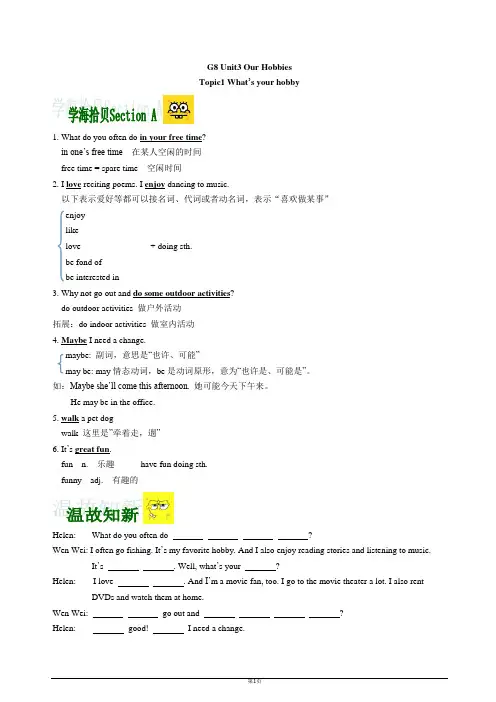
G8 Unit3 Our HobbiesTopic1 What’s your hobby1. What do you often do in your free time?in one’s free time 在某人空闲的时间free time = spare time 空闲时间2. I love reciting poems. I enjoy dancing to music.以下表示爱好等都可以接名词、代词或者动名词,表示“喜欢做某事”enjoylikelove + doing sth.be fond ofbe interested in3. Why not go out and do some outdoor activities?do outdoor activities 做户外活动拓展:do indoor activities 做室内活动4. Maybe I need a change.maybe: 副词,意思是“也许、可能”may be: may情态动词,be是动词原形,意为“也许是、可能是”。
如:Maybe she’ll come this afternoon. 她可能今天下午来。
He may be in the office.5. walk a pet dogwalk 这里是”牵着走,遛”6. It’s great fun.fun n. 乐趣have fun doing sth.funny adj. 有趣的Helen: What do you often do ?Wen Wei: I often go fishing. It’s my favorite hobby. And I also enjoy reading stories and listening to music.It’s . Well, what’s your ?Helen: I love . And I’m a movie fan, too. I go to the movie theater a lot. I also rent DVDs and watch them at home.Wen Wei: go out and ?Helen: good! I need a change.I.单项选择1. , I read books at home or travel around the country.A. In my spare timeB. On my spare timeC. At my free timeD. For my free time2. --- Hello, Sam! What’s your hobby?--- .A. I am a doctorB. I love listening to musicC. I like it very muchD. It’s interesting.3. --- What’s your hobby?--- My hobby is toys.A. collectB. collectingC. collectsD. playing.4. --- Where is Maria?--- I am not sure, she is in the school library.A. may beB. maybeC. mayD. might5. Mike enjoys stamps, not coins.A collecting B. to collect C. collected D. collects6. --- Why not fly kites with me tomorrow?--- I’m sure we’ll have a good time.A. Sounds good.B. Sounds boring.C. Sorry. I’m busy.D. Because I have no time7. What else are you of collecting?A. likeB. lovesC. fondD. enjoyed8. --- Where is my English book?--- it’s in your bag or it in your desk.A. Maybe; may beB. Maybe; maybeC. May be; maybeD. May be; may beII. 根据句意及首字母提示补全单词。
最新仁爱版英语八年级上册Unit3 Topic1知识点 完整版
Unit3 Topic1SectionA语法:过去常常做某事used to do sth(各种句式变化)区分①used to do sth过去常常做某事②be/get used to doing sth.习惯做某事③be used to do sth.=be used for doing sth.被用来做某事例如:①I used to hate climbing hills,but now I love it.②We are used to getting up early.③Wood is used to make paper.1.在某人的空闲时间in one’s free time=in one’s spare time2.去钓鱼go fishing 去旅游go traveling3.你的爱好是什么?What’s your hobby?喜欢做某事(6个)like/love/enjoy/prefer/be fond of/be interested in doing sth.4.听音乐listen to music5.做某事是有趣的be fun to do sth.6.为什么不做某事?Why don’t you +V原=Why not +V原7.做一些户外活动do some outdoor activities8.听起来sound为系动词,后跟形容词构成系表结构。
9.需要一个改变need a change10.随着音乐跳舞dance to music11.遛狗walk a pet dog12.集邮collect stamps13.种花plant flowers 浇花water flowers14.爬山climb mountainsUnit3 Topic1 SectionB1.集邮collect stamps 邮票集stamp collection2.想要做某事would like to do sth.=want to do sth.=feel like doing sth.3.感叹句what+名词①What beautiful stamps!②What fine weather!③What a nice girl!4.许多a lot of=lots of后跟可数名词复数或不可数名词5.三种推测①肯定推测must be(必定是)②可能性推测may be(可能是)③否定推测can't be(不可能是)6.向…学习learn…from学习做某事learn to do sth.7.你过去常常有什么爱好?What hobbies did you use to have?I used to collect baseball cards.过去常常做某事used to do sth.I used to go fishing.(否定句)I didn’t use to go fishing.(一般疑问句)Did you use to go fishing?Yes,I did/No,I didn,t.8.康康来了。
仁爱版英语八年级上册u3t1知识点
仁爱版英语八年级上册u3t1知识点本文将为大家介绍仁爱版英语八年级上册 Unit 3 Topic 1 的知识点。
该部分内容主要涉及基本单词、词组、句子及语法知识。
下文将分别进行介绍。
一、基本单词1. 动词:1)inflict:v. 使遭受痛苦,使受惩罚2)limit:v. 限制,约束,限定2. 名词1)struggle:n. 奋斗,斗争,努力2)limitation:n. 限制,局限性3. 形容词1)fierce:adj. 凶猛的,猛烈的,狂热的2)pathetic:adj. 可怜的,悲哀的,引起怜悯的二、词组1. inflict punishment on sb.:对某人施加惩罚2. limit sb./sth. to sth.:将某人/某事物限制在某种程度上3. struggle for sth.:为某事物而奋斗4. pathetic sight:可怜的景象5. in fierce competition:在激烈竞争中三、句子1. The cruel dictator inflicted severe punishment on those who opposed him.2. The teacher limited the number of words the students could usein their essays to 500.3. Many people struggle for their dreams all their lives.4. The beggar on the street was a pathetic sight to behold.5. The two companies were in fierce competition for the market share.四、语法知识1. To 形式的不定式在英语中,to 形式的不定式可以当作名词、形容词或副词使用。
仁爱版八年级英语上册Unit 3 Topic 3 重点知识点总结
仁爱版八年级英语上册Unit 3 Topic 3 重点知识点总结一,词组:1,answer questions回答问题2,take a shower/bath洗澡3,serve the food端上饭菜4,chat with与...聊天5,a piece of news一条新闻6,agree with sb同意某人的看法7,a useful book一本有用的书8,practice doing练习做某事9,hold the line不挂电话线10,answer the phone接电话11, at this time yesterday昨天的这个时候12,call sb to do sth打电话叫某人做某事13,wash clothes洗衣服14,do some cleaning做打扫15,a basketball game/match一场篮球比赛16,in a low voice低声地说17,beat sb/团队:打败某人或团队18,wake up醒来19,solve the problem解决问题20,laugh at sb嘲笑某人21,make faces at朝...做鬼脸22,on the last evening of the year旧历年的最后夜晚23,get together团聚24,in one’s hands在某人手中25,pass by经过26,fall down掉下,摔倒27,be afraid to do/of doing sth害怕做某事28,warm sb up使某人温暖29,go out 熄灭30,light a fourth match又划一根火柴31,take sb with sb把某人带上32,lie against the wall靠着墙躺33,knock at/on敲34,enjoy the moon赏月35,at church在教堂36,in the 1800s在19世纪37,stop doing sth停止做某事38,stop to do sth停下来做另一件事39,on Monday mornings在周一早上40,keep the door closed保持门关着二,重点句子:1,The telephone rings while she is practicing the violin.当她正在练习小提琴时,电话响起了。
仁爱英语八年级上册Unit3知识点总结
仁爱英语八年级上册Unit3知识点总结Unit3 Our HobbiesTopic1 What’s your hobby?【重点短语】1.in one’s free/spare time在某人空闲时间2.go fishing 钓鱼3.do some outdoor activities 做一些户外活动4.why not +v.=why don’t you + v.5.enjoy/like/love doing sth. 喜欢做某事be interested in doing 对做某事感兴趣be fond of doing sth. 喜欢做某事prefer doing sth. 更喜欢做某事6.stamp collection 邮票收集7.learn…from…从……中学习ed to do sth. 过去常常做某事be/get used to (doing0 sth. 习惯于做某事9.get started 着手,开始10.start/begin with…以……开始11.cut out 剪下12.stick…to…把……粘贴到……上13.share sth. with sb. 与某人分享某物14.finish school 毕业15.provide sb. with sth.= provide sth. for sb.为某人提供某物16.take/have a bath 洗澡17.whether…or not…是否18.recite poems 背诗【重点句型】1.What do you often do in your free time?你空闲时间经常做什么?2.--Why not go out and do some outdoor activities?--Sound good! Maybe I need a change.--为什么不出去做一些户外活动呢?--听起来不错,也许我需要改变。