
人教PEP版五年级上册英语Unit 6 说课稿
Unit 6 In a Nature Park 说课稿一、说教学内容今天我说课的内容是PEP 小学英语五年级上册Unit 6 In aNature Park的第四课时,主要学习bridge, house, road, building, tree, village, city七个新词。
并能够运用句型There are / is ,in the city / village,描述城市、乡村的景物。
二、说教材本节课是单词教学。
它是在学生初步学习了A部分的单词和句型“There is…之后进行教学的。
通过学习新词,感知句子There are…本课时容量大,但难度不大,并受到学生的喜爱,在课前我会让学生准备一副自己家乡的简笔画。
三、说教学目标《英语课程标准》指出:激发和培养学生学习英语的兴趣,使学生树立自信心,养成良好的学习习惯和形成有效的学习策略,发展学生自主学习的能力和合作精神是小学英语教学的基本任务。
在认真分析教材的基础上,我针对学生实际,将本课时的教学目标确定如下: 知识目标1、能够听、说、读、写单词bridge, house, road, building, tree.2、能够听、说、认读单词city, village能力目标能够运用句型There are / is … in the city / village,描述城市、乡村的景物。
情感目标培养学生热爱家乡,热爱环境的情感。
四、说教学重点1、掌握Let’s learn中的七个有关自然景物的单词bridge, house, road, building, tree, village, city ,其中前五个单词要求听、说、读、写四方面掌握。
2、在情景中理解单词的同时掌握句型There is / are…,能恰当地用此句型简单描述城市和村庄的景物There are … in the city / village. ,结合句型教师引导学生替换单词,描述周围事物,如:教室、校园等,从而进一步运用句型。
五、说教学难点1、如何利用所提供的情景以旧引新,让学生进入运用语言的状态。
2、名词复数的运用和读音。
六、说教法、学法小学英语教学应把培养学生的学习兴趣,调动学生学习英语的主动性、积极性作为教学的主要目的。
在本课教学中以情景教学为主。
并通过游戏、竞赛、简笔画等形式激发学生的兴趣,使每位学生都能积极地参与进来。
七、说教学过程(一)热身1、通过let’s chant,激发学生学习的兴趣教育家托尔斯泰说过:“兴趣是推动学生学习的强大动力,是学生参与教学活动的基础。
激发学生参与学习的兴趣,是新课导入的关键。
节奏感较强的chant,往往给学生带来新意、亲切的感觉,不仅能使学生迅速地兴奋起来,而且还会使学生把学习当成一种自我需要,自然地进入学习新知的情景。
因此,在热身的时候,首先让学生跟着录音一起chant能很快吸引住学生,同时还渲染了学生学习英语的良好气氛。
2、对话引入,促进语言实际运用能力的提高教师要真心诚意地把学生当成学习的主人,努力提高“导”的艺术,从而在教学中恰到好处地去启发、点拨、尽可能地给学生创造语言的实际运用机会。
因此,我在这个环节引导学生练说There be 句型,复习A部分已学国的四会单词以及句型,同时也为新知做好铺垫。
(二)呈现新知,合作互动。
Step1我会说Today,I will introduce my hometown to you .并通过简笔画创设情景,一边复习前面所学的单词,一边通过简笔画用there is\are引出本课的生词:bridge, house, road, building, tree。
Step2在操练时,我首先进行了一些机械的练习,如:“Listen, point and repeat. ”听音、指词、跟读,“Can you help me?”你能帮助我拼出单词吗?让学生对单词有初步的认识和印象。
Step3(体现任务型教学)指着简笔画再次用there is\are 描述我的家乡,并解释何时there is 何时用there are然后让学生拿出课前准备好的简笔画,以四人为以小组通过there is\are在句子中操练同时学会感知“There are…”句型,做到“词不离句,句不离词”,重视对学生思维,观察能力的培养,特别是对学生合作学习能力的培养,让学生们们在师生,生生,小组等不同的合作方式中,学会倾听,学会评价,而在这一过程中我将参与到他们的讨论中,为他们排疑解难提供帮助。
Step4小组为单位运用there is \are 向全班同学描绘自己的家乡。
教师给出适当的评价(以表扬为主)Step5情感提升,出示农村和城镇两张图片让学生讨论:I like village because there is \ are …或者I like city because there is \ are …培养学生热爱家乡爱护环境的情怀。
(三)课后作业1、用there is \ are 向父母介绍家乡。
2、完成作业本中的单词抄写练习。
五年级上册英语知识点归纳Unit 1 W hat’s he like?1.描述人的外貌单词old 老的 young 年轻的 tall 高的 short 矮的fat 胖的 thin 年轻的2.描述人的性格的单词kind 和蔼的 strict 严厉的 polite 有礼貌的 clever 聪明的hard-working 努力的 helpful 乐于帮助人的3.重点句型(1)---Who’s your English/ music/art/science/maths/Chinese teacher?(谁是你的英语/音乐/美术/科学/数学/语文老师?)---Mr. /Miss./Mrs./Ms. Jones. 琼斯先生/琼斯小姐/琼斯太太/琼斯女士(2)---What’s she/he like? ---She/He is clever.对人的性格和外貌提问,可用上面表示外貌和性格的单词回答。
(3)---Is he/she strict? 他/她严厉么?肯定回答Yes, he/ she is. 是,很严厉。
否定回答No, he/ she is n’t. 不,不严厉。
Unit 2 My week1.星期一到星期天首字母要大写。
Monday 星期一(Mon.) Tuesday 星期二(Tues.) Wednesday 星期三(wed.)Thursday 星期四(Thur.) Friday星期五(Fri.) Saturday 星期六(Sat.)Sunday 星期天(Sun.)2.watch TV 看电视 do homework 家庭 read books 看书wash my clothes洗衣服 play football踢足球3.本单单元重点学习怎样问星期及怎样回答。
今天是星期几? What day is it today?今天是星期一。
It’s Monday.4.问星期的某天常干什么事及回答。
你星期六常干什么? What do you often do on Saturday?我常做家庭作业. I often do homework.你们星期三常上些什么课? What do you have on Wednesday?我们上语文、数学和英语. We have Chinese math and English.3. What about you? 那你呢?(用于来问别人同样的问题而又不重复前面的问句。
)4. John likes Mondays and Fridays, because he likes P.E.Unit 3 What would like?1.食品类(hungry 饿的时候吃eat)ice cream 冰淇淋 hamburger 汉堡包 sandwich 三明治 salad 沙拉2.饮料类(thirsty 渴的时候喝drink)tea 茶 milk 牛奶 juice 果汁 water 水3.形容味道类单词delicious 好吃的 healthy 健康的 fresh 新鲜的 sweet 甜的 hot 辣的4.吃饭时,询问他人想吃和想喝什么时,----What would you like to eat/drink? (你想要吃喝什么?)----I’d like a sandwich/hamburger/ an ice cream, please(我想要一个三明治/汉堡/冰淇淋.)tea/milk/juice/water , please. 我想要点茶/牛奶/果汁/水。
注意:可数的食物也可以在前面加上数字,表示几个如:I’d like two hamburgers/three sandwiches/five ice creams, please.我想要两个汉堡/三个三明治/五个冰淇淋.5.当你想知道你朋友或父母最爱吃的食物或最爱喝的东西是什么时,---What’s your favourite food/drink?---Ice cream. It’s sweet./ Salad. It’s healthy.Unit4 What can you do?1.我们的才艺爱好dance 跳舞 draw cartoons 画漫画 do kung fu 练武术sing English songs 唱英语歌 play the pipa 弹琵琶swim 游泳 speak English 说英语 cook 烹饪play basketball打篮球 play ping-pong 打乒乓球注意:乐器名词前要加the,但是球类名词前不加the。
2.当举办宴会时,调查同学们会什么时,可以这样问:---what can you do for the party? (你能为聚会做什么?)---I can dance/do kung fu/ play the pipa. (我会跳舞/打武术/弹琵琶。
)3. ---Can you swim/cook/play ping-pong? (你会游泳/烹饪/打乒乓球吗?)----Yes.,I can./ No, I can’t. 是的,我会。
/不,我不会。
Unit5&Unit61.there be句型包括:(1)单数形式(只有) there is a/an…..+名词单数如:There is a clock/bike/photo/plant/water bottle.(这里有一个钟/自行车/相片/水瓶)There is an apple/egg.( 这里有一个苹果/鸡蛋)(2)复数形式(两个及以上的)There are +具体数字(two/three)/many/some+名词复数如:There are two bikes. 这里有两辆自行车。
人教版PEP五年级上册英语《Unit6 In a nature park-2》说课稿
人教版PEP五年级上册英语《Unit6 In a nature park-2》说课稿一. 教材分析《人教版PEP五年级上册英语》Unit6《In a nature park-2》是一节会话课。
本节课的主要内容是学习关于在自然公园里看到的景物和动物的词汇和句型。
学生将通过听、说、读、写的实践活动,进一步巩固和运用已学的语言知识,提高语言运用能力。
教材通过生动有趣的故事情境,引导学生理解和掌握单词和句型,并在真实语境中运用所学知识进行交流。
二. 学情分析五年级的学生已经具备了一定的英语基础,能够听懂并运用一些简单的英语句子进行交流。
但是,他们的英语听说能力参差不齐,部分学生对英语学习仍存在恐惧心理。
因此,在教学过程中,教师需要关注学生的个体差异,尽量调动学生学习的积极性,提高他们的英语听说能力。
三. 说教学目标1.知识目标:学生能够听懂、会说、会读本节课的主要词汇和句型,如“trees, flowers, lake, parrot, panda, snake”等。
2.能力目标:学生能够在真实情境中运用所学知识进行交流,提高语言运用能力。
3.情感目标:培养学生热爱大自然、保护环境的意识。
四. 说教学重难点1.教学重点:学生能够听懂、会说、会读本节课的主要词汇和句型。
2.教学难点:学生能够在真实情境中运用所学知识进行交流,特别是对部分后进生,需要教师给予更多的关注和引导。
五. 说教学方法与手段1.教学方法:采用情境教学法、交际教学法、任务型教学法等,让学生在真实情境中学习、运用英语。
2.教学手段:利用多媒体课件、图片、实物等辅助教学,提高学生的学习兴趣和参与度。
六. 说教学过程1.导入:教师通过展示自然公园的图片,引导学生谈论他们在自然公园里的所见所闻,激发学生的学习兴趣。
2.新课呈现:教师通过播放教材中的动画视频,让学生听懂并模仿其中的句子和词汇。
3.操练:教师学生进行小组活动,让学生在真实情境中运用所学知识进行交流。
人教版小学五年级英语全英说课模板
PEP 小学英语五年级下册中英文说课稿Good morning! My respected judges! It is a great honor to have a chance to stand here and talk to you today. What I am going to talk about is Unit Six------Work quietly---- in the PEP Primary English Students’ Book Grade Five.一、Analysis of textbookThe ma in topic in this unit is ‘Work quietly’. By presenting the scene of Tom and John talking in the library, the textbook enables students to perceive the semantic and pragmatic situations of the above sentence patterns. On the basis of reviewing the core language of Part A, dialogues should be expanded to learn new dialogues.(教材通过呈现Tom和John在图书馆交谈的情景,让学生感知上述句型的语义和语用情景。
对话在复习A部分核心语言的基础上,扩展学习新的语言对话)二、Teaching aims1.Aims on the knowledge: Be able to listen, read and write talk quietly, keep your desk clean . Understand the main idea of the dialogue, read aloud skillfully and perform the roles.(理解对话大意,熟练朗读并进行角色表演)2. Aims on the ability: Be able to use the words and sentence patterns learned to express what you should do on a given occasion.(能够用所学词汇和句型,表达在某个场合应该做的事情)3. Aims on the emotion: Develop the students' interests in studying English. Cultivate students' common sense of civilized etiquette and its expression in English. 培养学生的文明礼仪常识,以及在英语中的表达.三、Important Points and Difficulties in this lesson1.Be able to master the phrases and sentences. such as quietly, anything, keep your desk clean.2.Be able to use the words and sentence patterns learned to express what you should do on a given occasion.四,Preparations in this lessonSome pictures of public signs PPT五、Teaching Methods and studying methods1.Situational Teaching MethodDuring the teaching procedure, I make several situational conversations for the students. For example, I choose some students to do therole-playing game, and let them play the roles in the textbook, and make their own conversation by themselves according to their reality. By doing this game, the students can have chances to practice their oral English and join into the teaching procedure.(二) Interactive Teaching MethodGuessing game is one of activities in my teaching procedure. For example, the teacher makes body gestures, and the students guess what the gestures mean. By the interaction between teacher and students can avoid just the teacher’s talking, als o can activate atmosphere of the class, and let them learn English by games.(三) Task-based Teaching MethodIn the first lesson, I design a task for the students, for example. I ask the students to draw four pictures in spring, summer, fall and winter and put the words on the pictures. By doing this activity, the students can memorize the new words better.(四) Group Study MethodI divide the class into four groups and each group has its own name. Group study plays a very important role my lesson. By doing this, the students can study English in competitive cooperation.(五) Practice MethodPractice is very important. The students can not improve their English without practice, because practice makes perfect. By doing practice, the students can make full use of what they have learned in the class.三、 Teaching procedures(一)Warm-up(1) Guessing gameIn warming-up step, after the teacher and students greet each other, the teacher begins to make body gestures on weather, such as cold, hot, warm, cool, rainy, windy, cloudy and so on., and asks the students what is the weather like now. And the students guess what kind of weather it is. Suchas making a hot weather gesture, the teacher keeps fanning with his hand; making a cold weather gesture, and the teacher keep shaking. Any student guesses the right answer will be awarded a red star for his group. This step helps students go over some words on weather, and makes preparation for the new lesson.(二) Lead-in(1) Learning the new wordsThe teacher takes out four typical pictures in spring, summer, fall and winter, and sticks them on the blackboard. Then the teacher asks the students what season is it, and puts the word ‘season’ on the blackboard, and teaches the students how to read it. Then the teacher points at spring picture, and asks students what season it is. The students may not know the word ‘spring’, but they can answer it “Chuntian” in Chinese, then the teacher writes down the word ‘spring’below the picture, and teaches them how to read it. Using the same way, the teacher teaches other new words. After that the teacher invites some students to stand up and read the new words several times.(2) Guessing GameIn this step, the students put the new words into practice. The teacher chooses a volunteer, and shows him a picture of tree, and he draws the picture, and other students guess what season it is based on the picture the volunteer draw. Anyone who guesses right will be awarded a red star for his group. Every group has one chance to answer the question.(3) Task: Drawing picturesIn this step, the teacher requires every student drawing four pictures in spring, summer, fall and winter, and putting the new words on them.(4) Showing the mapIn this step, the teacher takes out a big map, and sticks it on the blackboard, and shows the students some cities on the map, such as Lhasa, Beijing, Shenzhen, Kunming, Harbin, and Jianshui, and begins another Guessing game: the teacher asks “what is the w eather like inLhasa/Shenzhen/Kunming/Harbin/Jianshui in spring/summer/fall/winter”. The students use “it is windy/sunny/warm/cold/hot/warm/cool” answering the questions. Anyone who guesses right will be awarded a red star for his group.(5) Role-playingIn this step, I choose some students to do the role-playing game, and let them play the roles in the textbook, and make their own conversation by themselves according to their reality. Each group at least makes a conversation. Such as:Converstion1A: which season do you like best?B: winterA: why do you like winter?B: Because I like snows.Conversation 2A: what is your favorite season?B: I like summer.A: why do you like summer?B: Because I like swimming.Anyone who does well will be awarded a red star for his group.(6) Let’s chantThe teacher plays the tape of Let’s chant, and the students follow the tape to chant together for two time. Then the teacher explains what the chant means. And chant it again.(7) Counting the red stars of each groupCongratulations to the winner group, and give them applauses.(8) HomeworkEach student is required writing the new words and four sentences patterns two times.(9) Blackboard writing planUnit 2 What is your favorite season1. Season, spring, summer, fall, winter.2. What is your favorite season/which season do you like best. I like..... 3.Why do you like ….? Because…….4. What is the weather like in …..? It is …….5. What season is it? It is ……四、My teaching plan conceptsLet students study English in situational conversation; let students study English competitive cooperation; let students study English in happiness; Let students have no fear in studying English.。
小学英语五年级上册Module 6 Unit 1说课稿

小学英语五年级上册Module 6 Unit 1说课稿一、说教材1、教材内容我说课的内容是小学英语三年级起始外研版第五册Module 6 Unit 1 You can play football well. 本单元是围绕can句型和各种常见运动展开的一系列话题,本模块要让学生了解和学习有关评价,肯定和鼓励的表达法,是对以前学过的关于能力的相关知识的拓展和延伸。
本单元通过Lingling加入足球队一事,让学生学会简单的自我评价和肯定与鼓励他人,进一步学会表达I can…well,You can…well.另外,在本课学习并运用几个新的动词短语,control the ball,catch the ball.本课时共分为三个部分,第一部分,新知识的学习,这部分主要为学生提供一些有助于本课新知识学习的素材(如:chant,图片,句子等),让学生能够循序渐进的掌握新知识。
第二部分,课文的学习,在第一部分的基础上,将学生学到的新知识运用到真是的生活场景中去。
第三部分,联系,主要培养学生学以致用的能力,复习句型I can… well,Can you… ? 和回答Yes , I can ./No , I can’t .培养学生语感,复习前面所学内容及运用语言表达的能力。
二、学生分析五年级大部份学生以前学会了run fast,jump high ,jump far,, play football ,play basketball,play table-tennis等动词短语,由于长时间没有温故而新,部份学生已遗忘了,这给本课的学习带来一定的困难,需3—5分钟复习。
三、说目标1、教学目标依据新课标要求本课的内容和学生现有的认知水平我确定以下教学目标:知识目标:能够听、说、读、写本课生单词well ,team ,control ,badly ,really ,catch ,fantastic ;熟悉运动类动词词组;掌握can句型I can …./Can you…并能做出准确回答Yes ,I can ./No , I can’t .技能目标:能综合运用所学语言进行交流,将新学词汇运用到句型中,发展学生自主学习的能力。
人教PEP版英语五下Unit6《Workquietly》说课稿
人教PEP版英语五下Unit 6《Work quietly》说课稿一. 教材分析《人教PEP版英语五下Unit 6 Work quietly》的主要内容围绕着在图书馆、教室等安静场所要注意安静的主题展开。
通过本节课的学习,学生能够掌握有关场所的词汇,如library, classroom, office等,以及相关的动词短语,如work quietly, talk quietly等。
同时,学生还能够学会如何用英语表达在公共场所要注意安静的规则。
二. 学情分析五年级的学生已经具备了一定的英语基础,能够听懂并运用简单的英语进行交流。
但是,对于一些复杂的句子结构和词汇,学生可能还有一定的困难。
因此,在教学过程中,我们需要注重引导学生通过观察、思考、实践等方式来掌握知识,提高他们的语言运用能力。
三. 说教学目标1.知识目标:学生能够听懂、说准、会写本节课的主要词汇和句型,如library, classroom, office, work quietly, talk quietly等。
2.能力目标:学生能够在真实情境中运用所学知识进行交流,提高他们的口语表达能力。
3.情感目标:培养学生养成在公共场所注意安静的好习惯,增强他们的社会公德意识。
四. 说教学重难点1.重点:学生能够准确地掌握本节课的主要词汇和句型,并在实际情境中进行运用。
2.难点:学生能够正确地使用动词短语work quietly, talk quietly等,并在句子中进行适当的调整。
五. 说教学方法与手段在本节课的教学过程中,我将采用任务型教学法、情境教学法和交际教学法等方法,引导学生通过观察、思考、实践等方式来掌握知识。
同时,我会运用多媒体课件、图片、实物等教学手段,激发学生的学习兴趣,提高他们的学习积极性。
六. 说教学过程1.热身(5分钟):通过歌曲、游戏等方式,引导学生复习旧知识,激发他们的学习兴趣。
2.呈现(10分钟):通过图片、实物等,展示本节课的主要词汇和句型,引导学生进行观察和思考。
pep小学英语五年级上册说课稿

在课前我播放本课时需要听懂、学会的歌曲“My new teachers”,让学生初步感知本单元的新语言。接着,再放第2页中Let’s chant的录音,让学生听歌谣猜猜本单元的课题,激发学生对新学期第一单元英语学习的兴趣。然后再播放三年级下册第六单元中的Let’s do ,师生一起边说边做动作:tall, tall, tall, Make yourself tall; short, short, short , Make yourself short. Big, big, big, Make your eyes big; Long , long , long, Make your arms long…复习以前曾经学过的有关人物体貌特征的形容词。让学生对本课的主要内容有个初步印象。
根据学生已有的认知基础及本课在单元中的地位及作用,依据小学英语教学的总体目标,结合小学英语词汇教学的特点,我确立本课的教学目标为:1、能听懂部句:Who’syour art teacherWhat’s he like并能正确作答。2、能够听、说、读、写单词:old, short, thin , tall, strong. 并能一上下文中理解其意思。 3、能够听懂指示语,并按照指令完成Let’s find out 中的简单任务,找出正确的画面。4、能够听懂、会唱歌曲“My new teachers”. 本课时的教学重点是Let’s learn 部分的单词:old , short, thin, tall, strong, young, funny, kind.要求学生在学习过程中能结合所给句型替换关键词,在情境中学习新单词,并逐步学会听、说、读、写单词:old, short, thin , tall, strong.
人教PEP版五年级英语上册《Unit6》精品教案教学设计小学优秀公开课
人教PEP版五年级英语上册第六单元教案Unit6 In a nature park 教学设计
学科:英语年级:五年级主备人:
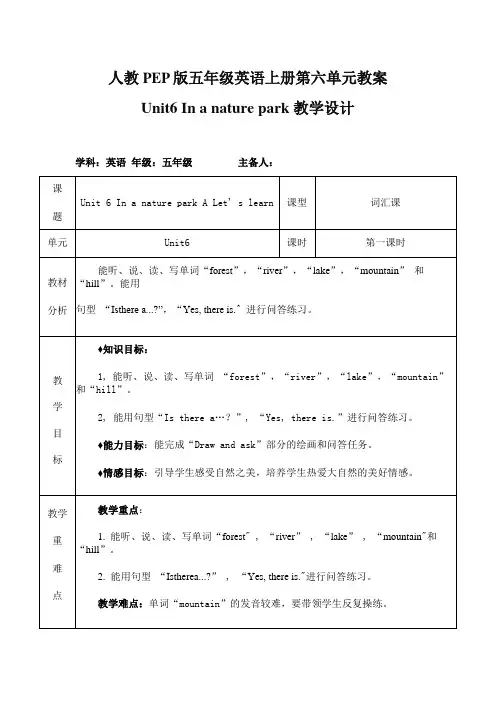
设计意图:用简笔画的方式在黑板上逐渐画出自然公园图,给学生一个整体的印象;通过多媒体课件,用直观的方式带领学生领略自然公园之美,能激发学生的学习热情,为本节课乃至本单元的学习奠定一个良好的基调。
(2)教师带领学生读几遍单词,在带读的时候要将单词“mountain"的发音读清楚,并及时帮助学生纠正错误的发音。
(3)教师指着黑板上自然公园中的河流,问:“Is there a river in the park?",引导学生回答:“Yes, there is.”。
(4)教师播放教学录音,全班学生跟着录音读,提醒学生在跟读的过程中注意模仿录音中的语音、语调。
(5)学生同桌合作,替换对话中的关键词编写新对话,然后请几位学生上讲台表演。
(三)趣味操练(Practice)
1.看口型猜单词。
(音的操练)
2.Draw and ask.
(1)学生同桌合作,拿出画笔和画纸,画出一个自然公园图。
(2)学生同桌合作,用句型“Is there a ... in front
of/beside/behind/. . . the…?”进行问答练习。
(四)输出运用(Production)
板书设计
学科:英语年级:五年级主备人:。
人教版PEP五年级上册英语《Unit6Inanaturepark-6》说课稿
人教版PEP五年级上册英语《Unit6 In a nature park-6》说课稿一. 教材分析《人教版PEP五年级上册英语》Unit 6的主题是“In a nature park”,这部分内容主要围绕自然公园展开,通过描述公园中的不同景物和活动,让学生学会使用一般现在时描述事物的特征和人的行为。
本节课的内容包括公园中的动物、植物以及人们在公园中的活动,如骑自行车、散步、拍照等。
教材通过丰富的插图和情景对话,让学生在真实的情境中学习英语,提高他们的语言运用能力。
二. 学情分析五年级的学生已经掌握了基本的英语语法和词汇,具备一定的听说读写能力。
他们在学习新知识时,善于观察和模仿,对生动有趣的事物充满好奇。
然而,部分学生可能在口语表达和句子结构方面还存在一定的困难。
因此,在教学过程中,教师需要关注学生的个体差异,创设良好的语言环境,激发学生的学习兴趣,帮助他们提高英语水平。
三. 说教学目标1.知识目标:学生能够听懂、会说、会读本节课的主要词汇和句子,如动物、植物、公园活动等。
2.能力目标:学生能够在真实情境中运用所学知识进行交流,提高他们的语言运用能力。
3.情感目标:培养学生热爱大自然、保护环境的意识。
四. 说教学重难点1.重点:学生能够掌握本节课的主要词汇和句子,并能熟练运用。
2.难点:学生能够正确运用一般现在时描述事物的特征和人的行为。
五. 说教学方法与手段本节课采用情境教学法、交际法、任务型教学法和分组合作学习法。
通过多媒体课件、图片、卡片等教学手段,创设生动、有趣的学习情境,激发学生的学习兴趣。
六. 说教学过程1.热身(5分钟)教师与学生进行简单的英语对话,检查学生的英语水平。
然后,引导学生谈论他们喜欢的公园,引入本节课的主题。
2.呈现(10分钟)教师通过展示公园的图片,引导学生说出公园中的动物、植物和活动。
同时,教授本节课的主要词汇和句子。
3.操练(10分钟)学生分组进行角色扮演,运用所学知识进行对话。
五年级上册英语第六单元教案
五班级上册英语第六单元教案五班级上册英语第六单元教案11、能够识别单词:list airport shoe ticket toothbrush.2、学习目标语句:Where are you going to go What are you going to take When are you going to go Who’s going to go with you3、功能:能够谈论旅行前的预备和具体事宜。
教学重点:1、把握新单词,并能够理解旅行所预备的物品。
2、能够口头运用Where are you going to go What are you going to takeWhen are you going to go to the airportWho’s going to go to the airport这类问句就具体信息提问。
教学难点:能够和同学用“where、what、when、who〞这四个单词开头的疑问句谈论旅行前的准备。
教学用具:录音机、PPT教学过程:Step1、Warm-up师生之间相互问候Step2、Presentation Free talkT:the summer holiday is coming ,so Where are you going to go in yoursummerholidays When are you going to go there What are you going to take What are you going to do there Who is going to go with you (生逐一答复后,师总结):I think you had a lovely time, Yes 由此活动引出Where, When, What, Who等特殊疑问词,并带着同学们复习一般将来时的用法。
教学目标:1、能够识别单词:list airport shoe ticket toothbrush.2、学习目标语句:Where are you going to go What are you going to take When are you going to go Who’s going to go with you3、功能:能够谈论旅行前的预备和具体事宜。
人教版PEP五年级上册英语《Unit2Myweek第六课时》说课稿
人教版PEP五年级上册英语《Unit 2My week第六课时》说课稿一. 教材分析《Unit 2 My week》是人教版PEP教材五年级上册的一单元,本课时为该单元的第六课时。
本课时主要讲述了关于日常活动的一些话题,通过学习,学生能够听懂、会说、会读关于日常活动的一些词汇,如:weekend, swim, read, write等。
同时,学生能够运用所学的词汇和句型描述自己的日常活动,从而提高他们的语言运用能力。
二. 学情分析五年级的学生已经掌握了基本的英语语法和词汇,他们对学习英语有着浓厚的兴趣。
但是,部分学生的发音不够准确,需要老师在课堂上进行纠正。
此外,部分学生对于如何运用英语描述自己的日常活动还有一定的困难,需要在课堂上进行引导和练习。
三. 说教学目标1.知识目标:学生能够听懂、会说、会读关于日常活动的一些词汇,如:weekend, swim, read, write等。
学生能够运用所学的词汇和句型描述自己的日常活动。
2.能力目标:学生能够流利地进行日常英语对话,提高他们的语言运用能力。
3.情感目标:通过学习,学生能够培养对英语学习的兴趣,增强自信心。
四. 说教学重难点1.重点:学生能够听懂、会说、会读关于日常活动的一些词汇,如:weekend, swim, read, write等。
学生能够运用所学的词汇和句型描述自己的日常活动。
2.难点:学生能够熟练地运用所学的词汇和句型进行日常英语对话。
五. 说教学方法与手段1.教学方法:采用任务型教学法,通过设置不同的任务,激发学生的学习兴趣,提高他们的语言运用能力。
2.教学手段:利用多媒体课件、图片、卡片等教学辅助工具,帮助学生更好地理解和记忆所学内容。
六. 说教学过程1.热身(5分钟):通过播放英语歌曲,让学生放松心情,营造英语学习氛围。
2.导入(10分钟):老师向学生问候,询问他们上周的活动,引出本课的主题——日常活动。
3.呈现(15分钟):老师通过展示图片、卡片等教学辅助工具,呈现本课的主要词汇和句型,让学生进行观察和思考。
unit6Howmany说课稿
、Unit 6 How many?Part B Peiod 1 说课稿一、教学内容今天我说课的内容是《新标准英语》小学三年级下册Unit 6 How many?Part B Period 2.二、教材分析大家都知道PEP版英语以话题为纲,以交际功能和语言结构为主线,引导学生运用英语完成有实际意义的语言任务,即话题—结构—任务。
本课时分Let's learn、Let's talk、Let's chant 和Let's find out四个部分。
Let's learn部分主要是教学数字单词16~20,并学习句子----How many cars do you have? ----We have twenty. Let's chant部分是为了练习第一课时所学的Let's talk和第二课时Let's learn部分的内容,提供给学生一个在实际生活中运用语言的机会。
借助任务型教学采用多样化的教学手段将听、说、玩、演、练溶于一体,激发学生学习英语的兴趣和愿望,发展自主学习的能力,形成初步用英语能够进行日常对话的能力。
并通过一系列的课堂活动,创设语境巩固、练习这三个方位介词。
三、教学目标《英语课程标准》指出:激发和培养学生学习英语的兴趣,使学生树立自信心,养成良好的学习习惯和形成有效的学习策略,发展学生自主学习的能力和合作精神是小学英语教学的基本任务。
在认真分析教材的基础上,我针对学生实际,将本课时的教学目标及重,难点确定如下:1、教学目标(1)知识目标:A、学习数词:seventeen,eighteen,nineteen,twenty。
B、能听懂、会说句子:How many cars do you have? I have twenty.C、能听懂、会说chant。
(2)能力目标:能熟练地用英语表演Let's talk.(3)情感目标:能够大胆地和同学进行交流,在游戏和表演中培养学生积极思考的习惯,使学生能够大胆表演。