
2021考研复习2020年英语(二)全国硕士研究生招生考试参考答案及解析
2021年全国硕士研究生入学统一考试 英语(二)真题+解析答案

2021年全国硕士研究生入学统一考试英语(二)(科目代码:204)考生注意事项1. 答题前,考生须在试题册指定位置上填写考生编号和考生姓名;在答题卡指定位置上填写报考单位、考生姓名和考生编号,并涂写考生编号信息点。
2. 选择题的答案必须涂写在答题卡相应题号的选项上,非选择题的答案必须书写在答题纸指定位置的边框区域内,写在其它地方无效。
3. 填(书)写部分必须使用黑色字迹签字笔或钢笔书写,涂写部分必须使用2B铅笔填涂。
4. 考试结束,将答题卡和试题册一并装入试题袋中交回。
Section ⅠUse of EnglishDirections: Read the following text. Choose the best word(s) for each numbered blank and mark A, B, C or D on the ANSWER SHEET. (10 points)It's not difficult to set targets for staff. It is much harder, ___1___ to understand their negative harder, consequences. Most work-related behaviors have multiple components. ___2___ one and the others become distorted.Travel on a London bus and you’ll ___3___ see how this works with drivers. Watch people get on and show their tickets. Are they carefully inspected? Never. Do people get on without paying? Of course! Are there inspectors to, ___4___ that people have paid? Possibly, but very few. And people who run for the bus? They are ___5___. How about jumping lights? Buses do so almost as frequently as cyclists.Why? Because the target is ___6___. People complained that buses were late and infrequent. ___7___, the number of buses and bus lanes were increased, and drivers were ___8___ or punished according to the time they took. And drivers hit these targets. But they_ ___9___ hit cyclists. If the target was changed to ___10___ you would have more inspectors and more sensitive pricing. If the criterion changed to safety, you would get more ___11___ drivers who obeyed traffic laws. But both these criteria would be at the expense of time.There is another ___12___: people became immensely inventive in hitting targets. Have you ___13___ that you can leave on a flight an hour late but still arrive on time? Tailwinds? Of course not! Airlines have simply changed the time a ___14___ is meant to take. A one-hour flight is now billed as a two-hour flight.The ___15___ of the story is simple. Most jobs are multidimensional, with multiplecriteria. Choose one criterion and you may well ___16___ others. Everything can be done faster and made cheaper, but there is a ___17___. Setting targets can and does have unforeseen negative consequences.This is not an argument against target setting. But it is an argument for exploring consequences first. All good targets should have multiple criteria ___18___ critical factors such as time, money, quality and customer feedback. The trick is not only to ___19___ just one or even two dimensions of the objective, but also to understand how to help people better ___20___ the objective.1.A. therefore B. again C. moreover D. however2.A. identify B. assess C. emphasize D. explain3.A. curiously B. quickly C. eagerly D. nearly4.A. check B. prove C. recall D. claim5.A threatened B mocked C. ignored D. blamed6.A. hospitality B. competition C. punctuality D. innovation7.A. Yet B. Besides C. Still D. So8.A. rewarded B. trained C grouped D. hired9.A. rather B. also C. once D. only10.A comfort B. efficiency C. security D. revenue11.A cautious B. quiet C. diligent D. friendly12.A. purpose B prejudice C. policy D. problem13.A. revealed B noticed C. admitted D. reported14.A. break B. departure C. transfer D. trip15.A. background B. moral C. style D. form16.A. sacrifice B. criticize C. tolerate D. interpret17.A. secret B. cost C. product D. task18.A. relating to B. calling for C. accounting for D. leading to19.A. predict B restore C. specify D. create20.A. review B. achieve C. present D. modifySection ⅡReading ComprehensionPart ADirections: Read the following four texts. Answer the questions below each text by choosing A, B, C or D. Mark your answers on the ANSWER SHEET. (40 points)Text 1"Reskilling" is something that sounds like a buzzword but is actually a requirement if we plan to have a future in which a lot of would-be workers do not get left behind.We know we are moving into a period where the jobs in demand will change rapidly, as will the requirements of the jobs that remain. Research by the World Economic Forum finds that on average 42 percent of the "core skills" within job roles will change by 2022. That is a very short timeline.The question of who should pay for reskilling is a thorny one. For individual companies, the temptation is always to let go of workers whose skills are no longer in demand and replace them with those whose skills are. That does not always happen. AT&T is often given as the gold standard of a company that decided to do massive reskilling program rather than go with a fire-and-hire strategy. Other companies had also pledged to create their own plans. When the skills mismatch is in the broader economy, though, the focus usually turns to government to handle. Efforts in Canada and elsewhere have been arguably languid at best, and have given us a situation where we frequently hear of employers begging for workers, even at times and in regions where unemployment is high.With the pandemic, unemployment is very high indeed. In February.at 3.5 per cent and 5.5 per cent respectively, unemployment rates in Canada and the United States were at generational lows and worker shortages were everywhere. As of May, those rates had spiked up to 13.3 per cent and 13.7 per cent, and although many worker shortages had disappeared, not all had done so. In the medical field, to take an obvious example, the pandemic meant that there were still clear shortages of doctors, nurses and other medical personnel.Of course, it is not like you can take an unemployed waiter and train him to be a doctor in a few weeks, no matter who pays for it. But even if you cannot close that gap, maybe you can close others, and doing so would be to the benefit of all concerned. That seems to be thecase in Sweden, where the pandemic kick-started a retraining program where business as well as government had a role.Reskilling in this way would be challenging in a North American context. You can easily imagine a chorus of "you can’t do that," because teachers or nurses or whoever have special skills, and using any support staff who has been quickly trained is bound to end in disaster. Maybe. Or maybe it is something that can work 'ell in Sweden, with its history of Co-operation between business, labor and government, but not in North America where our history is very different. Then again, maybe it is akin to wartime, when extraordinary things take place, but it is business as usual after the fact. And yet, as in war the pandemic is teaching us that many things, including rapid reskilling, can be done if there is a will to do them. In any case Sweden’s work force is now more skilled, in more things, and more flexible than it was before.Of course, reskilling programs, whether for pandemic needs or the post pandemic world, are expensive and at a time when everyone’s budgets are lean this may not be the time to implement them. Then again, extending income support programs to get us through the next months is expensive, too, to say nothing of the cost of having a swath of long-term unemployed in the POST-COVID years. Given that, perhaps we should think hard about whether the pandemic can jump-start us to a place where reskilling becomes much more than a buzzword.21.Research by the World Economic forum suggests_________.A. an urgent demand for new job skillsB. an increase in full-time employmentC. a steady growth of job opportunitiesD. a controversy about the "core skills"22.AT&T is cited to show _________.A. the characteristics of reskilling programsB. the importance of staff appraisal standardsC. an immediate need for government supportD. an alternative to the fire-and-hire strategy23.Efforts to resolve the skills mismatch in Canada_________.A. have proved to be inconsistentB. have driven up labor costsC. have appeared to be insufficientD. have met with fierce opposition24.We can learn from Paragraph 3 that there was__________.A. a sign of economic recoveryB. a call for policy adjustmentC. a change in hiring practicesD. a lack of medical workers25.Scandinavian Airlines decided to __________.A. create jobs vacancies for the unemployedB. prepare their laid-off workers for other jobsC. retrain their cabin staff for better servicesD. finance their staff's college educationText 2With the global population predicted to hit close to 10 billion by 2050, and forecasts that agricultural production in, some regions will need to nearly double to keep pace, food security is increasingly making headlines. In the UK, it has become a big talking point recently too, for rather particular reason: Brexit.Brexit is seen by some as an opportunity to reverse a recent trend towards the UK importing food. The country produces only about 60 percent of the food it eats, down from almost three-quarters in the late 1980s. A move back to self-sufficiency, the argument goes, would boost the farming industry, political sovereignty and even the nation’s health. Sounds great—but bow feasible is this vision?According to a report on UK food production from the University of Leeds, UK, 85 per cent of the country's total land area is associated with meat and dairy production. That supplies 80 per cent of what is consumed, so even covering the whole country in livestock farms wouldn't allow us to cover all our meat and dairy needs.There are many caveats to those figures, but they are still grave. To become much more self-sufficient, the UK would need to drastically reduce its consumption of animal foods, and probably also farm more intensively—meaning fewer green fields, and more factory-style production.But switching to a mainly plant-based diet wouldn't help. There is a good reason why the UK is dominated by animal husbandry: most of its terrain doesn't have the right soil or climate to grow crops on a commercial basis. Just 25 percent of the county's land is suitable for crop-growing, most of which is already occupied by arable fields. Even if we converted all thesuitable land to fields of fruit and veg—which would involve taking out all the nature reserves and removing thousands of people from their homes—we would achieve only a 30 percent boost in crop production.Just 23 percent of the fruit and vegetables consumed in the UK are currently home-grown, so even with the most extreme measures we could meet only 30 percent of our fresh produce needs. That is before we look for the space to grow the grains, sugars, seeds and oils that provide us with the vast bulk of our current calorie intake.26.Some people argue that food self-sufficient in UK would_________.A. be hindered by its population groundB. become a priority of governmentC. pose a challenge to its farming industryD. contribute to the nation's well-being27.The report by the University of Leeds shows that in the UK_________.A. farmland has been inefficiently utilizedB. factory-style production needs reformingC. most land is used for meat and dairy productionD. more green fields will be converted for farming28.Crop-growing in the UK is restricted due to__________.A. its farming technologyB. its dietary traditionC. its natural conditionsD. its commercial interests29.It can be learned from the last paragraph that British people__________.A. rely largely on imports for fresh produceB. enjoy a steady rise in fruit consumptionC. are seeking effective ways to cut caloorie intakeD. are trying to grow new varieties of grains30.The author's attitude to food self-sufficient in the UK is__________.A. defensiveB. doubtfulC. tolerantD. optimisticText 3When Microsoft bought task management app Wunderlist and mobile calendar Sunrise in2015, it picked up two newcomers that were attracting considerable buzz in Silicon Valley. Microsoft's own Office dominates the market for "productivity" software, but the start-ups represented a new wave of technology designed from the ground up for the smartphone world.Both apps, however, were later scrapped after Microsoft said it had used their best features in its own products. Their teams of engineers stayed on, making them two of the many acqui-hires" that the biggest companies have used to feed their insatiable hunger for tech talent.To Microsoft's critics, the fates of Wunderlist and Sunrise are examples of a remorseless drive by Big Tech to chew up any innovative companies that lie in their path. "They bought the seedlings and closed them down," complained Paul Arnold, a partner at San Francisco-based Switch Ventures, putting paid to businesses that might one day turn into competitors. Microsoft declined to comment.Like other start-up investors, Mr Arnold’s own business often depends on selling start-ups to larger tech companies, though he admits to mixed feelings about the result: “I think these things are good for me, if I put my selfish hat on. But are they good for the American economy?I don't know”The US Federal Trade Commission says it wants to find the answer to that question. This week, it asked the five most valuable US tech companies for information about their many small acquisitions over the past decade. Although only a research project at this stage, the request has raised the prospect of regulators wading into early-stage tech markets that until now have been beyond their reach.Given their combined market value of more than 5.5tn dollars, rifling through such small deals -many of them much less prominent than Wunderlist and Sunrise might seem beside the point. Between them, the five companies (Apple, Microsoft, Google, Amazon and Facebook) have spent an average of only 3.4bn dollars a year on sub-1bn dollars acquisitions over the past five years a drop in the ocean compared with their massive financial reserves, and the more than$130bn of venture capital that was invested in the US last year.However, critics say that the big companies use such deals to buy their most threatening potential competitors before their businesses have a chance to gain momentum, in some cases as part of a “buy and kill” tactic to simply close them down.31.What is true about Wunderlist and Sunrise after their acquisitions?A. Their market values declinedB. Their engineers were retainedC. Their tech features improvedD. Their products were re-priced32.Microsoft's critics believe that the big tech companies tend to __________.A. exaggerate their product qualityB. treat new tech talent unfairlyC. eliminate their potential competitionsD. ignore public opinions33.Paul Arnold is concerned that small acquisitions might__________.A. harm the national economyB. worse market competitionC. discourage start up investorsD. weaken big tech companies34.The US Federal Trade Commission intends to__________.A. supervise start-up's operationsB. encourage research collaborationC. limit Big Tech's expansionD. examine small acquisitions35.For the five biggest tech companies, their small acquisitions have_________.A. raised few management challengesB. brought little financial pressureC. set an example for future dealsD. generated considerable profitsText 4We’re fairly good at judging people based on first impressions, thin slices of experience ranging from a glimpse of a photo to five-minute interaction, and deliberation can be not only extraneous but intrusiv e. In one study of the ability she dubbed "thin slicing,” the late psychologist Nalini Ambady asked participants to watch silent 10-second video clips of professors and to rate the instructor’s overall effectiveness. Their ratings correlated strongly with students end-of-semester ratings. Another set of participants had to count backward from 1,000 by nines as they watched the clips, occupying their conscious working memory. Their ratings were just as accurate, demonstrating the intuitive nature of the social processing.Critically, another group was asked to spend a minute writing down reasons for theirjudgment, before giving the rating. Accuracy dropped dramatically. Ambady suspected that deliberation focused them on vivid but misleading cues, such as certain gestures of utterances, rather than letting the complex interplay of subtle signals form a holistic impression. She found similar interference when participants watched 15-second clips of pairs of people and judged whether they were strangers, friends, or dating partners.Other research shows we 're better at detecting deception and sexual orientation from thin slices when we rely on intuition instead of reflection. "It' s as if you' re driving a stick shift," says Judith Hall, a psychologist at Northeastern University, " and if you start thinking about it too much, you can' t remember what you' re doing. But if you go on automatic pilot, you re fine. Much of our social life is like that."Thinking too much can also harm our ability to form preferenc es. College students’ ratings of strawberry jams and college courses aligned better with experts' opinions when the students weren’t asked to analyze their rationale. And people made car-buying decisions that were both objectively better and more personally satisfying when asked to focus on their feelings rather than on details, but only if the decision was complex —when they had a lot of information to process.Intuition’s special powers are unleashed only in certain circumstances. In one study, participants completed a battery of eight tasks, including four that tapped reflective thinking (discerning rules comprehending vocabulary) and four that tapped intuition and creativity (generating new products or figures of speech). Then they rated the degree to which they had used intuition ("gut feelings," "hunches," "my heart"). Use of their gut hurt their performance on the first four tasks, as expected, and helped them on the rest. Sometimes the heart is smarter than the head.36.Nalini Ambaby's study deals with__________.A. instructor-student interactionB. the power of people's memoryC. the reliability of first impressionsD. people's ability to influence others37.In Ambaby's study, rating accuracy dropped when participantsA. focused on specific detailsB. discussed with one anotherC. watched shorter video clipsD. gave the rating in limited time38.Judith Hall mentions driving to mention that___________.A. memory can be selectiveB. reflection can be distractingC. social skills must be cultivatedD. deception is difficult to detect39.When you are making complex decisions, it is advisable to__________.A. follow your feelingsB. list your preferencesC. seek expert adviceD. collect enough data40.What can we learn from the last paragraph?A. Generating new products takes timeB. Objective thinking may boost intuitivenessC. Vocabulary comprehension needs creativityD. Intuition may affect reflective tasksPart BDirections: Read the following text and answer the questions by choosing the most suitable subtitle from the list A-G for each of the numbered paragraphs (41-45). There are two extra subtitles which you do not need to use. Mark your answers on the ANSWER SHEET. (10 points)A. Stay calmB. Stay humbleC. Don't make judgmentsD. Be realistic about the risksE. Decide whether to waitF. Ask permission to disagreeG. Identify a shared goalHow to Disagree with Someone More Powerful than YouYour boss proposes a new initiative you think won't work. Your senior colleague outlines a project timeline you think is unrealistic. What do you say when you disagree with someone who has more power than you do? How do you decide whether it's, worth speaking up? And if you do, what exactly should you say? Here's how to disagree with someone more powerful than you.41._________________________________You may decide it's best to hold off on voicing your opinion. Maybe you haven't finished thinking the problem through, the whole discussion was a surprise to you, or you want to get a clearer sense of what the group thinks. If you think other people are going to disagree too, you might want to gather your army first. People can contribute experience or information to your thinking —all the things that would make the disagreement stronger or more valid. It's also a good, idea to delay the conversation if you are in a meeting or other public space. Discussing the issue in private will make the powerful person feel less threatened.42.__________________________________Before you share your thoughts, think about what the powerful person cares about —it may be “the credibility of their team on getting a project done on time,” says Grenny. You're more likely to be heard if you can connect your disagreement to a higher purpose.” When you do speak up, don't assume the link will be clear. You'll want to state it overtly, contextualizing your statements so that you're seen not as a disagreeable underling but as a colleague who's trying to advance a shared goal. The discussion will then become more like a chess game thana boxing match.43.__________________________________This step may sound overly deferential, but it's a smart way to give the powerful person psychological safety and control. You can say something like, “I know we seem to be moving toward a first-quarter commitment here. I have reasons to think that won't work. I'd like to lay out my reasoning. Would that be OK?” This gives the person a choice, allowing them to verbally opt in, says Grenny. And, assuming they say yes, it will make you feel more confident about voicing your disagreement.44.___________________________________You might feel your heart racing or your face turning red, but do whatever you can to remain neutral in both your words and actions. When your body language communicates reluctance or anxiety, it undercuts the message. It sends a mixed message, and your counterpart gets to choose what to read, she explains. Deep breaths can help, as can speaking more slowly and deliberately. When we feel panicky, we tend to talk louder and faster. Simply slowing thepace and talking in an even tone helps the other person calm down and does the same for you. It also makes you seem confident, even if you aren't.45.___________________________________Emphasize that you’re offering your opinion, not gospel truth. “It may be a well-informed, well-researched opinion, but it's still an opinion, so talk tentatively and slightly understate your confidence. Instead of saying something like, “If we set an end-of-quarter deadline, we'll never make it,” say, “This is just my opinion, but I don’t see how we will make that deadline.” Having asserted your position, “demonstrate equal curiosity about other views," says Grenny. Remind the person that this is your point of view," and then invite critique. Be genuinely open to hearing other opinions.Section ⅢTranslationDirections: In this section there is a text in English. Translate it into Chinese, write your translation on ANSWER SHEET 2. (15 points)We tend to think that friends and family members are our biggest sources of connection, laughter and warmth. While that may well be true, researchers have also recently found that interacting with strangers actually brings a boost in mood and feelings of belong that we didn't expect.In our series of studies, researchers instructed Chicago area commuters using public transportation to strike up а conversation with someone near them. On average, participants who followed the instruction felt better than those who had been told to stand or sit in silence. The researchers also argued that when we shy away from casual interaction with strangers, it is often due to a misplaced anxiety that they might not want to talk to us. Much of the time, however, this belief is false. As it turns out, many people are actually perfectly willing to talk and may even be flattered to receive your attention.Section ⅣWritingPart A47. Directions:Suppose you are organizing an online meeting. Writing an email to Jack, an international student, to1)invite him to participate, and2)tell him the details.You should write about 100 words on ANSWER SHETE.Do not sign your own name at the end of the letter. Use “Zhang Wei” instead.Do not write the address. (10 points)Part B48. Directions:Write an essay based on the chart below. In your writing, you should1) interpret the chart, and2) give your commentsYou should write about 150 words on the ANSWER SHEET. (15 points)2021年全国硕士研究生招生考试英语(二)参考答案Section I Use of English1. D however2. C emphasize3. B quickly4. A check5. C ignored6. C punctuality7. D So8. A rewarded9. B also10. D revenue11. A cautious12. D problem13. B noticed14. D trip15. B moral16. A sacrifice17. B cost18. A relating to19. C specify20. B achieveSection ⅡReading Comprehension Text121. A. an urgent demand for new job skills22. D. an alternative to the fire-and-hire strategy23. C. have appeared to be insufficient24. D. a lack of medical workers25. B. prepare their laid-off workers for other jobsText226. D contribute to the nation's well-being27. C most land is used for meat and dairy production28. C its natural conditions29. A rely largely on imports for fresh produce30. B doubtfulText331. B Their engineers were retained32. C eliminate their potential competitions33. A harm the national economy34. D examine small acquisitions35. B brought little financial pressureText436. C the reliability of first impressions37. A focused on specific details38. B reflection can be distracting39. A follow your feelings40. D Intuition may affect reflective tasksPart B41 E. Decide whether to wait42 G. Identify a shared goal43 F. Ask permission to disagree44 A. Stay calm45 B. Stay humbleSection Ⅲ Translation46【参考译文】我们通常认为朋友和家人是我们关系、快乐和温暖的最大源泉。
2020年考研英语(二)真题 试题详细解析
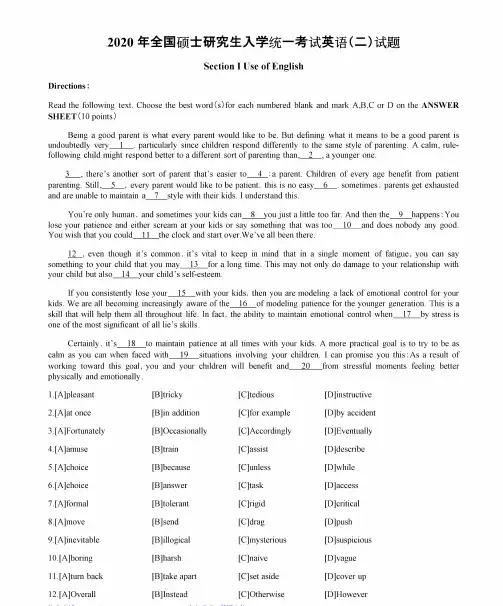
2020年全国硕上研究生入学统一考试英语(二)试题解析SectionI Use of EnglishI【答案】[C] tricky【解析】首段首句给出文章话题中心”成为一名好父亲或母亲是每一位父亲或母亲想要做的事情”,但第二句话话锋一转”但是定义什么是好父母无疑很,因为孩子们会对同类型的抚养模式做用不同的回应,“因此可排除p leasant、instructive这两个纯褒义词,tedious"冗长的“感情色彩过于消极,也排除,t ric k"y 复杂的符合语义逻辑要求,故为正确答案!2【答案】[C] for example【解析】上文表明,“孩子们会对抚养模式有不同的回应”,空格处所在句指出,“冷静,遵守规则的孩子,与更年少的孩子相比,对于不同的抚养模式,会做出更好的同应”,这两句话符合抽象具体”的逻辑关系,故for example为正确答案。
3【答案】[A]Fortunately【解析】第一段表明“定义合格的父母很复杂”,第二段首句指出“另外一种类型的父母很容易“第一段关键词"tricky"与本句中"easier"这两个词形成隐性的转折关系,"fo rtunately"符合逻辑关系的要求,故选为正确答案。
4【答案】[D] describe【解析】空格处所需动词与"parent"形成语义上的动宾关系,而第一段表明“定义合格的父母很复杂",第二段首句指出幸运地是,另外一种类型的父母很容易”,这两句话之间话题一致,逻辑关系相反,因此可推测该空格处所填入的动词应该与"define"语义相近,故"describe"描述为正确答案。
5【答案】[D]while【解析】该题考查句间逻辑关系,空格所在句表明“每位父母想变得有耐心”,下一句指山”这不是容易的",这两句话存在“一肯-否"的特征,形成对立关系,因此空格处应该填入表示“让步”概念的词故while为正确答案。
2020年全国研究生入学统一考试真题及答案解析(英语二)

2020年全国研究生入学统一考试试题及答案解析(英语二)Section I Use of EnglishDirections:Read the following text. Choose the best word (s) for each numbered blank and mark A, B, C or D on the ANSWER SHEET. (10 points)Being a good parent is, of course, what every parent would like to be. But defining what it means to be a good parent is undoubtedly very __1__, particularly since children respond differently to the same style of parenting. A calm, rule-following child might respond better to a different sort of parenting than, __2__, a younger sibling.__3__, there’s another sort of parent that’s a bit easier to __4__: a patient parent. Children of every age benefit from patient parenting. Still, __5__ every parent would like to be patient, this is no easy __6__. Sometimes parents get exhausted and frustrated and are unable to maintain a __7__ and composed style with their kids. I understand this.You’re only human, and sometimes your kids can __8__ you just a little too far. And then the __9__ happens: You lose your patience and either scream at your kids or say something that was a bit too __10__ and does nobody any good. You wish that you could __11__ the clock and start over. We’ve all been there.__12__, even though it’s common, it’s important to keep in mind that in a single mo ment of fatigue, you can say something to your child that you may __13__ for a long time. This may not only do damage to your relationship with your child but also __14__ your child’s self-esteem.If you consistently lose your __15__ with your kids, then you are inadvertently modeling a lack of emotional control for your kids. We are all becoming increasingly aware of the __16__ of modeling tolerance and patience for the younger generation. This is a skill that will help them all throughout life. In fact, the ability to emotionally regulate or maintain emotional control when __17__ by stress is one of the most important of all life’s skills.Certainly, it’s incredibly __18__ to maintain patience at all times with your children. A more practical goal is to try, to the best of your ability, to be as tolerant and composed as you can when faced with __19__ situations involving your children. I can promise you this: As a result of working toward this goal, you and your children will benefit and __20__ from stressful moments feeling better physically and emotionally.1. A tedious B pleasant C instructive D tricky2. A in addition B for example C at once D by accident3. A fortunately B occasionally C accordingly D eventually4. A amuse B assist C describe D train5. A while B because C unless D once6. A answer B task C choice D access7. A tolerant B formal C rigid D critical8. A move B drag C push D send9. A mysterious B illogical C suspicious D inevitable10. A boring B naive C harsh D vague11. A turn back B take apart C set aside D cover up12. A overall B instead C however D otherwise13. A like B miss C believe D regret14. A raise B affect C justify D reflect15. A time B bond C race D cool16. A nature B secret C importance D context17. A cheated B defeated C confused D confronted18. A terrible B hard C strange D wrong19. A trying B changing C exciting D surprising20. A hide B emerge C withdraw D escape今年完形填空的难度系数很小,基本无生词,长难句也很少。
2020全国硕士研究生入学统一考试204英语二考研真题及答案
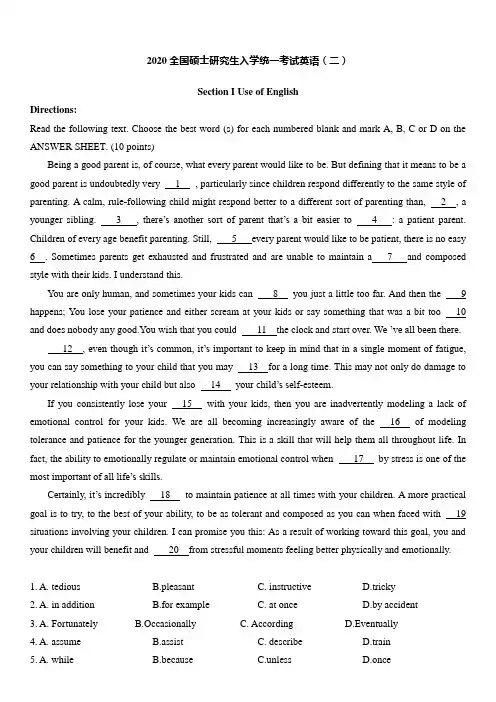
2020全国硕士研究生入学统一考试英语(二)Section I Use of EnglishDirections:Read the following text. Choose the best word (s) for each numbered blank and mark A, B, C or D on the ANSWER SHEET. (10 points)Being a good parent is, of course, what every parent would like to be. But defining that it means to be a good parent is undoubtedly very 1 , particularly since children respond differently to the same style of parenting. A calm, rule-following child might respond better to a different sort of parenting than, 2 , a younger sibling. 3 , there’s another sort of parent that’s a bit easier to 4 : a patient parent. Children of every age benefit parenting. Still, 5 every parent would like to be patient, there is no easy 6 . Sometimes parents get exhausted and frustrated and are unable to maintain a 7 and composed style with their kids. I understand this.You are only human, and sometimes your kids can 8 you just a little too far. And then the 9 happens; You lose your patience and either scream at your kids or say something that was a bit too 10 and does nobody any good.You wish that you could 11 the clock and start over. We ’ve all been there.12 , even though it’s common, it’s important to keep in mind that in a single moment of f atigue, you can say something to your child that you may 13 for a long time. This may not only do damage to your relationship with your child but also 14 your child’s self-esteem.If you consistently lose your 15 with your kids, then you are inadvertently modeling a lack of emotional control for your kids. We are all becoming increasingly aware of the 16 of modeling tolerance and patience for the younger generation. This is a skill that will help them all throughout life. In fact, the ability to emotionally regulate or maintain emotional control when 17 by stress is one of the most important of all life’s skills.Certainly, it’s incredibly 18 to maintain patience at all times with your children. A more practical goal is to try, to the best of your ability, to be as tolerant and composed as you can when faced with 19 situations involving your children. I can promise you this: As a result of working toward this goal, you and your children will benefit and 20 from stressful moments feeling better physically and emotionally.1. A. tedious B.pleasant C. instructive D.tricky2. A. in addition B.for example C. at once D.by accident3. A. Fortunately B.Occasionally C. According D.Eventually4. A. assume B.assist C. describe D.train5. A. while B.because C.unless D.once6. A. answer B.task C.choice D.access7. A. tolerant B.formal C. rigid D.critical8. A. move B.drag C. push D.send9. A. mysterious B.illogical C. suspicious D.inevitable10. A.boring B.native C.harsh D.vague11. A. turn back B.take apart C. set aside D.cover up12. A. Overall B.Instead C.However D.Otherwise13. A. like B.miss C.believe D.regret14. A. raise B.affect C. justify D.reflect15. A. time B.bond C. race D. cool16. A. nature B.secret C. importance D.context17. A. cheated B.defeated C. confused D.confronted18. A. terrible B.hard C.strange D.wrong19. A. trying B.changing C. exciting D.surprising20. A. hide B. emerge C. withdraw D.escapeSection II Reading ComprehensionPart ADirections:Read the following four texts.Answer the questions below each text by choosing A,B,C or D.Mark your answers on the ANSWER SHEET.(40 points)Text 1Rats and other animals need to be highly at tuned to social signals from others so that can identify friends to cooperate with and enemies to avoid. To find out if this extends to non-living beings, Loleh Quinn at the University of California, San Diego, and her colleagues tested whether rats can detect social signals from robotic rats.They housed eight adult rats with two types of robotic rat---one social and one asocial---for 5 our days. The robots rats were quite minimalist, resembling a chunkier version of a computer mouse with wheels-to move around and colorful markings.During the experiment, the social robot rat followed the living rats around, played with the same toys, and pened caged doors to let trapped rats escape. Meanwhile, the asocial robot simply moved forwards and backwards and side to side.Next, the researchers trapped the robots in cages and gave the rats the opportunity to release them bypressing a lever.Across 18 trials each,the living rats were 52 percent more likely on average to set the social robot free than the asocial one. This suggests that the rats perceived the social robot as a genuine social being. They may have bonded more with the social robot because it displayed behaviours like communal exploring and playing. This could lead to the rats better remembering having freed it earlier, and wanting the robot to return the favour when they get trapped, says Quinn.The readiness of the rats to befriend the social robot was surprising given its minimal design. The robot was the same size as a regular rat but resembled a simple plastic box on wheels. " We'd assumed we'd have to give it a moving head and tail, facial features, and put a scene on it to make it smell like a real rat, but that wasn't necessary," says Janet Wiles at the University of Queensland in Australia, who helped with the research.The finding shows how sensitive rats are to social cues, even when they come from basic robots. Similarly, children tend to treat robots as if they are fellow beings, even when they display only simple social signals." We humans seem to be fascinated by robots, and it turns out other animals are too,"says Wiles.21.Quinn and her colleagues conducted a test to see if rats can ____ .[A] pickup social signals from non-living rats[B]distinguish a friendly rat from a hostile one[C]attain sociable traits through special training[D] send out warning messages to their fellow22.What did the asocial robot do during the experiment?[A]It followed the social robot.[B]It played with some toys.[C]It set the trapped rats free.[D]It moved around alone.23.According to Quinn,the rats released the social robot because they____ .[A]tried to practice a means of escape[B]expected it to do the same in return[C]wanted to display their intelligence[D]considered that an interesting game24.James Wiles notes that rats ____ .[A]can remember other rat's facial features[B]differentiate smells better than sizes[C]respond more to actions than to looks[D]can be scared by a plastic box on wheels25.It can be learned from the text that rats____ .[A]appear to be adaptable to new surroundings[B]are more socially active than other animals[C]behave differently from children in socializing[D]are more sensitive to social cues than expectedText 2It is true that CEO pay has gone up-top ones may make 300 times the pay of typical workers on average, and since the mid-1970s, CEO pay for large publicly traded American corporations has, by varying estimates,gone up by about 500%. The typical CEO of a top American corporation now makes about S 18.9 million a year.The best model for understanding the growth of CEO pay is that of limited CEO talent in a world where business opportunities for the top firms are growing rapidly. The efforts of America's highest-earning 1% have been one of the more dynamic elements of the global economy. It's not popular to say, but one reason their pay has gone up so much is that CEOs really have upped their game relative to many other workers in the U.S.economy.Today's CEO, at least for major American firms.must have many more skills than simply being able to"run the company". CEOs must have a good sense of financial markets and maybe even how the company should, trade in them. They also need better public relations skills than their predecessors, as the costs of even a minor slip up can be significant. Then there's the fact that large American companies are much more globalized than ever before, with supply chains spread across a larger number of countries. To lead in that system requires knowledge that is fairly mind-boggling.The common idea that high CEO pay is mainly about ripping people off doesn't explain history very well.By most measures, corporate governance has become a lot tighter and more rigorous since the 1970s. Yet it is principally during this period of stronger governance that CEO pay has been high and rising. That suggests it is in the broader corporate interest to recruit top candidates for increasingly tough jobs.Furthermore, the highest CEO salaries are paid to outside candidates, not to the cozy insider picks. Another sign that high CEO pay is not some kind of depredation at the expense of the rest of the company. And the stock market reacts positively when companies tie CEO pay to, say, stock prices, a sign that those practices build up corporate value not just for the CEO.26. Which of the following has contributed to CEO pay rise?A. The growth in the number of corporationsB. The general pay rise with a better economyC. Increased business opportunities for top firmsD. Close cooperation among leading economicspared with their predecessors, today's CEOs are required to ___.A. foster a stronger sense of teamworkB. finance more research and developmentC. establish closer ties with tech companiesD. operate more globalized companies28. CEO pay has been rising since the 1970s despite ____.A. continual internal oppositionB. strict corporate governanceC. conservative business strategiesD. repeated governance warnings29.High CEO pay can be justified by the fact that it helps ___.A. confirm the status of CEOsB. motive inside candidatesC. boost the efficiency of CEOsD. increase corporate value30.The most suitable title for this text would be ___.A.CEOs Are Not OverpaidB. CEO Pay : Past and PresentC.CEOs' Challenges of TodayD.CEO Traits: Not Easy to DefineText 3Madrid was hailed as a public health beacon last November when it rolled out ambitious restrictions on the most polluting cars. Seven months and one election day later, a new conservative city council suspendedenforcement of the clean air zone, a first step toward its possible demise.Mayor Jose Luis Martinez-Almeida made opposition to the zone a centrepiece of his election campaign, despite its success in improving air quality. A judge has now overruled the city's decision to stop levying fines, ordering them reinstated. But with legal battles ahead, the zone's future looks uncertain at best.Among other weaknesses, the measures cities must employ when left to tackle dirty air on their own are politically contentious, and therefore vulnerable. That's because they inevitably put the costs of cleaning the air on to individual drivers---who must pay fees or buy better vehicles---rather than on to the car manufacturers whose cheating is the real cause of our toxic pollution.It's not hard to imagine a similar reversal happening in London. The new ultra-low emission zone (Ulez) is likely to be a big issue in next year's mayoral election. And if Sadiq Khan wins and extends it to the North and South Circular roads in 2021 as he intends, it is sure to spark intense opposition from the far larger number of motorists who will then be affected.It's not that measures such as London's Ulez are useless. Far from it. Local officials are using the levers that are available to them to safeguard residents' health in the face of a serious threat. The zones do deliver some improvements to air quality, and the science tells us that means real health benefits---fewer heart attacks, strokes and premature births, less cancer, dementia and asthma. Fewer untimely deaths.But mayors and councillors can only do so much about a problem that is far bigger than any one city or town. They are acting because national governments---Britain's and others across Europe---have failed to do so.Restrictions that keep highly polluting cars out of certain areas---city centres, “school streets”, even individual roads---are a response to the absence of a larger effort to properly enforce existing regulations and require auto companies to bring their vehicles into compliance. Wales has introduced special low speed limits to minimise pollution. We're doing everything but insist that manufacturers clean up their cars.31.Which of the following is true about Madrid's clean air zone?[A]Its effects are questionable[B]It has been opposed by a judge[C]It needs tougher enforcement[D]Its fate is yet to be decided32.Which is considered a weakness of the city-level measures to tackle dirty air?[A]They are biased against car manufacturers.[B]They prove impractical for city councils.[C]They are deemed too mild for politicians.[D] They put too much burden on individual motorists.33.The author believes that the extension of London's Ulez will ____.[A]arouse strong resistance.[B]ensure Khan's electoral success.[C]improve the city's traffic.[D]discourage car manufacturing.34.Who does the author think should have addressed the problem?[A]Local residents[B]Mayors.[C]Councilors.[D] National governments.35.It can be inferred from the last paragraph that auto companies ____.[A]will raise low-emission car production[B]should be forced to follow regulations[C]will upgrade the design of their vehicles[D]should be put under public supervisionText 4Now that members of Generation Zs are graduating college this spring --- the most commonly-accepted definition says this generation was born after 1995, give or take a year --- the attention has been rising steadily in recent weeks. GenZs are about to hit the streets looking for work in a labor market that's tighter than it's been in decades. And employers are planning on hiring about 17 percent more new graduates for jobs in the U.S. this year than last, according to a survey conducted by the National Association of Colleges and Employers. Everybody wants to know how the people who will soon inhabit those empty office cubicles will differ from those who came before them.If "entitled" is the most common adjective, fairly or not, applied to millennials (those born between 1981 and 1995), the catchwords for Generation Zs are practical and cautious. According to the career counselors and experts who study them, Generation Zs are clear-eyed, economic pragmatists. Despite graduating into the best economy in the past 50 years, Gen Zs know what an economic train wreck looks like. They were impressionable kids during the crash of 2008, when many of their parents lost their jobs or their life savings or both. They aren't interested in taking any chances. The booming economy seems to have done little to assuage this underlying generational sense of anxious urgency, especially for those who have college debt. College loan balances in the U.S. now stand at a record S1.5 trillion,according to the FederalReserve.One survey from Accenture found that 88 percent of graduating seniors this year chose their major with a job in mind. In a 2019 survey of University of Georgia students, meanwhile, the career office found the most desirable trait in a future employer was the ability to offer secure employment (followed by professional development and training,and then inspiring purpose). Job security or stability was the second most important career goal (work-life balance was number one) followed by a sense of being dedicated to a cause or to feel good about serving the greater good.That's a big change from the previous generation. Millennial wanted more flexibility in their lives, notes Tanya Michelson, Associate Director of Youth Sight, a UK-based brand manager that conducts regular 60-day surveys of British youth, in findings that might just as well apply to American youth. Generation Zs are looking for more certainty and stability, because of the rise of the gig economy. They have trouble seeinga financial future and they are quite risk averse."36.Generation Zs graduating college this spring ____[A]are recognized for their abilities[B]are in favor of job offers[C]are optimistic about the labor market[D] are drawing growing public attention37.Generation Zs are keenly aware____.[A]what a tough economic situation is like[B]what their parents expect of them[C]how they differ from past generations[D]how valuable a counselor's advice is38.The word "assuage" (line 9,para 2) is closet in meaning to ____[A]define [B]relieve [C]maintain [D]deepen39.It can be learned from Paragraph 3 that Generation Zs____[A] care little about their job performance[B] give top priority to professional training[C] think it hard to achieve work-life balance[D] have a clear idea about their future job.40.Michelsen thinks that compared with millennials, Generation Zs are ____[A]less realistic [B]less adventurous [C]more diligent [D]more generous Part BDirections:Read the following text and answer the questions by choosing the most suitable subheading from the list A-G for each numbered paragraphs(41-45).There are two extra subheadings which you do not need to use. Mark your answers on the ANSWER SHEET.(10 points)[A] Give compliments, just not too many.[B] Put on a good face,always.[C] Tailor your interactions.[D] Spend time with everyone.[E] Reveal,don't hide,information.[F] Slow down and listen.[G] Put yourselves in others' shoes.Five Ways to Win Over Everyone in the OfficeIs it possible to like everyone in your office? Think about how tough it is to get together 15 people,much less 50,who all get along perfectly.But unlike in friendships,you need coworkers.You work with them every day and you depend on them just as they depend on you.Here are some ways that you can get the whole office on your side.41.[E] Reveal, don't hide, information.If you have a bone to pick with someone in your workplace, you may try stay tight-lipped around them. But you won't be helping either one of you. A Harvard Business School study found that observers consistently rated those who were frank about themselves more highly, while those who hid lost trustworthiness.The lesson is not that you should make your personal life an open book, but rather, when given the option to offer up details about yourself or painstakingly conceal them,you should just be honest.42.[F] Slow down and listen.Just as important as being honest about yourself is being receptive to others.We often feel the need to tell others how we feel, whether it's a concern about a project, a stray thought, or a compliment. Those are all valid, but you need to take time to hear out your coworkers, too. In fact, rushing to get your own ideas out there can cause colleagues to feel you don't value their opinions. Do your best to engage coworkers in a genuine, back-and-forth conversation, rather than prioritizing your own thoughts.43.[D] Spend time with everyone.It's common to have a "cubicle mate" or special confidant in a work setting. But in addition to those trusted coworkers, you should expand your horizons and find out about all the people around you. Use your lunch and coffee breaks to meet up with colleagues you don't always see. Find out about their lives and interests beyond the job. It requires minimal effort and goes a long way. This will help to grow your internalnetwork, in addition to being a nice break in the work day.44.[A] Give compliments, just not too many.Positive feedback is important for anyone to hear. And you don't have to be someone's boss to tell them they did an exceptional job on a particular project. This will help engender good will in others. But don't overdo it or be fake about it.One study found that people responded best to comments that shifted from negative to positive, possibly because it suggested they had won somebody over.45.[C] Tailor your interactions.This one may be a bit more difficult to pull off, but it can go a long way to achieving results. Remember in dealing with any coworker what they appreciate from an interaction. Watch out for how they verbalize with others. Some people like small talk in a meeting before digging into important matters, while other are more straightforward. Jokes that work one person won't necessarily land with another. So, adapt your style accordingly to type. Consider the person that you're dealing with in advance and what will get you to your desired outcome.Section III TranslationIt’s almost impossible to go through life wit hout experiencing some kind of failure. But, the wonderful thing about failure is that it’s entirely up to us to decide how to look at it.We can choose to see failure as “the end of the world”. Or, we can look at failure as the incredible learning experience that it often is. Every time we fail at something, we can choose to look for the lesson we’re meant to learn. These lessons are very important, they’re how we grow, and how we keep from making that same mistake again. Failures stop us only if we let them.Failure can also teach us things about ourselves that we would never have learned otherwise. For instance, failure can help you discover how strong a person you are. Failure at something can help you discover your truest friends, or help you find unexpected motivation to succeed.生活中几乎不可能没有经历过某种失败。
2020考研英语二真题及答案解析

2020 考研英语二真题及答案剖析1、【答案】 Bconcluded【剖析】干中,一系列的研究已_____,事上,正常体重的人的患病要高于超重的人。
依照句,后边的部分上是研究的,因此concluded 吻合意,其他 denied(否 )与意相反, doubled(翻倍 )与意,ensured(保证 )不吻合意,因研究不能够保证后边的事,只能得出后边的事作。
因此正确答案 B。
2、【答案】 Aprotective【剖析】干中,于某些健康情况,超重事上是有_____。
依照前文研究的,超重能减少罹患疾病的,明超重拥有必然的保作用。
Dangerous和文章意思相反, sufficient 表示充足, troublesome 表示有麻,不吻合意,因此正确答案 A。
3、【答案】 Clikewise【剖析】第三句中,重的女人患缺的比率低于瘦的女人。
_____,在老年人中,必然程度上超重⋯⋯。
需要填入的是和前半句表示接的。
A instead 表示逆接的句意关系, B however 也表示逆接, D therefore 表示因此,只有 C likewise 意同地 ;也,而且。
因此正确答案 C。
4、【答案】 Aindicator【剖析】本句中, _____,必然程度上超重,常是健康的_____。
A,表示指示器,指。
B objective 表示客 ;C origin 表示本源, Dexample 表示例子。
依照前面的文章内容,已明确指出超重代表了健康,因此超重是健康的指。
因此正确答案 A。
5、【答案】 Dconcern【剖析】本句的句意是,需要更加_____是,很肥胖加以定。
A、impact(印象 );B、relevance(相关性 );C、 assistance(助 );D、concern(关注 )。
前文已到肥胖事上有利健康,但是又面一个,终究如何去定肥胖,因此需要更加关注的是肥的定,其他均不吻合意,因此正确答案D。
2020年考研英语二真题解析

2020年全国硕士研究生入学统一考试英语(二)试题及答案【完型填空答案解析】今年完形填空的难度系数很小,基本无生词,长难句也很少。
讲的是家长对孩子要有耐心,属于比较生活的话题。
下面我们一起来看一下答案及解析。
1.【答案】D tricky【解析】此处考察词义辨析+上下文语境。
文章首段首句为主题句:每位父母都想成为好的父母。
空格句开头为but,句意上出现了转折,“但是如何定义好的父母是个难题”,since后给出了原因,“因为不同的孩子对待同样的养育方式反应也是不同的”。
tricky意为“棘手的,困难的”,符合句意。
2.【答案】B for example【解析】此处考察上下文逻辑关系。
前面说了不同的孩子对待同样的养育方式反应也是不同的,此句为例证,如果换一种养育方式,一个冷静而听话的孩子可能会比他的弟弟或妹妹反应更好些。
所以用表示举例分析的for example最合适,其他选项另外、偶尔、意外地都不合适。
3.【答案】A Fortunately【解析】此处考察副词词义辨析+上下文语境。
空格所在句指出:还有一类父母描述起来会容易一些,这类就是非常耐心的父母。
第一段告诉我们如何定义怎样才是好的父母是个难题,这里在上下文文义上是个转折,幸运地是/还好,有一类父母比较容易定义,并且各个年龄段的孩子都可以从他们的养育方式中获益。
故选Fortunately,其他选项偶尔,对应地,最终地都不合适。
4.【答案】C describe【解析】此处考察动词词义辨析+上下文语境。
第一段告诉我们如何定义怎样才是好的父母是个难题,第二段出现转折说但是有一类父母很好描述/定义,describe与define相呼应,故选C符合句意。
5.【答案】A while【解析】此处考察上下文逻辑关系。
空格所在句指出:虽然每位父母都想成为耐心的父母,但这并不容易。
逗号前后为转折关系,四个选项中while表转折,选A符合句意。
6.【答案】B task【解析】此处考察名词词义辨析。
2021 年全国硕士研究生入学统一考试英语(二)试题及答案
2021 年全国硕士研究生入学统一考试英语(二)试题Section I Use of EnglishDirections:Read the following text. Choose the best word (s) for each numbered blank and mark A, B, Cor D on the ANSWER SHEET. (10 points)It’s not difficult to set targets for staff. It is much harder, 1 ,to understand their negative consequences. Most work-related behaviors have multiple components. 2 one and the others become distorted.Travel on a London bus and you’ll 3 see how this works with drivers. Watch people get on and show their tickets. Are they carefully inspected? Never. Do people get on without paying? Of course! Are there inspectors to 4 that people have paid? Possibly, but very few. And people who run for the bus? They are 5 . How about jumping lights? Buses do so almost as frequently as cyclists. Why? Because the target is 6 . People complained that buses were late and infrequent. 7 ,the number of buses and bus lanes were increased, and drivers were 8 or punished according to the time they took. And drivers hit these targets. But they 9 hit cyclists. If the target was changed to 10 , you would have more inspectors and more sensitive pricing. If the criterion changed to safety, you would get more 11 drivers who obeyed traffic laws. But both these criteria would be at the expense of time. There is another 12 : people became immensely inventive in hitting targets. Have you 13 that you can leave on a flight an hour late but still arrive on time? Tailwinds? Of course not! Airlines have simply changed the time a 14 is meant to take. A one-hour flight is now ballad as a two-hour flight.The 15 of the story is simple. Most jobs are multidimensional, with multiple criteria.Choose one criterion and you may well 16 others. Everything Can be done faster and made cheaper, but there is a 17 . Setting targets can and does have unforeseen negative consequences.This is not an argument against target-setting. But it is an argument for exploring consequences first. All good targets should have multiple criteria 18 critical factors such as time, money, quality and customer feedback. The trick is not only to 19 just one or even two dimensions of the objective, but also to understand how to help people better 20 the objective. 1. [A] therefore [B] however [C] again [D] moreover2. [A] Emphasize[B] Identify [C] Assess [D] Explain3. [A] nearly [B] curiously [C] eagerly [D] quickly4. [A] claim [B] prove [C] check[D] recall5. [A] threatened [B] ignored[C] mocked [D] blamed6. [A] punctuality[B] hospitality [C] competition [D] innovation7. [A] Yes [B] So[C] Besides [D] Still8. [A] hired [B] trained [C] rewarded[D] grouped9. [A] only [B] rather [C] once [D] also10. [A] comfort [B] revenue[C] efficiency [D] security11. [A] friendly [B] quiet [C] cautious[D] diligent12. [A] purpose [B] problem[C] prejudice [D] policy13. [A] reported [B] revealed [C] admitted [D] noticed14. [A] break [B] trip[C] departure [D] transfer15. [A] moral [B] background[C] style [D] form16. [A] interpret [B] criticize [C] sacrifice[D] tolerate17. [A] task [B] secret [C] product [D] cast18. [A] leading to [B] calling for [C] relating to[D] accounting for19. [A] specify[B] predict [C] restore [D] create20. [A] modify [B] review [C] present [D] achieveSection II Reading ComprehensionPart ADirections:Read the following four texts. Answer the questions below each text by choosing A, B, C orD. Mark your answers on the ANSWER SHEET. (40 points)Text 1“Reskilling” is something that sounds like a buzzword but is actually a requirement if we plan to have a future in which a lot of would-be workers do not get left behind. We know we are moving into a period where the jobs in demand will change rapidly, as will the requirements of the jobs that remain. Research by the World Economic Forum finds that on average 42 percent of the “core skills” within job roles will change by 2022. That is a very short timeline.The question of who should pay for reskilling is a thorny one. For individual companies, the temptation is always to let go of workers whose skills are no longer in demand and replace them with those whose skill are. That does not always happen. AT&T is often given as the gold standard of a company that decided to do a massive reskilling program rather than go with afire-and-hire strategy. Other companies had also pledged to create their own plans. When the skills mismatch is in the broader economy. Though, the focus usually turns to government to handle. Efforts in Canada and elsewhere have been arguably languid at best. And have given us a situation where we frequently hear of employers begging for workers. Even at times and in regions where unemployment is high.With the pandemic, unemployment is very high indeed. In February, at 3.5 percent and 5.5 P.C. respectively, unemployment rates in Canada and the U.S. were at generational lows and worker shortages were everywhere. As of May, those rates had spiked up to 13.3 P.C. and 13.7 percent, and although may worker shortages, has disappeared, not all had done so. In the medical field, to take an obvious example. The pandemic meant that there were still clear shortages, of doctors, nurse and other medical personnel.Of course, it is not like you can take an unemployed waiter and train him to be a doctor. In a few weeks. But even if you cannot close the gap, maybe you can close others and doing so would be to the benefit of all concern. That seems to be the case in Sweden: when forced to furlough 90 P.C. of their cabin staff. Scandinavian Airline decided to start up a short retaining program that res killed the laid-off workers to support hospital staff. The effort was a collective one and involved other companies as well as a Swedish university.21.Research by the World Economic Forum suggests .[A] an increase in full-time employment[B]an urgent demand for new job skills[C] a steady growth of job opportunities[D]a controversy re about the “core skills”22.AT&T is cited to show .[A]an alternative to the fire-and-hire strategy[B]an immediate need for government support[C]the importance of staff appraisal standards[D]the characteristics of res-killing programs23.Efforts to resolve the skills mismatch in Canada .[A]have driven up labour costs[B]have proved to be inconsistent[C]have met with fierce opposition[D]have appeared to be insufficient24.We can learn from Paragraph 3 that there was .[A]a call for policy adjustment[B]a change in hiring practices[C]a lack of medical workers[D]a sign of economic recovery25.Scandinavian Airlines decided to .[A]create job vacancies for the unemployed[B]prepare their laid-off workers for other jobs[C]retrain their cabin staff for better services[D]finance their staff’s college educationText 2With the global population predicted to hit close to 10 billion by 2050, and forecasts that agricultural production in some regions will need to nearly double to keep pace, food security is increasingly making headlines. In the UK, it has become a big talking point recently too, for a rather particular reason: Brexit.Brexit is seen by some as an opportunity to reverse a recent trend towards the UK importing food. The country produces only about 60 per cent of the food it eats, down from almostthree-quarters in the late 1980s. A move back to self-sufficiency, the argument goes, would boost the farming industr y, political sovereignty and even the nation’s health. Sounds great — but how feasible is this vision?According to a report on UK food production from the University of Leeds,UK,85 per cent of the country’s total land area is associated with meat and dairy production. That supplies 80 per cent of what is consumed, so even covering the whole country in livestock farms wouldn’t allow us to cover all our meat and dairy needs.There are many caveats to those figures, but they are still grave. To become much moreself-sufficient, the UK would need to drastically reduce its consumption of animal foods, and probably also farm more intensively — meaning fewer green fields and more factory-style production.But switching to a mainly plant-based die t wouldn’t help. There is a good reason why the UK is dominated by animal husbandry: most of its terrain doesn’t have the right soil or climate to grow crops on commercial basis. Just 25 per cent of the country’s land is suitable forcrop-growing, most of which is already occupied by arable fields. Even if we converted all the suitable land to fields of fruit and veg — which would involve taking out all the nature reserves and removing thousands of people from their homes — we would achieve only a 30 per cent boost in crop production.Just 23 per cent of the fruit and vegetables consumed in the UK are currently home-grown, so even with the most extreme measures we could meet only 30 per cent of our fresh produce needs. That is before we look for the space to grow the grains, sugars, seeds and oils that provide us with the vast bulk of our current calorie intake.26.Some people argue that food self-sufficiency in the UK would .[A]be hindered by its population growth[B]contribute to the nations well-being[C]become a priority of the government[D]post a challenge to its farming industry27.The report by the University of Leeds showed that in the UK .[A]farmland has been inefficiently utilised[B]factory style production needs reforming[C]most land is used for meat and dairy production[D]more green fields will be converted for farming28.Crop-growing in the UK is restricted due to .[A]its farming technology[B]its dietary tradition[C]its natural conditions[D]its commercial interests29.It can be learned from the last paragraph that British people .[A]rely largely on imports for fresh produce[B]enjoy a steady rise in fruit consumption[C]are seeking effective ways to cut calorie intake[D]are trying to grow new varieties of grains30.The author’s attitude to food self-efficiency in the UK is .[A]defensive[B]doubtful[C]tolerant[D]optimisticText 3When Microsoft bought task management app Wunderlist and mobile calendar Sunrise in 2015, it picked two newcomers that were attracting considerable buzz in Silicon Valley. Microsoft’s own Office dominates the market for “productivity” software, but the start-ups represented a new wave of technology designed from the ground up for the smartphone world. Both apps, however, were later scrapped after Microsoft said it had used their best features inits own products. Their teams of engineers stayed on, making them two of the many “acqui-hires” that the biggest companies have used to feed their great hunger for tech talent.To Microsoft’s critics, the fates of Wunder list and Sunrise are exa mples of a remorseless drive by Big Tech to chew up any innovative companies that lie in their path. “They bought the seedlings and closed them down,” complained Paul Amold, a partner at San Francisco-based Switch Ventures, putting an end to businesses that might one day turn into competitors. Microsoft declined to comment.Like other start-up investors, Mr Arnold’s own business often depends on selling start-ups to larger tech companies, though he admits to mixed feelings about the result: “I think these t hings are good for me, if I put my selfish hat on. But are they good for the American economy? I don’t know.”The US Federal Trade Commission says it wants to find the answer to that question. This week, it asked the five most valuable US tech companies for information about their many small acquisitions over the past decade. Although only a research project at this stage, the request hasraised the prospect of regulators wading into early-stage tech markets that until now have been beyond their reach.Given their combined market value of more than $5.5 trillion, rifling through such small deals — many of them much less prominent than Wunderlist and Sunrise — might seem beside the point. Between them, the five biggest tech companies have spent an average of only $3.4 billion a year on sub-$1 billion acquisitions over the past five years —a drop in the ocean compared with their massive financial reserves, and the more than $130 billion of venture capital that was invested in the US last year.However, critics say the big companies use such deals to buy their most threatening potential competitors before their businesses have a chance to gain momentum, in some cases as part of a “buy and kill” tactic to simply close them down.31.What is true about Wunderlist and Sunrise after their acquisitions?A.Their engineers were retained.B.Their market values declined.C.Their tech features improved.D.Their products were re-priced.32.Microsoft’s critics believe that the big tech companies tend to .A.exaggerate their product qualityB.eliminate their potential competitorsC.treat new tech talent unfairlyD.ignore public opinions33.Paul Arnold is concerned that small acquisitions might .A.weaken big tech companiesB.worsen market competitionC.harm the national economyD.discourage start-up investors34.The US Federal Trade Commission intends to .A.limit Big Tech’s expansionB.encourage research collaborationC.examine small acquisitionsD.supervise start-ups’ operations35.For the five biggest tech companies, their small acquisitions have .A.brought little financial pressureB.raised few management challengesC.set an example for future dealsD.generated considerable profitsText 4We’re fairly good at judging people based on first impressions, thin slices of experience ranging from a glimpse of a photo to a five-minute interaction, and deliberation can be not only extraneous but intrusive. In one study of the ability she called “thin slicing,” the late psychologist Nalini Ambady asked participants to watch silent 10-second video clips of professors and to rate the instructor’s overall effectiveness. Their ratings correlated strongly with students’end-of-semester ratings. Another set of participants had to count backward from 1,000 by nines as they watched the clips, occupying their conscious working memory. Their ratings were just as accurate, demonstrating the intuitive nature of the social processing.Critically, another group was asked to spend a minute writing down reasons for their judgment, before giving the rating. Accuracy dropped dramatically. Ambady suspected that deliberation focused them on vivid but misleading cues, such as certain gestures or utterances, rather than letting the complex interplay of subtle signals form a holistic impression. She found similar interference when participants watched 15-second clips of pairs of people and judged whether they were strangers, friends, or dating partners.Other research shows we’re better at detecting deception from thin slices when we rely on in tuition instead of reflection. “It’s as if you’re driving a stick shift,” says Judith Hall, a psychologist at Northeastern University, “and if you start thinking about it too much, you can’t remember what you’re doing. But if you go on automatic pilot, you’re fine. Much of our social life is like that.”Thinking too much can also harm our ability to form preferences. College students’ ratings of strawberry jams and college courses aligned better with experts’ opinions when the students weren’t asked to analyze their rationale. And people made car-buying decisions that were both objectively better and more personally satisfying when asked to focus on their feelings rather thanon details, but only if the decision was complex—when they had a lot of information to process. Intuition’s special powers are unleashed only in certain circumstances. In one study, participants completed a battery of eight tasks, including four that tapped reflective thinking (discerning rules, comprehending vocabulary) and four that tapped intuition and creativity (generating new products or figures of speech). Then they rated the degree to which they had used intuition (“gut feelings,” “hunches,” “my heart”). Use of their gut hurt their performance on the first four tasks, as expected, and helped them on the rest. Sometimes the heart is smarter than the head.36.Nalini Ambady’s study deals with .[A]the power of people’s memory[B]the reliability of first impressions[C]instructor- student interaction[D]people’s ability to influence others37.In Ambady’s study, rating accuracy dropped when participants .[A]focused on specific details[B]gave the rating in limited time[C]watched shorter video clips[D]discussed with one another38.Judith Hall mentions driving to show that .[A]reflection can be distracting[B]memory may be selective[C]social skills must be cultivated[D]deception is difficult to detect39.When you are making complex decisions, it is advisable to .[A]collect enough data[B]list your preferences[C]seek expert advice[D]follow your feelings40.What can we learn from the last paragraph?[A]Generating new products takes time[B]Intuition may affect reflective tasks[C]Vocabulary comprehension needs creativity[D]Objective thinking may boost intuitivenessPart BDirections:Read the following text and answer the questions by choosing the most suitable subheading from the list A-G for each numbered paragraphs (41-45). There are two extra subheadings which you do ned to use. Mark your answers on the ANSWER SHEET. (10 points)A.Stay calm.B.Stay humble.C.Decide whether to wait.D.Be realistic about the risks.E.Don’t make judgements.F.Identify a shared goal.G.Ask permission to disagree.How to disagree with someone more powerful than youYour boss proposes a new initiative you think won’t work. Your senior colleague outlines a project timeline you believe is unrealistic. What do you see when you disagree with someone who has more power than you do? How do you decide whether it’s worth speaking up? And if you do, what exactly should y ou say? Here’s how to disagree with someone more powerful than you. 41. CYou may decide it’s best to hold off on voicing your opinion. Maybe you haven’t finished thinking the problem through, or you want to get a clearer sense of what the group thinks. If you think other people are going to disagree, too, you might want to gather your army first. People can contribute experience or information to your thinking —all the things that would make the disagreement stronger or more valid. It’s also a g ood idea to delay the conversation if you are in a meeting or other public space. Discussing the issue in private will make the powerful person feel less threatened.42. FBefore you share your thoughts, think about what the powerful person cares about — it maybe the credibility of their team or getting a project done on time. You’re more likely to be heard if you can connect your disagreement to a higher purpose. State it overtly, contextualizing your statements so that you’re seen not as a disagreeable subordinate but as a colleague who’s trying to advance a common objective. The discussion will then become more like a chess game than a boxing match.43. GThis step may sound overly deferential, but it’s a smart way to give the power ful person psychological safety and control. You can see something like, “I know we seem to be moving toward a first-quarter commitment here. I have reasons to think that won’t work. I’d like to layout my reasoning. Would that be OK?” This gives the person a choice, allowing him to verbally opt in.And, assuming he says yes, it will make you feel more confident about voicing your disagreement.44. AYou might feel your heart racing or your face turning red, but do whatever you can to remain natural in both your words and actions. When your body language communicates reluctance or anxiety, it undercuts the message. It sends a mixed message, and your counterpart gets to choose what signals to read. Deep breaths can help, as can speaking more slowly and deliberately. When we feel panicky, we tend to talk louder and faster. Simply slowing the pace and talking in an even 英语(二)试题第9页(共10 页)tone helps the other person cool down and does the same for you. It also makes you seem confident, even if you aren’t.45. BEmphasize that you’re only offering your opinion, not gospel truth. It may be awell-informed, well-researched opinion, but it’s still an opinion, so talk tentatively and slightly understate your confidence. Instead of saying, “If we set an end-of-quarter deadline, we will never make it,” say, “This is just my opinion, but I don’t see how we will make that deadline.” Having asserted your opinion (as a position, not as a fact), demonstrate equal curiosity about other views. Remind the person that this is your point of view, and then invite critique. Be open to hearing other opinions.Section III Translation46.Directions:Translate the following text from English into Chinese. Write your translation on ANSWER SHEET.(15 points)We tend to think that friends and family members are our biggest sources of connection, laughter, and warmth. While that may well be true, researchers have also recently found that interacting with strangers actually brings a boost in mood and feelings of belonging t hat we didn’t expect.In one series of studies, researchers instructed Chicago-area commuters using public transportation to strike up a conversation with someone near them. On average, participants who followed this instruction felt better than those who had been told to stand or sit in silence. The researchers also argued that when we shy away from casual interactions with strangers, it is often due to a misplaced anxiety that they might not want to talk to us. Much of the time, however, this belief is false. As it turns out, many people are actually perfectly willing to talk—and may even be flattered to receive your attention.我们经常认为朋友和家庭成员是我们交流、大笑和温暖的最主要来源。
2020年全国硕士研究生入学统一考试英语(二)真题及解析
9、第(9)题选 A 、 mysterious B 、 illogical C 、 suspicious D 、 inevitable
10、第(10)题选 A 、 boring B 、 naive C 、 harsh D 、 vague
5、第(5)题选 A 、 while B 、 because C 、 unless D 、 once
6、第(6)题选 A 、 answer B 、 task C 、 choice D 、 access
7、第(7)题选 A 、 tolerant B 、 formal C 、 rigid D 、 critical
20、第(20)题选
3/19
A 、 hide B 、 emerge C 、 withdraw D 、 escape
第2题 阅读理解Part A (每题2分,共20题,共40分) 下列每小题的四个选项中,只有一
项是最符合题意的正确答案,多选、错选或不选均不得分。
21、根据下面资料,回答{TSE}题 Rats and other animals need to be highly attuned to social signals from others so they can identify friends to cooperate with and enemies to avoid. To find out if this extends to non-living beings, Laleh Quinn at the University of California, San Diego, and her colleagues tested whether rats can detect social signals from robotic rats. They housed eight adult rats with two types of robotic rat--one social and one asocial--for four days. The robot rats were quite minimalist, resembling a chunkier version of a computer mouse with wheels to move around and colorful markings. During the experiment, the social robot rat followed the living rats around, played with the same toys, and opened cage doors to let trapped rats escape. Meanwhile, the asocial robot simply moved forwards and backwards and side to side. Next, the researchers trapped the robots in cages and gave the rats the opportunity to release them by pressing a lever. Across 18 trial each, the living rats were 52 percent more likely on average to set the social robot free than the asocial one. This suggests that the rats perceived the social robot as a genuine social being, says Quinn. The rats may have bonded more with the social robot because it displayed behaviours like communal exploring and playing. This could lead to the rats better remembering having freed it earlier, and wanting the robot to return the favour when they get trapped, she says. "Rats have been shown to engage in multiple forms of reciprocal help and cooperation, including what is referred to as direct reciprocity--where a rat will help another rat that has previously helped them, "says Quinn. The readiness of the rats to befriend the social robot was surprising given its minimal design. The robot was the same size as a regular rat but resembled a simple plastic box on wheels. "We'd assumed we'd have to give it a moving head and tail, facial features, and put a scent on it to make it smell like a real rat, but that wasn't necessary, " says Janet Wiles at the University of Queensland in Australia,who helped with the research. The finding shows how sensitive rats are to social cues, even when they come from basic robots,says Wiles. Similarly, children tend to treat robots as if they are fellow beings, even when they display only simple social signals. "We humans seem to be fascinated by robots, and it turns out other animals are too, " says Wiles. {TS}Quinn and her colleagues conducted a test to see if rats can_______. A 、 pick up social signals from non-living rats B 、 distinguish a friendly rat from a hostile one C 、 attain sociable traits through special training D 、 send out warning messages to their fellow
2021考研英语(二)真题答案与解析
2021年全国硕士研究生招生考试英语(二)真题解析Section I Use of English1.[A]therefore[B]however[C]again[D]moreover【解析】由第一句中not difficult与第二句中much harder形成语意对立关系,由此确定[B]为正确答案,表示转折关系。
2.[A]Emphasize[B]identify[C]Assess[D]explain【解析】由空格后and可知前后两种情况并列,后者distorted表示“扭曲”,语意趋势上表示负面性,则前面要么填负面性语意词或正面性语意词汇。
选项[B],[]C和[D]都是中性趋势,排除,只有选项[A]符合题意,表示重视和强调。
提示:并列不仅包括语意并列,还包括结构并列。
3.[A]nearly[B]curiously[C]eagerly[D]quickly【解析】此题考查语境分析。
分析句子结构可知:travel on bus作为you will see how this works with drivers的条件或背景。
结合语境,同在一辆车,一切尽收眼底,所以选项[D]符合题意。
4.[A]claim[B]prove[C]check[D]recall【解析】该段第二句对drivers的工作界定为:watch people get on,由此可知其验票职责;在结合本题空格句中people have paid;由此可知选项[C]正确。
5.[A]threatened[B]ignored[C]mocked[D]blamed【解析】本题难度来自对they的界定,到底指drivers,还是指people(乘客);从上面的一系列问句形式中找答案。
Are they carefully inspected?主体是people;再对照文中几个疑问,主体都应该是people,所以选项[B]符合题意。
提示:选项[D]有干扰性,容易理解为:车在前面跑,乘客在后面追赶车,没有追上,结果被乘客责备。
2021_全国硕士研究生招生考试真题_英语二试题及解析
2021年全国硕士研究生入学统一考试英语(二)Section I Use of EnglishDirections:Read the following text.Choose the best word(s)for each numbered blank and mark A,B, C or D on the ANSWER SHEET.(10points)It's not difficult to set targets for staff.It is much harder,1,to understand their negative consequences.Most work-related behaviors have multiple components.2one and the others become distorted.Travel on a London bus and you'll3see how this works with drivers.Watch people get on and show their tickets.Are they carefully inspected?Never.Do people get on without paying? Of course!Are there inspectors to4that people have paid?Possibly,but very few.And people who run for the bus?They are5.How about jumping lights?Buses do so almost as frequently as cyclists.Why?Because the target is 6.People complained that buses were late and infrequent. 7,the number of buses and bus lanes were increased,and drivers were8or punished according to the time they took.And drivers hit these targets.But they9hit cyclists.If the target was changed to10,you would have more inspectors and more sensitive pricing.If the criterion changed to safety,you would get more11drivers who obeyed traffic laws.But both these criteria would be at the expense of time.There is another12:people became immensely inventive in hitting targets.Have you13 that you can leave on a flight an hour late but still arrive on time?Tailwinds?Of course not! Airlines have simply changed the time a14is meant to take.A one-hour flight is now ballad as a two-hour flight.The15of the story is simple.Most jobs are multidimensional,with multiple criteria.Choose one criterion and you may well16others.Everything Can be done faster and made cheaper,but there is a17.Setting targets can and does have unforeseen negative consequences.This is not an argument against target-setting.But it is an argument for exploring consequences first.All good targets should have multiple criteria18critical factors such as time,money,quality and customer feedback.The trick is not only to19just one or even two dimensions of the objective,but also to understand how to help people better20the objective.1. A.therefore B.however C.again D.moreover2. A.Emphasize B.Identify C.Assess D.Explain3. A.nearly B.curiously C.eagerly D.quickly4. A.claim B.prove C.check D.recall5. A.threatened B.ignored C.mocked D.blamed6. A.punctuality B.hospitality petition D.innovation7. A.Yet B.So C.Besides D.Still8. A.hired B.trained C.rewarded D.grouped9. A.only B.rather C.Once D.Alsofort B.revenue C.efficiency D.security11.A.friendly B.quiet C.cautious D.diligent12.A.purpose B.problem C.prejudice D.policy13.A.interesting B.revealed C.admitted D.noticed14.A.break B.trip C.departure D.transfer15.A.moral B.background C.style D.form16.A.interpret B.criticize C.sacrifice D.tolerate17.A.task B.secret C.product D.cost18.A.leading to B.calling for C.relating to D.accounting for19.A.specify B.predict C.restore D.create20.A.modify B.review C.present D.achieve参考答案:1-5:BADCB6-10:ABCDB11-15:CBDBA16-20:CDCADSection II Reading ComprehensionPart A Directions:Read the following four texts.Answer the questions after each text by choosing A,B,C or D.Mark your answers on the ANSWER SHEET.(40points)Text1Reskilling is something that sounds like a buzzword but is actually a requirement if we plan to have a future where a lot of would-be workers do not get left behind.We know we are moving into a period where the jobs in demand will change rapidly,as will the requirements of the jobs that remain.Research by the WEF detailed in the Harvard Business Review,finds that on average42per cent of the“core skill”within job roles will change by2022. That is a very short timeline,so we can only imagine what the changes will be further in the future.The question of who should pay for reskilling is a thorny one.For individual companies, the temptation is always to let go of workers whose skills are no longer demand and replace them with those whose skills are.That does not always happen.AT&T is often given as the gold standard of a company who decided to do a massive reskilling program rather than go with a fire-and-hire strategy ultimately retraining18,000employees.Prepandemic,other companies including Amazon and Disney had also pledged to create their own plans.When the skills mismatch is in the broader economy though,the focus usually turns to government to handle. Efforts in Canada and elsewhere have been arguably languid at best,and have given us a situation where we frequently hear of employers begging for workers even at times and in regions where unemployment is high.With the pandemic,unemployment is very high indeed.In February,at3.5per cent and5.5 per cent respectively,unemployment rates in Canada and the United States were at generational lows and worker shortages were everywhere.As of May,those rates had spiked up to13.3per cent and13.7per cent,and although many worker shortages had disappeared,not all had done so. In the medical field,to take an obvious example,the pandemic meant that there were still clearshortages of doctors,nurses and other medical personnel.Of course,it is not like you can take an unemployed waiter and train him to be doctor in few weeks,no matter who pays for it.But even if you cannot close that gap,maybe you can close others,and doing so would be to the benefit of all concerned.That seems to be the case in Sweden,where the pandemic kick-started a retraining program where business as well as government had a role.Reskilling in this way would be challenging in a North American context.You can easily imagine a chorus of"you can’t do that"because teachers or nurses or whoever have special skills, and using any support staff who has been quickly trained is bound to end in disaster.Maybe.Or maybe it is something that can work well in Sweden,with its history of co-operation between business,labour and government,but not in North America where our history is very different. Then again,maybe it is akin to wartime,when extraordinary things take place,but it is business as usual after the fact.And yet,as in war the pandemic is teaching us that many things,including rapid reskilling,can be done if there is a will to do them.In any case,Swedens’work force is now more skilled,in more things,and more flexible than it was before.Of course,reskilling programs,whether for pandemic needs or the postpandemic world,are expensive and at a time when everyone’s budgets are lean this may not be the time to implement them.Then again,extending income support programs to get us through the next months is expensive,too,to say nothing of the cost of having a swath of long-term unemployed in the POST-COVID years Given that,perhaps we should think hard about whether the pandemic can jump-start us to a place where reskilling becomes much more than a buzzword.21.Research by the World Economic Forum suggests[A]an increase in full-time employment[B]an urgent demand for new job skills[C]a steady growth of job opportunities[D]a controversy about the“core skills”22.AT&T is cited to show[A]an alternative to the fire-and-hire strategy[B]an immediate need for government support[C]the importance of staff appraisal standards[D]the characteristics of reskilling program23.Efforts to resolve the skills mismatch in Canada[A]have driven up labour costs[B]have proved to be inconsistent[C]have met with fierce opposition[D]have appeared to be insufficient24.We can learn from Paragraph3that there was[A]a call for policy adjustment.[B]a change in hiring practices.[C]a lack of medical workers.[D]a sign of economic recovery.25.Scandinavian Airlines decided to[A]Great job vacancies for the unemployed.[B]Prepare their laid-off workers for other jobs.[C]Retrain their cabin staff for better services.[D]finance their staff's college education.参考答案:21-25BADCBText2With the global population predicted to hit close to10billion by2050,and forecasts that agricultural production in some regions will need to nearly double to keep pace,food security is increasingly making headlines.In the UK,it has become a big talking point recently too,for a rather particular reason:Brexit.Brexit is seen by some as an opportunity to reverse a recent trend towards the UK importing food.The country produces only about60per cent of the food it eats,down from almost three-quarters in the late1980s.A move back to self-sufficiency,the argument goes,would boost the farming industry,political sovereignty and even the nations health.Sounds great-but how feasible is this vision?According to a report on UK food production from the University of Leeds,UK,85percent of the country's total land area is associated with meat and dairy production.That supplies80 percent of what is consumed,so even covering the whole country in livestock farms wouldn’t allow us to cover all our meat and dairy needs.There are many caveats to those figures,but they are still grave.To become much more self-sufficient,the UK would need to drastically reduce its consumption of animal foods,and probably also farm more intensively meaning fewer green fields and more factory-style production.But switching to a mainly plant-based diet wouldn’t help.There is a good reason why the UK is dominated by animal husbandry:most of its terrain doesn’t have the right soil or climate to grow crops on commercial basis.Just25per cent of the country’s land is suitable for crop-growing,most of which is already occupied by arable fields.Even if we converted all the suitable land to fields of fruit and vegetables which would involve taking out all the nature reserves and removing thousands of people from their homes—we would achieve only a30 percent boost in crop production.Just23per cent of the fruit and vegetables consumed in the UK are currently home-grown, so even with the most extreme measures we could meet only30per cent of our fresh produce needs.That is before we look for the space to grow the grains,sugars,seeds and oils that provide us with the vast bulk of our current calorie intake.26.Some people argue that food self-sufficiency in the UK would.[A]a be hindered by its population growth[B]contribute to the nations well-being[C]become a priority of the government[D]post a challenge to its farming industry27.The report by the University of Leeds showed that in the UK[A]farmland has been inefficiently utilised[B]factory style production needs reforming[C]most land is used for meat and dairy production[D]more green fields will be converted for farming28.Crop-growing in the UK is restricted due to.[A]its farming technology[B]its dietary tradition[C]its natural conditions[D]its commercial interests29.It can be learned from the last paragraph that British people.[A]rely largely on imports for fresh produce[B]enjoy a steady rise in fruit consumption[C]are seeking effective ways to cut calorie intake[D]are trying to grow new varieties of grains30.The author's attitude to food self-efficiency in the UK is.[A]defensive[B]doubtful[C]tolerant[D]optimistic参考答案:26-30DCCABText3When Microsoft bought task management app Wunerlist and mobile calendar Sunrise in 2015,it picked up two newcomers that were attracting considerable buzz in Silicon Valley. Microsoft’s own Office dominates the market for“productivity”software,but the start-ups represented a new wave of technology designed from the ground up for the smartphone world.Both apps,however,were later scrapped,after Microsoft said it had used their best features in its own products.Their teams of engineers stayed on,making them two of the many “acqui-hires”that the biggest companies have used to feed their insatiable hunger for tech talent.To Microsoft’s critics,the fates of Wunderlist and Sunrise are examples of a remorseless drive by Big Tech to chew up any innovative companies that lie in their path.“They bought theseedlings and closed them down,”complained Paul Arnold,a partner at San Francisco-based Switch Ventures,putting paid to businesses that might one day turn into competitors.Microsoft declined to comment.Like other start-up investors,Mr Arnold’s own business often depends on selling start-ups to larger tech companies,though he admits to mixed feelings about the result:“I think these things are good for me,if I put my selfish hat on.But are they good for the American economy?I don’t know.”The US Federal Trade Commission says it wants to find the answer to that question.This week,it asked the five most valuable US tech companies for information about their many small acquisitions over the past decade.Although only a research project at this stage,the request has raised the prospect of regulators wading into early-stage tech markets that until now have been beyond their reach.Given their combined market value of more than$5.5tm,rifling through such small deals---many of them much less prominent than Wunderlist and Sunrise---might seem beside the point.Between them,the five companies(Apple,Microsoft,Google,Amazon and Facebook) have spent an average of only$3.4bn a year on sub-$1bn acquisitions over the past five years---a drop in the ocean compared with their massive financial reserves,and the more than$130bn of venture capital that was invested in the US last year.However,critics say that the big companies use such deals to buy their most threatening potential competitors before their businesses have a chance to gain momentum,in some cases as part of a“buy and kill”tactic to simply close them down.31.What is true about Wuderlist and Sunrise after their acquisitions?[A]Their market values declined.[B]Their tech features improved.[C]Their engineers were retained.[D]Their products were re-priced.32.Microsoft’s critics believe that the big tech companies tend to[A]ignore public options[B]treat new tech talent unfairly[C]exaggerate their product quality[D]eliminate their potential competitors33.Paul Arnold is concerned that small acquisitions might[A]harm the national economy[B]worsen market competition[C]discourage start-up investors[D]weaken big tech companies34.The US Federal Trade Commission intend to[A]examine small acquisitions[B]limit Big Tech’s expansion[C]supervise start-ups operations[D]encourage research collaboration35.For the five biggest tech companies,their small acquisition have[A]brought little financial pressure[B]raised few management challenges[C]set an example for future deals[D]generate considerable profits参考答案:31-35CDAAAText4We're fairly good at judging people based on first impression,thin slices of experience ranging from a glimpse of a photo to five-minute interaction,and deliberation can be not only extraneous but intrusive.In one study of the ability she dubbed"thin slicing,"the late psychologist Nalini Ambady asked participants to watch silent10-second video clips of professors and to rate the instructor's overall effectiveness.Their ratings correlated strongly with students'end-of-semester ratings.Another set of participants had count backward from1,000bynines as they watched the clips,occupying their conscious working memory.Their ratings were just as accurate,demonstrating the intuitive nature of the social processing.Critically,another group was asked to spend a minute writing down reasons for their judgment,before giving the rating.Accuracy dropped dramatically.Ambady suspected that deliberation focused them on vivid but misleading cues,such as certain gestures or utterances, rather than letting the complex interplay of subtle signals form a holistic impression.She found similar interference when participants watched15-second clips of pairs of people and judged whether they were strangers,friends,or dating partners.Other research shows we're better at detecting deception an sexual orientation from thin slices when we rely on intuition instead of reflection.“It's as if you're driving a stick shift,”says Judith Hall,a psychologist at Northeastern University,“and if you start thinking about it too much,you can't remember what you're doing.But if you go on automatic pilot,you're fine. Much of our social life is like that.”Thinking too much can also harm our ability to form preferences.College students'ratings of strawberry jams and college course aligned better with experts'opinions when the students weren't asked to analyze their rationale.And people made car-buying decisions that were both objectively better and more personally satisfying when asked to focus on their feelings rather than on details,but only if the decision was complex-when they had a lot of information to process.Intuition's special powers are unleashed only in certain circumstances.In one study, participants completed a battery of eight tasks,including four that tapped reflective thinking (discerning rule comprehending vocabulary)and four that tapped intuition an creativity (generating new products or figures of speech).Then they rated the degree to which they had used intuition(“gut feelings,""hunches,""my heart").Use of their gut hurts their performance on the first four tasks,as expected,and helped them on the rest.Sometimes the heart is smarter than the head.36.Nalini Ambaby's study deals with[A]instructor student interaction[B]the power of people's memory[C]the reliability of first impressions[D]People's ability to influence others37.In Ambaby’s study,rating accuracy dropped when participants.[A]gave the rating in limited time[B]watched shorter video clips[C]focused on specific details[D]discussed with on another38.Judith Hall mentions driving to mention that.[A]memory can be selective[B]reflection can be distracting[C]social skills must be cultivated[D]deception is difficult to detect39.When you are making complex decisions,it is advisable to.[A]follow your feelings[B]list your preferences[C]seek expert advice[D]collect enough data40.What can we learn from the last paragraph?[A]Generating new products takes time.[B]Intuition may affect reflective tasks.[C]Vocabulary comprehension needs creativity.[D]Objective thinking may boost intuitiveness.参考答案:36-40CCBABPart BDirections:Read the following text and answer the questions by choosing the most suitable subheading from the list A-G for each of the numbered paragraphs(41-45).There are two extra subheadings which you do not need to use.Mark your answers on the ANSWER SHEET.(10points)A.Stay calmB.Stay humbleC.Don’t make judgmentsD.Be realistic about the risksE.Decide whether to waitF.Ask permission to disagreeG.Identify a shared goalHow to Disagree wit Someone More Powerful than YouYour boss proposes a new initiative you think won’t work.Your senior colleague outlines a project timeline you think is unrealistic.What do you say when you disagree with someone who has more power than you do?How do you decide whether it’s worth speaking up?And if you do, what exactly should you say?Here’s how to disagree with someone more powerful than you.41._____________You may decide it’s best to hold off on voicing your opinion.Maybe you haven’t finished thinking the problem through,the whole discussion was a surprise to you,or you want to get a clearer sense of what the group thinks.If you think other people are going to disagree too,you might want to gather your army first.People can contribute experience or information to your think—all the things that would make the disagreement stronger or more valid.It’s also a good idea to delay the conversation if you’re in a meeting or other public space.Discussing the issue in private will make the powerful person feel less threatened.42._____________Before you share your thoughts,think about what the powerful person cares about—it may be“the credibility of their team on getting a project done on time,”says Grenny.You’re more likely to be heard if you can connect your disagreement to a“higher purpose”.When you do speak up,don’t assume the link will be clear.You’ll want to state it overtly,contextualizing your statements so that you’re seen not as a disagreeable underling but as a colleague who’s trying to advance a shared goal.The discussion will then become more like a chess game than a boxing match.43._____________This step may sound overly deferential,but it’s a smart way to give the powerful person psychological safety and control.You can say something like,“I know we seem to be moving toward a first-quarter commitment here.I have reasons to think that won’t work.I’d like to lay out my reasoning.Would that be OK?”This gives the person a choice,allowing them to verbally opt in.And,assuming they say yes,it will make you feel more confident about voicing your disagreement.44._____________You might feel your heart racing or your face turning red,but do whatever you can to remain neutral in both your words and actions.When your body language communicates reluctance or anxiety,it undercuts the message.It sends a mixed message,and your counterpart gets to choose what to read.Deep breaths can help,as can speaking more slowly and deliberately. When we feel panicky we tend to talk louder and faster.Simply slowing the pace and talking in an even tone helps the other person calm down and does the same for you.It also makes you seem confident,even if you aren’t.45._____________Emphasize that you’re offering your opinion,not gospel truth.It may be a well-informed, well-researched opinion,but it’s still an opinion,my talk tentatively and slightly understate your confidence.Instead of saying something like“If we set an end-of-quarter deadline,we’ll never make it,”say,“This is just my opinion,but I don’t see how we will make that deadline.”Having asserted your perfectly willing to talk-and may even be flattered to receive your attention.参考答案:EGFABSection III Translation46.Directions:Translate the following text into Chinese.Write your translation on ANSWER SHEET.(15 points)We tend to think that friends and family members are our biggest source of connection,laughter and warmth.While that may well be true,researchers have also recently found that interacting with strangers actually brings a boost in mood and feelings of belonging that we didn’t expect.In one series of studies,researchers instructed Chicago-area commuters using public transportation to strike up a conversation with someone near them.On average,participants who followed this instruction felt better than those who had been told to stand or sit in silence.The researchers also argued that when we shy away from casual interactions with strangers,it is often due to a misplaced anxiety that they might not want to talk to us.Much of that time, however,this belief is false.As it turns out,many people are actually perfectly willing to talk and may even be flattered to receive your attention.参考译文:我们往往认为朋友和家人是我们关系、笑容和温暖的最大来源。