
牛津译林英语七年级英语下册Unit 2 Neighbours 知识点归纳
7B Unit2 知识点解析一、知识要点1.Where are you going?你打算去哪里?be going此处为“现在进行时表将来”。
现在进行时表将来主要用于表示按计划或安排将要发生的动作,常有“意图”“安排”或“打算”的含义。
这种现在进行时比较生动,给人一种期待感。
go, come, leave等表示位移的动词,都可以用于现在进行时表将来。
例如:He is going. 他要走了。
I’m coming. 我要来了。
Tom is leaving. 汤姆要走了。
2. I’m going to visit our new neighbours.我打算拜访我们的新邻居。
be going to意为“计划,打算”,后接动词原形,用于表将来。
例如:I’m going to wash the car if I have time. 若有时间我想洗洗车。
Where are we going to stay tonight? 我们今晚住哪里?3. I’m afraid they won’t welcome visitors like you.恐怕他们不会欢迎像你一样的拜访者。
(1)welcome作及物动词,意为“欢迎’’,可与介‘词to连用;也可作形容词,意为“受欢迎的"。
如:Welcome you to our school! 欢迎到我们学校来!You’re welcome.不用谢。
(2)句中like是介词,意为“像,相似’’,其反义词是unlike;作动词时,意为“喜欢’’,后可接动名词或不定式作宾语。
如:What is Jim like? 吉姆这个人怎么样?They like playing football on Sunday.他们喜欢在星期天踢足球。
(3)won’t是will与not的缩略形式。
“will+动词原形"也是一般将来时的构成之一。
如:We will take a bus to work.我们将乘公共汽车上班。
4. Most of them have 14 floors.most of意为“……中的大多数”,后面接可数名词复数作主语时,谓语动词用复数形式;也可接不可数名词,此时谓语动词用单数形式。
例如:Most of them are going to Guangzhou next week.他们中的多数人都准备下星期去广州。
Most of the water is clean. 大部分水是干净的。
【注意】most of 后的名词是单数时,谓语动词也用单数形式。
例如:Most of the apple is red. 这个苹果大部分是红的。
5. There’s something wrong with my computer.我的电脑出故障了。
(1)此句包含句型:There is something wrong with…(某物出毛病了/坏了。
)此句型的同义结构有:Something is wrong with...;...is broken..;...doesn’t work.等。
(2)something是不定代词,用于肯定句或希望得到对方肯定回答的疑问句中。
在疑问句或否定句中多用anything。
当形容词修饰这类不定代词时,必须后置。
如:I have something important to tell you.我有一些重要的事情告诉你。
6.They help us with all kinds of problems.他们帮助我们解决各种难题。
help sb.with sth.意为“帮助某人解决难题’’,其中with可用动词原形来代替。
如:He often helps me learn English.他经常帮助我学习英语。
7.Some of them often visit the old people and do some shopping for them.他们中的一些人经常会去探望老人并为他们采购些物品。
do some shopping意为“买东西,购物",相当于go shopping。
在疑问句中,也用some而不用any。
类似结构还有:do some reading(阅读),do some cooking(烧饭),do some washing(洗衣服)等。
8.You’re lucky to live in a neighbourhood like that,Simon.住在像那样的居民区,你真幸运,西蒙。
lucky是luck的形容词形式,后接不定式,其反义词是unlucky(不幸运的)。
此句也可表达为:It’s lucky for you to live in a neighbourhood like that,Simon.9.People go there when they need help with their...当人们在……需要帮助时,人们就去那儿(寻求帮助)。
(1)when意为“当……时’’,是连词,引导时间状语从句,从句中常用一般现在时表示将来时,而主句可用一般将来时,即所谓的“主将从现’’原则。
如:I’ll go to the park when I’m free tomorrow.当我明天有空时,我将去公园。
(2)句中的help是不可数名词,后面接介词with。
如:I need help with my English.我英语需要帮助。
10.Will you wait for us to call back?你会等我们回电话吗?(1)wait是不及物动词,后接介词for。
如:Someone is waiting for you under the tree.树下有人在等你。
(2)句中to call back是动词不定式作目的状语。
call back意为“回电话’’。
11.My parents and I are planning a day out with my uncle’s family the day after tomorrow.我和我父母正计划后天与叔叔全家外出一天。
(1)a day out意为“外出一天",out是副词,修饰名词day,作后置定语。
如:the weather today今天的天气the people there那儿的人民(2)the day after tomorrow意为“后天",是与一般将来时连用的时间状语。
12.So she goes to work by train.因此她乘火车去上班go to work by train意为“乘火车去上班"。
“by+交通工具’’表示交通方式,“go to...by+交通工具’’意为“乘……去某地’’。
如:We go to the park by bus.=We take a bus to the park.我们乘公共汽车去公园。
13.I’m good at drawing.我擅长绘画。
be good at--do well in意为“擅长",后接名词、代词或动名词作宾语。
14.That sounds like a good idea.那听起来是个好主意。
sound是连系动词,意为“听起来……’’,后接形容词作表语;sound like后接名词作宾语;sound还可作名词,意为“动听、悦耳的声音"。
如:Your idea sounds great.你的主意听起来棒极了。
’ I can hear the sound of running water.我能听到流水的声音。
15.Please look at the information below.请看下面的信息。
’information是不可数名词,below是副词,故修饰名词时需后置。
below还可作介词,意为“在……下面’’,但不是指在某物垂直的下方,而under是指在某物垂直的下方。
16.They will make you feel better!他们将使你(们)感觉更好!make意为“使,让",是使役性动词,后接动词原形或形容词作宾语补足语。
如:His words make me happy.他的话让我开心。
I will make Jim fix the bicycle.我将让吉姆修理自行车。
17.Are you worrying about what to wear to a party or how to design your home?你在为参加聚会该穿什么或者怎样设计你的家而烦恼吗?(1)“worry about”① worry可用作不及物动词或及物动词。
作及物动词时,意为“使烦恼,使担忧”。
作不及物动词时,意为“发愁,担心,烦恼”,常与介词about连用。
例如:What’s worrying you? 什么事使你烦恼?Don’t worry about me. 不要为我担心。
Your parent is coming, don’t worry. 你的家长就要来了,不要担心。
② worry about sb./sth. 意为“为某人/某事而焦虑、烦恼、担心,担心某人/某事”。
例如:Don’t worry about me. 不要为我担心。
She worries about little things. 她为一些小事而烦恼。
【拓展】worry about与be worried aboutworry about强调“担心”的动作,worry为动词;be worried about侧重“担心”的状态,worried为形容词。
例如:Your mother will worry about you. 你妈妈会担心你。
Mrs. Brown is always worried about her son. 布朗夫人总是为她的儿子担心。
(2)what to wear与how to design是“疑问词+动词不定式"结构,此结构在句中作宾语。
如:I don’t know when to leave.我不知道何时出发。
18.People will get help if there is something wrong with their washing machine or fridge.假如人们的洗衣机或冰箱坏了,他们将得到帮助。
if意为“假如,如果",引导条件状语从句,从句中用一般现在时表示将来时。
如:If it rains tomorrow,I’ll stay at home.假如明天下雨,我将待在家里。
19. something与anythingsomething作不定代词,意为“某事,某物”,多用于肯定句中。
Unit 2 知识点梳理-牛津译林版七年级英语下册
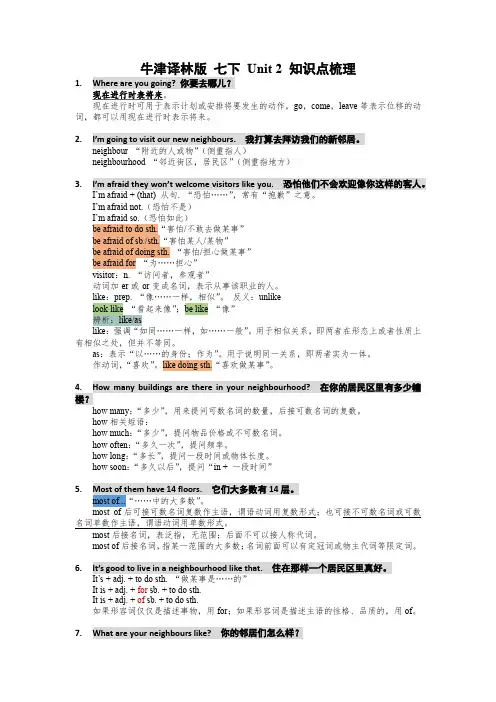
牛津译林版七下Unit 2 知识点梳理1.Where are you going?你要去哪儿?现在进行时表将来。
现在进行时可用于表示计划或安排将要发生的动作,go,come,leave等表示位移的动词,都可以用现在进行时表示将来。
2.I’m going to visit our new neighbours. 我打算去拜访我们的新邻居。
neighbour “附近的人或物”(侧重指人)neighbourhood “邻近街区,居民区”(侧重指地方)3.I’m afraid they won’t welcome visitors like you. 恐怕他们不会欢迎像你这样的客人。
I’m afraid + (that) 从句. “恐怕……”,常有“抱歉”之意。
I’m afraid not.(恐怕不是)I’m afraid so.(恐怕如此)be afraid to do sth.“害怕/不敢去做某事”be afraid of sb./sth.“害怕某人/某物”be afraid of doing sth. “害怕/担心做某事”be afraid for “为……担心”visitor:n. “访问者,参观者”动词加-er或-or变成名词,表示从事该职业的人。
like:prep. “像……一样,相似”。
反义:unlikelook like “看起来像”;be like “像”辨析:like/aslike:强调“如同……一样,如……一般”。
用于相似关系,即两者在形态上或者性质上有相似之处,但并不等同。
as:表示“以……的身份;作为”。
用于说明同一关系,即两者实为一体。
作动词,“喜欢”。
like doing sth.“喜欢做某事”。
4.How many buildings are there in your neighbourhood? 在你的居民区里有多少幢楼?how相关短语:how much:“多少”,提问物品价格或不可数名词。
牛津英语七年级下册 Unit 2 Neighbours知识汇总

牛津英语七年级下册Unit 2 Neighbours 一、单元重点词组二、重点句型1.I'm afraid they won't welcome visitors like you. 恐怕他们不会欢迎像你这样的客人。
(1)I'm afraid 译为“恐怕”,是一种口语表达习惯,通常不用he's afraid, she's afraid.例:I'm afraid it is going to rain tomorrow. 恐怕明天要下雨了。
翻译:恐怕他下个星期不能去上学了因为他得了感冒。
补充:be afraid of sth 害怕某物我害怕蛇I'm afraid so. 我恐怕是这样的。
I‘m afraid not. 我恐怕不是这样的。
I think so. 我如此认为。
I don't think so. 我不这样认为。
★ be afraid of doing sth★ be afraid to do sth 表示“怕….. ”之意---Can I have dinner with you?我能与你共进晚餐吗?--- Sorry, I'm afraid not.这里的意思是:对不起,不能(2)visitor 派生词有visit演变(3)like 介词像与…一样/ 动词喜欢做某事2.Most of them have 14 floors.大多数楼有14层。
most的用法表示“数量上最多,最大”,为many或much 的最高级。
例:She had the most money of all of them.在这些人中,她最有钱。
most of + the/this/these/that/those/物主代词+名词,指某一范围内的多数。
(名词前面一定要有修饰词)例:Most of the students come from China. most of my booksmost of +可数名词复数+ V复most of +不可数名词+V单★most 与most of 的区别1 most+名词表泛指,无范围如:most young peopleII most of + 名词指某一范围的多数III most of +人称代词,of 不能少如:most of them两者有时可互换:Most teachers in this school are women.= Most of the teachers in this school are women.3. It’s good to live in a neighbourhood like that. 住在那样的居民区里真好。
译林版丨七年级英语下册 Unit 2 知识点总结

译林版丨七年级英语下册Unit 2 知识点总结Unit 2 Neighbours一、重点词组、句型用法1. I am afraid they won`t welcome visitors like you.我恐怕他们不会欢迎向你这样的客人。
be afraid to do sth 害怕去做某事be afraid of sth /doing sth.害怕某物/做某事be afraid+(that)从句welcome sb. 欢迎某人welcome to sp.欢迎来到某地like (prep)像He, _______his elder brother, likes chatting with others. I’m afraid so.恐怕是的。
I’m afraid not. 恐怕不是这样的。
2.It`s good to live in a neighbourhood like that. 住在那样一个小区很好。
It`s+形容词to do sth3.What are your neighbours like?= How are you neighbours?你的邻居们(性格品质)如何?What be sb/sth like?你认为…怎么样(性格品质)?(用形容词回答)What do/does sb. like?某人喜欢什么?What do/does sb. look like?某人长什么样子(外貌)?4. They often meet at the community centre and share their different skills.different +名词复数5.Some of them are volunteers.他们中有一些人是志愿者。
some/most/all of +名词/代词(名词前有限定词)one of +复数表示“……之一”Most of the water is for drinking. 大多数水都是用来喝的。
牛津译林英语七年级英语下册unit2neighbours知识点归纳 (2).docx

一、知要点1. Where are you going?你打算去哪里?be going 此“ 在行表将来”。
在行表将来主要用于表示按划或安排将要生的作,常有“意”“安排”或“打算”的含。
种在行比生,人一种期待感。
go, come, leave 等表示位移的,都可以用于在行表将来。
例如: He is going.他要走了。
I ’m coming. 我要来了。
Tom is leaving.姆要走了。
2. I’m going to vi sit our new neighbours.我打算拜我的新居。
be going to意“ 划,打算”,后接原形,用于表将来。
例如: I ’m going to wash the car if I have time.若有我想洗洗。
Where are we going to stay tonight?我今晚住哪里?3. I ’m afraid they won’t welcome visitors like you.恐怕他不会迎像你一的拜者。
(1)welcome作及物,意“ 迎’’,可与介‘to用;也可作形容,意“受迎的 " 。
如:Welcome you to our school!迎到我学校来!You’re welcome .不用。
(2)句中like是介,意“像,相似’’,其反是unlike;作,意“喜’’,后可接名或不定式作。
如:What is Jim like?吉姆个人怎么?They like playing football on Sunday.他喜在星期天踢足球。
(3)won ’t是 will与not的略形式。
“ will+原形"也是一般将来的构成之一。
如:We will take a bus to work.我将乘公共汽上班。
4. Most of them have 14 floors.most of 意“⋯⋯中的大多数”,后面接可数名复数作主,用复数形式;也可接不可数名,此用数形式。
译林牛津版七年级英语下册7B U2知识点梳理:Neighbours

Most of the water is for drinking.大多数水都是用来喝的。
Most of the students in our class are boys.我们班大多数学生是男生。(注意主谓一致)
9.That sounds like a good idea.那听起来像是个好主意。(That sounds good!)
sound like +名词词组听起来像…… look like …看起来像……
sound(听起来)/look(看起来)/feel(感觉)/smell(闻起来)/taste(尝起来)/become(变得,成为),以及be动词,都是动词家族中较特殊的一类词,叫做“连系动词”,一般后接形容词,而大多数行为动词要用副词来修饰。
What do/does sb. look like?某人长什么样子(外貌)?
4. They often meet at the community centre and share their different skills.
different +名词复数
5.Some of them are volunteers.他们中有一些人是志愿者。
eg. They look cool!他们看起来很酷!The music sounds beautiful!音乐听起来很美妙!
10.Some college students are ready to help.一些大学生乐于帮忙。
be ready to do sth.准备/乐于做某事be ready for sth为……做好准备
牛津译林英语七年级英语下册unit2neighbours知识点归纳
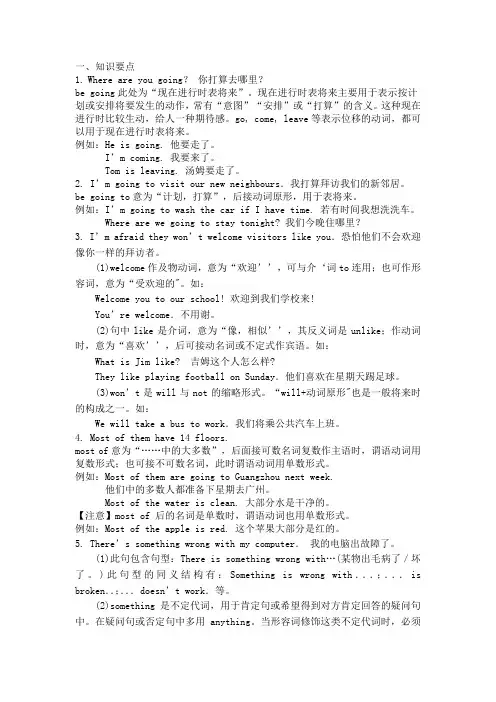
一、知识要点1.Where are you going?你打算去哪里?be going此处为“现在进行时表将来”。
现在进行时表将来主要用于表示按计划或安排将要发生的动作,常有“意图”“安排”或“打算”的含义。
这种现在进行时比较生动,给人一种期待感。
go, come, leave等表示位移的动词,都可以用于现在进行时表将来。
例如:He is going. 他要走了。
I’m coming. 我要来了。
Tom is leaving. 汤姆要走了。
2. I’m going to vi sit our new neighbours.我打算拜访我们的新邻居。
be going to意为“计划,打算”,后接动词原形,用于表将来。
例如:I’m going to wash the car if I have time. 若有时间我想洗洗车。
Where are we going to stay tonight? 我们今晚住哪里?3. I’m afraid they won’t welcome visitors like you.恐怕他们不会欢迎像你一样的拜访者。
(1)welcome作及物动词,意为“欢迎’’,可与介‘词to连用;也可作形容词,意为“受欢迎的"。
如:Welcome you to our school! 欢迎到我们学校来!You’re welcome.不用谢。
(2)句中like是介词,意为“像,相似’’,其反义词是unlike;作动词时,意为“喜欢’’,后可接动名词或不定式作宾语。
如:What is Jim like? 吉姆这个人怎么样?They like playing football on Sunday.他们喜欢在星期天踢足球。
(3)won’t是will与not的缩略形式。
“will+动词原形"也是一般将来时的构成之一。
如:We will take a bus to work.我们将乘公共汽车上班。
牛津译林版七年级英语下册Unit2知识点汇总
牛津译林版七年级英语下册Unit2知识点汇总Neighbours重点单词与短语1.Neighbour n. [英] 邻居=[美] neighbor考点: neighbour 为可数名词,复数形式neighbours.例句: My neighbours are very friendly. 我的邻居们很热情.2.Visitor n. 采访者,参观者考点: visitor 意为”访问者,参观者”,为可数名词,多指交际商务观光或探望的访客. [归纳] 以-or结尾表示人的名词actor 男演员inventor 发明家doctor 医生translator翻译家collector收集者conductor售票员3.Like prep. 像,类似;.......怎么样辨析like,as4.Helpful adj. 愿意帮忙的;有用的固定搭配helpful in doing sth. 做某事很有帮助It’s helpful to do sth. 做某事有帮助V.help help sb. with sth.= help sb. do sth.5. community n. 社区考点community 意为”社区,社团”,为可数名词. 作主语强调整体时,谓语动词用单数;强调”社区的人”时,谓语动词用复数.例句The new arts centre will serve the whole community. 这座新的艺术中心将为整个社区服务.典型例题我们的社区很大. very large.Community 为集合名词.集合名词用来指一群人或一些事物的总称,类似的词还有police,family等.5.Skill n. 技能,技巧固定搭配skill in/at .........方面的技能develop a skill 发展技能Practical skill 实际技能with skill 非常熟练例句Reading and writing are two important skills.阅读和写作是两种重要的技能.6.Problem n. 问题,难题固定搭配have a problem 有问题deal with a problem 处理问题Fix a problem 解决问题cause a problem 引起问题例句There are still some serious problems in this street. 这条街上任然有一些严重的问题.7.Something pron. 某事,某物考点something 多用于肯定句中,作主语时,谓语动词用单数形式. something 还可用于表现说话人希望得到肯定回答的疑问句中.例句There is something wrong with my bike. 我的自行车出了点毛病.Would you like something to eat? 你想吃点什么吗?8.Check vt. 检查;核实固定搭配check in 登记check out 结账退房;调查Check on 检查,查看check off 核对,查对例句Our English teacher often checks our homework. 我们的英语老师经常检查我们的作业.Check 用作及物动词时,可跟名词,代词,从句等作宾语.中考真题I will meet Jane at the station. Please what time she will arrive.A.CountB. chooseC. checkD. catch9.Broken adj. 损坏了的;破碎的考点broken 可用于名词之前作定语或连系动词之后作表语.例句The watch is broken. 这块表坏了.10.Fix vt. 修理固定搭配fix up 修理;装饰fix on 选定,确定联fix v. 安装,使固定;确定辨析fix,repair,mend例句I fix a picture on the wall. 我在墙上装上一幅画.I must have my car repaired. 我必须把我的车修好.11.College n. 学院辨析college, university12.Lucky adj.幸运的固定搭配be lucky to do sth.很幸运做某事be sb.'s lucky day 是某人的掌运反义词:unlucky adj.不幸的联想:luck n. lucky adj. Luckily adv.13.Fire n.火固定搭配make a fire 生火start a fire 放火,纵火set fire to sth. 纵火焚烧某物be on fire 起火put out a fire 灭火fight a fire 救火例句It took firemen several hours to put out the fire.消防员花了好几个小时才把火补灭。
牛津译林版七年级下册 Unit2 Neighbours 知识点总结
牛津译林版七年级下册unit2 Neighbours 1.I’m afraid they won’t welcome visitors like you.恐怕他们不会欢迎你这样的客人。
句中的like为介词,意为“像,类似,像......一样”Eg: Don’t look at me like that. 别像那样看着我。
2.I live in a flat in City Garden in Ninth Street.我住在第九大道城市花园的一个公寓里。
live in 居住在......Eg: We live in the same alley.我们住在同一条小巷里。
3.How many buildings are there in your neighbourhood?你的邻近有多少建筑物?how many (+可数名词)多少= how much (+不可数名词)Eg: How many parents do that?有多少父母能做到这样吗?How much is this worth?这值多少钱?4.There are about 20 buildings.有大约20栋建筑物。
there be 句型表示“有(某处存在某物)”have 也可表示“有(某人拥有某物)”Eg: There are some apples on the table.有一些苹果在桌上。
We have all kinds of books.我们有各种各样的书。
there be 句型的就近原则:be 动词的使用取决于be动词后最近的词为单数还是复数。
Eg: There is a book on the desk.有一本书在书桌上。
There are three books on the desk.有三本书在书桌上。
若be动词后的词为不可数名词,则be动词用单数。
Eg: There is some milk in the fridge.有一些牛奶在冰箱里。
七年级英语下册Unit2Neighbours知识归纳与拓展新版牛津版
Unit 2 Neighbours知识归纳与拓展【词汇解析】1. visitorvisitor是可数名词,意为“游客,参观者”,其复数形式是visitors。
visitor的动词形式是visit,意为“参观,访问”; visit也可用作名词,常构成短语pay a visit to,相当于动词visit。
如:Visitors often do some shopping in local shops.游客们常在当地商店购物。
We will visit the Palace Museum next week.下周我们将参观故宫。
Some American students will pay a visit to our school next month.下个月,一些美国学生将访问我们学校。
2. likelike作介词时,意思是“像,类似”,不可作句子的谓动词,常与“be”动词一起使用,或构成短语look like,意为“看起来像”;like作动词时,意为“喜欢”。
如:They don’t welcome a visitor like you.他们不欢迎像你这样的来访者。
The boy looks like his father.这个男孩看起来像他爸爸。
Everyone in my class like learning English very much.我班上的每个人都非常喜欢学英语。
【拓展】like的反义词有两个:dislike是动词,意为“不喜欢”,相当于hate;unlike 是介词,意为“不像”。
3. luckylucky是形容词,意为“幸运的”,可以作表语或作定语修饰名词,常用结构有:be lucky to do sth.意为“做某事是幸运的”;It is lucky of sb. to do sth.意为“某人做某事真幸运”。
如:He is really a lucky boy.他真是个幸运儿。
最新最新译林版牛津英语7Bunit2-neighbours知识点讲解
Unit2 Neighbours词汇/句型1.neighbour n.邻居拼写:居民区,社区2.meet(1)vt.遇见,碰见I met him in the street.(2)vt.迎接Will you meet her at the station?[拓展]Meet with 偶然遇见On my way home, I met with an old friend.3.afraid adj.害怕,畏惧(1)be afraid to do sth害怕做某事I’m af raid to go out alone at night.(2)be afraid of doing sth害怕……I’m afraid of falling into the river.(3 )be afraid that从句,表示恐怕……I’m afraid that I can’t help you.4.like prep.(1)像,类似Lily makes a kite like a butterfly.Don’t do it like that.(2)像…一样,常用词组look likeMy brother looks like my father.5.It’s good to live in a neighbourhood like that.It是形式主语,to live in a neighbourhood是真正的主语。
句式:It is+adj+(for/of sb) to do sth6.help sb. with sth翻译:他经常帮我复习英语。
help sb (to) do sth翻译:他经常帮妈妈打扫房间。
7.翻译:我的电脑出毛病了something interesting有趣的事8.词汇:(1)checkcheck in 登记,报到check out结账离开check up核对,检查check one’s answer 检查某人的答案ask for money 要钱10.someonesomeone 某人,用于肯定句,否定结构anyone翻译:有人正在敲门。