
外研版小学英语(一年级起点)六年级上册Module8 Unit1 参考教案
Module8 Unit1 参考教案
一、教学内容
外语教学与研究出版社(一起点)六年级上册
第八模块Unit 1 Do you often tidy your bed?
二、教学过程建议
(一)热身导入
1. 请学生说SB Module 7 Unit 2活动4的韵句,鼓励学生边说边做动作。
2. 播放SB Unit 1活动1的动画或录音,请学生看动画或边听录音边看挂图,理解语境:Simon兴冲冲地跑来告诉Darning自己在打扫房间时找到了一枚硬币。
3. 再次播放录音,请全班跟读,并学习“coin”的语义。
最后请部分学生展示对话。
(二)任务呈现
教师对学生说同学们,你们有没有经常做某些事的习惯?今天我们的任务就是介绍自己经常从事的活动,以便让同伴更加了解我们。
在这之前,我们先来看一看Amy有什么经常从事的活动吧。
”
(三)课文学习
1. 播放SB Unit 1活动2的动画或录音,请学生看动画或边听录音边看挂图。
教师帮助学生理解课文语境。
2. 再次播放录音,请学生完整听一遍对话,进一步理解语句。
播放第三遍录音,请学生逐句跟读。
对于学生跟读有困难的语句,教师先带读较难词语,然后按照意群、节奏重点带读,请学生注意模仿语音语调。
3. 在跟读过程中,通过展示图片、做动作、说明等方式,学习“ever, tidy messy”的语义,并引导学生注意“tidy”的不同变化形式。
可适当归纳已学的多词性的词,如“call, cry, dance, drink, help, jump, love, phone, play, rain, snow talk, walk”(既是动词也是名词),“clean, open” (既是动词也是形容词),表示颜色的词(既是名
词也是形容词),“slow, fast”(既是形容词也是副词)等。
此处教师只需归纳已学单词,不必扩展。
4. 请学生观察、分析、归纳对话中的“often”和行为动词一般现在时的特点及基本用法,并适当扩展到其他人称。
5. 完成AB Unit 1练习1。
这是课文阅读理解练习。
教师引导学生理解练习要求: 阅读课文和问题,把相应答句的序号填写在下方的表格中。
先请学生完整地阅读一遍课文,再请学生朗读问句和答句。
然后请学生根据课文内容,逐一为问句寻找答句,并将答句的序号写在表格中。
先请学生独立完成,再请学生两人一组相互检查。
最后请部分学生说出答案,全班核对。
6. 完成AB Unit 1练习2。
请学生在完成AB Unit 1练习1后,根据练习1的内容进行问答。
先请学生朗读例句,然后请学生两人一组,仿照例句开展问答练习。
最后请部分小组向全班展示。
7. 请学生分组、分角色朗读对话,并请部分学生进行角色扮演。
8. 再次展示挂图,并在黑板上写出“tidying, bed, help, often, desk, messy, read, stories”作为提示词,鼓励学生看挂图和提示词复述课文,注意纠正学生的语音语调。
(四)训练巩固
1. 完成SB Unit 1活动3。
请学生看图,听录音并跟读。
2. 完成AB Unit 1练习3。
教师引导学生理解练习要求:听录音,根据录音内容在表格的相应位置打V。
先请学生朗读表格中的短语,理解题目内容。
然后完整播放一遍录音,请学生整体感知。
再次播放录音,请学生根据录音内容,在表中相应的位置打√。
播放第三遍录音,请学生两人一组相互检查。
最后请部分学生说出答案,全班核对。
外研版小学六年级英语上册Module 8教案
外研六上Module 8Unit 1【教学目标】.能运用语句:A: Do you often play with dolls? B: Do you often clean your room?1.能够运用Do you often ?的句型谈论行为和爰好,会用以下几种方式回答:Yes, I do. /No,I don' t. /Not really./ Not often./Not very often.2.对自己做事的喜好程度做出正确描述。
3.培养学生的合作精神和与人交流的能力。
【教学重难点】重点1.能理解often,并运用句子:D。
you often?2.知道以下几种回答的区别:Yes, I do. /No,I don, t./Not really./Not often./Not very often.并会根据喜好程度做出正确的表达。
【教学过程】Step 1 Warm up1. Greetings. A chant "hobbies"2. Review.Q)呈现遮盖着某部分的图片T: Look, I have some photos. Look at this photo, what are(is he/she) theydoing?(屏幕出示几组学生活动的照片,逐一出示照片及短语)play computer games, speak English, swim, play basketball help yourmum, eat fast food., watch Thread stories, clean your room(2)复习句型Do you often?几种方式回答:Yes, I do. / No,I don' t./Not really. /Not often. / Not very often.(设计意图:回忆已学词组,巩固旧知,为新授做好铺垫)Step 2Presentation1.出示课题:Module 8 Unitl Looking at photos.).看图回答:a. Who are they?b. What are they doing?过渡:T:Do you want to see Amy' s photo?Ss: Yes.T:You can say "Yes, I' d love to."3.带着问题听读第一遍课文a.How many photos are they talking about?b.What can you see in them?课件呈现三幅图片并让学生描述图片。
外研版小学英语(一年级起点)上册Module 8 Unit1 参考教案
Unit1 参考教案How many?一、教学目标(一)知识技能目标:1. 懂、会读、会说、会写单词one ,two ,three, four, five, six, seven, eight, nine ,ten2. 能听懂、会读、会写句子How many? Count the number from1 to 10.3. 能听懂、会说基数词1到10。
(二)运用能力目标:1. 让学生感受英语课堂的活跃性,让学生在日常生活中能运用所学语言。
2. 培养学生用英语思维的能力,及大胆用英语交流的能力。
(三)素质教育目标:1.培养学生浓厚的英语学习兴趣,积极参与说英语、唱歌曲、做游戏等实践活动。
2.帮助学生树立较强的自信心,培养学生乐于与他人合作的精神。
二、教学重、难点重点:1.熟练掌握下列单词:one, two, three, four, five, six, seven, eight, nine , ten 2.能听懂、会说、会读以下句子:How many?Count the number from1 to 10.并能进行扩展,在实际生活中灵活运用。
难点:1.熟练掌握本单元的单词和句型,能在实际生活中灵活运用。
2.注意six和three的读音。
三、教学意图1.培养学生对重点词汇和句子的认读能力。
2.培养学生的听说能力。
3.通过多种形式的活动激发学生的学习兴趣。
四、教具准备电子白板、电子课本、课文录音、一些小奖品。
五、教学过程Step 1.Warming-up1.教师和学生一起说唱英语童谣《Hello》,并做出相应的动作。
唱唱做做的活动活跃了课堂气氛,营造了和谐、宽松的学习氛围,让学生很快把注意力集中到课堂教学中来。
2.教师走下讲台到学生当中,和学生做简单的Free Talk.,复习已学的知识内容,同时帮助学生快速进入英语思维的状态,为整堂课的进行做好准备。
Step 2.Presentation教师给学生呈现一张熊猫的图片:T: Look, what’s this?S: It’s a panda.T: How many?S: 1教师在和学生做这组问答时,可以利用夸张的口形和肢体语言,让学生更加简单易懂地理解句义。
Module8(教学设计)外研版(一起)英语六年级上册

《英语》(新标准)(小学一起)六年级上册Module8教学设计调动已有的知识参与到活动中,为下一步的课文教学作铺垫。
造一个快乐的学习氛围。
Step 2: 学习活动一(5分钟)1.聚光灯出示两个人物,Daming 和Daming’s father, 让学生猜一猜,他们发生了什么事情?(Does Damingoften … ?)a.当学生回答后,教师重复说出短语,并指出今天我们要争做“爱好小调查员”。
b.让学生观看今天的课文动画。
2.教师出示及板书课题。
T: Amy and Lingling are tidyingTom’s bed. Why? Ok! Today let’slearn Module 8 Unit 1 Do you oftentidy your bed?学生观看图片进行猜测。
tidy yourroom学生跟随老师朗读课题。
通过一个小小的猜谜游戏,调动学生学习热情,引出第一部分内容。
根据录音内容证实学生的猜测,猜对老师会奖励小贴纸,扩大学生的参与面。
板书本课课题即重点句型,为接下来的学习做好铺垫。
Step 3: 学习活动二(20分钟)1. 看书,听录音,并且下划线Do youoften ...?2.再听课文,带着这样的问题:DoesLingling often tidy her room? Isit tidy or messy?3.看书听录音。
学生仔细观看活动二动画。
小组内讨论所画内容。
学生带问题感知课文。
小组讨论并汇报。
播放课文动画,整体呈现对话,让学生整体感知对话,了解对话大意。
小组合作学习互相解决新单词和短语。
个别小组到展台前展示单词的书写及发音,然后在黑板上选择任意单词汇报其记忆方法。
4.小组之间操练目标语句:Do you often tidy your room? Yes, I do/ No, I don’t.5.当有的学生回答No, I don’t 时,乘胜追击,继续问学生: What do you often do?6.继续开展操练活动:让每个学生用一张小纸条,写好他们愿意做的事情,当教师说:play football,凡是写这个活动内容的学生都站起来说:“We often play football.”7. 分角色朗读课文。
外研版一起小学英语六年级上册教案

s ten thoThen the teacher show another pictures and ask the questions ]如:学校、街道、尺子、大笨钟。
图片的背 而是它的长度和年龄的数字)How long is it? How old is it? T: So you can guess the answers. If your answer is right ,so yo can get a gift .51: it ' s ••• ..lortg/ s .... y ears old. 52: it ' s ••• ..lortg/ s .... y ears old.贴近生活 的导入可 」以让学生 感觉英语 学习的真 实。
T: oh, your answer is right.(老师把图片翻过来对一对学生 给出的答案是否接近正确答案。
并给最接近答案的孩子奖 这一环节 励。
) 4.句型操练: T:ok, now you can pick a thing, and ask your partner using this new sentencesFor example: ...................(老师和——个基础比较好 的学生进行对话示范) Now, please pair work, after 2 minutes, have some students the dialogue.Step4: Learn the new words 1. Listen and find out the question sentences. Can we walk all of the great wall? How long is it? How old is it?让学生自 己去找问 题,可以 改变以前 那样总是 say 由老师提 问学生回 答的模 式,可以 让学生自 己提出问 2. Listen and answer the questions.(为了提高孩子的理解能 力,老师还可以提出更多而问题让学生口答,如: what are they talking about? How old is the moon? ...... ) 3. Listen and repeat together. 4. Listen and repeat again. Have some students say out the sentences one by one. 5. Read the dialoge . ( Group A is Simon, Group B is Daming.) 6. Pair work. 7. show the results, and give the best group a gift. Step 5. Practice.1. Teacher show the pictures: desk, classroom, street, the SummerPalace, your school, your city, the moon. Then have the student make a dialogue.2. The students can choose a picture to make a dialogue.3. Act it out4. If possible, the teacher show another pictures have the students make some new dialogues. Step 6 :Activity book. 1. Ok, turn to page 2 and finish the pare 1 and part 3. 2. Check the answer. Step 7: Homework 1 .完成课堂活动用书第三题。
Module8Unit1Doyouoftenplaywithdolls(教学设计)外研版英语六年级上
Module 8 Unit1 Do you often play with dolls教学设计一、教材分析:本节课是外研版小学英语六年级上册的第八模块的第一单元。
本单元主要围绕着“Do you often play with dolls?”这一话题展开,通过学习询问和回答关于玩具的频率的问题,培养学生的听、说、读、写的能力,同时也帮助学生扩展词汇量和提高语言表达能力。
二、教学目标:1. 学会运用频率副词询问和回答关于玩具的频率。
2. 能够用简单的句子描述自己和他人的玩具使用频率。
3. 通过对话和练习,提高学生的听、说、读、写的能力。
4. 培养学生的合作意识和团队合作能力。
三、教学重点和教学难点:教学重点:1. 学会使用频率副词询问和回答关于玩具的频率。
2. 提高学生的听、说、读、写的能力。
教学难点:1. 运用频率副词正确询问和回答关于玩具的频率。
2. 提高学生的语言表达能力和口语交际能力。
四、学情分析:学生是小学六年级的学生,他们已经具备一定的英语基础,能够简单地进行英语对话和阅读。
他们对玩具这一话题感兴趣,但在表达自己的意见和观点时可能存在一定的困难。
因此,本节课需要通过多种形式的练习和活动激发学生的学习兴趣,提高他们的参与度。
五、教学过程:Step 1: WarmupGreet the students and review the previous lesson briefly.Show some pictures of different toys and ask the students if they like playing with these toys. Encourage them to express their preferences using sentences like "I like playing with dolls" or "I don't like playing with toy cars."Step 2: PresentationIntroduce the target sentence: "Do you often play with dolls?" Write it on the board and explain the meaning to the students.Teach the frequency adverbs: always, usually, often, sometimes, rarely, never. Write them on the board and explain their meanings and usage.Use examples to demonstrate how to form questions and answers using the target sentence and frequency adverbs. For example:Teacher: Do you often play with dolls?Student: Yes, I often play with dolls.Practice the target sentence and frequency adverbs with the whole class. Ask individual students questions using the target sentence and encourage them to answer using the frequency adverbs. For example:Teacher: Do you always play with toy cars?Student: No, I rarely play with toy cars.Step 3: PracticeDivide the class into pairs or small groups.Give each group a set of picture cards depicting different toys.Instruct the students to take turns asking and answering questions about the frequency of playing with each toy. For example:Student A: Do you often play with toy cars?Student B: No, I sometimes play with toy cars.Monitor the students' conversations and provide assistance if needed.After the practice, ask some groups to share their findings with the whole class. For example, ask a student from each group to report on the toy they oftenplay with and the toy they rarely play with.Step 4: ConsolidationPlay a game called "Toy Survey." Give each student a survey sheet with questions about toy preferences and frequency of playing with different toys.Instruct the students to walk around the classroom and ask their classmates the survey questions. They should record their classmates' answers on the survey sheet. After the survey, ask some students to share their findings with the whole class. For example, ask a few students to share the toy that is most popular among their classmates and the toy that is least popular. Step 5: WrapupReview the target sentence and frequency adverbs with the whole class. Ask some students to provide examples using the target sentence and frequency adverbs.Summarize the main points of the lesson and provide feedback on the students' performance. Praise their efforts and improvements.Assign relevant exercises from the textbook or workbook for homework.例子:Warmup: Show pictures of different toys, such as dolls, toy cars, action figures, and stuffed animals. Ask the students, "Do you like playing with dolls?" Encourage them to answer using plete sentences, such as "Yes, I like playing with dolls" or "No, I don't like playing with dolls because I prefer toy cars."Presentation: Write the target sentence "Do you often play with dolls?" on the board. Explain its meaning and emphasize the use of the frequency adverb "often." Give an example dialogue:Teacher: Do you often play with dolls?Student: Yes, I often play with dolls.Practice: Divide the class into pairs. Give each pair a set of picture cards depicting different toys. Instruct the students to ask and answer questions about the frequency of playing with each toy. For example: Student A: Do you usually play with toy cars?Student B: No, I rarely play with toy cars.Consolidation: Play the "Toy Survey" game. Give each student a survey sheet with questions about toy preferences and frequency of playing with different toys. Instruct the students to walk around theclassroom and ask their classmates the survey questions. Afterward, ask some students to share their findings with the whole class. For example:Student: According to the survey, most of my classmates often play with stuffed animals, and very few of them never play with action figures.Wrapup: Review the target sentence and frequency adverbs. Ask the students to create their own sentences using the target sentence and frequency adverbs. For example, "Do you always play with toy cars?" or "I sometimes play with dolls, but I usually play with action figures."六、板书设计:Do you often play with dolls?always usually often sometimes rarely never七、教学反思:本节课通过引入频率副词,教授了有关玩具频率的表达方式。
M8外研社版英语(新标准)(一年级起点)六年级上册课件设计
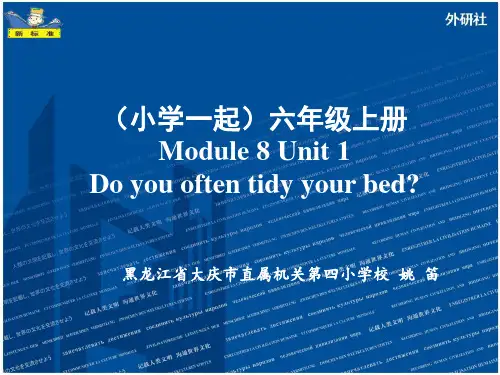
always总是 often经常 sometimes有时 never从不
I often play football. tidy my room. watch TV.
The room is tidy. The room is messy.
We can live well in a tidy room. 我们生活在整洁的房间里,会很舒服的。
coin
硬币
————
————
Does Tom —e—ve—r tidy his bed?
曾经
No, he doesn't.
read books.
listen to music.
Do you often
?
eat bananas cook dinner send emails
go swimming clean the classroom drink tea
Does he/she often
?
Do you often
?
play basketball play the flute collect stamps tidy the bed read books phone Grandma
She_n_e_v_e_r plays football. Because she doesn't like it. She s_o_m__e_ti_m_e_s_ cleans the blackboard for her teachers.
He _o_f_te_n_reads English books. Because he loves English.
外研版(一起)六年级英语上册《Module8Revision》教案设计1
外研版(一起)六年级英语上册《Module 8 Revision》教案设计1一、教学目标1. 知识与技能:通过本节课的学习,使学生能够熟练掌握并运用Module 8中的重点词汇和句型,提高学生的英语听说读写能力。
2. 过程与方法:通过小组合作、情境创设、任务驱动等教学手段,培养学生自主学习、合作学习和探究学习的能力。
3. 情感态度与价值观:激发学生学习英语的兴趣,培养学生积极向上的情感态度,增强学生的跨文化交际意识。
二、教学内容1. 词汇:复习Module 8中的重点词汇,如weather, sunny, cloudy, rainy, windy等。
2. 句型:复习Module 8中的重点句型,如"How's the weather today?", "It's sunny/cloudy/rainy/windy."等。
3. 语法:复习一般现在时态的用法。
三、教学重点与难点1. 重点:熟练掌握Module 8中的重点词汇和句型,能够运用所学知识进行日常交流。
2. 难点:正确运用一般现在时态描述天气情况,区分不同天气状况的词汇。
四、教具与学具准备1. 教具:多媒体课件、录音机、黑板、粉笔等。
2. 学具:英语课本、练习册、笔记本、文具等。
五、教学过程1. 导入:通过播放天气预报视频,引导学生关注天气话题,激发学生学习兴趣。
2. 新课展示:利用多媒体课件展示Module 8中的重点词汇和句型,引导学生跟读、模仿。
3. 小组合作:将学生分成小组,进行角色扮演,模拟天气预报员播报天气。
4. 任务驱动:布置任务,让学生用英语描述自己所在城市的天气情况,并进行汇报。
5. 巩固练习:设计相关练习题,检查学生对Module 8知识的掌握程度。
六、板书设计1. Module 8 Revision2. 重点词汇:weather, sunny, cloudy, rainy, windy等。
最新外研版小学英语六年级上册M8U1公开课教学设计
最新外研版小学英语六年级上册M8U1公开课教学设计Module 8总备课知识与技能:全体学生能朗读课文,阅读相关短文,并能按要求完成语句书写。
过程与方法:运用已学语言谈论日常生活习惯。
情感态度与价值观:在学习和日常交际中,能初步注意到中外生活习惯的异同。
第一课时Unit 1 Do you often play with dolls ?【教学目标】:知识与技能:How many photos are there in the story ?What can you see in them ?Does Amy often play with dolls /read stories / clean her room?过程与方法:探究式学习方法,小组合作交流法,情景教学法,任务型教学法情感、态度和价值观:谈论行为习惯和喜好。
【重点】:本模块的单词及句型【难点】:现在进行时的用法【课时安排】:1课时【教学过程】:(一)导入:一.复习:1.老师向学生展示自己的一些照片,让学生对照片进行描述。
2.让学生几个人一组讨论各自在星期天都喜欢干什么,引导大家关注自己和同伴的日常生活。
二.任务呈现与课文导入:1.拿着自己的照片,询问学生是否经常去公园或经常做与你相同的事情:Do you often ?出示一些表现各种活动的单词卡片,让学生说出相应动词或词组。
例如:help your mum ,eat fast food , readstories 等。
出示单词卡片,向学生提问:Do you often help your mum?引导学生作出回答。
2.带领学生温习often 的意思。
在黑板上写出星期一到星期日的单词,一边说句子,一边在相应的位置上打勾号I watch TV on Friday , Saturday and Sunday . I often watch TV.3.告诉学生:在今天的课文中,我们要了解到Amy 和Lingling 的一些爱好和习惯。
【六年级】外研版英语六上MODULE8Unit1Lookingatphotosword教案2篇
【关键字】六年级外研版六年级英语上册教案Module 8 Unit 1 Looking at Photos教学内容:Unit one Looking at Photos学习任务:Do you often play with dolls?功能:谈论行为习惯和喜好教学程序:1.WarmerHave the students look at activity 1. They should number the pictures1, 2,and 3 respectively. Make sure they do this very lightly in pencil so that they can erase it later.Now tell the students that you are you are going to say things about the story and they have to say which pictures you are talking about.2. Listen, point and find ‘often”.Have the students close their books.Tell the students that you are going to play the tape and stop after each utterance. The students have to tell you who the speaker was: Lingling or Amy.No w play the tape a second time and tell the students to call out ‘stop’ each time they hear the word ‘often’.3. Ask and answer.Get two pieces of large paper.On one piece write ‘very often’ and on the other piece write ‘not very often’.Put the pieces of paper on the walls around the classroom.Now tell the students that you are going to ask them questions and they have to point to the relevant responses.Example: T: do you often go to see films?Ss:(point to the response that is relevant for them)T: do you often play computer games?Ss (point to the response that is relevant for them)4. homework: read the text板书设计:Unit one Looking at PhotosDo you often play with dolls?Do you often go to see films?Do you often play computer games?教学札记:Learning and EnjoyingModule 8 Unit 1 Looking at Photos.预习提纲只看课文插图,听录音一遍。
外研版(一起)六年级英语上册教案Module8Unit1(1)
MODULE 8Unit 1 Do you often tidy your room?
学科
英语
班级
六年级
单元
Module 8
课题
Do you often tidy your room?
磨教材
教材简析
玲玲想知道艾米在干什么,艾米告诉她自己在整理房间。玲玲发现艾米的书橱比较乱就主动帮她一起整理,收拾完后两人高兴地一起读书。
教学目标
能力目标:用一般现在时态对日常行为进行问答。
知识目标:四会单词tidy bookshelf week often room stories story
四会句子:Do you often tidy your room? Nories to my little brother.
2.预习(Preview)
板书课题,引出词组tidy your room,告诉学生tidy可以当动词用,意思是整理、收
磨
教
学
过
程
拾;也可以当形容词用,意思是整齐的、整洁的。带领学生朗读该词组,然后教师进行提问。T: Do you often tidy your room? S:Yes, I do. / No, I don’t.对于做肯定回答的学生,教师予以表扬。并告诉学生,在日常生活中要养成良好的习惯。今天我们就去Amy家看看Amy和Lingling有哪些好习惯值得我们学习。
⑵看书听录音,回答下列问题。
①What is Amy doing?
②What can’t Amy find in her room?
③Does she often tidy her bookshelf?
④What will Lingling do for Amy?