
译林牛津版 8A Unit 8 Natural disasters Reading I The Taiwan Earthquake 教学
We should … 1.Keep calm. 2.Protect your head. 3.Hide in the washroom or under a strong
desk. …...
Please remember:
In face of disasters, calmness, faith(信念) and courage are the most important.
felt
ran in all directions
saw
shook
came down
fell down
a loud noise like thunder
real noise like bombs heard
screaming
did
ran out, but...
Which one is not the reason why Timmy couldn’t ran out?
1.A report on the Taiwan earthquake. 2.A story about the Taiwan earthquake.
Timmy
Read para1-2 silently to find out the answers.
1.What was Timmy doing when the earthquake happened? He was sleeping when the earthquake happened.
What do you think of Timmy from his experience through the earthquake? (Qualites)
clever calm brave strong-minded hopeful optimistic(乐观的) insistent(坚持不懈的) persevering(坚韧的,有毅力的)
Reporter: ….What were you doing when it started? Timmy: ... Reporter: What did you feel/hear/see/do …? Timmy: … Reporter: …How/Why did you…? Timmy: … Reporter: …. Thank you for your time!
_E_a_r_th____
Shook and cracked(裂开).
Glass, bricks and walls Fell down and _c_a_m_e__d_o_w. n
Read para3-5 silently to find out the answers.
1.What was everything around like when the earthquake ended? It was dark and silent.
8上 Unit8 Natural disasters
Reading I The Taiwan earthquake
By Ling Juan
Predict from the title and illustration.
The Taiwan earthquake
Read quickly to tell what the text is about.
D.He slept so deeply that he was trapped when he realized the earthquake.
Read para1-2 again to think about how people felt.
People felt _f_r_i_g_h_t_e_n__e_d_/_s_c_a_r_e_d__/_p_a_n_i_c_k__y_(惊b慌e失ca措u的s) e…
2.What did Timmy do to help himself out?
Put what Timmy did into the right order.
A.He shouted for help. B.He tried to find his way out. C.He told himself to calm down. D.He pulled himself slowly through the dark. E.He screamed for help when hearing some noise above him.
......
What should/shouldn’t we do if we meet with an earthquake?
We should not …. 1.Don’t be too frightened. 2.Don’t use the lift. 3.Don’t rush out in at happened
_N_o_i_s_e___ People
Sounded like thunder and bombs.
Slept without preparation. _Sc_r_e_a_m__e_din fear. Ran in a_l_l_d_i_re_c_t_io. ns
A.He got so frightened that he didn’t want to run out. He tried his best to run out.
B.He lived alone so no one woke him up and helped him.
C.The walls came down and the door closed, so he had no way out.
2.What did Timmy feel, hear, see and do during the earthquake?
What did Timmy feel, hear, see and do during the earthquake?
ran out of the building
a slight shake
Homework
1. Retell the story as you are Timmy.
2. Write a passage to call on people to give helping hands to the disaster area. (at least 80 words)
The right order:C____A_____D_____B_______E____________
Read para3-5 aloud to feel what Timmy experienced in the earthquake.
Timmy’s feelings
Make an interview about the earthquake.
牛津英语8A Unit8 natural disasters 单元知识解析
牛津英语Unit8 natural disasters单元知识解析Welcome to the unit and comic strip❶ Didn't you hear the rain?难道你没听到雨声吗?(教材第92页)否定疑问句表示一.种惊讶或不快。
否定疑问句意为“难道.......吗?”Aren't you afraid of your father?难道你不怕你爸爸吗?Don't you know you should tidy up your bedroom?难道你不知道你应该把卧室收拾好吗?[拓展]①否定疑问句的用法归纳:a.表示说话人预期或希望得到肯定答复。
Don't you like the lovely snowman?你不喜欢这个可爱的雪人吗?b.表示赞叹或感慨,意为“真..... ,译成汉语时,句末用感叹号。
Isn't it a lovely day?今天天气真好!c.表示批评、厌烦、责难等。
Can't you speak a little louder?你不能大点儿声说话吗?d.表示较客气地提出请求、邀请等。
Don't you think we should keep it secret?你不认为我们应该保密吗?②否定疑问句的回答形式同肯定疑问句,且一定要根据事实回答,事实是肯定的就用yes,反之就用no。
-Don't you like English?难道你不喜欢英语吗?一Yes,I do. I like it very much.不,我非常喜欢。
一Can't you swim?难道你不会游泳?-No, I can't. I will learn to swim this year.对,我不会。
我今年要学游泳。
❷Who will mop up the water if I go home without you?如果你不跟我回家谁来把水拖干净呢? (教材第92页)(1) mop (mopped, mopped, mopping)此处用作及物动词,意为“用拖把擦干净”。
译林牛津版8A Unit 8 Natural Disaster Reading (共17张PPT)
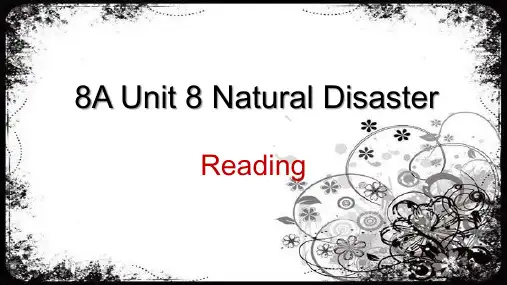
If you are in the earthquake, what should you do?
Write a letter to your friends, and tell them the earthquake Timmy faced.
________________________________________________________ ________________________________________________________ ________________________________________________________ Try to use ________________________________________________________ ________________________________________________________ the phrases ________________________________________________________ we have ________________________________________________________ learnt today. ________________________________________________________ ________________________________________________________
“Help! Please help! I’m here!”
Watch a video about the people after the earthquake
译林牛津版 8AUNIT8 Naturadisaster Task

Let’s choose the topic!
A fire An earthquake(in Wenchuan) A flood A rainstorm A typhoon A snowstorm A sandstorm An accident
Choose a topic -----a rainstorm in Changzhou introduction
during the rainstorm after the rainstorm
Useful expressions:
Which is useful for you? Choose them out !
1.What did you do? 1.wore more clothes/rain coat/glasses 2.called 110/119/120 hotline 3.closed the door and windows 4. went to high places---
Unit6 Natural disasters
Main task
How many natural disasters do you know now?
A fire An earthquake(in Wenchuan) A flood A rainstorm A typhoon A snowstorm A sandstorm An accident
P3 Suddenly, a strong wind came from behind .We lost our
umbrella in the wind and I nearly fell over. We could do nothing but walk slowly in the storm. When we arrived at the bus stop, we could see many people. We were really worried as there would be no buses soon. At last, we got on a bus and went to Millie’s house.
译林牛津版8A Unit 8 Natural disasters Grammar 教学课件 (共17张PPT)
now
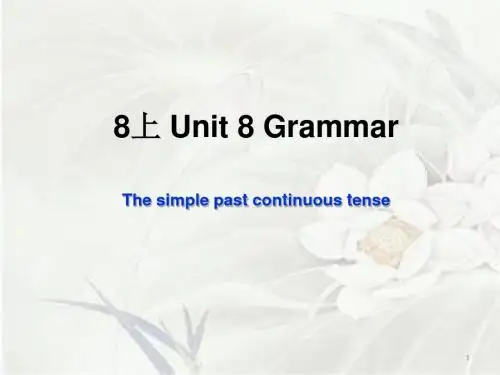
• What were you doing when the phone rang?
(background description – I was watching T.V.)
• What happened when you were watching T.V.?
3
PAST CONTINUOUS TENSE
• The Past Continuous describes an action that was already happening at a time in the past and was not finished at the time.
• It means that the action was in progress at a certain time in the past. Example: At 5 o´clock Mark was playing football with his friends.
Key word: when
Past Continuous
1. To say that something was in progress at a certain time in the past
2. To describe a background situation (was / were + ING)
•I was watching T.V. at 8.30 pm last night. (I started at 8.00 pm
and was still watching T.V. at 8.30 pm).
初中英语译林版备课资料8AUnit 8 Natural disasters讲解分析+教案设计+习题设计+单元检测

Unit 8 Natural disasters单元概述单元教材分析:本单元围绕Natural disasters这个话题展开,让学生谈论了解各种自然灾难以及在各种自然灾难中如何自救,并注意从学生自己生活的实际环境出发,拓展了一些自然现象和自然灾害。
“Comic strip”部分通过Eddie和Hobo的对话情境,激发学生对本单元的学习兴趣,引出天气状况,同时初步导入本单元的重要语法——过去进行时。
“Welcome to the unit”部分通过对比自然灾难与人为事故来了解并掌握几种常见的自然灾难的名称,掌握句式:…if…和Was anyone hurt?等;“Reading”部分通过学习了解台湾地震幸存者Timmy的故事,了解台湾地震的基本情况,培养学生根据关键词和语境猜测大意的能力,学习并掌握大量的词汇、词组和句式,理解使用过去进行时的语境,同时培养学生根据已有的阅读材料抓住故事细节和故事情节发展的能力,引导学生运用正确的阅读技巧,全面提高阅读能力,教育学生在自然灾难中的自我保护。
“Grammar”部分介绍了过去进行时的构成和用法,学会“while”“when”和“as”在过去进行时中的具体运用;“Integrated skills”部分让学生通过听录音,从录音材料中提取信息,补全灾难预防提示表,并以“What should we do first?”让学生学会处理一些日常生活中的突发事故,训练学生的听、说、读、写技能;“Study skills”是英语构词教学中的一种,通过把两个独立的英语单词结合到一起构成另外一个单词,也就是“合成法”。
学生通过学会通过两个单词的意思,猜测出它们构成的新词的意思;“Task”部分通过回顾单元基础知识,学习在写作中陈述事实性信息,让学生根据一些要点完成Sandy 的范文,并根据范文设计出一种自然灾难文章的要点提纲,尝试写出相关文章。
训练学生的写作能力,综合运用英语的能力。
译林牛津版 8A Unit 8 Natural disasters Reading I The Taiwan Earthquake 公开课教学课件 (共42张PPT)
3. People screamed in fear. in fear 害怕地,恐惧地 相似的结构还有: in trouble 有麻烦的 in need 需要帮助的 in danger 处于危险之中
e.g. They got lost in the forest. They had to try different ways in fear.
6. calm down
平静下来
7. shout for help
大喊救命
8. be/stay alive
活着
9. find one’s way out
寻找出路
10.pull myself slowly
黑暗中拽着自己
through the dark
缓慢爬行
11.move away the bricks 搬走砖块
e.g. Please move away the desk and the chair. 请把那个桌子和那把椅子搬开。
Discussion
What are the right ways to protect yourselves if you are in an earthquake?
hide ourselves under the furniture
flood
earthquake typhoon
natural disaster
shake shaking
v.&n. n.震动 震动 摇动
run out of the building
a bomb
a loud noise like bombs under the ground
run in all directions
译林牛津版 8A Unit 8 Natural disasters Reading I The Taiwan Earthquake 教学课件 共19张PPT)
scream
W
E
/bɔm/
bomb
fear
/fiə/
S in all directions
Earthquakes are really big disasters!
There was an earthquake in Taiwan. It happened on 21st
September 1999. More than1,700 people died. Timmy survived the earthquake. He wrote his story and put it on his home page.
PeoplTimmy shouted for help and pulled himself slowly through the dark.
WWhhiilele-re-raediangdi4ngFil5l in the form
When the earthquake came, what did Timmy feel/hear/see/do? He…
Studying Independently
While-reading 2 Scanning
Listen and answer the questions
1.What was Timmy doing when the earthquake
started?
He was sleeping.
2. What happened to the buildings? Pieces of glass and bricks fell down.
lesson.
No matter what terrible disasters you are facing,
牛津译林版八年级英语8A Unit8 Natural disasters知识点归纳总结
8A Unit8 Natural disasters一.词汇拓展1.shake v.→shaking (n.) 摇动2.direct v. →direction(n.) 方向3.live v. →alive (adj.) 活着的4.safe adj. →safety(n.) 安全5.fear (n.) →fearful(adj.)可怕的、担心的二.重点短语1. wash away 冲走wash 代词away2. be all wet 全湿了3. start to rain 开始下雨4. wake up 醒来wake代词up wake up+名词5. mop up the water 把水拖干净6. crash into a tree 撞在树上7. start big fire 引起大火8. fall from the tree 从树上掉下来9. a heavy storm with thunder and lightening 伴有雷电的大暴雨10. catch fire 着火11.in the early morning 在清晨12.feel a slight shake 感觉到轻微的晃动13.hear a loud noise like thunder 听到像雷声的噪音14. start to shake 开始摇晃shake hands with sb.15.scream in fear 恐惧地尖叫16. run out of the building 跑出楼房17.try my best to run out 尽我所能的跑出18.begin to calm down 开始平静下来19.say to oneself 自言自语20. calm down 平静下来21. silent silence silently 安静寂静的22. not at all 一点也不23 find one’s way out 找到出路24. hear about the fire 听说火灾hear of 听说hear from收到...的来信25. Was anyone hurt? 有没有受伤?hurt v.adj.26. fear v. fearful fearless 害怕A moment of fear went through my mind. 一丝恐惧掠过我的脑海。
牛津译林版8AUnit8英语期末复习专题英语教案
牛津译林版8A Unit8英语期末复习专题英语教案一、教学内容本节课我们将复习牛津译林版8A Unit 8《Natural disasters》的内容。
具体包括:Grammar:review of the usage of passive voice;Vocabulary:review words and expressions related to natural disasters;Reading:review the main idea and key information of the article;Writing:write a short passage about a natural disaster.二、教学目标1. To review and consolidate the knowledge of passive voice and its usage in sentences;2. To enhance students' vocabulary about natural disasters and their ability to use them in context;3. To improve students' reading skills summarizing the main idea and key information of the article.三、教学难点与重点1. The usage of passive voice;2. The understanding and application of vocabulary related to natural disasters;3. The ability to summarize the main idea and key information of the article.四、教具与学具准备1. Blackboard;2. Multimedia projector;3. Handouts with exercises;4. Answer sheets for selfchecking.五、教学过程1. Leadin:Show pictures of different natural disasters and ask students to name them, then elicit the topic of the unit.2. Review of passive voice:Present several sentences about natural disasters and ask students to change them into passive voice. Discuss the usage and rules of passive voice.3. Vocabulary review:Ask students to match the words and expressions related to natural disasters with their definitions. Then have a brainstorming session to see how many words they can recall.4. Reading review:Divide students into groups and ask them to summarize the main idea and key information of the article. Share their answers and discuss as a class.5. Writing practice:Ask students to write a short passage about a natural disaster they have experienced or learned about. Provide them with guiding questions to help structure their writing.6. Oral practice:Pair students up and ask them to discuss the causes and effects of natural disasters. Encourage them to use the vocabulary they have reviewed.六、板书设计1. Passive voice:Rules and examples;2. Vocabulary:List of words and expressions related to natural disasters;3. Main idea and key information of the article.七、作业设计1. Write a short passage about a natural disaster using passive voice;2. Translate the following sentences into English using the vocabulary learned:洪水造成了严重的损失。
译林牛津版 8A Unit 8 Natural disasters Reading I The Taiwan Earthquake 教学课件 共19张PPT)
3. How was he saved?
People heard him scream and moved away the bricks.
While-reading 3 Scanning
Read carefully and find the main idea ofriinbgle1TaSikwimanmienagrthquake
While-reading 1 Skimming
Did Timmy give up or try his best to survive when he was in danger during the earthquake? He tried his best to survive.
Post–reading
Put the pictures in the correct order.
I saw the bright daylight. I screamed for help.
ITwhReaswetatrlaelsplplceatdmh. eedsowtonr. y acTSchooemreedapritenhoqgpuleatkoreanstthoauretteopdfittochetsuhbaurkeileds.in.g.
lesson.
No matter what terrible disasters you are facing,
keep calm and never give up!
Summary
1. Read aloud the article and try to retell the story. 2. Remember the new words in this