
冀教版英语六年级下Lesson_14_Tomorrow We Will Play
close 关;关闭 angry 发怒的;生气的 will (情态动词)会;将
pick 摘;采
表示一般将来时态的时间状语有: tomorrow(明天),next year(明年),next month(下 个月),the day after tomorrow(后天),soon(不久)
句型转化: 含有will的一般将来时的肯定句变否定句,在will后 加not, will not 可以缩写成 won't; 变一般疑问句时,把will提到主语前。(注:第一人 称变为第二人称) 举例: We will go to the park. I will go to the zoo with my mother. She will go on a trip this summer. I will have a party with my friends. They will see a film tomorrow.
B my rain boots in spring. • 6. I ____ A. take off B. put on
二、小小翻译官
在春天 in spring 在夏天 in summer
在秋天 in autumn 在冬天 in winter
穿上 put on 脱掉 take off
雨靴 rain boots 冬季夹克 winter jacket
Danny: I will not fly a kite! I will look at the beautiful flowers in the park. I will pick some flowers for my mother!
Jenny: Danny! You can't pick the flowers in the park. Danny: Oh! Err...Then I Will run home and close the door.
in + 年/ 季节/ 月/ 周/ 上午、下午、晚上
on + 星期 / 具体某一天 at + 时间点 before 在……之前
after 在……之后
一般将来时态
一般将来时态:用来表示将要发生的动作、行为或存 在的状态。 句型结构:主语+will +动词原形+其他 will 是情态动词,与后面的动词原形共同作句子的谓 语,构成一般将来时,will 没有人称和数的变化。
be going to = will
I am goingto eat donuts tomorrow.
I will eat donuts tomorrow.
Part 1 What will you do tomorrow?
Danny: Tomorrow is Saturday. What will we do? Jenny: We will go to the park. We will fly a kite.
一、选择 C in a year. • 1.There are four ____ A. days B. weeks C. seasons D. season A ice. • 2.Winter is cold, ____ A. there is B. there are C. There is D. There are B I don’t like to get wet. • 3. I like the rain,____ A. But B. but C. And D. and C • 4. There is snow in____. A. spring B. autumn C. winter D. summer B a hot sunny day! • 5. ____ A. How B. What hat’s wrong. Danny: Sorry. Don’t be angry.I will not do it.
Part2 Let's do it!
will a. They ______ go on a trip next week. will b. Summer is coming. It ______ be hot soon. I need a fan. will not go to the zoo today. c. It's rainy. I _______ I don't want to get wet. not go to d. Next Spring Festival, I will ______ Harbin. It's too cold.
Look, draw and write.
a. This Saturday, I will play basketball. This Sunday, I will listen to music. b. This Saturday, I will fly a kite. This Sunday, I will read a book. c. This Saturday, I will have a picnic. This Sunday, I will do my homework.
happen
发生
sit in the sun
play sports fly a kite look at flowers look at the clouds lie on the grass hear the birds singing
沐浴阳光
做体育运动 放风筝 赏花 赏云 躺在草地上 听鸟唱歌
1 How many seasons are there in a year? 2 How’s the weather in different seasons? 3 What’s the weather like in summer? 4 What happens to trees in different seasons?
冀教版六年级英语下册:Lesson 14 Tomorrow We Will Play

重点句型三
Summer is coming. 夏天要来了。
【详解】 coming是come的现在分词形式,表示一般将来
时,是即将发生的事情。
【拓展】 在英语中,一些动词可以用现在
分词形式表示将来,如fly, leave, go等。
Test
单项选择。
( A )1.What
you do tomorrow?
Close the window, please.
请关上窗户。
angry
(形容词)发怒的;生气的
【搭配】 be angry with sb. 生某人的气
He is very angry. 他非常生气。
1. What will you do tomorrow?
Tomorrow is Saturday.
will go on a trip
a. They
next we ___ will go
the zoo today. I don’t want
to get wet.
b. Summer is coming. It
_____be
will hot soon. I need a fan.
人称。)
例如:a.Jenny will go to th e beach this summer
holiday.
b.She is going to visit her grandpa next week.
一般将来时:
用法:表示将要发生的动作或存在的状态。
构成:1.主语+ will+V
2.主语+ be + going to +V
是第几人称,情态动词都用will。
六年级下英语教案-Lesson 14 Tomorrow We Will Play冀教版

六年级下英语教案-Lesson 14 Tomorrow We Will Play 冀教版一、教学目标1.学生能够听、说、认读和理解词汇:tomorrow, play, baseball, soccer, volleyball。
2.学生能够听懂并理解英文句型“What will you do tomorrow?”。
3.学生能够能够用英语对自己的明天进行表述,从而培养学生的英语口语表达能力。
4.培养学生之间的合作意识,提高学生的团队合作能力和动手能力。
二、教学重点1.较为准确地发音和运用词汇:tomorrow, play, baseball, soccer, volleyball。
2.理解英文句型“What will you do tomorrow?” 的语法结构,从而能够简单表述明天的活动。
3.培养学生主动表达的意识和能力,鼓励学生开口表述自己的想法和计划。
三、教学难点1.学生对英文句型的掌握程度,需要针对不同的情况进行较为灵活的授课。
2.学生的口语表达能力,需要教师在教学中创造有利于学生口语表达的环境,提高学生口语表达的自信心和准确度。
四、教学过程1.创设情境1.通过图片和视频等方式呈现各种运动场地,即棒球场、足球场和排球场等。
2.引导学生进行简单的思考或者讨论,例如:你喜欢哪种运动?你们学校有哪些运动场地?2.输入词汇1.引导学生认识“tomorrow”、“play”、“baseball”、“soccer”和“volleyball”这5个词汇,重点放在发音和意思的介绍上。
2.利用图片和情境对词汇进行练习,以达到较为准确地发音和运用的目的。
3.精讲语言知识点1.输入句型“What will you do tomorrow?”并进行介绍和讲解。
2.在音、形和义三个层面,对句型进行练习。
例如:孩子们边学边问:What will you do tomorrow? I will play soccer./What will he do tomorrow? He will play baseball.4.团体活动1.将学生分成3人或4人一组,让每组自己讨论,相互交流他们打算去做的事情,并写下来,汇报给全班。
冀教版六年级下册英语Lesson14 Tomorrow We Will Play

六年级下册
What will you do this weekend?
Danny: Tomorrow is Saturday. What will we do? Jenny: We will go to the park. We will fly a kite. Danny: I will not fly a kite! I will look at the
例句:I’m going to clean my bedroom tomorrow. 明天我打算打扫我的卧室。
考向 (2)由will构成的一般将来时的其他句式:
①否定句:主语+ won't (will not的缩写)+ 动词原 形 +其他.
例句:He won't play football with Jenny tomorrow. 明天他不和詹妮一起踢足球。
open the window close the window
知识点 3 Don’t be angry. 不要生气。 否定祈使句 否定祈使句有四种形式: (1) Don’t +行为动词原形+其他!
例句:Don’t close the door! 不要关门! (2) Don’t + be + 形容词+ 其他!
知识点1 We will go to the park. 我们将要去公园。
句型结构:主语+will +动词原形+其他. 例句:He will play football with Jenny tomorrow.
明天他将和詹妮一起踢足球。
考向(1)这是一个一般将来时的句子,表示在将来某一
时间将要发生的动作或存在的状态。 PPT模板:/moazai/ 资料下载:/ziliao/ 试卷下载:/shiti/ PPT论坛: 语文课件:/kejian/yuw en/ 英语课件:/kejian/ying yu/ 科学课件:/kejian/kexu e/ 化学课件:/kejian/huaxue/ 地理课件:/kejian/dili/
冀教版英语六年级下册 Lesson 14 Tomorrow We Will Play 教案

Lesson 14 Tomorrow We Will Play教案一、教学目标:1.知识目标:使学生能够听懂、会说、认读并书写单词:angry; fan ; wrong; close; beautiful; 句型:—What will you do tomorrow?学生将学会用英语来表达他们的计划。
2.能力目标:学生能够听懂,都会本课句子。
用英语表达自己的计划。
3.情感目标:感受不同计划的表达方式。
二、教学重点掌握重点词汇和句型三、教学难点:使学生学会用英语来表达他们的计划。
四、教学用具:多媒体课件、单词卡五、教学步骤和建议(一)Warm up1.通过老师的提问来引发学生的思考,用图片引导学生猜出所学的单词,引出本节课题。
2.让学生打开课本第40页,并介绍文中的对话。
3.让学生观察图片,初步理解文章内容。
(二)New words1.学习本课的重点词汇和句型,同时用单词卡片对词汇进行操练。
(1)学习重点①fan风扇出示图片通过文中给出的图片,学习单词shopWe need a fun in summer.夏天我们需要一台电扇。
(2)学习重点②angry 发怒的出示图片Her behavior really made me angry.她的行为确实令我恼火。
(3)学习重点③close 关闭出示图片The shop will close at 9 p.m.这家商店晚上九点关门。
(4)学习重点④wrong 错误的出示图片I got all the wrong answers.我的答案全都错了。
(5)学习重点学习重点⑤beautiful 美丽的出示图片We have over 30 beautiful pictures here.我们这里有30多张美丽的图片。
2.让学生知道这节课学了多少个单词,分别是什么,学生认读巩固单词。
(1)加深他们对于单词的记忆(2)总结,看看学生掌握情况,夯实记忆angry; fan ; wrong; close; beautiful;(三)Text1.播放课文音频,学生听(1)以小组为单位,朗读并讨论文章所表达的意思(2)选出文章中的新单词以及单词的句子部分的语段(3)最后老师带着学生们多遍朗读文章,朗读流畅,知晓内容2.分各种形式朗读课文(单独、小组、男女等)3.分组表演对话(四)Key points1.讲解What will you do tomorrow?用法并举例2.讲解We will go to the park. 用法并举例3.小试牛刀练习运用4.讲解I will not fly a kite!用法5.讲解Don’t be angry用法(五)Practice课本第41页,完成L et’s do it! 部分拓展练习,运用本课所学重点知识。
Lesson 14 Tomorrow We Will Play英文版 冀教版小学英语六年级下学期
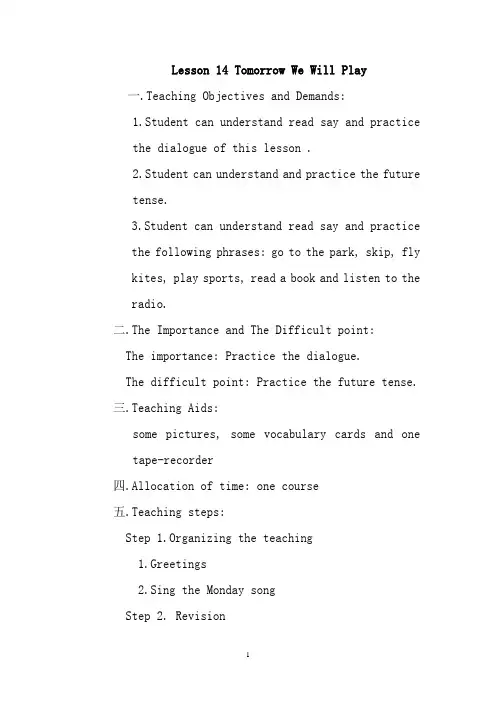
Lesson 14 Tomorrow We Will Play一.Teaching Objectives and Demands:1.Student can understand read say and practicethe dialogue of this lesson .2.Student can understand and practice the futuretense.3.Student can understand read say and practicethe following phrases: go to the park, skip, fly kites, play sports, read a book and listen to the radio.二.The Importance and The Difficult point:The importance: Practice the dialogue.The difficult point: Practice the future tense.三.Teaching Aids:some pictures, some vocabulary cards and one tape-recorder四.Allocation of time: one course五.Teaching steps:Step anizing the teaching1.Greetings2.Sing the Monday songStep 2. Revision1.Play “Simon says”to review action words (swim,jump, walk and run)2.Review locations and the structure “Let’s goto the _____ (location) to ___(verb) ___(noun).”with an object—prompt drill.Object phrasepot Let’s go to the kitchen to make supper.Soap Let’s go to the bathroom to wash hands. TV Let’s go to the living room to watch TV.Clothes Let’s go to the shop to buy ____.Book Let’s go to the library to red books. Step 3.Key concepts: will skip fly very park1.Introduce:a.The Ss have seen much of the key vocabularyin this lesson before, especially “fly kites”and “park”. When we introduce “park” and“fly”, ask the class to say “Let’s go tothe park to fly kites”.b.Demonstrate“skip”with skipping rope.Remember that the Ss mastered “skippingrope”.c.Demonstrate “very” by skipping fast andthen very fast as the teacher say the words.d.Here’s a way to introduce “will”. Explainthat will is another way to say “going to”.Ask the volunteers to draw lines to match the words.Yesterday today tomorrowWorked walk going to laughAte go going to seeLaughed jump going to eatJumped see going to jumpWent laugh going to walkSaw play going to goPlayed eat going to play2.Student book :Play the audiotape as the students follow along their books.3.Practice:Divide the class into small groups. Ask each group to make up a dialogue about going to the park tomorrow.六.Students’ activity:1.Sing the English song.2.Play “Simon says”.3.Practice “Let’s go to the ____(location)to ___(verb) _____(noun)”.4.Imitation.5.Group work to make up a dialogue.七.Blackboard:Lesson 14 Tomorrow We Will Play Fly a kite Go to the parkI’m going to ….I will ……。
六年级下册英语课件-Lesson 14 Tomorrow We Will Play 冀教版
返回
• will angry pick close wrong
•
• What will you do tomorrow?
• We will fly a kite. • I will not fly a kite.
1. play sports 2. pick the flowers 3. learn English 4.go to the park 5.fly a kite 6.eat breakfast
7.listen to the radio
A.摘花 B. 听收音机 C. 去公园 D. 进行体育运动
E. 学英语 F. 吃早饭
Let's Show
Homework
Finish your exercise book Lesson 14.
在我的印象里,他一直努力而自知,每天从食堂吃饭后,他总是习惯性地回到办公室看厚厚的专业书不断提升和充实自己,他的身上有九零后少见的沉稳。同事们恭喜他,大多看 到了他的前程似锦,却很少有人懂得他曾经付出过什么。就像说的:“如果这世上真有奇迹,那只是努力的另一个名字,生命中最难的阶段,不是没有人懂你,而是你不懂自已。” 而他的奇迹,是努力给了挑选的机会。伊索寓言中,饥饿的狐狸想找一些可口的食物,但只找到了一个酸柠檬,它说,这只柠檬是甜的,正是我想吃的。这种只能得到柠檬,就说 柠檬是甜的自我安慰现象被称为:“甜柠檬效应”。一如很多人不甘平庸,却又大多安于现状,大多原因是不知该如何改变。看时,每个人都能从角色中看到自已。高冷孤独的安 迪,独立纠结的樊胜美,乐观自强的邱莹莹,文静内敛的关睢尔,古怪精灵的曲筱绡。她们努力地在城市里打拼,拥有幸或不幸。但她依然保持学习的习惯,这样无论什么事她都 有最准确的判断和认知;樊胜美虽然虚荣自私,但她努力做一个好HR,换了新工作后也是拼命争取业绩;小蚯蚓虽没有高学历,却为了多卖几包咖啡绞尽脑汁;关睢尔每一次出镜 几乎都是在房间里戴着耳机听课,处理文件;就连那个嬉皮的曲筱潇也会在新年之际为了一单生意飞到境外……其实她们有很多路可以走:嫁人,啃老,安于现状。但每个人都像 个负重的蜗牛一样缓缓前行,为了心中那丁点儿理想拼命努力。今天的努力或许不能决定明天的未来,但至少可以为明天积累,否则哪来那么多的厚积薄发和大器晚成?身边经常 有人抱怨生活不幸福,上司太刁,同事太蛮,公司格局又不大,但却不想改变。还说:“改变干嘛?这个年龄了谁还能再看书考试,混一天是一天吧。”一个“混”字就解释了他 的生活态度。前几天我联系一位朋友,质问为什么好久不联系我?她说自已每天累的像一条狗,我问她为什么那么拼?她笑:“如果不努力我就活得像一条狗了。”恩,新换的上 司,海归,虽然她有了磨合几任领导的经验,但这个给她带来了压力。她的英语不好,有时批阅文件全是大段大段的英文,她心里很怄火,埋怨好好的中国人,出了几天国门弄得 自己像个洋鬼子似的。上司也不舒服,流露出了嫌弃她的意思,甚至在一次交待完工作后建议她是否要调一个合适的部门?她的脸红到了脖子,想着自己怎么也算是老员工,由她 羞辱?两个人很不愉快。但她有一股子倔劲,不服输,将近40岁的人了,开始拿出发狠的学习态度,报了个英语培训班。回家后捧着英文书死啃,每天要求上中学的女儿和自己英 语对话,连看电影也是英文版的。功夫不负有心人,当听力渐渐能跟得上上司的语速,并流利回复,又拿出漂亮的英文版方案,新上司看她的眼光也从挑剔变柔和,某天悄悄放了 几本英文书在她桌上,心里突然发现上司并没那么讨厌。心态好了,她才发现新上司的优秀,自从她来了后,部门业绩翻了又翻,奖金也拿到手软,自己也感觉痛快。她说:这个 社会很功利,但也很公平。别人的傲慢一定有理由,如果想和平共处,需要同等的段位,而这个段位,自己可能需要更多精力,但唯有不断付出,才有可能和优秀的人比肩而立。 人为什么要努力?一位长者告诉我:“适者生存。”这个社会讲究适者生存,优胜劣汰。虽然也有潜规则,有套路和看不见的沟沟坎坎,但一直努力的人总会守得云开见月明。有 些人明明很成功了,但还是很拼。比如剧中的安迪,她光环笼罩,商场大鳄是她的男闺蜜,不离左右,富二代待她小心呵护,视若明珠,加上她走路带风,职场攻势凌历,优秀得 让身边人仰视。这样优秀的人,不管多忙,每天都要抽出两个小时来学习。她的学习不是目的,而是能量,能让未来的自己比过去更好一些。现实生活中,努力真的重要,它能改 变一个人的成长轨迹,甚至决定人生成败。有一句鸡汤:不着急,你想要的,岁月都会给你。其实,岁月只能给你风尘满面,而希望,唯有努力才能得到!9、懂得如何避开问题的 人,胜过知道怎样解决问题的人。在这个世界上,不知道怎么办的时候,就选择学习,也许是最佳选择。胜出者往往不是能力而是观念!在家里看到的永远是家,走出去看到的才 是世界。把钱放在眼前,看到的永远是钱,把钱放在有用的地方,看到的是金钱的世界。给人金钱是下策,给人能力是中策,给人观念是上策。财富买不来好观念,好观念能换来 亿万财富。世界上最大的市场,是在人的脑海里!要用行动控制情绪,不要让情绪控制行动;要让心灵启迪智慧,不能让耳朵支配心灵。人与人之间的差别,主要差在两耳之间的 那块地方!人无远虑,必有近忧。人好的时候要找一条备胎,人不好的时候要找一条退路;人得意的时候要找一条退路,人失意的时候要找一条出路!孩子贫穷是与父母的有一定 的关系,因为他小的时候,父母没给他足够正确的人生观。家长的观念是孩子人生的起跑线!有什么信念,就选择什么态度;有什么态度,就会有什么行为;有什么行为,就产生 什么结果。要想结果变得好,必须选择好的信念。播下一个行动,收获一种习惯;播下一种习惯,收获一种性格;播下一种性格,收获一种命运。思想会变成语言,语言会变成行
六年级英语下册Lesson 14 Tomorrow We Will Play冀教版 (7)
What will you do? I will…
I will
fly a kite run take pictures plant trees look at flowers/clouds play basketball go on a trip
Let’s read!
R’t do that! Mum will be a___.
Fill in the blanks.
1.The weather is rainy,please close the window.
2.Wow,the apples are so big on the tree.I will pick some.
Make a dialouge.
-Tomorrow is Saturday.What will you do?
-I will go to the park. Will you go with me?
-En… I will fly a kite/play pingpong/look at flowers…
Lesson 14 Tomorrow We Will Play!
What do you like to do?
I like to
fly a kite run take pictures plant trees look at flowers/clouds play basketball go on a trip
• If Danny pick the flowers,how does Jenny feel? Jenny is angry.
Fill in the blanks.
1.The weather is rainy,please c___ the window.
六年级下英语教案-Lesson14TomorrowWeWillPlay冀教版
教案:六年级下英语教案 Lesson 14 Tomorrow We Will Play(冀教版)一、教学目标1. 知识目标:(1)学生能够听懂、会说、会读Lesson 14中的单词和句型。
(2)学生能够运用所学的单词和句型描述未来的计划。
2. 能力目标:(1)学生能够通过图片和情境,正确使用一般将来时描述自己的计划。
(2)学生能够在日常生活中运用所学的单词和句型进行交流。
3. 情感目标:培养学生热爱生活,积极乐观的人生态度。
二、教学内容1. 单词:go, swim, have lunch, see, visit, shop2. 句型: What will you do tomorrow?I will go/swim/have lunch/see/visit/shop.三、教学重点与难点1. 重点:单词go, swim, have lunch, see, visit, shop和句型What will you do tomorrow? I will go/swim/havelunch/see/visit/shop.2. 难点:一般将来时的运用。
四、教具与学具准备1. 教具:PPT、图片、卡片2. 学具:课本、练习册、单词卡片五、教学过程1. 热身(5分钟)(1)引导学生复习上一节课学过的单词和句型。
(2)学生自由交流,分享自己今天的经历。
2. 导入(10分钟)(1)教师出示一张明天的日历,引导学生思考明天的计划。
(2)学生分享自己的明天计划,教师记录并在黑板上展示。
3. 新课呈现(15分钟)(1)教师出示单词和句型的图片,引导学生学习和发音。
(2)学生跟读单词和句型,教师纠正发音。
(3)学生分组练习,教师巡回指导。
4. 巩固练习(10分钟)(1)学生分成小组,用所学的单词和句型互相问答。
(2)教师选取小组回答,给予评价和反馈。
5. 拓展活动(5分钟)(1)学生分成小组,根据图片或卡片,用所学的单词和句型编写小故事。
六年级英语下册Lesson 14 Tomorrow We Will Play冀教版 (6)
I am going to teach English.
I will teach English.
Everyone is going to learn English.
Everyone will learn English.
Practice
• It’s rainy. I am going to stay at • It’s rainy. I will stay at home. home.
at 7:00.
Tomorrow I will wake up at 7:00.
I will eat breakfast
at 7:15.
I am going to eat breakfast at 7:15.
I am going to drive my car to school.
I will drive my car to school.
play cards
play checkers
play on the computer
play with the doll
skip with the skipping rope
draw a picture
write a story
fly a kite
ride a bicycle
Listen and answer.
• His pencil is lost. He is going • His pencil is lost. He will buy
to buy a new one.
a new one.
• Tomorrow is Sunday. We are going to swim.
• Tomorrow is Sunday. We will swim.
六年级下册英语教案Lesson14TomorrowWeWillPlay冀教版
教案:六年级下册英语教案Lesson 14 Tomorrow We Will Play(冀教版)教学目标:1. 能够听懂、会说、会读本课的生词和句子。
2. 能够运用所学知识谈论未来的一般将来时态。
3. 培养学生的合作意识和团队精神。
教学内容:1. 生词:mountain, river, pool, farm, beach, go, visit, play。
2. 句子:1. We will go to the mountain. 2. We will visit the river.3. We will play at the pool.4. We will go to the farm.5. We will play on the beach.教学重点与难点:1. 重点:掌握本课的生词和句子,能够运用所学知识进行简单的对话。
2. 难点:能够正确运用一般将来时态谈论未来计划。
教具与学具准备:1. 教具:PPT、黑板、粉笔。
2. 学具:课本、练习本、文具。
教学过程:Step 1: 热身(5分钟)1. 教师与学生用英语进行简单的对话,如问候、询问身体状况等。
2. 学生进行小组活动,用英语介绍自己的家庭成员和兴趣爱好。
Step 2: 引入(10分钟)1. 教师播放PPT,展示本课的生词和句子。
2. 学生跟读生词和句子,教师纠正发音。
Step 3: 讲解与实践(10分钟)1. 教师讲解一般将来时态的用法,引导学生理解并运用到对话中。
2. 学生进行角色扮演,运用所学知识进行对话。
Step 4: 巩固与拓展(10分钟)1. 教师组织学生进行小组活动,用英语讨论未来的计划。
2. 学生展示自己的小组活动成果,教师给予评价和指导。
Step 5: 作业布置(5分钟)1. 教师布置作业:抄写生词和句子,编写一篇关于未来计划的短文。
板书设计:1. 课题:Lesson 14 Tomorrow We Will Play2. 生词:mountain, river, pool, farm, beach3. 句子:We will go to the mountain. We will visit the river. We will play at the pool. We will go to the farm. Wewill play on the beach.作业设计:1. 抄写生词和句子,每个单词和句子写两遍。