
PEP英语六年级下册 Unit 1单元知识梳理
新版PEP六年级英语下册Unit 1知识点归纳
一、必背词汇
tall ------ taller 高的----更高的dinosaur 恐龙short ------ shorter 矮的/短的----更矮的/更短的hall 大厅
long ------ longer 长的----更长的than 比
strong------ stronger 强壮的----更强壮的both 两个都
old ------ older 老的/旧的----更老的/更旧的meter 米
形容词young------ younger 年轻的----更年轻的kilogram千克;公斤
adj. small------ small 小的----更小的others size 号码thin ------ thinner 瘦的----更瘦的feet 脚
heavy------heavier 重点----更重的wear 穿
low------ lower 低地----更低地countryside乡村
smart------smarter 聪明的----更聪明的shadow 影子;阴影
become变成;开始变得
辅+元+辅--------双写最后一个辅音字母+er
辅音字母+y -----改y为i +er
big-----bigger 大的-----更大的happy-----happier 开心的-----更开心的thin-----thinner 瘦的-----更瘦的heavy-----heavier 重的------更重的
fat-----fatter 胖的------更胖的funny-----funnier 滑稽的------更滑稽的
二、重点句型
⑴问年龄,身高,体重等
How old are you? How tall are you? How heavy are you?
---- I’m _______ (years old). ---- I’m ______metres tall. ---- I’m ______ kilograms .
⑵问物品的情况:
① How large is your room? 你的房间有多大?
It’s __________ m2 (square meters.) 有_______ 平方米。
② How long is your bed? 你的床有多长?
It’s _________cm long. 有______厘米长。
③ How big are your feet? (= What size are your shoes?) 你的脚有多长?
I wear size ______.(= My shoes are size________.) 我穿_______码的鞋。
⑶形容谁比谁更… …
am
①主语+ be is ( even/much ) …er than …
are
如:I am taller than you. 我比你高。
I am 4 cm taller than your brother. 我比你弟弟高4cm .
I am taller and stronger than your brother. 我比你的弟弟更高更壮。
Jack is even stronger than his father. Jack 甚至比他爸爸还壮。
Zhang Peng and John are much younger than Mr.Green. 张鹏和John 比Mr. Green 要年轻多了。
其它句型:
1.That’s the tallest dinosaur in this hall. 那是这个厅里最高的恐龙。
2. It’s taller than both of us together. 它比我俩加起来还高。
3. Your feet are bigger than mine. 你的脚比我的大。
4. There are more dinosaurs over there. 那儿有更多的恐龙。
5. Who is taller than you? 谁比你高?
6. You are becoming a big beautiful bird. 你将要变成一只美丽的大鸟。
7. The sun gets lower and lower, but my shadow gets longer and longer.太阳变得越来越低,我的影子变得越来越长。
六年级下册单元知识点
第一单元
四会单词:tall—taller更高的short—shorter 更矮的strong—stronger更强壮的old—older 年龄更大的young—younger 更年轻的big—bigger更大的heavy—heavier 更重的long—longer 更长的thin—thinner 更瘦的small—smaller (体型)更小的
四会句型: How tall are you? 你有多高?
I’m 164 cm tall. 我164 厘米高。
You’re shorter than me. 你比我矮。
You’re 4 cm taller than me.你比我高4厘米。
How heavy are you? 你有多重?
I’m 48 kg. 我48千克。
应该掌握的知识点:
1、表示两者之间有所比较时,句子中的形容词要用比较级形式。
形容词变为比较级的变化规则:
(1)一般情况下,在形容词的词尾直接加er。
如: tall—taller short—shorter.(2)以字母e结尾的形容词,在词尾直接加r,如:nice—nicer. late—later (3)以重读闭音节结尾,且结尾只有一个辅音字母的词,先双写这个辅音字母,再加er.如:big—bigger thin—thinner fat—fatter (4)以辅音字母加y结尾的双音节形容词,先变y为i , 再加er。
如:easy—easier heavy—heavier funny—funnier.
形容词比较级的变化口诀:
原级变为比较级,通常er加上去。
若是结尾辅元辅,辅音双写要牢记。
辅音加y结尾时,把y变i 是必须。
原级若以e结尾,直接加r不后悔。
2、部分形容词比较级的不规则变化:good—better well—better bad—worse badly—worse many—more much—more little—less far—farther
3、同义句:
How tall are you?==What’s your height?
How heavy are you?==What’s your weight?
4、以How开头的问句(仅限小学阶段):
How are you? 问身体状况。
How old…? 问年龄
How tall…? 问身高
How long…? 问长度
How big…? 问大小(指外型、形体的大小)
How heavy…? 问体重、重量
How many…? 问多少,物体的数量
How much…? 问价格
5、it’s 与its:这两个词发音相同但意义不同。
it’s是it is的缩写,汉语意思是“它是”,如:it’s a fat cat. 它是一只肥猫。
its是代词,意思是“它的”,如:that is its tail. 那是它的尾巴。
6、My schoolbag is bigger than _________.
A. you
B. your C yours
这里的正确答案应该是选项C. yours。
Yours是名词性物主代词,它在这里所代表的意思是“your schoolbag”. Than后面要跟名词或名词性短语,因此在这里一定要用名词性物主代词。
与形容词性物主代词相对应的名词性物主代词还有:my---mine your---yours his—his her—hers it—its their---theirs。
新人教PEP六年级英语下册《Unit1_知识详解》
新⼈教PEP六年级英语下册《Unit1_知识详解》Unit1 知识详解A Let’s talk 知识详解重难点1. 如何⽤形容词的最⾼级来描述事物课⽂应⽤:That’s the tallest dinosaur in this hall. 那是这个厅⾥最⾼的恐龙。
亲爱的同学们,你们班⾥⼀定有个⼦“最⾼”的同学吧?也⼀定有学习“最好”的同学吧?这⾥的“最⾼”“最好”怎么表达呢?这时我们就⽤到了形容词的最⾼级,让我们⼀起来学习⼀下吧!形容词的最⾼级⽤于三者或三者以上的⼈或事物进⾏⽐较,具体⽤法如下:三者或三者以上⽐较,表⽰“之最”时,常⽤“the + 形容词最⾼级”的结构表⽰,后跟表⽰⽐较范围的介词短语。
例如:Lucy is the shortest of the three. 露西是三个⼈中最矮的。
形容词的最⾼级前⾯如果有much, by far, nearly, almost等词语修饰,这些词语应放在定冠词the的前⾯。
例如:She is by far the best of all the students in the class. 她是班⾥所有学⽣中最好的(学⽣)。
表⽰“之最”的形容词,如excellent, perfect等,没有最⾼级,也没有⽐较级。
作状语的副词的最⾼级前不加定冠词the。
例如:Of all the boys, he runs fastest. 所有男孩中,他跑得最快。
2. ⼤家⼀起“⽐⼀⽐”课⽂应⽤:It’s taller than both of us together. 它⽐我们俩加起来还⾼。
句型结构:A + be动词+ 形容词⽐较级(taller, stronger …)+ than + B.重点解析:此句型主要⽤于两者进⾏⽐较,课⽂句⼦中的taller是形容词的⽐较级形式。
当我们需要对事物进⾏⽐较时,就会⽤到⽐较级。
形容词的⽐较级是在形容词原形(即原级)的基础上变化⽽来的。
英语六年级下册第一单元知识点
英语六年级下册第一单元知识点English: In the first unit of the sixth-grade English textbook, students typically learn about various topics such as introducing oneself, talking about hobbies, describing family members, discussing daily routines, and expressing likes and dislikes. They are introduced to new vocabulary related to these themes, along with grammar points such as present simple tense, possessive adjectives, basic prepositions of place and time, and question forms. Reading passages and dialogues are provided to reinforce comprehension skills, and students are encouraged to engage in speaking activities to practice their oral communication. Additionally, they may learn about cultural aspects related to English-speaking countries, fostering a broader understanding of the language and its context. Throughout the unit, students engage in activities that promote listening, speaking, reading, and writing skills, aiming for comprehensive language acquisition.中文翻译: 在六年级英语教科书的第一单元中,学生通常会学习各种主题,如自我介绍,谈论爱好,描述家庭成员,讨论日常作息,以及表达喜好和不喜欢。
新人教pep版六年级英语下册unit1复习总结
新人教pep版六年级英语下册unit1复习总结一、单词巩固:(写出下列形容词的比较级)一、重点句子。
1.I’m taller than this dinosaur.我比这只恐龙高。
2.Some dinosaurs are bigger than houses.Some are smaller than our schoolbags.一些恐龙比房子大。
一些比我们的书包小。
3.询问体重的问句:--How heavy is it?它体重多少?--It’s five tons.它5吨。
4.询问鞋子的尺码:--What size are your shoes?你穿多大号的鞋?--What are your shoes?你穿多大号鞋?--My shoes are size35.我穿35号的鞋。
5.询问高度:--How tall is it?它有多高?--Maybe4metres.可能4米。
--I’m1.65metres.我身高1.65米。
--Size7.7号。
6.询问体重:--How heavy are you?你体重多少?--I’m48kilograms.我体重48千克。
课堂操练:按要求完成句子。
1.I am46kilograms.(对画线部分提问)1.Ⅰwear size37in China.(对画线部分提问)2.My friend is9years old.(对画线部分提问)3.Peter is shorter than Sam.(对画线部分提问)5.I am stronger than my brother.(改为一般疑问句)三、语法专项:形容词比较级的规则变化:单音节词和少数双音节词:(1)一般在词尾加“er”。
例如:tall—taller,young younger,old一older,small smaller。
(2)以字母“e”结尾的词,加“r”。
例如:fine—finer,nice-nicer,late-later。
六年级下册英语第一单元知识点
六年级下册英语第一单元知识点Here is a 700-word English article covering the key knowledge points from the first unit of the 6th grade English textbook:Learning English: An Adventure Awaits。
Learning a new language can be an exciting and rewarding journey. As students embark on their 6th grade English studies, they will discover a world of possibilities open up before them. English is a global language spoken by millions around the world, and mastering it can unlock doors to new experiences, relationships, and opportunities. 。
One of the foundational elements of English is vocabulary. Students will expand their English word power by learning a variety of nouns, verbs, adjectives, and other parts of speech. This includes common everyday words as well as more academic vocabulary. Knowing the meanings of words and how to use them properly is crucial for communicating effectively in English. 。
pep六年级英语下册知识点总结
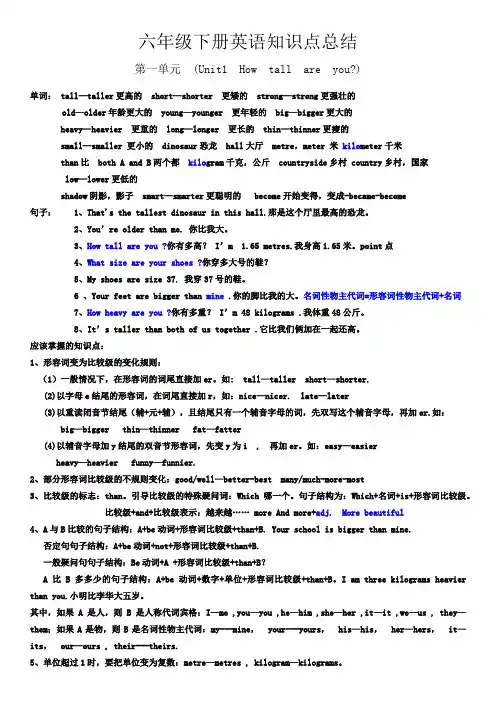
六年级下册英语知识点总结第一单元(Unit1 How tall are you?)单词: tall—taller更高的short—shorter 更矮的strong—strong更强壮的old—older年龄更大的young—younger 更年轻的big—bigger更大的heavy—heavier 更重的long—longer 更长的thin—thinner更瘦的small—smaller 更小的 dinosaur恐龙 hall大厅 metre,meter 米kilo meter千米than比 both A and B两个都 kilo gram千克,公斤 countryside乡村 country乡村,国家low—lower更低的shadow阴影,影子 smart—smarter更聪明的 become开始变得,变成-became-become句子: 1、That's the tallest dinosaur in this hall.那是这个厅里最高的恐龙。
2、You’re older than me. 你比我大。
3、How tall are you ?你有多高? I’m 1.65 metres.我身高1.65米。
point点4、What size are your shoes ?你穿多大号的鞋?5、My shoes are size 37. 我穿37号的鞋。
6 、Your feet are bigger than mine .你的脚比我的大。
名词性物主代词=形容词性物主代词+名词7、How heavy are you ?你有多重? I’m 48 kilograms .我体重48公斤。
8、It’s taller than both of us together .它比我们俩加在一起还高。
应该掌握的知识点:1、形容词变为比较级的变化规则:(1)一般情况下,在形容词的词尾直接加er。
如: tall—taller short—shorter.(2)以字母e结尾的形容词,在词尾直接加r,如:nice—nicer. late—later(3)以重读闭音节结尾(辅+元+辅),且结尾只有一个辅音字母的词,先双写这个辅音字母,再加er.如:big—bigger thin—thinner fat—fatter(4)以辅音字母加y结尾的双音节形容词,先变y为i , 再加er。
(完整word版)PEP小学英语六年级下册第一单元知识要点.doc
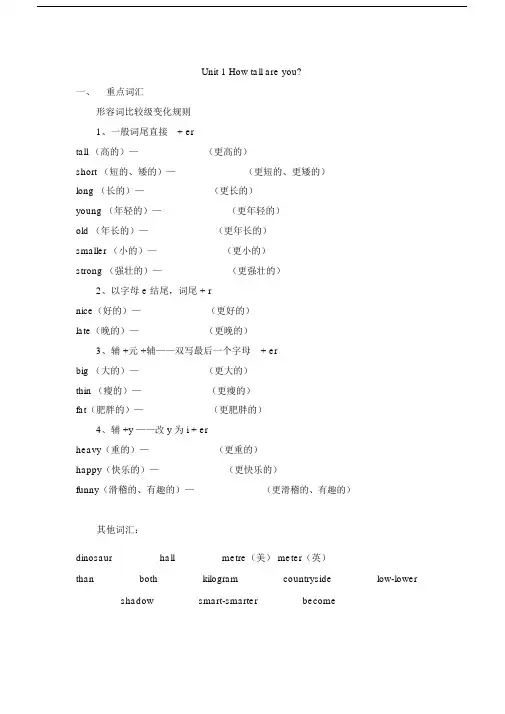
Unit 1 How tall are you?一、重点词汇形容词比较级变化规则1、一般词尾直接+ ertall (高的)— ____________(更高的)short (短的、矮的)— ____________(更短的、更矮的)long (长的)— ____________(更长的)young (年轻的)— ____________(更年轻的)old (年长的)— ____________(更年长的)smaller (小的)— ____________(更小的)strong (强壮的)— ____________(更强壮的)2、以字母 e 结尾,词尾 + rnice(好的)— ____________(更好的)late(晚的)— ____________(更晚的)3、辅 +元 +辅——双写最后一个字母+ erbig (大的)— ____________(更大的)thin (瘦的)— ____________(更瘦的)fat(肥胖的)— ____________(更肥胖的)4、辅 +y ——改 y 为 i + erheavy(重的)— ____________(更重的)happy(快乐的)— ____________(更快乐的)funny(滑稽的、有趣的)—____________(更滑稽的、有趣的)其他词汇:dinosaur ________ hall ________ metre(美) meter(英) ________than________ both________ kilogram________ countryside________ low-lower ________ shadow________ smart-smarter________ become____________二、重点句型1、年How old are you?I’m ⋯How old is he/she/XXx?2、身高How tall are you?I’m ⋯How tall is he/she/XXx?3、体重How heavy are you?I ’m How heavy is he/she/XXx? years old.He/ She/ XXx is ⋯ years old.metres.He/ She/ XXx is ⋯ metres.⋯ kilograms .He/ She/ XXx is ⋯kilograms .4、鞋What size are your shoes?My shoes are size⋯I wear(穿)size ⋯What size are his/ her shoes?His/ Her shoes are size⋯He/ She wears(穿)size ⋯5、两人或两个物品行比: A 比 B 更⋯⋯A + be ( am/is/are) + than + B例: I am ____________ _________ you.我比你更重。
人教PEP版英语六年级下册Unit 1-4知识点总结(期末复习)
Unit1How tall are you?一、核心词汇互为反义词的比较级:shorter更矮的/更短的—taller更高的/longer更长的older更年长的—younger更年轻的thinner更瘦的—stronger更强壮的/heavier更重的bigger更大的—smaller更小的拓展词汇——形容词比较级:1.形容词比较级一般情况下直接在原级词尾加-er。
如:clean—cleaner;2.以不发音的e结尾的单词直接加-r。
如:large—larger nice—nicer;3.以“辅音字母+y”结尾的单词变y为i,再加-er。
如:easy—easier busy—busier happy—happier funny—funnier;4.以重读闭音节结尾的单词,要先双写词尾的辅音字母,再加-er。
如:red—redder fat—fatter sad—sadder;5.不规则变化。
如:good—better bad—worse many—more little —less6.多音节词和部分双音节词则在词前加more。
如:beautiful—more beautiful exciting—more exciting二、了解词汇dinosaur恐龙hall大厅metre米(美式英语:meter)than比both两个都kilogram千克;公斤countryside乡村lower(low的比较级)更低地shadow阴影;影子smarter(smart的比较级)更聪明的become开始变得;变成三、核心句型1.—How tall are you?你有多高?—I’m1.64metres.我身高1.64米。
2.—What size are your shoes,Mike?迈克,你穿多大号的鞋?—Size7.7号。
3.—How heavy are you?你体重多少?—I’m48kilograms.我体重48公斤。
统编部编人教版六年级下册英语:第一单元知识梳理
统编部编人教版六年级下册英语:第一单
元知识梳理
本文档概述了统编部编人教版六年级下册英语第一单元的知识内容,旨在帮助学生更好地理解和掌握相关知识点。
1. 单词研究:
- 本单元的核心词汇包括:apple, book, cat, dog, elephant, fish, giraffe, hat, ice cream, juice. 学生应该重点掌握这些单词的发音和拼写,并能够正确运用它们进行基本的表达。
2. 句型练:
- 本单元主要介绍了一些基本的句型,学生需要熟悉并运用它们进行口语表达。
例如:
- What's this? This is an apple.
- Is this a book? Yes, it is. / No, it isn't.
- Can you see a cat? Yes, I can. / No, I can't.
3. 语法点:
- 本单元的语法重点是“this is”和“can you”,学生应该理解它们的基本用法,并能够在句子中正确运用。
4. 阅读理解:
- 本单元提供了一些简短的阅读理解题目,学生需要仔细阅读问题并选择正确的答案。
5. 口语练:
- 本单元提供了一些口语练题目,学生可以根据题目进行自由练,提高口语表达能力。
以上是统编部编人教版六年级下册英语第一单元的知识梳理。
希望本文档能够对学生们的学习有所帮助,使他们能够更好地掌握和运用相关知识。
2020新人教版(PEP)小学英语六年级下册各单元知识点总结
2020新人教版(PEP)小学英语六年级下册各单元知识点总结Unit 1 How tall are you?Here XXX:1.Regular adjectives: add -er to the end of the word.tall - XXXshort - shorterlong - longerstrong - strongerold - olderyoung - youngersmall - smallerlow - lowersmart - smarter2.Adjectives ending in -e: add -r to the end of the word.large - largerlate - latersimple - simplersafe - safer3.Adjectives XXX: double the final consonant and add -er.big - biggerXXX - XXXfat - fattersad - sadderhot - hotterwet - wetter4.Adjectives ending in -y: change the -y to -i and add -er.happy - happierheavy - XXXXXX - funnierangry - angrierXXX - XXXwindy - windierbusy - busierearly - earlierXXX:dinosaur。
hall。
than。
both。
meter。
kilogram。
size。
feet。
wear。
countryside。
shadow。
e.Here XXX:1.Asking about age。
height。
weight。
etc.How old are you?How tall are you?How heavy are you?I am (age) years old。
六年级下册第一单元英语知识点
Unit 1: English Knowledge Points for Grade 6Vocabulary:New words related to daily life, school, and hobbies.Phrases and expressions commonly used in conversations.Grammar:Simple present tense: used to describe habitual actions or general truths. Basic sentence structure: subject + verb + Object (SVO).Listening and Speaking:Understanding and responding to questions about daily activities, school life, and hobbies.Asking and answering questions using "What?", "Where?", "When?", "Who?", and "How?"Reading and Writing:Reading comprehension skills to understand short texts and answer questions. Writing basic sentences and paragraphs about daily life, school, and hobbies.Cultural Understanding:Learning about different cultures and customs through language.词汇:与日常生活、学校生活和兴趣爱好相关的新词汇。