
仁爱版英语九年级上册Unit 1 Topic 1 Section B 教案
四、教学过程
学习目标
教学活动
评价要点
要点归纳
目标1:学
习并能
说出、
写出P3—4的生词,并能进行英汉互译
自学指导1
1.自学内容:课本P3—4的生词。
2.自学方法:先根据音标试读,同桌互相正音,提问。
3.自学时间:5分钟
评价要点
要点归纳
目标2、熟读1a,能够说出1a的知识点,能够熟练做题。
自学指导2
自学内容:课本3页1a
自学方法:听录音和扫读。
自学时间:5分钟
自学要求:听1a,完成1b;读1a,完成1c.
自学检测2
完成课本1b和1c.,找出1a中的重点短语和句子。
自学检测2
1.参加一些志愿者活动
2多么精彩的一次经历呀!
自学指导3
自学内容:预习课本P4过去分词的构成及用法
自学方法:通过例子总结用法
自学时间:5分钟
自学要求:通过预习能够自己总结过去分词的构成及用法
自学检测3
完成课本2a、2b、2c
__________________________________________
当堂训练:
一、单项选择
1. — _____ you ever _____ to the USA?
— Yes, we have.
A. Have, gone B. Have, been
C. Did, go D. Did, went
2. ______ it rains heavily, ______ farmers are still
working in the fields.
A. Though, but B. Though, still
4.自学要求:会读,知道其汉语意思,并能英汉互译。
(学生看书自学,教师巡视辅导。)
自学检测1
disabled
shut
ever
ro能熟练说出、写出P3—4的生词,并能进行英汉互译。
1. Some words:
disabled shut ever rope
学习目标
教学活动
(1)一般在动词词尾+ed
(2)以e结尾的+d
(3)以“辅音字母+y”结尾的变y为i+ed.
(4)以重读闭音节结尾的双写最后一个辅音字母+ed
3.learn…from..
4.though尽管,虽然不与but连用,可与yet,still连用
5.have no time to do sth.
二、学习目标
1、学习并能说出、写出P3—4的生词,并能进行英汉互译
2、熟读1a,能够说出1a的知识点,能够熟练做题。
3、能够说出现在完成时的结构及用法,并能熟练做题。
三、评价任务
1、针对目标1,通过学习P3—4的生词,让学生并能熟练说出、写出P3—4的生词,并能进行英汉互译。
2、针对目标2,通过熟读1a,能够说出1a的知识点,能够做题。
3、中招考点:
现在完成时have/has gone to and have/has been to的用法,是学生必须掌握的知识要点,所以一定要让学生弄明白现在完成时的用法。
4、学情分析:
本班学生英语学科基础较差,部分学生学习兴趣不是很足,而现在完成时have/has gone to and have/has been to.的用法十分重要,鉴于这一点,上课前应当充分备足课,知识点应让学生一点一点地归纳出来,努力提高学生的学习兴趣。
3向...学习
4帮助别人让我感到高兴
5尽管我没有时间旅游,但是我仍然很高兴。
2.学生通过熟读1a,能够说出1a的知识点,能够熟练做题。
1.参加一些志愿者活动
2多么精彩的一次经历呀!
3向...学习
4帮助别人让我感到高兴
5尽管我没有时间旅游,但是我仍然很高兴。
。
目标
3:能够说出现在完成时的结构及用法,并能熟练做题。
C. Though, / D. Although, but
3. — I helped a disabled man yesterday.
— ______ wonderful experience!
A. WhatB. How a
C. HowD. What a
4. Jessie learnt a lot ______ the book after
reading it.
A. from B. of C. at D. with
3、学生通过举一些例句,让学生能够说出现在完成时的结构及用法,并能熟练做题。
要点归纳
1.sb. have/has been to…某人去过……(去而复返)sb. have/has gone to…某人去……了(去而未归)
2.规则动词过去分词的构成:
短语learn…from…, have (no) time to do sth. , put on,
jump rope
语法:现在完成时动词过去分词的构成
2、教材分析:
本节课为该话题的第二节课,建议用1-2课时上完。主要学习现在完成时是本话题的语法重点。在Section A的1a,康康和Maria谈论去残疾儿童在家做志愿者谈论考查,学习现在完成时have/has gone to and have/has been to.的用法及过去分词的构成。
基于“课程标准、中招视野、两类结构”
九(上)Unit1 Topic1Section B教案设计
(新授课)
制作学校:城关乡二中
修订人:张秀华
一、学习目标确定的依据:
1、课程标准相关要求:《英语课程标准》(2011年版)要求学生能够会读会写知汉意的单词和短语
单词:disabled, shut, ever, rope
仁爱英语九年级上册Unit1Topic1SectionB教学设计

5.情感态度与价值观方面,学生对环保问题的认识较为模糊,需要通过本章节的学习,引导他们关注现实生活中的环境问题,培养环保意识。
三、教学重难点和教学设想
(一)教学重难点
1.词汇:本章节的重点词汇和短语如global warming、pollution、solve、environmental protection等,是学生在讨论环境问题时必须掌握的基础知识。
(三)学生小组讨论
在讲授新知识后,我会组织学生进行小组讨论。每个小组选择一个环境问题,如global warming、pollution等,讨论以下问题:“What causes this problem? How can we solve it?”各小组成员需要分工合作,搜集资料、整理观点,并在规定时间内进行汇报。
在此过程中,我会巡回指导,解答学生在讨论过程中遇到的问题,引导他们运用所学知识进行思考和表达。通过小组讨论,学生不仅能巩固所学知识,还能培养团队协作和解决问题的能力。
(四)课堂练习
为了检验学生对本节课知识的掌握程度,我会设计以下课堂练习:
1.完成一篇关于环保的阅读理解,让学生在阅读中巩固词汇和语法知识。
接着,我会播放一段关于环保的视频,让学生了解全球各地在环保面所做的努力和取得的成果。观看完毕后,我会组织学生进行简短的讨论,分享他们的观后感和对环保的看法。这样,既为新课的学习奠定了情感基础,又激发了学生的学习兴趣。
(二)讲授新知
在这一环节,我将系统地讲授本节课的新知识。首先,我会带领学生学习本节课的核心词汇和短语,如global warming、pollution、solve、environmental protection等。通过例句、同义词和反义词的对比,帮助学生更好地理解和记忆这些词汇。
新版仁爱英语九年级上册U2T1SA渗透法制教育教案

1Unit 2 Saving the EarthTopic 1 Pollution has caused too many problems.Baini Middle School :Chen WenjuSection AⅠ.Teaching aims (教学目标): 1.Knowledge aims (知识目标):(1)掌握本课的重点词汇和短语,巩固一般过去时和现在完成时的用法和区别。
(2)能够用一般过去时和现在完成时描述过去和现在的变化。
(3)正确使用there be sth./sb. doing sth.来表达“有某人/物正在做某事”。
(4)学习了解《中华人民共和国环境保护法》和《中华人民共和国野生动物保护法》的相关法律知识。
2.Skill aims (能力目标):(1)能听懂描述环境变化的对话,区别一般过去时和现在完成时的用法。
(2)能理解和运用一般过去时和现在完成时来进行听、说、读、写活动。
3.Emotional aims: (情感目标):通过学习了解“动物的生存现状”和环境污染带给动物的危害,让学生了解环境污染的严重性,并让学生树立良好的环保意识,自觉在日常生活中爱护环境,保护环境,珍爱野生动物。
The key points and difficult points (教学重难点): 1. Key points (教学重点):Words and phrases: bee, butterfly, mess, shame, several, pollute, waste, villager, destroy, cut down, goodness, pour, see sb./sth. do sth., see sb./sth. doing sth., cut down, my goodnessSentences: What a shame! / What a mess!The flowers and grass have gone!What has happened here?There be sth./sb. doing sth.There are several factories pouring waste water into the stream.Everything has changed.Grammar: differences between Simple Past and Present Perfect tense.2.Difficult points(教学难点):(1)正确使用there be sth./sb. doing sth.来表达“有某人/物正在做某事” 。
仁爱版英语九上1(Unit1 Topic1)全英文教案
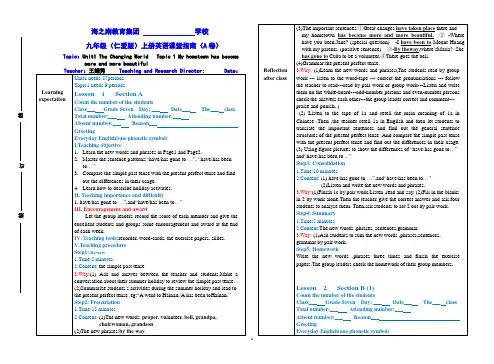
海之南教育集团 学校九年级(仁爱版)上册英语课堂指南(A 卷)Topic :Unit1 The Changing World Topic 1 My hometown has becomemore and more beautifulTeacher :王娟秀 Teaching and Research Director: Date :Learning expectationUnit1 needs 27periods Topic1 needs 9 periods Lesson 1 Section A Count the number of the studentsClass ___ Grade Seven Day: ___ Date ___ The ___ classTotal number:___ Attending number:___Absent number:___ Reason ___GreetingEveryday English(one phonetic symbol)I.Teaching objective1. Learn the new words and phrases in Page1 and Page2.2. Master the sentence patterns:“have/has gone to …”, “have/has beento …”3. Compare the simple past tense with the present perfect tense and findout the differences in their usage.4. Learn how to describe holiday activities.II. Teaching importance and difficulty1. have/has gone to …”,and “have/has been to …”III. Encouragement and awardLet the group leaders record the score of each member and give theexcellent students and groups some encouragement and award at the endof each week.IV. Teaching tools:recorder, word-cards, the exercise papers, slides.V.Teaching procedureStep1: Review1.Time:5 minutes2.Content: the simple past tense3.Way:(1) Ask and answer between the teacher and students.Make aconversation about their summer holiday to review the simple past tense.(2)Summarize students ’s activities during the summer holiday and lead tothe present perfect tense .eg:“A went to Hainan./A has been toHainan.”Step2: Presentation1.Time:15 minutes2.Content: (1)The new words: proper , volunteer, bell, grandpa,chairwoman, grandson(2)The new phrases:by the wayReflection after class(3)The important sentences:①Great changes have taken place there and my hometown has become more and more beautiful. ② -Where have you been,Jane? (special question) -I have been to Mount Huang with my parents. (positive sentence) ③-By theway ,where ’sMaria?–She has gone to Cuba to be a volunteer.④There goes the bell. (4)Grammar:the present perfect tense.3.Way: (1)Learn the new words and phrases(The students read by group work --- listen to the word-tape --- correct the pronunciations --- follow the teacher to read---read by pair work or group work---Listen and write them on the white-board---odd-number persons and even-number persons check the answers each other---the group leader correct and comment--- praise and punish. )(2) Listen to the tape of 1a and retell the main meaning of 1a in Chinese .Then ,the teacher retell 1a in English and then let students to translate the important sentences and find out the general sentence structures of the present perfect tense .And compare the simple past tensewith the present perfect tense and find out the differences in their usage. (3) Using figure pictures to show the differences of “have/has gone to …” and “have/has been to …” Step3: Consolidation 1.Time:10 minutes2.Content: (1) have/has gone to …”,and “have/has been to …”(2)Listen and write the new words and phrases.3.Way:(1)Finish 1c by pair work.Listen ,read and say. (2)Fill in the blanks in 2 by work alone.Then the teacher give the correct answer and ask four students to analyse them. Then,ask students to act 2 out by pair work. Step4: Summary 1.Time:5 minutes2.Content:The new words ,phrases, sentences,grammar.3.Way: (1)Ask students to sum the new words ,phrases,sentences, grammar by pair work. Step5: HomeworkWrite the new words ,phrases three times and finish the exercise papers.The group leaders check the homework of their group members.Lesson 2 Section B (1)Count the number of the studentsClass ___ Grade Seven Day: ___ Date ___ The ___ class Total number:___ Attending number:___Absent number:___ Reason ___ GreetingEveryday English(one phonetic symbol)装订线I.Teaching objective1. Learn the new words and phrases in Page3 and part ones in Page4.2. Go on learning the usage of the present perfect tenseII. Teaching importance and difficulty1.past participle2.-Have/Has +sb+pp.+…?-Yes ,sb.have/has.-No, sb.haven’t/hasn’t. ”III. Encouragement and awardLet the group leaders record the score of each member and give the excellent students and groups some encouragement and award at the end of each week.IV. Teaching tools:recorder, word-cards, the exercise papers, slides.V.Teaching procedureStep1: Review1.Time:5 minutes2.Content: (1)The present perfect tense (2)The important words and phrases learnt last lesson.3.Way:(1) Check the work after class. (2)Review The present perfect tense.(3) dictation.Step2: Presentation1.Time:15 minutes2.Content: (1)The new words: disabled, ever, shut, rope, online, teenager, granny, describe(2)The new phrases:in detail(3)The important sentences:①Have you cleaned rooms for the disabled for the disabled children?(general question) –Yes, I have.②-Have you ever fed them? –No, I haven’t. But I have cooked for them. ③-ThoughI had no time to travel, I still felt very happy.(4)Grammar:the present perfect tense.3.Way: (1)Learn the new words and phrases(The students read by group work --- listen to the word-tape --- correct the pronunciations --- follow the teacher to read---read by pair work or group work---Listen and write them on the white-board---odd-number persons and even-number persons check the answers each other---the group leader correct and comment--- praise and punish. )(2) Show some pictures of disabled children.Make a dialogue with students to know whether they have helped disabled children and lead to 1a.(3) Listen to the tape of 1a and retell the main meaning of 1a in Chinese .Then ,the teacher retell 1a in English and then let students to translate the important sentences and find out the general sentence structures of the present perfect tense . (4) Analyse the important sentences and then practise orally.Step3:Consolidation1.Time:10 minutes2.Content: (1)Review past tense and past participle of verbs .(2)Practise general questions of the present perfect tense in1b3.Way:(1) Review past tense and past participle of verbs by work alone and then, ask several students to sum up the rules. (2) Practise general questions of the present perfect tense in1b by pair work orally and ask some pairs to PK.Step4: Summary1.Time:5 minutes2.Content:The new words ,phrases, sentences,grammar.3.Way:①Ask students to sum the new words ,phrases,sentences, grammar by pair work.Step5: HomeworkWrite the new words ,phrases three times and finish the exercise papers.The group leaders check the homework of their group members. Lesson 3 Section B (2)Count the number of the studentsClass___ Grade Seven Day: ___ Date___ The___ class Total number:___ Attending number:___Absent number:___ Reason___GreetingEveryday English(one phonetic symbol)I.Teaching objective1. Learn the new words and phrase left in Page4.2. Go on learning the usage of the present perfect tense3. Compare the teenagers’ life in the past with that nowadays and lead students to cherish the happy life at present.II. Teaching importance and difficulty1. The new words and phrase2.The present perfect tense.III. Encouragement and awardLet the group leaders record the score of each member and give the excellent students and groups some encouragement and award at the end of each week.IV. Teaching tools:recorder, word-cards, the exercise papers, slides.V.Teaching procedureStep1: Review1.Time:5 minutes2.Content: (1)The present perfect tense. (2)The important words andTeacher’s workis finished. phrases learnt last lesson.3.Way:(1) Check the work after class.(2)Review the present perfect tense (3) dictation.Step2: Presentation1.Time:15 minutes2.Content: (1)The new words: education, childhood, support, laborer,develope, rapidly, luckily, development.(afford)(2)The phrases: a hard life ,in order to ,give support to, a good education,day and night(3)The important sentences:①Can you describe it in detail. ②Parentscouldn’t afford an education for their children. ③In order to help supporttheir families, they had to be child labores. ④Now our country hasdeveloped rapidly.⑤The government gives support to poor families, sochildren can get a good education.(4)Grammar:The present perfect tense.3.Way: (1)Learn the new words and phrases(The students read by groupwork --- listen to the word-tape --- correct the pronunciations --- followthe teacher to read---read by pair work or group work---Listen and writethem on the white-board---odd-number persons and even-number personscheck the answers each other---the group leader correct and comment---praise and punish. )(2) Show some pictures of the life of teenagers in the past. Make adialogue with students to talk about the differences between the life ofteenagers in the past and nowdays lead to 2a.(3) Listen to the tape of 2a and retell the main meaning of 2a inChinese .Then ,the teacher retell 2a in English and then let students totranslate the important sentences and find out the general sentencestructures of the present perfect tense . (4) Analyse the importantsentences and then practise orally.Step3:Consolidation1.Time:10 minutes2.Content: (1)Review past tense and past participle of verbs .(2)Practise general questions of the present perfect tense in1b3.Way:(1) Review past tense and past participle of verbs by work aloneand then, ask several students to sum up the rules. (2) Practise generalquestions of the present perfect tense in1b by pair work orally and asksome pairs to PK.Step4: Summary1.Time:5 minutes2.Content:The new words ,phrases, sentences,grammar.3.Way:①Ask students to sum the new words ,phrases,sentences,grammar by pair work.Step5: HomeworkWrite the new words ,phrases three times and finish the exercisepapers.The group leaders check the homework of their group members.Lesson 4 Section C (1)Count the number of the studentsClass___ Grade Seven Day: ___ Date___ The___ classTotal number:___ Attending number:___Absent number:___ Reason___GreetingEveryday English(one phonetic symbol)I.Teaching objective1. Learn the new words and phrase in Page5 and Page6.II. Teaching importance and difficultyThe usage of the new words and phrase.III. Encouragement and awardLet the group leaders record the score of each member and give theexcellent students and groups some encouragement and award at the endof each week.IV. Teaching tools:recorder, word-cards, the exercise papers, slides.V.Teaching procedureStep1: Review1.Time:5 minutes2.Content: (1)The present perfect tense.(2)The important words andphrases in Page4.3.Way:(1) Check the work after class. (2)Review The present perfecttense (3) dictation.Step2: Presentation1.Time:15 minutes2.Content: (1)The new words: narrow,communication, quick, leisure,relative, mainly, telegram,sort,fax,rapid,progress,already,succeed.(2)The phrases: keep in touch with ,far away ,reform andopening-up,make progress.(ring roads,living conditions)3.Way: (1) Show some pictures of Beijing in the past and at present andask the students to discuss the differences between them lead to the newwords and phrases in 1a.(2)Learn the new words and phrases(The students read by group work ---listen to the word-tape --- correct the pronunciations --- follow the teacherto read---read by pair work or group work---Listen and write them on thewhite-board---odd-number persons and even-number persons check theanswers each other---the group leader correct and comment---praise and punish. )Step3:Consolidation1.Time:15 minutes2.Content: (1)The new words and phrases.3.Way:(1) Practise how to use the new words and phrases by doing the exercise papers. (2) Give the standard answers and ask several students to analyse the questions in their paper.(3) The group leaders correct and supplement some opionions.(4)The teacher comment.Step5: HomeworkWrite the new words ,phrases three times and finish the exercises in the workbooks.The group leaders check the homework of their group members.Lesson 5 Section C (2)Count the number of the studentsClass___ Grade Seven Day: ___ Date___ The___ class Total number:___ Attending number:___Absent number:___ Reason___GreetingEveryday English(one phonetic symbol)I.Teaching objective1.Go on learning the usage of the present perfect tense3. Compare the past Beijing with the present Beijing and learn the great changes in China.4.Inspire students to cherish the happy life at present and to cultivate their patriotism.II. Teaching importance and difficulty1. The present perfect tense.2. Some sentences.III. Encouragement and awardLet the group leaders record the score of each member and give the excellent students and groups some encouragement and award at the end of each week.IV. Teaching tools:recorder, the exercise papers, pictures.V.Teaching procedureStep1: Review1.Time:5 minutes2.Content: (1)The present perfect tense. (2)The words and phrases learnt last lesson.3.Way:(1) Check the work after class.(2)Review the present perfect tense (3) dictation.Step2: Presentation1.Time:15 minutes2.Content:(1)The important sentences:①My granny has lived in Beijing for more than forty yeas.②People kept in touch with their friends and relatives far away mainly by letter or telegram. ③Beijing has made rapid progress and it has already succeeded in hosting the 2008 Olympic Games.3.Way: (1)Let the students look at the pictures in 1a and disscuss the differences in English using the simple past tense and the present perfect tense. (2) Listen to the tape of 1a and retell the main meaning of 1a in Chinese .Then ,the teacher retell 2a in English and then let students to translate the important sentences analyse the important sentences and then practise orally. (3) Let students finish 1b by work alone.Then,check the answers.Step3:Consolidation1.Time:10 minutes2.Content: (1)The important sentences and the present perfect tense.3.Way:(1) Fnish 1c by pair work.Step4: Extension1.Time:5 minutes2.Content: The changes in our hometown.3.Way:①Discuss the changes in our hometown by group work.Step5: HomeworkWrite the important sentences and finish the exercise papers.The group leaders check the homework of their group members.Lesson 6 Section DCount the number of the studentsClass___ Grade Seven Day: ___ Date___ The___ class Total number:___ Attending number:___Absent number:___ Reason___GreetingEveryday English(one phonetic symbol)I.Teaching objective(1)The new words:organization,composition,note,consider, tool. (2)Thephrases: draw up, thanks to (3)Review and sum up the importantwords, phrases,sentences and the present perfect tenseII. Teaching importance and difficulty1.The dictation and usage of the important words,phrases,sentences and the present perfect tenseIII. Encouragement and awardLet the group leaders record the score of each member and give the excellent students and groups some encouragement and award.IV. Teaching tools: word-cards.V.Teaching procedureStep1: Learn new words and phrases1.Time:10 minutes2.Content:The new words:organization, composition, note, consider, tool.(2)The phrases: draw up, thanks to3.Way: (1)Learn the new words and phrases(The students read by group work --- listen to the word-tape --- correct the pronunciations --- follow the teacher to read---read by pair work or group work---Listen and write them on the white-board---odd-number persons and even-number persons check the answers each other---the group leader correct and comment--- praise and punish. )Step2: Review1.Time:15 minutes2.Content: (1) the important words,phrases,sentences and the present perfect tense3.Way:(1) ①Divide the students into four groups.Then,let the students go to the white-board to write down the important words or phrases or sentences or grammars.②The group leaders record the results and hand them in.Step3: Comment and supplement.1.Time:10 minutes3.Way: (1)The teacher comment the students’show and supplement some points.(2) Give the groups and persons praise and award that are of the first three places.Lesson 7 (Composition)Count the number of the studentsClass___ Grade Seven Day: ___ Date:___ The___ class Total number:___ Attending number:___Absent number:___ Reason___GreetingEveryday English(one phonetic symbol)I.Teaching objectiveLearn the basic steps of writing a composition.II. Teaching importance and difficulty1.How to write a composition to the pictures.III. Encouragement and award(1)Praise students writes well point out the advantages and disadvantages of the students’ compositions.IV.Teaching procedureStep1 Discussion1.Time:10 minutes2.Content:The basic steps of writing a composition3.Way: (1)Discuss how to write the composition in 4 of Section D. (2)The teacher sum up the basic steps.Step2 Writing1.Time:20 minutes2.Content: (1) A composition about the changes in Li Ming’s hometown according to the pictures in 4.3.Way:(1) Write a composition by work alone. (2) Read over and give remarks by pair work..Step3 Comment1.Time:10 minutes2.Content:The compositions of each students.3.Way: (1)The group leaders skim through their members’compositions and remarks and sum up the advantages and disadvantages and pink out the best compositions to give them to the teacher .(2 Let two students to read two best compositions and let all the students to find out the advantages and disadvantages and discuss how to revise the disadvantages.(3)The teacher comments,summarizes and praise.Lesson 8 (practice)Count the number of the studentsClass___ Grade Seven Day: ___ Date:___ The___ class Total number:___ Attending number:___Absent number:___ Reason___GreetingEveryday English(one phonetic symbol)I.Teaching objectivePractice and consolidate the important knowledge in Topic1 of Unit 1.II.Teaching procedureStep1 the students finish Paper B1.Time:40 minutes2.Content:Paper B3.Way: Finish Paper B at one lesson .Lesson 9 (The assessment of Paper B)Count the number of the studentsClass___ Grade Seven Day: ___ Date:___ The___ class Total number:___ Attending number:___Absent number:___ Reason___GreetingEveryday English(one phonetic symbol)I.Teaching objectivePractice and consolidate the important knowledge in Topic1 of Unit 1.II.Encouragement and award:Praise the persons and groups which do well .III.Teaching procedureStep1Check Paper B1.Time:10 minutes2.Content:Paper B3.Way: Check Paper B by pair work,Then, the group leaders sum up the problems which are done badly.Step2 Analyse and assess Paper B1..Content:Paper B2..Way: (1)Analyse and assess it by some students and then the group leaders.(2)The teacher gives them some help if there is need.(3) The teacher comments and praise the persons and groups which do well .。
人教版英语九年级全册Unit1 SectionB(3a-Self Check)精品教案
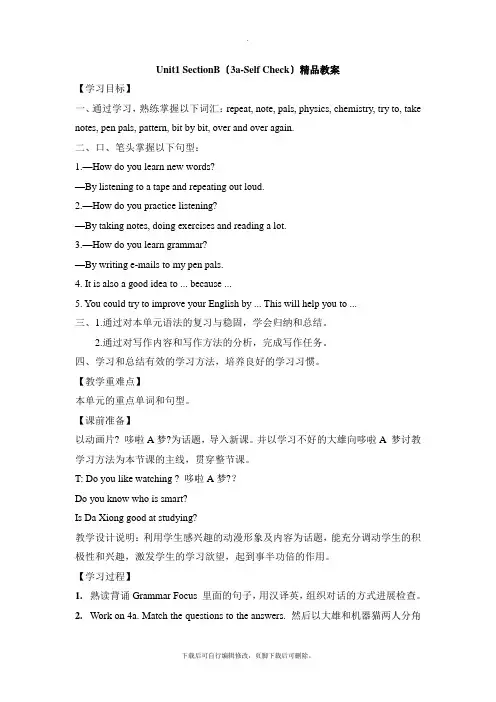
Unit1 SectionB〔3a-Self Check〕精品教案【学习目标】一、通过学习,熟练掌握以下词汇:repeat, note, pals, physics, chemistry, try to, take notes, pen pals, pattern, bit by bit, over and over again.二、口、笔头掌握以下句型:1.—How do you learn new words?—By listening to a tape and repeating out loud.2.—How do you practice listening?—By taking notes, doing exercises and reading a lot.3.—How do you learn grammar?—By writing e-mails to my pen pals.4. It is also a good idea to ... because ...5. You could try to improve your English by ... This will help you to ...三、1.通过对本单元语法的复习与稳固,学会归纳和总结。
2.通过对写作内容和写作方法的分析,完成写作任务。
四、学习和总结有效的学习方法,培养良好的学习习惯。
【教学重难点】本单元的重点单词和句型。
【课前准备】以动画片? 哆啦A梦?为话题,导入新课。
并以学习不好的大雄向哆啦A 梦讨教学习方法为本节课的主线,贯穿整节课。
T: Do you like watching ? 哆啦A梦??Do you know who is smart?Is Da Xiong good at studying?教学设计说明:利用学生感兴趣的动漫形象及内容为话题,能充分调动学生的积极性和兴趣,激发学生的学习欲望,起到事半功倍的作用。
仁爱版九年级英语上册Unit1Topic1SectionB新授课的教案

四、教学过程
学习目标
教学活动
评价要点
要点归纳
目标1:学
习并能
说出、
写出P3—4的生词,并能进行英汉互译
自学指导1
1.自学内容:课本P3—4的生词。
2.自学方法:先根据音标试读,同桌互相正音,提问。
3.自学时间:5分钟
(1)一般在动词词尾+ed
(2)以e结尾的+d
(3)以“辅音字母+y”结尾的变y为i+ed.
(4)以重读闭音节结尾的双写最后一个辅音字母+ed
3.learn…from..
4.though尽管,虽然不与but连用,可与yet,still连用
5.have no time to do sth.
—Yes, we have.
A. Have, gone B. Have, been
C. Did, go D. Did, went
2. ______ it rains heavily, ______ farmers are still
working in the fields.
A. Though, but B. Though, still
reading it.
A. from B. of C. at D. with
3、学生通过举一些例句,让学生能够说出现在完成时的结构及用法,并能熟练做题。
要点归纳
1.sb. have/has been to…某人去过……(去而复返)sb. have/has gLeabharlann ne to…某人去……了(去而未归)
2.规则动词过去分词的构成:
仁爱版九年级英语上册U1T1SA优质教案
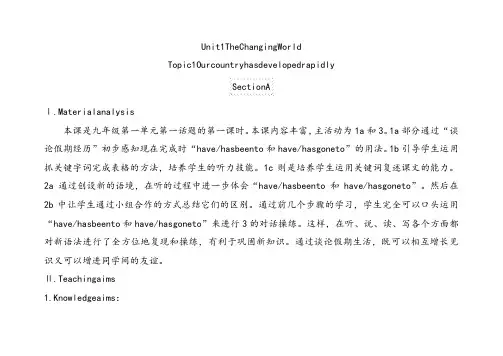
Unit1TheChangingWorldTopic1OurcountryhasdevelopedrapidlySectionAⅠ.Materialanalysis本课是九年级第一单元第一话题的第一课时。
本课内容丰富,主活动为1a和3。
1a部分通过“谈论假期经历”初步感知现在完成时“have/hasbeento和have/hasgoneto”的用法。
1b引导学生运用抓关键字词完成表格的方法,培养学生的听力技能。
1c则是培养学生运用关键词复述课文的能力。
2a通过创设新的语境,在听的过程中进一步体会“h ave/hasbeento和have/hasgoneto”。
然后在2b中让学生通过小组合作的方式总结它们的区别。
通过前几个步骤的学习,学生完全可以口头运用“have/hasbeento和have/hasgoneto”来进行3的对话操练。
这样,在听、说、读、写各个方面都对新语法进行了全方位地复现和操练,有利于巩固新知识。
通过谈论假期生活,既可以相互增长见识又可以增进同学间的友谊。
Ⅱ.Teachingaims1.Knowledgeaims:掌握本课的重点词汇和短语,初步学习现在完成时。
2.Skillaims:培养学生的听力能力。
培养学生的口语表达能力。
能通过整合对话内容,提升综合语言运用能力,为语言输出做好准备。
3.Emotionalaims:(optional)引导学生了解不同的假期生活,热爱生活,增进友谊。
4.Cultureawareness:(optional)通过了解不同的假期生活,引导学生关注不同的生活方式有不同的人生意义,培养他们热爱生活的品质。
Ⅲ.Thekeypointsanddifficultpoints1.Keypoints:Wordsandphrases:bell,takeplace,volunteer,have/hasbeento…,have/hasgoneto…,so…that …,bytheway,behappytodo…Sentences:Theregoesthebell./Itmustbefun.Grammar:PresentPerfect(have/hasbeento和have/hasgoneto的用法) 2.Difficultpoints:能通过听、说和读的方式感知并掌握have/hasdone的用法。
仁爱版九年级英语上册Unit2Topic1SectionB优秀教学案例
(二)问题导向
1.设计一系列问题,引导学生思考和探讨人物描述的重要性,如:为什么我们需要描述人物?描述人物对我们的日常生活有何帮助?
2.提出问题,让学生思考如何准确地使用英语描述人物,如:如何表达一个人的高矮胖瘦?如何描述一个人的眼睛、鼻子和嘴巴?
1.培养学生对英语学习的兴趣和自信心,让他们在学习过程中感受到成就感,从而提高他们的学习积极性。
2.培养学生具备良好的人际交往能力,使他们懂得如何用英语赞美他人,提高他们的综合素质。
3.教育学生关爱身边的人,学会尊重和理解他人,培养他们的同理心和关爱他人的价值观。
4.通过本节课的学习,使学生认识到描述人物的重要性,提高他们在现实生活中观察和描述人物的能力。
2.设计自我评价表,让学生对自己的学习态度、参与度和成果进行评价,培养他们的自我管理能力。
3.教师对学生的学习过程和成果进行评价,关注他们的进步和成长,及时给予反馈和鼓励。
4.组织学生进行同伴评价,让他们互相评价和学习,共同提高英语水平。通过以上教学策略的实施,相信学生能够更好地掌握描述人物的知识和技能,提高英语实际应用能力,并培养良好的人际交往和情感态度。
3.引导学生学会如何询问和回答人物描述相关的问题,如:What does he/she look like? How old is he/she?
4.通过课堂学习和实践活动,提高学生的英语听说读写综合技能,尤其是听力和口语表达能力。
(二)过程与方法
1.采用任务型教学法,让学生在实际语境中练习英语,提高他们的口语表达能力和团队协作能力。
4.小组合作促进互动与交流:本案例中,我组织了学生进行小组合作,让他们共同完成人物描述的任务。通过小组合作,学生能够互相学习、交流和分享,提高了他们的团队合作和交流能力。此外,小组合作还培养了学生的批判性思维和自我反思能力,使他们能够更好地理解和评价他人的观点。
仁爱版九年级英语上册Unit 1 Topic 2 Section B教案
Unit 1 The Changing WorldTopic 2 Section B教案Teaching aims and demands1. Learn the new word: increase2. Master these sentences:(1) What’s the population of China?(2) It is increasing by 80 million every year.(3) Which country has the largest population?(4) So it is.(5) The problem is more serious in developing countries.(6) China has already carried out the one-child policy to control the population.3. Learn how to read the numbers: million, billion.Teaching aids录音机/多媒体课件/小黑板/世界人口示意图Teaching PlanStep 1 Review1.检查上节课教师布置的探究性活动,组织学生互评,教师选出较好的几份点评。
T: Many students wrote very well. You can talk about a lot of social problems.(由学生谈论的人口问题,引入本课话题——人口数量。
)T: Some students have talked about the population problem. As we know, it is hard to improve our living conditions, because we have a large population. Now, what’s the population of our country? (由学生举手回答。
仁爱版英语九年级Unit 1 Topic 1 Section B 教学案例
(仁爱版英语九年级)Unit 1 Topic 1 Section B 教学案例(仁爱版英语九年级)Unit 1 Topic 1 Section B 教学案例Step 1Review 第—步复习(时间:10分钟)创设情境对话,复习现在完成时态,并学习局部生词。
1. (通过做游戏,复习现在完成时。
)T: Hi, boys and girls. Let’s play the game “Quick Response〞.T: Where have you been, S1S1: I have been to Hong Kong, and I bought many things.…T: Where has S2 goneS3: He/She has gone to Mr. Lee’s office.T: When will he/she come backS3: In an hour.…2. (教师出示一张吉姆的旅游照片,介绍他的假期经历,导入并教授生词。
)T: Do you want to know where Jim has been during his summer holiday Ss:Yes.T: It’s a photo of him. Let me describe it in detail.(板书并要求学生掌握。
)describe, in detailS4: Has he been to BeijingT: Yes, he has. He has been to Beijing with his parents, granny and little sister.(板书并要求学生掌握。
)grannyT: His little sister went there for further education. Her dream is to study abroad. Luckily, with the development of our country, most of you will have a chance to study abroad. You are all lucky. But there are many disabled children. They are unlucky. We should try our best to help them. Look at this picture. Let’s have a discussion.(板书并适当讲解生词,要求学生掌握education, development, develop;理解disabled;了解luckily。
Unit1 Topic1 SectionB 教案 仁爱版九年级英语上册
九年级上册Unit 1 Topic 1 Our country has developed rapidly.Section B【教学构思】一、教材分析:本课属于课标话题人与社会——“节假日活动(Festivals,holidays and celebrations)”中节日与假日(Festivals and holidays)项目,涉及课标功能意念表“情感(Emotions)”中高兴(Happiness)项目,主要谈论Kangkang和Maria的暑期活动。
主要教学活动为1a,通过Kangkang和Maria的对话,继续学习Present Perfect,延续Section A的对话内容,更具体地谈论两个人的暑期活动。
在2a复习动词的过去式,学习动词的过去分词。
本课通过Maria参加残疾儿童之家志愿者活动和Kangkang为社区老人表演的经历,传递助人为乐的精神,让学生得到德育熏陶,立德树人也是我们的学科目标。
二、设计说明:根据学情和本课的语法及话题,本节课的教学设计将听与说相结合,以1a为载体,立足话题,聚焦语法,通过听说练习内化知识;在语言生成阶段,循序渐进,帮助学生学以致用,并通过同伴合作完成学习任务。
本课在重、难点突破的方法上有所创新,通过设计pair work和group work,学生在活动中应用所学知识,达到学以致用。
【教学目标】1. 通过听力活动和朗读对话,掌握对话大意和细节,培养“听”与“读”的语言能力;2. 在练习和对话中学习动词过去分词变化规则和现在完成时的一般疑问句及其答语,掌握动词过去分词,准确运用现在完成时的一般疑问句及其答语;3. 掌握以ed结尾的动词过去式和过去分词的读音规则,通过跟读模仿,学习现在完成时的一般疑问句及其答语的语音语调,学习语音知识并正确发音;4. 在小组活动中实践运用所学语言知识,在讨论、思辨、梳理、概括等思维活动中,发展思维品质;5. 通过学习对话和小组活动,学习助人为乐的精神。