
Unit 2 I can do it. period1
I believe I can fly
If I can see it, then I can do it
只要我能看见希望,我就能成功
If I just believe it
如果我相信我能行
There's nothing to it
那就没有什么不可以的
I believe I can fly
Bill:
Well, I can teach English and I can speak a little Chinese.
Mr Zhang: Can you sing English songs? Bill: Yes, I can.
Mr Zhang: That’s good.
I can learn English well!
( √ ) c. I can use the computer.
(
) d. I can play basketball.
( √ ) e. I can serve visitors. ( √ ) f. I can speak English.
Question: When you want to find a job, what kind of question you will meet?
1) I can _______________. speak Chinese 2) I can _______________. read in Chinese
4) I can _______________. 3) I can _______________. serve customers repair computers drive cars 5) I can _______________. teach English 6) I can _______________.
Activity 3
Think and talk. 想一想,与同伴谈论自己能做的事。
What can you do? I can …..
Activity 4
Read and tick. 阅读方框中的句子,在括号中勾出你认为求职需 要具备的能力。
( √ ) a. I can drive a car. ( ) b. I can swim.
我相信我能飞翔
I believe I can touch the sky 我相信我能触到天空
English teacher
—What can you do? —I can teach English.
Students
—What can you do? —I can read books.
Engineer
Activity 6
Read and underline. 阅读对话,用下画线标出询问和谈论能力的语 句。 Bill: Good morning, sir!
Mr Zhang: Good morning! Your name, please? Bill: I’m Bill Brown.
Mr Zhang: Can you say something about yourself?
用中文阅读
repair computers
修理电脑
ride a bike
骑自行车
sing English songs
唱英文歌
draw pictures
画画
speak Chinese
说汉语
Round one: Act and guess
比赛规则如下: 每组选出2名 学生,在40秒内由一名学生根 据屏幕上的图片模拟动作,另 外一名学生用英语表达出来。 每说对一个可为本组获得一分。
Bill: Good morning ,sir! name , please? Mr Zhang: Good morning ! Your_____ Bill: I’m Bill Brown. something about yourself? Mr Zhang: Can you say _______ English and I can speak Bill: Well, I can teach_______ a little Chinese. _____ sing English songs ? Mr Zhang: Can you ___________ Bill: Yes, I can. Mr Zhang: That’s good.
play basketball
ride a bike
sing English songs repair computers
draw pictures
play basketball
serve visitors
speak Chinese
use the computer
drive a car
三国 演义
—What can you do? —I can build a building.
Singer
—What can you do? —I can sing songs.
—What can you do? —I can take care of patients.
nurse
Who’s he? He’s Yao Ming.
teach English
swim
read in Chinese
Activity1
Look and complete. 看图,用方框中的词组完成下面的句子。
speak Chinese teach English
drive cars repair read in Chinese
computers serve customers
`
1.( T ) Bill wants to find a job.
2.( F) Mr Zhang asks Bill about his name and phone number. 3.( F) Bill can not speak English. 4. ( T ) Bill can sing English songs.
What can he do well? He can play basketball well.
Who’s he? He’s Wang Lihong.
What can he do well? He can sing well.
Who’s he?
He’s Steve Jobs.
What can he do? He can make the iphone popular.
repair the computer
repair the bike
repair the car
repair the TV
serve people
serve students
serve the old
serve the child
What are we going to talk about today? Today we’re going to talk about ability.
本课学习目标
知识目标 ⑴能掌握描述个人能力的词汇,如speak Chinese, ⑵能掌握询问和描述个人能力时所使用的句型,如: Can you sing English songs?
serve visitors
Vocabulary of describing abilities
drive a car
开车
2
use the computer
使用电脑
swim
游泳
play basketball
打蓝球
teach English
教英语
serve visitors
接待客人
read in Chinese
“—What can you do?”
“—I can…… ” “—And I can……”
Attention
• 1.How many skills does Bill have? -Three. • 2.What do they talk about? -Asking for a听懂关于询问和描述个人能力的对话。
⑵能罗列个人能力,并询问和了解同学的个人能力。
情感目标 能欣赏自我,欣赏他人。
Vocabulary of describing abilities
1
2 3
2
三国 演义
draw pictures
4
repair computers
5
read in Chinese
Listen and circle. 听录音,在活动4的字母序号上圈 出张青能做的事。
( √ ) a. I can drive a car. ( ) b. I can swim.
( √ ) c. I can use the computer.
(
) d. I can play basketball.
( √ ) e. I can serve visitors. ( √ ) f. I can speak English.
6
sing English songs
speak Chinese
ride a bike
Vocabulary of describing abilities
7 8 9
2
drive a car
10
use the computer
11 12
swim
play basketball
teach English
外研版英语六年级上册Module4Unit2Period1教案与反思2022
Unit 2Our favourite festival is the Spring Festival.Period 1本课时为第四模块第二单元的第一课时,主要学习教材第23页的内容。
活动1通过大明和西蒙谈论在中秋节和端午节吃什么的场景呈现新词moon cake、the Mid-Autumn Festival、the Dragon Boat Festival;活动2通过四段描述中国传统节日的小短文呈现了新词race、the Lantern Festival、hang以及重点句型“形容词性物主代词/名词所有格+favourite festival is+节日名词”。
让学生能够用所学词汇和句型介绍中国节日,并表达自己对节日的喜好。
知识目标1.能够听、说、认读词汇:moon cake、the Mid-Autumn Festival、the Dragon Boat Festival、race、the Lantern Festival、hang。
2.能够用句型“形容词性物主代词/名词所有格+favourite festival is +节日名词”描述某人最喜欢的节日。
能力目标1.能够用所学词汇和句型描述某人喜欢的节日。
2.能够用所学词汇和句型介绍中国节日,并比较中西方节日的差异。
3.能够用正确的语音、语调朗读课文。
情感目标教育学生热爱中国文化,增强学生的爱国意识。
教学重点能够在实际情景中描述某人喜欢的节日。
教师讲解句型,并创设真实情景,带领学生反复操练该句型,以突破重点。
教学难点能够灵活运用所学词汇和句型介绍中国的节日。
学生反复朗读课文,熟悉课文内容,然后仿照课文内容介绍中国的传统节日。
学生可分组讨论完成任务,有问题向教师寻求帮助。
多媒体课件、录音机、图片。
Step 1:Warm-up教师播放关于中国传统节日的英文歌曲,第一遍学生静听,感受其旋律;第二遍师生一起跟着音乐小声哼唱;第三遍师生一起大声唱出来。
四年级英语下册_Unit_2_What_time_is_it(The_first_period第一课

Unit 2 What time is it?教材分析本单元学习的主题是学习时间的表达及描述不同时间进行的日常活动。
教学内容主要是通过“询问时间和到时间做某事”来进一步学习动词及动词短语、名词还有数词的运用。
教学重点是能听、说、认读核心句型“—What time is it? —It's 9 o'clock. It's time for English class.”“It's time to go to school.”;能听、说、认读单词和短语:music class, PE class, English class, breakfast, lunch, dinner, get up, go to school, go home, go to bed教学目标知识与能力目标:·能够听、说、认读核心句型“—What time is it? —It's 9 o'clock. It's time for English class.” “It's timeto go to school.”·能够在情景中运用句型“—What time is it? —It's…”询问时间并回答·能够在情景中运用句型“It's time to/for…”来描述即将要做的事情·能够按照意群朗读短文、理解短文内容并完成句子仿写活动·能够听、说、认读单词和短语:music class, PE class, English class, breakfast, lunch, dinner, get up, go to school, go home, go to bed·能够正确使用上述单词和短语描述自己的日常活动·能够掌握字母组合ir/ur 的发音规则,即在单词中发长音/ɜː/·能够读出符合ir/ur 发音规则的单词,并能根据发音拼写出符合ir/ur 发音规则的单词情感态度、文化意识、学习策略目标:·培养学生树立严格的时间观念,养成守时守纪的好习惯·了解地球上不同时区在同一时刻的时间是不同的·注重合作学习与实践活动,培养心灵手巧的学生课时安排课时安排第一课时: Part A Let's talk & Let's play 第二课时: Part A Let's learn & Let's do 第三课时: Part A Let's spell第四课时: Part B Let's talk & Let's play 第五课时: Part B Let's learn & Let's play第六课时: Part B Read and write & Let's check & Let's singThe first period(第一课时)Part A Let’ s talk & Let's play▶教学内容与教学内容与目标目标课时教学内容课时教学目标Let's talk·通过观察、谈论Let's talk 板块的图片,能够在图片、PPT 和教师的帮助下理解对话大意·通过听录音,能够学会按照正确的语音、语调及意群朗读对话,并能在小组中进行角色表演·能够在情景中运用句型“—What time is it? —It's…o'clock.”询问时间并回答·能够在情景中恰当运用句型“It's time for…”描述“到该做某事的时候了”·能够在语境中理解新词over, now, o'clock, kid 的意思,并能正确发音Let's play·通过活动了解地球上不同时区在同一时刻时间不同的常识并在实际交流中操练巩固句型“What time is it?”▶教学重点能够在情景中运用句型“—What time is it? —It's…o'clock. It's time for…”询问时间并回答。
高中英语人教版必修三《unit2Period1》课件
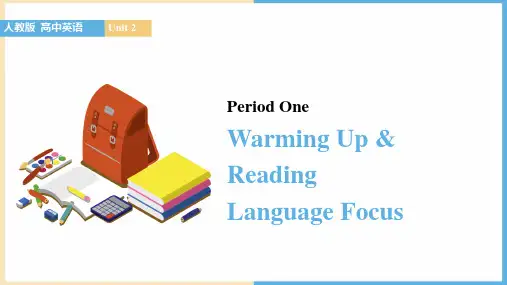
family meal
ቤተ መጻሕፍቲ ባይዱ
3.According to the passage,which should NOT be done by parents? A.Forming a healthful eating habit themselves. B.Forcing kids to have vegetables. c.stoc up on some fruits at home.
icy pavement.
(3)We must balance the advantages against the disadvantage
s
(权衡利弊) before we decide.
(4)While performing,the athlete lost his A
and fell off
人教版 高中英语 Unit 2
Period One
Warming Up & Reading Language Focus
Good nutrition and a balanced diet will help your children grow up healthily.No matter how old your kids are,you can
reduce my blood pressure. (3)—Hi,Tom! Come and try this ice cream! It is really
delicious!
—Sorry! I’m dieting.The doctor lets me eat a lowsugar diet (我在节食,医生让我吃一些低糖的食物).
人教版高中英语选修六课后阅读训练5.【Unit 2 Period 1】及答案解析
人教版高中英语选修六课后阅读训练5.【Unit2Period1】及答案解析Ⅰ.阅读理解APoetry is one of the important art forms of literature,and is an easy way to express your feelings.Moreover, everyone understands it in their own way.Some find relief in poems;some read them simply for peace;some read poems for simple artistic pleasure.There are some special features of poetry,which make it quite different from other forms of literature.First of all,poems have rhythmic patterns.Generally most parts of a poem follow the same form of rhythm.Poems may have rhyme,but they don’t have to.The lines are neatly arranged together so that they express a particular feeling or emotion.There can be various types of poems but according to the pattern or the form,there are mainly three types:Lyrics(抒情诗):The lyric mainly concentrates on human thoughts and emotions rather than a story.Lyrics always bear song-like appeal.These are mainly short poems.Popular lyric poem forms are the elegy(挽歌),theode(颂歌)and the sonnet(十四行诗).William Shakespeare,Edmund Waller and Keats are some of the greatest lyric writers of all times.Narrative poems:This type of poetry tells a story.Narrative poems are usually long poems.Epics(史诗)and ballads fall under this type.Some of the greatest epic poets are John Milton,Dante,Edgar Allan Poe,Alexander Pope, William Shakespeare,etc.Dramatic poems:Any drama that is written in verse is a dramatic poem.These poems generally tell a story. Black verse,dramatic monologues and closet drama belong to this type.William Shakespeare,Christopher Marlowe and Ben Jonson are some of the great dramatic poets.Whatever the form is,one thing,which cannot be denied,is that poetry is one of the most powerful tools to express our feelings.【语篇概述】本文主要讲了诗歌的一些特点以及诗歌的几个类别。
Unit 2 Period 1 Listening and Speaking教案
教学过程
教学环节
教师活动
学生活动
设计意图
Daily routine
Step 1
Warm up
Teacher greets the whole class as usual.
=ethics
Virtues are the flip side of vices.
abeneficial quality or power of a thing
-Teach the meaning of new words.
Step 5
Let’s play
Teacher choses students to answer the questions.
3.What did Jane say about the girl's life?
Keys:
1.She carried the student to a safe place and looked after her. Then she went to the hospital with the student and called her sister.
Students answer the questions loudly together.
-Check the teaching situation of last lesson quickly.
-Help students consolidate the knowledge points.
Lead-in
人教版英语七年级上册Starter Unit2 Period1参考教案

(最新版)Starter Unit2 Period1参考教案-新单词Teaching and Learning Goals:In our life ,we must touch some things. eg: pen,ruler,map,etc.This class we will learn some things we can use in our life .Say it in English .and we will try our best to remember them .So this class we will learn the words in starter unit 2 and try to use them .Teaching and learning stepsStep 1Learn to read the words bying listening firstIn our countryside, Students in Grade 7 have poor English .they can’t write the letters right ,a nd they can’t say the letters from Aa to Zz. So first they must try to listen to the tape ,then read after the tape,try to remember them according to the picture . Sometimes teacher can lead them to read.I, listen and read .1, put some picture of the words and ask students to guess what it is.2, Play the tape ,let students listen and try to repeat .3, Let students read by themselves , sometimes teacher can lead to read.4, Students read the words to his\her deskmate, and then read in group. Ask the other students to correct for them .Step 2 :Learn to remember words on …一. Remember the words by looking at pictures.In this unit, some words can learn by looking at the picture.this can make students have more interests in English . The following words can do like this .map cup ruler pen orange jacket key quiltWe can put the picture on TV, let students learn the words looking at them .0range ruler pen jacketquilt key map cupThe other wordsII. Remember the words by act the dialogue.如,what , is ,this , in ,English , it ,a ,an, spell ,pleaseBy acting the dialogue;A: What’s this in English ?B: It’s a\an ……..A: Spell it ,please .B: M-A-PIII. Remember the words by their similar usage . 如,1. a , an均为冠词,用法类似但有不同,a用于以辅音开头的单数可数名词前,而an 用于以元音开头的单数可数名词前。
人教版七年级下册英语Unit 2 Period 1 Section A(1a-2d)
③getdressed
考点4 getdressed穿上衣服 这 是 “ get+ 形 容 词 ” 结 构 。 “get/bedressedin+衣服或表示颜色的词”意为 “穿上……的衣服或穿……颜色的衣服”。
e.g. Let’sgetdressedandgototheconcert. 我们穿上衣服去音乐会吧。 Mr. Zhangisdressedinred/inaredjacket. 张先生穿着红色的衣服/一件红色的夹克衫。
1cStudentAistheinterviewer. StudentBisRick. AskandanswerquestionsaboutRick'sday.
A:Whattimedoyouusuallytakeashower, Rick? B:Iusuallytakeashoweratsixforty.
“考点精讲点拨”链接。
1aMatchtheactivitieswiththepictures.
1. getup①____2c. gotoschool②______
d
3. getdressed③______4. brushteeth④______
5. eatbreakfast______b6. takeashower_____ f
Scott:Fromtwelveo'clockatnighttosixo'clockinthemorning. Interviewer:Whattimedoyouusuallygetup? Scott:Ateightthirtyatnight. ThenIeatbreakfastatnine.
Interviewer:That'safunnytimeforbreakfast! ⑧ Scott:Yeah. Afterthat, Iusuallyexerciseatabouttentwenty. ⑨ Interviewer:Whendoyougotowork? ⑩ Scott:Ateleveno'clock, soI'mneverlateforwork. ⑪
Starter_Unit2_Period1(1a-2e)全英版教案
Starter Unit2 Period1(1a-2e)全英版教案Teaching Aims1. Knowledge Objects(1)Function:Students learn to write letters I — R regularly(2)Key V ocabulary:what, is, this, in, English, map, pen, ruler, orange, jacket, key, quilt, it, a, that(3)Target Language:①Wha t’s this in English? ②Spell it, please.2. Ability Objects:Identify things;Spell words3. Moral Objects:Speak English actively, don’t be shy.Teaching Key PointsTo read and write I—R correctly and regularly.Teaching Difficult PointsTo write I—R correctly and regularly.Teaching MethodsListening and speaking methods; Group workTeaching AidsA tape recorder; Some color cardsTeaching ProceduresStep 1 Revision (About 5 minutes)Review the letters that students have learned in the last unit. Look for the small letters in the picture on page S5 1a for these big letters on the left. Check the ones you find.Step 2 Lead-in (About 5 minutes)Prepare a quilt, a map, a jacket, a key, a ruler, a pen, an orange. Hold the key up and ask “What’s this in English?”“It’s a key.” Students can give answers.Repeat the same questions and then get students to answer. If possible, use flashcards to teach the spelling of the words. Put a flashcard beneath a drawing of each object.Let Ss pay attention to “a”and “an”, learn how to use them.Step 3 Listening (1b) (About 5 minutes)Listen for the first time. Ask Ss to pay attention to the intonation and the sentence stress. Make some marks like “/”, “.”and“’”.What’s this in English?It’s an orange.What’s that in English?It’s at jacket.Listen for the second time. Repeat the sentences.Step 4 Pair work (lc) (About 5 minutes)Let Ss make conversations in pairs by the things in la. Then act out in front of the class.Step 5 Letters learning (2a 2b 2c 2d) (About 13 minutes)1. Listen and repeat.Let Ss read one by one, pay attention to the differences between I and R. Teacher should encourage them.2. Listen and number the letters.3. Look and copy.Have the students watch the teacher writing the letters on the blackboard, then ask them to follow the teacher and write down these letters on their exercise books. Let the students know the differences between the big letters and the small letters.Step 6 Extension (About 5 minutes)Ask the students to say out where we can findEnglish words or English names around us and what they are. What’s the meaning of it?Maybe the students can list a lot. If they couldn’t, give them some notes such as WC’NBA,Exit and so on. Let the students try their best to search as many abbreviations as possible.Step 7 Summary (About 5 minutes)Let the students show what they have learnt m this class.Step 8 Homework (About 2 minutes)Write the letters I—R on the exercise books,Practice the target language “What’s this/that in English?”Black board DesignStarter Unit 2 What’s this in English?The First Period (la—2e) Letters:Ii Jj Kk LI Mm Nn Oo Pp Qq Rr Sentences:—What’s this in English?—It’s an orange.—What’s that in English?—It’s a jacket.。
新版-牛津译林版小学英语六年级上册Unit 2 What a day! Period 1同步练习
新版-牛津译林版小学英语六年级上册Unit2 What a day! Period 1同步练习翻译将下列汉语翻译成英语。
(1)蚂蚁(2)蜜蜂(3)变成(4)云(5)多云的【答案】(1)ant(2)bee(3)become(4)cloud(5)cloudy【解析】(1)蚂蚁ant。
(2)蜜蜂bee。
(3)变成become。
(4)云cloud。
(5)多云的cloudy。
翻译将下列汉语翻译成英语。
(1)饮料(2)在高处(3)蜂蜜(4)有趣的(5)下雨【答案】(1)drink(2)high(3)honey(4)interesting(5)rain【解析】(1)饮料drink。
(2)在高处high。
(3)蜂蜜honey。
(4)有趣的interesting。
(5)下雨rain。
翻译将下列汉语翻译成英语。
(1)展示,展览(2)晴朗的(3)天气(4)起风的【答案】(1)show(2)sunny(3)weather(4)cloudy【解析】(1)展览/展示show。
(2)晴朗的sunny。
(3)天气weather。
(4)多云的cloudy。
翻译今天早晨天气晴朗。
【答案】It was sunny this morning.【解析】晴朗的sunny,今天早上this morning,根据this morning 判断本句子是一般过去时,所以答案是:It was sunny this morning.翻译我们在公园里看到很多有趣的鹦鹉。
【答案】We saw many interesting parrots in the park.【解析】看见see;很多有趣的鹦鹉many interesting parrots,在公园in the park,根据句意判断本句子是一般过去时,see的过去式是saw,所以答案是:We saw many interesting parrots in the park.翻译我们把风筝在空中放的很高。
StarterUnit2Period1(1a_2e)课件人教版英语七年级上册
学习目标 新知学习 重点研讨 课堂小结 当堂检测
1b Listen and repeat.
What’s this in English? It’s an orange. What’s that in English? It’s a jacket.
mK pR j QlO nI
学习目标 新知学习 重点研讨 课堂小结 当堂检测
2e Talk about what these letters mean.
P = parking
停车场;停车位
学习目标 新知学习 重点研讨 课堂小结 当堂检测
2e Talk about what these letters mean.
3. What’s this in English? 这个用英语怎么说? 句型用来询问某物,回答时要用“It is/ It’s a(n) + 名词”, 其中 it 用来指代 this 或that。 其同义句为:What’s the English for this / that? what’s = what is, 意为“是什么”。 用来提问的特殊疑问句总是放在句子的开头。
NBA = National Basketball Association (美国)全国篮球协会
学习目标 新知学习 重点研讨 课堂小结 当堂检测
2e Talk about what these letters mean.
kg = kilogram 千克;公斤
学习目标 新知学习 重点研讨 课堂小结 当堂检测
1. this 是指示代词,意为“这;这个”,指近处或距说话人 近的人或事物。 This is a ruler.