
外研版九上英语Module 2 Unit 1
____in__M__a_y______. 3 Labour Day in the US is on _t_h_e_f_ir_s_t_M__o_n_d_a_y_
on 4th July. It’s the start of the v_a_c_a_t_io_n_ season.
activity flag found vacation
2 On 1st October, you can see the national _f_la_g_s_ everywhere in China.
holiday.
从那以后
Tony: Do you have any plans for the holiday this year?
Lingling: Yes. My parents and I are going to visit some friends in Shandong Province and we’ll stay there until the end of the holiday. While we’re staying with our friends, we’re going to spend one day in Qingdao. When is your national day, Betty?
6 Say the dates. 10th September 4th July
1st October 25th December
速度接龙
➢ 全班同学分成小组。 ➢ 一个同学读完后,下一个同学立刻接上,用时
最短的组获胜。 ➢ 如有读错应立即改正,不改正者结束后将在小
组用时上另加3秒以作处罚。
1st
holiday activities. It’s the start of the vacation
season, and most people take a vacation
sometime in July or August. 去度假
各种各样的
Lingling: And is there anything special on that day? Betty: Well, you can see American flags everywhere. We usually have a picnic somewhere nice. Kids have great fun. We also watch bands play music in public parks. 玩得高兴;有乐趣
3 Listen and read.
How many countries are mentioned in the dialogue? What are they? Three. They are China, the US and the UK.
Complete the table.
Holiday Date Duration
Tony: Well, we celebrate May Day in the UK. It’s not always on the first day of May. It’s on the first Monday in May.
Betty: In the US, Labour Day is a national holiday, but it’s on a different date. It’s on the first Monday in September. It’s the last day before the new school year begins.
Daming: Do you have a national day in the UK, Tony?
Tony: No, we don’t –we celebrate Christmas with a two-day holiday. And my family always go somewhere interesting as soon as the holiday begins. 一……就……
__i_n__S_e_p_te_m__b_e_r__.
Now listen and check.
Lingling: In China, many holidays are on the first day of the month. For example, we celebrate Labour Day on 1st May.
Unit 1 My family always go somewhere interesting as soon as the holiday begins.
外研·九年级上册
New words
found v. 创立;创建 flag n. 旗;旗帜 until prep. & conj. 直到……为止 off adv. 不上课 ;休息;不工作
Let’s go somewhere nice for a picnic.
as soon as意为“一……就……”。用来引导 时间状语从句。 例句:我们一看见这所房子,就把他选作我们的
家了。 We chose the house for our home as soon as we saw it.
7th
13th
2nd
8th
20th
3rd
9th
21st
4th
10th
31st
5th
11th
6th
12th
Now work in pairs. Ask and answer questions about important dates.
—When is your birthday? —The tenth of September.
founded on 1st October 1949. People have
celebrated the National Day since then.
There are flowers and national flags
everywhere, and we have a three-day
Complete the rest of the table.
Ways of celebrate
China
US
celebrating with flowers and national flags
celebrating with flags; having picnics; watching bands play music in public parks
China National day 1st October three days
US Independence day
4th July one day
Tony: The First of October is China’s National
Day, isn’t it, Lingling?
Lingling: Yes. The People’s Republic of China was
3. There are flowers and national flags everywhere, and we have a three-day holiday.
基数词+名词 (+形容词)”可构成复合形容词, 在句中作定语。其中,词与词之间用连字符连接, 名词用单数形式。
如:a four-year-old boy。
4th fourth 10th tenth 31st thirty-first
5th fifth
11th eleventh
6th sixth 12th twelfth
1, 2, 3要全变,其他th添后面, 八(eight) 去t,九(nine) 去e, 以y结尾变ie, five, twelve两兄弟,ve要用f替。 遇到几十几,只变个位就可以。
When is your
birthday?
vacation n. 假期;假日
season kid
band UK
fourth sixth
n. 度假旺季;节期 n. 小孩 n. 乐队 英国 num. 第四 num. 第六
seventh eighth ninth tenth twelfth
twentieth
num. 第七 num. 第八 num. 第九 num. 第十 num. 第十二 num. 第二十
2. And my family always go somewhere interesting as soon as the holiday begins.
用形容词修饰something,somewhere等不定代词或 不定副词时,形容词要放在不定代词或不定副词的 后面,如anything special, somewhere interesting。 例句:我们去个好地方野餐吧。
The Lantern Festival
What festivals do you know?
Spring Festival
Mid-Autumn Festival
Double Ninth Festival
Dragon Boat Festival
Module 2 Public holidays
Listening andd answer the questions. 1 Which public holiday are people celebrating?
People are celebrating Labour Day.
Module 2 Unit 1 外研版英语九年级上册知识点详解
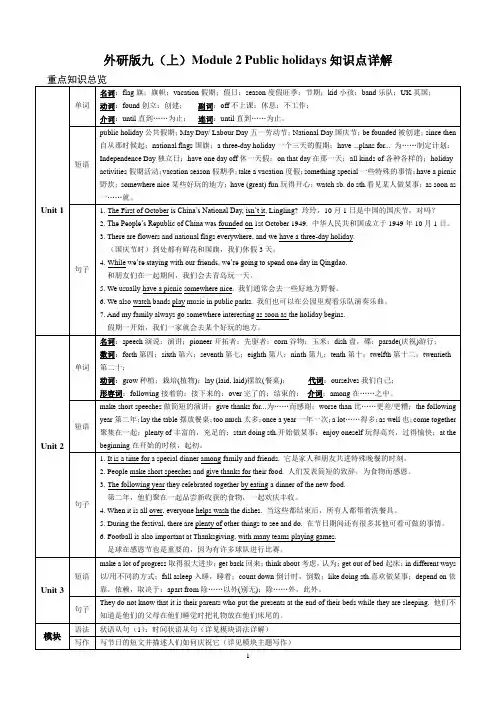
外研版九(上)Module 2 Public holidays知识点详解Unit 1 My family always go somewhere interesting as soon as the holiday begins.★(A2).【知识点再现】The First of October is China’s National Day, isn’t it, Lingling? 玲玲,10月1日是中国的国庆节,对吗?【知识点1】the First of October 意为“十月一号”。
英语年月日的表达“在英国英语中,通常可有两种表达法。
以“1988年5月2日”为例:表达法①:写法:(the) 2 (nd) May, 1988;读法:the second of May, nineteen eighty-eight;表达法②:写法:May (the) 2 (nd), 1988;读法:May the second, nineteen eighty-eight。
如:I was born on March 6th, 1990. 我出生于1990年3 月6日。
读成:I was born on March the sixth, nineteen ninety. 或I was born on the sixth of March, nineteen ninety. 【拓展】①写法中,日期与月份之间不可加逗号;②写法中,年份前的逗号可以省略;③写法中,代表日期的序数词词尾(-st,-nd,-rd或-th)均可省略;④写法中,序数词前的定冠词the,一般可省略(尤其是以序数词开头的场合);但在读法中,该定冠词则不省略。
【知识点2】本句是反意疑问句。
在陈述句之后,附加上一个简短问句,对陈述句所述的事情提出相反的疑问,这种疑问句叫作反意疑问句。
反意疑问句由“陈述句+附加疑问句”两部分构成。
反意疑问句的结构有两种:前肯后否;前否后肯。
外研版九年级上册Module 2 Public holidays Unit 1单元整体教学设计
外研版九年级上册Modu1e2Pub1icHo1idays大单元教学设计国的某一节日做简单的介绍,感受我国文化的底蕴,培养学生热爱国家、名族的情怀。
核心语言知识分析:本模块主要语法状语从句的用法,主要学习时间状语从句的用法,使学生能够准确表达,达到自如运用的程度。
知识储备:1 .学生对“节假日”话题并不陌生,在七年级的时候就学过关于“春节”的相关内容,也能够做简单的介绍。
本模块主要谈论世界主要国家的节假日与庆祝活动。
内容比较丰富、有趣,所以学生对话题会比较感兴趣,也很容易进行讨论。
2 .学生在八年级学习了since›when 与whi1e 的基本用法,对这些词的用法有所感知和理解。
3 .学生掌握了一些有效的阅读策略。
可能面临的问题:1 .学生对话题比较熟悉,但是单词的储备还是欠缺,很多的词汇不熟悉,比较难开展讨论,可能只会在文中找些单词来进行描述,信息获取,文化知识的内化对于学生而言有一定难度。
2 .学生可能会分不清when 与whi1e 的用法,弄不清延续性动词和非延续性动词,造成理解上的一定困难。
3 .学生信息收集整理以及有逻辑的写作输出能力有待提高。
模块内容分析(Ana1ysisof the1earning materia1s)学情分析(Ana1ysisof thestudents)I 单元主题:节假日]庆节的庆祝方式,以及从哪一年开始庆祝。
学生能够在听、读任务完成后进行简单的表述。
在学习对话之前,活动1、2的设计为学生扫清了新词障碍。
Why:本单元语篇旨在让学生初步了解中、美两国的节日。
II.教学目标(TeaChingobjectives)在本课学习结束时,学生能够:1.熟练运用文中的重点句型和日常交际用语。
2.通过听、说活动,获取和梳理四大世界奇观的基本信息。
能够简单阐述自己的观点。
II1教学重、难点(Key&dif∏cu1tpoints)1.掌握文中重点词汇和句型。
2.掌握关于停顿的听力技巧,提高听的能力。
外研版英语课件九上module2publicholidaysunit1myfamilyalwaysgosomewhereinterestingassoonastheholidaybe

oneday
Celebratingwithflags, picnicsand
watchingbandsplaymusic inparks
1777
Readagainandanswer!
1.What’sLingling’sholidayplan?
HerparentsandshearegoingtovisitsomefriendsinS handongProvinceandthey’llstaythereuntiltheendo ftheholiday.Whilethey’restayingwiththeirfriend s,they’regoingtospendonedayinQingdao.
DragonBoatFesti Mid-AutumnFestival val
Workinpairs.Askand answerquestionsabou taChinesepublicholid ay.
MayDay Lantern Festival
NtootCwhhpeorweohssoeelnoetnctleahfseesCs.thivinaelsaenpduwbloicrhkoinligdraoyups,aska8ndan
2. WhenisthisholidayinChina? Thisisholidayison1stMayinChina.
Fillintheblanks.
Nowlistenandcheck!
LabourDayinChinaison_____1_s__t_M__a_y.
MayDayintheUKison_______t_h_e_f_i_r_s.tMondayinMay
2.WhatdoesTony’sfamilyalwaysdoassoonastheh olidaybegins?
秋九年级英语外研版上册课件:Module 2 Unit 1(共40张PPT)
Yes. My parents and I are going to visit some friends in Shandong Province and we’ll stay there until the end of the holiday. 是 的。我和父母要到山东省去拜访一些朋友,并将一 直待到假期结束。(教材第10页)
要点思维导图
举例
I do my homework until 10 o’clock every day.
我每天做家庭作业直到10点钟。
He didn’t go to bed until he finished his
homework. 他直到写完作业才上床睡觉。
应用
( B )1.—Excuse me! May I come in? —Not yet. Please wait on your chair ________
Module 2 Public holidays
Unit 1 My family always go somewhere interesting as soon
as the holiday begins.
第一课时 Getting ready & vocabulary
课前导学
found flag until off
Yes. The People’s Republic of China was founded on 1st October 1949. People have celebrated the National Day since then. 是的, 中华人民共和国成立于1949年10月1日。人们自从 那时起就开始庆祝国庆节了。(教材第10页)
外研版九年级英语初三上册Module2 Unit1课件

解析口诀:one → first, two → second, three →third 这三个词变化特殊,要单独记;eight →eighth,nine→ninth, 八去t,九去e后再加th; five→fifth, twelve→twelfth,五、十二把ve换 成f再加-th; twenty→twentieth, thirty→thirtieth... 整十先把词 尾y改为ie再加-th。两位数时则十位数用基数词,个 位数用序数词,如:twenty-first。
Tony: No, we don't --- we celebrate Christmas with a two-
day holiday. And my family always go somewhere
interesting as soon as the holiday begins.
一..就..
Tony: The First of October is China's National Day,
isn 't it, Lingling?
反意疑问句
Lingling: Yes. The People's Republic of China was founded on 1st October 1949. People have 自从
Spring Festival
Women's Day
Labour Day
National Day
Mid-Autumn Day Dragon Boat Festival Tomb-sweeping Day
Christmas Day Thanksgiving Day
初中英语 外研版九上Module 1 Unit 2 教材重要知识点梳理

Unit 2 The Grand Canyon was not just big.1.与look相关的常见短语:①look around 往四周看②look across眺望;向对面看③look down往下看④look up往上看;查阅(字典等)⑤look through浏览⑥look over 从上面看过去;仔细检查⑦look forward to盼望;期待2.辨析:get out of & get off(1)get out of,意为“下车”,后常接car,taxi等小型交通工具,其反义词组为get into。
The young man got out of his car and entered the shopping mall. 年轻人从自己的车下来,进了购物商场。
(2)get off,意为“下车(船、飞机等)”,后接bus,ship,plane等大型交通工具,其反义词组为get on。
The old man didn’t get off the bus until it stopped.老人直到公交车停稳才下车。
3.辨析:through & across & over & past(1)through,介词,“穿过”,表示从某空间内部穿过。
Which river runs through Shanghai?哪条河流从上海市内流过?(2)across,介词,“穿过”,表示从某物表面横穿而过。
Don’t go across the road when traffic lights are red.红灯亮时,不要横过马路。
(3)over,介词,“越过”,表示从某物上方越过。
Jump over the fire and be careful.小心跳过火堆。
(4)past,介词,“经过”,表示从某地旁边经过。
I go past a big supermarket on my way to school.在我上学的路上,我要经过一家大型超市。
外研版九年级英语上册教案 Module1 Unit2 (1)
多媒体课件
教 学 过 程
二次设计
Step 1
Warming
up and
leading in.
(Act. 1)
1. Ask the students to work in pairs and talk about a great wonder.
2. Show the following questions on the screen.
5. I didn’t r_______long in that city. I came back after two days.
Ⅱ.用所给词的适当形式填空
1. Why did you keep_______(silence) at the meeting? Didn’t you have anything to say?
3. Try to find passages with facts to read.
教学反思
本节课的教学设计, 抓住学生的好奇心理, 活化我们的英语教材, 透过扩展教材资料或活动步骤, 充分激发他们勤于思考、敢于创新的兴趣, 鼓励他们多角度、多方向、新颖独特的提出问题、解决问题; 提倡一题多议, 敢破常规, 使教学向纵深发展。其次, 抓住了阅读技巧, 课堂教学方明确向, 加强学生实际练习、多运用, 确立以“知识理解型”教学模式向“思维训练型”教学模式的转变。
⑤Far below me, the ground fell away and down to a river.
教学难点
1. Get the key information quickly from the reading material.
2. Know how to write about what you see and your feeling when you travel.
外研版九年级英语上册Module 2 Unit 1教学课件
have fun as soon as
PRC __(found) on 1st October in 1949. I _(find) your book just now. 2 I _(call) you as soon as I reach there I went home as soon as I _(finish) it.
July 4th
How many days
Three days One day
Flowers and
All kinds of
How to flags everywhere holiday activities
celebrate A three-day
American flags
Year the celebration
National Day
PRC was founded on October 1st in 1949. People have celebrated National Day since then. They hold all kinds of celebrations…
ห้องสมุดไป่ตู้
在立宪君主制国家英国,按历史惯例,国王的生日 为英国国庆日,现伊丽莎白二世的生日为4月21日, 但由于伦敦4月气候欠佳,因此将每年的6月第二个 星期六定为“女王官方诞辰日”。女王父亲乔治六世 在位时,也是在6月为他过生日,尽管他实际生日 是12月14日,此前两位国王乔治五世和爱德华八世 恰好都在6月出生,才能在实际生日中领受举国臣 民的共同贺寿。和美国的独立日比起来,英国国庆 不免有王室“一己之私”的意味,加之还有不少人 呼吁取消君主制,所以英国的国庆自然低调得多, 不像美国那么隆重铺张。女王贺寿活动中很重要的一
新 外研版英语九年级上Module 2 Unit 1 同步练习(附答案)
Unit 1My family always go somewhere interesting as soon as the holiday begins.(第一课时)Ⅰ.根据句意及首字母或汉语提示写出正确的单词1.The children will have two days o________ next week. They won't have lessons. 2.December is the t________ month of the year.3.In the US, “v________” has the same meaning as “holiday”.4.My cousin is the most important member in the ________ (乐队).5.—Do you live on the tenth floor?—No. I live on the ________ (第二十) floor.Ⅱ.用英语写出下面的节日6.January 1st ________________7.March 8th ________________8.May 1st ________________9.May 5th (lunar month农历) ________________10.June 1st ________________11.July 4th (美国国庆) ________________12.September 10th ________________13.August 15th (lunar month) ________________14.October 1st(中国国庆) ________________15.4th Thursday in November(美国) ________________Ⅲ.根据汉语意思完成句子16.从那以后,我就没有见过玛丽。
外研版九年级上册英语课件Module 2 Unit 1
4. 度假旺季;节期 __s_e_a_s_o_n_______ 5. 小孩 ___k_id______________________________ 6. 乐队 ___p_a_b_a_n_d______ 7. 英国 ___U_K__________ 副词
8. 不上课;休息;不工作 _____o_f_f _______
as the holiday begins.
课堂导学
1. The People’s Republic of China was founded on 1st October 1949. 中华人民共和国成立于1949年10月1日。(教 材第10页) found在这里用作及物动词,意思是“创立;创建”,其过去式 和过去分词都是founded。如: They founded the company five years ago. 他们5年前创办了这家公司。
二、听填信息。 听Unit 1 Act.3对话, 完成下列信息表。对话听两遍。
Country China
Holiday
Date
1.C__h_in_a_’_s_N_a_t_io_n_a_l 2._1_st_O__ct_o_b_e_r____
Day _
_
Country
Holiday
Date
3.__A_m__e_r_i_c_a_____
些山东省的朋友,并且我 visit some friends in Shandong
们将在那里一直待到假期 Province and we’ll sil the end of the holiday.
3. 这时是假期的开始,大 It’s the start of the vacation
6. 一天one day 7. ……结束时the end of… 8. 休息一天have one day off 9. 各种各样的all kinds of 10. ……的开始the start of… 11. 去度假take a vacation