
人教版九年级上册英语 Unit 6 词汇和语法基础(解析版) (1)
知识图谱Unit 6 When was it invented?知识精讲一、必背词汇heel n. 鞋跟;足跟electricity n. 电;电能scoop n. 勺;铲子style n. 样式;款式project n. 项目;工程pleasure n. 高兴;愉快zipper n. (= zip) 拉链;拉锁daily adj. 每日的;日常的website n. 网站pioneer n.先锋;先驱list v. 列表;列清单n. 名单;清单mention v. 提到;说到nearly adv. 几乎;差不多boil v. 煮沸;烧开smell n. 气味v. 发出⋯⋯气味;闻到saint n. 圣人;圣徒doubt n. 疑惑;疑问v. 怀疑fridge n. 冰箱translate v. 翻译lock v. 锁上;锁住earthquake n. 地震sudden adj. 突然(的)biscuit n. 饼干cookie n. 曲奇饼instrument n. 器械;仪器;工具crispy adj. 脆的;酥脆的sour adj. 酸的;有酸味的customer n. 顾客;客户Canadian n/ adj. 加拿大的;加拿大人的n. 加拿大人divide v. 分开;分散purpose n. 目的;目标basket n. 篮;筐hero n. 英雄;男主角二、重点词汇1. style n.1). a way of doing something, especially one that is typical of a person, group of people, place, or period做事方式;(尤指)风格,作风例句:He wouldn't try to mislead you - it's not his style.他不会有意误导你的——他不是那种人。
2). fashion, especially in clothing(尤指服装上的)风尚,潮流,流行式样例句:The classic black dress is always in style.典雅的黑色连衣裙永远都不会过时。
2. project n.1). a piece of planned work or an activity that is finished over a period of time and intended to achieve aparticular purpose项目;方案;工程例句:a scientific research project科研项目2). a study of a particular subject done over a period of time, especially by students(尤指学生做的)课题,研究例句:He's doing a class project on pollution.他正在做一个有关污染的学校课题。
3. daily adj.happening on or relating to every day每天(的),天天(的)Take the tablets twice daily.例句:Exercise has become part of my daily routine.锻炼已经成为我日常生活的一部分。
4. mention v.1). to speak about something quickly, giving little detail or using few words提及,说起,谈到例句:Did she happen to mention whether she would be coming?她有没有碰巧提到她是否会来?2). to refer to something or someone谈及,提到例句:Did she mention me in her letter?她在信中提到我了吗?5. divide v.1). to (cause to) separate into parts or groups(使)分开;(使)分组例句:At the end of the lecture, I'd like all the students to divide into small discussion groups.讲座结束后,我想让所有学生分成几个讨论小组。
2). to share分享;分摊例句:I think we should divide (up) the costs equally among/between us.我认为我们应该平均分摊这些费用。
3). If something divides two areas, it marks the edge or limit of them.分隔,隔开例句:There's a narrow alley that divides our house from the one next door.一条窄窄的胡同将我们的房子和邻居的隔开了。
【拓展】1). divide sth by sthto calculate the number of times that one number fits (exactly) into another用…除…例句:10 divided by 5 is/equals 2.10除以5等于2。
2). divide (sth) into sthIf a number divides into another number, it fits (exactly) into it when multiplied a particular number of times.(…)除…例句:What do you get if you divide 6 into 18?6除18等于多少?三、必背短语take place发生;出现by accident偶然;意外地without doubt 毫无疑问;的确all of a sudden突然;猛地by mistake错误地;无意中divide ... into把⋯⋯分开the Olympics奥林匹克运动会look up to钦佩;仰慕have a point有道理take place发生;出现dream of梦见less than 少于achieve one’s dream实现某人的梦想not only…but also不但……而且……fall into落入;掉入四、经典句型1. ---When was the zipper invented?---It was invented in 1893.---拉链是什么时候发明的?---拉链是1893年发明的。
2. ---Who was it invented by?---It was invented by Whitcomb Judson.---它是被谁发明的?---是惠特科姆·贾德森发明的。
3. ---What is the hot ice-cream scoop used for?---It’s used for serving really cold ice-cream.---热冰激凌勺是做什么用的?---是用来挖很冰的冰激凌用的。
三点剖析一、考点1. 情景交际---with pleasurewith pleasure是常见的口语表达,相当于sure,常用来回答对方的请求。
例句:---Could you please help me carry the box?---With pleasure.---你能帮我搬一下那个箱子吗?---当然可以。
【拓展】pleasure是名词,作不可数名词讲表示“高兴;愉快”;作可数名词讲表示“高兴的事;愉快的事”。
2. with的用法with是介词,基本用法如下:1). 表示“和”或“和……一起”。
例句:Tom with his parents is going to visit his teachers.汤姆和他的父母要去拜访他的老师们。
2). 表示“有”或“带有”。
例句:He bought a house with a swimming pool.他买了一所带泳池的房子。
3). 表示“用”(使用的工具或手段)。
例句:We see with our eyes and hear with our ears.我们用眼睛看,用耳朵听。
4). 表示“由于,因为”。
例句:She trembled with fear.她吓得发抖。
5). 表示“方式、情况、环境或条件”。
例句:I’ll do it with pleasure.我很高兴做这件事。
6). 表示“随着……”。
例句:The shadows lengthened with the approach of sunset.随着日落的临近,影子也逐渐拉长。
【拓展】without与with意义相反,表示“不具有,没有”。
二、易错点1. somebody, anybody, nobody, everybody1). somebody意为“某人;有人”,多用于肯定句中。
例句:There is somebody in the room.房间里有人。
2). anybody意为“任何人”,常用于否定句和疑问句中。
例句:Did you see anybody there?你看到那儿有什么人么?3). nobody意为“无人;没有人”,是否定词,相当于not…anybody。
例句:She knocked at the door, but nobody answered.她敲了敲门,但没人应答。
4). everybody意为“所有人;人人”。
例句:Everybody knows he sings well.大家都知道他很会唱歌。
2. happen & take place1). happen表示“发生”,通常指未准备地发生或偶然发生。
例句:The accident happened at about 10.事故大约发生在10点钟。
2). take place通常指预先安排好要发生的事,因此在汉语中除翻译为“发生”外,还译为“举行”。
例句:The meeting will take place on Sunday.会议将于星期日举行。
Great changes have taken place here since last year.自去年以来,这里发生了巨大变化。
3). happen & take place都属于不及物动词,因此既不能带宾语,也不能用被动语态。
人教版九年级上册英语unit6知识点

人教版九年级上册英语unit6知识点九年级上册英语Unit6知识点回顾在九年级上册英语中,Unit6是一个重要的单元,主要涉及到时间的表达和询问,并且包括几个重要的语法结构。
本文将对这些知识点进行回顾,并探讨如何运用这些知识点来提高英语水平。
1. 时间的表达在Unit6中,我们学习了几种表示时间的方法。
首先是使用基数词表示具体的日期,例如:July 1st。
另一种方法是使用序数词表示星期几,例如:Monday。
在具体的时间表达上,我们可以使用24小时制,也可以使用12小时制。
例如:9:30表示上午9点30分,而15:45表示下午3点45分。
此外,我们还学习了表示频率的表达方式,包括always、usually、often、sometimes、seldom和never等。
这些词汇可以帮助我们描述我们日常的活动和习惯。
2. 时间的询问在英语中,询问时间是一个常见的场景。
在Unit6中,我们学习了几种方式来询问时间。
最常见的方式是问"What time is it?",这是一个简单而直接的方式。
当然,我们还可以使用更为复杂的方式来询问,例如:"What's the time now?"或者"What time do you have?"。
这些方式在日常交流中也是常见的。
3. 一般现在时和现在进行时在Unit6中,我们学习了一般现在时和现在进行时两种时态。
一般现在时用于叙述客观事实和常规习惯,例如:"I go to school every day.";现在进行时则用于表示正在进行的动作,例如:"She is watching TV right now."这两种时态在日常英语中非常常见,掌握它们的用法对于提高口语表达能力至关重要。
4. 发表意见和建议在Unit6中,我们还学习了一些表达意见和建议的句子。
Unit 6人教版九年级英语词汇与语法基础

第01讲_Unit 6 词汇与语法基础知识图谱-Unit 6 When was it invented?情景交际---with pleasurewith的用法第01讲_Unit 6 词汇与语法基础错题回顾Unit 6 When was it invented?知识精讲一、必背词汇heel n. 鞋跟;足跟electricity n. 电;电能scoop n. 勺;铲子style n. 样式;款式project n. 项目;工程pleasure n. 高兴;愉快zipper n. (= zip) 拉链;拉锁daily adj. 每日的;日常的website n. 网站pioneer n.先锋;先驱list v. 列表;列清单n. 名单;清单mention v. 提到;说到nearly adv. 几乎;差不多boil v. 煮沸;烧开smell n. 气味v. 发出⋯⋯气味;闻到saint n. 圣人;圣徒doubt n. 疑惑;疑问v. 怀疑fridge n. 冰箱translate v. 翻译lock v. 锁上;锁住earthquake n. 地震sudden adj. 突然(的)biscuit n. 饼干cookie n. 曲奇饼instrument n. 器械;仪器;工具crispy adj. 脆的;酥脆的sour adj. 酸的;有酸味的customer n. 顾客;客户Canadian n/ adj. 加拿大的;加拿大人的n. 加拿大人divide v. 分开;分散purpose n. 目的;目标basket n. 篮;筐hero n. 英雄;男主角二、重点词汇1. style n.1). a way of doing something, especially one that is typicalof a person, group of people, place, or period做事方式;(尤指)风格,作风例句:He wouldn't try to mislead you - it's not his style.他不会有意误导你的——他不是那种人。
人教版九年级英语上册unit6知识点
人教版九年级英语上册unit6知识点Unit 6: TravelingIntroduction:Traveling has always been an exciting and enriching experience for individuals of all ages. In the 9th grade English textbook of People's Education Press, Unit 6 focuses on various aspects related to travel, such as planning a trip, describing places, and asking for directions. Let's delve into the knowledge points of this unit and explore the fascinating world of traveling.1. Vocabulary:Vocabulary plays a crucial role in expanding our knowledge and enhancing communication skills. In Unit 6, you will come across numerous words related to travel. Some essential vocabulary words include "destination" (a place someone is going to), "tourist attraction"(a place of interest for travelers), "accommodation" (a place to stay while traveling), and "itinerary" (a planned route for a journey). Learning and understanding these words will help you express your ideas more effectively when discussing travel-related topics.2. Grammar:Grammar forms the foundation of any language. In Unit 6, you will learn valuable grammar concepts that can assist you in building grammatically correct sentences while discussing travel experiences. For instance, you will familiarize yourself with the use of present continuous tense when talking about future travel plans. Additionally, the unit also introduces the concept of reported speech, enabling you to recount conversations or recommendations regarding travel.3. Reading Comprehension:Unit 6 consists of various reading passages that aim to improve your reading comprehension skills. These passages cover diverse topics related to travel, including hotel reviews, travel brochures, and articles about tourist destinations. By reading and understanding these passages, you will not only enhance your vocabulary but also develop your ability to grasp information from written texts.4. Speaking and Listening:Effective communication is a vital component of any travel experience. Unit 6 provides ample opportunities to improve your speaking and listening skills. Through dialogues and group activities, you will learn how to ask for directions, describe places, and talk about travel experiences. These activities encourage teamwork and foster an interactive learning environment.5. Writing:Unit 6 also focuses on developing your writing skills. You will learn different writing formats, such as brochures and postcards, enabling you to effectively convey information about travel destinations. Additionally, you will practice writing travel itineraries, allowing you to plan and organize your own trips. These writing exercises aim to sharpen your composition skills and enhance your ability to convey information concisely.Conclusion:Unit 6 of the 9th-grade English textbook provides a comprehensive understanding of travel-related topics. By delving into vocabulary, grammar, reading comprehension, speaking, listening, and writing exercises, you can develop crucial language skills necessary for expressing your ideas and experiences related to travel. Remember, the knowledge gained from this unit is not limited to the classroom but can be applied to real-life situations, enriching your future travel experiences. So, gear up and embark on an exciting linguistic journey in the world of travel!。
最新人教版9年级英语第六单元知识点归纳
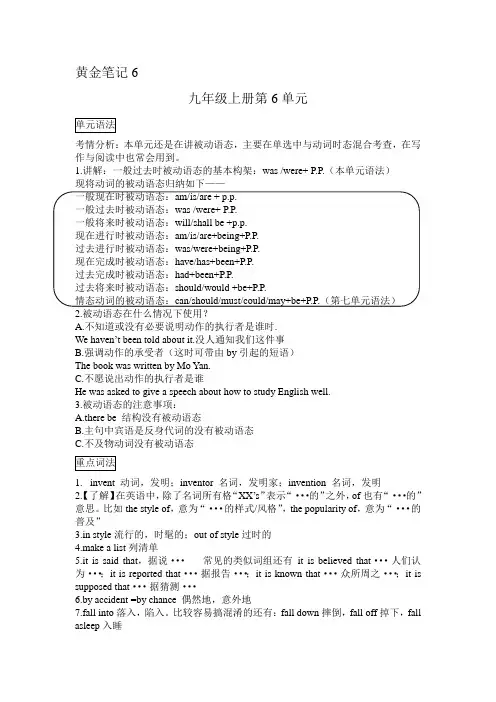
黄金笔记6九年级上册第6单元考情分析:本单元还是在讲被动语态,主要在单选中与动词时态混合考查,在写作与阅读中也常会用到。
1.讲解:一般过去时被动语态的基本构架:was /were+ P.P.(本单元语法)现将动词的被动语态归纳如下——2.被动语态在什么情况下使用?A.不知道或没有必要说明动作的执行者是谁时.We haven’t been told about it.没人通知我们这件事B.强调动作的承受者(这时可带由by引起的短语)The book was written by Mo Yan.C.不愿说出动作的执行者是谁He was asked to give a speech about how to study English well.3.被动语态的注意事项:A.there be 结构没有被动语态B.主句中宾语是反身代词的没有被动语态C.不及物动词没有被动语态1.invent 动词,发明;inventor 名词,发明家;invention 名词,发明2.【了解】在英语中,除了名词所有格“XX’s”表示“···的”之外,of也有“···的”意思。
比如the style of,意为“···的样式/风格”,the popularity of,意为“···的普及”3.in style流行的,时髦的;out of style过时的4.make a list列清单5.it is said that,据说···常见的类似词组还有it is believed that···人们认为···;it is reported that···据报告···;it is known that···众所周之···;it is supposed that···据猜测···6.by accident =by chance 偶然地,意外地7.fall into落入,陷入。
Unit6知识点归纳(短语+句型+语法) 人教版九年级英语全册
人教版九年级U6知识点归纳(短语+句型+语法)Unit 6 When was it invented?【重点短语】1. by accident 偶然地;意外地2. without doubt 毫无疑问的;的确3. by mistake 错误地;无意中4. look up to 钦佩;仰慕5. take place 发生;出现6. all of a sudden 突然;猛地7. divide…into… 把……分开8. the Olympics 奥林匹克运动会9. the style of ……的样式10. be used for 被用于……11. give sth. to sb./ give sb. sth. 给某人某样东西12. be used for doing ,用来做…...14. all day 整天15. by mistake 错误地16. make mistake犯错17. by accident 意外,偶然19. not…until… 直到……才……20. fall into 落入,掉进21. fall down 摔倒22. in the way 这样23. travel around 周游24. knock into 撞上. 某人)25. divide sth. into … ,将…划分成,【重点句型】1.Who was it invented by? It was invented by Bell.2. What is the hot ice-cream scoopused for? It s used for serving really cold ice-cream.3. English is spoken by many people.4. I gave a pen to him.= I gave him a pen. 我给了他一支笔。
5. It made me happy. 它使我高兴6. I didn’t go to bed until I finished my work. 我直到完成我的工作才去睡觉。
【致胜中考2021】九年级 Unit 6 (词汇+语法讲解)2021届人教版英语中考一轮复习
【致胜中考2021】一轮复习:九年级U6 词汇+语法讲解【单词默写】【单词变形】【单词变性】musical形容词变名词_____________ national形容词变名词_____________ professional形容词变名词_____________sudden形容词变副词_____________ nearly副词变形容词_____________ Canadian形容词变名词_____________ electricity名词变形容词_____________ pleasure名词变形容词_____________ ruler名词变动词_____________【一词多义】1. sudden _________ __________It’s so sudden that I can’t believe my eyes.All of a sudden, the car behind me hit mine.2. ruler __________ ___________The ruler told his people not to get out.We use a ruler to measure.3. smell _____________ ______________Could you smell something strange?There is a delicious smell. My mother must cook something.4. doubt _________ ____________I always doubt how hard he works.Mary will win the competition without doubt.5. list ____________ ______________You can make a shopping list in case that you forget what you will buy. You can list what you want to buy on the paper.【词汇用法】1. low: adj./at a low temperature/in a low voice2. doubt: n./no doubt/without doubt/v./doubt +从句3. smell: v./smell+adj.相关词辨析: sound vs. look vs. taste vs. smell vs. feelsound: v./sound+adj./sound like/n.look: look+adj.taste: taste+adj.smell: smell+adj.feel: feel+adj.4. divide: v./divide …into…/be divided into…【高频短语】all of a sudden____________ a basket of____________ without doubt____________ no doubt____________ a list of____________ make a list____________with pleasure____________ hope project____________out of style____________in style____________on the website____________ divide…into…____________boil the water____________【攻占语法】被动语态(二)一、主动表被动的意思: ______________________________________二、无被动语态的动词:1) 不及物动词或动词短语无被动语态(即多数的瞬间动词):appear, die(死亡), disappear(消失), end (vi. 结束), fail, happen, last, lie, remain, sit, spread, standbreak out, come true, fall asleep, keep silence, lose heart, take place.2) 不能用于被动语态的及物动词或动词短语:fit, have, hold, marry, own, wish, cost, notice, watch agree with, arrive at / in, shake hands with, succeed in, suffer from, happen to, take part in, walk into, belong toThis key just fits the lock.3) 系动词无被动语态appear, be become, fall, feel, get, grow, look, remain, seem, smell, sound, stay, taste, turn三、主动表被动的动词1. need doingThe room needs cleaning.2. write, sell, playThe clothes sell well during the “Double Eleven”.The pen writes smoothly.The piano plays well.3. feel, sound, taste, smell【词汇练习】1.The science teacher told us that water b ________ at the temperature of 100 C.2. C ________ speak English and French.3.In our hotel, we should provide the best service for our c ________ and let them feel at home.4.The Internet is playing a more and more important part in our d ________ life.5.Dr. Naismith d ________ the men in his class into two teams and taught them to play basketball.6.We can improve our English by reading English newspaper like China D____.7.Li Na is without d ________ one of the greatest tennis players in the world.8. A sudden e ________ happened in the village and almost nobody survived.9.People put fruit and vegetable in a f ________ to keep them fresh.10.H ________ are people who are admired for having done something very brave or having achieved somethinggreat.11.Jane is not only good at singing but also good at playing all kinds of musical i ________.12.The door was l ________, so we had to wait outside.13.The temperature today is l ________ than that of yesterday, so put on your coat before going out.14.He m ________ several useful books in the course of his speech and I took notes in time.15.Mr. Bell learnt to send m ________ notes through an instrument similar to a telephone. It sound beautiful.16.In China, tea is regarded as the n ________ drink because most Chinese people like drinking it.17.N ________ half of the passengers got injured during the accident.18.As teenagers, we read both for p ________ and knowledge.19.It is said that a Chinese r ________ called Shen Nong was the first to discover tea as a drink.20.The soup tastes s ________, maybe you have put too much salt in it.21.For most people, stinky tofu s ________ terrible but tastes great.22.He said he just didn’t like the job anyhow, but that was just s ________ grapes.23.Children have different s ________ of learning: some learn by seeing, some by hearing, some by doing.24.Would you please t _________ it into Chinese for me? I know little French.【语法练习】1.--- Do you like the material?--- Yes, it ___ very soft.A. is feelingB. feltC. feelsD. is felt2.The young teacher has ____ competent.A. been proved to beB. proved to beC. been provedD. proved being3.The boy needs _______ and his bike needs_______.A. to rest, to mendB. resting, mendingC. to rest, mendingD. resting, to mend4.The new piano______(play) well. I like it very much.5.The pen __________(write) smoothly. I suggest you buy one.6.The flowers needs _____________(water) every morning.【参考答案】【单词变形】【单词变性】musical形容词变名词music national形容词变名词nation professional形容词变名词profession sudden形容词变副词suddenly nearly副词变形容词near Canadian形容词变名词Canada electricity名词变形容词electricalpleasure名词变形容词pleasantruler名词变动词rule【一词多义】1. sudden 突然的突然It’s so sudden that I can’t believe my eyes.All of a sudden, the car behind me hit mine.2. ruler 统治者尺子The ruler told his people not to get out.We use a ruler to measure.3. smell 闻到味道Could you smell something strange?There is a delicious smell. My mother must cook something.4. doubt 疑惑疑问I always doubt how hard he works.Mary will win the competition without doubt.5. list 清单列出You can make a shopping list in case that you forget what you will buy. You can list what you want to buy on the paper.【高频短语】all of a sudden突然a basket of一箩筐without doubt毫无疑问no doubt难怪a list of列表make a list制作清单with pleasure很乐意hope project希望工程out of style过时in style流行地on the website在网上divide…into…把…分成boil the water煮沸水被动语态(二)一、主动表被动的意思: 用主动形式表达被动的意义【词汇练习】Boils Canadians customers daily divided Daily doubt earthquake fridge heroes instrument locked lower mentioned musical national Nearly pleasure ruler salty smells sour styles translate【语法练习】CBC plays writes watering。
人教九年级英语Unit6全单元知识点讲解
eg:---Do you know who invented the light bulb(电灯泡)?
---Edison.
拓展:
inventor n.发明家
invent v.发明
invention n.发明
Edison,a great ________,________ many
Boil the potato for 20 minutes. 把土豆煮20分钟。 Water boils at 100℃. 水在100℃沸腾。
• remain v.保持不变;剩余 ① 作连系动词,“仍然是(处于某种状态);
保持不变”=keep。其后可接形容词、名词、 分词或介词短语作表语。
eg;The room remains cool all summer. 这个房间整个夏天保持凉爽。
• by accident 偶然;意外地=by chance eg:我在街上偶然遇到了Tom。
I met Tom by accident in the street.(作 状语)
Tea was invented _b__y_a_c_c_id__en__t _.
• nearly(almost) adv.几乎;差不多 eg:我几乎从自行车上摔下来。
great _________ during his life.
• heel n.鞋跟;足跟 • scoop n.勺;铲子 • electricity n.电;电能
• style n.样式;款式;风格;方式
eg:The style of the shirt is just in season.
I wouldn't tell lies to you.That's not my style. in style流行的;时髦的 out of style过时的 a life style生活方式
九年级英语 unit6 知识点总结知识点分析人教版新目标
九年级英语Unit6【单元目标】Ⅰ.单词与短语单词prefer gentle remind heart latest feature display interest whatever miss suggest energy honest course suit expect taste actually mainly laboratory type cancer increase risk main shock短语1.prefer… to…比起…更喜欢…2.to be honest 老实说;说实在的3.remind of 提醒;使记起4.on display 展览;陈列5.be bad for 对…有害;有害于6.stay away from 与…保持距离7.be in agreement 意见一致8.dance to 随着…跳舞9.sing along with 伴随…唱歌10.be important to sb. 对某人重要11.be sure 确定;一定12.get together 聚集在一起13.cause cancer 致癌14.taste good 尝起来好Ⅱ.目标句型:---What / which kind of + n. + do / does sb like?---Sb like(s) / love(s) / prefer(s) / enjoy(s) +n. + that从句(表示一种限制)Ⅲ.语法定语从句(见最后一页)【重点词汇】1. prefer动词更喜欢宁愿a)prefer sth.更喜欢某事 I prefer English. 我更喜欢英语。
b)prefer doing宁愿做某事 To do 强调特定的或某次具体的动作He preferred reading at home on rainy days.c)prefer to do sth 宁愿做某事doing强调一般性倾向即对某种行为的“偏爱”The boy preferred notto go with his parents.d)prefer sb to do sth 更希望某人做… We prefer you to stay for dinnere)prefer sth to sth. 同…相比更喜欢… I prefer dogs to cats. 与猫相比我更喜欢狗。
新人教版九年级英语UNIT6知识点讲义
新人教版九年级英语UNIT6知识点讲义在九年级英语学习中,UNIT6是一个重要的单元,涵盖了许多重要的知识点。
本文将对新人教版九年级英语UNIT6的知识点进行详细的讲解,希望对同学们的学习有所帮助。
一、重点单词1. connect(v.)-连接例句:We need to connect the two wires to have electricity.词组:connect with与...连接2. educate(v.)-教育例句:Parents have the responsibility to educate their children.词组:receive an education接受教育3. remove(v.)-移除例句:Please remove your shoes before entering the house.词组:remove from...从...中移除4. influence(n.)-影响例句:His speech had a great influence on the audience.词组:have an influence on对...有影响5. generation(n.)-一代人例句:Each generation brings something new to the world.词组:the older generation年纪较大的一代人6. worldwide(adj.)-全球的例句:The internet has made communication worldwide much easier.词组:all over the world全球各地二、重点短语1. take up开始从事例句:She decided to take up painting after retirement.2. set up建立例句:He set up his own company after years of hard work.3. make progress取得进步例句:With hard work, she made great progress in her English studies.4. look up查寻例句:If you don't know the meaning of a word, you can look it up in the dictionary.5. break down(机器等)出故障例句:The car broke down on the way to the airport.6. be addicted to对...上瘾例句:He is addicted to playing video games and spends too much time on them.三、重点语法1. 定语从句定语从句是指在句子中修饰名词或代词的从句。
Unit6笔记人教版英语九年级全册
Unit 6知识梳理总结九年级(1)(2)班【词汇梳理】rule(v.统治)→ ruler (n. 统治者)boil(v.煮沸;烧开)→ boiling (adj. 正在沸腾的)→ boiled (adj. 沸腾过的)→boiled water 开水nation(n.国家;民族)→national (adj. 国家的;民族的)→ National Day 国庆节doubt(v.怀疑;n.疑惑;疑问)→There is no doubt that... 毫无疑问translate(v.翻译)→translation (n. 翻译)→ translator(n.翻译家;翻译官)→translate...into...把......翻译成......music(n.音乐)→musical (adj. 音乐的)→musician(n.音乐家)Canada(n.加拿大)→Canadian (adj. 加拿大的;加拿大人的;n.加拿大人)hero(n.英雄)→heroes (pl.)【短语归纳】in style 时髦的out of style 过时的with pleasure 很乐意帮忙make a list(of)列(...的)清单be used for...= be used to do被用来... think of想起;认为fall into 落入by accident=by mistake=by chance偶然;意外take place发生without doubt 毫无疑问at a high/low price/voice/temperature 以高价/低价/高声/低声/高温/低温translate...into... 把......翻译成...... all of a sudden突然stop... from...阻止......做...... not only...but also...不但......而且......look up to钦佩;仰慕the number of... ......的数量e up with=think of/up想出(主意;计划)daily life日常生活by mistake错误地;无意地in the end最后【考点梳理】1.Did you know that tea, the most popular drink in the world(after water), was invented by accident?accident (n.事故;事件)—accidental (adj.偶然的;意外的)—accidentally (adv.偶然地;意外地)by accident=by chance偶然;意外e.g. Please be careful, or you will have a car accident.This piece of music was invented by accident.2.It is said that a Chinese ruler called Shen Nong was the first to discover tea as a drink. It is said that... 据说......(It是形式主语,that从句是真正主语)It is believed that... 人们认为...It is reported that... 据报道...3.It produced a nice smell so he tasted the brown water.smell n. 气味;v.发出......气味;闻到①作可数名词,意为“气味”。