
七年级英语上册全模块教案外研版
Unit 1 I like reading一、词汇:and, dance, read, run, sing, swim, walk二、短语:1. do sports computer games3. play football television2.三、句型:1).What’s your favourite sport2).Do you like watching television Yes/No.3) I like reading四、教学过程:(Teaching procedures):Step 1: Warm-up: Review the sentence structure “What’s your favourite sport”and then lead-in this lesson.Step 2: Look at the pictures on screen and read words after the teacher, In this step, students should know some verbs about actions and some phrases about the word “play”. (可以通过(What is she/ he doing 来引导学生对动名词的形式的认识,为like+ doing 做准备)。
Step 3: Do listening part1). listen and say. (注意 do 以及like +doing)2). Listen and number(Activity 2)3)Listen and match(Activity 3)Step 4: Look at the pictures and have a try (Activity 2)1).What’s your favourite sport2).Do you like watching television Yes/No.3) I like reading4) like +doing5) doing 的变化规则Step 5: Finish Activity5 through the changing sentences. (把I like reading变成一般疑问句)Step 6: Talk about hobbies through the sentences What’s your favourite sport/ Do you like watching television / I like readingStep 7:do exercise on the book and screen, and then check the answers.Step 8:Homework (做同步课课练的练习)五、练习反馈。
(五分钟小测,选择填空和完成句子)1、选择填空:()1. –- What’s your favourite sport---________A. Swiming.B. Swimming .C. Swim()2. I like _______________ music.A. listenB. listening toC. listen to()3. ___________ she like ______________A. Do, runningB. Does, runningC. does, running()What’s hobby ---_____________.A. Playing footballB. play footballC. Play the football.2、完成句子:1.我的爱好是跑步和游泳。
My hobby is ________________ and ________________.2.我们喜欢打篮球.We like ______________________.3. 你喜欢玩电脑吗Do you like _______________________六、教学进度与教学反思。
_______________________________________________________________________________ _______________________________________________________________________________ _______________________________________________________________________________ _______________________________________Unit 2 I can dance一、词汇:cook, draw, type二、短语: a car 2. ride a bike 3. speak English 4. write Chinese三、句型:you speak Chinese Yes, I can. / No, I can’t.四、教学过程:Teaching procedures:Step 1: Review the phrases of verbs then lead-in this lesson. using“Do you like singing” “Can you sing”Step 2: Look at the pictures on screen and read words after the teacher, In this step, students should know the verb phrases of “play” and the usages of “can” Can you speak Chinese (你会讲汉语吗)Yes,I can. No, I can’t. 是的,我会。
不,我不会。
Can he/she ride a bikeYes, he/she can. No, he/ she can’t.Step 3: Listen to the tape and do exercise.( Activity 1, 2, 3,4)Step 4: Work in pairs. Ask and say. (Activity 7,9 )Step 5: Write the sentence using “can” (Activity 5, 8)Step 6: Grammar 1). Can 的用法2)play 后面冠词的用法总结Step 6. Homework (做同步课课练的练习)Write a composition “ My hobby”五、练习反馈。
(五分钟小测,选择填空和完成句子)1、选择填空:( ) you write English ----________, I can. , I do ,I can.( ) 2. She can swim, _______ she can’t play football.A. andB. butC. or( ) 3.. Lingling can play _______ basketball and play ____ piano.A. /, /B. /, theC. the, /( ) 4. I can _____________Chinese __________ I can’t sing.A. speak, andB. say, butC. speak, but2、完成句子:1.她会说日语吗是的.她会.Can she ____________________. Yes, ______________.2.他可以弹钢琴.He can ____________________3. 他们不能骑马.They can’t _________________.4.我可以踢足球.I can ____________________________六、教学进度与教学反思。
_______________________________________________________________________________ _______________________________________________________________________________ _______________________________________________________________________________ _______________________________________Unit 3 What’s the weather like in summ er一、词汇:spring,summer,autumn,winter,warm, hot,cool,cold.二、短语:1. be like 2. in summer三、句型:1)---- What’s the weather like in spring/summer/autumn/winter2)----It’s warm/hot /cool/cold.四、教学过程:Teaching procedures:Step 1:Review the important sentence structure and phrases in Unit 1and 2.Step 2:Warm-up: Listen to a song about seasons and then lead-in this lesson.Step 3:Learn the new words and sentence structures1)---- What’s the weather like (in spring/summer/autumn(fall)/winter )春天/夏天/秋天、冬天的天气怎么样2)----It’s warm/hot /cool/cold.3) 扩充词汇:sunny, windy, cloudy, snowy, rainy, dry, wetStep 4:Listen and do exercise (Activity 1, 245 and 7.)Step 5:Make a survey and give a report(汇报)1)make a dialogue using the questionsWhat’s your favourite seasonWhat’s the weather like in springWhat colour (do you think) is springWhy ( Because..)What do you like doing in spring2)give a reportStep 7:Grammar:关于介词in 的用法Step 8:Homework 1.同步课课练Unit3Write a composition about your favourite season.五、练习反馈。
外研版英语七年级上册教案合集(全册)
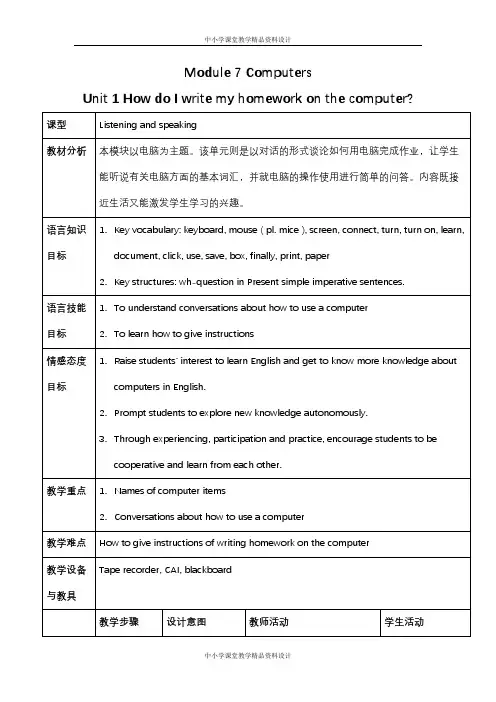
Module 7 ComputersUnit 1 How do I write my homework on the computer?初一英语外研版(上)教案Module 8 Choosing presents一、学习目标:1.单词和短语:card, party, present, would, always, great, cake, never, special, eat, give, sing, happy, secret, CD,cinema, concert, magazine, scarf, silk, shirt, T-shirt, choose, exercise, wear, expensive,clothes, shoes, spend, money, film, song, match, weekend, at weekends, dear, hear, hear from,afraid2.交际用语:1)—Would you like to come to my birthday party?—Yes, I’d like to. When is it?2) Great!3) It’s a secret.3.重点句子:1) Daming always gets birthday presents!2) She often goes to the cinema.3) What do you usually do at a Chinese birthday party?4) We sometimes give birthday cards.5) My mother never makes a birthday cake.二、重点及难点:1.频度副词的使用及在句中的位置。
2.动词第三人称单数形式。
I always like birthday parties.三、教学设计:Unit 1 I always like birthday parties.ⅠTeaching modelListening and speakingⅡTeaching methodInteractive approachⅢTeaching aims1. To get to know the adverbs of frequency.2. To understand conversations involving “Daming’s birthday”.3. To be able to pronounce the third person singular endings4. To be able to describe what people do on their birthdayⅣTeaching ObjectivesKey vocabulary: card, party, present, would, always, great, cake, never, special, eat, give, sing, happy, secretKey structures:1)Would you like to come to my birthday party?2) I always like birthday parties.3) What do you usually do at a Chinese birthday party?4) My mother never makes a birthday cake.5) We sometimes give birthday cards.ⅤTeaching aidsTape recorder,OHP,video, handoutⅥTeaching StepsStep 1 Warming-up1. Show some picturesof birthday and say what they are.Key words:birthday , birthday card , birthday party , birthday cake , birthday presents , have a party , make a cake , eat noodles, eat birthday cake, sing Happy Birthday song…2.Match the words with the pictures.3. Read the words after the teacher.4. Introduce the new words.5. Enjoy a song: Happy birthday.Step 2 Listening practice.1. Make sure the students understand the symbols they must use to complete the chart2. Play the recording through once while they just listen.3. Ask the students to listen to the recording.4. Play the recording again, then they can check their answer with a partner.5. Call back the answer from the whole class and check the answer.Step 3 Work in pairs.Say what you always / usually / often / never do on your birthday.1. Read through the verbs and have the students repeat them. Make sure theyunderstand them.2. Ask the students to think about what they do, and make a list using the adverbs of frequency individually.3. Pair them to talk about what they do.4. Call back the answer from the whole class and check the answer.Step 4 Listen and read.1. Ask the students to read the conversation silently.2. Play the recording and ask the students to listen and read the conversation.3. Read the conversation.4. Act it out.Step 5 Check (√) the true sentences.1. Ask the students to read through the sentences and have the students follow and /or repeat.2. Play the recording again, then they can check their answer with a partner.3. Call back the answer from the whole class and check the answer.Keys:1. √2. ×3. ×4. √5. ×4. Correct the false sentences.5. Call back the answer from the whole class and check the answer.Step 6 Underline the correct words.1. Ask the students to read through the passage.2. Underline the correct words.3. Call back the answer from the whole class and check the answer.Keys: 1. special 2. cut3. presentsStep 7 Complete the sentences with the words from the box.1. Ask the students to read through the sentences.2. Complete the sentences with the words from the box with a partner.3. Call back the answer from the whole class and check the answer.Keys: 1. always 2. usually 3. never 4. sometimesStep 8Listen and repeat.1. Play the recording once without stopping.2. Ask the whole class to repeat.3. Ask the students to practice the sounds in pairs.Step 9 Work in pairs.Ask and answer like this:—What do you often / usually / always /… do on your birthday?—I often / usually / always /… on my birthday.—What do you often / usually / always /… do on Teachers’ Day?—I often / usually / always /… on Teachers’ Day.Step 10Grammar1. 动词第三人称单数词尾变化有三种形式。
外研版七年级英语上册模块各单元教案 Module 1 Unit 1 Nice to meet you教案

新外研版七年级英语上册教案Module 1 My classmates一、教学内容:Unit 1 Nice to meet you二、课型:Listening and speaking三、教学目标:知识与技能:1、能运用动词“be”的一般现在时的陈述和一般疑问形式。
2、能运用代词I,my,you,your,he,his,she,her。
3、能听懂别人的自我介绍。
4、能利用“be”动词作简单的自我介绍或询问对方个人信息。
情感态度与价值观:1、掌握在作自我介绍时英美人士和中国人的不同对答习惯。
2、培养良好的人际交流态度,交流时要尊重对方的习惯,令对方感到舒服。
四、教学重难点:重点:1、掌握基本词汇:Chinese, from, where, year, about, Ms, not, hi, our, American, he, China,What about, America, England。
2、动词“be”的一般现在时的陈述和一般疑问形式。
3、自我介绍的表达方式。
难点:1、能运用“be”的一般现在时的陈述和一般疑问形式。
2、能听懂别人的自我介绍。
3、能利用“be”动词作简单的自我介绍或询问对方个人信息。
五、教学准备:本次课堂为听说课,主要采用互动式教学法,创设真实语境,通过个人呈现,同伴互动,小组活动等师生、生生的交流,充分体现了学生在学习过程中的主体地位,教师只是课堂的引导者,组织者和合作者,让学生在使用中学会英语,综合培养学生的英语语言运用能力。
在教学过程中,采用多媒体手段辅助教学,利用各种图片和习题任务贯穿整个教学过程。
因此,本节课需准备:PPT课件、录音机、课堂练习、奖品。
教学步骤教师活动学生活动设计意图Step One Warming-u p (5’)Activity 1. Greet the studentsas usual.T: I’m very glad to be here andgive you a lesson. Just now, you arepuzzled about my name. Now let metry to introduce myself.“My name is Ms Mo. I’m ateacher. I’m from China and I’m1、Greet the teacher.用自己的图片吸引学生的兴趣,做出自我介绍,引出话题,以及重点句型。
外研版初中英语七年级上册教案全册
外研版初中英语七年级上册教案全册教案简介本教案是针对外研版初中英语七年级上册编写的一套全册教案。
全册共包含教学大纲、教学目标、教学内容、教学流程等内容,旨在提供给教师进行教学准备和教学实施的参考。
教学大纲- 介绍初中英语七年级上册的教学目标和教学内容- 探讨教学方法和教学评估方式- 安排教学时间和课程进度教学目标- 培养学生的听、说、读、写和翻译能力- 培养学生对英语研究的兴趣和积极性- 培养学生的跨文化交际能力教学内容- 课文研究:涵盖了各个主题的课文,如自我介绍、家庭、学校、食物、颜色、时间等- 词汇和语法:研究基本的词汇和语法知识,如动词、名词、形容词、冠词、介词等- 听力和口语:通过听力练和口语对话,提高学生的听力和口语表达能力- 阅读和写作:通过阅读文章和写作练,培养学生的阅读和写作能力教学流程1. 准备:教师准备教学材料、课件以及其他辅助教学工具2. 导入:通过与学生的交流、图片展示等方式引入课题,激发学生的研究兴趣3. 研究:根据教学大纲和教学内容,进行课文研究、词汇和语法讲解、听力和口语练、阅读和写作训练等4. 巩固:通过练、活动和游戏巩固所学知识,帮助学生加深理解和记忆5. 总结:对本节课进行总结,帮助学生归纳所学的重点和要点6. 作业:布置适当的作业,巩固学生的研究成果7. 反馈:对学生的作业进行评改,并给予相应的反馈和建议教学评估- 通过课堂表现和讨论,评估学生的理解和掌握程度- 通过口语和写作练,评估学生的语言表达能力- 通过考试或测验,评估学生的研究成果以上是对外研版初中英语七年级上册教案全册的简要介绍,希望能对教师们的教学工作提供一定的参考和帮助。
> 注意:以上信息是根据您提供的标题内容进行编写,具体教案的内容和安排可能需要您根据实际需要进行制定和调整。
外研版七年级英语上册全部教案
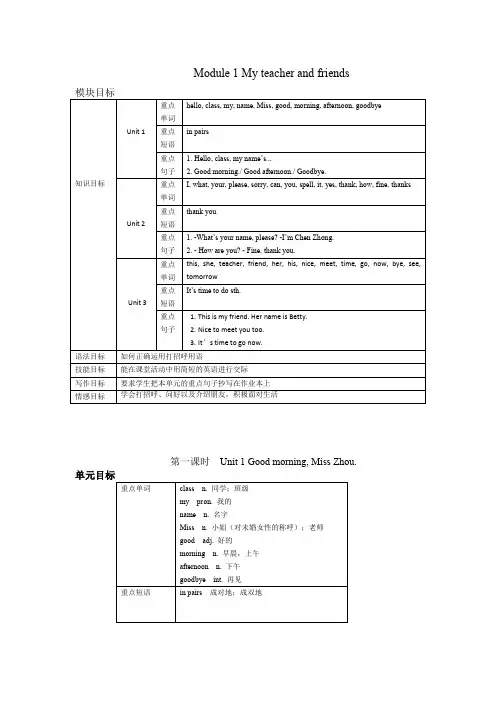
Module 1 My teacher and friends第一课时Unit 1 Good morning, Miss Zhou.环节1 新课导入教师想学生作自我介绍,说“My name’s...”引导学生说出“Good morning, Miss/Mr...”。
教师可以让一部分学生用“My name’s...”作自我介绍,然后教师用“Hello,...”来问候学生。
教师请学生互相作自我介绍并问候,让学生迅速熟悉起来,感受到新集体的温暖。
设计意图:以自我介绍和问好的形式进行教学,能帮助学生尽快了解老师和同学的情况,消除距离感。
环节21.教师在黑板上画一个升起的太阳并标注时间,或用PPT呈现。
2.教师板书“Good morning”并领读这个句子。
3.教师播放录音,让学生边看、边听,跟读、模仿,认真体会这些语言在什么样的语境下使用。
4. 根据学生情况,重复播放录音2-3遍,让学生模仿。
5. 学生个体活动,完成匹配。
6. 教师播放录音,学生核对答案。
7. 教师让部分学生重复答案,关注并及时纠正学生的不准确发音。
8. 学生两人一组,练习问候语言,教师提醒学生用自己的真是姓名。
9. 教师在屏幕上随机呈现不同的时间场景,让学生练习,以检查学生的掌握程度。
10. 教师播放录音,学生认真听并跟读。
11. 教师让部分学生读字母,教师帮助纠正发音。
12. 教师让学生完成字母表的书写,提醒学生关注大小写字母。
13. 教师播放录音,提醒学生不要急于动笔,养成良好的听的习惯。
14. 教师播放录音,让学生边听边写,注意书写的规范和整齐。
15. 学生两人一组核对答案,并对对方的书写给予评价。
板书设计练习设计请完成本课对应训练!第二课时Unit 2 Good morning. I’m Chen Zhong.单元目标教学过程环节1 新课导入课前播放小学阶段学过的歌曲Hello和Good morning渲染气氛,同时复习上一节课学过的句型。
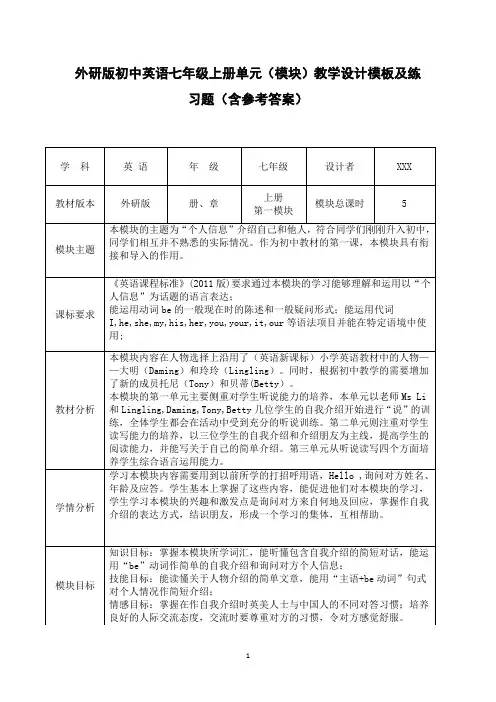
外研版初中英语七年级上册《Module 1》模块教学设计及练习题(含参考答案)
Students get information from the reading material about personal information.
Student-centered classroom activities to stimulate students' enthusiasm and interest in learning
Final evaluation is used to evaluate the learning content of each class to understand the students' specific grasp of the content
第五
课时
Students can use the sentence structure of different friends to introduce their situation to different friends
Key vocabulary: everyone,
capital,but, very, big, city, small,first,last,
first name,
last name
Students get information from the reading material about personal information.
1.Ask some students to introduce themselves to the other students.
2.Ask them to talk about the pictures in the PPT.
外研版初中七年级上册英语教案全册

Module 1 My classmates Unit 1 Nice to meet you.教学过程教学过程What's your name? Where are you from?How old are you? Which class are you in?Nice to meet you.Step 2: Listening1.Play the recording in activity 1 and ask the students to listen and checkhow many people speak.2.Play it again and ask the students to check the words their hear.3.Check the answers with the whole students.Step 3: Listen and read1.Play the recording in activity 3 and ask the students to listenand answer the questions. Then check the answers.(1) How many people speak in the conversation?(2) Who are they?(3) Are they in the same class?2.Play it again and check the true sentences in act3. Ask somestudents to correct the wrong ones.3. Put the students into groups of four to practise the dialogue.The students repeat it several times, changing roles each time.4.Talk about the pictures in the PPT and show their performances.5.Ask the students to sum up the useful sentences in the dialogue andintroduce “Everyday English.”6.Finish act 4 and 5 in groups. Teacher checks the answers.Step 4: Pronunciation1.Explain that this activity focuses on some English phonemes which aredifficult to pronounce for speakers of Chinese.2.Play the recording once without stopping.教学过程3.Play it again and ask the students to repeat.4.Practise the sounds in pairs, then finish the exercises on the PPT.Step 5: Speaking1.Talk about the pictures by asking and answer in paris like this:A: What’s his name?B: His name is….A: Where is he from?B: He's from….A: How old is he?B: He's ...years old.Step 6: Module taskTask 1: Who has the most friends?运用本课句型,在规定的八分钟时间内,以小组为单位,看谁结交的朋友最多,她将获得一份丰厚的奖品。
外研版七年级英语上册教案 Starter Module 2Unit 3 I’m twelve
Unit3 I’mtwelve.◇目标导航◇类别课时要点重点单词old adj.年龄的,……岁的twelve num.十二eleven num.十一thirteen num.十三fourteen num.十四fifteen num.十五si.十六seventeen num.十七eighteen num.十八nineteen num.十九twenty num.二十boy n.男孩预习指导一、方法指导1.学生自主预习本单元PS12~S13中的新单词(见词汇表P88),熟悉它们的拼写及读音。
2.学生自主预习本课时内容,熟悉询问年龄的英语句型。
二、预习检测Ⅰ.汉译英1.十一eleven2.十二twelve3.十三thirteen4.十四fourteen5.十五fifteen6.十六sixteen7.十七seventeen 8.十八eighteen9.十九nineteen 10.二十twenty11.男孩boy 12.女孩girl13.桌子desk 14.椅子chair15.书包bagⅡ.根据汉语意思完成句子,每空一词1.请问你叫什么名字?What’s your name ,please?2.我叫大明。
I’m Daming.3.你多大了?How old are you?4.我十二岁了。
I’m twelve.课堂教学Step1 情景导入老师带领学生回顾数字1~10的英语表达。
Step2 听一听,读一读,完成教材任务11.先播放录音,训练学生听力,熟悉本课时对话用语。
2.再播放录音,让学生跟读,同时理解对话内容。
3.老师重点难点,帮助学生理解下列句子及用法:—How old are you?—I’m twelve.Step3 学习数字,完成教材任务2,3,4和51.听录音,并跟读,学习数字,完成教材任务2。
学生先跟录音读,然后集体朗读,之后自主读出这些数字,最后老师提问,请几位学生读出这些数字,看谁读得又准确又好。
外研版英语七年级上册教案:Starter Module1--4模块教案(12课时)
新外研英语七年级上Starter部分Module1 Unit1教案Unit 1 Good morning, Miss Zhou.课型:Listening and speaking课时:45 minute s课前预测:the first lesson of their Junior High School,It’s necessary to help them know the importance of learning English and some basic methods.教学方法:Interactive approach板书设计:Key words and sentences about everyday English in PPT.教学目标:1. Master the key words and expressions in Unit 1.2.Learn to use the key sentences to greet each other..3.Cultivate their ability of creation.教学重难点:1.Key words and expressions:hello, class, my, name, is , miss, good ,good afternoon etc.2.Key sentences:Good morning/afternoon.My name’s Miss Zhou.Goodbye!E tc.3.How to use what they have learnt to greet each other.4.How to write the 26 letters regularly.教学准备:PPT/pictures on the Internet/ videotape.教学过程:Step 1.Warming up:1.:Show some pictures to tell them the importance of English learning.2.Show pictures on the Internet to tell them what is the correct way of learning English.step2.Introduction1.learn new words by showing some pictures.2.Read all the new words together.step3.Practice:1.practice the dialogues in pairs in class like that .2.Act their dialogues out in class.step4.Key points:name’s = name is / the differences of Mr and Missstep5.Match1.Match the dialogues in Part 3 by themselves.2.Check answers one by one. Encouragement should be given.3.Read the dialogues in groups.step6.Listen and sayListen to the tape in Part 5 and say after it. E specially, they shouldpay attention to the pronounciation of the 26 letters.step7.Sing the ABC Song.1.Listen to the song at first, then imitate how to sing it for severaltimes.2.Ask some of them to sing the song in class. E ncouragement should begiven.step8.Write.1.It’s very important to tell them how to write the letters regularly,so the teacher needs to spend more time on this step. T he teacher should check their spelling carefully and correct them in time.2.The best work should be showed to others in class.3.Have a small inclusion about their work.step9.Listen1.Listen to the tape in Part 7, write the names regularly.2.Check answers and ask them to write their own names in English. step10.ExercisesDo some exercises in class to consolidate what they have learnt in this lesson. E ncouragement should be given.S tep11. Homework1.Sing ABC Song.2.Read the dialogues in Unit 1 smoothly.3.Write the 26 letters carefully in their exercise books.新外研英语七年级上starter部分Module1 Unit2教案Unit 2Good morning, I’m Chen Zhong.课型:Listening and speaking课时:45 minutes课前预测:They have learnt how to write the 26 letters regularly, in this lesson, they need to consolidate them and learn some new everyday English.教学方法:Interactive approach板书设计:Key words and sentences about greetings in PPT.教学目标:1. Master the key words and expressions in Unit2.2.Learn to use the key sentences to greet each other.3.Cultivate their ability of creation.教学重难点:1.Key words and expressions:I, you, your, spell, sorry, how, fine etc.2.Key sentences:What’s your name?I’m Lingling.Sorry?Can you spell it ,please?。
秋季学期外研版初中七年级英语上册教案全册
秋季学期外研版初中七年级英语上册教案全册Module1Myclamate(共5课时)Unit1Nicetomeetyou(2课时)Ⅰ.Teachinggoal(教学目标)1.能够听懂、读懂关于自我介绍的对话。
2.能够运用所学动词be的基本句型进行简单的自我介绍。
Ⅱ.Teachingdifficultie(教学重难点)重点:掌握本单元的基本词汇和句型,正确运用be动词的各种形式造句。
难点:能够用英语进行自我介绍。
Ⅲ.Teachingaid:(教学辅助)PPT课件第1课时(Activity1—3)ⅣTeachingcontent(教学内容)Ⅴ.Teachingprocedure:(教学过程)Step1.Warming-up播放英文歌曲或视频“Dayoftheweek”来活跃课堂气氛,同时为接下来的教学内容作好准备。
当学生能熟练地唱出这首歌时,英语教学就变得容易多了。
Step2Liteningandreading1.Litenandread.(Activity1)①教师播放录音,让学生整体感知对话内容。
②教师再次播放录音,学生跟—1—读、模仿。
③学生两人一组练习对话。
④教师让不同的小组展示对话,关注学生的发音。
2.Litenandrepeat.Nowpoint,akandanwer.(Activity2)①教师放录音,学生听录音。
②教师再次播放录音,学生跟读、模仿。
③学生两人一组根据日历练习对话。
④教师让部分小组展示对话。
环节说明:本活动以日历的形式让学生学习表示星期一至星期日的7个词汇,然后指着日历上的具体日期来询问星期几,进而练习相关句型“Whatdayiittoday”教师向学生说明在西方国家Sundayithefirtdayoftheweek,让学生了解这种文化差异。
Step3Practice1.Readandmatch.Nowlitenandcheck.(Activity3)①学生个体活动,完成匹配。
外研版初中七年级上册英语教案全册
Module 1 My classmates Unit 1 Nice to meet you.教学过程教学过程What's your name? Where are you from?How old are you? Which class are you in?Nice to meet you.Step 2: Listening1.Play the recording in activity 1 and ask the students to listen and checkhow many people speak.2.Play it again and ask the students to check the words their hear.3.Check the answers with the whole students.Step 3: Listen and read1.Play the recording in activity 3 and ask the students to listenand answer the questions. Then check the answers.(1) How many people speak in the conversation?(2) Who are they?(3) Are they in the same class?2.Play it again and check the true sentences in act3. Ask somestudents to correct the wrong ones.3. Put the students into groups of four to practise the dialogue.The students repeat it several times, changing roles each time.4.Talk about the pictures in the PPT and show their performances.5.Ask the students to sum up the useful sentences in the dialogue andintroduce “Everyday English.”6.Finish act 4 and 5 in groups. Teacher checks the answers.Step 4: Pronunciation1.Explain that this activity focuses on some English phonemes which aredifficult to pronounce for speakers of Chinese.2.Play the recording once without stopping.教学过程3.Play it again and ask the students to repeat.4.Practise the sounds in pairs, then finish the exercises on the PPT.Step 5: Speaking1.Talk about the pictures by asking and answer in paris like this:A: What’s his name?B: His name is….A: Where is he from?B: He's from….A: How old is he?B: He's ...years old.Step 6: Module taskTask 1: Who has the most friends?运用本课句型,在规定的八分钟时间内,以小组为单位,看谁结交的朋友最多,她将获得一份丰厚的奖品。