
Dare的用法练习
Dare的用法练习
知识点整理
(1)作情态动词
·用于疑问句、否定句、条件句
·有过去式变化
·后接动词原形
·否定式直接加not
·疑问句之间提前
(2)作实义动词
·有人称和数量的变化
·肯定句中要跟带to的不定式
·否定句、疑问句中to可带可不带
·to为不定式符号
附录:情态动词与实义动词的区别
·情态动词只表示对某事的期待、要求、推测
·情态动词不表示某事的发生状态
·情态动词没有人称、数的变化
·情态动词没有非谓语形式,即没有不定式、分次等形式。
一般来说,在疑问句与否定句中,使用情态动词的dare。
Dare he say "no"?
He dare not/daren't say "no".
一、练习
(一)翻译句子
(1)他敢告诉我们真相吗?(一般现在时)
(2)他不敢告诉我们他知道些什么。
(一般过去式)
(3)恐怕你不敢做这样的事。
(4)如果你敢违反规定,就会受到处罚的。
(5)我想他敢告诉经理事实的真相。
(6)这个学生不敢在课堂上提出任何问题。
(7)你敢在这么拥挤的车道上开车吗?
参考答案
(1)Dare he tell us the trurh?
Does he dare (to) tell us the truth?
(2)He dared not tell us what he knew.
He did not dare (to) tell us what he knew.
(3)I’m afraid you dare not/daren’t do things like this.
I’m afraid you do not dare (to) do things like this.
(4)If you dare to break the rule, you will be punished.
If you dare break the rule, you will be punished.
(5)I suppose he dares to tell manager the truth.
(6)This student doesn’t dare (to) ask any question on class.
(7)Do you dare (to) drive on such a crowded road?。
(完整)英语语法 情态动词及练习题
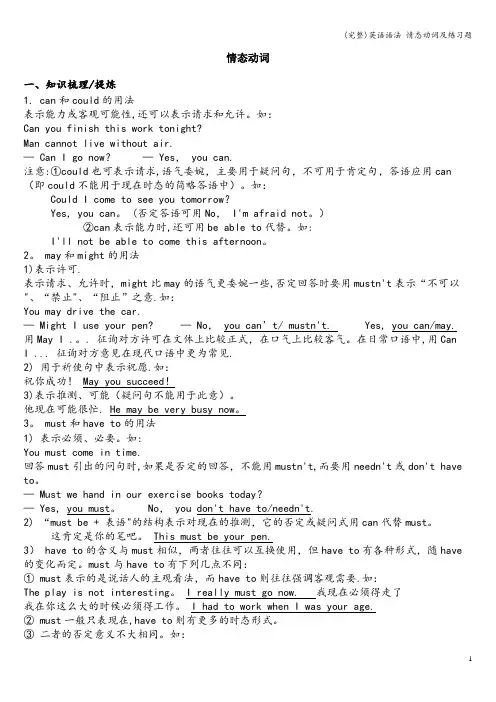
情态动词一、知识梳理/提炼1. can和could的用法表示能力或客观可能性,还可以表示请求和允许。
如:Can you finish this work tonight?Man cannot live without air.— Can I go now?— Yes, you can.注意:①could也可表示请求,语气委婉,主要用于疑问句,不可用于肯定句,答语应用can (即could不能用于现在时态的简略答语中)。
如:Could I come to see you tomorrow?Yes, you can。
(否定答语可用No, I'm afraid not。
)②can表示能力时,还可用be able to代替。
如:I'll not be able to come this afternoon。
2。
may和might的用法1)表示许可.表示请求、允许时,might比may的语气更委婉一些,否定回答时要用mustn't表示“不可以"、“禁止"、“阻止”之意.如:You may drive the car.— Might I use your pen? — No,you can’t/ mustn't. Yes, you can/may. 用May I .。
. 征询对方许可在文体上比较正式,在口气上比较客气。
在日常口语中,用CanI ... 征询对方意见在现代口语中更为常见.2) 用于祈使句中表示祝愿.如:祝你成功! May you succeed!3)表示推测、可能(疑问句不能用于此意)。
他现在可能很忙. He may be very busy now。
3。
must和have to的用法1) 表示必须、必要。
如:You must come in time.回答must引出的问句时,如果是否定的回答,不能用mustn't,而要用needn't或don't have to。
情态动词用法总结及相应练习

情态动词用法总结及相应练习在英语中,情态动词属于助动词。
除了作简略回答外,它们一般不能单独使用,它们必须与动词原形一起使用构成句子的谓语。
不同的情态动词会有不同的意义和用法。
有时,同一个情态动词在不同的语境中也会产生不同的含义。
下面我们将讨论这些情态动词的用法。
情态动词的推测性用法和非推测性用法情态动词一般有两种用法:推测性用法(epistemic use)和非推测性用法(non-epistemic use)。
推测性用法是指做出推测,预测事物发生的可能性;非推测性用法则指情态动词本身的基本含义,如XXX表示能力,may表示许可,must和should表示必须和义务,need 表示需要等。
例如:I can swim。
(非推测性用法)This can be true。
(推测性用法)You may go now。
(非推测性用法)He may be ill now。
(推测性用法)You must finish it before lunch time。
(非猜测性用法)He must be at home for he never goes out at dinner time。
(推测性用法)我们把英语中的9大神态动词按其猜测性和非猜测性用法列表如下:情态动词非推测性用法推测性用法can/could能力/许可(ability/n)可能(possibility)may/might许可(n)可能(possibility)will/would意愿(n)预言性(predictability)XXX责任和义务(n)应该是(logical necessity)must责任和任务(n)一定,一定(logical necessity)神态动词非猜测性用法的申明1.may和might透露表现允许may能够与分歧的人称搭配,透露表现“答应、允许”。
比方:May I know your name?You may be the first to leave if you are in a hurry。
思马得英语100个句子搞定英语语法(44)dare的用法

44.dare的用法<例句>She dared not move.她不敢动。
<语法分析>作为情态动词的dare,表示“敢......”,这时没有人称形式,但有过去式dared。
作为情态动词的dare主要用于否定句,在带有否定意思的句子和疑问句及条件从句中也可以用dare。
作为及物动词时,dare有人称和数的变化,有现在时和过去时的形式,可以与助动词连用,也有其非限定形式。
及物动词dare可以用于多类句子中表示“向......挑战,敢于尝试,敢于面对”等。
<触类旁通>(1) They dare not say anything.他们什么都不敢说。
语法分析:情态动词的dare用于否定句。
(2) I hardly dared breathe as somebody walked past the door.有人从门口经过时,我几乎都不敢喘气了。
语法分析:用在带有否定意思的句子中。
(3) I wonder if he dared come home.不知道他敢不敢回家。
语法分析:用在条件从句中。
(4) I dare say everything will be all right.我看一切都会好的。
语法分析:用在某些习语中,如I dare say, don't you dare等。
(5) I dared them to debate with me about it.我问他们敢不敢和我辩论这个问题。
语法分析:及物动词dare表示“向......挑战,敢于尝试”等。
<巩固练习>(1) She ______[dare] me to jump off the two diving board.(2) I have never _____[dare] to disturb him.(3) Who _____[dare] to go?(4) You are tired, I _____ say.(5) Don't you _____ touch that table?(6) How _____ she take my book without even asking?(7) She didn't _____ to disobey.<参考答案>(1) dared (2) dared (3) dares (4) dare (5) dare (6) dare (7) dare。
情态动词的用法及练习(附答案)
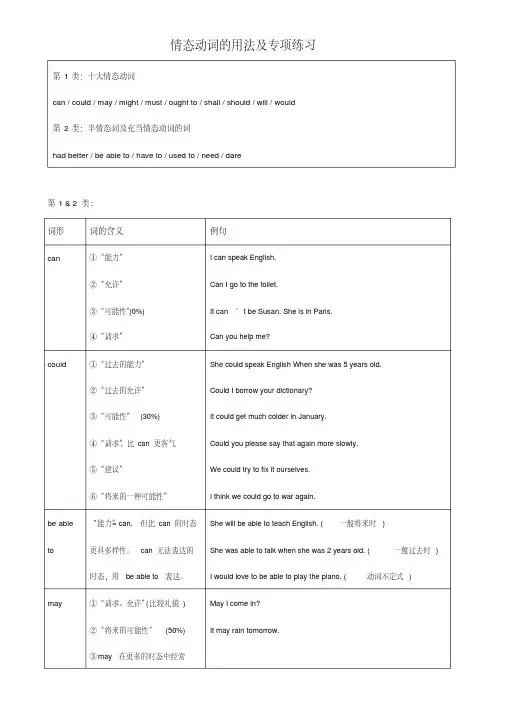
情态动词的用法及专项练习第1 & 2类:词形词的含义例句can ①“能力”②“允许”③“可能性”(0%)④“请求”I can speak English.Can I go to the toilet.It can’t be Susan. She is in Paris. Can you help me?could ①“过去的能力”②“过去的允许”③“可能性”(30%)④“请求”, 比can更客气⑤“建议”⑥“将来的一种可能性”She could speak English When she was 5 years old. Could I borrow your dictionary?It could get much colder in January.Could you please say that again more slowly.We could try to fix it ourselves.I think we could go to war again.be able to “能力”= can, 但比can的时态更具多样性。
can无法表达的时态,用be able to表达。
She will be able to teach English. (一般将来时)She was able to talk when she was 2 years old. (一般过去时)I would love to be able to play the piano. (动词不定式)may ①“请求、允许”(比较礼貌)②“将来的可能性”(50%)③may 在更多的时态中经常May I come in?It may rain tomorrow.第1类:十大情态动词can / could / may / might / must / ought to / shall / should / will / would 第2类:半情态词及充当情态动词的词had better / be able to / have to / used to / need / dare用be allowed to来代替might “较小的可能性”(≤30%)I might move to Canada some day.must ①“必须”(责任、义务)②“可能性”(推测) (100%)③“禁止”(否定式) Everyone must pay taxes.She didn’t arrive. She must be sick.You mustn’t p l ay with fire. It’s dangerous.have to ①“必须、不得不”(客观上不得不做)②多种时态里面代替“must”,因must只有一般现在,但have to 可以有多种时态。
(完整word版)初中英语情态动词详细用法归纳(含练习及答案)(直接打印版),推荐文档
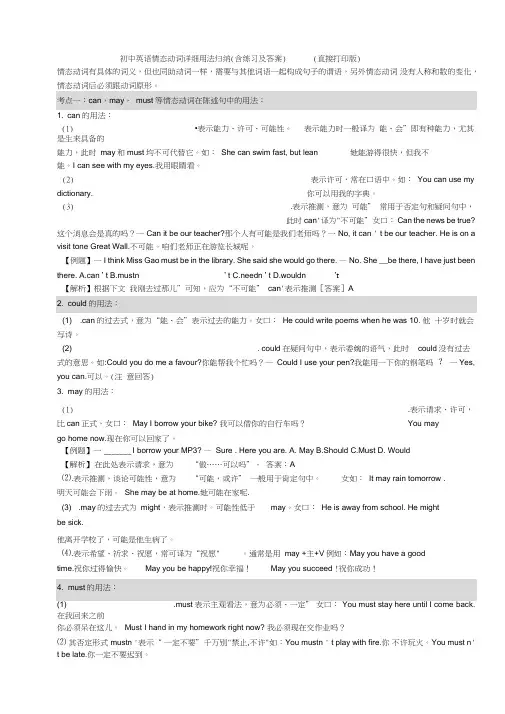
初中英语情态动词详细用法归纳(含练习及答案) (直接打印版)情态动词有具体的词义,但也同助动词一样,需要与其他词语一起构成句子的谓语,另外情态动词没有人称和数的变化,情态动词后必须跟动词原形。
1. can的用法:(1)•表示能力、许可、可能性。
表示能力时一般译为能、会”即有种能力,尤其是生来具备的能力,此时may和must均不可代替它。
如:She can swim fast, but lean 她能游得很快,但我不能。
I can see with my eyes.我用眼睛看。
(2)表示许可,常在口语中。
如:You can use my dictionary. 你可以用我的字典。
(3).表示推测,意为可能” 常用于否定句和疑问句中,此时can'译为"不可能”女口:Can the news be true?这个消息会是真的吗?一Can it be our teacher?那个人有可能是我们老师吗?一No, it can ' t be our teacher. He is on a visit tone Great Wall.不可能。
咱们老师正在游览长城呢。
【例题】一I think Miss Gao must be in the library. She said she would go there. —No. She __be there, I have just beenthere. A.can ' t B.mustn ' t C.needn ' t D.wouldn 't【解析】根据下文我刚去过那儿”可知,应为“不可能” can'表示推测[答案]A(1) .can的过去式,意为“能、会”表示过去的能力。
女口:He could write poems when he was 10. 他十岁时就会写诗。
(2) . could在疑问句中,表示委婉的语气,此时could没有过去式的意思。
Need和dare的用法小结和练习含答案
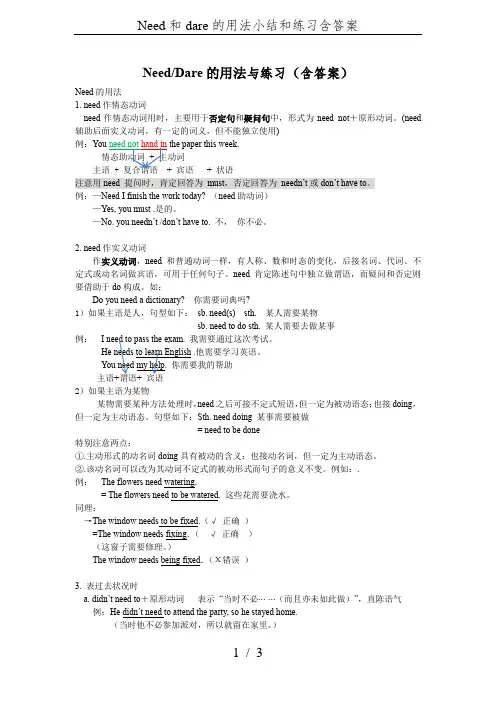
Need/Dare的用法与练习(含答案)Need的用法1. need作情态动词need作情态动词用时,主要用于否定句和疑问句中,形式为need not+原形动词。
(need 辅助后面实义动词,有一定的词义,但不能独立使用)例:宾语+ 状语注意用need 提问时,肯定回答为must,否定回答为needn’t或don’t have to。
例:—Need I finish the work today? (need助动词)—Yes, you must .是的。
—No. you needn’t /don’t have to. 不,你不必。
2. need作实义动词作实义动词,need和普通动词一样,有人称、数和时态的变化,后接名词、代词、不定式或动名词做宾语,可用于任何句子。
need肯定陈述句中独立做谓语,而疑问和否定则要借助于do构成。
如:Do you need a dictionary? 你需要词典吗?1)如果主语是人,句型如下:sb. need(s) sth. 某人需要某物sb. need to do sth. 某人需要去做某事例:I need to pass the exam. 我需要通过这次考试。
He needs to learn English .他需要学习英语。
You need my help.主语+2)如果主语为某物某物需要某种方法处理时,need之后可接不定式短语,但一定为被动语态;也接doing,但一定为主动语态。
句型如下:Sth. need doing 某事需要被做= need to be done特别注意两点:①.主动形式的动名词doing具有被动的含义;也接动名词,但一定为主动语态。
②.该动名词可以改为其动词不定式的被动形式而句子的意义不变。
例如:.例:The flowers need watering.= The flowers need to be watered. 这些花需要浇水。
(完整版)情态动词用法及其练习与答案
情态动词情态动词有can (could), may (might), must, have to, shall (should, will (would), dare (dared), need (needed), ought to等。
情态动词无人称和数的变化;不能单独使用,必须与其后的动词原形构成谓语。
一、can, could1) 表示能力(体力、知识、技能)。
如:Can you lift this heavy box? (体力)Mary can speak three languages.(知识)Can you skate?(技能)此时可用be able to代替。
Can只有一般现在式和一般过去式;而be able to则有更多的时态。
如:I’ll not be able to come this afternoon.当表示“经过努力才得以做成功某事”时应用be able to,不能用Can。
如:He was able to go to the party yesterday evening in spite of the heavy rain.2) 表示请求和允许。
-----Can I go now?----- Yes, you can. / No, you can’t.此时可与may互换。
在疑问句中还可用could, might代替,不是过去式,只是语气更委婉,不能用于肯定句和答语中。
---- Could I come to see you tomorrow?---- Yes, you can. ( No, I’m afraid not. )3) 表示客观可能性(客观原因形成的能力)。
They’ve changed the ti metable, so we can go by bus instead.This hall can hold 500 people at least.4) 表示推测(惊讶、怀疑、不相信的态度),用于疑问句、否定句和感叹句中。
助动词与情态动词讲解及练习题
助动词与情态动词讲解及练习题TPMK standardization office【 TPMK5AB- TPMK08- TPMK2C-助动词与情态动词一、助动词助动词有be, have, do, will, shall。
它们本身没有词义,只和实义动词的一定形式构成复合谓语,用来表示时态和语态,构成否定、疑问及加强语气等。
1、be (am, is, are, were, been)(l)“be + -ing”构成进行时态;(2)“be + 过去分词”构成被动语态;(3)“be + 动词不定式”构成复合谓语:①表按计划安排要发生的事。
The prime minister is to visit Japan next year.总理将于明年访问日本。
②用于命令。
You're to do your homework before you watch TV.你得做完了作业才能看电视。
2、have (has, had)(1)“have+过去分词”构成完成时态。
如:Have you seen the film(2)“have been + -ing”构成完成进行时态。
如:What have you been doing these days 这些日子你一直在干什么?3、do (does, did)(1)“do not + 动词原形”构成行为动词的否定式。
如:His brotherdoesn’t like playing basket.;(2)“Do + 主语 + 动词原形”构成行为动词的一般疑问句。
Does he go toschool by bike every day (3)“do + 动词原形”用于祈使句或陈述句中表示加强语气。
如:I did go to see him, but he wasn’t in我确实去看望他了,但他不在家。
Do do some work. 请一定做点什么;(4)代替前面刚出现的动词以避免重复。
高中英语 情态动词讲解和练习
情态动词情态动词是表达说话者的感情和语气的动词,它们的一个显著特点是不能单独使用,必须与实义动词的原形共同使用构成整个句子的谓语部分。
常用的情态动词罗列如下:Shall/should = ought to, will/would, may/might, can/could, must。
Need/dare 这两词既可以作情态动词,同时也可以作实义动词,我们称其为半情态动词。
1. shall:(1)征询对方意见或请示对方,多用于第一或第三人称的疑问句中。
如:Let’s go out for a walk, shall we?Shall he come in or stay outside? 让他进来还是在外面呆着?(2)说话者含有警告,命令, 承诺或者威胁的语气,多用于第二或第三人称。
如:You shan’t leave until six o’clock. 你不到六点不准离开。
No one shall stop me from speaking out the truth. 没有人能阻拦我说出真话。
What you have done now shall be paid for one day. 你今天所做的一切总有一天要偿还的。
(3)用在法律条约等文件中,表示义务,规定。
如:Each citizen shall carry his identification card when traveling.2.should(1) 等于ought to 表示应该。
如:You should wear school uniforms when you are at school.(2) Should 还可表示“居然”,说明说话者的惊讶和不理解。
如:It’s strange that he should have passed the driving test. 真奇怪,他居然通过驾驶考了。
(3) 可表示推断。
(2020新教材)外研版英语必修第二册同步练习Unit 1 Period Ⅱ
Period ⅡUsing language——Grammar &VocabularyGrammar(情态动词一)课前自主预习[观察句子,总结规律]① ... I was_able_to hold a knife and fork—and chopsticks!②But there are still some dishes that Dad dare not try even after many years of marriage to my mother.③Mum and I just have_to find a way to get him into the kitchen!④... we'd_better not eat too much roast food as it may make us suffer from heat inside our bodies, ...⑤You needn't try it if you don't want to, Mum said, ...[我的发现]以上五个句子都使用了情态动词。
(1)①句中的be able to意为“________”。
(2)②句中的dare意为“________”。
(3)③句中的have to意为“________”。
(4)④句中的'd better为________的缩写,意为“________”。
(5)⑤句中的need意为“________”。
答案:(1)能够(2)胆敢,敢于(3)不得不(4)had better;最好(5)需要精讲课时语法一、be able to的用法be able to意为“能够,有能力”,不仅有时态、人称和数的变化,而且还可以与某些系动词或情态动词连用(通常不与can 连用),甚至还可以有非谓语形式。
He hasn't_been_able_to get in touch with her.他一直未能和她联系上。