
1996年06月大学英语四级考试听力真题及答案
1996年6月大学英语四级(CET-4)听力真题试卷Part I Listening Comprehension (20 minutes)Section A1. A) Place another order. B) Call to check on it.C) Wait patiently. D) Go and find the furniture.2. A) She doe sn’t need the job.B) She hasn’t got a job yet.C) She has got a good job. D) She is going to start work soon.3. A) She got home before 9 o’clock.B) She had a bad cold.C) She had a car accident. D) She was delayed.4. A) She hasn’t gone camping for several weeks.B) She like to take long camping trips.C) She prefers not to go camping on weekends.D) She often spends a lot of time planning her camping trips.5. A) A writer. B) A teacher. C) A reporter. D) A student.6. A) She has not heard of Prof. Johnson.B) She has not heard of Prof. Johnson’s brother.C) She is a good friend of Prof. Johnson’s.D) She does not know Prof. Johnson’s.7. A) Coming back for a later show. B) Waiting in a queue.C) Coming back in five minutes. D) Not going to the movie today.8. A) He has got a heart attack. B) He was unharmed.C) He was badly hurt. D) He has fully recovered from the shock.9. A) The man went to Australia during Christmas.B) The man visited Australia during the summer vacation.C) The man didn’t have a good time because of the different weather.D) The man remained home while his parents went to see his uncle.10. A) To attend a party at a classmate’s home.B) To do homework with her classmate.C) To attend an evening class. D) To have supper out with her classmate.Section B11. A) He fell into the river but couldn’t swim.B) He fell into the river together with his bike.C) He had his foot caught between two posts in the river.D) He dived into the river but couldn’t reach the surface.12. A) He jumped into the river immediately.B) He took off his coat and jumped into the water.C) He dashed down the bridge to save the boy.D) He shouted out for help.13. A) H e asked what the young man’s name was.B) He asked the young man to take him home.C) He gave his name and then ran away.D) He thanked the young man and then ran away.Passage T wo14. A) Alcohol helps develop people’s intelligence.B) Heavy drinking is not necessarily harmful to one’s health.C) Controlled drinking helps people keep their wits as they age.D) Drinking, even moderately, may harm one’s health.15 A) Worried. B) Pleased. C) Surprised. D) Unconcerned.16. A) At a conference. B) In a newspaper.C) On television. D) In a journal.Passage Three17. A) To seek adventure there. B) To be with her mother on Christmas.C) To see the animals and plants there. D) To join her father on Christmas.18. A) She was seriously injured. B) She survived the accident.C) She lost consciousness. D) She fell into a stream.19. A) To avoid hostile Indians. B) To avoid the rain.C) To avoid the strong sunlight. D) To avoid wild animals.20. A) They gave Julia food to eat. B) They drove Julia to a hospital.C) They invited Julia to their hut. D) They took Julia to a village by boat.1996年6月四级听力参考答案1. C2. B3. D4. B5. C6. D7. A8. B9. A 10. A11.C 12. A13. D 14.C15.B16. A 17.D 18.B 19.C 20. D1996年6月大学英语四级(CET-4)听力原文Section A1.M: I haven't received the furniture I ordered yet. Maybe I should call to check on it.W: Don't worry. It takes at least a week to arrive.Q: What does the woman think the man should do?2.M: Congratulations! I understand you've got a job. When will you start to work?W: Y ou must be thinking of someone else. I'm still waiting to hear the good news.Q: What does the woman mean?3.W: If it hadn't been snowing so hard, I might have been home by 9 o'clock.M: It's too bad you didn't make it. Jane was here and she wanted to see you.Q: What happened to the woman?4.M: Janet is quite interested in camping, isn't she?W: Yes, she often goes for weeks at a time.Q: What does the woman say about Janet?5.W: Good evening, Professor David. My name is Susan Gray. I'm with the local newspaper. Doyou mind if I ask you a few questions?M: Not at all. Go ahead, please?Q: What is Susan Gray?6.M: Do you know Professor Johnson's brother?W: I've never met him, but I've heard that he is as well-known as Johnson herself.Q: What do we learn from the woman's reply?7. W: The movie starts in 5 minutes and there's bound to be a long line.M: Why don't we come back for the next show? I'm sure it would be less crowded.Q: What is the man suggesting?8. W: Were you hurt in the accident?M: I was shocked at the time, but wasn't hurt at all. My bike was totally damaged though.Q: What do we know about the man?9.W: Where were you on Christmas David? I called you several times and nobody was home. M: My parents and I traveled to Australia to visit my uncle. It was quite an experience to spend Christmas in summer.Q: What do we learn from this conversation?10. M: It's seven o'clock already. Mary should be home by now.W: Oh. I forgot to tell you that she called this afternoon and told me that she was going to a party at her classmate's house and wouldn't be home until 10.Q: What did Mary say she was going to do?Section BPassage OneA young man who refused to give his name dived into the river yesterday morning to save a twelve-year-old boy. The boy ran away after he was rescued. He had been swimming in the river and had caught his foot between two concrete posts under the bridge. He shouted out for help, At the time a young man was riding across the bridge on his bicycle. He quickly got down and dived into the river. He then freed the boy's foot and helped him to the river bank where a small crowd had collected. The boy thanked his rescuer sincerely, then ran off down the road. He was last seen climbing over a gate before disappearing over the top of the hill. The young man who was about 20 years of age said, "I don't blame the boy for not giving his name. Why should he? If he wants to swim in the river, that's his business. And if I wanted to help him, that's mine. Y ou can not have my name either." He then ran back to the bridge, got on his bicycle and rode away.Questions 11 to 13 are based on the passage you have just heard.11. What happened to the 12-year-old boy?12. What did the young man do when he saw the boy in danger?13. What did the little boy do after he was rescued?Passage TwoResearchers have discovered a link between drinking and thinking. A moderate amount of alcohol may help us keep our mental abilities as we age. Brain scans show alcohol abuse kills brain cells. But little is known about the effects of life-long drinking. So moderate drinkers may want to toast new findings from researchers at Duke, and Indiana Universities. Dr. Joe Christian of Indiana Universities says men who have one or two drinks each day retain slightly stronger comprehension skills than the non-drinker or the heavy drinker. The doctor and his colleagues gave mental tests to nearly 4000 male twins between the ages of 66 and 76. The moderate drinkers had slightly better reasoning ability than their brothers who drink more or less. Other studies have found that alcohol in moderation can help the heart. But alcohol abuse can cause bone loss andother health problems. This study was presented at an alcoholism meeting in San Antonio. Questions 14 to 16 are based on the passage you have heard.14. What has recent research found about drinking?15. How would moderate drinkers feel about the new research findings?16. Where was the result of the study first made public?Passage ThreeOn Christmas Eve 1971, Julia Smith was taking a flight in Peru with her mother to join her father, a Professor, who was an expert on the jungle and plants and animals living there. Unfortunately, the plane crashed in a storm. The passengers all died except Julia who only had a few cuts. She was determined to survive. She had no map, only a bag of sweets and her torn clothes. She found a stream and followed it, trying to keep in the shade as much as possible, because she had no hat. For ten days, she walked along the river, eating fruits from the trees. At night she slept near the river bank, on the ground which was wet from the rain. She often felt weak, but she refused to give up. On the 10th day, she arrived at a small but. The three Indian hunters who visited the hut every two weeks rescued her and took her by boat to a small village from where she was flown to a hospital. She was safe at last.Questions 17 to 20 are based on the passage you have just heard.17. Why was Julia taking a flight in Peru?18. What happened to Julia after the plane crash?19. Why did Julia try to stay in the shade when she walked along the river?20. What did the three Indian hunters do?。
大学英语四级听力及答案
大学英语四级听力及答案怎么提升自己的英语四级听力呢?最简单的方法就是坚持大学每天的晨读了。
下面是店铺给大家整理的大学英语四级听力及答案,供大家参阅!大学英语四级听力材料及答案听力真题:Conversation Two23.A. He is sad to have lost his job.B. He totally supports the woman's choice.C. He insists that the woman major in business.D. He doesn't believe in his wife.24.A. Because he is out of employment.B. Because he lets the woman down.C. Because he has to delay the woman's study.D. Because the woman chooses the wrong major.25.A. In their home.B. In the school.C. At a grocery.D. On the telephone.答案解析:Conversation TwoM: Hi, honey! What's going on?W: I have great news to tell you. I just found out that I was accepted as an R.A. next year!M: That's really great news! [24]I'm sorry that you had to postpone your studying abroad because I lost my job. I justinterviewed at a home grocery delivery business, so we'll see if I get hired.W: Don't worry. Everything will be OK!M: I think so. Don't forget I'm an optimist.W: Eh, dad, I want to talk with you about declaring a major in anthropology. Business isn't the best choice for me.M: Well, I don't know why you can't declare your own major.[23]If this is what you really want to do, then your mother and I will support your decision.W: Thanks, dad! I just want you to know that I will make you proud!M: Your mother and I are already proud of you.W: Thanks, dad. I am really interested in anthropology and I promise that I will become a success with my degree.M: We believe in you!W: Well, [25]I'd better hang up. I have a lot of reading to catch up on before finals. Talk to you soon!Questions 23 to 25 are based on the conversation you have just heard.23. Which is true about the man according to the conversation?正确答案:B解析:细节题。
1993年06月大学英语四级考试听力真题及答案
1993年6月大学英语四级(CET-4)听力Part I Listening Comprehension (20 minutes)Section A1. A) The pear. B) The weather.C) The sea food. D) The cold.2. A) Mary has never studied mathematics. B) Mary must be good at mathematics.C) Mary enjoys learning mathematics. D) Mary probably is poor at mathematics.3. A) George’s brother.B) George’s wife.C) George’s father.D) George’s father-in-law.4. A) She can use his car. B) She can borrow someone else’s car.C) She must get her car fixed. D) She can’t borrow his car.5. A) At 2:35. B) At 2:45.C) At 3:00. D) At 3:15.6. A) To the bank. B) To bookstore.C) To a shoe store. D) To the grocer’s.7. A) Near the station. B) In the country.C) In the city. D) Near her work place.8. A) At a cigarette store. B) At a bus station.C) At a gas station. D) At Aunt Mary’s9. A) From upstairs. B) From next door.C) From the Nelsons’ house.D) From the back door10. A) The choice of course B) A day course.C) An evening course. D) Their workSection BPassage OneQuestions 11 to 14 are based on the following passage you have just heard.11. A) They haven’t reached a decision yet.B) They have decided to go hunting bears.C) They want to go hunting camping. D) They want to go exploring the country.12. A) Susie. B) Tom.C) The speaker. D) The speaker’s husband13. A) They chased the bear away. B) They stayed outside the tent and did nothing.C) They climbed up a tree. D) They put some honey outside for the bear to eat14. A) He ate the honey. B) He drank the beer.C) He chased the people away. D) He turned things upside down.Passage TwoQuestions 15 to 17 are based on the passage you have just heard.15. A) He missed the appointment. B) He arrived late.C) He was sick. D) He was very busy.16. A) He was busy sightseeing. B) He couldn’t reach Mr. Jordan’s office.C) He didn’t want to see Mr. Jordan any more. D) He didn’t want to take the trouble making it17. A) The trip didn’t do any good to his health.B) The trip was a complete disappointment.C) The trip was enjoyable but not fruitful in terms of business.D) The trip made it possible for him to meet many interesting people.Passage ThreeQuestions 18 to 20 are based on the passage you have just heard.18. A) He lost consciousness. B) He was slightly wounded.C) He was seriously injured. D) He was buried under an icebox.19. A) About four days. B) Around eight days.C) A day and a half. D) More than six days.20. A) His father pulled him out in time. B) He left the area before the earthquake.C) He stayed in an icebox. D) Their house escaped the earthquake.1993年6月四级听力参考答案:1. C2. D3. C4. D5. B6. D7. B8. C9. A 10. A11. A 12. A 13. B 14. D 15. C16. D 17. C 18. B 19. A 20. B1993年6月大学英语四级(CET-4)听力真题试卷听力原文:Section A1. W: You don`t feel very well, do you? You look pale. Have you got a cold?M: Oh, no, but my stomachaches. Maybe the seafood doesn`t agree with me.Q: What probable caused the man`s stomachache?2. M: What`s the matter with Mary?W: She becomes nervous whenever it comes to learning mathematics.Q: What do we learn from the conversation?3. M: I wish I could see George here.W: He was planning to come, but a moment ago, his wife called to say that he had to take his father to the hospital.Q: Who was ill?4. W: I need a car this weekend, but mine has broken down.M: I`m sorry to hear it, but you can always rent one if you have a license.Q: What does the man mean?5. W: Did you go to the football match last Saturday?M: Oh yes. It was supposed to start at 2:30, but it was delayed 15 minutes.Q: When did the football match start?6. M: What do you want me to get? I`m leaving now.W: Pick up a bottle of milk and a loaf of bread please.Q: Where is the man probably going? 7. M: If I were you, I`d live in the city instead of going to work by train.W: But the country is so beautiful in spring and fall.Q: Where does the woman prefer to live?8. M: Please buy two packs of cigarettes for me while you are at the store.W: I`m not going to any store. I`m going to see Aunt Mary. But I will get them for you at the gas station.Q: Where will the woman stop on her way?9. M: What`s all that noise? It sounds as if it`s coming from next door, The Nelson aren`t back yet, are they?W: I don`t think so. It must be the window cleaner working upstairs.Q: Where does the woman think the noise is coming from?10. W: Do you want a day course or an evening course?M: Well, it will have to be an evening course since I work during the day.Q: What are they talking about?Section BPassage OneOur family is trying to decide where to go for a vacation this summer. Our son Tom wants to go to Yellow Stone Park again to see the bears. We did that last summer and what an experience it was! When we got there, we put up our tent and went to explore. As we returned, we heard our daughter Susie cry out and then we saw a bear enter our camp. Tom wanted his father to chase him away. His father said, "No, it`s dangerous to chase a bear. And don`t let him chase you." Susie said: "What shall we do?" "Maybe we ought to climb a tree." Tom said: "No, we`ve got to get him out of there. He might go to sleep in our tent." "Maybe we could make him leave if we put some honey outside for him to eat." Susie suggested. Then I said: "How are you going to get the honey? It`s in the tent." We watched the bear enter the tent and heard him upset everything inside. "It`s foolish for us to try to catch him." Said my husband. "Leave him alone and wait for him to come out." We waited but the bear stayed inside. We had to sleep in the car.Question 11 to 14 are based on the passage you have just heard.11. where have the family decided to go in the vacation this summer?12. who do you think saw the bear first?13. what did they do when they saw a bear enter their tent?14. what did the bear do in the tent?Passage TwoI flew to San Francisco to take care of some business with Mr. Jorden. But as soon as I arrived, I got sick and couldn`t meet with him. I had to call our appointment off. Then when I felt better, I thought about visiting him at his home. But he lived too far away. I tried to telephone him during office hours but he was busy. The receptionist said that Mr. Jorden would call me back. But he didn`t. I gave up trying to make a new appointment because it would take more time and effort than I wanted to spend. A few days later, I saw a man on the street who looked like Mr. Jorden and I called out to him. It was someone else. When I returned to my hotel that day, I found a message which said that Mr. Jorden had gone out of town on some sudden unexpected business. I was sorry I had missed seeing him. But I really enjoyed my sightseeing in San Francisco.Questions 15 to 17 are based on the passage you have just heard.15. Why couldn`t the speaker meet Mr. Jorden when he got to San Francisco?16. Why did the speaker give up making another appointment?17. What do we learn from the story?Passage Three:A six-year-old boy has been found alive after spending four days and five nights in an icebox that was buried under tons of ruins in Thursday`s big earthquake. The boy Tom was found early yesterday in the village of Sem as rescuers were working to pull his father out of the ruins of their home. Hearing a faint cry of "Get me out. Get me out", rescuers dug down another one point five meters and found the boy in the icebox. He was pronounced in a good condition, suffering only four or five slight wounds. Tom`s eight brothers and sisters died in the earthquake which officials say may have killed as many as 50,000 people, By Sunday foreign doctors were leaving the earthquake areas as hope had faded of finding any more survivors.Questions 18 to 20 are based on the passage you have just heard.18. What happened to the boy in earthquake?19. How many days had passed before the boy was rescued?20. How did the boy survive the big earthquake?。
1995年06月大学英语四级考试听力真题及答案
1995年6月四级听力真题Part I Listening Comprehension (20 minutes)Section A1. A) Librarian and student. B) Operator and caller.C) Boss and secretary. D) Customer and repairman.2. A) Look for the key. B) Repair the car.C) Fix a shelf. D) Paint a shelf.3. A) To make the woman angry. B) To please the man’s mother.C) David is the man’s good friend. D) David is good at carrying on conversations.4. A) He must meet his teacher. B) He must attend a class.C) He must go out with his girlfriend. D) He must stay at school to finish his homework.5. A) He wants to pay. B) he doesn’t want to eat outC) He wants to eat somewhere else. D) He doesn’t like Japanese food.6. A) He didn’t work as hard as he was supposed to.B) He didn’t pass the physics exam.C) He did better in an earlier exam.D) He found something wrong with the exam.7. A) He is attending his sick mother at home.B) He is on a European tour with his mother.C) He is at home on sick leave.D) He is in Europe to see his mother.6. A) They don’t know how to get to Mike’s home.B) They are discussing when to meet again.C) They went to the same party some time ago.D) They will go to Mike’s birthday party.9. A) Five lessons.B) Three lessons.C) Twelve lessons. D) Fifteen lessons.10. A) Find a larger room.B) Sell the old table.C) Buy two bookshelves. D) Rearrange some furniture.Section BPassage OneQuestions 11 to 13 are based on the passage you have just heard.11. A) Courses in British history.B) Language courses.C) Courses in sports. D) Teacher training courses.12. A) To attract more students. B) To make the courses suitable for students of all levels.C) To let the students have a good rest. D) To make the summer school more likea holiday.13. A) Because they all work very hard.B) Because their teachers are all native speakers of English.C) Because they learn not only in but also out of class.D) Because they are all advanced students.Passage TwoQuestions 14 to 16 are based on the passage you have just heard.14. A) Because it takes too long to process all the applications.B) Because its resources are limited.C) Because it is a library for special purposes.D) Because there is a shortage of staff.15. A) Discard his application from.B) Forbid him to borrow any items.C) Cancel his video card. D) Ask him to apply again.16. A) One month.B) One week.C) Two weeks. D) Two months.Passage ThreeQuestions 14 to 16 are based on the passage you have just heard.17. A) Chemicals. B) Vapor.C) Water. D) Gas.8. A) By passing steam over dry ice. B) By turning ordinary ice into steam.C) By heating dry ice. D) By mixing dry ice with ordinary ice.19. A) It takes a longer tim e to melt. B) It is lighter to carry.C) It is cleaner to use than ordinary ice. D) It is not so cold as ordinary ice.20. A) In the 1920’s. B) In the 1930’s.C) In the 1940’s. D) In the 1950’s.1995年6月四级听力参考答案1995年6月大学英语四级(CET-4)听力原文Section A1.W: How long will it take you to fix my watch?M: I`ll call you when it`s ready. But it shouldn`t take longer than a week.Q: what is the probable relationship between the speakers?2.M: I can`t find the key to my car, I need to go for a drive.W: I`ll look for it later. Right now I want you to help fix the shelf before I paint it.Q: What will they do first?3.W: I really can`t stand the way David controls the conversation all the time. If he`s going to be at the Christmas party, I just won`t come.M: I`m sorry you feel that way. But my mother insists that he come.Q: Why is David being invited to the party?4 W: John, do you want to go swimming with me today?M: Sure, but I can`t leave now. I have an appointment with my professor at 3 o`clock.Q: Why can`t John go swimming now?5. W: I hear there is a good Japanese restaurant nearby. Would you like to go there for lunch?M: Yes, but it`s my treat this time.Q: What does the man mean?6 W: You look upset. Anything wrong?M: I failed in physics exam again in spite of all the efforts I made.Q: What do we know about the man from the conversation?7. W: I wonder what`s happened to Jerry. He hasn`t been around for at least 2 weeks.M: He took a leave to see his mother in Europe.Q: Why is Jerry away?8.M: Hi, Jane. So glad to see you again.W: Likewise. I remember the last time we wet was 5 months ago at Mike`s birthday party. How are you doing?Q: What do we know about the speakers?9. W: Professor Clark said that the mid-term exam would cover the first 15 lessons?M: Really? I thought it only included the first 12 lessons. Then I must spend the weekend to go over the rest of the lessons.Q: How many lessons must the man review over the weekend?10.W: We do need another bookshelf in this room. But the problem is the space for it.M: How about moving the old dining table to the kitchen?Q: What does the man suggest they should do?Section BPassage One:Most summer school courses in Britain last for two to four weeks. During that time students live either with a British family, or at the school, or in a hotel. They have about 15 hours of lessons every Monday to Friday, usually in the mornings. Each school has a lot ofdifferent courses. Some are for beginners and others are for intermediate or advanced students. The lessons are fun; the classes are small and the teachers are all from English-speaking countries. But summer school students don`t just speak English in the classroom. They are in Britain, so they speak and read and hear it outside, too. That`s why they learn so quickly and why a summer school course is really a holiday. Only one third of each course is taught in the classroom. The rest takes place during a busy afternoon and evening timetable of visits, sports and games. These activities help everyone to make new friends, have fun and improve their English.Questions 11 to 13 are based on the passage you have just heard.11. What kind of course do summer schools offer?12. Why do summer schools arrange visits and other activities for the students?13. Why do students in summer schools learn quickly?Passage Two:This library is an English language teaching and learning library. Unfortunately our resources are limited and so not everyone can join. Teachers of English, university students and professionals who are in the medical, engineering and management fields can all join the library. Those from other professions are welcome to apply. But your application will not necessarily be approved. You must fill in a library application form and put it in the box on the libranrian`s desk.Because of the high number of applications we receive each week, you must wait one week. Please bring your student or work cards to pick up your library cards. Library application forms which are not picked up within 2 months will be discarded and you will have to reapply.You may borrow one video at a time. The video must be returned in one week. If you can not return it one time, please call. Otherwise your video library card will be cancelled. You may borrow 3 items at one time. That is 3 books or 3 cassettes. Items must be returned within 1 month. You can telephone the library to renew items for another month.Questions 14 to 16 are based on the passage you have just heard.14. Why can`t the library issue library cards to everyone who applies?15. What will the library do if a reader fails to renew the videos when it is due?16. For how long can a reader keep the book before he renews it?Passage Three:Can you imagine ice that does not melt and is not wet? Have your ever heard of dry ice? Dry ice is made by freezing a gas. It is quite different from ordinary ice which is simply frozen water. Dry ice was first manufactured in 1925. It has since fulfilled the hopes of its inventor. It can be used for making artificial fog in the movies. When steam is passed over dry ice, a very dense vapor rises. It can also be used for destroying insects in grain supplies. It is more practical than ordinary ice because it takes up less space and it is 142 degrees colder. Since it turns into steam, instead of melting into water, it is cleaner to use. For these reasons, it is extremely popular and many people prefer it to ordinary ice. Dry ice is so cold that if you touch it with your hare fingers, it will burn you.Questions 17 to 20 are based on the passage you have just heard.17. What is dry ice made of?18. How is an artificial fog made in the movies?19. What is the advantage of dry ice over ordinary ice?20. When was dry ice first made?。
专业英语四级真题1996年[5篇材料]
![专业英语四级真题1996年[5篇材料]](https://360docs-1393072327.cos.ap-beijing.myqcloud.com/6c195af829ea81c758f5f61fb7360b4c2e3f2a9a.webp)
专业英语四级真题1996年[5篇材料]第一篇:专业英语四级真题1996年TEST FOR ENGLISH MAJORS(1996)PARTIWRITINGWrite a composition of about 150 words on the following topic: Every college student would agree that life in college is not the same as it was in the middle school.Now, you have been asked by the Students' Union to write a passage entitled THE MAIN DIFFERENCE BETWEENMY COLLEGE LIFE AND MY MIDDLE SCHOOL LIFEas part of an introduction programme for new students coming in September.You are to write in three paragraphs.In the first paragraph, state clearly what you think the main difference is between college and middle school life.In the second paragraph, state which life you prefer and why.In the last paragraph, bring what you have written to a natural conclusion with a summary or suggestion.Marks will be awarded for content, organization, grammar and appropriacy.Failure to follow the instructions may result in a loss of marks.PARTⅣCLOZE[15 MIN] Decide which of the choices given below would correctly complete the passage if inserted in the corresponding blanks.Choose the best one for each blank.Since 1895 the National Trust(国家文物信托基金会)has worked for the preservation of places of historic interest and natural beauty in England, Wales and Northern Ireland.Today the Trust —and its own members —is the largest landowner and conservation society in Britain.Wherever you go, you are close to land that is protected by the National Trust.Over 350 milescoastline; 90,000 acres of land, lakes and forests in one area of natural beautyprehistoric and Roman ruins; moorlands and farmland, woods and islands;; even seventeen whole villages — all are open to the public atBut the Trust'sfurther than this.It has in its possession a hundred gardens hundred gardens and parksof the National Trust.The walking-sticks in the hall, the flowers, silver-framed photographs, books and papers in the rooms are signs that the house is still loved and26.A.itB.whichC.thisD.whether itpulsoryC.spontaneousD.voluntary28.A.maintainedB.watchedC.renewedD.repaired29.A.unusedB.underdevelopedC.unwantedD.unspoilt30.A.besidesB.nearbyC.aloneD.beyond31.A.interiorB.inlandC.insideD.inner32.A.byB.atC.toD.on33.A.developsB.extendsC.enlargesD.prolongs34.A.someB.nearbyC.on averageD.more35.A.architecturalB.archetypeC.architectureD.archaeology36.A.are givingB.have givenC.been givenD.have been given37.A.primitiveB.initialC.elementaryD.original38.A.timesB.generationsC.yearsD.age groups39.A.residentB.dwellerC.tenantD.housekeeper40.A.lived inB.kept overC.resided withD.taken upPARTⅤGRAMMAR AND VOCABULARY[15 MIN]41.You won't get a loan ________ you can offer some security.A.lestB.in caseC.unlessD.other than42.________time, he'll make a first-class tennis player.A.HavingB.GivenC.GivingD.Had43.I________ the party much more if there hadn't been quite such a crowd of people there.A.would enjoyB.will have enjoyedC.would have enjoyedD.will be enjoying44.This company has now introduced a policy ________ pay rises are related to performance at work.A.whichB.whereC.whetherD.what45.He wasn't asked to take on the chairmanship of the society, ________ insufficiently popular with all members.A.having consideredB.was consideredC.was being consideredD.being considered46.This may have preserved the elephant from being wiped out as well as other animals in Africa.A.huntedB.huntingC.that huntedD.are hunted47.The office has to be shut down ________ funds.A.being a lack ofB.from lack ofC.to alack ofD.for lack of48.In international matches, prestige is so important that the only thing that matters is to avoid ______.A.from being beatenB.being beatenC.beatingD.to be beaten49.As it turned out to be a small house party, we ________so formally.A.need not have dressed upB.must not have dressed upC.did not need to dress upD.must not dress up50.Western Nebraska generally receives less snow than ________ Eastern Nebraska.A.inB.it receives inC.doesD.it does in51.________ no cause for alarm, the old man went back to his bedroom.A.There wasB.SinceC.BeingD.There being52.The brilliance of his satires was ________ make even his victims laugh.A.so as toB.such as toC.so thatD.such that53.If he ________ in that way for much longer he will find himself in the bankruptcy court.A.carries onB.carries offC.carried byD.carried away54.Although the false banknotes fooled many people, theydid not ________ to close examination.A.look upB.pay upC.keep upD.stand up55.He must give us more time, ________ we shall not be able to make a good job of it.A.consequentlyB.otherwiseC.thereforeD.doubtlessly56.When there was a short ________ in the conversation, I asked if anyone would like anything to drink.A.blankB.spaceC.pauseD.wait57.You can do it if you want to, but in my opinion it's not worth the ________ it involves.A.effortB.strengthC.attemptD.force58.The main road through Littlebury was blocked for three hours today after an accident ________two biningD.containing59.Very few scientists ________ with completely new answers to the world's e e e e up60.Hotel rooms must be ________ by noon, but luggage may be left with the porter.A.departedB.abandonedC.vacatedD.displaced61.Half the excuses she gives are not true, but she always seems to ________ them.A.get on withB.get away withC.get up fromD.get in on62.The________ physicist has been challenged by others in his field.A.respectableB.respectfulC.respectiveD.respecting63.With hundreds of works left behind, Picasso is regarded as a very ________ artist.A.profoundB.productiveC.prosperousD.plentiful64.The city suffered________ damage as a result of the earthquake.A.consideredB.considerateC.considerableD.consideri ng65.Undergraduate students have no ________ to the rare books in the school library.A.accessB.entranceC.wayD.path PARTⅥREADING COMPREHENSIONSECTION A[30 MIN][25 MIN]In this part there are four passages followed by questions or unfinished statements, each with four suggested answers marked A, B,C and D.Choose the one that you think is the correct answer.TEXT A1In the past thirty years many social changes have taken place in Britain.The greatest of these have probably been in the economic lives of women.2The changes have been significant, but, because tradition and prejudice can still handicap women in their working careers and personal lives, major legislation to help promote equality of opportunity and pay was passed during the 1970s.3At the heart of women's changed role in society has been the rise in the number of women at work, particularly married women.As technology and society permit highly effective and generally acceptable methods of family planning there has been a decline in family size.Women as a result are involved in child-rearing for a much shorter time and related to this, there has been a rapid increase in the number of women with young children who return to work when the children are old enough not to need constant care and attention.4Since 1951 the proportion of married women who work has grown from just over a fifth to a pared with their counterparts elsewhere on the Continent, British women comprise a relatively high proportion of the work-force, about two-fifths, but on average they work fewer hours, about 31 a week.There is still a significant difference between women's average earnings and men's, but the equal pay legislation which came into force at the end of 1975appears to have helped to narrow the gap between women's and men's basic rates.5As more and more women joined the work-force in the 1960s and early 1970s there was an increase in the collective incomes of women as a whole and a major change in the economic role of large numbers of housewives.Families have come to rely on married women's earnings as an essential part of their income, rather than as “pocket money”.At the same time social roals within the family are more likely to be shared, exchanged or altered.66.The general idea of the passage is aboutA.social trends in contemporary Britain.B.changes in women's economic status.C.equal opportunity and pay in Britain.D.women's roles within the family.67.According to the author, an increasing number of married women are able to work becauseA.their children no longer require their care.B.there are more jobs available nowadays.C.technology has enabled them to find acceptable jobs.D.they spend far less time on child care than before.TEXT BNature' s Gigantic Snowplough1On January 10, 1962, an enormous piece of glacier broke away and tumbled down the side of a mountain in Peru.A mere seven minutes later, when cascading ice finally came to a stop ten miles down the mountain, it had taken the lives of 4,000 people.2it is extremely cold at very high altitudes, snow rarely melts.It just keeps piling up higher and higher.Glaciers are eventually created when the weight of the snow is so great that the lower layers are pressed into solid ice.But most avalanches occur long before this happens.As snow accumulates on a steep slope, it reaches a critical point at which the slightest vibration will send it sliding into the valley below.3Even an avalanche oflight power can be dangerous, but the Peruvian catastrophe was particularly terrible because it was caused by a heavy layer of ice.It is estimated that the ice that broke off weighed three million tons.As it crashed down the steep mountainside like a gigantic snowplough, it swept up trees, boulders and tons of topsoil, and completely crushed and destroyed the six villages that lay in its path.4At present there is no way to predict or avoid such enormous avalanches, but, luckily, they are very rare.Scientists are constantly studying the smaller, more common avalanches, to try to understand what causes them.In the future, perhaps dangerous masses of snow and ice can be found and removed before they take human lives.68.The first paragraph catches the reader's attention with aA.first-hand report.B.dramatic description.C.tall tale.D.vivid word picture.A.violently ruinous.B.spectacularly interesting.C.stunning.D.unpleasant.70.The passage is mostly aboutA.avalanches.B.glaciers.C.Peru.D.mountains.CI was born in Tuckahoe, Talbot Country, Maryland.I have no accurate knowledge of my age, never having seen any authentic record containing it.By far the larger part of the slaves know as little of their age as horses know of theirs, and it is the wish of most masters within my knowledge to keep their slaves thus ignorant.I do not remember having ever met a slave who could tell of his birthday.They seldom come nearer to it than planting-time, harvesting, springtime, or falltime.A lack of information concerning my own was a source of unhappiness to me even during childhood.The white children could tell their ages, I could not tell why I ought to be deprived of the same privilege.I was not allowed to make any inquiries of my master concerning it.Heconsidered all such inquiries on the part of a slave improper and impertinent.The nearest estimate I can give makes me now between twenty-seven and twenty-eight years of age.I come to this, from hearing my master say, some time during 1835, I was about seventeen years old.2My mother was named Harriet Bailey.She was the daughter of Issac and Betsey Bailey, both coloured, and quite dark.My mother was of a darker complexion than either my grandmother or grandfather.3My father was a white man.He was admitted to be such by all I ever heard speak of my parentage.The opinion was also whispered that my master was my father;but of the correctness of this opinion, I know nothing;the means of knowing was withheld from me.My mother and I were separated when I was but an infant — before I knew her as my mother.It is a common custom, in the part of Maryland from which I ran away, to part children from their mothers at a very early age.Frequently, before the child has reached its twelfth month, its mother is taken from it, and hired out on some farm a considerable distance off, and the child is placed under the care of an older woman, too old for field labour.For what this separation is done, I do not know, unless it be to hinder the development of the child's affection towards its mother.71.The author did not know exactly when he was born becauseA.he did not know who his mother was.B.there was no written evidence of it.C.his master did not tell his father.D.nobody on his farm knew anything about it.72.In the mid-nineteenth century, slaves oftenA.marked their birthdays by the season.B.did not really care how old they were.C.forgot the exact time when they were born.D.pretended not to know each other's birthdays.73.The author's mother told himA.his father was black.B.his father was white.C.nothing about his father.D.his master was his father.74.According to the passage, when the author was very young his motherA.ran away.B.was light-skinned.C.had several children.D.was sent to work elsewhere.75.The author had not spent much time with hisA.mother.B.master.C.grandfather.D.grandmother.76.The author was most probably raisedA.by his grandparents.B.by an old woman slave.C.with his master's support.D.together with other children.TEXTEXT D Please Recycle That Bobsled Run(大学橇滑道)1For the 1992 Winter Games, French organizers constructed a new motorway, parking lots and runs for skiing in the Alps.Environmentalists screamed “Disaster!'.Th us warned, the Norwegians have adopted ”green“ advice and avoided great blots on the landscape.The speed-skating rink was built to look like an overturned ship, and placed so as not to disturb a bird sanctuary.Dug into a mountainside, the hockey arena is well concealed and energy efficient.The bobsled run is built out of wood not metal and hidden among trees.No wonder the president of the International Olympic Committee has called these the first ”Green Games“.2Lillehammer's opening ceremonies featured a giant Olympic Torch burning biogas produced by rotting vegetation.During construction, builders were threatened with $7,500 fines for felling trees unnecessarily.Rare trees were carefully transplanted from hillsides.Food is being served on potato-based plates that will be fed, in turn, to pigs.Smoking has been banned outdoors as well as in, with enforcement by polite requests.3Environmentalists have declared partial victory, though Coca-Cola's plan todecorate the town with banners has been scaled back, there are still too many billboards for strict green tastes.Perhaps, but after the Games, athlete housing will be converted into vacation homes or shipped to the northlands for student dormitories.Bullets will be plucked from biathlon targets and recycled to keep the lead from poisoning ground water.And these tricks won't be forgotten.Embarrassed by environmental protests, the I.O.C.claims that green awareness is now entrenched — along with sport and culture —as a permanent dimension of the Olympic Charter.4Indeed, Sydney was successful in becoming host for the 2000 Summer Games in part on the strength of its endorsement from Greenpeace.Aspiring host cities are picking up the code.Salt Lake City, bidding for the 2002 Games, may opt to use the bobsled run that Calgary built for the '88 Games.after that, who could deny that recycling is an Olympic movement?77.Which of the following countries has not paid enough attention to the ”green" issues?A.Norway.B.France.C.America.D.Australia.78.In which area did the environmentalists fail in Lillehammer?A.Energy.B.Smoking.C.Housing.D.Advertising.79.Which of the following describes the I.O.C.'s attitude towards the environmentalists' protests?A.Trying to commit themselves.B.Showing indifference and contempt.C.Arguing for practical difficulties.D.Negotiating for gradual changes.80.The 2002 Games might be held inA.Oslo.B.Calgary.C.Sydney.D.Salt Lake City.第二篇:专业英语四级作文真题参考2011年专业英语四级作文真题参考范文2011专四便条写作真题网友参考范文April 20, 2008Dear my friend,The summer vacation is coming next month.I hope you will visit our home town and stay with us.It's very beautiful here with everything in bloom now.If possible, you can come here by the train No.1010, which will arrive here at 18:00.I am looking forward to seeing you as soon as possible.Sincerely,2011年专四作文真题网友参考范文Should private car owners be taxed for pollution?私家车主是否应交污染税?With the development of society, many people can afford a car.As the number of the cars is rising, we are facing some problems.One big problem is the pollution caused by the use of cars.In order to solve this problem, government agencies in some big cities recently suggest that a “pollution tax” should be put on private cars in order to control the number of cars and reduce pollution in the city.For my part, I agree to this viewpoint, and my reasons are as follows:第三篇:2006-2010年英语四级作文真题及听力课堂,开放式外语学习的平台!2010年12月大学英语四级作文真题Part I Writing(30 minutes)Directions:For this part, you are allowed 30 minutes to write a short essay entitled How Should Parents Help Children to Be Independent? You should write at least 150 words following the outline given below.1.目前不少父母为孩子包办一切 2.为了让孩子独立, 父母应该……How Should Parents Help Children to Be Independent?参考范文Help Children to Be IndependentThanks to the “family plan”policy,toda y in China many families have one child.Loving and caring for children is an old Chinese tradition that has remained for thousands of years.Butthe children are spoilt so much that they have less independence.They rely on their parents in everything.That is bad for a child's growing.Therefore,parents should develop the children's independence instead of doing everything for them.There are some ways to help children to be independent.First of all,you should believe your children can do the things well.Second,give them more chances to practise,when they don't know how to do it,just tell them the way.Third,don't be afraid to see them fail.In the beginning,they may do something bad.But don't worry,just let them try again.They can do the work as well as you if given more time.To be independent is good for the children.A child who is independent will succeed easily in the future.2010年06月大学英语四级作文真题Part I Writing(30 minutes)注意:此部分试题在答题卡1上。
1996年英语专业四级真题试卷.doc
1996年英语专业四级真题试卷[真题] 120Part II LISTENING COMPREHENSION In Sections A、B and C you will hear everything once only.Listen carefully and then answer the questions that follow. Mark the correct answer to each question on your ANSWER SHEET. SECTION A CONVERSATIONS In this section you will hear several conversations. Listen to the conversations carefully and then answer the questions that follow.第1题:Joe went to court because he was a ___.w breakerB.trainee lawyerC.friend of the judgeD.traffic policeman第2题:Where did the speaker think they were supposed to meet?A.On the platform.B.On the train.C.Near the stairs.D.At the information desk.第3题:What is being described?A.Telephone.B.Telegraph.C.Microfilm.D.Microscope.第4题:How long was the coach delayed?A.Three hours and forty-five minutes.B.Five and a half hours.C.Two hours and forty-five minutes.D.Eight hours and fifteen minutes.第5题:What does the speaker imply?A.I want you to have a fully enjoyable holiday.B.Your plans for the trip interest me a lot.C.I think you should arrive according to the plan.D.We are now making plans for your journey.第6题:What does the speaker mean ?A.The shop told me this would happen.B.I didn’t know it would be like this.C.It became smaller but still fits me.D.The cardigan is well worth the price.第7题:When will the writer’s new book be published?A.In the spring.B.In the summer.C.In the autumn.D.In the winter.第8题:What does the speaker mean?A.Travelling by car is more dangerous than by air.B.There are 300 air crashes each year in the US.C.The air crashes each year kill about 50,000 people.D.Travelling by plane is more dangerous than by car.第9题:What does the man mean?A.It’s really nice to have a change.B.They ought to have been changed long ago.C.The curtains are of a wrong colour.D.The curtains are still quite good.第10题:The woman’s usual attitude towards films is ___.A.mixed.B.fascinated.C.enthusiastic.D.disinterested.第11题:According to the conversation, the woman’s sister ___.A.was probably upsetB.had little educationC.always writes like thatually never writes第12题:The man’s purpose in visiting was to ___.A.take a courseB.see the cityC.go to the parkD.take a rest第13题:What does the man indicate?A.Most people like the museum.B.It is difficult to get up early.C.There might be varied opinions.D.It is a problem to get there.第14题:What does the woman mean?A.She does not really need his help.B.She has not started thinking about it yet.C.She is very grateful to the man for his advice.D.She has already talked with the man.第15题:Which of the following best describes the woman’s reaction?A.Overjoyed.B.Confused.C.Surprised.D.Supportive.第16题:The woman is going to the supermarket tomorrow because ___.A.the supermarket is closing down after Christmas.B.the man is going to help her with shopping.C.tomorrow is the only day she is free before Christmas.D.she wants to get enough food for the holiday period.第17题:John is going to France because ___.A.he’ll start a new business in propertiesB.he has been left property thereC.he’s made a fortune with his uncleD.his uncle wants his company there第18题:What happened to the schoolboy?A.He forgot to lock the cold store door.B.He was forced to work throughout the night.C.He caught cold while working at the butcher’s.D.He was locked up by accident in a cold store.第19题:Mr. Warren Christopher ___.A.believes there is hope for peaceB.will report to the UN on ThursdayC.will hold more talks before leaving the regionD.is not sure that the peace process will succeed第20题:With whom did Mr. Christopher NOT meet?A.The Syrian President.B.The PLO leader.C.The Jordanian President.D.The Israeli Prime Minister.第21题:The number of the escaped prisoners is ___.A.6B.5C.1D.7第22题:Following the prison breakout, the Government is to ___.A.restructure the prison serviceB.discipline some prison officersC.recruit more security staffD.look into security conditions第23题:The aim of the agreement is to ___.A.encourage trade in the regionB.crack down on drug smugglingC.save the declining fishing industryD.strengthen cross-boarder police presence第24题:Which group of people is now taking advantage of the agreement?A.Canadian police.B.Businessmen.C.Drug traffickers.D.Customs officers.第25题:The percentage of cocaine brought through the coast has increased by ___.A.10%B.50%C.60%D.70%PART V READING COMPREHENSION In this section there are several reading passages followed by twenty questions or unfinished statements, each with four suggested answers marked [A]、[B]、[C] and [D]. Choose the one that you think is the correct answer. Mark your answers on your ANSWER SHEET.In the past thirty years many social changes have taken place in Britain. The greatest of these have probably been in the economic lives of women.The changes have been significant, but, because tradition and prejudice can still handicap women in their working careers and personal lives, major legislation to help promote equality of opportunity and pay was passed during the 1970s.At the heart of women’s changed role in society has been the rise in the number of women at work, particularly married women. As technology and society permit highly effective and generally acceptable methods of family planning there has been a decline in family size. Women as a result are involved in child-rearing for a much shorter time and related to this, there has been a rapid increase in the number of women with young children who return to work when the children are old enough not to need constant care and attention.Since 1951 the proportion of married women who work has grown from just over a fifth to a half. Compared with their counterparts elsewhereon the Continent, British women comprise a relatively high proportion of the work-force, about two-fifths, but on average they work fewer hours, about 31 a week. There is still a significant difference between women’s average earnings and men’ s, but the equal pay legislation which came into force at the end of 1975 appears to have helped to narrow the gap between women’s and men’s basic rates.As more and more women joined the work force in the 1960s and early 1970s there was an increase in the collective incomes of women as a whole and a major change in the economic role of large numbers of housewives. Families have come to rely on married women’s earnings as an essential part of their income rather than as “pocket money”. At the same time social roles within the family are more likely to be shared, exchanged or altered.第26题:The general idea of the passage is about _________.A.social trends in contemporary BritainB.changes in women’s economic statusC.equal opportunity and pay in BritainD.women’s roles within the family第27题:According to the author, an increasing number of married women are able to work because ______.A.their children no longer require their careB.there are more jobs available nowadaysC.technology has enabled them to find acceptable jobsD.they spend far less time on child care than beforeNature’s Gigantic SnowploughOn January 10,1962, an enormous piece of glacier broke away and tumbled down the side of a mountain in Peru. A mere seven minutes later, when cascading ice finally came to a stop ten miles down the mountain, it had taken the lives of 4000 people.This disaster is one of the most (devastating) examples of a very common event: an avalanche of snow or ice. Because it is extremely cold at very high altitudes, snow rarely melts. It just keeps piling up higher and higher. Glaciers are eventually created when the weight of the snow is so great that the lower layers are pressed into solid ice. But most avalanches occur long before this happens. As snow accumulates on a steep slope, it reaches a critical point at which the slightest vibration will send it sliding into the valley below.Even an avalanche of light power can be dangerous, but the Peruvian catastrophe was particularly terrible because it was caused by a heavy layer of ice. It is estimated that the ice that broke off weighed threemillion tons. As it crashed down the steep mountainside like a gigantic snowplough, it swept up trees, boulders and tons of topsoil, and completely crushed and destroyed the six villages that lay in its path.At present there is no way to predict or avoid such enormous avalanches, but, luckily, they are very rare. Scientists are constantly studying the smaller, more common avalanches, to try to understand what causes them. In the future, perhaps dangerous masses of snow and ice can be found and removed before they take human lives.第28题:The first paragraph catches the reader’s attention with a _____.A.firsthand reportB.dramatic descriptionC.tall taleD.vivid word picture第29题:In this passage devastating means _____.A.violently ruinousB.spectacularly interestingC.stunningD.unpleasant第30题:The passage is mostly about _______.A.avalanchesB.glaciersC.PeruD.mountainsI was born in Tuckahoe, Talbot Country, Maryland. I have no accurate knowledge of my age, never having seen any authentic record containing it. By far the larger part of the slaves know as little of their age as horses know of theirs, and it is the wish of most masters within my knowledge to keep their slaves thus ignorant. I do not remember having ever met a slave who could tell of his birthday. They seldom come nearer to it than planting-time, harvesting, springtime, or fall-time. A lack of information concerning my own was a source of unhappiness to me even during childhood. The white children could tell their ages, I could not tell why I ought to be deprived of the same privilege. I was not allowed to make any inquiries of my master concerning it. He considered all such inquiries on the part of a slave improper and impertinent. The nearest estimate I can give makes me now between twenty-seven and twenty-eight years of age. I come to this, from hearing my master say, some time during1835, I was about seventeen years old.My mother was named Harriet Bailey. She was the daughter of Issac and Betsey Bailey, both coloured, and quite dark. My mother was of a darker complexion than either my grandmother or grandfather.My father was a white man. He was admitted to be such by all I ever heard speak of my parentage. The opinion was also whispered that my master was my father; but of the correctness of this opinion, I know nothing; the means of knowing was withheld from me. My mother and I were separated when I was but an infant—before I knew her as my mother. It is a common custom, in the part of Maryland from which I run away, to part children from their mothers at a very early age. Frequently, before the child has reached its twelfth month, its mother is taken from it, and hired out on some farm a considerable distance off, and the child is placed under the care of an older woman, too old for field labour. For what this separation is done, I do not know, unless it be to hinder the development of the child’s affection towards its mother.第31题:The author did not know exactly when he was born because _______.A.he did not know who his mother wasB.there was no written evidence of itC.his master did not tell his fatherD.nobody on his farm knew anything about it第32题:In the mid-nineteenth century, slaves often ______.A.marked their birthdays by the seasonB.did not really care how old they wereC.forgot the exact time when they were bornD.pretended not to know each other’s birthdays第33题:The author’s mother told him ______.A.his father was blackB.his father was whiteC.nothing about his fatherD.his master was his father第34题:According to the passage, when the author was very young his mother _______.A.run awayB.was light-skinnedC.had several childrenD.was sent to work elsewhere第35题:The author had not spent much time with his ______.A.motherB.masterC.grandfatherD.grandmother第36题:The author was most probably raised ______.A.by his grandparentsB.by an old woman slaveC.with his master's supportD.together with other childrenPlease Recycle That Bobsled Run(大雪橇滑道)For the 1992 Winter Games, French organizers constructed a new motorway, parking lots and runs for skiing in the Alps. Environmentalists screamed “Disaster!” Thus warned, the Norwegians have adopted “green”advice and avoided great blots on the landscape. The speed-skating rink was built to look like an overturned ship, and placed so as not to disturb a bird sanctuary. Dug into a mountainside, the hockey arena is well concealed and energy efficient. The bobsled run is built out of wood not metal and hidden among trees. No wonder the president of the International Olympic Committee has called these the first “Green Games.”Lillehammer’s opening ceremonies featured a giant Olympic Torch burning biogas produced by rotting vegetation. During construction, builders were threatened with $ 7500 fines for felling trees unnecessarily. Rare trees were carefully transplanted from hillsides. Food is being served on potato-based plates that will be fed, in the end, to pigs. Smoking has been banned outdoors as well as in, with enforcement by polite requests.Environmentalists have declared partial victory: though Coca-Cola’s plan to decorate the town with banners has been scaled back, there are still too many billboards for strict green tastes. Perhaps, but after the Games, athlete housing will be converted into vacation homes or shipped to the northlands for student dormitories. Bullets will be plucked from biathlon targets and recycled to keep the lead from poisoning ground water. And these tricks won’t be forgotten. Embarrassed by environmental protests, the IOC claims that green awareness is now entrenched—along with sport and culture—as a permanent dimension of the Olympic Charter.Indeed, Sydney was successful in becoming host for the 2000 Summer Games in pan on the strength of its endorsement from Greenpeace. Aspiringhost cities are picking up the code. Salt Lake City, bidding for the 2002 Games, may opt to use the bobsled run that Calgary built for the ’88 Games. After that, who could deny that recycling is an Olympic movement?第37题:Which of the following countries has not paid enough attention to the “ green” issues?A.Norway.B.France.C.America.D.Australia.第38题:In which area did the environmentalists fail in Lillehammer?A.Energy.B.Smoking.C.Housing.D.Advertising.第39题:Which of the following describes the IOC’s attitude towards the environmentalists’ protests?A.Trying to commit themselves.B.Showing indifference and contempt.C.Arguing for practical difficulties.D.Negotiating for gradual changes.第40题:The 2002 Games might be held in ______.A.OsloB.CalgaryC.SydneyD.Salt Lake CityPART IV GRAMMAR AND VOCABULARY There are thirty sentences in this section. Beneath each sentence there are four words or phrases marked A、B、C and D. Choose one word or phrase that best completes the sentence. Mark your answers on your ANSWER SHEET.第41题:You won’ t get a loan ______ you can offer some security.A.lestB.in caseC.unlessD.other than第42题:_______ time, he’ll make a first-class tennis player.A.HavingB.GivenC.GivingD.Had第43题:I _______ the party much more if there hadn’t been quite such a crowd of people there.A.would enjoyB.will have enjoyedC.would have enjoyedD.will be enjoying第44题:This company has now introduced a policy _______ pay rises are related to performance at work.A.whichB.whereC.whetherD.what第45题:He wasn’t asked to take on the chairmanship of the society, _______ insufficiently popular with all members.A.having consideredB.was consideredC.was being consideredD.being considered第46题:This may have preserved the elephant from being wiped out as well as other animals _______ in Africa.A.huntedB.huntingC.that huntedD.are hunted第47题:The office has to be shut down ________ fund.A.being a lack ofB.from lack ofC.to a lack ofD.for lack of第48题:In international matches, prestige is so important that the only thing that matters is to avoid ______.A.from being beatenB.being beatenC.beatingD.to be beaten第49题:As it turned out to be a small house party, we _______ so formally.A.need not have dressed upB.must not have dressed upC.did not need to dress upD.must not dress up第50题:Western Nebraska generally receives less snow than ______ Eastern Nebraska.A.inB.it receives inC.doesD.it does in第51题:______ no cause for alarm, the old man went back to his bedroom.A.There wasB.SinceC.BeingD.There being第52题:The brilliance of his satires was ___ make even his victims laugh.A.so as toB.such as toC.so thatD.such that第53题:If he ______ in that way for much longer he will find himself in thebankruptcy court.A.carries onB.carries offC.carried byD.carded away第54题:Although the false banknotes fooled many people, they did not ______ to close examination.A.look upB.pay upC.keep upD.stand up第55题:He must give us more time, ______ we shall not be able to make a good job of it.A.consequentlyB.otherwiseC.thereforeD.doubtlessly第56题:When there was a short ______ in the conversation, I asked if anyone would like anything to drink.A.blankB.spaceC.pauseD.wait第57题:You can do it if you want to, but in my opinion it’s not worth the ______ it involves.A.effortB.strengthC.attemptD.force第58题:The main road through Littlebury was blocked for three hours today after an accident ______ two lorries.A.involvingB.includingbiningD.containing第59题:Very few scientists _______ with completely new answers to the world’s problems.e toe rounde one up第60题:Hotel rooms must be ______ by noon, but luggage may be left with the porter.A.departedB.abandonedC.vacatedD.displaced第61题:Half the excuses she gives are not true, but she always seems to ______ them.A.get on withB.get away withC.get up fromD.get in on第62题:The ______ physicist has been challenged by others in his field.A.respectableB.respectfulC.respectiveD.respecting第63题:With hundreds of works left behind, Picasso is regarded as a very ______ artist.A.profoundB.productiveC.prosperousD.plentiful第64题:The city suffered _______ damage as a result of the earthquake.A.consideredB.considerateC.considerableD.considering第65题:Undergraduate students have no ______ to the rare books in the school library.A.accessB.entranceC.wayD.pathPART ⅢCLOZE Decide which of the choices given below would best complete the passage if inserted in the corresponding blanks. Mark the best choice for each blank on your ANSWER SHEET.Since 1895 the National Trust( 国家文物信托基金会)has worked for the preservation of places of historic interest and natural beauty in England, Wales and Northern Ireland.Today the Trust—(26)___ is not a government department but a charity depending on the (27)___support of the public and its own members—is the largest landowner and conservation society in Britain.Wherever you go, you are close to land that is protected and(28)___ by the National Trust. Over 350 miles of (29) ___ coastline; 90 000 acres of land, lakes and forest in one area of natural beauty (30)___; prehistoric and Roman ruins; moorlands and farmland, woods and islands; lengths of ( 31 )___ waterways; even seventeen whole villages—all are open to the public at all times subject only(32)___ the needs of fanning, forestry and the protection of wildlife.But the Trust’ s protection (33) ___ further than this. It has in its possession a hundred gardens and(34) ___ two hundred historic buildings which it opens to paying visitors. Castles and churches, houses of (35)___ or historic importance, mills, gardens and parks (36)___ to the Trust by their former owners.Many houses retain their (37)___ contents of fine furniture, pictures, and other treasures accumulated over (38)___, and often the donor himself continues to live in part of the house as a (39)___ of the National Trust. The walking-sticks in the hall, the flowers, silver-framed photographs, books and papers in the rooms are signs that the house is still loved and (40)___ and that visitors are welcomed as private individuals just as much as tourists.第66题:A.itB.whichC.thisD.whether it第67题:A.deliberatepulsoryC.spontaneousD.voluntary第68题:A.maintainedB.watchedC.renewedD.repaired第69题:A.unusedB.underdevelopedC.unwantedD.unspoilt第70题:A.besidesB.nearbyC.aloneD.beyond第71题:A.interiorB.inlandC.insideD.inner第72题:A.byB.atC.toD.on第73题:A.developsB.extendsC.enlargesD.prolongs第74题:A.someB.nearbyC.on averageD.more第75题:A.architecturalB.archetypeC.architectureD.archaeology第76题:A.am givingB.have givenC.been givenD.have been given第77题:A.primitiveB.initialC.elementaryD.original第78题:A.timesB.generationsC.yearsD.age groups第79题:A.residentB.dwellerC.tenantD.housekeeper第80题:A.lived inB.kept overC.resided withD.taken up。
1996年6月英语四级真题及答案
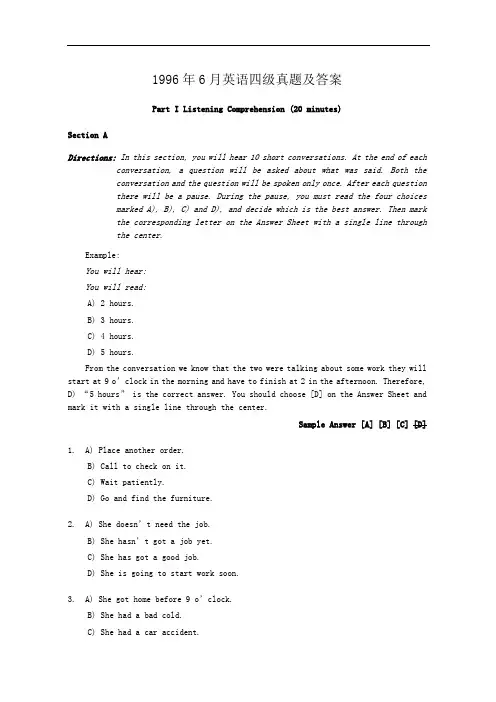
1996年6月英语四级真题及答案Part I Listening Comprehension (20 minutes)Section ADirections: In this section, you will hear 10 short conversations. At the end of each conversation, a question will be asked about what was said. Both theconversation and the question will be spoken only once. After each questionthere will be a pause. During the pause, you must read the four choicesmarked A), B), C) and D), and decide which is the best answer. Then markthe corresponding letter on the Answer Sheet with a single line throughthe center.Example:You will hear:You will read:A) 2 hours.B) 3 hours.C) 4 hours.D) 5 hours.From the conversation we know that the two were talking about some work they will start at 9 o’clock in the morning and have to finish at 2 in the aft ernoon. Therefore, D) “5 hours” is the correct answer. You should choose [D] on the Answer Sheet and mark it with a single line through the center.Sample Answer [A] [B] [C] [D]1. A) Place another order.B) Call to check on it.C) Wait patiently.D) Go and find the furniture.2. A) She doesn’t need the job.B) She hasn’t got a job yet.C) She has got a good job.D) She is going to start work soon.3. A) She got home before 9 o’clock.B) She had a bad cold.C) She had a car accident.D) She was delayed.4. A) She hasn’t gone camping for several weeks.B) She like to take long camping trips.C) She prefers not to go camping on weekends.D) She often spends a lot of time planning her camping trips.5. A) A writer.B) A teacher.C) A reporter.D) A student.6. A) She has not heard of Prof. Johnson.B) She has not heard of Prof. Johnson’s brother.C) She is a good friend of Prof. Johnson’s.D) She does not know Prof. Johnson’s.7. A) Coming back for a later show.B) Waiting in a queue.C) Coming back in five minutes.D) Not going to the movie today.8. A) He has got a heart attack.B) He was unharmed.C) He was badly hurt.D) He has fully recovered from the shock.9. A) The man went to Australia during Christmas.B) The man visited Australia during the summer vacation.C) The man didn’t have a good time because of the different weather.D) The man remained home while his parents went to see his uncle.10. A) To attend a party at a classmate’s home.B) To do homework with her classmate.C) To attend an evening class.D) To have supper out with her classmate.Section BDirections: In this section, you will hear 3 short passages. At the end of each passage,you will hear some questions. Both the passage and the questions will bespoken only once. After you hear a question, you must choose the best answerfrom the four choices marked A), B), C) and D). Then mark the correspondingletter on the Answer Sheet with a single line through the center.Passage oneQuestions 11 to 13 are based on the passage you have just heard.11. A) He fell into the river but couldn’t swim.B) He fell into the river together with his bike.C) He had his foot caught between two posts in the river.D) He dived into the river but couldn’t reach the surface.12. A) He jumped into the river immediately.B) He took off his coat and jumped into the water.C) He dashed down the bridge to save the boy.D) He shouted out for help.13. A) He asked what the young man’s name was.B) He asked the young man to take him home.C) He gave his name and then ran away.D) He thanked the young man and then ran away.Passage TwoQuestions 14 to 16 are based on the passage you have just heard.14. A) Alcohol helps develop people’s intelligence.B) Heavy drinking is not n ecessarily harmful to one’s health.C) Controlled drinking helps people keep their wits as they age.D) Drinking, even moderately, may harm one’s health.15. A) Worried.B) Pleased.C) Surprised.D) Unconcerned.16. A) At a conference.B) In a newspaper.C) On television.D) In a journal.Passage ThreeQuestions 17 to 20 are based on the passage you have just heard.17. A) To seek adventure there.B) To be with her mother on Christmas.C) To see the animals and plants there.D) To join her father on Christmas.18. A) She was seriously injured.B) She survived the accident.C) She lost consciousness.D) She fell into a stream.19. A) To avoid hostile Indians.B) To avoid the rain.C) To avoid the strong sunlight.D) To avoid wild animals.20. A) They gave Julia food to eat.B) They drove Julia to a hospital.C) They invited Julia to their hut.D) They took Julia to a village by boat.Part II Vocabulary and Structure (20 minutes)Directions: There are 30 incomplete sentences in this part. For each sentence there are four choices marked A), B), C) and D). Choose the ONE that best completesthe sentence. Then mark the corresponding letter on the Answer Sheet witha single line through the center.21. After the robbery, the shop installed a sophisticate alarm system as an insurance________ further losses.A) forB) fromC) againstD) towards22. ________ the earth to be flat, many feared that Columbus would fall off the edgeof the earth.A) Having believedB) BelievingC) BelievedD) Being believed23. A healthy life is frequently thought to be ________ with the open countryside andhomegrown food.A) tiedB) boundC) involvedD) associated24. Sir Denis, who is 78, has made it known that much of his collection ________ tothe nation.A) has leftB) is to leaveC) leavesD) is to be left25. Before the first non-stop flight made in 1949, it ________ necessary for all planesto land for refueling.A) would beB) has beenC) had beenD) would have been26. In Britain today women ________ 44% of the workforce, and nearly half the motherswith children are in paid work.A) build upB) stand forC) make upD) conform to27. ________ might be expected, the response to the question was very mixed.A) AsB) ThatC) ItD) What28. If I correct someone, I will do it with as much good humor and self-restraint asif I were the one ________.A) to correctB) correctingC) having correctedD) being corrected29. Features such as height, weight, and skin color ________ from individual toindividual and from face to face.A) changeB) varyC) alterD) convert30. I make notes in the back of my diary ________ thing to be mended or replaced.A) byB) inC) withD) of31. The room is in a terrible mess; it ________ cleaned.A) can’t have beenB) mustn’t have beenC) shouldn’t have beenD) wouldn’t have been32. A well-written composition ________ good choice of words and clear organizationamong other things.A) calls onB) calls forC) calls upD) calls off33. The traditional approach ________ with complex problems is to break them down intosmaller, more easily managed problems.A) to dealingB) in dealingC) dealingD) to deal34. It has been revealed that some government leaders ________ their authority andposition to get illegal profits for themselves.A) employB) takeC) abuseD) overlook35. We were struck by the ex tent ________ which teachers’ decisions served theinterests of the school rather than those of the students.A) toB) forC) inD) with36. Shelly had prepared carefully for her biology examination so that she could be sureof passing it on her first ________.A) intentionB) attemptC) purposeD) desire37. The ancient Egyptians are supposed ________ rockets to the moon.A) to sendB) to be sendingC) to have sentD) to have been sending38. The store had to ________ a number of clerks because sales were down.A) lay outB) lay offC) lay asideD) lay down39. All the students in this class passed the English exam ________ the exception ofLi Ming.A) onB) inC) forD) with40. Young adults ________ older people are more likely to prefer pop songs.A) other thanB) more thanC) less thanD) rather than41. Writing is a slow process, requiring ________ thought, time, and effort.A) significantB) considerableC) enormousD) numerous42. ________ right now, she would get there on Sunday.A) Would she leaveB) If she leavesC) Were she to leaveD) If she had left43. It’s already 5 o’clock now. Don’t you think it’s about time ________?A) we are going homeB) we go homeC) we went homeD) we can go home44. Lightning is a ________ of electrical current from a cloud to the ground or fromone cloud to another.A) rushB) rainbowC) rackD) ribbon45. Today, ________ major new products without conducting elaborate market research.A) corporations hardly introduce everB) corporations hardly ever introduceC) hardly corporations introduce everD) hardly corporations ever introduce46. I’ve already told you that I’m going to buy it, ________.A) however much it costsB) however does it costs muchC) how much does it costD) no matter how it costs47. New York ________ second in the production of apples, producing 850,000,000 poundsthis year.A) rankedB) occupiedC) arrangedD) classified48. Melted iron is poured into the mixer much ________ tea is poured into a cup froma teapot.A) in the same way likeB) in the same way whichC) in the same wayD) in the same way as49. By success I don’t mean ________ usually thought of when that word is used.A) what isB) that weC) as youD) all is50. I caught a ________ of the taxi before it disappeared around the corner of thestreet.A) visionB) glimpseC) lookD) scenePart III Reading Comprehension (35 minutes)Directions: There are 4 passages in this part. Each passage is followed by some questions or unfinished statements. For each of them there are four choicesmarked A), B), C) and D). You should decide on the best choice and markthe corresponding letter on the Answer Sheet with a single line throughthe center.Passage OneQuestions 21 to 25 are based on the following passage.Exchange a glance with someone, then look away. Do you realize that you have made a statement? Hold the glance for a second longer, and you have made a different statement. Hold it for 3 seconds, and the meaning has changed again. For every social situation, there is a permissible time that you can hold a person’s gaze without being intimate, rude, or aggressive. If you are on an elevator, what gaze-time are you permitted? To answer this question, consider what you typically do. You very likely give other passengers a quick glance to size them up (打量) and to assure them that you mean no threat. Since being close to another person signals the possibility of interaction. You need to emit a signal telling others you want to be left alone. So you cut off eye contact, what sociologist Erving Goffman (1963) calls “a dimming of the lights.” You look down at the floor, at the indicator lights, anywhere but into another passenger’s eyes. Should you break the rule against staring at a stranger on an elevator, you will make the other person exceedingly uncomfortable, and you are likely to feel a bit strange yourself.If you hold eye contact for more than 3 seconds, what are you telling another person? Much depends on the person and the situation. For instance, a man and a woman communicate interest in this manner. They typically gaze at each other for about 3 seconds at a time, then drop their eyes down for 3 seconds, before letting their eyes meet again. But if one man gives another man a 3-second-plus stare, he signals, “I know you”, “I am interested in you,” or “You look peculiar and I am curious about you.” This type of stare often produces hostile feelings.51. It can be inferred form the first paragraph that ________.A) every glance has its significanceB) staring at a person is an expression of interestC) a gaze longer than 3 seconds is unacceptableD) a glance conveys more meaning than words52. If you want to be left alone on an elevator, the best thing to do is ________.A) to look into another passenger’s eyesB) to avoid eye contact with other passengersC) to signal you are not a threat to anyoneD) to keep a distance from other passengers53. By “a dimming of the lights” (Para. 1, Line 9) Erving Goffman means “________”.A) closing one’s eyesB) turning off the lightsC) creasing to glance at othersD) reducing gaze-time to the minimum54. If one is looked at by a stranger for too long, he tends to feel ________.A) depressedB) uneasyC) curiousD) amused55. The passage mainly discusses ________.A) the limitations of eye contactB) the exchange of ideas through eye contactC) proper behavior in situationsD) the role of eye contact in interpersonal communicationPassage TwoQuestions 56 to 60 are based on the following passage.The picnics, speeches, and parades of today’s Labor Day w ere all part of the first celebration, held in New York City in 1882. Its promoter was an Irish-American labor leader named peter J. McGuire. A carpenter by trade, McGuire had worked since the age of eleven, and in 1882 was president of the United Brotherhood of Carpenters and Joiners (UBCJ). Approaching the City’s Central Labor Union that summer, he proposed a holiday that would applaud (赞许)“the industrial spirit-the great vital force of every nation,” On September 5 his suggestion bore fruit, as an estimated 10,000 workers, many of them ignoring their bosses’ warnings, left work to march from Union square up Fifth Avenue to 42nd Street. The event gained national attention, and by 1893 thirty states had made Labor Day an annual holiday.The quick adoption of the scheme may have indicated less about the state lawmakers’ respect for working people than about a fear of risking their anger. In the 1880s the United States was a land sharply divided between the immensely wealthy and the very poor. Henry George was accurate in describing the era as one of “progress and poverty.” In a society in which factory, owners rode in private Pullmans while ten-year-olds slaved in the mines, strong anti-capitalist feeling ran high. Demands for fundamental change were common throughout the labor press. With socialists demanding an end to “wage slavery” and anarchists (无政府主义) singing the praises of the virtues of dynamite (炸药), middle-of-the-roaders like Samuel Gompers and McGuire seemed attractively mild by comparison. One can imagine practical capitalists seeing Labor Day as a bargain: A one-day party certainly cost them less than paying their workersdecent wages.56. Judging from the passage, McGuire was ________.A) a moderate labor leaderB) an extreme-anarchist in the labor movementC) a devoted socialist fighting against exploitation of man by manD) a firm anti-capitalist demanding the elimination of wage slavery57. We can see from the first paragraph that the first Labor Day march ________.A) immediately won nationwide supportB) involved workers from 30 statesC) was opposed by many factory ownersD) was organized by the UBCJ58. Which of the following is the key factor in the immediate approval of Labor Dayas a national holiday?A) The lawmakers’ respect for the workers.B) The worker’s determination to have a holiday of their own.C) The socialists’ demands for thorough reform.D) The politicia ns’ fear of the workers’ anger.59. We lean from the passage that the establishment of Labor Day ________.A) was accepted by most bosses as a compromiseB) marked a turning point in the workers’ struggle for more rightsC) indicated the improvement of the workers’ welfareD) signaled the end of “wage slavery”60. McGuire proposed Labor Day in order to ________.A) draw people’s attention to the striking contrast between the rich and the poorB) make prominent the important role of the working class in societyC) win for the workers the right to shorter working hoursD) expose the exploitation of the workers by their bossesPassage ThreeQuestions 61 to 65 are based on the following passage.In the old day, children were familiar with birth and death as part of life. This is perhaps the first generation of American youngsters (年轻人) who have never been close by during the birth of a baby and have never experienced the death of a familymember.Nowadays when people grow old, we often send them to nursing homes. When they get sick, we transfer them to a hospital, where children are forbidden to visit terminally ill patients-even when those patients are their parents. This deprives (剥夺) the dying patient of significant family members during the last few days of his life and it deprives the children of an experience of death, which is an important learning experience.Some of my colleagues and I once interviewed and followed approximately 500 terminally ill patients in order to find out what they could teach us and how we could be of more benefit, not just to them but to the members of their families as well. We are most impressed by the fact that even those patients who were not told of their serious illness were quite aware of its potential outcome.It is important for family members, and doctors and nurses to understand these patients’ communications in order to truly understand their needs, fears, and fantasies (幻想). Most of our patients welcomed another human being with whom they could talk openly, honestly, and frankly about their trouble. Many of them shared with us their tremendous need to be informed, to be kept up-to-date on their medical condition and to be told when the end was near. We found out that patients who had been dealt with openly and frankly were better able to cope with the approach of death and finally to reach a true stage of acceptance prior to death.61. The elders of contemporary Americans ________.A) were often absent when a family member was born or dyingB) were quite unfamiliar with birth and deathC) usually witnessed the birth or death of a family memberD) had often experienced the fear of death as part of life62. Children in America today are denied the chance ________.A) to learn how to face deathB) to visit dying patientsC) to attend to patientsD) to have access to a hospital63. Five hundred critically ill patients were investigated with the main purpose of________.A) observing how they reacted to the crisis of deathB) helping them and their families overcome the fear of deathC) finding out their attitude towards the approach of deathD) learning how to best help them and their families64. The need of a dying patient for company shows ________.A) his desire for communication with other peopleB) his fear of approaching deathC) his pessimistic attitude towards his conditionD) his reluctance to part with his family65. It may be concluded from the passage that ________.A) dying patients are afraid of being told of the approach of deathB) most doctors and nurses understand what dying patients needC) dying patients should be truthfully informed of their conditionD) most patients are unable to accept death until it is obviously inevitablePassage FourQuestions 66 to 70 are based on the following passage.Faces, like fingerprints, are unique. Did you ever wonder how it is possible for us to recognize people. Even a skilled writer probably could not describe all the features that make one face different from another. Yet a very young child-or even an animal, such as a pigeon-can learn to recognize faces, we all take this ability for granted.We also tell people apart by how they behave. When we talk about someone’s personality, we mean the ways in which he or she acts, speaks thinks and feels that make that individual different from others.Like the human face, human personality is very complex. But describing someone’s personality in words is somewhat easier than describing his face. If you were asked to describe what a “nice face” looked like, you pro bably would have a difficult time doing so. But if you were asked to describe a “nice person”, you might begin to think about someone who was kind considerate, friendly, warm, and so forth.There are many words to describe how a person thinks, feels and acts. Gordon Allport, an American psychologist, found nearly 18,000 English words characterizing differences in people’s behavior. And many of us use this information as a basis for describing, or typing, his personality. Bookworms, conservatives, military types-people are described with such terms.People have always tried to “type” each other. Actors in early Greek drama wore masks to show the audience whether they played the villain’s (坏人) or the hero’s role. In fact, the words “person” and “personality” c ome from the Latin persona, meaning “mask”. Today, most television and movie actors do not wear masks. But we can easily tell the “good guys” from the “bad guys” because the two types differ in appearance as well as inactions.66. By using the example of finger prints, the author tells us that ________.A) people can learn to recognize facesB) people have different personalitiesC) people have difficulty in describing the features of finger printsD) people differ from each other in facial features67. According to this passage, some animals have the gift of ________.A) telling people apart by how they behaveB) typing each otherC) telling good people from had peopleD) recognizing human faces68. Who most probably knows best how to describe people’s personality?A) The ancient Greek audienceB) The movie actorsC) PsychologistsD) The modern TV audience69. According to the passage, it is possible for us tell one type of person from anotherbecause ________.A) people differ in their behavioral and physical characteristicsB) human fingerprints provide unique informationC) people’s behavior can be easily described in wordsD) human faces have complex features70. Which of the following is the major point of the passage?A) Why it is necessary to identify people’s personalityB) Why it is possible to describe peopleC) How to get to know peopleD) How best to recognize peoplePart IV Translation (15 minutes)Directions: In this part, there are four items which you should translate into Chinese, each item consisting of one or two sentences. These sentences are all takenfrom the Reading Passages you have just read in Part Three of Test PaperOne. You are allowed 15 minutes to do the translation. You should referback to the passages so as to identify their meanings in the context.71. (Passage 1, Lines 6-7, Para. 1)You very likely give other passengers a quick glance to size them up and to assure them that you mean no threat.72. (Passage 2, Lines 2-3, Para. 2)In the 1880s the United States was a land sharply divided between the immensely wealthy and the very poor.73. (Passage 3, Lines 3-5, Para. 3)We were most impressed by the fact that even those patients who were not told of their serious illness were quite aware of its potential outcome74. (Passage 4, Lines 2-3, Para. 1)Even a skilled writer probably could not describe all the features that make one face different from another.Part V Writing (30 minutes)Directions: For this part, you are allowed thirty minutes to write a composition on the topic Global Shortage of Fresh Water. You should write at least 100words and you should base your composition on the outline (given in Chinese)below:1. 人们以为淡水是取之不尽的(提示:雨水、河水、井水…)2. 实际上淡水是非常紧缺的(提示:人口增加,工业用水增加,污染…)3. 我们应该怎么办Global Shortage of Fresh Water1996年6月四级参考答案Part IPart IIPart III71. 你很可能给其他乘客很快的一瞥,打量他们一下,以此让他们确信你对他们没有威胁。
1995年06月大学英语四级考试听力真题及答案
1995年6月四级听力真题Part I Listening Comprehension (20 minutes)Section A1. A) Librarian and student. B) Operator and caller.C) Boss and secretary. D) Customer and repairman.2. A) Look for the key. B) Repair the car.C) Fix a shelf. D) Paint a shelf.3. A) To make the woman angry. B) To please the man’s mother.C) David is the man’s good friend. D) David is good at carrying on conversations.4. A) He must meet his teacher. B) He must attend a class.C) He must go out with his girlfriend. D) He must stay at school to finish his homework.5. A) He wants to pay. B) he doesn’t want to eat outC) He wants to eat somewhere else. D) He doesn’t like Japanese food.6. A) He didn’t work as hard as he was supposed to.B) He didn’t pass the physics exam.C) He did better in an earlier exam.D) He found something wrong with the exam.7. A) He is attending his sick mother at home.B) He is on a European tour with his mother.C) He is at home on sick leave.D) He is in Europe to see his mother.6. A) They don’t know how to get to Mike’s home.B) They are discussing when to meet again.C) They went to the same party some time ago.D) They will go to Mike’s birthday party.9. A) Five lessons.B) Three lessons.C) Twelve lessons. D) Fifteen lessons.10. A) Find a larger room.B) Sell the old table.C) Buy two bookshelves. D) Rearrange some furniture.Section BPassage OneQuestions 11 to 13 are based on the passage you have just heard.11. A) Courses in British history.B) Language courses.C) Courses in sports. D) Teacher training courses.12. A) To attract more students. B) To make the courses suitable for students of all levels.C) To let the students have a good rest. D) To make the summer school more likea holiday.13. A) Because they all work very hard.B) Because their teachers are all native speakers of English.C) Because they learn not only in but also out of class.D) Because they are all advanced students.Passage TwoQuestions 14 to 16 are based on the passage you have just heard.14. A) Because it takes too long to process all the applications.B) Because its resources are limited.C) Because it is a library for special purposes.D) Because there is a shortage of staff.15. A) Discard his application from.B) Forbid him to borrow any items.C) Cancel his video card. D) Ask him to apply again.16. A) One month.B) One week.C) Two weeks. D) Two months.Passage ThreeQuestions 14 to 16 are based on the passage you have just heard.17. A) Chemicals. B) Vapor.C) Water. D) Gas.8. A) By passing steam over dry ice. B) By turning ordinary ice into steam.C) By heating dry ice. D) By mixing dry ice with ordinary ice.19. A) It takes a longer tim e to melt. B) It is lighter to carry.C) It is cleaner to use than ordinary ice. D) It is not so cold as ordinary ice.20. A) In the 1920’s. B) In the 1930’s.C) In the 1940’s. D) In the 1950’s.1995年6月四级听力参考答案1995年6月大学英语四级(CET-4)听力原文Section A1.W: How long will it take you to fix my watch?M: I`ll call you when it`s ready. But it shouldn`t take longer than a week.Q: what is the probable relationship between the speakers?2.M: I can`t find the key to my car, I need to go for a drive.W: I`ll look for it later. Right now I want you to help fix the shelf before I paint it.Q: What will they do first?3.W: I really can`t stand the way David controls the conversation all the time. If he`s going to be at the Christmas party, I just won`t come.M: I`m sorry you feel that way. But my mother insists that he come.Q: Why is David being invited to the party?4 W: John, do you want to go swimming with me today?M: Sure, but I can`t leave now. I have an appointment with my professor at 3 o`clock.Q: Why can`t John go swimming now?5. W: I hear there is a good Japanese restaurant nearby. Would you like to go there for lunch?M: Yes, but it`s my treat this time.Q: What does the man mean?6 W: You look upset. Anything wrong?M: I failed in physics exam again in spite of all the efforts I made.Q: What do we know about the man from the conversation?7. W: I wonder what`s happened to Jerry. He hasn`t been around for at least 2 weeks.M: He took a leave to see his mother in Europe.Q: Why is Jerry away?8.M: Hi, Jane. So glad to see you again.W: Likewise. I remember the last time we wet was 5 months ago at Mike`s birthday party. How are you doing?Q: What do we know about the speakers?9. W: Professor Clark said that the mid-term exam would cover the first 15 lessons?M: Really? I thought it only included the first 12 lessons. Then I must spend the weekend to go over the rest of the lessons.Q: How many lessons must the man review over the weekend?10.W: We do need another bookshelf in this room. But the problem is the space for it.M: How about moving the old dining table to the kitchen?Q: What does the man suggest they should do?Section BPassage One:Most summer school courses in Britain last for two to four weeks. During that time students live either with a British family, or at the school, or in a hotel. They have about 15 hours of lessons every Monday to Friday, usually in the mornings. Each school has a lot ofdifferent courses. Some are for beginners and others are for intermediate or advanced students. The lessons are fun; the classes are small and the teachers are all from English-speaking countries. But summer school students don`t just speak English in the classroom. They are in Britain, so they speak and read and hear it outside, too. That`s why they learn so quickly and why a summer school course is really a holiday. Only one third of each course is taught in the classroom. The rest takes place during a busy afternoon and evening timetable of visits, sports and games. These activities help everyone to make new friends, have fun and improve their English.Questions 11 to 13 are based on the passage you have just heard.11. What kind of course do summer schools offer?12. Why do summer schools arrange visits and other activities for the students?13. Why do students in summer schools learn quickly?Passage Two:This library is an English language teaching and learning library. Unfortunately our resources are limited and so not everyone can join. Teachers of English, university students and professionals who are in the medical, engineering and management fields can all join the library. Those from other professions are welcome to apply. But your application will not necessarily be approved. You must fill in a library application form and put it in the box on the libranrian`s desk.Because of the high number of applications we receive each week, you must wait one week. Please bring your student or work cards to pick up your library cards. Library application forms which are not picked up within 2 months will be discarded and you will have to reapply.You may borrow one video at a time. The video must be returned in one week. If you can not return it one time, please call. Otherwise your video library card will be cancelled. You may borrow 3 items at one time. That is 3 books or 3 cassettes. Items must be returned within 1 month. You can telephone the library to renew items for another month.Questions 14 to 16 are based on the passage you have just heard.14. Why can`t the library issue library cards to everyone who applies?15. What will the library do if a reader fails to renew the videos when it is due?16. For how long can a reader keep the book before he renews it?Passage Three:Can you imagine ice that does not melt and is not wet? Have your ever heard of dry ice? Dry ice is made by freezing a gas. It is quite different from ordinary ice which is simply frozen water. Dry ice was first manufactured in 1925. It has since fulfilled the hopes of its inventor. It can be used for making artificial fog in the movies. When steam is passed over dry ice, a very dense vapor rises. It can also be used for destroying insects in grain supplies. It is more practical than ordinary ice because it takes up less space and it is 142 degrees colder. Since it turns into steam, instead of melting into water, it is cleaner to use. For these reasons, it is extremely popular and many people prefer it to ordinary ice. Dry ice is so cold that if you touch it with your hare fingers, it will burn you.Questions 17 to 20 are based on the passage you have just heard.17. What is dry ice made of?18. How is an artificial fog made in the movies?19. What is the advantage of dry ice over ordinary ice?20. When was dry ice first made?。
1996年1月大学英语四级试题+答案+听力原文
1996年1月大学英语四级(CET-4)真题试卷Part I Listening Comprehension (20 minutes)Section ADirections: In this section, you will hear 10 short conversations. At the end of each conversation, a question will be asked about what was said. Both theconversation and the question will be spoken only once. After eachquestion there will be a pause. During the pause, you must read the fourchoices marked A), B), C) and D), and decide which is the best answer.Then mark the corresponding letter on the Answer Sheet with a single linethrough the center.Example:You will hear:You will read:A) 2 hours.B) 3 hours.C) 4 hours.D) 5 hours.From the conversation we know that the two were talking about some work they will start at 9 o’clock in the morning and have to finish at 2 in the afternoon. Therefore, D) “5 hours” is the correct answer. You should choose [D] on the Answer Sheet and mark it with a single line through the center.Sample Answer [A] [B] [C] [D]1. A) At home.B) At the riverside.C) At the health center.D) At his office.2. A) Having an interview.B) Filling out a form.C) Talking with his friend.D) Asking for information.3. A) She made a mistake by taking too few courses in the first term.B) The courses she took were too difficult for her.C) She took too many courses during her first term.D) She found it difficult to deal with college courses.4. A) Worried and frightened.B) Very relaxed.C) Quite unhappy.D) Angry with the professor.5. A) He enjoys reading letters.B) He has been job-hunting.C) He is offering the woman a job.D) He is working for a company.6. A) She lost her way.B) She lost her keys.C) She lost her car.D) She lost her handbag.7. A) More than an hour and a half.B) Not more than half an hour.C) More than two hours.D) Less than an hour and a half.8.A) She is sure who is going to win.B) Now it is a good time to start the game.C) The game has been going on for a long time.D) The same team always wins.9. A) The ideas of the paper are not convincing.B) Some parts of the paper are not well written.C) The handwriting of the paper is not good.D) The paper is not complete.10. A) Looking for a young lady.B) Looking for her wrist watch.C) Looking for a young gentleman.D) Looking for a man wearing a wrist watch.Section BDirections: In this section, you will hear 3 short passages. At the end of each passage,you will hear some questions. Both the passage and the questions will bespoken only once. After you hear a question, you must choose the bestanswer from the four choices marked A), B), C) and D). Then mark thecorresponding letter on the Answer Sheet with a single line through thecenter.Passage oneQuestions 11 to 14 are based on the passage you have just heard.11. A) It had many problems.B) It was the most democratic country in the world.C) It was fair to women.D) It had some minor problems to solve.12. A) The women of some states.B) The women in the state of Wyoming only.C) The members of the National Women’s Association.D) The women in the state of Massachusetts only.13. A) At the very beginning of the 20th century.B) At the end of the 19th century.C) After Susan Anthony’s death.D) Just before Susan Anthony’s death.14. A) She worked on the draft of the American Constitution.B) She was the chairman of the National Women’s Association.C) She was born in New York and died in Massachusetts.D) She was an activist in the women’s movement for equal rights.Passage TwoQuestions 15 to 16 are based on the passage you have just heard.15.A) People with problems.B) Travels around the world.C) Beautiful America.D) People in great cities.16. A) He spent three months writing “Travels with Charley”.B) He enjoyed his travels around the United States.C) He was fond of writing about his travels.D) He didn’t enjoy the trip as much as Charley.Passage ThreeQuestions 17 to 20 are based on the passage you have just heard.17. A) The long distance between his home town and New York.B) His unpopular character.C) The high unemployment rate in New York.D) His criminal record.18. A) He wanted to be put in prison again.B) He needed the money to support his family.C) He hated the barber there.D) He wanted to make himself well known.19. A) He went directly to the police station.B) He drove out of the town and tried to escape.C) He waited for the police to arrest him.D) He argued with the police angrily.20. A) Mr. Spears enjoyed living in prison.B) Mr. Spears was known as a greedy man in his community.C) The police in New York were not very efficient.D) The only way for Mr. Spears to support his family was by going to prison again.Part II Vocabulary and Structure (20 minutes)Directions: There are 30 incomplete sentences in this part. For each sentence there are four choices marked A), B), C) and D). Choose the ONE that bestcompletes the sentence. Then mark the corresponding letter on the AnswerSheet with a single line through the center.21. The fifth generation computers, with artificial intelligence, ________ and perfectednow.A) developedB) have developedC) are being developedD) will have been developed22. This ticket ________ you to a free meal in our new restaurant.A) givesB) grantsC) entitlesD) credits23. You ________ her in her office last Friday; she’s been out of town for two weeks.A) needn’t have seenB) must have seenC) might have seenD) can’t have seen24. That was so serious a matter that I had no choice but ________ the police.A) called inB) calling inC) call inD) to call in25. She was so ________ in her job that she didn’t hear anybody knocking at the door.A) attractedB) absorbedC) drawnD) concentrated26. ________ as it was at such a time, his work attracted much attention.A) Being publishedB) PublishedC) PublishingD) To be published27. At first, the speaker was referring to the problem of pollution in the country, buthalfway in her speech, she suddenly ________ to another subject.A) committedB) switchedC) favouredD) transmitted28. It is politely requested by the hotel management that radios ________ after 11o’clock at night.A) were not playedB) not to playC) not be playedD) did not play29. Although I like the appearance of the house, what really made me decide to buy itwas the beautiful ________ through the window.A) visionB) lookC) pictureD) view30. Cancer is second only ________ heart disease as a cause of death.A) ofB) toC) withD) from31. Despite the wonderful acting and well-developed plot the ________ movie couldnot hold our attention.A) three-hoursB) three-hourC) three-hours’D) three-hour’s32. The manager needs an assistant that he can ________ to take care of problems in hisabsence.A) count onB) count inC) count upD) count out33. The organization had broken no rules, but ________ had it acted responsibly.A) neitherB) soC) eitherD) both34. We gave out a cheer when the red roof of the cottage came ________ view.A) fromB) inC) beforeD) into35. They took ________ measures to prevent poisonous gases from escaping.A) fruitfulB) beneficialC) validD) effective36. Doing your homework is a sure way to improve your test scores, and this isespecially true ________ it comes to classroom tests.A) whenB) sinceC) beforeD) after37. Careful surveys have indicated that as many as 50 percent of patients do not takedrugs ________ directed.A) likeB) soC) whichD) as38. In developing countries people are ________ into overcrowded cities in greatnumbers.A) breakingB) fillingC) pouringD) hurrying39. It’s reported that by the end of this month the output of cement in the factory________ by about 10%.A) will have risenB) has risenC) will be risingD) has been rising40. If I had remembered ________ the window, the thief would not have got in.A) to closeB) closingC) to have closedD) having closed41. There are other problems which I don’t propose to ________ at the moment.A) go intoB) go aroundC) go forD) go up42. Don’t get your schedule ________; stay with us in this class.A) to changeB) changingC) changedD) change43. It is quite necessary for a qualified teacher to have good manners and ________knowledge.A) extensiveB) expansiveC) intensiveD) expensive44. Jean doesn’t want to work right away b ecause she thinks that if she ________ a jobshe probably wouldn’t be able to see her friends very often.A) has to getB) were to getC) had gotD) could have got45. I felt somewhat disappointed and was about to leave, ________ something occurredwhich attracted my attention.A) unlessB) untilC) whenD) while46. A love marriage, however, does not necessarily ________ much sharing of interestsand responsibilities.A) take overB) result inC) hold onD) keep to47. The ability to store knowledge makes computers different form every other machine________ invented.A) everB) thusC) yetD) as48. I’m not sure whether I can gain any profit from the investment, so I can’t make a(n)________ promise to help you.A) exactB) definedC) definiteD) sure49. I have kept that portrait ________ I can see it every day, as it always reminds me ofmy university days in London.A) whichB) whereC) whetherD) when50. The sports meet, originally due to be held last Friday, was finally ________ becauseof the bad weather.A) set offB) broken offC) worn offD) called offPart III Reading Comprehension (35 minutes)Directions: There are 4 passages in this part. Each passage is followed by somequestions or unfinished statements. For each of them there are four choicesmarked A), B), C) and D). You should decide on the best choice and markthe corresponding letter on the Answer Sheet with a single line through thecenter.Passage OneQuestions 51 to 55 are based on the following passage.Space is a dangerous place, not only because of meteors (流星) but also because of rays from the sun and other stars. The atmosphere again acts as our protective blanket on earth. Light gets through, and this is essential for plants to make the food, which we eat. Heat, too, makes our environment endurable. Various kinds of rays come through the air from outer space, but enormous quantities of radiation from the sun are screened off. As soon as men leave the atmosphere they are exposed to this radiation but their spacesuits or the walls of their spacecraft, if they are inside, do prevent a lot of radiation damage.Radiation is the greatest known danger to explorers in space. The unit of radiation is called rem. Scientists have reason to think that a man can put up with far more radiation than 0.1 rem without being damaged; the figure of 60 rems has been agreed on. The trouble is that it is extremely difficult to be sure about radiation damage-a person may feel perfectly well, but the cells of his or her sex organs may be damaged, and this will not be discovered until the birth of deformed (畸形的) children or even grandchildren. Missions of the Apollo flights have had to cross belts of high radiation and, during the outward and return journeys, the Apollo crew accumulated a large amount of rems. So far, no dangerous amounts of radiation have been reported, but the Apollo missions have been quite short. We simply do not know yet how men are going to get on when they spend weeks and months outside the protection of the atmosphere, working in a space laboratory. Drugs might help to decrease the damage done by radiation, but no really effective ones have been found so far.51. According to the first paragraph, the atmosphere is essential to man in that________.A) it protects him against the harmful rays from spaceB) it provides sufficient light for plant growthC) it supplies the heat necessary for human survivalD) it screens off the falling meteors52. We know from the passage that ________.A) exposure to even tiny amounts of radiation is fatalB) the effect of exposure to radiation is slow in comingC) radiation is avoidable in space explorationD) astronauts in spacesuits needn’t worry about radiation damage53. The harm radiation has done to the Apollo crew members ________.A) is insignificantB) seems overestimatedC) is enormousD) remains unknown54. It can be inferred from the passage that ________.A) the Apollo mission was very successfulB) protection from space radiation is no easy jobC) astronauts will have deformed children or grandchildrenD) radiation is not a threat to well-protected space explorers55. The best title for this passage would be ________.A) The Atmosphere and Our EnvironmentB) Research on RadiationC) Effects of Space RadiationD) Importance Protection Against RadiationPassage TwoQuestions 56 to 60 are based on the following passage.Taste is such a subjective matter that we don’t usually conduct preference tests for food. The most you can say about anyone’s preference, is that it’s one person’s opinion. But because the two big cola (可口可乐) companies—Coca-Cola and Pepsi Cola are marketed so aggressively, we’ve wondered how big a role taste preference actually plays in brand loyalty. We set up a taste test that challenged people who identified themselves as either Coca-Cola or Pepsi fans: Find your brand in a blind tasting.We invited staff volunteers who had a strong liking for either Coca-Cola Classic (传统型) or Pepsi,Diet (低糖的) Coke, or Diet Pepsi. These were people who thought the y’d have no trouble telling their brand from the other brand.We eventually located 19 regular cola drinkers and 27 diet cola drinkers. Then we fed them four unidentified samples of cola one at a time, regular colas for the one group, diet versions for the other. We asked them to tell us whether each sample was Coke or Pepsi; then we analyzed the records statistically to compare the participants’ choices with what mere guess-work could have accomplished.Getting all four samples right was a tough test, but not too tough, we thought, for people who believed they could recognize their brand. In the end, only 7 out of 19 regular cola drinkers correctly identified their brand of choice in all four trials. The diet-cola drinkers did a little worse-only 7 of 27 identified all four samples correctly.While both groups did better than chance would predict, nearly half the participantsin each group made the wrong choice two or more times. Two people go all four samples wrong. Overall, half the participants did about as well on the last round of tasting as on the first, so fatigue, or taste burnout, was not a factor. Our preference test results suggest that only a few Pepsi participants and Coke fans may really be able to tell their favorite brand by taste and price.56. According to the passage the preference test was conducted in order to ________.A) find out the role taste preference plays in a person’s drinkingB) reveal which cola is more to the liking of the drinkersC) show that a person’s opinion about taste is mere guess-workD) compare the ability of the participants in choosing their drinks57. The statistics recorded in the preference tests show ________.A) Coca-Cola and Pepsi are people’s two most favorite drinksB) there is not much difference in taste between Coca-Cola and PepsiC) few people had trouble telling Coca-Cola from PepsiD) people’s tastes differ from one another58. It is implied in the first paragraph that ________.A) the purpose of taste tests is to promote the sale of colasB) the improvement of quality is the chief concern of the two cola companiesC) the competition between the two colas is very strongD) blind tasting is necessary for identifying fans59. The word “burnout” (Line 4, Para. 5) here refers to the state of ________.A) being seriously burnt in the skinB) being unable to burn for lack of fuelC) being badly damaged by fireD) being unable to function because of excessive use60. The author’s purpose in writing this passage is to ________.A) show that taste preference is highly subjectiveB) argue that taste testing is an important marketing strategyC) emphasize that taste and price are closely related to each otherD) recommend that blind tasting be introduced in the quality control of colasPassage ThreeQuestions 61 to 65 are based on the following passage.The concept of “environment” is certainly difficult and may even be misunderstood; but we have no handy substitute. It seems simple enough to distinguish between the organism and the surrounding environment and to separate forces acting on an organism into those that are internal and biological and those that are external and environmental. But in actual practice this system breaks down in many ways, because the organism and the environment are constantly interacting so that the environment is modified by the organism and vice versa (反之亦然).In the case of man, the difficulties with the environmental concept are even more complicated because we have to deal with man as an animal and with man as a bearer (持有者) of culture. If we look at man as an animal and try to analyze the environmental forces that are acting on the organism, we find that we have to deal with things like climate, soil, plants and such-like factors common to all biological situations; but we also find, always, very important environmental influences that we can only class as “cultural”, which modify the physical and biological factors. But man, as we know him, is always a bearer of culture; and if we study human culture, we find that it, in turn, is modified by the environmental factors of climate and geography. We thus easily get into great difficulties from the necessity of viewing culture, at one moment, as a part of the man and, at another moment, as a part of the environment.61. Which of the following words can best describe the popular understanding of“environment” as the author sees it?A) Elaborate.B) Prejudiced.C) Faultless.D) Oversimplified.62. According to the author the concept of “environment” is difficult to explain becaus e________.A) it doesn’t distinguish between the organism and the environmentB) it involves both internal and external forcesC) the organism and the environment influence each otherD) the relationship between the organism and the environment is unclear63. In analyzing the environmental forces acting on man the author suggests that________.A) biological factors are less important to the organism than cultural factors to manB) man and other animals are modified equally by the environmental forcesC) man is modified by the cultural environment as well as by the naturalenvironmentD) physical and biological factors exert more influence on other organisms than onman64. As for culture, the author points out that ________.A) it develops side by side with environmental factorsB) it is also affected by environmental factorsC) it is generally accepted to be part of the environmentD) it is a product of man’s biological instincts65. In this passage, the author is primarily concerned with ________.A) the interpretation of the term “environment”B) the discussion on organisms and biological environmentC) the comparison between internal and external factors influencing manD) the evaluation of man’s influence on culturePassage FourQuestions 66 to 70 are based on the following passage.The speaker, a teacher from a community college, addressed a sympathetic audience. Heads nodded in agreement when he said, “High school English teachers are not doing their jobs.” He described the inadequacies of his students, all high school graduates who can use language only at a grade 9 level. I was unable to determine from his answers to my questions how this grade 9 level had been established.My topic is not standards nor its decline (降低). What the speaker was really saying is that eh is no longer young; he has been teaching for sixteen years, and is able to think and speak like a mature adult.My point is that the frequent complaint of one generation about the one immediately following it is inevitable. It is also human nature to look for the reasons for our dissatisfaction. Before English became a school subject in the late nineteenth century, it was difficult to find the target of the blame for language deficiencies (缺陷). But since then, English teachers have been under constant attack.The complainers think they have hit upon an original idea. As their own command of the language improves, they notice that young people do not have this same ability. Unaware that their own ability has developed through the years, they assume the new generation of young people must be hopeless in this respect. To the eyes and ears of sensitive adults the language of the young always seems inadequate.Since this concern about the decline and fall of the English language is not perceived as a generational phenomenon but rather as something new and peculiar to today’s young people, it naturally follows that today’s English teachers cannot be doing their jobs. Otherwise, young people would not commit offenses against the language.66. The speaker the author mentioned in the passage believed that ________.A) the language of the younger generation is usually inferior to that of the oldergenerationB) the students had a poor command of English because they didn’t work hardenoughC) he was an excellent language teacher because he had been teaching English forsixteen yearsD) English teachers should be held responsible for the students’ poor command ofEnglish67. In the author’s opinion, the speaker ________.A) gave a correct judgment of the English level of the studentsB) had exaggerated the language problems of the studentsC) was right in saying that English teachers were not doing their jobsD) could think and speak intelligently68. The author’s attitude towards the speaker’s remarks is ________.A) neutralB) positiveC) criticalD) compromising69. It can be concluded from the passage that ________.A) it is justifiable to include English as a school subjectB) the author disagrees with the speaker over the standard of English at Grade 9levelC) English language teaching is by no means an easy jobD) language improvement needs time and effort70. In the passage the author argues that ________.A) it is unfair to blame the English teachers for the language deficiencies of thestudentsB) young people would not commit offences against the language is the teachers didtheir jobs properlyC) to eliminate language deficiencies one must have sensitive eyes and earsD) to improve the standard of English requires the effort of several generationsPart IV Translation (15 minutes)Directions: In this part, there are five items which you should translate into Chinese, each item consisting of one or two sentences. These sentences are all takenfrom the Reading Passages you have just read in Part Three of Test PaperOne. You are allowed 15 minutes to do the translation. You should referback to the passages so as to identify their meanings in the context.71. (Passage 2, Lines 1-2, Para. 5)Scientists have reason to think that a man can put up with far more radiation than 0.1 rem without being damaged;72. (Passage 2, Lines 1-3, Para. 3)Them we fed them four unidentified samples of cola on at a time, regular colas for the one group, diet versions for the other.73. (Passage 2, Lines 1-2, Para. 5)While both groups did better than chance would predict, nearly half the participants in each group made the wrong choice two or more times.74. (Passage 3, Lines 4-5, Para. 2)...we find that we have to deal with things like climate, soil, plants, and such-like factors common to all biological situations;75. (Passage 4, Lines 1-2, Para. 3)My point is that the frequent complaint of one generation about the one immediately following it is inevitable.Part V Writing (30 minutes)Directions: For this part, you are allowed thirty minutes to write a composition on the topic The Two-day Weekend. You should write at least 100 words and youshould base your composition on the outline (given in Chinese) below:1. 双休日给大学生带来的好处。
大学英语四级考试1996年1月试卷及答案
大学英语四级考试1996年1月试卷及答案Part I Listening Comprehension (20 minutes)Section ADirections: In this section, you will hear 10 short conversations. At the end of each conversation, a question will be asked about what was said. Both the conversation and the question will be spoken only once.After each question there will be a pause, During the pause, you must read the four choices marked A), B), C) and D), and decide which is the best answer. Then mark the corresponding letter on the Answer Sheet with a line through the centre. Example: You will hear:You will read:A) At the office.B) In the waiting room.C) At the airport.D) In a restaurant.From the conversation we know that the two were talking about some work they had to finish in the evening. This is most likely to have taken place at the office. Therefore, A) "At the office" is the best answer.You should choose [A] on the Answer Sheet and mark it with a single line through the centre.Sample Answer [A] [B] [C] [D]1. A) At home. B) At the riverside. C) At the health center. D) At his office.2. A) Having an interview. C) Talking with his friend.B) Filling out a form D) Asking for information.3. A) She made a mistake by taking too few courses in the first term.B) The courses she took were too difficult for her.C) She took too many courses during her first term.D) She found it difficult to deal with college courses.4. A) Worried and frightened. B) Very relaxed.C) Quite unhappy. D) Angry with the professor.5. A) He enjoys reading letters. B) He has been job-hunting.C) He is offering the woman a job. D) He is working for a company.6. A) She lost her way. B) She lost her keys.C) She lost her car. D) She lost her handbag.7. A) More than an hour and a half. B) Not more than half an hour.C) More than two hours. D) less than an hour and a half.8. A) She is sure who is going to win.B) Now it is a good time to start the game.C) The game has been going on for a long time.D) The same team always wins.9. A) The ideas of the paper are not convincing.B) Some parts of the paper are not well written.C) The handwriting of the paper is not good.D) The paper is not complete.10. A) Looking for a young lady. B) Looking for her wrist watch.C) Looking for a young gentleman. D) Looking for a man wearing a wrist watch.Section BDirections: In this section, you will hear 3 short passages. At the end of each passage, you will hear some questions. Both the passage and the questions will be spoken only once. After you hear a question, you must choose the best answer from the four choices marked A), B), C) and D).Then mark the corresponding letter on the Answer Sheet with a single line through the centre.Passage OneQuestions 11 to 14 are based on the passage you have just heard.11. A) It had many problems. B) It was the most democratic country in the world.C) It was fair to women. D) It had some minor problems to solve.12. A) The women of some states. B) The women in the state of Wyoming only.C) The memebers of the National Women's Association.D) The women in the state of Massachusetts only.13. A) At the very beginning of the 20th century.B) At the end of the 19th century. C) After Susan Anthony's death.D) Just before Susan Anthony's death.14. A) She worked on the draft of the American Constitution.B) She was the chairman of the National Women's Association.C) She was born in New York and died in Massachusetts.D) She was an activist in the women's movement for equal rights.Passage TwoQuestions 15 to 16 are based on the passage you have just heard.15. A) People with problems. B) Travels around the world.C) Beautiful America. D) People in great cities.16. A) He spent three months writing "Travels with Charley".B) He enjoyed his travels around the United States.C) He was fond of writing about his travels.D) He didn't enjoy the trip as much as Charley.Passage ThreeQuestions 17 to 20 are based on the passage you have just heard.17. A) The long distance between his home town and New York.B) His unpopular character.C) The high unemployment rate in New York. D) His criminal record.18. A) He wanted to be put in prison again.B) He needed the money to support his family.C) He hated the barber there.D) He wanted to make himself well known.19. A) He went directly to the police station.B) He drove out of the town and tried to escape.C) He waited for the police to arrest him.D) He argued with the police angrily.20. A) Mr.Spears enjoyed living in prison.B) Mr. Spears was known as a greedy man in his community.C) The police in New York were not very efficient.D) The only way for Mr.Spears to support his family was by going to prison again.Part II Vocabulary and Structure (20 minutes)Directions: There are 30 incomplete sentences in this part. For each sentence there are four choices marked A), B), C) and D). Choose the ONE that best completes the sentence. Then mark the corresponding letter on the Answer Sheet with a single line through the centre.21. The fifth generation computers, with artificial intelligence,______ and perfected now.A) developed B) have developedC) are being developed D) will have been developed22. This ticket ______ you to a free meal in our new restaurant.A) gives B) grants C) entitles D) credits23. You ______ her in her office last Friday; she's been out of town for two weeks.A) needn't have seen B) must have seenC) might have seen D) can't have seen24. That was so serious a matter that I had no choice but _____ the police.A) called in B) calling in C) call in D) to call in25. She was so _______ in her job that she didn't hear anybody knocking at the door.A) attracted B) absorbed C) drawn D) concentrated26. ______ as it was at such a time, his work attracted much attention.A) Being published B) Published C) Publishing D) To be published27. At first, the speaker was referring to the problem of kpollution in the country, but halfway in her speech, she suddenly ______ to another subject.A) committed B) switched C) favoured D) transmitted28. It is politely requested by the hotel management that radios _____ after 11 o'clock at night.A) were not played B) not to play C) not be played D) did not play29. Although I like the appearance of the house, what really made me decide to buy it was the beautiful _____ through the window.A) vision B) look C) picture D) view30. Cancer is second only ______ heart disease as a cause of death.A) of B) to C) with D) from31. Despite the wonderful acting and well-developed plot the ______ movie could not hold our attention.A) three-hours B) three-hour C) three-hours' D) three-hour's32. The manager needs an assistant that he can ______ to take care of problems in his absence.A) count on B) count in C) count up D) count out33. The organization had broken no rules, but ______ had it acted responsibly.A) neither B) so C) either D) both34. We gave out a cheer when the red roof of the cottage came ______ view.A) from B) in C) before D) into35. They took _______ measures to prevent poisonous gases from escaping.A) fruitful B) beneficial C) valid D) effective36. Doing your homework is a sure way to improve your test scores, and this is especially true ______ it comes to classroom tests.37. Careful surveys have indicated that as many as 50 percent of patients donot take drugs _______ directed.A) like B) so C) which D) as38. In developing countries people are ______ into overcrowded cities in great numbers.A) breaking B) filling C) pouring D) hurrying39. It's reported that by the end of this month the output of cement in the factory _____ by about 10%.A) will have risen B) has risen C) will be rising D) has been rising40. If I had remembered ______ the window, the theif would not have got in.A) to close B) closing C) to have closed D) having closed41. There are other problems which I don't propose to ______ at the moment.A) go into B) go around C) go for D) go up42. Don't get your schedule ______ ; stay with us in this class.A) to change B) changing C) changed D) change43. It is quite necessary for a qualified teacher to have good manners and ______ knowledge.A) extensive B) expansive C) intensive D) expensive44. Jean doesn't want to work right away because she thinks that if she _____ a job she probably wouldn't be able to see her friends very often.A) has to get B) were to get C) had got D) could have got45. I felt somewhat disappointed and was about to leave, ______ something occurred which attacted my attention.A) unless B) until C) when D) while46. A love marriage, however, does not necessarily ______ much sharing of interests and responsibilites.A) take over B) result in C) hold on D) keep to47. The ability to store knowledge makes computers different from every other machine ______ invented.A) ever B) thus C) yet D) as48. I'm not sure whether I can gain any profit from the investment, so I can't make a(n) _______ promise to help you.A) exact B) defined C) definite D) sure49. I have kept that portrait _______ I can see it every day, as it always reminds me of my university days in london.A) which B) where C) whether D) when50. The sports meet, orginally due to be held last Friday, was finally ______ because of the bad weather.A) set off B) broken off C) worn off D) called offPart III Reading Comprehension (35 minutes)Directions: There are 4 reading passages in this part. Each passage is followed by some questions or unfinished statements. For each of them there are four choices marked A), B), C) and D). You should decide on the best choice and mark the corresponding letter on the Answer Sheet with a single line through the centre.Passage OneQuestion 51 to 55 are based on the following passage:Space is a dangerous place, not only because of meteors (流星) but also because of rays from the sun and other stars. The atmosphere again acts as our protective blanket on earth. Light gets through, and this is essential for plants to make the food which we eat. Heat, too, makes our environment endurable. Various kinds of rays come through the air from outer space, but enormous quantities of radiation from the sun are screened off. Af soon as men leave the atmosphere they are exposed to this radiation but their spacesuits or the walls of their kspacecraft,if they are inside, do prevent a lot of radiation damage.Radiation is the greatest known danger to explorers in space. The unit of radiation is called "rem". Scientists have reason to think that a man can put up with far more radiation than 0.1 rem without being damaged; the figure of 60 rems has been agreed on. The trouble is that it is extremely difficult to be sure about radiation damage-- a person may feel perfectly well, but the cells of his or her sex organs may be damaged, and this will not be discovered untilthe birth of deformed (畸形的) children or even grandchildren. Missions of the Apollo flights have had to cross belts of high amount of rems. So far, no dangerous amounts of radiation have been reported, but the Apollo missions have been quite short. We simply do not know yet how men are going to get on when they spend weeks and months outside the protection of the atmosphere, working in a space laboratory. Drugs might help to decrease the damage done by radiation, but no really effective ones have beenfound so far.51. According to the first paragraph, the atmosphere is essential to man in that ______.A) it protects him against the haumful rays from spaceB) it provides sufficient light for plant growthC) it supplies the heat necessary for human survivalD) it screens off the falling meteors52. We know from the passage that ______.A) exposure to even tiny amounts of radiation is fatalB) the effect of exposure to radiation is slow in comingC) radiation is avoidable in space explorationD) astronauts in spacesuits needn't worry about radiation damage53. The harm radiation has done to the Apollo crew members ______.A) is insignifiacant B) seems overestimatedC) is enormous D) remains unknown54. It can be inferred from the passage that ______.A) the Apollo mission was very successfulB) protection from space radiation is no easy jobC) astronauts will have deformed children or grandchildrenD) radiation is not a threat to well-protected space explorers55. The best title for this passage would be ______.A) The Atmosphere and Our Environment B) Research on RadiationC) Effects of Space Radiation D) Importance of Protection Against RadiationPassage TwoQuestions 56 to 60 are based on the following passage:Taste is such a subjective matter that we don't usually conduct preference tests for food. The most you can say about anyone's preference, is that it's one person's opinion. But because the two big cola (可乐饮料)companies-Coca-Cola and Pepsi Cola are marketed so aggressively, we've wondered how big a role taste preference actually plays in brand loyalty. We set up a taste test that challenged people who identified themselves as either Coca-Cola or Pepsi fans: Find your brand in a blind tasting.We invited staff volunteers who had a strong liking for either Coca-Cola Classic (传统型) or Pepsi, Diet (低糖的) Coke, or Diet Pepsi.These were people who thought they'd have no trouble telling their brand from the other brand. We eventually located 19 regular cola drinkers and 27 diet cola drinkers. Then we fed them four unidentified samples of cola one at a time, regular colas for the one group, diet versions for the other. We asked them to tell us whether each sample was Coke or Pepsi; then we analyzed the records statistically to compare the participants' choices with what mere guess-work could have accomplished.Getting all four samples right was a tough test, but not too tough,we thought, for people who believed they could recogniza their brand.In the end, only 7 out of 19 regular cola drinkers correctly identified their brand of choice in all four trials. The diet-cola drinkers did a little worse-only 7 to 27 identified all four samples correctly.While both groups did better than chance would predict, nearly half the participants in each group made the wrong choice two or more times.Two people got all four samples wrong. Overall, half the participants did about as wellon the last round of tasting as on the first, so fatigue, or taste burnout, was not a factor. Our preference test results suggest that only a few Pepsi participants and Coke fans may really be able to tell their favorite brand by taste and price.56. According to the passage the preference test was conducted in order to _______.A) find out the role taste preference plays in a person's drinkingB) reveal which cola is more to the liking of the drinkersC) show that a person's opinion about taste is mere guess-workD) compare the ability of the participants in choosing their drinks57. The statistics recorded in the preference tests show _____.A) Coca-Cola and Pepsi are people's two most favorite drinksB) there is not much difference in taste between Coca-Cola and PepsiC) few people had trouble telling Coca-Cola from PepsiD) people's tastes differ from one another58. It is implied in the first paragraph that ______.A) the purpose of taste tests is to promote the sale of colasB) the improvement of quality is the chief concern of the two cola companiesC) the competition between the two colas is very strongD) blind tasting is necessary for identifying fans59. The word "burnout" (Line 4, Para. 5) here refers to the state of _____.A) being seriously burnt in the skinB) being unable to burn for lack of fuelC) being badly damaged by fireD) being unable to function because of excessive use60. The author's purpose in writing this passage is to ______.A) show that taste preference is highly subjectiveB) argue that taste testing is an important marketing strategyC) emphasize that taste and price are closely related to each otherD) recommend that blind tasting be introduced in the quality control of colasPassage ThreeQuestions 61 to 65 are based on the following passage:The concept of "environment" is certainly difficult and may even be misunderstood; but we have no handy substitute. It seems simple enough to distinguish between the organism and the surrounding environment and to separate forces acting on an organism into those that are internal and biological and those that are external and environmental. But in actual practice this system breaks down in many ways, because the organism and the environment are constantly interacting so that the environment is modified by the organism and vice versa (反之亦然).In the case of man, the difficulties with the environmental concept are even more complicated because we have to deal with man as an animal and with man as a bearer (持有者) of culture. If we look at man as an animal and try to analyze the environmental forces that are acting on the organism, we find that we have to deal with things like climate,soil, plants, and such-like factors common to all biological situations; but we also find, always, very important environmental influences that we can only class as "cultural", which modify the physical and biological factors. but man, as we know him, is always a bearer of culture; and if we study human culture, we find that it, in turn, is modified by the environmental factors of climate and geography. We thus easily get into great difficulties from the necessity of viewing culture, at one moment, as a part of the man and, at another moment, as a part of theenvironment.61. Which of the following words can best describe the popular understanding of "environment" as the author sees it?A) Elaborate B)Prejudiced. C)Faultless D)Oversimplifid62. According to the author the concept of "environment" is difficult to explain because _______.A) it doesn't distinguish between the organism and the environmentB) it involves both internal and external forcesC) the organism and the environment influence each otherD) the relationship between the organism and the environment is unclear63. In analyzing the environmental forces acting on man the author suggests that _______.A) biological factors are less important to the organism than cultural factors to manB) man and other animals are modified equally by the environmental forcesC) man is modified by the cultural environment as well as by the natural environmentD) physical and biological factors exert more influence on other organisms than on man64. As for culture, the author points out that ______.A) it develops side byside with environmental factorsB) it is also affected by environmental factorsC) it is generally accepted to be part of the environmentD) it is a product of man's biological instincts65. In this passage, the author is primarily concerned with ______.A) the interpretation of the term "environment"B) the discussion on organisms and biological environmentC) the comparison between internal and external factors influencing manD) the evaluation of man's influence on culturePassage FourQuestions 66 to 70 are based on the following passage:The speaker, a teacher from a community college, addressed a sympathetic audience. Heads nodded in agreement when he said, "High school English teachers are not doing their jobs." He described the inadequacies of his students, all high school graduates who can uselanguage only at a grade 9 level. I was unable to determine from his answers to my questions how this grade 9 level had been established.My topic is not standards nor its decline (降低). What the speaker was really saying is that he is no longer young; he has been teaching for sixteen years, and is able to think and speak like a mature adult.My point is that the frequent complaint of one generation about the one immediately following it is inevitable. It is also human nature to look for the reasons for our dissatisfaction. Before English became a school subject in the late nineteenth century, it was difficult to find the target of the blame for language deficiencies (缺陷). But since then, English teachers have been under constant attack.The complainers think they have hit upon an original idea. As their own command of the language improves, they notice that young people do not have this same ability. Unaware that their own ability has developed through the years, they assume the new generation of young people must be hopeless in this respect. To the eyes and ears of sensitive adults the language of the young always seems inadequate.Since this concern about the decline and fall of the English language is not perceived as a generational phenomenon but rathe as something new and peculiar to today's young people, it naturally follows that today's English teachers cannot be doing their jobs.Otherwise, young people would not commit offenses against the language.66. The speaker the author mentioned in the passage believed that _____.A) the language of the younger generation is usually inferior to theat of the older generationB) the students had a poor command of English because they didn't work hard enoughC) he was an excellent language teacher because he had been teaching English for sixteen yearsD) English teachers should be held responsible for the students' poor command of English67. In the author's opinion, the speaker ______.A) gave a correct judgement of the English level of the studentsB) had exaggerated the language problems of the studentsC) was right in saying that English teachers were not doing their jobsD) could think and speak intelligently68. The author's attitude towards the speaker's remarks is ______.A) neutral B) positive C) critical D) compromising69. It can be concluded from the passage that ______.A) it is justifiable to include English as a school subjectB) the author disagrees with the speaker over the stadard of English at Grade 9 levelC) English language teaching is by no means an easy jobD) Language improvement needs time and effort70. In the passage the author argues that ______.A) it is unfair to blame the English teachers for the language deficiencies of the studentsB) young people would not commit offences against the language if the teachers did their jobs properlyC) to eliminate language deficiencies one must have sensitive eyes and earsD) to improve the standard of English requires the effort of several generationsPart IV Translation (15 minutes)Directions: In this part, there are five items which you should translate into Chinese, each item consisting of one or two sentences.These sentences are all taken from the Reading Passages you have just read in Part Three of Test Paper One. You are allowed 15 minutes to do the translation. You should refer back to the passages so as to identify their meanings in the context.71. (Passage 2, Lines 1-2, Para. 5)Scientists have reason to think that a man can put up with far more radiation than 0.1 rem without being damaged;72. (Passage 2, Lines 1-3, Para. 3)Then we fed them four unidentified samples of cola on at a time,regular colas for the one group, diet versions for the other.73. (Passage 2, Lines 1-2, Para. 5)While both groups did better than chance would predict, nearly half the participants in each group made the wrong choice two or more times.74. (Passage 3, Lines 4-5, Para. 2)... we find that we have to deal with things like climate, soil,plants, and such-like factors common to all biological situations;75. (Passage 4, Lines 1-2, Para. 3)My point is that the frequent complaint of one generation about the one immediately following it is inevitable. 答案Script for Listening Comprehension1. M: Hello, this is John Hopkins at the Riverside Health Center. I'd like to speak to Mr.Jones.W: I'm sorry, Mr.Hopkins, my husband isn't at home. But I can give you his office phone number. He won't be back until 6 o'clock.Q: Where does Mrs.Jones think her husband is now?A) At home. B) At the riverside. C) At the health center. D)At his office.2. M: Let me see. I have printed my family name, first name, date of birth, and address. Anything else?W: No. That's all right. We'll fill in the rest of it if you'll just sign your name at the bottom.Q: What has the man been doing?A) Having an interview. C) Talking with his friend.B) Filling out a form. D) Asking for information.3. W: I had to deal with so many courses last term that I really had a hard time.M: I told you it would be better for you if you took fewer courses during the first semester.Q: What do we learn about the woman?A) She mad ea mistake by taking too few courses in the first term.B) The courses she took were too difficult for her.C) She took too many courses during her first term.D) She found it difficult to deal with college courses.4. W: Weren't you nervous when the professor called on you in class?M: I'd say I was shaking all over.Q: How did the man feel when he was called on?A) Worried and frightened. B) Very relaxed.C) Quite unhappy. D) Angry with the professor.5. W: Hey, Mike, what's that you're reading?M: It's a letter from a company where I applied for a job. They're offering me a job after I graduate.Q: What do we learn about Mike?A) He enjoys reading letters. B) He has been job-hunting.C) He is offering the woman a job. D) He is working for a company.6. M: Think it over carefully, you must have left it somewhere.W: But the problem is that I have to have it now. I need it to use my car, and when I get home, to open the door. Q: What happened to the woman?A) She lost her way. B) She lost her keys.C) She lost her car. D) She lost her handbag.7. W: How much time did you have for writing the paper?M: We were given three hours, but I finished in less than half the time.Q: How long did it take the ma to write his paper?A) More than an hour and a half. B) Not more than half an hour.C) More than two hours. D) Less than an hour and a half.8. M: Let's see if the basketball game has started yet.W: Started? It must be clear who is winning by now.Q: What does the woman mean?A) She is sure who is going to win.B) Now it is a good time to start the game.C) The game has been going on for a long time.D) The same team always wins.9. M: What do you think of my paper?W: The ideas are good. If I were you, though, I'd rewrite the last two paragraphs to make it better.Q: What's the woman's comment on the man's paper?A) The ideas of the paper are not convincing.B) Some parts of the paper are not well written.C) The handwriting of the paper is not good.D) The paper is not complete.10. W: Excuse me, sir, but have you seen a young gentleman looking for his wrist watch?M: A young man, Madam?Q: What's the woman doing?A) Looking for a young lady. B) Looking for her wrist watch.C) Looking for a young gentleman. D) Looking for a man wearing a wrist watch.Passage OneSusan Anthony was born in massachusetts in 1820 and died in Rochester, N.Y., in 1906. In the 1850s, she saw many problems in her country and wated to do something about them.One of these problems was that women did not have the right to vote in the United States. Susan Anthony and many others felt that women and men should have equal rights. In 1869 she helped start the National Women's Association. This group worked hard to get women the right to vote in the United States.In 1869, the state of Wyoming gave women the right to vote. Some other states also allowed women to vote. But Susan Anthony and the National American Women's Association Wanted all women to have the right to vote. They worked to add this to the constitution of the United States. Finally, in 1920, fourteen years after Susan anthony's death, an article was added to the Constitution. It gave all American women the right to vote. Questions 11 to 14 are based on the passage you have just heard.11. What did Susan Anthony think about her country?A) It had many problems. B) it was the most democratic country her country?C) It was fair to women. D) It had some minor problems to solve.12. Who among the American women had the right to vote before 1920?A) The women of soem states.B) The women in the state of Wyoming only.。
大学英语四级历年听力试题(06.6~10.12)附听力原文
大学英语四级考试(CET4)历年真题听力(2006.6 ~ 2010.12)2006年6月Part ⅢListening Comprehensionsection A注意:此部分答题在答题卡2上作答。
11.A)The girls got on well with each other. B)It's understandable that girls don't get along.C)She was angry with the other young stars. D)The girls lacked the courage to fight.12.A)The woman does her own housework. B)The woman needs a housekeeper.C)The woman's house is in a mess. D)The woman works as a housekeeper.13.A)The Edwards are quite well off.B)The Edwards should cut down on their living expenses.C)It'll be unwise for the Edwards to buy another house.D)It's too expensive for the Edwards to live in their present house.14.A)The woman didn't expect it to be so warm at noon.B)The woman is sensitive to weather changes.C)The woman’s forecast was unreliable.D)The woman turned cold all of a sudden.15.A)At a clinic. B)In a supermarket. C)At a restaurant. D)In an ice cream shop.16.A)The woman did not feel any danger growing up in the Bronx.B)The man thinks it was quite safe living in the Bronx district.C)The woman started working at an early age to support her family.D)The man doesn't think it is safe to send an 8-year-old to buy things.17.A)The man has never seen the woman before.B)The two speakers work for the same company.C)The two speakers work on the same floor.D)The woman is interested in market research.18.A)The woman can't tolerate any noise.B)The man is looking for an apartment.C)The man has missed his appointment.D)The woman is going to take a train trip.Questions 19 to 21 are based on the conversation you have just heard.19.A)To make a business report to the woman.B)To be interviewed for a job in the woman's company.C)To resign from his position in the woman's company.D)To exchange stock market information with the woman.20.A)He is head of a small trading company.B)He works in an international insurance company.C)He leads a team of brokers in a big company.D)He is a public relations officer in a small company.21.A)The woman thinks Mr. Saunders is asking for more than they can offer.B)Mr. Saunders will share one third of the woman's responsibilities.C)Mr. Saunders believes that he deserves more paid vacations.D)The woman seems to be satisfied with Mr. Saunders's past experience.Questions 22 to 25 are based on the conversation you have just heard.22.A)She's worried about the seminar. B)The man keeps interrupting her.C)She finds it too hard. D)She lacks interest in it.23.A)The lecturers are boring. B)The course is poorly designed.C)She prefers Philosophy to English. D)She enjoys literature more.24.A)Karen's friend. B)Karen's parents.C)Karen's lecturers. D)Karen's herself.25.A)Changing her major. B)Spending less of her parents' money.C)Getting transferred to the English Department. D)Leaving the university.Section B注意:此部分试题请在答题卡2上作答.Passage OneQuestion 26 to 29 are based on the passage you have just heard.26.A)Rent a grave. B)Bury the body.C)Bury the dead near a church. D)Buy a piece of land for a grave.27.A)To solve the problem of lack of land. B)To see whether they have decayed.C)To follow the Greek religious practice. D)To move them to a multi-storey graveyard28. A)They should be buried lying down.B)They should be buried standing up.C)They should be buried after being washed.D)They should be buried when partially decayed.29.A)Burning dead bodies to ashes. B)Storing dead bodies in a remote place.C)Placing dead bodies in a bone room. D)Digging up dead bodies after three years.Passage TwoQuestion 30 to 32 are based on the passage you have just heard.30.A)Many foreign tourist visit the Unite States every year.B)Americans enjoy eating out with their friends.C)The United States is a country of immigrants.D)Americans prefer foreign foods to their own food.31.A)They can make friends with people from other countries.B)They can get to know people of other cultures and their lifestyles.C)They can practise speaking foreign languages there.D)They can meet with businessmen from all over the world.32.A)The couple cook the dishes and the children help them .B)The husband does the cooking and the wife serves as the address.C)The mother does the cooking while the father and children wait on the guests.D)A hired cook prepares the dishes and the family members serve the guests.Passage ThreeQuestions 33 to 35 are based on the passage you have just heard.33. A)He took them to watch a basketball game.B)He trained them to play European football.C)He let them compete in getting balls out of a basket.D)He taught them to play an exciting new game.34.A)The players found the basket too high to teach.B)The players had trouble getting the ball out of the basket.C)The players had difficulty understanding the complex rules.D)The players soon found the game boring.35.A)By removing the bottom of the basket. B)By lowering the position of the basket.C)By simplifying the complex rules. D)By altering the size of the basket.Section C注意:此部分试题在答题卡2上;请在答题卡2上作答。