
小学英语语法专题:一般现在时和现在进行时(附练习)
注意:一般现在时经常和频率副词连用。 句型
1. be 动词的变化。 否定句:主语 + be + not +其它。 如: He is not a worker. 他不是工人。
一般疑问句: Be +主语 +其它。 如: -Are you a student?
-Yes. I am. / No, I'm not.
- Do you often play football? - Yes, I do. / No, I don't. 当主语为第三人称单数时,要用 does 构成一般疑问句。如: - Does she go to work by bike? - Yes, she does. / No, she doesn't.
,所有变化都体现在助动词 be ( is / am
1)现在进行时的肯定形式:主语 +be(am/ is/are)+doing+ 其他成分 I am singing . They are writing .
2)现在进行时的否定形式 :主语 +be(am/ is/are)+not +doing+ 其他成分 I am not singing . They aren’ t writing .
be 动词包括: am, is, are。第三人称单数用 is;过去式为 was;复数 are,过去式为 were.
have,遇到主语是第三人称单数时,要用
has; 动词 be 的第三人称单
Hale Waihona Puke 提升练习一、 写出下列动词的第三人称单数
drink ________ go _______ stay ________
D. is missing,
8..Having a computer for personal use is no easy task because technology ____ so rapidly. A. is changing B. has changed C. will have changed D. will change
特殊疑问句:疑问词 +一般疑问句。如: How does your father go to work?
动词第三人称单数形式构成规则 动词原形变第三人称单数的规则与发音规律同名词单数变复数大致相同,请认真观察。
1、大多数动词在词尾加“ ① stop - stops [s] ② read- reads [z]
下面几个动词变为单数时,原词的元音部分的发音发生了较大的变化,请注意记忆。
如:
1)、 do [du:] - does [dz] 2)、 say [sei]- says [sez]
以不发音字母“ e”结尾的开音节词,如果尾音是 所加“ s”
[s] , [z]时,加“ s”后字母“ e”
发音, 与
一起读做 [iz]。 如: close-closes [iz]
二、用括号内动词的适当形式填空。 1. He often ________(have) dinner at home. 2. Daniel and Tommy _______(be) in Class One. 3. We _______(not watch) TV on Monday. 4. Nick _______(not go) to the zoo on Sunday. 5. ______ they ________(like) the World Cup? 6. What _______they often _______(do) on Saturdays? 7. _______ your parents _______(read) newspapers every day? 8. The girl ______ _(teach) us English on Sundays. 9. She and I _____ ___(take) a walk together every evening. 10. There ___ _____(be) some water in the bottle.
点击下方空白区域查看答案
▼ 一、写出下列动词的第三人称单数
drinks
goes
stays
looks
has
passes
comes
watches
plants
studies
brushes
does
二、用括号内动词的适当形式填空。
makes carries flies teaches
has
are
don ’ t watch
worry - worries
3、以“ s, x, ch, sh”结尾的,在词尾加“ es”,发音为 [iz] 如:
teach- teaches [iz]
watch - watches [iz]
4、以“ o”结尾的动词,加“ es”,读 [z] 如: go- goes [z] do- does [z
5. ______are you eating? I’ m eating ______ meat. A. What,some B. Which,any C. Where,not D. What,a
6. Is she ____ something? A. eat B. eating C. eatting D. eats
注意 : 不是所有动词都能用现在进行时态的 ,如: see、 like、 want 、 know 等动词往往都不用进行时态.
提升练习
1. Look. Lucy is_____ a new bike today. A. jumping B. running C. riding D takeing
2. The children _____ football. A. is playing B. are playing C. play the D. play a
S”在清辅音后发音为 [s] ,在浊辅音及元音后发音为 make- makes [s] play- plays [z]
[z] 。如:
2、以辅音字母加“ y”结尾的,要先将“ y”变为“ i”,然后在加“ es”读 [iz] 如:
fly - flies [z]
carry - carries [z]
study- studies [z]
3. They ______TV in the evening. They do their homework. A. are watching B. can‘ t watching C. don ’t watch D. don ‘t watching
4. Listen! She____ in the classroom. A. is singing B. sing C .to sing D. is sing
3)一般疑问句及回答: be(am/ is/are)+ 主语 +doing+其他成分 Am I singing ? Yes ,you are . / No ,you aren’ t . Are they writing ? Yes ,they are . / No ,they aren’ t .
4)特殊疑问句及回答 :特殊疑问词 +be(am/ is/are)+ 主语 +doing+其他成分 What are you doing ? We are playing (要求就提问内容具体回答 ).
look _________ have_______ pass_______
come________ watch______ plant_______
study_______
brush________ do_________
make ________ carry ____ fly ________ teach_______
doesn’ t go
do do Do read teaches take is
Do like
现在进行时
第一 概念
现在进行时表示说话时正在进行或发生的动作
,也可表示当前一段时间内的活动或现阶段正在进行
的动作.
结构:助动词 be ( am / is / are ) +现在分词 .
第一 句型结构:
1.现在进行时的肯定形式、否定形式、疑问形式及其回答 / are ) 上.
9. The building_______ ,I can‘t stand the noise. A. was being built B. is built C. is being built D. builds
10. I can’ t catch up with the fashion,because the clothes style_______ all the time. A. has changed B. is changed C. is changing D. changed
小学英语语法专题:一般现在时和现在进行时(附练习)
一般现在时 构成:
1. be 动词:主语 +be(am,is,are)+其它。如: I am a boy.我是一个男孩。
2.行为动词:主语 +行为动词 (+其它 )。如: We study English.我们学习英语。
当主语为第三人称单数 (he, she,it)时,要在动词后加 "-s" 或 "-es" 。如: Mary likes Chinese.玛丽喜 欢汉语。
7.My dictionary ___,I have looked for it everywhere but still___ it.
A. has lost,don ‘ t find
小学英语一般现在时讲解附练习
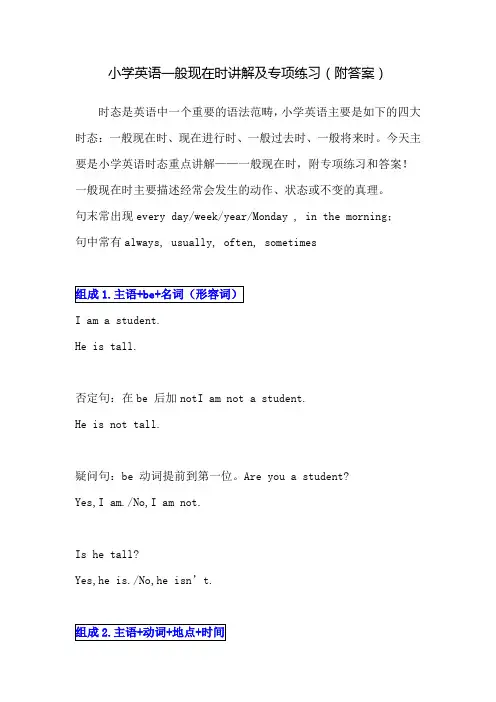
小学英语一般现在时讲解及专项练习(附答案)时态是英语中一个重要的语法范畴,小学英语主要是如下的四大时态:一般现在时、现在进行时、一般过去时、一般将来时。
今天主要是小学英语时态重点讲解——一般现在时,附专项练习和答案!一般现在时主要描述经常会发生的动作、状态或不变的真理。
句末常出现every day/week/year/Monday , in the morning;句中常有always, usually, often, sometimesI am a student.He is tall.否定句:在be 后加notI am not a student.He is not tall.疑问句:be 动词提前到第一位。
Are you a student?Yes,I am./No,I am not.Is he tall?Yes,he is./No,he isn’t.We go to school on Monday.He goes to the park on Sunday.否定句:主语+don’t/doesn’t’t+动词原形+地点+时间We don’t go to school on Monday.He doesn’t go to the park on Sunday.疑问句:在句首加do或doesDo you go to school on Monday?Yes, we do./ No, we don’t.Does he go to the park on Sunday?Yes, he does./ No, he doesn’t.专项练习一、写出下列动词的第三人称单数形式。
eat read do take washwatch have carry study flycatch go have cook looksing teach like get come play二、用单词的正确形式填空:1.Mike ___________ (do) his homework every day.2.There ____________ (be) some water in the glass.3.We like ____________ (play) basketball after class.4.I like singing. I often ____________ (listen) to the music in the evening.5.My grandma ___________ (watch) TV every day.三、选择最佳的答案:1.____Alice often play the piano. No, she _____.A. Do; doB. Does; doesC. Does; doesn't2.___ your penfriend __ in Beijing?A. Do; liveB. Do; livesC. Does; live3.Tom and Mike __ very excited, they will take a trip.A.IsB. areC. am4.I like ________ very much.What about you?A. danceB. dancedC. dancing5.I can’t find my pen. Let me __.A. go and ask herB. go and ask hersC. go and ask she6.Fangfang is a good student. She ____maths.A. does good atB. well do itC. is good at7.The kite ____ a bird.A. look likeB. is lookingC. looks like8.Bill and I ___ good friends.A. isB. areC. am9.Sandy often ___ his homework on Sundays .A. doB. doesC. did10.What do you usually do on the weekend? I __________.A.went swimmingB. go swimmingC. visited grandparents10.What do you usually do on your holiday?A. saw elephantsB. sing and danceC.took picture11.I ____ a student. I go to school ____bus every day.A. is; byB. am; onC. am; by12.I ____ a brother. She ____ a sister.A. have; hasB. has; hasC. have; have13.You ____ a student. He ____ a teacher.A. is; isB. are; isC. are; are15. He always _____ football games.A. watchesB. watchC. doesn't16.My best friend _____ shells.A. collectsB. collectC. often17.She doesn’t _____ listening to the music.A. oftenB. likeC. likes18.My mother and I ___ always watch romantic films.A. doesn’tB. don’tC. do19.---When _____ he get home on Friday?----He gets home at four on Friday.A. doB. doesC. did专项练习题答案一、写出下列动词的第三人称单数形式。
一般现在时,现在进行时语法及练习
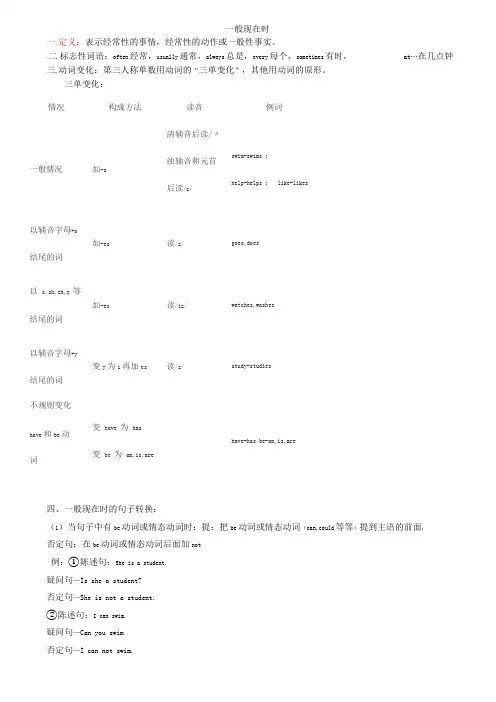
一般现在时一.定义:表示经常性的事情,经常性的动作或一般性事实。
二.标志性词语:often经常,usually通常,always总是,every每个,sometimes有时,at…在几点钟三.动词变化:第三人称单数用动词的“三单变化”,其他用动词的原形。
三单变化:情况构成方法读音例词一般情况加-s 清辅音后读/〃浊轴音和元首后读/z/swim-swims ;help-helps ;like-likes以辅音字母+o结尾的词加-es读/z/goes,does以s,sh,ch,x 等结尾的词加-es读/iz/watches,washes 以辅音字母+y结尾的词变y为i再加es读/z/study-studies 不规则变化have和be动词变have 为has变be 为am,is,arehave-has be-am,is,are四、一般现在时的句子转换:(1)当句子中有be动词或情态动词时:提:把be动词或情态动词(can,could等等)提到主语的前面;否定句:在be动词或情态动词后面加not例:①陈述句:She is a student.疑问句—Is she a student?否定句—She is not a student.②陈述句:I can swim.疑问句—Can you swim否定句—I can not swim.(2)当句子中即没有be动词,也没有情态动词时,则在主语前加助动词do (you,以及复数),does(单数she,he,it)变成问句;在主语后谓语动词前加助动词don’t (I,you,以及复数),doesn’t (单数she,he,it)变成否定句,助动词后的动词要变成动词原形。
例:①陈述句:We get up at 7:00 every morning.疑问句—Do you get up at 7:00 every morning?否定句—We don,t get up at 7:00 every morning.②陈述句:She has a little brother.疑问句—Does she have a little brother?否定句—She doesn,t have a little brother.总结:当主语是第三人称单数时:1、动词变相应的第三人称单数形式2、肯定句主语+动词s+其它3、否定句主语+doesn't+动词原形+其它4、一般疑问句Does+主语+动词原形+其它5、肯定回答Yes,主语+does6、否定回答No,主语+doesn't7、特殊疑问句特殊疑问词+一般疑问句当主语不是第三人称单数时:1、肯定句主语+动词原形+其它2、否定句主语+don't+动词原形+其它3、一般疑问句Do+主语+动词原形+其它4、要注意,句式结构错则全都错。
【时态】小学一般现在时与现在进行时讲解及练习
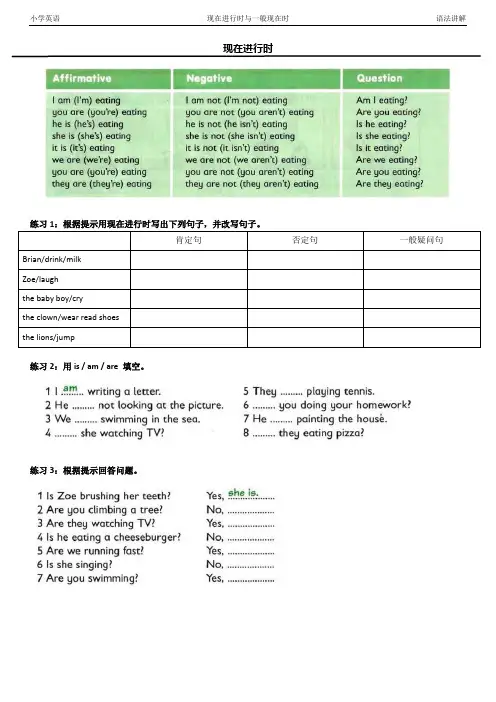
现在进行时
练习2:用is / am / are 填空。
练习3:根据提示回答问题。
练习4:看图用现在进行时写句子。
一般现在时
(一)主语为I/you/we/they
练习2:按要求改写句子。
(二)主语为he/she/it
肯定句否定句一般疑问句Zoe/like/sports
Dave/live/in London
She/cry/in the bedroom
练习2:按要求写句子。
练习3:按要求改写句子。
(三)一般现在时总结
练习1:选择适当的助动词填空。
练习2:句型转换。
练习3:根据提示完成短文。
一般现在时与现在进行时
练习1:改为否定句。
练习2:改为一般疑问句。
练习3:选择适当的词填空。
练习4:选择适当的词。
练习5:用now或者every day 填空。
练习6:用am / is / are 或者do / does 填空。
练习7:根据提示回答问题。
练习8:根据用一般现在时或现在进行时提示写句子。
改变名词: 小学一年级一般现在时和现在进行时讲解及习题
改变名词: 小学一年级一般现在时和现在进行时讲解及习题一、什么是一般现在时和现在进行时?- 一般现在时:一般现在时表示现在经常或反复发生的动作、状态或事实。
例如:我吃饭、他们上学等。
- 现在进行时:现在进行时表示现在正在进行的动作。
它由“be”动词(am/is/are)加上动词的现在分词构成。
例如:我正在吃饭、他们正在上学等。
二、一般现在时的构成和用法1. 构成:主语 + 动词原形(第三人称单数要加-s)。
2. 用法:- 表示客观事实、惯或经常性动作。
例如:The sun rises in the east.(太阳从东方升起。
)- 表示感觉、个人观点或常识。
例如:I like apples.(我喜欢苹果。
)三、现在进行时的构成和用法1. 构成:主语 + am/is/are + 现在分词。
2. 用法:- 表示现在正在进行的动作。
例如:I am eating dinner.(我正在吃晚饭。
)- 表示计划、安排或临时决定。
例如:We are going to the park.(我们要去公园。
)四、现在时和现在进行时的练题请根据句子的时间判断,将下面的动词填入一般现在时或现在进行时:1. My sister __________ (read) a book every day.2. They __________ (watch) TV at the moment.3. We __________ (go) to school from Monday to Friday.4. He ___________ (play) football every Saturday.5. I __________ (play) the piano right now.答案:1. reads2. are watching3. go4. plays5. am playing以上是关于小学一年级一般现在时和现在进行时的讲解及习题。
(完整版)一般现在时-现在进行时混合练习
一般现在时和现在进行时的区别一、概念不同:一般现在时表示主语经常性和习惯性的动作或存在的状态, 也表示说话者的能力及自然现象。
而现在进行时表示说话时(瞬间)正在进行的动作,也表示目前或现阶段一直进行的动作.如: She often does her homework in the evening.She is doing her homework now.二、在构成方式上的不同:一般现在时中谓语动词的构成有以下三种情况:①be 动词的一般现在时形式:am,is,are.②动词 have 的一般现在时形式:have,has。
③其他行为动词的一般现在时形式有动词原形或第三人称单数形式.而现在进行时中谓语动词的构成是:am/is/are+动词的-ing 形式(现在分词)。
三、时间状语不同:一般现在时的时间状语主要有:always,usually,often, sometimes , never , every day ,on Sundays , in the morning/afternoon/evening 等;现在进行时的时间状语主要有:now,these days,this week, at the moment 等,有时句首有“Look!”、“Listen!”或“It’s+时刻”等词、句存在。
如: We play football in the afternoon。
(习惯性动作)My mother is reading a book now。
(动作正在发生)四、用语范围不同:某种表示情感、意识(如 want,like,know 等);表示“有” 的 have 等动词,一般不用于现在进行时,但可用于一般现在时。
如:我现在就想回家。
误:I am wanting to go home now。
正:I want to go home now.他有一台电脑。
误:He is having a computer.正:He has a computer.一.写出下列动词的第三人称形式和 ing 形式.1.dance________ 2. stop ________3. sit________ 4。
一般现在时和现在进行时区别及习题

一、基本用法不同【1】一般现在时用来表示习惯性的动作或状态。
如:She goes to school by bike every day.她每天骑自行车去上学。
【2】现在进行时用来表示现在(说话的瞬间)正在发生或进行的动作或者用来表示现阶段正在进行或存在的状态。
如: Look ! She is reading under the tree.瞧!她正在树下看书。
二、谓语动词的形式不同【1】一般现在时的谓语动词:1) be动词用am/is/are这三种形式;2) 实义动词用动词原形或第三人称单数形式( 根据主语数的变化而变化) 。
【2】现在进行时谓语动词的形式为:am / is / are+ 动词 -ing形式。
如:We go to schoolat seven in the morning.我们早晨七点钟上学。
I am reading English now.我现在正在读英语。
三、时间状语不同【1】一般现在时常与o ften, sometimes, always, usually等频率副词及once a week/day 等频率短语连用,还与every morning /day / week..., on Wednesday, in the morning/ afternoon / evening等时间状语连用。
【2】现在进行时常与now, these days, these weeks等时间状语连用。
句首有Look ! / Listen !等提示语时,后面的句子中动词一般用现在进行时。
四、特殊用法1.一般现在时的特殊用法:表示客观真理、自然现象往往要用一般现在时表示。
如:The moon goes round the earth.月亮绕着地球转。
2.现在进行时的特殊用法:现在进行时与always连用时,往往含有赞扬、厌恶、责备等感情色彩。
如: He is always working hard.他总是非常努力地工作。
小学英语六年级所有时态综合练习
小学英语六年级所有时态综合练习在小学英语六年级的学习中,时态是一个非常重要的语法知识点。
掌握好时态,对于正确表达英语句子和理解英语文章都有着至关重要的作用。
接下来,我们将对小学英语六年级所学的一般现在时、一般过去时、一般将来时和现在进行时这四种主要时态进行综合练习。
一、一般现在时一般现在时表示经常发生的动作或存在的状态。
当主语是第三人称单数(he,she,it)时,动词要用第三人称单数形式。
1、构成主语+ be(am/is/are)+表语主语+实义动词(当主语是第三人称单数时,动词要加 s 或 es)2、时间状语always(总是),usually(通常),often(经常),sometimes(有时),never(从不),every day/week/month/year(每天/每周/每月/每年)3、例句I am a studentHe often plays football after schoolThey are very happy练习:1、 My father ______ (watch) TV every night2、 She ______ (like) music very much3、 The children often ______ (play) in the park二、一般过去时一般过去时表示过去发生的动作或存在的状态。
1、构成主语+ was/were +表语主语+动词的过去式2、时间状语yesterday(昨天),last week/month/year(上周/上个月/去年),ago(以前),in +过去的年份3、例句I was at home yesterdayThey played basketball last weekHe went to Beijing two years ago练习:1、 We ______ (have) a party last night2、 She ______ (buy) a new dress yesterday3、 He ______ (do) his homework an hour ago三、一般将来时一般将来时表示将来要发生的动作或存在的状态。
一般现在时与现在进行时讲解及练习
一般现在时一、定义与讲解:一般现在时表示经常或习惯性的动作或一般性事实;,也可表示现在的状态或主语具备的性格和能力;通常与副词every day每天,always总是,usually通常,often经常sometimes有时,等时间状语连用;例:1表示事物或人物的特征、状态;The sky is blue.天空是蓝色的;Mary’s father is an English teacher. 玛丽的爸爸是一名英语老师;2表示经常性或习惯性的动作;I get up at six every day.我每天六点起床;She plays sports every day. 她每天都做运动;3表示客观现实;The table has four legs.桌子有四条腿;There are 50 students in my class. 我们班有50个学生;4表示客观真理,科学原理,自然现象,等客观事实或格言谚语等;The sun rises in the east every day.太阳每天从东方升起;The earth goes around the sun.地球绕着太阳转;5表示平日的喜好;I like bananas. We don’t like vegetables.He likes ice cream. She doesn’t like strawberries.二.只有主语在第三人称单数时用动词的“三单形式”,其他人称用动词原形;★动词三单形式的变化规则:1.1多数直接在动词词尾加-s.play — plays like — likesask---asks work---works get---gets call---calls2以字母s, x, ch, sh或o结尾的动词,在词尾直接加-es.watch---watches wish---wishes do---does go---goes3以“辅音字母加- y”结尾的动词,要先变y为i再加-es.try---tries study---studies cry---cries fly---flies2.不规则变化:be---- is have----has三、一般现在时的句子转换:1变一般疑问句:当句子中有be动词或情态动词时,则把be动词或情态动词can,could等提到主语的前面,口诀:一调二变三问号;2变否定句:在be动词或情态动词后面直接加not变成否定句. be后not莫忘记例:①陈述句:She is my sister..疑问句→ Is she your sister Yes, I am./ No, I’m not.否定句→ She is not my si ster.②陈述句:I can play soccer.疑问句→ Can you play soccer Yes,Ican./ No, I can’t.否定句→ I can not /can’t play soccer.★注意:对一般疑问句的回答:一般用什么问就用什么来回答;但以下例外:Is this a pencil Yes , it is./ No, it isn’t.Is that your backpack Yes , it is./ No, it isn’t.Are these your parents Yes, they’re./ No, they aren’t.Are those Jim’s brothers Yes,they’re./ No, they aren’t.3当句子中没有be动词,也没有情态动词时,变一般疑问句时,在主语前加助动词do I, we, you,以及复数, does第三人称单数she,he,it等变成问句;4变否定句时,在主语后谓语动词前加助动词don’t, doesn’t变成否定句,切记:助动词后的动词则还原成动词原形;例:①陈述句:We get up起床at 7:00 every morning.疑问句→Do you get up at 7:00 every morning否定句→We don’t get up at 7:00 every morning.②陈述句:She has a brother.疑问句→ Does she have a brother否定句→ She doesn’t have a brother.※在一般现在时中,当主语是第三人称单数时,谓语动词要用第三人称单数形式,即常在动词原形后加-s或-es;但有些同学们对于哪些主语是第三人称单数还不十分清楚,现归纳总结如下:一、人称代词he, she, it是第三人称单数;如:He likes watching TV. 他喜欢看电视;She has lunch at twelve. 她十二点吃午餐;二、单个人名、地名或称呼作主语;是第三人称单数;如:①Han Mei likes salsd . 韩梅喜欢萨拉;②Beijing is in China. 北京在中国;③Uncle Wang often plays volleyball.. 王叔叔经常打排球;三、单数可数名词或"this / that / the+单数可数名词"作主语时,是第三人称单数;如:②This book is yours. 这本书是你的;③That car is red. ④The cat is Lucy's. 这只猫是露茜的;四、不定代词someone, somebody, nobody, everything, something等及指示代词this, that作主语时,是第三人称单数;①Everyone is here. 大家到齐了;②There is a watch on the table. 桌上有块手表;③This is a pen. 这是一支钢笔;④That is an eraser.五、不可数名词作主语时为第三人称单数;如:①The milk牛奶is in the glass. 牛奶在玻璃杯里;②The bread is very small. 那面包很小;六、当数字或字母作主语时,看作第三人称单数;如:①"6" is a lucky number. "6"是个吉利数字;②"I" is a letter. "I"是个字母;一、按照要求改写句子1.This is my pencil 变一般疑问句your pencil 2. These red socks are Kate’s . 变一般疑问句socks Kate’s3. Mary does not have any books . 变肯定句some books .4. She likes theblack bag very much . 变为否定句5. I like apples. 用she改写句子6. It’s an English dictionary . 对画线部分提问. 7. He has hamburger and apples for dinner . 变一般疑问句二、用Be动词填空;1. you Li Fen No, not .2. Mr. green very busy Yes , he .3..This book very interesting .4. What class you in5. You and I good friends .6. The basketball club fun .三.用所给动词的适当形式填空;1. Lin Tao like his ruler .2. Let’s have ice cream .3. Let’s play tennis4. He like English.5. Nice meet you6. I need some fruits.一般现在时用法专练:一、写出下列动词的第三人称单数形式;have like drink _____ go _____ stay ____ study___ _ teach_____make ______look ______have____ come_____ watch______ plant_____ fly _____ do_____ 二、用括号内动词的适当形式填空;1. He often ________have dinner at home.2. Daniel and Tommy _______be in Class One.3. We_______not watch TV on Monday.4. Nick ____ ___not go to the zoo on Sunday.5. ______ they ________like pears6. _______ your parents _______have eggs every day7. There ________be some water in the bottle.18. Mike _______like cooking.9. They _______have the same hobby.10. Liu Tao ______ _do not like PE.11. This boy often _______watch TV in the evening.五、改错划出错误的地方,将正确的写在横线上1. Is your brother speak English __________________2. Does he likes going fishing ________________3. He likes play games after class. _______________ __4. Mr. Wu teachs us English. _______________5. She don’t do her homework on Sundays. _____________一般现在时态句型转换1.This is a white key. 对画线部分进行提问2.B en’s bag is yellow and red . 对画线部分进行提问3.Her name is Gina. 对画线部分进行提问4.My phone number is 673-8220. 对画线部分进行提问5.The boy’s name is Jack. 对画线部分进行提问6.The picture is on the wall. 对画线部分进行提问7.Your baseball is under the chair. 对画线部分进行提问8.His book is on the desk. 对画线部分进行提问9.Some balls are in the dresser. 对画线部分进行提问10.My computer is on my desk. 对画线部分进行提问11.He is Johnny. 改为一般疑问句12.These are his parents. 改为一般疑问句13.This is my sister. 改为一般疑问句baseball is under the bed. 改为一般疑问句key is on the bed. 改为一般疑问句has a tennis racket. 改为一般疑问句have some baseball bats. 改为一般疑问句has many things to do today. 改为一般疑问句like hamburgers . 改为一般疑问句have a TV. 改为一般疑问句are Tina. 改为否定句are my brothers. 改为否定句books are on the bookcase. 改为否定句books are under the desk. 改为否定句has a computer game. 改为否定句have a big TV in our house. 改为否定句has some money in her pocket. 改为否定句likes ice cream. 改为否定句to meet you 写出答语35.Is that a dictionary 改为复数句____________________________________________36These are photos. 改为单数句he your cousin 作肯定回答Linda his sister 作否定回答this a Chinese book 作否定回答are dictionaries. 改为单数句the CD on the sofa 作肯定回答the chairs next to the table 作否定回答is my book 改为复数句子are on the sofa . 改为单数句子现在进行时现在进行时是由“助动词beam, is, are+动词-ing”构成,表示说话者“此刻”或现阶段的行为;二、现在进行时的基本结构1.肯定句:主语+beam, is, are+现在分词+…… 例如:I am speaking with him on the phone. 我正和他通电话;He is playing tennis. 他正在打网球; My parents are dancing. 我父母正在跳舞;2.否定句:主语+be not+现在分词+…… 例如:I'm not studying. 我没在学习; She is not reading now. 现在她不是在看书;They are not writing. 他们没在写;3.一般疑问句:Be动词+主语+现在分词+…… 例如:1— Is she still helping Li Ling她还在帮助李玲吗— Yes, she is. 是的;/No, she isn't. 不,她没在帮李玲;2— Are you listening to music 你正在听音乐吗— Yes, I am. 是的;/No, I'm not. 不,我没有听音乐;4.特殊疑问句:特殊疑问词+be动词+主语+现在分词+…… 例如:— What are you studying 你正在学什么— I'm studying English. 我在学英语;— What is Mike doing 迈克在做什么----He is watching the football match. 他在看足球比赛;三、现在分词的变化规则1.一般在动词末尾加ing,如:think-thinking go-going2.以不发音字母e结尾的动词,先去掉e,再加ing,如:come-coming make-making3.以重读闭音节结尾的动词,中间只有一个元音字母,词尾只有一个辅音字母,应双写末尾的辅音字母,再加ing, 如:put-putting run-running四、现在进行时的基本用法1.表示此时此刻说话者正在进行的动作;例如:The teacher is talking with his students. 这位老师正在同他的学生交谈;What are you doing now 你现在干什么呢2.表示现阶段正在进行的动作,但此刻并不一定在进行; 例如:We are doing an experiment this week. 我们这个星期正在做一个实验;但说话时并不一定在做实验;3.现在进行时有时可用来表示将来发生的动作,这一用法常用于go, come, leave, start 等短暂性动词,后面也常用表示较近的将来时间状语如tomorrow, tonight, this morning/Friday 等,表示安排或计划好的事情;例如:We are leaving for Shanghai tomorrow. 我们明天启程去上海;4.现在进行时表示说话时正发生的或者正进行的动作;常与时间状语now , at the moment 等连用;It is raining hard now . Don't hurry .I am writing a letter . Will you please turn down the radioWatch out 当心It's falling .Look The clouds are gathering .Look at this picture of a busy railway station . A train is standing at one of the platforms ready to leave . Some of thepassengers are looking out of the windows watching the late-comers who are hurrying along looking for empty seats .We are busy at the moment . I'm selling cigarettes . My father is selling some sweets .5.表示按计划、安排将要发生的动作;We are going to Rome next week . Mr Black is leaving for Shanghai in a few days .Are you doing anything special tonight6.用在时间和条件状语从句中表达将来正进行的动作;I'll telephone you tomorrow while I'm waiting .I'll think about it while you are writing the report .When you are talking with him , take care not to mention this .If you are standing at the corner when I pass , I'll give you a lift into town .五、现在进行时的练习题按要求改写句子The boy is playing basketball.否定句:____________________________一般疑问句:_________________________ 肯定回答:__________________________ 否定回答:__________________________ 对“is playing basketball”提问:__________________________对“ The boy”提问:__________________________They are singing in the classroom.否定句:____________________________ 一般疑问句:_________________________ 肯定回答:__________________________ 否定回答:__________________________ 对“are singing ”提问:__________________________对“ in the classroom”提问:__________________________,the window ,open, now.用现在进行时连词成句._____________________birds are singing in the tree.就划线部分提问________________________,who,the window, cleaning连词成句______________________7. The children are playing games near the house.就划线部分提问_______________is closing the door now.改成否定句______________________are doing your homework.用“I”作主语改写句子______________________,the tree, sing, now, under.用现在进行时连词成句._____________________Young Pioneers are helping the old woman.改成一般疑问句______________________II.单项选择1.我在照看孩子.AI am looking after the baby. BI'm look aftering the baby.CI look am aftering the baby. DI looking after the baby.'s making ______a kite.AI, me BMy, my CMy, me DHis, his the woman ______ yellow your teacherAin Bputting on Cwearing DhavingThe twins _____their mother do the housework.Aare wanting Bhelp Care helping Dare looking the birds doing They are singing in a tree.AWho BWhat CHow DWhere she ____somethingAeat Beating Ceatting Deats7.你在干什么AWhat is you doing BWhat are you doCWhat are you doing DWhat do you doare you listening_____A/Bfor Cat Dto9.我正在听他说话.AI listening to him.BI'm listening to him.CI'm listen to him.DI'm listening him.are ____their clothes.Amakeing Bputting Cput away Dputting on III.用现在进行时完成下列句子:do sing an English song.mend mend a car.fly a kite Yes ,_______.sit in the boatask questionsplay games now.man______________work near the house now.。
小学英语语法时态归纳及练习(含答案解析)
英语时态归纳一、一般现在时:标志词:often(经常) sometimes(有时) always(总是) usually(通常) never(从不) every(每一)行为动词词型变化形式:一般现在时动词只有第三人称有词形变化;其他人称(第一人称:I, we;第二人称:you;第三人称复数:they、my friends)动词均用原形。
当主语是第三人称单数时,一般动词在一般现在时句子中的变化规律:1、多数在动词后加s:play—plays like—likes ,2、以s,x,sh,ch,o结尾的动词加es wash–washes catch–catches do–does3、以辅音字母加y结尾,把y改i再加es fly—flies study—studies4、以元音字母加y结尾,直接加s buy – buys5、不规则变化have—has一般现在时基本用法功能1.表示事物或人物的特征、状态。
如:The sky is blue.天空是蓝色的。
2.表示经常性或习惯性的动作。
如:I get up at six every day.我每天六点起床。
3.表示客观现实。
如:The earth goes around the sun.地球绕着太阳转。
The earth is round.构成1. be动词:主语+be(am,is,are)+其它。
如:I am a boy.我是一个男孩。
2.行为动词:主语+行为动词(+其它)。
如:We study English.我们学习英语。
句型肯定句:A.be动词:主语+ be + 其它成分He is a worker.B.行为动词:主语+动词(注意人称变化) +其它成分We like the little cat.否定句:A.be动词:主语+ be + not+其它成分They are not students.B.行为动词:主语+助动词(do/does) + not+动词原形+其它成分We don’t like the little cat.一般疑问句:A.be动词:Am / Is /Are +主语+ 其它成分Are you a teacher? Yes, I am. / No, I am not.Are they students of your school. Yes, they are / No they aren’t.B.行为动词:助动词(Do/Does)+主语+动词原形+ 其它成分Do you like it? Yes, I do. / No. I don’t .Does he(she) like it? Yes, he( she )does. / No, he ( she )doesn’t.特殊疑问句:疑问词+ 一般疑问句A.be动词:How many students are there in your school?B.行为动词:What do you usually do on Sunday?一般现在时动词be和have的变化形式1.动词Be 叫连系动词, 用法:第一人称单数用am,第三人称单数用is,其它人称用are。
一般现在时和现在进行时时态练习及讲解
小学英语一般现在时讲解及练习一. 意义:表示经常发生的事情,动作或存在的状态二. 构成及变化1.be 动词的变化。
肯定句:主语+be(am,is,are)+其它。
如:I am a boy.我是一个男孩。
否定句:主语+ be + not +其它。
如:He is not a worker. 他不是工人。
一般疑问句:Be +主语+其它。
如:-Are you a student? -Yes. I am. / No, I'm not.特殊疑问句:疑问词+一般疑问句。
如:Where is my bike?2.行为动词的变化。
l 、当主语为第一,二人称及复数时,助动词为do肯定句:主语+动词原形(+其它)。
如:We often play basketball after school. 否定句:主语+ don't+ 动词原形(+其它)。
如口:we don' t play basketball after school. 一般疑问句:Do +主语+动词原形+其它?如:Do you often play basketball after school l? Yes, we do. / No, we don't. 特殊疑问句:疑问词+以do开头的一般疑问句?如:What do you often do after school ?2、当主语为第三人称单数时,助动词为does 肯定句:主语+动词三单式(+其它)。
如:He swims well.否定句:主语+ doesn' t动词原形(+其它)。
如:He doesn t swim well.. 一般疑问句:Does +主语+动词原形+其它。
如:Does he swim well ?Yes, he does. / No, he doesn't.特殊疑问句:疑问词+以does开头的一般疑问句?如:How does your father go to work? 三.第三人称单数的动词变化规则(只有在第三人称为主语的肯定句中,动词才用三单式)(1)多数动词直接加S:runs gets likes collets take S P la ys climbs(2)结尾是s, x, sh, ch, o前为辅音字母,结尾加es :brusheswatches teaches goes does washes crosses mixes(3)动词末尾y前为辅音:将y改为i加es: study —studies fly —flies carry —carries cry —cries但在y前如果为元音则直接加s: buys says四.时间标志:always , usually , ofte n , sometimes ,every一般现在时练习题(1)I.用下列单词的适当形式填空1.We often __________ (play) in the playgro und.2.He _________ (get) up at six o ' clock.3. _________ you ___________ (brush) your teeth every morning?4.What _________________ (do) he usually _________________ (do) after school?5.Da nny _________________ (study) En glish, Chin ese, maths, scie nee and Art atschool.6.Mike sometimes __________ (go) to the park with his sister.7.At eight at ni ght, she ______ (watch) TV with his pare nts.8. _______ Mike _________ (read) En glish every day?9.How many lessons __________ your classmates _________ (have) on Mon day?10.What time ________ his mother __________ (do) the housework?11.句型转换1.Do you often play football after school?(改为肯定句)2.1have many books.(改为否定句)3.Gao Shan ' s sister likes playingpble tennis (改为否定句)4.She lives in a small tow n near New York.(改为一般疑问句)5.1watch TV every day.(改为一般疑问句)6.We have four lessons.(改为否定句)7.Nancy doesn ' t run fast(改为肯定句)8.My dog runs fast.(改为否定句)9.Mike has two letters for him.一般疑问句:_________________________________________________ 否定句:___________________________________________________ 10.1usually play football on Friday after noon.否定句: ____________________________________________________ 一般疑问句:_______________________________________________ 划线提问:___________________________________________________ 11.Su Yang usually washes some clothes on Saturday.否定句: ____________________________________________________ 一般疑问句:_______________________________________________ 划线提问:_________________________________________________ 12.Mingming usually waters the flowers every day.否定句: ____________________________________________________ 一般疑问句:_______________________________________________ 13.Tom does his homework at home.否定句: ____________________________________________________ 一般疑问句:_______________________________________________ 一般现在时练习题(2)一、用所给动词的真确形式填空1.I like ____________ (swim).2. ___________ He (read) English every day.3. ___________ We (go)to school at seven in the morning.4. ___________ Mike (go)to school at seven in the morning.5. ________________ My mother ___ (like) (go) shopping.6.I can ________ (draw) many beautiful pictures.7.She __________ (make) a model plane.8.Do you _________ (like) ________ (run)?9.Does he ___________ (like) ______ (jump) ?10. __________________ Does Nancy (grow)flowers on Saturday ?11. __________________ The teachers _____ (like) (dance).12. __________________ The teacher ______ (like) (dance).13. _____________________ The students (speak) English in class.14. __________________ The student (speak) Chinese after class.15.Let ' s _____________ a nd play football . (go)16.He ______________ like swimming . (not)17.I ' m sorry _____________ that . (hear)18.Wang Bing is _____________ (write) an E-mail to his friend .19.He has ______________ a headache . (get)20. _______ you study English at school ? Yes , I _________ . (do)21. _________ your sister study English at school ? No , she _______ . (do)22.I ' m __________ better . (feel)23.Why ___________ Tom absent today ? (be)二、用所给的人称改写句子1.I take photos on Sunday. (Mike)2.We grow beautiful flowers. (she)3.They like collecting stamps. (Ben)4.I listen to music carefully. (my aunt)5.You like making a model ship. (Helen)6.We clean the classroom every day. (he)7.They look after the pandas. (Mr Wang)8.I draw a tree and some flowers. (Nancy) 9.We go to bed at eight. (my sister)10.I read newspapers in the evening. (Mr Green)小学现在进行时讲解及练习题1、概念:现在进行时表示说话时正在发生的事情或状态。