
外研版七年级英语下册Module 11 Body language知识点汇总
Module 11 Body language
必背单词
1. kiss v.吻;亲吻→kisses(第三人称单数)
2. shake v.摇晃→shook(过去式)
3. British adj.英国的;英国人的→Britain n.英国
4. German n.德国人;德语→Germans pl ;
adj.德国的;德国人的;德语的→Germany n. 德国5. Japanese n. 日本人;日语
adj.日本的;日语的;日本人的→Japan n.日本
6. Russian n.俄罗斯人;俄语
adj.俄罗斯的;俄罗斯人的;俄语的→Russia n.俄国
7. visitor n.游客;观光者→visit v.参观
8. nod v.点(头)→nodded(过去式)
9. hug v.拥抱;紧抱→hugged(过去式)
10. India n.印度→Indian adj. 印度的
11. touch v. 触摸;接触→touches(第三人称单数)
12. bow v. 鞠躬;弯腰
13. smile v. & n. 微笑
14. what int. 什么(表示惊奇)
15. head n. 头;头部
16. each pron. 各个;每个
17. together adv. 一起;共同
18. Maori adj. 毛利人的
19. nose n. 鼻子
必背短语
20. each other 互相
21. body language 肢体语言
22. in Russia 在俄罗斯
23. touch noses 碰鼻子
24. in the US 在美国
必背句子
25. We Chinese often shake hands and smile when we meet visitors, and
sometimes we nod our heads.
我们中国人在见到客人时常常握手并微笑,有时我们会点头。
26. That's because people do different things in different countries.
那是因为不同国家的人们做法不同。
27. In India people put their hands together and nod their heads.
在印度人们双手合十并点头。
必背单词
1. foot n. 脚;足→feet pl.
2. body n.身体,躯干→bodies pl.
3. foreign adj.外国的→foreigner n.外国人
4. personal adj.个人的→person n.人
5. hold v.握着;使不动→held(过去式)
6. move v.移动→movement n.移动
7. polite adj.礼貌的→impolite adj. 无礼的(反义词) →politely adv. 礼貌地
8. wave v.挥(手);招(手);摆(手)→waved(过去式)
9. finger n. 手指
10. knee n. 膝盖
11. leg n. 腿
12. mouth n. 嘴;口
13. arm n. 臂;手臂
14. somewhere adv. 某处;某个地方
15. fact n. 事实;细节
16. rude adj. 粗鲁的;无礼的
必背短语
17. North American 北美人
18. arm in arm 臂挽臂地
19. South American 南美人
20. not at all 一点也不
21. in fact 事实上
必背句子
22. Give them more personal space.
要给他们更多的私人空间。
23. How about touching people?
碰触人们怎么样?
24. In some places, it isn't polite to look at people when you talk.
在有些地方跟别人说话时看着他们是不礼貌的。
必背单词
1. bring v. 带来→brought(过去式)→take v. 带走(对应词)
必背短语
2. bow to. . . 向……鞠躬
3. many other things 许多其他的事
4. a way of ……的一种方法
5. on time 准时,按时
必背句子
6. Open doors for others.
为别人打开门。
7. You cannot touch anything if the teacher doesn't ask you to.
如果老师不让你做你不能碰触任何东西。
8. It's a way of being polite and showing respect.
这是一种礼貌和表示尊重的方法。
外研版七下M11Body-language知识清单
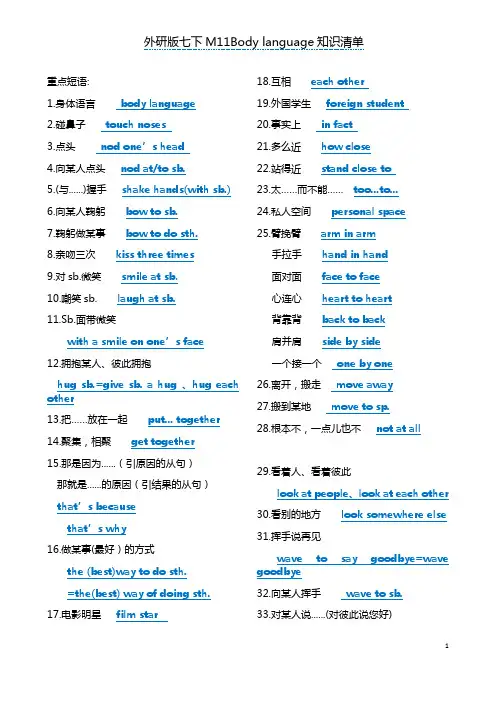
重点短语:1.身体语言body language2.碰鼻子touch noses3.点头nod one’s head4.向某人点头nod at/to sb.5.(与......)握手shake hands(with sb.)6.向某人鞠躬bow to sb.7.鞠躬做某事bow to do sth.8.亲吻三次kiss three times9.对sb.微笑smile at sb.10.嘲笑sb. laugh at sb.11.Sb.面带微笑with a smile on one’s face12.拥抱某人、彼此拥抱hug sb.=give sb. a hug 、hug each other13.把……放在一起put... together14.聚集,相聚get together15.那是因为......(引原因的从句)那就是......的原因(引结果的从句)that’s becausethat’s why16.做某事(最好)的方式the (best)way to do sth.=the(best) way of doing sth.17.电影明星film star18.互相each other 19.外国学生foreign student20.事实上in fact21.多么近how close22.站得近stand close to23.太……而不能……too...to...24.私人空间personal space25.臂挽臂arm in arm手拉手hand in hand面对面face to face心连心heart to heart背靠背back to back肩并肩side by side一个接一个one by one26.离开,搬走move away27.搬到某地move to sp.28.根本不,一点儿也不not at all29.看着人、看着彼此look at people、look at each other30.看别的地方look somewhere else31.挥手说再见wave to say goodbye=wave goodbye32.向某人挥手wave to sb.33.对某人说......(对彼此说您好)say sth. to sb.( say hello to each other ) 34.那很简单that’s easy35.小心be careful=look out36.小心(不)做某事be careful(not) to do sth.37.对......礼貌、粗鲁be polite /rude to sb.38.做某事是有(不)礼貌的/粗鲁的It’s polite / impolite / rude to do sth.39.讲话礼貌speak politely40.做某事是合理的It’s all right to do sth.41.事实上in fact42.班规class rules43.听老师的话listen to the teacher44.认真地听listen carefully45.站成一排stand in line46.站地太近stand too close 47.独自进入实验室enter the lab alone48.准时,按时on time49.抓住某物(抓住你的胳膊)hold sth.(hold your arm)50.紧紧抓住,抓住不放某人、坚持某事(紧紧抓住你、坚持你的梦想)hold on to sb/sth.(hold on to you、hold on to your dream ) 51.不挂断电话,等一下,继续Hold on.=Hang on.=Wait a moment/minute.52.给某人带来某物bring sb. sth.=bring sth. to sb. 53.将某物展示给某人看show sth. to sb.=show sb.sth. 54.带领某人参观show sb. around.....重点句子:1.我们学校将会有些俄罗斯教师来访,我要去迎接来访者。
初一七年级英语下册外研版Module 11 Body language 模块知识点归纳
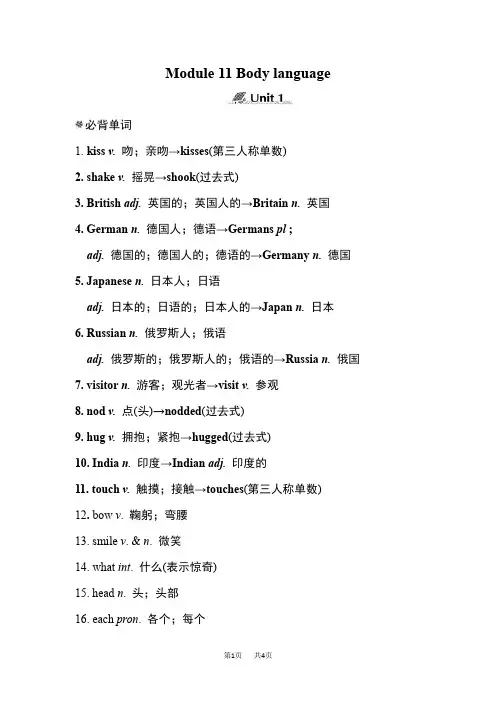
Module 11 Body language必背单词1. kiss v.吻;亲吻→kisses(第三人称单数)2. shake v.摇晃→shook(过去式)3. British adj.英国的;英国人的→Britain n.英国4. German n.德国人;德语→Germans pl ;adj.德国的;德国人的;德语的→Germany n. 德国5. Japanese n. 日本人;日语adj.日本的;日语的;日本人的→Japan n.日本6. Russian n.俄罗斯人;俄语adj.俄罗斯的;俄罗斯人的;俄语的→Russia n.俄国7. visitor n.游客;观光者→visit v.参观8. nod v.点(头)→nodded(过去式)9. hug v.拥抱;紧抱→hugged(过去式)10. India n.印度→Indian adj. 印度的11. touch v. 触摸;接触→touches(第三人称单数)12. bow v. 鞠躬;弯腰13. smile v. & n. 微笑14. what int. 什么(表示惊奇)15. head n. 头;头部16. each pron. 各个;每个17. together adv. 一起;共同18. Maori adj. 毛利人的19. nose n. 鼻子必背短语20. each other 互相21. body language 肢体语言22. in Russia 在俄罗斯23. touch noses 碰鼻子24. in the US 在美国必背句子25. We Chinese often shake hands and smile when we meet visitors, andsometimes we nod our heads.我们中国人在见到客人时常常握手并微笑,有时我们会点头。
26. That's because people do different things in different countries.那是因为不同国家的人们做法不同。
外研版七年级英语下册Module11Bodylanguage专题讲解
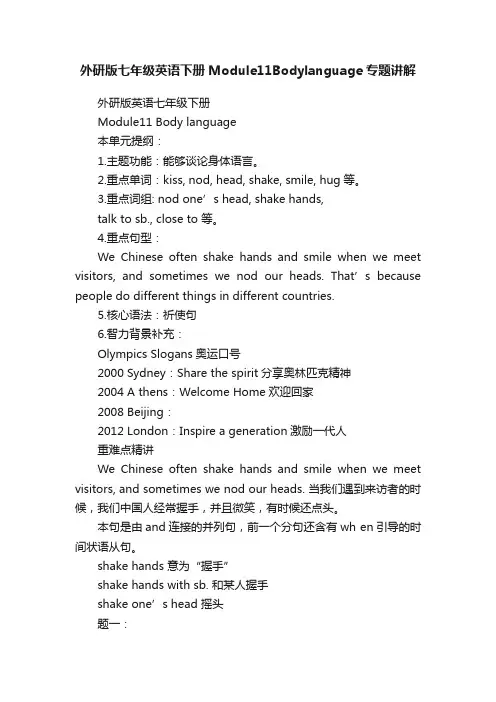
外研版七年级英语下册Module11Bodylanguage专题讲解外研版英语七年级下册Module11 Body language本单元提纲:1.主题功能:能够谈论身体语言。
2.重点单词:kiss, nod, head, shake, smile, hug等。
3.重点词组: nod one’s head, shake hands,talk to sb., close to 等。
4.重点句型:We Chinese often shake hands and smile when we meet visitors, and sometimes we nod our heads. That’s because people do different things in different countries.5.核心语法:祈使句6.智力背景补充:Olympics Slogans奥运口号2000 Sydney:Share the spirit分享奥林匹克精神2004 A thens:Welcome Home欢迎回家2008 Beijing:2012 London:Inspire a generation激励一代人重难点精讲We Chinese often shake hands and smile when we meet visitors, and sometimes we nod our heads. 当我们遇到来访者的时候,我们中国人经常握手,并且微笑,有时候还点头。
本句是由and连接的并列句,前一个分句还含有wh en引导的时间状语从句。
shake hands 意为“握手”shake hands with sb. 和某人握手shake one’s head 摇头题一:翻译题:1. 我见到他的时候,总是微笑。
2. 我爸爸妈妈站了起来,和老师握手。
In the US some people shake hands, and some kiss or hug each other.在美国,一些人握手,一些人相互亲吻或者拥抱。
外研社七年级英语下册Module11Bodylanguage知识点复习(最新整理)
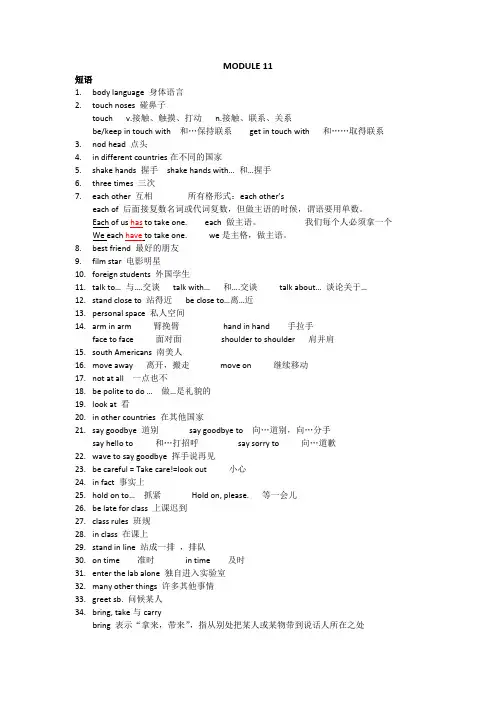
MODULE 11短语1.body language 身体语言2.touch noses 碰鼻子touch v.接触、触摸、打动n.接触、联系、关系be/keep in touch with 和…保持联系get in touch with 和……取得联系3.nod head 点头4.in different countries在不同的国家5.shake hands 握手shake hands with… 和…握手6.three times 三次7.each other 互相所有格形式:each other’seach of 后面接复数名词或代词复数,但做主语的时候,谓语要用单数。
Each of us has to take one. each 做主语。
我们每个人必须拿一个We each have to take one. we是主格,做主语。
8.best friend 最好的朋友9.film star 电影明星10.foreign students 外国学生11.talk to… 与….交谈talk with… 和….交谈talk about… 谈论关于…12.stand close to 站得近be close to…离…近13.personal space 私人空间14.arm in arm 臂挽臂hand in hand 手拉手face to face 面对面shoulder to shoulder 肩并肩15.south Americans 南美人16.move away 离开,搬走move on 继续移动17.not at all 一点也不18.be polite to do … 做…是礼貌的19.look at 看20.in other countries 在其他国家21.say goodbye 道别say goodbye to 向…道别,向…分手say hello to 和…打招呼say sorry to 向…道歉22.wave to say goodbye 挥手说再见23.be careful = Take care!=look out 小心24.in fact 事实上25.hold on to… 抓紧Hold on, please. 等一会儿26.be late for class 上课迟到27.class rules 班规28.in class 在课上29.stand in line 站成一排,排队30.on time 准时in time 及时31.enter the lab alone 独自进入实验室32.many other things 许多其他事情33.greet sb. 问候某人34.bring, take与carrybring 表示“拿来,带来”,指从别处把某人或某物带到说话人所在之处take 表示“带走,拿走”,指从说话人所在地把某人或某物带走或拿走carry仅表示“携带,带着”,不含方向句子:1. That’s because people do different things in different countries. 那是因为不同国家的人们做法不同。
Module11BodyLanguage知识点总结七年级英语下册

外研七下M11知识点(单词+短语+语法)M11 Body LanguagePart One Key Words1.Russian (adj.) 俄罗斯的;俄语的;俄罗斯人的(n.) 俄罗斯人,俄语Russia (n.) 俄罗斯【类似单词】Nation——People【拓展】“国人”变复数规律:①大多数是直接在词尾加s eg: IndiaIndianIndians①单复数同形eg:ChineseJapanese①将man改成men eg:FrenchmanFrenchmen2.shake (v.) 摇晃【词形变化】shakeshookshaken【用法】shake hands with sb 和某人握手【原句】We Chinese often shake hands and smile when we meet visitors, and sometimes we nod our heads.(课本P66)3.smile (v.&n.) 微笑【短语】(v.) smile at sb. 对某人微笑(n.) with a smile面带微笑【拓展】辨析smile、laugh【原句】We Chinese often shake hands and smile when we meet visitors, and sometimes we nod our heads.(课本P66)4.time (n.) [C] 次数[U] 时间5.hug (v&n.) 拥抱6.Together (adv.) 一起,共同【短语】① put....together 把...放在一起① get together 聚会7.Each other 互相,彼此【拓展】①所有格形式:each other’s①each (pron.) 每个,各个指两者或两者以上中的每个,在句中作主语、宾语、同位语等①each of .... ....中的每一个,该结构作主语时,谓语动词用单数。
外研版英语七下第十一模块Body language重要知识点总结
Module11 Body languageUnit1 They touch noses!1.shake hands (with sb.) “(和某人)握手”We Chinese usually shake hands with others when we meet for the first time.我们中国人第一次和他人见面通常会握手。
2.time的用法(1)用作可数名词,“次数”。
一次用once,两次用twice,三次或以上用“基数词+times”。
I play basketball three or four times a week.我一周打球三至四次。
(2)用作不可数名词,“时间”。
常用于句型It takes sb.some time to do sth.“做某事花了某人多少时间”It usually takes Tom about 2 hours to finish his homework every day.每天完成家庭作业Tom用时大约2小时。
(3)常见时间表达法:①on time “按时;准时”②in time “及时”③ in no time “立刻;马上”④at any time “随时”⑤for the first/second/st time”第一/二/...最后一次”⑥have a good/great/wonderful time “玩得开心;过得愉快”⑦all the time “一直”⑧from time to time=at times “有时候”3.kiss的用法(1)用于动词,常用于kiss sb.on...意为“亲吻某人(身体部位)”。
Mrs Brown k issed her daughter on her nose.布朗夫人亲了一下她女儿的鼻子。
(2)用于名词,常用于give sb a kiss“给某人一个吻”。
Mrs Brown gave her daughter a kiss to say good night.布朗夫人亲了一下女儿说晚安。
Module11Bodylanguage知识点总结外研版七年级下册英语
1. kiss three times 亲吻三次2. shake hands with sb (shook) 跟…握手3. touch noses 碰鼻4. nod our heads (nodded) 点头5. hug each other (hugged) 互相拥抱6. put their hands together 双手合十重点句型:1. That’s because people do different things in different countries.那是因为不同国家的人做不同的事情。
That’s because you were not careful enough.那是因为你不够仔细。
That’s because I didn’t know much about body language in this country.那是因为我对这个国家的肢体语言不了解。
重点点拨:1. each other 互相,彼此eg: help each other2. 国家和国人China (中国) -Chinese (中国人)Japan (日本) — Japanese (日本人)Germany (德国) -German(s)(德国人)France (法国) — French (法语) Frenchman-FrenchmenRussia (俄国) -Russian(s)(俄国人)Britain (英国) -- English (英语) Englishman-EnglishmenIndia (印度)—Indian(s)(印度人)词类变化:shake-shook nod-nodded hug-hugged hold-held bring-brought meet-met visit-visitor foreign- foreigner(s) person- personal polite-impolite- politely1. stand close to.... 站得离…很近2 walk arm in arm ... 手拉手走3.hold your arm 抓着你的胳膊4. talk to. /with sb about sth. 跟某人谈论某事5.move away 移开6. wave to say goodbye 挥手告别7.be careful with 对…谨慎/小心8. some ways to do 一些做事的方法9.Giv e them more personal space. 给他们更多的私人空间。
外研版英语七年级下册模块11Bodylanguage知识点归纳
外研社七年级英语下册模块11Body language知识点归纳知识点一:模块11的短语1.shakehands握手2.eachother互相,彼此3.nod one's head点头4.at school在学校5.in different countries在不同的国家6.arm in arm臂挽臂地7.not at all一点也不8.in fact事实上9.a way to do sth.做某事的方式10.around the world世界各地11.talk to...和……交谈12.move away搬走,离开13.look at看……14.waveto向……挥手15.SouthAmerican南美人16.North American北美人知识点二:重点词语解释1.Lingling,you know,in Russia,people usually kissthree times,left,right,left.玲玲,你知道吗,在俄罗斯,人们见面的时候通常亲吻三次,左边,右边,左边。
(1)times的意思是“次数,倍数”,表示次数,常用于三次及三次以上。
如:I have been here for many times before.我之前就来过这里很多次了(2)同样表示次数的还有:once一次,twice两次;对于次数的提问用“how many times”。
如:—How many times have you been to the park?你来过这个公园多少次了?—Twice.两次了。
2.We Chinese often shake hands and smile when we meet visitors,and sometimes we nod our heads.我们中国人见到来访者的时候经常握手并微笑,有时会点头示意。
(2)辨析:sometimes,sometimes,sometime及some time◆sometimes“有时候”,副词。
外研版七下module 11 body language知识点总结
Module 11 Body Language1. body language 身体语言2. touch noses 碰鼻子(touch 作动词, 意为: 接触, 触摸.作名词时, 意为: 接触, 联系, 关系) be/get in touch with和……取得联系keep in touch with 和…保持联系3. nod head 点头(nod 是动词,过去式是nodded; 现在分词是nodding) nod one’s head点头nod sb. a welcome 向某人点头表示欢迎4. 一次 once; 两次 twice; 三次 three times (大于等于三的用数字+times)5. shake hand s握手 (shake 是动词,意为: 摇晃,摇动,震动) Shake hand s with sb. 和某人握手5. people do different things in different countries在不同的国家人们做不同的事情different后要用名词复数6. hug each other互相拥抱each other 为相互代词,放动词后使用,如: help each othershake hands with each other; 所有格形式: each other’s. each of 后面接复数名词或代词复数,但做主语的时候, 谓语要用单数. 如: Each of boys has to take one. 每一个男孩必须拿一个。
Hug可以作名词也可以作动词She hugged the baby in her baby in her arms and ran out. 她紧抱着婴儿跑了出去She gave me a hug. 她给了我一个拥抱Give sb a hug 给某人一个拥抱。
Each 与every 都有每个的意思,但用法不同Each 既可以作形容词,也可以做代词。
七年级英语下册词法语法手册Module11Bodylanguage复习素材新版外研版
Module 11 Body language语法精选1. each 每个each表示“(两个或两个以上人或物中的)每个”,谓语动词用单数。
它还可以用作代词,置于复数主语之后,谓语动词用复数;也可以用在“each(one) of复数名词或代词”短语中,此时谓语动词通常用单数,也可用复数,但用复数谓语动词则比较口语化。
常构成短语each other,表示“相互”。
如:①They each have an email address.他们每个人都有自己的电子邮箱。
②We should help each other.我们应该互相帮助。
2. hold 抓住;举办hold作动词,意为“握住;抓住;举办;召开”。
如:①He held on to the chair to stop himself from falling.他扶住椅子,以免摔倒。
②We will hold a party in the open air next week.下个礼拜我们将在露天举办一场晚会。
与hold相关的短语有:hold on(电话用语)别挂断,等一下;hold on to坚持;抓紧;不放开。
3. shake hands 握手shake hands意为“握手”。
shake one’s hands=shake hands with sb.意为“跟某人握手”。
shake可作及物动词或不及物动词,意为“摇晃;摇动”;还可以作名词,意为“摇动;抖动”。
如:①He did not shake my hands. 他没有和我握手。
(作及物动词)②The trees were shaking in the wind. 树木在风中摇动。
(作不及物动词)③I noticed the shake of his hands. 我注意到他的手在抖动。
(作名词)4. British 英国人British意为“英国人”。
首字母无论在何种情况下都大写。