
新版外研版七年级上册Module_6_Unit2_The_tiger_lives_in_Asia
Animals
The elephant lives in Africa and in Asia. This elephant lives in Africa. It eats plants, leaves, bamboo and a little fruit, but it doesn’t eat meat. It likes water. There are only about 1,800 pandas in China and about 200 of them live in zoos. The panda eats about 30 kilos of bamboo a day, as well as plants and leaves. This black and white animal is the favourite of people all over the world.
Monkeys live in Africa, Asia and America.There are about 200 kinds of monkeys. Monkeys eat meat, leaves, fruit and even eggs.
Speaking
Play a game
Ask questions and guess what our
2. The panda eats about 30 kilos of bamboo a day, as well as plants and leaves. 熊猫一天吃大概30公斤的竹子, 也吃植物和 树叶。 I have a computer as well as an MP4 player. as well as 意为“并且,还”,常用来连接 并列的单词或短语。如: Mike eats meat as well as vegetables for lunch.
It looks like a cat.
tiger
Words and expressions
Africa / ' æfrɪkə / 非洲 Asia / ' eɪʃə/ 亚洲 Europe / ' jʊərəp/ 欧洲 little / ' lɪtl] adj. 极少量的 a little 少量 only/ ' əunli/ adv. 仅仅;只 about / ə ' baut/ adv. 大约,大致 kilo / ' kɪləu/ n. 千克;公斤 people/ ' pi:pl/ n. 人,人们 all over the world 全世界 Afican/ ' æ frɪkən/ adj. 非洲的 n. 非洲人
3. It likes water and is good at swimming. 它喜欢水,擅长游泳。 Cindy is good at tennis. 辛迪擅长打网球。 be good at 意为“在……方面 (学得, 做 得) 好、擅长……”, 其后可接名词、代 词或动词的-ing形式, 其近义词组为 do well in。如: Those boys are good at playing tennis. 那些男孩们擅长打网球。
as well as 并且,还 grass / ɡrɑ:s/ n. 草 large / lɑ:dʒ/ adj. 大的,巨大的 usually / ' juːʒuəli/ adv. 通常 alone / ə ' ləun/ adv. 独自的 be good at 擅长 strong / strɒŋ/ adj. 强壮的;强大的 catch / kæ tʃ/ V. 抓住;接住 many kinds of 许多种类 even / ' i:vn/ adv. 甚至
favourite animal is. 问问题并且猜最喜爱的动物是什么。 每组选出一名代表来回答问题,组员 可以补充。
两只老虎.mp4
Reading Task 3
阅读方法指导3 详细阅读,理解课 选词填空,并注意正确的形式。 文,找出关键词。 African a little grass kilo only world 1.The elephant eats a little fruit. _____ kilos 2.The panda eats about 30 ______ of bamboo a day. 3.The zebra eats plants, leaves and _______ but not grass bamboo. only 4.There are ______ about 1,800 panda in China. world 5. Monkeys live in many countries all over the ______ but not in Europe. 6.You can find elephants in Africa and Asia, but zebras are only _______animals. African
4. American, from, Americans, come _____________________________ Americans come from America. 5. zoo, in, there are, 200, panda,
about
There are about 200 pandas in _____________________________ zoos. _____________________________
请观察
1.The elephant lives in Africa and in Asia. 2.It eats plants.
3.It likes water. 4.The panda eats about 30 kilos of bamboo a day. 5. The zebra doesn’t eat bamboo. 6. Does it eat meat?
Find these places on the map. Africa America Asia Europe
非洲
美洲 亚洲 欧洲
2____ Europe 1 Africa _____
Asia 3_____
North 4 ______ America 南 South 5America _____
一.Teaching objectives 1)To describe animals including what they eat and where they live. 2) To know the importance of protecting animals. 3)To use capital letters correctly.
二.Teaching importances and difficulties 1)Present simple: the third person singular. 2)There are……
panda
Does it eat bamboo? Yes, it does.
elephant
Does it eat meat? No, it doesn’t.
三、 按要求完成句子。 1. They study in high school. (就划线部分提问) Where do ______ ___ they study? 2. The panda eats bamboo. (改为复数句子) pandas The ______ eat bamboo ________. 3. They are American girls. (改为单数句子) ___ __ __ American girl. She is an 4. The kangaroo comes from Australia. (改为同义句) The kangaroo __ ____ Australia. is from
Where does it come from? Where does it live? What does it often eat? What does it like doing? Does it eat meat? Does it come from Africa?
二、连词成句。 1. tiger, swimming, good, the, at, is The tiger is good at swimming. ____________________________ 2. Asian, the, is, zebra, not, an, animal The zebra is not an Asian animal. _____________________________ 3. elephants, meat, do, eat, not Elephant do not eat meat. _____________________________
monkey
Does it eat fruit? Yes, it does.
tiger
eats The tiger _____ meat.
第三人称单数形式
zebra
doesn't _____ bamboo. The zebra _______ eat
否定形式: doesn't +动词原形
(猜一猜)
第三人称单数行为动词的一般现在时
肯定句: 主语(第三人称单数)+V.-s/es +其他 否定句:主语(第三人称单数)+doesn’t+V.-原 +其他 一般疑问句:Does +主语(第三人称单数)+V.-原 +其他? 肯定回答:Yes, 主语+does. 否定回答:No, 主语+doesn’t.
M6U2 The tiger lives in Asia新外研七年级上课件
The zebra is an African animal. Like the panda, it’s black and white. It eats plants and leaves, as well as grass, but the zebra doesn’t eat bamboo.
zebra
Home: Africa Food: plants, leaves and grass
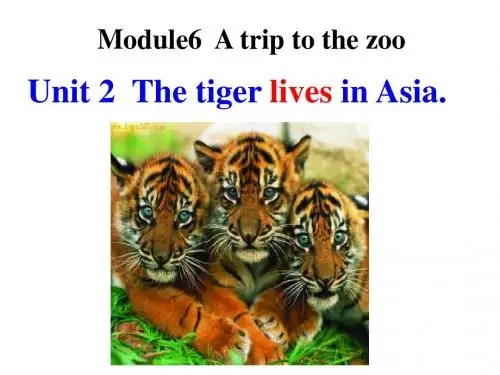
The tiger lives in Asia. It’s a very large animal and usually lives alone. It likes water and is good at swimming. It’s strong and catches many kinds of animals for food.
Home: Food: Asia
tiger
meat, many kinds of animals
monkey
Monkeys live in Africa, Asia and America. There are about 200 kinds of monkeys. Monkeys eat meat, leaves, fruit and even eggs!
Module6 A trip to lives in Asia.
Do you like wild animals?
Do you want to know where they lives?
1. How many animals are there in the passage?
Home: Africa, Asia Food: plants and a little fruit
外研版七年级英语上册教学设计《Module 6 Unit 2 The tiger lives in
外研版七年级英语上册教学设计《Module 6 Unit 2 The tiger lives in Asia》(第一课时)一. 教材分析《Module 6 Unit 2 The tiger lives in Asia》是人教版英语七年级上册的一篇课文。
本节课主要介绍了有关动物及其生活地区的词汇和句型。
教材内容丰富,插图生动有趣,有助于激发学生的学习兴趣。
通过本节课的学习,学生能够掌握有关动物的词汇,如tiger, panda, elephant, giraffe等,以及表示地点的词汇,如forest, mountn, Africa, Asia等。
同时,学生还能学会用一般现在时描述动物的生活习性。
二. 学情分析七年级的学生具备一定的基础英语知识,对动物和生活地点有一定的了解。
但部分学生可能对一些动物的英文名称和生活地点较陌生。
因此,在教学过程中,教师需要关注学生的个体差异,充分调动学生的积极性,引导他们通过观察、思考、讨论等方式主动学习。
三. 教学目标1.知识目标:–能够听懂、会说、会读课文中的词汇和句型。
–能够用一般现在时描述动物的生活习性。
2.能力目标:–能够运用所学的词汇和句型进行简单的交流。
–能够根据图片或提示,用英语描述动物和生活地点。
3.情感目标:–培养学生对动物的关爱和保护意识。
–增强学生学习英语的自信心和兴趣。
四. 教学重难点•掌握课文中的词汇和句型。
•能够用一般现在时描述动物的生活习性。
•正确运用一般现在时描述动物的生活习性。
•灵活运用所学词汇和句型进行交流。
五. 教学方法1.任务型教学法:通过完成各种任务,让学生在实践中学习英语。
2.情境教学法:创设生动有趣的情境,激发学生的学习兴趣。
3.合作学习法:引导学生进行小组讨论和合作,提高学生的参与度。
六. 教学准备1.教材:《人教版英语七年级上册》2.课件:包含课文内容、图片、动画等3.教学道具:动物图片、地图等4.作业素材:相关动物的资料和图片七. 教学过程1.导入(5分钟)–教师通过播放动物的叫声或展示动物的图片,引导学生谈论他们喜欢的动物。
外研版七年级英语上册《Module6Unit2ThetigerlivesinAsia》教学设计
外研版七年级英语上册《Module 6 Unit 2 The tiger lives in Asia》教学设计一. 教材分析外研版七年级英语上册《Module 6 Unit 2 The tiger lives in Asia》主要介绍了关于动物的地理分布。
通过本节课的学习,学生可以掌握有关动物的词汇和句型,并能够运用所学知识进行简单的交流。
教材内容丰富,插图生动有趣,有利于激发学生的学习兴趣。
二. 学情分析七年级的学生已经掌握了基本的英语语法和词汇,具备一定的听说读写能力。
但部分学生在发音和听力方面仍有待提高。
针对这一情况,教师应注重培养学生的发音准确性,提高他们的听力水平,并鼓励学生大胆开口说英语。
三. 教学目标1.知识目标:学生能够掌握关于动物的词汇,如tiger、lion、elephant等;理解并运用句型“Where does the tiger live?”进行询问和回答。
2.能力目标:学生能够正确发音单词和句型,提高听力水平;能够用英语简单描述动物的地理分布。
3.情感目标:培养学生热爱大自然,关注动物保护的意识。
四. 教学重难点1.重点:掌握有关动物的词汇和句型。
2.难点:正确发音单词和句型,运用所学知识进行实际交流。
五. 教学方法1.情境教学法:通过设定各种情境,让学生在实际环境中运用所学知识。
2.游戏教学法:运用游戏激发学生的学习兴趣,提高他们的参与度。
3.任务型教学法:布置课后任务,让学生将所学知识运用到实际生活中。
六. 教学准备1.准备动物图片和相关词汇的卡片。
2.制作PPT,包括动物图片、词汇和句型。
3.准备听力材料,如动物生活的音频或视频。
七. 教学过程1.导入(5分钟)利用PPT展示各种动物的图片,引导学生进行观看和描述。
同时,教师提问:“Can you name the animals?”,让学生自由回答。
2.呈现(5分钟)教师展示PPT,呈现本节课的主要词汇和句型。
外研版七年级上册英语M6 Unit 2 The tiger lives in Asia

meat
meat, leaves, fruitande ggs
Animals TheelephantlivesinAfricaandinAsia. ThiselephantlivesinAfrica. Iteatsplantsandalittle❶fruit,
butitdoesn'teatmeat. Itlikeswater. Thereareonlyabout1,
leaavses_________________fruit.
拓展 当aswellas连接的两个成分作主语时,其后谓 语的单复数形式通常要与其前面的主语保持 一致。 eg:Tomaswellashisparentsishere. 汤姆和他的父母在这儿。
知识点 4 leaf/liːf/n. 叶子
eg:Thereisaleafonthefloor. 地板上有一片叶子。 考向 leaf的复数形式是leaves;leaves还可作为动
知识点 6 begoodat擅长
考向 后跟名词、代词或动名词。同义短语为 dowellin;反义短语为bebadat。 eg:Iamgoodatswimming. 我擅长游泳。
典例 Englishismyfavoritesubject,andIamgood________it. (山东临沂C) A.for B.to C.at D.of
InEnglish, weusecapitalletterswiththefirstwordofasentence. Wealsousecapitalletterswiththenamesofcountrie
s,towns,placesetc.
一、单项选择 1.6,789reads____D____. A.sixthousand, sevenhundred, eightynine B.sixthousandandsevenhundred, eightynine C.sixthousands, sevenhundredandeightynine D.sixthousand, sevenhundredandeightynine 2.—Weshouldenjoythebeautiesof______D__nature. —Yes,Ithinkso. A.aB.anC.theD.不填
外研版七年级英语上册《Module6Unit2ThetigerlivesinAsia》说课稿
外研版七年级英语上册《Module 6 Unit 2 The tiger lives in Asia》说课稿一. 教材分析《Module 6 Unit 2 The tiger lives in Asia》是人教版七年级英语上册的一篇课文。
本节课主要介绍了有关动物的常识,通过讲述老虎生活在亚洲的故事,让学生了解不同动物的生活习性和地理分布。
教材内容丰富,插图生动,有利于激发学生的学习兴趣。
此外,本节课还涉及了表示位置的词汇和短语,如“on the left”、“next to”等,为学生提供了丰富的语言实践机会。
二. 学情分析七年级的学生已经掌握了基本的英语语法和词汇,具备一定的听说读写能力。
但学生在实际运用英语进行交流时,还存在一定的困难,如发音不准确、词汇搭配不当等。
因此,在教学过程中,教师需要关注学生的个体差异,尽量调动学生的积极性,提高他们的英语实际运用能力。
三. 说教学目标1.知识目标:让学生掌握表示位置的词汇和短语,如“on the left”、“next to”等;了解不同动物的生活习性和地理分布。
2.能力目标:培养学生运用英语进行简单描述和交流的能力,提高他们的听说读写技能。
3.情感目标:培养学生关爱动物、保护环境的意识。
四. 说教学重难点1.重点:表示位置的词汇和短语的用法;不同动物的生活习性和地理分布。
2.难点:运用英语描述动物的特点和位置。
五. 说教学方法与手段1.教学方法:采用任务型教学法,让学生在完成任务的过程中学习英语,提高他们的实际运用能力。
2.教学手段:利用多媒体课件、图片、卡片等辅助教学,激发学生的学习兴趣。
六. 说教学过程1.导入:通过展示动物图片,引导学生谈论自己喜欢的动物,激发学生的学习兴趣。
2.新课展示:教师带领学生学习表示位置的词汇和短语,如“on theleft”、“next to”等。
并通过展示教材图片,让学生描述不同动物的位置。
3.课堂活动:学生分成小组,根据教材内容,用英语编写关于动物的短剧,并进行表演。
新外研版七年级英语上册 Module 6 Unit 2 The tiger lives in Asia.

题组专训
用little 或a little 完成下列句子: 1. 冰箱里几乎没有牛奶了,但是有点儿果汁。你
想来一些吗? There is __l_it_t_le__ milk in the fridge, but ___a____ __l_it_t_le__ juice. Would you like some?
the ground. What beautiful scenery it is!【中考·哈尔滨】
A. leaf
B. leafs
C. leaves
【点拨】考查名词的复数形式。句意为“——艾丽斯,你最 喜欢哪个季节?——秋季。落叶就像一块厚厚的地毯铺在地 上。多么美丽的景色啊!”leaf的复数形式是leaves。故选C。
题组专训
用little 或a little 完成下列句子:
2. I have __C___ homework to do today, so I’m happy.
A. much
B. many
C. little
D. few
【点拨】根据后面“我很高兴”可知前面“我
今天作业很少”,故选C。
题组专训
3. 他不仅喜欢篮球,还喜欢足球。 He likes _fo_o_t_b_a_l_l_a_s_w__el_l_a_s_b_a_s_k_e_t_b_a_l_l __ .
9. Mr Smith lives in London,a big city in E urope .
10. He has a large family. There are seven people in it.
课后巩固
三、用方框中所给单词的适当形式填空,每词限 用一次 Asia, even, about, alone, leaf
Module6-Unit2-The-tiger-lives-in-Asia-教案(外研版七年级上册)
Module6 Unit2 The tiger lives in Asia 教案(外研版七年级上册)ⅠTeaching modelReading and writing.ⅡTeaching methodInteractive approachⅢTeaching aims1. To get information about animals from the reading material.2. To learn to find specific information in the reading.3. To learn to use capital letters.ⅣTeaching ObjectivesKey vocabulary: Africa, Asia, Europe, little, only, kilo (= kilogram ), people, African, grass, large, usually, alone, strong, catch, even, worldKey phrase: a little, as well as,be good atKey structures:The elephant lives in Africa and in Asia.The zebra is an African animal.The zebra doesn’t eat bamboo.The tiger lives in Asia.Monkeys live in Africa, Asia and America.ⅤTeaching aidsRecorder , OHP , videoⅥTeaching StepsStep 1 Warming-up1. Review the text of Unit 1.2. Show some pictures, ask the students to look at the pictures, then talk something about the pictures.3. Introduce the new words.4. Read the new words.Step 2 Find these places on the map.1. Show a map of the world.2. Find these places (Africa, America, Asia, Europe)on the map.3. Check with a partner .4. Call back the answers from the whole class .5. Show some pictures, ask the students to look at the pictures, then talk something about the pictures. Step 3 Reading.1. Play the recording.2. Ask the students to read through the passage.3. Read the passage and complete the table in Activity 3.4. Check with a partner.5. Call back the answers from the whole class.Keys:Elephants Africa and Asia plants, leaves, bamboo and a little fruitPandas China bamboo, plants and leavesZebras Africa plants, leaves and grassTigers Asia many kinds of animalsMonkeys Africa, Asia and America meat, leaves, fruit and eggs6. Complete the sentences with the correct form of the words and expression from the box in Activities 4.7. Check with a partner.8. Call back the answers from the whole class.Keys: 1. a little 2. kilos 3. grass 4. only 5. world 6. AfricanStep 4 Writing.1. Read the introduction about a zoo.2. Correct the mistakes.3. Ask the students to notice capital letters.The zoo has many animals. The animals come from many different countries. The panda lives in China and it eats bamboo. There are elephants from Africa and Asia. The tiger comes from Asia. It eats meat.Step 5 Do exercises:A.首字母填空:1. China is a country in A .2. They are Europeans. They come from E .3. The dog is my favourite a .4. In autumn, we can see the yellow l of the trees.5. The old man lives a . I usually talk with him.Keys:1. Asia2.Europe3. animal4. leaves5. aloneB.完成句子:1.狮子是欧洲的吗?Is the lion ?2.他们不是非洲人。
外研版七年级英语上册Module 6 unit2 The tiger lives in Asia.教
外研版七年级英语上册Module 6 unit2 Thetiger lives in Asia.教案Module6 A trip to the zooUnit2 The tiger lives in Asia.Part One — Analysis of the Teaching Material1. Status and Function:The type of the unit is reading and writing. It tells students five kinds of animals and where they are from. It expands the knowledge of species and geography for students.2. Teaching Key Points and Difficult Points:The Key Points:To master the key vocabulary and useful expressions.To get information about animals from the reading material.To use the present simple and the third person singular.To know the expression of classification of animals.Difficult Points:To be able to pronounce the four places correctly.To use the present simple and the third person singular to introduce animals.3.Analysis of the Students:The students have known some knowledge of animals, they areinterested in talking about animals and eager to know more about other animals. They are active to show their ability. So it’s necessary to encourage them to search for information from the reading and enrich their vocabulary and knowledge of animals.Part Two— Teaching Aims and Demands1. Knowledge ObjectKey vocabulary: Africa, Asia, Europe, African, grass, alone, strong, catch Key phrase: a little, as well as, be good atKey structures: The elephant lives in Africa and in Asia. The zebra doesn’t eat bamboo. Monkeys live in Africa, Asia and America.2. Ability ObjectTo get information about animals from the reading material.To write short passages about animals .3. Moral ObjectTo improve the students’ awareness of loving animals and protecting the environmentPart Three— Teaching and Studying Methods1. Teaching Methods1) Communicative teaching method2)Task -based method2. Studying Methods1) Individual study2 )Communicating and cooperating.3. Teaching AidsMulti-media, learning sheets.Part Four—Teaching Procedures:Step 1 Warming-up:Show the students some pictures and sentences, asking them to guess what animal it is.Purpose of my designing: Raise the students’ interest in the lesson by playing the guessing game. In this way, they will know today’s lesson has something to do with the five animals.Step 2 Pronunciation of places:1. Show the students the world map and teach them the place words by modeling and repeating chorally.Purpose of my designing: It’s difficult for students to pronounce the four place words, so it’s necessary to teach them the pronunciation. At the same time they can understand where the places are by looking at the map.2. Ask the students to look at the map and pictures and say out where the animals live.Purpose of my designing: Make the students have the sense of the third singular, and let them to consolidate the pronunciation of the places. Step 3 Reading:Task1: Ask the students to scan the passage and find out how many animals there are and what they are.Purpose of my designing: This step is employed to make the students get the general idea of the passage. At the same time let the students have a chance to practise their reading ability.Task2: Ask the students to read the whole passage more carefully, completing the table on the book. Then have students use the full sentences to show their answers.Purpose of my designing: It can help the students to get more information from the passage. Students can improve their speaking by using full sentences to show their answers instead of words.Task3: Ask the students to read the passage paragraph by paragraph, completing the tasks according to the requirements.Purpose of my designing: By this step students can get further information from the passage. Also they should pay attention to the third singular when they are doing the tasks.Step 4 WritingTask1: Give time for students to read the writing samples, underlining the useful words and expressions.Purpose of my designing: After reading the passage, the students may haven’t got a clear awareness of how to write a short passage to introduce animals, this step can help them to strengthen the ideas ofwriting animals.Task2: Encourage the students to discuss the sentence patterns of writing animals. If necessary, give them some help.Purpose of my designing: There are some students who have the poor writing skills, by discussing and cooperating with each other, it can help these students more or less.Task3: Ask the students to write a short passage according to the information. Encourage them to check the writing with each other and correct the mistakes. At last invite several students to read out their writings.Purpose of my designing: Students can practice their writing ability. At the same time it may help students to understand the importance of cooperation.Step 5 Moral educationShow some pictures to students in order to improve their awareness of loving animals and protecting the environment.Step 6 HomeworkAsk all the students to write a passage about their favorite animals, and if they like they can search more information about animals and make a poster.。
外研版英语七年级上册Module 6 Unit 2《The tiger lives in Asia》
外研版英语七年级上册Module 6 Unit 2《The tiger lives in Asia》教学设计一. 教材分析外研版英语七年级上册Module 6 Unit 2《The tiger lives in Asia》主要介绍了一些亚洲国家的动物。
本课包括两个部分:一部分是关于亚洲国家的动物的阅读材料,另一部分是相关动物的词汇和短语。
通过学习本课,学生能够了解亚洲国家的动物,提高他们的阅读理解能力,同时丰富他们的词汇量。
二. 学情分析七年级的学生已经掌握了一些基本的英语语法和词汇,他们对学习新的英语知识充满热情。
然而,他们可能在阅读理解方面存在一些困难,特别是对于一些抽象的概念和复杂的句子结构。
因此,在教学过程中,教师需要帮助学生理解课文内容,提高他们的阅读理解能力。
三. 教学目标1.知识目标:学生能够掌握亚洲国家的动物的名称和特点,了解它们的生活习性。
2.能力目标:学生能够阅读并理解课文内容,提高他们的阅读理解能力。
3.情感目标:学生能够培养对动物的兴趣和保护动物的意识。
四. 教学重难点1.重点:学生能够掌握亚洲国家的动物的名称和特点。
2.难点:学生能够理解课文中的复杂句子结构和抽象概念。
五. 教学方法1.任务型教学法:通过完成各种任务,激发学生的学习兴趣,提高他们的参与度。
2.合作学习:鼓励学生分组讨论,培养他们的团队合作能力。
3.情境教学法:通过创设情境,帮助学生理解课文内容,提高他们的阅读理解能力。
六. 教学准备1.教材:外研版英语七年级上册Module 6 Unit 2《The tiger lives inAsia》。
2.多媒体教学设备:用于展示图片和视频。
3.教学课件:用于辅助教学。
七. 教学过程1.导入(5分钟)教师通过展示一些亚洲国家的动物的图片,引导学生谈论他们所知道的动物,激发他们的学习兴趣。
2.呈现(10分钟)教师通过展示课文中的阅读材料,让学生阅读并理解课文内容。
在呈现过程中,教师可以解释一些生词和短语,帮助学生理解课文。
外研版英语七年级上册:Module 6 Unit 2 The tiger lives in Asia.课件(8)
Home Africa (live in) and Asia
China Africa Asia
Africa, Asia and America
Food
(eat) plants,
as welal nasd a little fruit
bamboo, plants, asnwdell as leaves
2.What animal is the favourite of people all over the world? The panda
ⅡThe second reading. Read the passage again and fill the blank
Elephants Pandas Zebras Tigers Monkeys
Likes (sth/doing)
Be good at
Your favourite animal
My favourite animal
Look(shape,colour): strong,black, fat,thin ……
is a It is/has …
Home: Asia, Africa, America……
climbing……
Your feeling: cute, lovely… It is cute, …
I like it very much.
Homework:
1.Everyone, please complete the composition.
2.If you like, make a poster about animals and introduce the animals in English.
ⅠFirst reading Read quickly and quietly then answer the questions: