
外研版七年级下册Module4 Unit1
Free talk
Work in pairs. Talk about what your school will be in 10 years. We’ll send our homework to our teachers by emaes
可以看出, will表示的一般将来时, 本身没 有人称和数的变化。如果要表达“将来不 会…”, 就用它的否定形式, will后面直接加 not,它的的缩写形式是won’t。如: The teachers won’t write on the blackboard with chalk. 如果询问将来的事, 用它的疑问形式, 将 will 提到句首, 如: Will students go to school in the future? Will there be computers in school?
5. There is a class meeting every Tuesday.
(用tomorrow改写句子)
There will ______ be a class meeting
_________ tomorrow .
请根据汉语句子完成英语句子, 每空词
数不限。 1. 将来会有商店吗? ___________ in the future Will there be shops___________? 2. 学生将用电子邮件把作业发送给老师。 The students ________ will send their homework to the teacher ________ by email .
Module 4 Unit 1 Everyone will study at home.
Free talk Talk about life in the future
1 Will you have an interesting life or a dull life ? Why ? 2 Which subject will you be good at ? 3 What job will you get ? 4 Will you travel around the world ? 5 Where will you go ? …
3. I ____ B my aunt tomorrow evening. A. visit B. will visit C. will visits 4. Everyone will write on a computer. _____ A won’t use paper. A. They B. It C. We 5. ____ B a lot of books for your classmates next term? A. Are there will B. Will there be C. Will there are
4. Will there be teachers? Yes, they will. 5. Will there be computers in school? Yes, they will. 6. Will we read books in the future? No, they won’t.
no one
Everyone uses a pen. No one uses a calculator.
Things we use in school nowadays.
Dream school
Listen and check the true sentences for Daming and Betty.
Sample passage
Our school is a modern junior middle school. The classrooms are nice and big. In each classroom there is a computer. Teachers use it to control a projector. In my classroom, there are forty desks and chairs. There are two blackboards on the walls. And there are two pictures, too.
Betty Daming
1. Everyone will study at home in the future. 2. Everyone will send their homework to the teacher by email.
3. There will be a computer on every desk in the future.
in the future, in future Will there be schools in the future? 将来会有学校吗? Don’t be late again in future. 以后别再迟到了。 从含义上看, in the future 意为“在将来; 在未来”;而in future意为“今后;从今以 后”。 从与“现在”的关系看, in the future 距
(改为一般疑问句,并作肯、否定回答) — ____ Will there be ___ any sheep near the tree? — Yes ___, there ________ will . — ___, __________ No there won’t .
4. His brother is walking up the Great Wall. (用will改写句子) His brother will __________ walk up the Great Wall.
school.
(改为一般疑问句,并作肯、否定回答)
— ____ use computers in Will the students ___
school?
— ___, Yes ________ they will . — ___, No __________ they won’t .
3. There will be some sheep near the tree.
Work in pairs: Say what you use to study English.
I use a pen and a dictionary. I don’t use a calculator. (Internet, cell phone, radio, computer…)
everyone
3. 人们将通过电脑互相谈话。 People___________________ will talk to each other on their computers. 4. 将没有人再用动物干农活。 _________________________ No one will use animals to do farm work any more. 5. 老师们不再用粉笔在黑板上写字。 The teachers won’t _____________ write on a blackboard _________ with chalk .
And will they send their homework to the
teacher by email? 他们将通过电子邮件将
作业发给老师么?
by 在此处是介词,表示方法,手段,或
方式,是”用…, 靠…, 通过…”之意。如
:
Send it by air email! 用航空邮件寄吧!
They want to travel by train. 他们想坐火车旅行。
3 How will the students send their homework to the teachers? They will send their homework to the teachers by email. 4 Will the teachers use chalk in classes?
请根据句意选择正确的选项填空。 1. We’ll ___ C for you outside the school gate. A. waits B. waiting C. wait 2. Each of the students will ___ A a computer on their desk. A. have B. has C. having
My dream school
Schools will be quite different in the future. Say something about your dream school. Use the words in the table to help you. cable TV cell phone computer email Internet satellite TV MSN robot
7. Will teachers use a blackboard and chalk? No, they won’t. 8. Will students use paper, pens and pencils? No, they won’t.
一般将来时:will 如果表示的不是打算,意图或计划,而 是未来的事实或对将来的预测等,就要 用“will+动词原形”来表达。如: There will be a computer on every desk in the future. Students will use computers to learn. Planes will be very large so flying will be very cheap.
At the corner, there is a shelf. There are many interesting books and a dictionary on the shelf. I like my classroom very much. Do you have a nice classroom, too?
Ms. Huang 外研版_初一下册Module 4 Unit 1 Everyone will study at home.
have a party
do my homework
stay in bed
— What will you do at the weekend? — I’ll …
do the housework
have an English lesson
have a party
have a piano lesson
everyone will have lots of (8)_______ time. free
1 Complete the questions about the future. Will students go (go) to school in the future? Will students use 1_________________(use) pens and paper?
there won’t be any schools!
Ms Li: How will students learn then? Daming: Everyone will study at home. Students will use computers and get information on the Internet. They can ask their teachers questions by
chalk
不可数
a piece of chalk
一支粉笔 The teachers will write
chalk on a blackboard with_______. 粉笔
carry
carries(第三人称单数) carried (过去式) carry ---Will they _____a lot of books to school? won’t ---No, they________.
新 外研七下练习Module 4 Unit 1 课时测试卷(含答案)
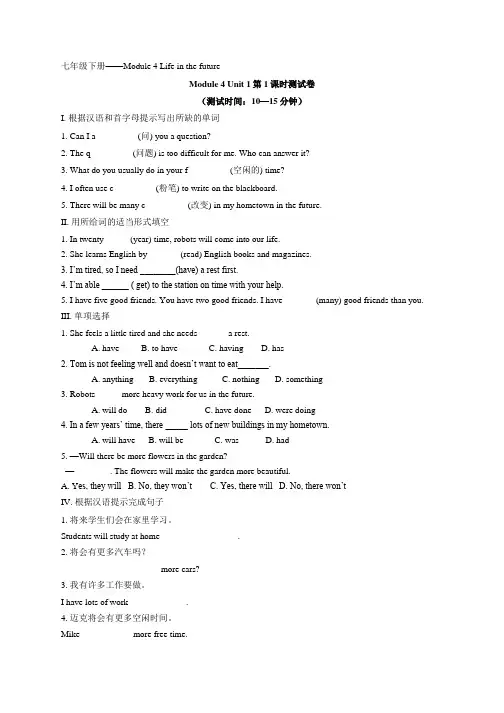
七年级下册——Module 4 Life in the futureModule 4 Unit 1第1课时测试卷(测试时间:10—15分钟)I. 根据汉语和首字母提示写出所缺的单词1. Can I a_________ (问) you a question?2. The q_________ (问题) is too difficult for me. Who can answer it?3. What do you usually do in your f_________ (空闲的) time?4. I often use c_________ (粉笔) to write on the blackboard.5. There will be many c_________ (改变) in my hometown in the future.II. 用所给词的适当形式填空1. In twenty _____ (year) time, robots will come into our life.2. She learns English by _______(read) English books and magazines.3. I’m tired, so I need ________(have) a rest first.4. I’m able ______ ( get) to the station on time with your help.5. I have five good friends. You have two good friends. I have _______(many) good friends than you. III. 单项选择1. She feels a little tired and she needs ______ a rest.A. haveB. to haveC. havingD. has2. Tom is not feeling well and doesn’t want to eat_______.A. anythingB. everythingC. nothingD. something3. Robots _____ more heavy work for us in the future.A. will doB. didC. have doneD. were doing4. In a few years’ time, there _____ lots of new buildings in my hometown.A. will haveB. will beC. wasD. had5. —Will there be more flowers in the garden?—________. The flowers will make the garden more beautiful.A. Y es, they willB. No, they won’tC. Yes, there willD. No, there won’tIV. 根据汉语提示完成句子1. 将来学生们会在家里学习。
新外研版七年度级下英语课件Module4Unit

• Insufficient contextual understanding: Some of the texts in this unit are written in a context that students may not be familiar with, leading to difficulties in comprehension.
• English proficiency development: The unit aims to improve students' overall English proficiency by providing a variety of listening, speaking, reading, and writing activities.
包含本单元所有课文的PPT,内容详细,图片丰富,有助于学 生更好地理解课文内容。
教学教案
提供本单元的教学目标、教学重点和难点、教学步骤和教学 方法等,为教师提供全面的教学指导。
Audio and video materials
课文录音
提供本单元所有课文的朗读录音,帮助学生纠正发音,提高语音水平。
教学视频
Ability goals
培养学生的听、说、 读、写能力,提高学 生的英语综合运用能 力。
培养学生的跨文化交 际能力,提高学生的 跨文化交流素养。
外研版七年级下Module4 Unit1课件(共15张PPT)

In the future
I will use _____.
I don’t use _____.
Everyone uses _____. No one uses _____.
I won’t use ______.
Everyone will use ____. No one will use _____.
Group-work
•Work in groups and talk about your dream school. •Then make a report.
Exercises
• • • • • • • • 1.我明天打算去购物。 will _____shopping go I____ tomorrow. 2.学生们将在家学习。 will _____at study Students ____ home. 3.下星期将有个音乐会。 will ____a be There ___ concert next week. 4.未来人们将会住在海底。 live under the sea in the future. People will ___ ___
A:Will there ______in the future? B:No,there___.I think everyone will______and will _____.They won’t use____.They will use______. A:Will students ____to their teachers by email? B:Yes,they ___Students will______their teachers on the computers. A:I’m not sure.I think students will_____but in school.Everyone will ____on their desk.They will ____or _____.The teachers won’t _____with chalk.No one will use_____.
2019-2020年七年级英语下册 Module 4 Life in the future全模块教案 外研版
2019-2020年七年级英语下册 Module 4 Life in the future全模块教案外研版一、教学内容分析本模块以未来的教室及学习为切入点,谈论将来我们生活的各个方面,学生较为有兴趣,便于展开活动。
Unit1的主要内容是涉及一些有关于教室和科学方面的名词,一篇出现了将来时的听力、一段有关未来教室的对话以及相关的几个训练活动,在这个过程中学习和掌握一般将来时WILL+动词原形的陈述,一般疑问句及问答,及否定句。
二、学生情况分析本模块以学生心目中的未来教室为话题,这与学生的现实生活密切相关,他们有话可说,乐于参与课堂活动,而涉及的语法项目是一般将来时will 的陈述句,否定句,一般疑问句及回答,动词不用任何的变化,学生应该较为容易掌握。
三、教学目标1.能够正确理解有关未来学校的对话。
2.能够听懂有关未来生活的简单对话。
3.能够用一般疑问句正确问答有关将来的信息。
四、教学重点和难点1.词汇的正确运用。
2.一般将来时will 的陈述句,否定句,一般疑问句及回答五、教学策略任务型教学、自主学习、合作学习六、教学手段磁带,图片七、教学过程Step 1 . Everyday EnglishWhat day is it today?What do you do today?What are you going to do tomorrow?……Step2.Warm-upT: What will you do at this weekend?S: I will do my homework at this weekend..T: Will you play the piano this afternoon?S: Yes, I will /No, I will not.………Like this, ask the students to work in pairs to review the future tense.Step2. PresentationT: What will you do at this weekend?Help the students answer: I will play games at this weekend.(用be going to+do引出will+do,使同学们在很自然的复习语境中导入到新课)Ask the students to work in pairs to practice will+do.Step3.Vocabulary(1) Use the pictures to teach the new words :cable, , cell phone, , paper, ruler, satellite TV.(2)guessing games :What do you use to learn math and science ? calculatorWhat do I use to teach English? chalk(3)Let students repeat the words loudly.(创设情景教单词,使学生自然地掌握了单词的读音和用法。
外研版七年级StarterModule4练习题及答案
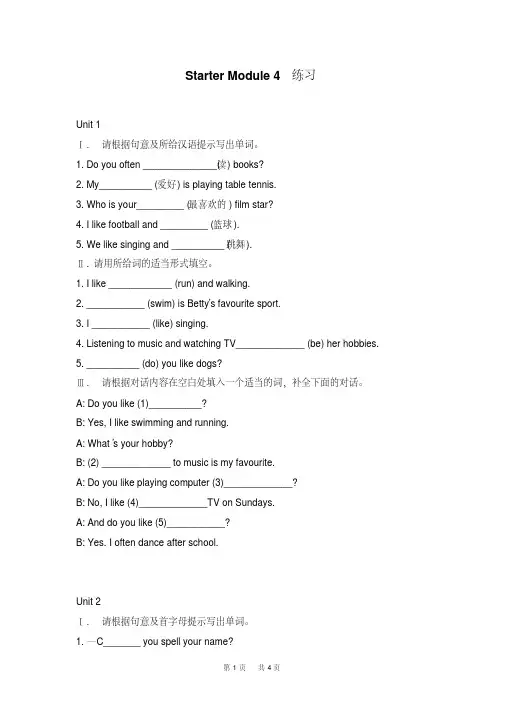
Starter Module 4 练习Unit 1Ⅰ.请根据句意及所给汉语提示写出单词。
1. Do you often ______________(读) books?2. My__________ (爱好) is playing table tennis.3. Who is your_________ (最喜欢的) film star?4. I like football and _________ (篮球).5. We like singing and __________ (跳舞).Ⅱ. 请用所给词的适当形式填空。
1. I like ____________ (run) and walking.2. ___________ (swim) is Betty’s favourite sport.3. I ___________ (like) singing.4. Listening to music and watching TV_____________ (be) her hobbies.5. __________ (do) you like dogs?Ⅲ.请根据对话内容在空白处填入一个适当的词,补全下面的对话。
A: Do you like (1)__________?B: Yes, I like swimming and running.A: What’s your hobby?B: (2) _____________ to music is my favourite.A: Do you like playing computer (3)_____________?B: No, I like (4)_____________TV on Sundays.A: And do you like (5)___________?B: Yes. I often dance after school.Unit 2Ⅰ.请根据句意及首字母提示写出单词。
外研版英语七年级第二学期Module 4 Life in the future 单元练习(含3个单元+答案)
外研版英语七年级下册Module 4 Life in the future 单元练习Unit1 Everyone will study at home一. 根据句意和首字母提示补全单词1. How is her l______ in England now?2. What are you going to be in the f _________?3. Danny has nothing to do now. He is f_____.4. Look! My English teacher is writing on the blackboard with c________.5. I have some q________ to ask you, Miss Black.二. 用所给词的适当形式填空.1. Here _____ (be) two nice photos of my family.2. Robots are able to (do) lots of things for us.3. Chinese students have a lot of homework_______(do)every day.4. Our teachers are all very __________(friend) to us students.5. . In my dream school there won’t be_____ (some) dirty classrooms.三. 单项选择( )1. There will _____ lots of rain in the next year.A. haveB. beC. hasD. is( )2. My grandparents go to the supermarket ______ bus every week.A. onB. inC. withD. by( )3. You need _______early tomorrow.A. comesB. comeC. comingD. came( )4. —What are you doing, Lily? —I’m sending a letter to my sister ____ email.A. withB. byC. useD. of( )5. Can you give me ________? We have none in our classroom.A. chalkB. a chalkC. some chalksD. a piece of chalk( )6.—Why are you in such a hurry, Mike?—There ______ an NBA basketball game in ten minutes.A. will beB. will haveC. is going to haveD. are going to be( )7. — Will ________ any schools in fifty years?— It's hard to say. Maybe students will study at home.A. there areB. there beC. these areD. they are( )8. Jim and Jack _______ to Los Angeles in two days.A. will goB. goesC. goD. is going( )9. —______you study at home in 100 years? —Yes, I______.A. Are; amB. Will; willC. Will; doD. Are; do( )10. —Will students have lots of homework to do this weekend?—________. Teachers won’t give them much homework any more.A. Yes, they willB. Yes, they doC. No, they won’tD. No, they don’四.句型转换.1. Tom and Jim will go swimming tomorrow. (改为否定句)___________________________________2. Will the weather get warm in the future? (作否定回答)___________________________________3. We’ll go to London on Saturday afternoon. (对划线部分提问)___________________________________4. My father will go to England by plane. (对画线部分提问)___________________________________5. China is a modern and strong country.(用in twenty years改写句子)____________________________________________________五. 根据汉语提示完成句子.1. Excuse me. Can you help me_________ (拿) this box?2. I am busy this week, but I will be ________(空闲的) next week.3. ___________(也许) I will be a manager in the future.4. How many ___________(直尺) have you got, Lisa?5. Wang Na __________(需要) a bottle of cola.六.补全对话A: What do you think your life will be like in ten years?B: 1______________A: Where will you live?B: 2______________A: How will you get there?B: 3_____________A: Will life be interesting there?B: Yes. I think it will be very interesting.A: 4_____________B: Of course there will be. I think the department stores(百货商店) will have all kinds of things and we can take anything for free.A: 5_____________B: I agree (同意). People will have a happy life there.1. ______2. ______3. ______4. ______5. ______七. 任务阅读①. Life in the future will be different from life today. But what will life be likein the future? The population(人口) is growing A . There will be many people in the world and most of them will live to over 100 years old. Computers will be very B and useful, and there will be computers in every home. Travelling will be very cheap and C .And many people will go to other countries for holidays. There will be changes in our food, too. There will not be________(many) room for cows and sheep, so meat will be very expensive. ②也许没有人会每天都吃它。
七年级英语下册 Module 4 《Garden city and its neighbors》 Unit 1 Going to see a film知识精讲 牛津沈
初一英语Module 4 Garden city and its neighbors Unit 1 Goingto see a film沈阳牛津版【本讲教育信息】一、教学内容:Module 4 Garden city and its neighborsUnit 1 Going to see a film二、主要内容(一)课标单词(二)重点短语(三)重要句型(四)一般将来时的用法(五)如何用英语指示方向三、知识总结与归纳(一)课标单词1. moment2. weekend3. adventure4. space5. action6. enemy7. king8. prince9. princess10. violin11. diary12. show13. bookshop(二)重点短语1. see a film2. hold on3. last for4. in a moment5. turn right/left6. walk along7. on one’s right/left(三)重要句型1. —May I speak to Kitty, please?—Speaking.此句为打电话用语。
如找某人讲话还可说Is this Kitty speaking?—May I speak to Kitty?—Speaking. This is Kitty. Who is that?Or Hold on, please./ Wait a moment, please.Or Sorry, she is out.Or Sorry, you’ve got the wrong number.2. Neither do I.此句为倒装句。
I don’t like swimming. Neither does he.3. Full of fun.be full of = be filled withThe bottle is full of water. = The bottle is filled with water.4. How long will “Swan lake” last for?last 持续How long do you think the fine weather will last?(四)一般将来时的用法shall/will +动词原形1. will 可用于所有人称,但 shall 仅表示单纯将来时,用于第一人称 I 和 we,作为will 的一种替代形式。
2020-2021学年七年级英语外研版下册Module 4 Unit 1--unit3考点
Language points
• 2.Will our life be different in the future? 考点2:life/laif/n.生活;生命 考点批注:life泛指一般意义上的“生活”时,是不可数名词;若 表示某种生活方式,则是可数名词。 e.g. I think our life is colourful.我认为我们的生活是丰富多彩的。
Language points
<中考在线5>It was raining. My father asked me__D____ a raincoat. A.take B.takes C.took D.to take
点拔:用固定搭配法解题。句意:下雨了,我爸爸让我带上雨衣。ask sb.to do sth.要求某人做某事,其中的动词不定式作宾语补足语。
Language points
考点6: maybe/'meibi/adv.也许 e.g.Maybe his mother is a teacher.也许他的妈妈是一位老师。
辨析:maybe与may be maybe 副词,意为“也许,大概”,常位于句首作状语。 may be 为“情态动词+be”结构,在句中作谓语,意为“可能是”。
e.g.Maybe you'll have better luck next time.也许下次你的运气会好一 点。 It may be my mum's hat.它可能是我妈妈的帽子。 Δmay be 与maybe 可相互转换: She may be angry. Maybe she is angry. 她可能生气了。
Language points
3.Will students need computers at school?
外研版英语七年级下册_Module4_Unit1参考教案
Module4 Unit1参考教案教学目标1.语言知识目标:掌握下列单词: chalk, ruler, question, carry, life, level, change, everything, future, in the future, need, will, maybe, ask, by, able, be able to, more, not ...any more, free2. 语言技能目标:1)能听懂谈论未来的简单对话,能判断未来事实。
2)能用will表达自己对未来的想象。
3. 情感目标:通过对未来美好的憧憬,培养积极乐观的精神。
教学方法以说为主要教学方式,以讨论为主要方法,通过同桌讨论和小组以及全班讨论,让每个学生充分练习口语和说的能力,并将听说读写有机地贯穿一体。
设立一些语言环境,结合自己或他人的旅游经历以及旅游景点,最后一起学习重难点,为突破重难点做一些课堂和课后的练习。
教学过程Step 1:Warming upGive some pictures and videos about the schools in the future to students. Let them watch it.Step 2:Work in pairs. Look at the picture of the Activity 1 and describe it. Use the words in the box to help you.Step 3:Listen and choose Lingling’s answers to the questions.1. Will our life be different in the future?Yes, it will. / No, it won’t.2. Will our school change?Yes, they will. / No, they won’t.3. Will everything be different?Yes, it will. / No, it won’t.4. Will students need computer at school?Yes, they will. / No, they won’t.5. Will they carry lots of books to school?Yes, they will. / No, they won’t.Answers: 1. Yes, it will. 2. Yes, they will. 3. Yes, it will. 4. Yes, they will.5. No, they won’t.Step 4:Listen and read the Activity 3. And then check (√) the students’ ideas about the future in the box of the Activity 3.Step5:To study Everyday English.¤ Well, I’m not sure.¤ That’s be great!Step6:Complete the passage of the Activity 4 with the correct form of the words and expression from the box.Betty: We’ll always (1) _____ teachers because computers will never be (2) _____ to check the students’ (3) ______ and answer their (4) ________ by (5) __________ or Internet. Will students need to go to school (6) __________? Yes, (7) ________ they will, because school is good fun, but everyone will have lots of (8) ______ time. Answers: (1) need (2) able (3) level (4) questions (5) telephone(6) any more (7) maybe (8) freeStep7:Listen and mark the stress. And then listen and repeat.blackboard computer eraser Internet telephoneStep8:Listen to those phonetic symbols of the Activity 6. And then listen and repeat.Step9:Work in pairs. Ask and answer the questions.1. Will schools be different in the future?2. Will students use books in the future?Step10:Work in pairs. Talk about what your school will be like in ten years.— We will study at home and only go to school for sports and games.—Well, this is good, but I’ll miss my teachers and friends.Step11:Study the following new words.chalk, ruler, question, carry, life, level, change, everything, future, in the future, need, will, maybe, ask, by, able, be able to, more, not ...any more, freeStep12:Explain and study the important and difficult points.1. The usage of word “more”.2. Difference between “in future”and “in the future”.3. The usage of word “free”.4. “in+ some time/ period of time”5. The usage o f word “by”.6. The usage of expression “be able to”.7. The usage of expression “not... any more”.8. The usage of expression “as well”.Step13:HomeworkReview and recite the important points of Unit 1.。