
Unit 11 How was your school trip?
What did they do last weekend?
watched TV played soccer
listened to music go(went) shopping
read a book (read)
eat(ate) ice cream go(went) to the zoo
milk
cow
horse
feed
farmer
go for a walk
milk the cow
ride a horse
feed chickens
talk with a farmer
take some photos
1a
Match the phrases with the pictures.
1. went for a walk e 2. milked a cow b 3. rode a horse a 4. fed chickens c 5. talked with a farmer f 6. took some photos d
had / ate ice cream (have/ eat)
went out with friends (go)
bought a gift (buy)
visit Visitors’ Center (visited)
1b
Listen and circle the three things Carol did on her school trip. 1. went for a walk 2. milked a cow 3. rode a horse 4. fed chickens 5. talked with a farmer 6. took some photos
Ask your parents when and where did they ever went, and what they think of their vacations. Then make a recording. ( 问问你的父母曾经何时去过什
么地方, 感觉如何,并作好记录。)
Section A 2a-3b
— Where did she go last Sunday?
— She went to the beach.
— Where did he go last Sunday?
— He stayed at home.
— Where did they go last Sunday?
— They went to summer camp.
watch (watched) a dolphin show
Which activities did I do?
met meet friendly have delicious food had got get sb’s letter people
climb the mountain climbed go shopping went eat ice cream ate saw see interesting movies
Did you +V. …….? Yes, I did. I V.-ed ……. (No, I didn’t.. I didn’t +V.….
buy (bought) a gift take( took) photos have ( had) a pizza
go (went) to outdoor pool watch (watched) a movie about sharks
Language Goal :
Talk about past events
Do you know what animals there
are on the farm?
cow
horse
chicken
duck
goose
dog
pig
sheep
Read the words and expressions loudly.
On rainy Day
watched TV with a friend
went for a drive
slelp late
studied hard for the test
•past tense •过去式 did came put fed rode stayed watched played read brought
activities
take took photos played play beach volleyball
win a prize won 奖品
bought buy a dress
ride a horse rode
What did you they do last Sunday?
Ask like this: Did he watch TV last night?
did some washing yesterday. She ________________
Did he… last night?
read a book last night. He ___________
— Did he go … ? — Yes, … . / No, … .
Look !
What did you do last weekend?
watch ed TV
listen ed to music go (went) skateboarding
played soccer
What did you do last weekend?
go to the beach went cleaned the room
Unit 11
How was your school trip?
Period 1
Section A 1a~1c
Brainstorming
Weekend activities:
What do you usually do on weekends?
What do/does he / she / they often do?
根据提示完成句子
1.I usually get ___(get) up at 6:30 in the morning. Today I ______ (get) up at 7:20, I ______ (be) late got was told for class. Mr. Yang ______(tell) me not _______ to be (be) late again. Did have 2. --______you ______ (have) a good time last Sunday? went --No, Ididn’t(do not). I _____ (go) camping with my friends _____ but it __________(rain). rained 3. –Where ______(be) you last night? I called (call) you, ______ were but you ________(be) not in. were –Oh, I _________(be) in my uncle’s house. was I ______ (have) supper there. had
— Did they go shopping? — No, they didn’t. — Did they visit the museum. — Yes, they did.
What did you do on your last school trip? Did you go to the zoo? Did you go to the aquarium? Were there any…? What else did you do? …
go to the beach
have some ice cream
go fishing
Did you …? Yes, I did. / No, I didn’t.
surf the Internet
go skateboarding
play soccer
Make a survey: Did you have a trip?
surfed the Internet
What did you do on your last school trip?
went to the beach (go)
went to the zoo
saw soake)
What did you do on your last school trip?
Present am Past was
is
are
was
were
根据句意及首字母填空 1. Our job is to m ilk the cows. _ 2. We t ook many photos about Mount. Hua last year. 3. Now I will f_______ the pet cat. eed ode 4. He r_______ a horse to visit last month. armer 5. In Australia, a f_______ can have lots of field(田地). 用括号内所给单词的适当形式填空 came 1. Tom and Mary ________ (come) to China last month. didn’t 2. My mother ________ (not do) housework yesterday. Did go 3. ________ your father ________ (go) to work every day last year? was 4. He ________ (be) here just now. have 5. Did she ________ (have) supper at home?
七年级英语下册Unit 11 How was your school trip超全重要短语和句子(英汉対译)
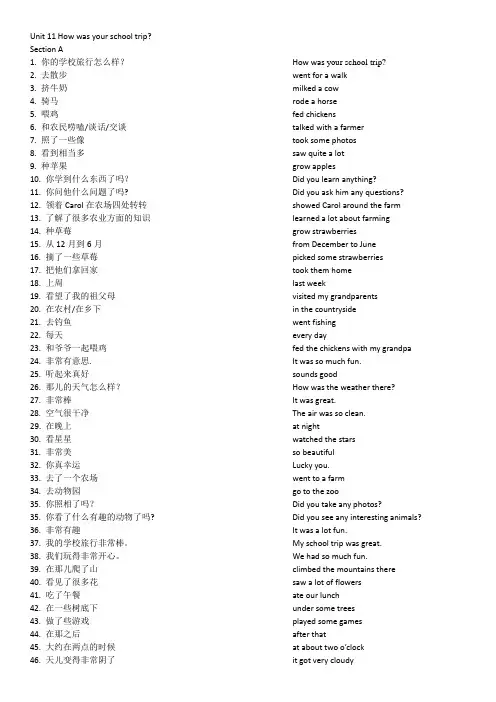
Unit 11 How was your school trip?Section A1. 你的学校旅行怎么样?How was your school trip?2. 去散步went for a walk3. 挤牛奶milked a cow4. 骑马rode a horse5. 喂鸡fed chickens6. 和农民唠嗑/谈话/交谈talked with a farmer7. 照了一些像took some photos8. 看到相当多saw quite a lot9. 种苹果grow apples10. 你学到什么东西了吗?Did you learn anything?11. 你问他什么问题了吗? Did you ask him any questions?12. 领着Carol在农场四处转转showed Carol around the farm13. 了解了很多农业方面的知识learned a lot about farming14. 种草莓grow strawberries15. 从12月到6月from December to June16. 摘了一些草莓picked some strawberries17. 把他们拿回家took them home18. 上周last week19. 看望了我的祖父母visited my grandparents20. 在农村/在乡下in the countryside21. 去钓鱼went fishing22. 每天every day23. 和爷爷一起喂鸡fed the chickens with my grandpa24. 非常有意思. It was so much fun.25. 听起来真好sounds good26. 那儿的天气怎么样?How was the weather there?27. 非常棒It was great.28. 空气很干净The air was so clean.29. 在晚上at night30. 看星星watched the stars31. 非常美so beautiful32. 你真幸运Lucky you.33. 去了一个农场went to a farm34. 去动物园go to the zoo35. 你照相了吗?Did you take any photos?35. 你看了什么有趣的动物了吗? Did you see any interesting animals?36. 非常有趣It was a lot fun.37. 我的学校旅行非常棒。
2024七年级英语下册Unit11Howwasyourschooltrip教案(新版)人教新目标版
1. 导入新课(5分钟)
目标:引起学生对学校旅行的兴趣,激发其探索欲望。
过程:
开场提问:“你们知道学校旅行是什么吗?它与我们的生活有什么关系?”
展示一些关于学校旅行的图片或视频片段,让学生初步感受旅行的魅力或特点。
简短介绍学校旅行的基本概念和重要性,为接下来的学习打下基础。
2. 学校旅行基础知识讲解(10分钟)
拓展与延伸
1. 提供与本节课内容相关的拓展阅读材料
为了让学生更深入地了解学校旅行的相关知识,巩固本节课所学内容,教师可以提供以下拓展阅读材料:
- 一篇关于学校旅行的文章,介绍学校旅行的目的、意义以及对学生成长的影响。
- 一段关于学校旅行中的安全知识的介绍,教育学生如何保护自己。
- 一些学生写的关于学校旅行的日记或游记,让学生了解其他同学的经历和感受。
- 题目:
A: How was your school trip?
B: It was great. We went to the museum.
C: That sounds fun. What did you see there?
D: We saw paintings and sculptures. We also went on a guided tour.
详细介绍每个案例的背景、特点和意义,让学生全面了解学校旅行的多样性或复杂性。
引导学生思考这些案例对实际生活或学习的影响,以及如何应用学校旅行解决实际问题。
4. 学生小组讨论(10分钟)
目标:培养学生的合作能力和解决问题的能力。
过程:
将学生分成若干小组,每组选择一个与学校旅行相关的主题进行深入讨论。
小组内讨论该主题的现状、挑战以及可能的解决方案。
人教版七年级英语下册Unit11Howwasyourschooltrip单元复习
2.__ta_k_e_____ 4.__h_a_d_____ 6._r_o_d_e_____ 8.__b_u_t_____ 10.__a_______
基础复现天天练 Work seriously
●难点释疑 ①go on a school trip意为“参加学校郊 游”。如: All the students went on a school trip last week. 上周所有学生都参加学校郊游活动。 ②worry是动词,意为“担心”。常见一般 搭配为 worry about。如: You don’t need to worry about me.
目录 contents
4 主要语法
主要语法
Work seriously
四、主要语法 用一般过去时询问或描述过去事 件及关感受
★询问对过去事件的感受: 1.—How was your school trip? —It was great. ——你的学校旅行怎么样?——很好。 2.—Were the strawberries good ? —Yes, they were. ——草莓好吃吗?——是的,好吃。
Life on the farm was so much 8 .We went fishing in the early morning, went 9 a walk after
基础复现天天练 Work seriously
supper and watched the 10 at night when the weather was fine.They were very beautiful.
Have 10 nice day! Write to me if you can.
Yours, Lily
新目标英语七年级下册讲义—Unit 11 How was your school trip

新目标七年级下册Unit 11 How was your school trip? 讲义一、重点单词k 挤奶2. cow .奶牛3. horse 马4. feed 喂养;饲养5. farmer 农民;农场主6. quite 相当;安全7. anything (常用于否定句或疑问句)任何东西;任何事物8. everything 一切;所有事物9. grow 种植;生长;发育10. farm 农场;务农;种田11. pick 采;摘12. excellent极好的;优秀的13. countryside 乡村;农村14. yesterday 昨天15. flower花16. worry 担心;担忧17. luckily 幸运地;好运地18. sun 太阳19. museum博物馆20. fire 火灾21. painting .油画;绘画22. exciting adj.使人兴奋的;令人激动的23. lovely可爱的24. expensive 昂贵的25. cheap 廉价的;便宜的26. slow缓慢的;迟缓的27. fast 快地(的)28. robot .机器人29. guide 导游;向导30. gift 礼物;赠品31. dark 黑暗的;昏暗的32. hear(heard)听到;听见自测表:二、短语归纳1.school trip 学校旅行2.go for a walk 去散步k a cow 给奶牛挤奶4.ride a horse 骑马5.feed chickens 喂鸡6.talk with 和......交谈7.take photos /a photo拍照st week上周9.ask some questions问一些问题10.quite a lot 相当多11.show sb. around sp.带某人参观某地12.learn about 了解13.grow strawberries种植草莓14.from...to... 从…到…15.pick some strawberries摘草莓16.take sth home带…回家17.climb the mountains 爬山18.visit my grandparents看望我的祖父母19.go fishing 去钓鱼20.so much 如此多的21.go to the zoo去动物园22.go to a farm去农场23a lot of fun很多乐趣24.play games 做游戏e out 出来26.go to the countryside去乡下27.science museum科学博物馆28.visit a museum 参观博物馆29.play chess with sb... 和…下棋30.buy sth for sb为某人买31.be interested in…对…感兴趣32.all in all总的来说33.not...at all 一点也不,根本不三、句型集萃1. How + be…? + like? ……怎么样?2. How do/does+主语+feel about...? 对......感觉如何?3. too many + 可数名词复数太多的……4.teach sb. how to do sth. 教某人怎样做某事5.quite + a / an + 形容词+可数名词单数= a + very + 形容词+可数名词单数一个相当/ 很……6.buy sth. for sb.=buy sb. Sth.为某人买东西7.It’s +形容词+to do sth. 做某事是......的8.sound+形容词听起来......四、词汇、句型讲解及拓展1.How was your school trip?学校旅行怎么样?【解析】How+be+主语?=What be+主语+like?意为“….怎么样?”★★★本句的答语:It was great./It was OK./It was/wasn’t good….【拓展】how是疑问副词,意为“怎么样,怎么”,用来构成特殊疑问句,主要用法如下:1)询问如何做某事,或者做某事方式。
人教新目标版七年级英语下册Unit11Howwasyourschooltrip优质教案

Unit 11 How was your school trip ?一、教学目标:1. 语言知识目标基本词汇:milk, cow, horse, feed, farmer, quite, anything, grow, farm, pick, excellent, coutryside, yesterday, flower, worry, luckily, sun, museum,fire, painting, exciting, lovely, expensive, cheap, slow, fast, robot,guide, gift, everything, interested, dark, hear基本词组:milk a cow, ride a horse, feed chickens, quite a lot (of…), in the countryside, fire station, all in all, be interested in基本句型:How was your school trip ? It was great !Did you go to the zoo ? No, I didn’t. I went to a farm.Did you see any cows ? Yes, I did. I saw quite a lot.Did Carol ride a horse ? No, she didn’t.But she milked a cow. Were the strawberries good ? Yes, they were . No, they weren’t.2. 技能目标: 能运用一般过去时描写过去的事情3. 情感目标:学会客观地表达对事物的看法,培养乐观向上的性格二、教学重难点:1. 教学重点:一般过去时的判断及选用2. 教学难点:正确运用一般过去时三、教学步骤:Period 1Section A (1a-2d)Step 1 : Warming –up1 GreetingWho is on duty today ?Who was on duty yesterday ?What is the weather like today ?What was the weather like yesterday ?2 Song : Play the song “ Old MacDonald had a farm” and have Ss find out the animals in the songGet Ss answer like this : On the farm ,there are some ducks, cats,chickens, cows pigs,dogs and horses . They are animals.Step 2 : Presentation1 Show a picture and tell Ss: This is also a farm. Last week Carol and his classmates had a school trip. They went to the farm. What did they do on the farm? How was their school trip?2 Show some pictures again and try to get the past tense verbs expressions according to the pictures.(1) Show the picture and the question(2) Ask one student to answer the question.(3) All students read it toghter.Q:Did he ride a horse?A:Yes, he did. He rode a horse.Q:Did he milk a cow?A:Yes, he did. He milked a cow.Q:Did he ride a horse?A :No, he didn’t .Did he feed chickens?Yes, he did. He fed chickens.Did you go to the zoo?No, I didn’t. I went to a farm.Did you see any cows ?Yes, I did. I saw quite a lot.Did they pick any strawberries on the farm ?Yes, they did .How were the strawberries?They were delicious.Were the strawberries good?Yes, they were.No, they weren’t.How was your school trip ?It was great.Were the strawberries good ?Yes ,they were.No, they weren’t.Step 3 ExercisesStep 4 : Practice (Listening and speaking)1a Match the phrses with the pictures.1b Listen and circle the three things Carol did on her school trip in 1a.1c Ask and an swer questions about Carol’s school trip.2a Listen and check the questions you hear.2b Listen again.Circle T for true or F for false2c Ask and answer questions about Carol’s visit to the farm.Step 5 :Tasks:1 Look at the pictures and practice the dialogueA:How was your school trip?B: It was …(boring/interesting/good/great…)A:What did you do on the school trip ?B:I went for a walk with my classmates.2 2d Role-play the conversation3.Groupwork: Make a survey. Ask your partners what they didlast week. Then give a reporter.Step 6 : Grammar Focus ( Get Ss read aloud )How was your school trip ? It was great !Did you go to the zoo ? No, I didn’t. I went to a farm.Did you see any cows ? Yes, I did. I saw quite a lot.Did Carol ride a horse ? No, she didn’t. But she milked a cow.Were the strawberries good ? Yes, they were . No, they weren’t.Step 6 Summary and Language pointsStep 7 Exercises :Period 2Section A (Grammar Focus-3b)Step 1:1 GreetingHow are you today ?How were you yesteday ?How was your last school trip ?2 Free talk :T : Do you want to know something about your classmates’ school trip ?Now Ask your partner :What did you do on your school trip ? Then fillin the following chart.Step 2 :Pre-task :1.Look at the pictures and fill in the blanks.2.Write the past forms of the following verbs.3. Check the past forms .Then ask Ss to summerize the rules of past forms ofthe regular verbs.Then explain the rules of past forms of the regular verbsStep 3 While-task 3a1 Ask Ss to read the letters in 3a .2 Ask Ss to complete Jim’s letter on the left and Bill’s reply on the right.3 Check the answers .Ask Ss to pay attention to the past tenst verbs.4 Explain the language points5 Read the letters together.Step 4: Post-task1. Challenge:Ask Ss to fill in the blanks according to the pictures.2 Check the answers. Ask Ss to read the answers one by one.3 Have a student read the letter out aloud.4 Ask Ss to read the letter several times. Try to recite it.5 Groupwork: Make up a story. Each student adds a sentence.If he or she can’tadd a sentenec .He or she must sing an English song.You can begin like this:Last week I visited my aunt’s house.____________________________________________________________________________________________________________________________Step 5 Language points and ExercisesPeriod 3Section B (1a-2c)Step 1:1 GreetingWhat did you do yesterday ?How were you yesterday ?2 Review: GamesUse your imagation and make up a story. Each student adds a sentence.If he or she can’t add a sentence,h e or she must sing an English song.Step 2 :Preparation 1a1 Match the activities with the pictures.2 Check the answersStep 2 :Listening 1b 1c1 Listen and answer the questions.1 How was Jane’s trip ?2 How was Tony’s trip ?2 Check the answers.3 Listen again. What did Jane and Tony do on their last school trip ? CheckTony or Jane.Step 3:Speaking 1d1 What was your last school trip like ?Discuss it with your partner with the following words.2 Teach Ss to read the following words :interesting difficult lovely slowexciting boring cool hotlucky large expensive terrible decilious great cheap fast3 Discuss like following conversation.A: I went to a farm on my last school trip.There are many animals on the farm.They are very lovely.B: That sounds great.A: How was your school trip ?B: It was __________A: How was the food there ?B: It was _____________A: How was the weather ?B: It was ___________Step 4: Prepatation2a Do the following words describe good things or bad things ? Put a √for good and an ×for bad . Leave a blank if they can mean both.Step 5 : Reading 2b,2c1 Read Helen’s and Jim’s diary entries and answer the questions in 2b2 Read the diaries again and complete the chart in 2cHow do Helen and Jim describe these things ?3 Check the answers .Ask Ss to pay attention to the past tenst verbs.4 Explain the language points5 Read the passages aloudStep 6 : Language points and exercises.Period 4Section B (3a-Self check )Step 1:1 GreetingHow are you feeling today?What did you do last night?How was your homework yesterday?2 Review : GamesUse your imagnation and make up a story. Each student adds a sentence.If he or she c an’t add a sentence,he or she must sing an English song. Step 2 : Preparation1.3a Look at the pictures of Bob’s school plete his diary entry.2. 3b Linda is Bob’s classmate. Complete her diary entry.Step 2 : Writing3c Now write a diary entry for your own school trip.Explain if you liked it or didn’t like it and why.Step 3 : Self-check1 Write more verbs and their past forms in each group.2 Complete the conversations with the correct forms of the verbs in the box.3 Check the answers4 Grammar: The Simple Past Tense。
Unit-11-How-was-your-school-trip教案

Unit 11 How was your school trip?1. Target language—How was your school trip? — It was great.—Did you go to the zoo? —Yes , Yes, I did. /No, I didn't.—Were the strawberries? —Yes, they were.words , phrases & sentences. regular verb, irregular verb2. Key sentences—How was your school trip? — It was great.—Did you go to the zoo? —Yes, Yes, I did. /No, I didn't.3. Teaching important / difficult pointsHow to listen to and talk about recent past events.4. StructuresSimple past tense; How questions; Yes/No questions and short answers; Adjectives of description.5. Difficulties Simple past tense.6. Importance How to listen to and talk about recent past events7.Teaching aids A tape recorder. Some picture. CAI.8. Periods Four periods.Period 1 (Section A: 1a-1c)Step I Warming up and lead-inGreet the students and talk about weekend activities with them.T: Hello! Everyone. Today we’ll learn to talk about recent past events. Now first please tell me what you often do on weekends.S1: I often play basketball on weekends.S2: I often watch TV.T: (Point to the word “weekend”) What does this word mean?S: Saturday and Sunday are the weekend.S1: I played basketball last weekend.S2: I cleaned my room last weekend.Step II Talking about the picture (1a)1. Ask the students to match the words with the pictures.Check the answers.T: Look at the picture. What did each person in the picture do?S1: She played tennis.S2: She did homework.2. Ask the students to talk about the picture in 1aT: Now please look at the picture on page 53. Suppose you are Lucy in the picture. What did you do last weekend in Picture a?S1: I went to the movies.T: What did you do last weekend in Picture b?S2: I played soccer / football.T: Please ask and answer in pairsStep III Listening and speaking (1b, 1c)1. Ask the students to listen to the conversation and fill in the blanks in the picture.Check the answers.2. Ask the students to read the conversation in 1c and then make conversations in pairs.Sample conversations:S1: What did you do last weekend, Lucy?S2: On Sunday morning, I played tennis.Ask the students to make their own conversations. Show the following.—What did you / he / she / they do last weekend / last Sunday morning / last Monday / yesterday?—I / We / He / she / They went to the beach / played computer games / did my homework / cleaned my room / went to the movies.Step Ⅳ Homework1. Ask the students to do Exercises 1 & 2 in the workbook.2. Ask the students to learn the new words and expression.教学反思:______________________________________________________________________________ ______________________________________________________________________________ ______________________________________________________________________________ ______Period 2 (Section A: 2a-2d)Step I Revision and lead-inCheck the homework.T: Today we’ll go on talking about the recent past events. We know when we talk about the things we did in the past, we must use the past forms of the verbs. For example: clean→cleaned; visit→visited; look→looked; study→studied; do→did; have→had; go→went. Now read after me these words.Then ask the students what they did last weekend.T: What did you do last weekend?S1: I played football last weekend.S2: I did my homework last weekend.S3: I cleaned my room last weekend.T: Well! What did your brother do last weekend?S4: He watched TV last weekend.S5: He went to the movies last weekend.Step II Listening (2a, 2b)1. Listen to the recording and underline the words.T: OK. Do you know what Carol, Ben and Emma did last weekend? Now let’s li sten to a conversation between a teacher and three students. They will talk abot some of the activities and people, but they will not talk about others. Please under-line the words you hear on the recording.Then check the answers.2. Ask the students to listen and write.Check the answers.3. Ask the students to listen to and repeat the conversation after the recording. Step III Pairwork (2c)1. Ask the students to practice the conversation.Ask the students to read the words repeatedly.Ask the students to ask and answer in pairs.Sample conversations:1) S1: What did you do last weekend?S2: I visited my grandmother.S1: What about your friend, Carol?S2: She went to a bookshop. What did you do?S1: I stayed at home and did some reading.2. Ask the students to make conversations.Step IV GrammarAsk the students to read the sentences in the Grammar Focus and underline the verbs in them.Show the following.What did you do last weekend?I played soccer. We went to the beach. She did her homework. He went to the movie. They played tennis.T: The underlined parts in these sentences are called past form. And in English they formed the simple past tense. The simple past tense is one of the most common tenses in English. We use the simple past to refer to an action in the past that is finished. Step V Homework1. Ask the students to learn more past forms of irregular verbs in the dictionary.2. Ask the students to read a short story and pay attention to the verb forms in the story.教学反思:______________________________________________________________________________ ______________________________________________________________________________ ______________________________________________________________________________ __Period 3 ( Section A: 3a-3c)Step I RevisionAsk the students to complete the part of the story from Cinderella.Check the answers by asking some students to read the part of the story. The students may meet some new words during the reading, ask them to try to guess the meaning. T: As we can see, nearly all the verbs are in past forms in the story. In fact, when we keep diary, we always use the simple past.Step II Lead-inTalk about recent past events with the students.T: Good! Now answer my question: What did you do last weekend?S1: I watched TV at home last weekend.S2: I stayed at home last weekend.S3: I played basketball last weekend.T: Well done, everyone. You did many interesting things. But I stayed at home last weekend. I did much housework. I cleaned my room. I washed my clothes. It was not very good, because I was very tired. Now answer: How was your weekend?Help them answer.Ss: It was great / good / OK...Write down and get the students to read the dialogue:—How was your weekend? —It was great.Step III Reading and speaking (3a)1. Ask the students to describe what each person in each scene did.T: Look at the picture in 3a. Tell me what the person in each scene did.S1: In Picture 1: She went to the beach.S2: In Picture 2: He did his homework and watched TV.S3: In Picture 3: She cleaned her room and studied for the math test.2. Ask the students to read the expressions and the conversations.T: Now please read the expressions above the picture and the conversations in the picture. The second part of each conversation is incomplete. They are listed above the picture. Read them and write the correct number on the blank lines in the speech bubbles to complete the conversations.Then check the answers by asking some students to read the completed conversations. Step IV Pairwork (3b)1. Ask the students to read the conversation in 3b first. And then ask them to make conversations.T: Now practice asking and answering questions about what the people in the pictures did last weekend. Practice in pairs. Use the dialogue as an example. Give the students two minutes to read and make the conversations.A: How was Sarah’s weekend?B: It wasn’t ver y good. She cleaned her room and studied for the math test. Sample conversations:1) S1: How was Tony’s weekend?S2: It was OK. He did his homework and watched TV.2) S3: How was Sa rah’s weekend?S4: It wasn’t very good. She cleaned her room and studied for the math test. Step Ⅴ HomeworkAsk the students to finish the exercises.教学反思:_______________________________________________________________________________ _______________________________________________________________________________ _______________________________________________________________________________ __Period 4 ( Section B: 1a-2c)Step I Revision and lead-inCheck the homework.T: Hi, class! Nice to see you again in a new day. Did you finish your homeworkyesterday?S: Yes, we did.T: Good. Who’d like to show us your answers?Ask some students to read the answers and the story. Key to the homework in Period 3:I. 1. got, yesterday morning 2. didn’t do3. What did, do4. How was5. wasII. went, sat, was, was, opened, was, said, said, said, put on, looked, went, was, was, asked, danced, said, was, forgot, rang, said, ran, lost, was, was, didn’t know, lived, went, said, went, opened, said, said, was, wereThen ask the students the following questions.T: What did your parents do yesterday?S1: My mother did some reading and my father watched TV.S2: My father played computer games and my mother helped me with my English.S3: My parents went to visit one of their old friends.T: OK! Look at the pictures. Could you tell me what Lucy did yesterday?S1: She watched TV yesterday.S2: She cooked at home yesterday.S3: She cleaned the car with her friends yesterday.S4: She studied geography yesterday.Help to answer and read the new word geography.Step II Reading and writing (1a, 1b)1. Ask the students to match the words with the pictures in 1a.T: Jim studied geography yesterday, too. He also did other things. Now open your books and turn to page 56. Look at the pictures in 1a. Read the words and then write the letter of each picture in the blank in front of the correct phrase.Check the answers.T: Right. Now ask and answer in pairs, using the question: What did Jim / Sally do yesterday?Sample conversations:1) S1: What did Jim do yesterday?S2: He did his homework.2) S3: What did Sally do yesterday?S4: She played the guitar.2. Ask the students to draw a happy face or an unhappy face under each picture. Help to answer.S: No. I think doing homework is an unhappy thing.T: What about playing the guitar?S: It’s a happy thing.T: In Picture b, the boy played the guitar. It was fun. The happy face shows it was fun. Now please draw a happy face or an unhappy face under each picture a, c and d.Check the answers.Step III Listening (2a)1. Ask the students to listen to the conversation Sally and Jim and write the answers in the chart.Check the answers.Play the recording and ask the following questions.T: First, what did Sally do last weekend?S1: She stayed at home and did lots of things. She cleaned her room and did her homework. And on Sunday, she went to the library.T: Good. What about Jim? What did Jim do last weekend?S2: He played soccer on Saturday morning. On Sunday afternoon, he went to a movie. On Sunday night, he visited his friend’s house.2. Ask the students to repeat after the recording line by line and try to write them down.T: I will play the recording twice again. First repeat after the recording and then try to write the conversations down.Step IV Pairwork (2b, 2c)1. Ask the students to read the dialogue first. And then make a conversation.2. Ask the students to talk about what they did last weekend.3. Then ask the students to write down what they did last weekend.T: OK. You did very well. Now please write down what you did last weekend. Give the students two or three minutes to write.Step V Homework1. Ask the students to do Exercise 6 in the workbook.2. Ask the students to write something about what they did last week.教学反思:______________________________________________________________________________ ______________________________________________________________________________ ______________________________________________________________________________ ______Period 5 Section B: 3a-3c)Step I Revision and lead-inT: Today we will go on talking about the past events. We’ll learn an article about how kids spent the weekend. Now can you tell me what you did last weekend? Sample answers:S: Last Saturday I wen t to my aunt’s house. There I played computer games with T: Well done. Now look at the pictures and say what they did yesterday morning? S1: Lucy listened to the radio. Tom did some reading. Bill and Bob played soccer, and Jim went to school by bike.T: Oh! Which school did Jim go to?S2: He went to No. 4 Middle School.Write down the new words: No.=number, middle, middle school. Teach to read the new words.T: Which school are you in?S3: We’re in No. 3 Middle School.Step II Reading (3a)1. Ask the students to read the article, and then answer the following questions.1) How many students did their homework or studied?2) Did two kids visit friends?2. Read the article again and circle the activities you like. Underline the activities you don’t like.3. Explain the key and difficult points in the passage.1) spend 花费,度过(1)spend money on sth 花钱买某物(在……上花钱)。
人教版七年级下册 Unit 11 How was your school trip 知识点(适合于听写 学生对照背诵)-带答案
人教版七年级下册Unit 11 How was your school trip 知识点1.把...喂给...用...喂养...以...为食...2.一个能干的农夫正在他的大农场耕作。
3.在农场周围散步4.许多/ 许许多多的5.我有很多事情要告诉你。
6.相当漂亮的一个女孩(quite / very )7.你知道关于他的一些事吗?8.带领某人参观某地9.show up / show off / on show10.看见一些有趣的事情11.从某人哪里学到很多关于12.名词前有哪些词时,无介词13.一名优秀的运动员在...方面优秀14.幸运的是,我们及时上了汽车。
15.一般过去时的标志词16.蛮好玩17.你说的太多了18.so many 和so much的区别19.很开心做某事20.担忧某事(worry)2种e out 的含义3种22.天气变得非常的晴朗。
23.长得很好/ 长大/种植水稻24.绘画/ 油画25.去旅行(2种)26.到...去旅行/ 去度假27.沿途/ 顺便问一下/ 以这种方式28.教我们如何制作机器人教某人如何做某事29.教某人某事30.我不知道去哪里/做什么/怎么做31.北京房子的价格很高。
32.总的来说33.让人兴奋的一天34.今天的学校旅行/五分钟的路程35.复合不定代词36.对...感兴趣/37.听到某人做某事/听到某人正在做某事38.不客气(all)39.作文构思40.你的学校旅行怎么样?41.去散步42.给奶牛挤奶43.骑马44.喂鸡45.与农民交谈46.拍一些照片47.带领Alice参观农场48.学习了很多关于农务49.从十二月到六月种植草莓50.摘一些草莓51.带他们回家52.你上周旅行怎么样?54.我去农村拜访我爷爷奶奶了。
55.你做什么了?56.我晚上观看星星了。
57.你真幸运。
58.你去动物园了吗?不,我没有。
我去了农场。
59.你看到一些牛了吗?是的,看到了。
我看到了很多。
七年级英语下册Unit11Howwasyourschooltrip说课稿(人教新目标版)
七年级英语下册 Unit 11 How was your school trip说课稿(人教新目标版)一. 教材分析本次说课的教材为人教新目标版七年级英语下册Unit 11 How was your school trip。
本单元主要围绕学校旅行的话题展开,通过描述旅行的经历和感受,让学生学会使用一般过去时进行问答。
教材内容丰富,包括听力、口语、阅读和写作等方面,有助于学生全面提高英语水平。
二. 学情分析七年级的学生已经掌握了基本的英语语法和词汇,具有一定的听说读写能力。
但部分学生对一般过去时的运用还不够熟练,需要在课堂上进行针对性的训练。
此外,学生对学校旅行的经历和感受有较高的兴趣,可以激发他们学习英语的积极性。
三. 说教学目标1.知识目标:学生能够掌握一般过去时的问法和答法,正确运用动词过去式描述过去发生的事情。
2.能力目标:学生能够听懂、会说、会读、会写关于学校旅行的描述,提高英语综合运用能力。
3.情感目标:通过本节课的学习,学生能够表达对学校旅行的喜爱和回忆,培养对英语的兴趣。
四. 说教学重难点1.重点:学生能够熟练运用一般过去时进行问答,描述学校旅行的经历。
2.难点:学生能够正确运用动词过去式,表达过去发生的事情。
五. 说教学方法与手段1.教学方法:采用任务型教学法,让学生在实际语境中练习英语,提高运用能力。
2.教学手段:利用多媒体课件、图片、卡片等辅助教学,增加课堂趣味性。
六. 说教学过程1.热身(5分钟):播放一首关于旅行的英文歌曲,让学生谈论自己的旅行经历,激发学习兴趣。
2.导入(10分钟):通过展示一组学校旅行的照片,引导学生谈论旅行中的趣事,为新课的学习做好铺垫。
3.新课呈现(15分钟):讲解一般过去时的问法和答法,示例说明如何用动词过去式描述过去发生的事情。
让学生跟读、模仿,确保正确掌握。
4.实践环节(15分钟):学生分角色扮演,模拟学校旅行的场景,运用一般过去时进行问答。
人教七下Unit 11 How was your school trip?知识点
Unit 11 How was your school trip?Section A1. How was your trip yesterday?(1)本句为询问某事情况的常用句型,其中was是be动词的过去式,如果询问当前的情况则be动词用is。
其答语常用:It was great! (好极了) / It was OK.(还可以)/ It wasn’t good.(不好。
)/ All right.(很好。
)/ It was not bad.(还不错。
)等。
How + be+…?相当于What + be +… + like? 例如:-How was her holiday?-It was not bad.(2)How是疑问副词,意为“如何,怎样”,常用来引导特殊疑问句来询问方式、程度、状况等。
常用于以下交际用语中:1)How is/are +sb. ? 用来询问人的身体、工作、学习或生活等的状况。
例如:-How are you? -Fine, thank you.2)How is/are +sth.?用来询问某物或者某事的状况如何。
例如:How is your work?3)How do you do? 并不表示疑问,是第一次见面时的问候语,回答仍用此句。
例如:How do you do? ---How do you do?4)How is it going?/ How is everything going? 用来询问事情进展如何。
例如:How is it going? Very well./ Not too bad./just so so.2. feed chickenfeed 作及物动词,意为“喂养,饲养”,其后常接表示动物名称的词作宾语。
例如:My father’s job is to feed the animals.拓展:(1)feed..to…意为“把……喂给……吃”。
feed后接饲料或者食物名称做宾语,to为介词,其后一般接动物或者小孩等名词表示对象。
人教版英语七年级下册Unit_11_How__was_your_school_trip_?_Section__B
2c Complete the chart. How do Helen and
Jim describe these things?
Helen the trip the train Jim
1c Listen again. What did Jane and Tony
do on their last school trip? Check (√) Tony or Jane.
went to the countryside climbed went to saw some drew a an art paintings pictures mountain museum
watch flowers
watched flowers
pick strawberries picked strawberries
1a Match the activities with the pictures 1.go to the zoo __ 4. climb a mountain__ 2.visit a museum__ 5. visit a fire station__ 3.ride a horse__ 6.go fishing__
e
a
d
b
f
c
1a Match the activities with the pictures 1.go to the zoo _a_ 4. climb a mountain_e_ 2.visit a museum_c_ 5. visit a fire station_d_ 3.ride a horse_b_ 6.go fishing_f_
II. 译出下列短语 去散步 去购物 去钓鱼 挤奶牛 骑马 骑自行车 喂小鸡 和某人谈话 拍照