
外研版八上英语Module 12Unit 1
bottom Cover drop
harmful
imagine lift medical pain
This could be (5) _h_a_r_m__fu_l_ for him! Even worse, you might (6)__d_r_o_p_ him while you are moving him! That would cause a lot of (7)_p_a_i_n_. (8)_C_o_v_e_r_ him with a coat and make sure he is warm. Then wait for the doctors to arrive.
harmful drop training cover
n. 问题;烦恼;困难 v. 举起;抬起;提起 n. 电梯 adj. 有害的 v. 使落下;投下 n. 训练;培训 v. 盖;盖上
first aid at the bottom of… What’s wrong with…? lift up make sure
2. What can’t we do and why? We can’t _l_if_t_ him _u_p__ or sit him on the chair because that could be _h_a_r_m__fu_l_. We may __d_r_o_p_ him and __h_u_r_t_ him even more.
It’s dangerous to run down the stairs
There’s some broken glass in the kitchen.
The piece of furniture is heavy and the boy can’t lift it.
Imagine you are in those situations, what should you do to help them?
2. Why must Betty know how to make people comfortable?
√A. Because she did some basic medical training.
B. Because she is a doctor.
C. Because she is a good girl.
3. Which way can make him comfortable?
A.
√B.
We can cover him with a coat.
Now read these first aid suggestions and decide if they are good ideas (√) or bad ideas (×).
It’s dangerous to play sports. Please be careful.
Our parents gave the life to us. Life is so fragile(脆弱的), cherish(珍惜)our life and keep growing!
New words & phrases
you or speaking to you.
Lingling: Shout for help? Call 120?
Ms James: Good idea, but what should we do before help arrives?
Tony: Make him comfortable. Ms James: And how can we do that?
➢ Shout for help. ➢ Call 120. ➢ Give first aid.
Which is the right?
2 Listen and check what the pictures are about?
Ms James: Accidents often happen before you notice them. You could fall when you go down the stairs at school. It’s quite dangerous in the kitchen at home because broken glass or knives can cut you. And moving heavy furniture is dangerous too. You could drop it and hurt your foot.
Accidents are everywhere, what can we do with it?
If someone is hurt, we can give some __fi_r_s_t _ __a_i_d__.
What happened to him?
He __fe_l_l_ (fall) down and he _b_r_o_k_e_ (break) his leg. So, he has a _b_r_o_k_e_n_ (break) leg.
Betty: Make sure he’s warm. Cover him with a coat.
Ms James: That’s such good advice that you could be a doctor, Betty!
Read and answer
1. What can we do? We can _s_h_o_u_t_ _f_o_r_ help or call 120, and make him _c_o_m__f_o_rt_a_b_l_e_ before help arrives.
Fill in the tables 1. He is lying at the b__o_tt_o_m_ of the _st_a_i_r_s. wrong with 2. He isn’t _m_o_v_i_n_g_ or _m__a_k_in_g_ a sound.
the boy? 3. He is __in__ _p_a_i_n_.
1. we can _a_s_k_ him, but he might have
_t_ro_u__b_le_ hearing you or _s_p_e_a_k_in_g_ to you.
What should 2. We should _sh_o_u__t _fo_r_ help or call 120.
3. What’s wrong with the boy? A. He is running down the stairs.
√B. He is lying at the bottom of the stairs and in pain. C. He cut his hand this morning.
we do to help 3. We can’t _l_if_t_ him _u__p_ or sit him on
him?
the chair because that could be _h_a_r_m_f_u_l.
4. We need to _c_o_v_e_r_ him _w__it_h_ a coat to
4. Why can’t the boy answer you? A. Because he doesn’t want to answer you. B. Because he isn’t happy.
√C. Because he could have trouble hearing you or speaking to you.
3 Listen and read.
Ms James: This morning’s class is about first aid, or giving someone basic medical help. Let’s imagine an accident. A boy is lying at the bottom of the stairs. He isn’t moving or making a sound. He is in pain. What can we do to help him?
在……的底端,底部
Betty: First of all, find out what’s wrong with him.
Ms James: How do we do that? 查明;发现;
Betty: Ask him.
找到
Ms James: Ok. But he could have trouble hearing
broken adj. 破碎的
glass n. 玻璃
stairs n.(pl). 楼梯
aid n. 救助;帮助
medical adj. 医学的;医疗的
imagine v. 想象,设想 bottom n. 底部;下端
wrong adj. 有毛病的;错误的 adv. 不正确的;错误的
trouble lift
Listen and choose
1. What’s the conversation about? A. A traffic about an accident.
√B. A class about how to give first aid.
C. A class about how to make someone happy.
Language points
1. He is in pain. in pain “处在疼痛之中”。 例:你还疼吗?Are you still in pain?
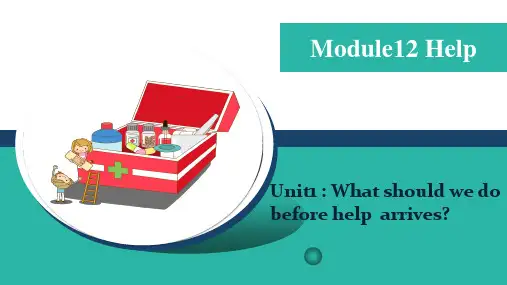
Module 12 Help
Unit 1 What should we do before help arrives?
外研·八年级上册
Hundreds of people died from car accidents every day!
Module12Unit1导学案外研版英语八年级上册

Module 12Help主题内容及学习目标主题范畴:人与自然子主题:自然灾害与防范措施,人身安全与自我保护1. 语言知识:学习和掌握一些急救单词、短语和知识点,能够听懂关于急救的话题,读懂相关的阅读材料,给出关于急救的方法。
2. 文化知识:了解应对突发事故的方法和措施,增强防范意识和能力。
3. 语言技能:掌握用祈使句给别人提出指令的方法;掌握用情态动词表示推测的用法。
4. 学习策略:了解如何进行急救。
Unit 1What should we do before help arrives?课前预习单词和短语重点单词名词1. 玻璃glass•(n.)眼镜glasses2. (pl.)楼梯stairs•(adj.)楼上的(ad v.)往楼上Upstairs3. 救助;帮助aid4. 底部;下端bottom5. 问题;烦恼;困难trouble•(短语)处于困境中be in trouble6. 训练;培训training动词7. 想象,设想imagine•(adj.)富于想象力的;创新的imaginative8. 使落下;投下drop•(过去式) dropped9. 盖;盖上cover形容词10. 破碎的broken•(v.)打破(记录);打碎break11. 医学的;医疗的medical•(短语)医疗救助medical help•(短语)医疗培训medical training12. 有害的harmful•(短语)对……有害be harmful to …兼词13. (adj.)有毛病的;错误的(ad v.)不正确地;错误地wrong•(短语)出错;出故障go wrong14. (v.)举起;抬起;提起(n.)电梯lift根据语境或提示,完成句子。
1. We need to learn something about first aid(急救).2. Loud noise is h armful to the ear.3. Pay attention to the b roken bottle on the floor.4. We may face lots of t rouble in our daily life, but please be strong.5. Amy fell off the s tairs this morning and hurt badly.6. It is difficult to i magine what life will be like in the future.7. Daming, what's w rong with you?8. If you want to be a doctor, you need to learn lots of m edical knowledge.佳句仿写1. A boy is lying at the bottom of the stairs.2. First of all, find out what's wrong with him.3. But he could have trouble hearing you or speaking to you.4. Make sure he's warm.5. That's such good advice that you could be a doctor, Betty!句子仿写瓶子的底部有个名字。
外研版八年级英语上全册课文翻译

外研版八年级英语上全册课文翻译Module 1怎样学英语Unit 1让我们尽可能多的讲英语詹姆斯老师:同学们,欢迎回来!今天,我们打算谈论一下学习英语的好方法。
准备好了吗?谁有一些建议?玲玲:在课堂上我们应该总是讲英语。
詹姆斯老师:好!让我们尽可能多地讲英语。
大明:为什么不在我们笔记本上记下我们的错误呢?詹姆斯老师:那是个好主意,而且不要忘记在错误旁边写下正确的答案,还有什么其它的建议?玲玲:每天拼写并大声朗读新单词是个好主意。
詹姆斯老师:非常感谢,玲玲,听广播怎么样?大明:是的,那也有益于我们的发音。
但有很多生词。
詹姆斯老师:你(们)不必理解每个单词(的含义)。
你(们)只需要听关键词和主要意思。
大明:阅读也一样。
英语故事很有趣。
通过阅读我逐渐了解了世界上的许多事情。
玲玲:我认为写作也很重要。
我们为什么不尽量去找些英语笔友呢?我们可以给他们写信。
詹姆斯老师:太棒了!我同意你的提议。
U nit 2你应该向她微笑把你的问题发送给语言博士黛安娜。
很多学生请求给予如何提高他们的英语水平的建议。
这儿是三个基本问题。
第一个问是关于(如何)理解英文电影和歌曲。
来自湖北的李浩写道:我喜欢看英文电影和听英文歌曲,但我理解的不多。
我该怎么办呢?看电影和听歌曲是学习英语很好的方式!看和听几遍,并猜测生词的含义。
每一遍你都会学到新东西。
我还建议你和朋友们谈论一下这些电影或歌曲。
第二个问题是关于口语的。
来自吉林的王帆写道:“我们学校有一位来自美国的老师。
我很腼腆,不敢与她说话。
我该怎么办?”你可以说:“嗨!你好吗?”“你喜欢中国吗”这些都是展开交谈的好方式。
在你开始(讲英语)前,你应该向她微笑!记住这一点:不要害羞,去试一试。
第三个问题是关于词汇的。
来自安徽的张雷写道:我写下生词,但我很快就忘记了,我怎样才能记住它们呢?不用担心,忘记生词是很自然的!我建议你每天把四五个单词写在纸片上并放在你的房间里。
看到这些单词的时候就读一读,并且尽量使用它们。
外研版八年级英语上册Module 12 Help Unit1课件
A.
B We can cover him with a coat.
Read and fill
What's wrong with the boy?
1.He is lying at thebottomof the stairs .
(2) make+sb.+adj. 使某人... make him happy/sad
这个消息让我们很激动。 The good news made us excited.
4. No, that could be harmful! You could drop him and ...(教材P96)
Point
the imperative sentence
一、祈使句的用法
祈使句是用来表示请求、建议、命令、劝告、警告或禁止等语气的句子。 祈使句的主语you通常省略,谓语动词用原形。祈使句的句末通常用句号 或感叹号。朗读时用降调。
1.祈使句的四种句式 (1)Let型:Let+宾语+动词原形(+其他). Let him come here.让他来这儿。 (2)Do型:行为动词原形(+宾语+其他). Cut up these bananas.把这些香蕉切碎。 (3)Be型:Be+表语(+其他). Be quiet. 保持安静。 (4)No + v.-ing/名词 No smoking!禁止吸烟! 注意:为了使祈使句的语气更委婉,常在句首或句末加上please。 Sit down , please. 请坐。
make sure he's warm .
外研版初中英语八年级上册(WY)教案 Module 12 Unit 1
Module12 Help一、教学内容:Unit 1What should we do before help arrives?二、课型:Listening and speaking三、教学目标:1、能够正确使用下列单词和词组: broken, glass, medical, imagine,bottom, at the bottom of…, wrong, What’s wrong with …?, trouble, lift up, drop, make sure, have trouble doing sth., cover…with…, No, that could be harmful….2、能够正确使用情态动词must, can, could表示推测。
3、能够听懂谈论急救话题的听力材料。
4、能够谈论突发事故及应采取的相应措施。
四、教学重难点:1、能够听懂谈论急救话题的听力材料。
(重点)2、能够谈论突发事故及应采取的相应措施。
(难点)五、教学准备:课堂整体运用任务型教学模式,培养学生独立自主的学习能力。
本课指导学生通过听说获取信息,培养学生的听说技能。
在教学过程中,采用多媒体手段辅助教学,利用各种图片和习题任务贯穿整个教学过程。
因此,本节课需准备:PPT课件、挂图、课堂练习表格、奖品六、教学过程:七、板书设计:Module 12 HelpUnit1. What should we do before help arrives? imagine, imagine doing sth. e.g. I often imagine flying in the sky.bottom, at the bottom of… e.g. Shall we have a picnic at thebottom of this mountain?wrong, What’s wrong with …? e.g. What is wrong with you? trouble, have trouble doing sth. I have trouble finishing the homework by myself.make sure Make sure it’s safe to stay here. cover… with…, Can you cover the boy with a coat? No, that could be harmful.达标训练题一.用所给词的适当形式填空:1. Look! The boy is _________(lie) on the floor.2.The little girl has trouble __________ ( speak).3. It is ______( harm) to read in the sun.4. The students made their teacher ____________.(angry).5. What could we do before help ___________(arrive)?二、选择正确的答案:( ) 1.—What’s ________ with you ?— I have a bad cold.A. problemB. matterC. troubleD. wrong( ) 2. The boy is hurt badly. He is _____ pain.A. inB. onC. atD. of( ) 3. That’s such good advice that you ________ be a doctor.A. couldB. shouldC. willD.would ( ) 4. We should shout ____________ when we are in danger.A. of helpB. to helpsC. for helpD. at help ( ) 5. —Look at the light! Someone ______ be at home.— Yes, you’re right.A. canB. mustC. can’tD. mustn’t。
外研版英语八年级上册单元教案-Module12
外研版英语八年级上册单元教案Module 12HelpUnit 1What should we do before help arrives?Ⅰ.Teaching modelListening and speakingⅡ.Teaching aims1.To listen and understand the conversation about first aid.2.To talk about safety and first aid.3.To know about something about first aid and learn how to protect ourselves.Ⅲ.Teaching aidsTape recorder,OHP,videoⅣ.Teaching steps第一课时(Activity 1-Activity 3)Step 1:Have a dictation1.Show some pictures of the new words.2.Learn the new words with the pictures and read the new words.Step 2:Ask and answer1.Give some questions to the students and ask the students to talk about safety and first aid.2.Talk freely according to the questions with the words in the box in Activity 1.accident,broken,dangerous,furniture,glass,kitchen,stairs For example:What happened after class?What's wrong with the girl?…Step 3:Listening1.Listen to the tape and check what the pictures are about,then finish Activity 2.2.Play the tape again and read the listening material after the tape.Step 4:Listening and reading1.Get the class to read the dialogue.Then ask them to act out in pairs.2.Read it again and read these first aid suggestions and decide if they are good ideas or bad ideas.3.Let them share their ideas and check the answers.4.Underline all the points which are important with the partner.5.Show the points to the class,and the teacher explains some difficulties to them.6.Work in pairs and act out the conversation.Step 5:Everyday EnglishWhat can we do to…?How do we do that?How can we do that?Step 6:Homework1.Learn the new words by heart.2.Act out the conversation in groups.3.Finish off the workbook exercises.Blackboard DesignUnit 1What should we do before help arrives?New words:broken,glass,stairs,first aid,medical,imagine,at the bottom of,trouble,lift up,harmful,drop,training,make sure,coverKey points:1.情态动词must,can,could表示推测,后接动词原形2.祈使句表示建议和指导,它的肯定式和否定式用法3.at the bottom of指“在……底部,底端”4.find out 表示“查明,发现,找到”5.have trouble doing sth./have trouble with sth.表示“做……有困难,有问题”第二课时(Activity 4-Activity 6)Step 1:Have a dictationGet the students to write the words and phrases in Unit 1,then check the answers to see if they have grasped the usages of the points.Step 2:Answer the questions1.Read the conversation in Activity 3 again.2.Answer the questions in Activity 3.(1)What's this morning's class about?(2)How can we shout for help if we have trouble?Step 3:Practice1.Read the words in the box in Activity 4.bottom,Cover,drop,harmful,imagine,lift,medical,pain 2.Complete the passage with the words in the box.Let's (1)________you see a boy lying at the (2)________ of the stairs.What should you do?Call for (3)________help immediately.Do not (4)________the boy up and sit him on a chair.This could be (5)________for him.Even worse,you might (6)________him while you are moving him!That would cause a lot of (7)________.(8)________ him with a coat and make sure he is warm.Then wait for the doctors to arrive.3.Read the passage and check the answers.Step 4:Pronunciation1.Listen and underline the words the speaker stresses.(1)Let's imagine an accident.(2)What can we do to help him?(3)Find out what's wrong with him.(4)Make sure he's warm.(5)Cover him with a coat.2.Listen again and repeat.Step 5:Speaking1.Work in pairs.Ask and answer questions.Student A:You are a teacher of basic medical training.Student B:You are a student of basic medical training.—What do you do if someone's hurt?—Ask him/her what happened…2.Let them act in front of the class.Step 6:Homework1.Revise all the check points in this unit.2.Finish off the workbook exercises.Blackboard DesignUnit 1What should we do before help arrives?Answers:(1)It's about first aid,and giving someone basic medical help.(2)We can call 120.Activity 4:(1)imagine(2)bottom(3)medical(4)lift(5)harmful(6)drop(7)pain(8)Cover—What do you do if someone's hurt?—Ask him/her what happened…Unit 2Stay away from windows and heavy furniture.Ⅰ.Teaching modelReading and writingⅡ.Teaching aims1.To learn about usages of modal verbs—must,can,could.2.To write instructions on self-protection in disasters or accidents.3.To learn how to protect themselves.Ⅲ.Teaching aidsTape recorder,OHP,videoⅣ.Teaching steps第一课时(Activity 1-Activity 3)Step 1:Warming up and lead-in1.Help students to revise what was learnt in Period 1 of this module.2.Show them some pictures about accidents.3.Have the students talk about how to deal with the accidents.Step 2:Pre-reading1.Work in pairs.Look at the pictures and ask and answer the questions.For example:(1)Where are the people?(2)What are they doing?Why?2.Let students share their answers.3.Look at the title of the passage and think about what to do in an earthquake.Step 3:Reading1.Get the students to read the passage once or twice quickly,then check their answers to Activity 2.Get the class to read the passage again.2.Ask and answer:(1)What should we do if we are inside a building when the earthquake happens?(2)What should we do if we are outside a building when the earthquake happens?3.Let someone share the answers.4.Read the passage after the tape.Then read by themselves.Step 4:Explain1.Students find the difficulties while reading.If necessary,ask the teacher for help.2.The teacher explains some useful expressions and grammar points.Step 5:Homework1.Read the words and the passage.2.Copy the words and expressions.3.Finish some exercises in workbook.Blackboard DesignUnit 2Stay away from windows and heavy furniture.New words:earthquake,warn,inside,keep clear of,calm,brave,helpful,powerKey points:jump out of 跳出warn sb.about sth.警告某人注意某事in short 总之be careful of sth.小心某事keep calm保持镇静stay away from 远离第二课时(Activity 4-Activity 7)Step 1:Review1.Ask and answer about the passage in Activity 3:(1)What should we do if we are in a car during the earthquake?(2)What should we do if we are in a room during the earthquake?2.Let them share their answers.Step 2:Have a dictationGet the students to write the words and phrases in Unit 2,then check the answers to see if they have grasped the usages of the points.Step 3:Practice1.Read the sentences.Decide if the following actions are right or wrong.When the earthquake started…(1)…I hid under a table.(2)…Sam sat on his desk.(3)…Alice ran out of the building.(4)…Peter and Helen stayed in their car.(5)…my family and I moved away from the beach.2.Let the students share their answers like this:I think hiding under the table is right.…3.Read the words and expressions in the box.brave,inside,keep,calm,power,lines,street,lights,warn 4.Use them to answer the questions below:(1)What is difficult to do before an earthquake?(2)Where should you stay before the ground stops shaking?(3)What should you do when you are with other people?(4)What shouldn't you stand near or under in the street?5.Let them answer the questions.Step 4:Writing1.Work in pairs.Do the following research.Inside your schoola list of safe places and dangerous places at your school if an earthquake happens.where the nearest stairs and doors to the outside of the school buildings are.Outside your schoola list of places near your school.Note if they are safe or dangerous.where the streets go,and where street lights and power lines are.2.Write some instructions about what to do in an earthquake.For example:Go out and meet on the playground.Do not use the lift.3.Work in pairs.Check and share the instructions.Step 5:Homework1.Revise the key points in Unit 2.2.Finish the workbook.Blackboard DesignUnit 2Stay away from windows and heavy furniture.Key words:brave,inside,keep,calm,power lines,street lights,warnAnswers to Activity 5:(1)To warn people about the earthquake.(2)Hide under the table.(3)Keep calm,be brave and be helpful.(4)We shouldn't stand near street lights or under power lines.Unit 3Language in useⅠ.Teaching modelRevision and applicationⅡ.Teaching aims1.To summarize and consolidate the use of modal verbs—must,can,could.2.To write instructions on self-protection in disasters or accidents.3.To develop the ability of protecting themselves during an accident.Ⅲ.Teaching aidsTape recorder,OHP,videoⅣ.Teaching steps第一课时(Activity 1-Activity 5)Step 1:Warming upAsk and answer the questions about first aid:1.Can we stay near the heavy furniture when the earthquake happens?2.What should you do when you are with other people in an earthquake?Step 2:Language practice1.Read the sentences and fill in the blanks with the proper words.(1)That________ be harmful!(2)Betty,you________ know!(3)________ ________ ________ windows and heavy furniture.(4)Do not ________ near street lights ________ under power lines.2.Check the answers and read the sentences aloud.Step 3:Grammar review1.Read the sentences in Activity 1.(1)It is dangerous.You ________keep out!(2)These stairs are not safe.You ________use them.(3)The rocks are falling down.You________ get hit.(4)The river is too deep.You ________swim in it.(5)Betty ________know what to do because she did some basic medical training.2.Complete the sentences with could,must or mustn't.3.Read and sentences again and check the answers.Step 4:Practice1.Read the sentences in Activity 2.2.Underline the correct words to complete the first aid instructions.3.Read out the sentences and check the answers.4.Look through the words and expressions in Activity 3.5.Use them to complete the poster.(1)________from the windows.(2)________a table.(3)________ the lift.(4)________the building quickly when the ground stops shaking.(5)________calm.6.Read the poster to check the answers.7.Read the words and expressions in the box in Activity 4.chance,Cover,in pain,in trouble,medical8.Use the words and expressions to complete the conversation.9.Act out the conversation to check the answers.10.Read the words in the box in Activity 5.clear,inside,power,rock,trouble,warn11.Complete the news report with the correct form of the words in the box.Information is coming in that there could be (1)________because of heavy rain in the north.The government is (2)________ people about falling (3)________.Some roads have a lot of rocks on them,but people are trying to (4)________them quickly.In some places there is no (5)________.And people must stay (6)________to keep away from falling rocks.12.Read the report and check the answers with the class.13.Read the report again and check the true sentences.14.Then share their answers.Step 5:HomeworkFinish the workbook in this unit.Blackboard DesignUnit 3Language in useAnswers:1.(1)must(2)mustn't(3)could(4)mustn't(5)must3.(1)Stay away(2)Hide under(3)Don't use(4)Leave(5)Keep4.(1)chance(2)in trouble(3)in pain(4)Cover(5)medical5.(1)trouble(2)warning(3)rocks(4)clear(5)power(6)inside第二课时(Activity 6-Activity 11)Step 1:Listening1.Before listening,read the sentences in Activity 6 carefully.(1)We were having ________at home when the earthquake happened.(2)The room started to________.(3)Father shouted to everyone to get under the________.(4)We could not get out of the room because the ________would not open.(5)My father called for help on his________.(6)People came to help us and we left our________.2.Play the tape and let them listen and complete the sentences.3.Listen again and check the answers.4.Read the listening materials after the tape.Step 2:Reading1.Read the passage for the first time,then complete the questions in Activity 7.2.Ask some students to show the answers and check the answers.3.Play the tape,then let students read after it.4.Work in pairs and find the difficulties in the passage.If necessary,ask the teacher for help.5.Explain the difficulties to the students.Step 3:Around the worldSpecial buildings in Japan1.Get the students to read this passage,before reading,teach then the key words and phrases.2.Then ask a few students to read it,and translate it into Chinese at last.3.Solve the problems which the students meet in reading.Step 4:WritingMaking a poster about preventing accidents at school.1.Make a list of accidents that can happen at school.2.Work in groups.Choose an accident from the list in Activity 8 and give instructions about what to do.3.Make a poster about preventing accidents at school using must/mustn't.4.Present the posters to the class.Step 5:Homework1.Finish the workbook.2.Revise all the check points.Blackboard DesignUnit 3Language in usea ten-year-old girlby+doingstart to do sth.be proud ofIt is very lucky that…。
外研版八年级英语上册Unit 1
neither terrible
wish probably come on
adv.(某人或某物)也不 adj.使人烦恼的;可怕的 v.但愿;希望 adv.或许;可能 快点
minus
degree (s)
temperature
What’s the temperature?
20℃
tweIntt’ys…degrees
cold cool hot
hot
freezing wram war
m cool
cold
freezing
2 Listen
City Temperature
and check
Beijing -8 ~-2ºc
(√) the correct
Shanghai
5~9ºc
informa -tion
Xቤተ መጻሕፍቲ ባይዱ’an
–1~14ºc
2. What’s the weather like in Beijing now? It is very cold.
3. Does Tony like showers and windy weather? No, he doesn’t.
4 Listen and read.
Betty: Hey, boys! Tony: Hi, Betty. Hi, Lingling. Where are you going? Betty: We’re going to the park to skate. There’s
like snow as well. But I don’t like
我也不喜欢。
Betty: Me neither. Rainy weather is
terrible!
新 外研版八上Module 12 Unit 1 (1)练习题
Unit 1 第1课时Ⅰ.根据句意及首字母或汉语提示完成句子1.We should help others when they are in t.2.There is some g in pieces on the ground.Please be careful when you walk by.3.Her bag d on the floor and she picked it up.4.My bike was b yesterday, so I had to walk to school.5.In the game, players have to (抬起) their knees higher than usual.6.Nobody can (想象) what the life will be like without mobile phones.7.When accidents happen, we should offer the (医学的) help immediately.8.The old man fell down from the (楼梯) and hurt his legs.Ⅱ.根据汉语意思完成句子9.我们只能在海底找到这种鱼。
We can only find this kind of fish the sea.10.王先生把他的小女儿举起来并放在了他的肩膀上。
Mr Wanghis little daughter and put her on his shoulders.11.你看起来很焦虑。
你怎么了?You look very worried. you?12.那位老太太不能动,也不能发出声音。
她现在正处于极大的疼痛之中。
The old woman couldn't move .Now she is great .Ⅲ.按要求完成下列各题13.It's bad for your health to eat too much. (改为同义句)It's your health to eat too much.14.You shouldn't talk loudly in the library.(改为祈使句)loudly in the library.15.We can use a coat to cover him to make him warm.(改为同义句) We can him a coat to make him warm.Ⅳ.单项填空()16.It was lovely weather we decided to spend the day on the beach.A.such a; thatB.such; thatC.such; asD.so; that()17.I have trouble English fluently. What should I do?A.to speakB.speakingC.spokeD.speak()18.—Look! Why are there so many people?—There are some policemen. I think there a traffic accident.A.must haveB.can haveC.is going to beD.must be()19.There are some boxes on the ground.Let's onto the truck.A.lift up itB.lift it upC.lift up themD.lift them upⅤ.补全对话,方框中有两个选项多余A: Hi, Jane. 20.B: Hi, Mary. I'm much better now. Thank you for coming to see me. A: 21.B: While I was riding along the street, suddenly a car hit me. 22. A: Terrible! What happened then?B: One of the walkers called the First Aid Centre. 23. The ambulance(救护车) came five minutes later.A: How kind they were!B: Yes. I don't know what their names are.A: I hope that you will be better soon.B: Thank you.A: 24.答案Ⅰ.1.trouble2.glass3.dropped4.broken5.lift6.imagine7.medical8.stairsⅡ.9.at the bottom of10.lifted up11.What's wrong with12.or make a sound; in; painⅢ.13.harmful to14.Don't talk15.cover; withⅣ.16.B17.B18.D考查情态动词的用法。
教育部参赛_外研版八上Module 12Unit1_马淑霞
用can’t或者mustn’t填空
mustn’t You _______ come to school late. can’t You _______ eat in the classroom.
根据答语用can 和must 填空
Can you wrap hongbao in white paper? No, you can’t.
They can’t draw on the wall.
sleep in class
They can’t sleep in class.
do our homework
We must do our homework.
go to the Internet cafe(网吧)
We mustn’t go to the Internet cafe.
chopsticks I bought a pair of _______________ . We Chinese can eat with them.
baseball cap I bought a _______________ . We can wear it on our head.
Can we accept the present with one hand? Can we open the present at once?
In Spring Festival in China, people can’t.
It must be among the Christmas meal.
Yes? No?
Can you open the present at once in China?
No, you can’t.
用can或者must填空
外研版八年级英语上册Module 12 unit1 .教案
外研版八年级上册Module 12 Help Unit 1 What should we do before help arrivesListen again and check (√) or (×).1 Ask the boy what is wrong.2 Get help.3 Shout so the boy can hear you.4 Move the boy to a more comfortable place.5 Make sure the boy is warm.把学生分成三组,抢答问题六、小组活动 1.播放课文动画,强调学生注意语音语调2.要求学生做角色表演跟课文动画读对话角色表演小组到教室前表演提高学生语音语调,加强英语运用能力,加强学生社交技能。
七、知识延伸学习课本之外更多的急救知识模拟事故场景,让学生根据场景作讨论学生看图片,讨论不同场景的急救知识知识源于课本,高于课本。
让学生在充分理解课文知识的情况下,再增加额外技能,达到i+1的教学目的。
八、总结 1.教师问:What have we learnttoday?2. 教师等学生回答之后,在PPT上展示:1. the new words and expressions2. injuries in daily life3. first aid knowledge of accidents 学生回答:newwords, accidents,first aid.将整节课程的线索和脉络清晰的再现给学生,使学生对本节课的教学内容有全面系统的了解,同时使主要知识在学生头脑中留下清晰完整的印象。
九、情感升华教师展示:“Life is valuable. But life belongs tous only once.”学生读,并且了解意思。
在学习急救知识之后,情感上让学生得到教育:生命是很可贵的,但是生命只有一次,我们应该多掌握急救知识,以便随时帮组救助自己和他人十、课后作业Talk the first aid about the earthquake.十一、课后评价将三组学生的得分进行比较,并给获胜组颁发“最佳表现奖”。
2018年秋八年级英语外研版上册:Module 12 Unit 1
二、根据汉语意思补全下列句子,每空一词
1. 首先,请告诉我你叫什么名字。
__________ __________ __________, tell me what your name is,
please.First
of
all
2. 这个问题如此难,以至于没有人能回答出来。
This is __________ __________ difficult question __________
nobody can answesruicth.
a
3. 萨tha莉t ,罗伯特怎么了?
Sally, __________ __________ __________ with Robert?
what
is
wrong
4. 她在学习英语方面有困难,所以很着急。 She has _____tr_ou_b_le__ _______w_i_th_ English and she is so worried.
A. good
B. better
C. harm
D. harmful
( )2. Polluted air __________ our health.
A. isDharm to B. is harm for
C. does harmful to D. does harm to
( )3. Smoking does __________ to our health. It’s
Module 12 Help
Unit 1 What should we do before help arrives?
第一课时 Getting ready & vocabulary