
2013年06月大学英语四级真题(含答案)
2013年6月大学英语四级考试试题Part Writing(30minute)Directions:For this part,you are allowed30minute to write a short essay on the topic of students selecting their lectures. You should write at least120words following the outline when bellow:1.有些大学允许学生自由选择某些课程的任课教师2.学生选择教师时所考虑的主要因素3.学生自选任课教师的益处和可能产生的问题Part II Reading comprehension(skimming and scanning)(15minute)HighwayA government study recommended a national highway system of33,920miles,and congress passed the Federal-Aid Highway Act of1944,which called for strict,centric controlled desert criteria.The interstate highway system was finally launched in1956and has been hailed as one of the greatest public works projects of the century.To build its44,000-mile web of highways,bridge and tunnels,hundreds of unique engineering designs and solutions had to be worked out.Consider the many geographic,features of the country:mountains,steep grades,wetlands,rivers,deserts and plains.Variables included the slope of the land,the ability of the pavement to support the load.Innovative,designs of roadways,tunnels,bridges,overpasses,and interchanges that could run through or bypass urban areas soon began to weave their way across the country,forever altering the face of American.Long-span,segmented-concrete,cable-stayed bridges such as Hale Boggs in Louisiana and the Sunshine Skyway in Florida,and remarkable tunnels like Fort Mchenry in Maryland and Mr.baker in Washington developed under the nation's physical challenges,Traffic control systems and methods of construction developed under the interstate program soon influenced highway construction around the world,and were invaluable in improving the condition of urban streets and traffic patterns.Today the interstate system links every major city in the U.S,and the U.S with Canada and Mexico.Built with safety in mind the highways have wide lanes and shoulders,dividing medians,or barriers,long entry and exit lanes,our engineered for safe turns,and limited access.The death rate on highways is half that of all other U.S roads(0.86deaths per100million passenger miles compared to1.99deaths per100million on all other roads)By opening the North American continent,highways have enabled consumer goods and services to reach people in remote and rural areas of jobs,access to the growth options in terms of jobs access to cultural programs health care,and other benefits.Above all,the interstate system provides individuals with what they enrich most:personal freedom of mobility.The interstate system has been an essential element of the nation's economic growth in terms of shipping and job creation:more than75percent of the nation's freight deliveries arrive by truck.And most products that arrive by rail or air use interstates for the last leg of the journey by vehicle.Not only has the highway system affected the American economy by providing shipping routes,it has led to the growth of spin-off industries like service stations,motels,restaurants,and shopping centers.It has allowed the relocation of manufacturing plants and other industries from urban areas to rural.By the end of the century there was an immense network of paved roads,residential streets,expressways,and freeways built to support millions of vehicles.The high way system was officially renamed for Eisenhower to honor his vision and leadership.The year construction began he said:"Together,the united forces of our communication and transportation systems are dynamic elements in the very name we bear-United States.Without them,we would be a mere alliance of many separate parts."1.National standards for paved roads were in place by1921.2.General Eisenhower felt that the broad German motorways made more sense than the two-lane highways of America.3.It was in the1950s that the American government finally took action to build a national highway system.4.Many of the problems presented by the country’s geographical features found solutions in innovative engineering5.In spite of safety considerations,the death rate on interstate highways is still higher than that of other American roads.6.The interstate highway system provides access between major military installations in America.7.Services stations,motels and restaurants promoted the development of the interstate highway system.8.The greatest benefit brought about by the interstate system was___________9.Trucks using the interstate highways deliver more than__________________10.The interstate system was renamed after Eisenhower in recognition_____________PartⅢListening ComprehensionSection A11.A)The girls got on well with each other.B)It's understandable that girls don't get along.C)She was angry with the other young stars.D)The girls lacked the courage to fight.12.A)The woman does her own housework.B)The woman needs a housekeeper.C)The woman's house is in a mess.D)The woman works as a housekeeper.13.A)The Edwards are quite well-off.B)The Edwards should cut down on their living expenses.C)It'll be unwise for the Edwards to buy another house.D)It's too expensive for the Edwards to live in their present house.14.A)The woman didn't except it to be so warm at noon.B)The woman is sensitive to weather changes.C)The weather forecast was unreliable D)The weather turned cold all of a sudden.15.A)At a clinic.B)At a restaurant.C)In a supermarket.D)In an ice cream shop.16.A)The woman did not feel any danger growing up in the Bronx.B)The man thinks it was quite safe living in the Bronx district.C)The woman started working at an early age to support her family.D)The man doesn’t think it safe to send an8-year-old to buy things.17.A)The man has never seen the woman before.B)The two speakers work for the same company.C)The two speakers work in the same floor.D)The woman is interested in market research.18.A)The woman can't tolerate any noise.B)The man is looking foe an apartment.C)The man has missed his appointment.D)the woman is going to take a train trip.Questions19to21are based on the conversation you have just heard.19.A)To make a business report to the woman.B)To be interviewed for a job in the woman's company.C)To resign from his position in the woman's company.D)To exchange stock market information with the woman.20.A)He is head of a small trading company.B)He works in an international insurance company.C)He leads s team of brokers in a big company.D)He is a public relations officer in a small company.21.A)The woman thinks Mr.Saunders is asking for more than they can offer.B)Mr.Saunders will share one third of the woman's responsibilities.C)Mr.Saunders believes that he deserves more paid vacations.D)The woman seems to be satisfied with Mr.Saunders'past experience.22.A)She's worried about the seminar.B)The man keeps interrupting her.C)She finds it too hard.D)She lacks interest in it.23.A)The lecturers are boring.B)The course is poorly designed.C)She prefers Philosophy to English.D)She enjoys literature more.24.A)Karen's friend.B)Karen's parents.C)Karen's lecturers.D)Karen's herself.25.A)Changing her major.B)Spending less of her parents'money.C)Getting transferred to the English Department.D)Leaving the university.Passage One Question26to29are based on the passage you have just heard.26.A)Rent a grave.B)Burn the body.C)Bury the dead near a church.D)buy a piece of land for a grave.27.A)To solve the problem of lack of land.B)To see whether they have decayed.C)To follow the Greek religious practice.D)To move them to a multi-Storey28.A)They should be buried lying down.B)They should be buried standing up.C)They should be buried after being washed.D)They should be buried when partially decayed.29.A)Burning dead bodies to ashes.B)Storing dead bodies in a remote place.C)Placing dead bodies in a bone room.D)Digging up dead bodies after three years.Passage Two Question30to32are based on the passage you have just heard.30.A)Many foreign tourist visit the Unite States every year.B)Americans enjoy eating out with their friends.C)The United States is a country of immigrants.D)Americans prefer foreign foods to their own food.31.A)They can make friends with people from other countries.B)They can get to know people of other cultures and their lifestyles.C)They can practice speaking foreign languages there.D)They can meet with businessmen from all over the world.32.A)The couple cook the dishes and the children help them.B)The husband does the cooking and the wife serves as the address.C)The mother does the cooking while the famepand children within the guests.D)A hired cook prepares the dishes and the family members serve the guests.Passage Three Questions33to35are based on the passage you have just heard.33.A)He took them to watch a basketball game.B)He trained them to play European football.C)He let them compete in getting balls out of a basket.D)He taught them to play an exciting new game.34.A)The players found the basket too high to teach.B)The players had trouble getting the ball out of the basket.C)The players had difficulty understanding the complex rules.D)The players soon found the game boring.35.A)By removing the bottom of the basket.B)By lowering the position of the basket.C)By simplifying the complex rules.D)By altering the size Of the basket.Section CFor American time is money.They say,“you only get so much time in this life;you'd better use it wisely."The (36)__________without be better than the past or present.As American are(37)__________to see things,unless people use their time for constructive activity,Thus American(38)__________a"well-organized"person is punctual and is(40)__________of other people's time.They do not(41)__________people's time with conversation or other activity that has no(42)__________beneficial outcome.The American attitude toward time is not(43)__________shared by others,especially non-Europeans.They are more likely to regard time as(44)__________.One of the more difficult things many students must adjust to in the states is the notion that time must be saved whenever possible and used wisely every day.In the contest(45)__________.McDonald’s,KFC,and eating meals.As McDonald’s restaurants(46)__________, bringing not just hamburgers but an emphasis on speed,efficiency,and shiny cleanliness.Part IV reading comprehension(reading in depth)Section AEI Nino is name given to the mysterious and often unpredictable change in the climate of the world.This strange___47_____happens every five to eight years.It starts in the Pacific Ocean and is thought to be caused by a failure in the trade winds(信风),which affects the ocean currents driven by these winds.As the trade winds lessen in____48____,the ocean temperatures rise causing the Peru current flowing in form the east to warm up by as much as5`C.The warming of the ocean has far-reaching effects.The hot,humid(潮湿的)air over the ocean causes severe ___49___thunderstorms.The rainfall is increased across South American____50____floods to Peru.In the West pacific, there are droughts affecting Australia and Indonesia.So while some parts of the world prepare for heavy rains and floods, other parts face drought,poor crops and____51____.EI Nino usually lasts for about18months The1982-83EI Nino brought the most___52____weather in modern history.Its effect was worldwide and it left more than2,000people dead and caused over eight billion pounds ____53___of damage.The1990EI Nino will____55___,but they are still not__56___sure what leads to it or what affects how strong it will be.A)estimate B)strength C)deliberately D)notify E)tropical F)phenomenon G)stable H)attractionI)completely J)destructive K)starvation L)bringing M)exhaustion N)worth O)strikeSection BPassage OneCommunications technologies are far from equal when it comes to conveying the truth.The first study to tell lies in phone conversations as they are in emails.The fact that emails are automatically recorded-and can come back to haunt(困扰)you appears to be the key to the finding.Jeff Hancock of Cornell University in Ithaca,Mew York,asked30students to keep a communications diary for a week.In it they noted the number of conversations or email exchanges they had lasting more than10minutes,and confessed to how many lies they told.Hancock then worked out the number of lies per conversation foe each medium.He found that lies made up14per cent of emails,21per cent of instant messages,27per cent of face-to-face interactions and an astonishing37per cent of phone calls.His resolves to be presented at the conference on human-computer interaction in Vienna,Austria,in April,have surprised psychologists.Some expected e-mailers to be the biggest liars,reasoning that because deception makes people uncomfortable,the detachment(非直接接触)of emailing would make it easier to lie.Others expected people to lie more in face-to-face exchanges because we are most practiced at that form of communication.But Hancock says it is also crucial whether a conversation is being recorded and could be reread,and whether it occurs in real time.People appear to be afraid to lie when they know the communication could later be used to hold them to account,he says.This is why fewer lies appear in email than on the phone.People are also more likely to lie in real time in a instant message or phone call say-than if they have time to think of a response,says Hancock.He fond many lies are spontaneous(脱口而出的)responses to an unexpected demand,such as:“Do you like my dress?"Hancock hopes his research will help companies work our the best ways for their employees to communicate.For instance,the phone might be the best medium foe sales where employees are encouraged to stretch the truth.But,given his result,work assessment where honesty is a priority,might be best done using email.57.Hancock's study focuses on____________.A)the consequences of lying in various communications’media.B)the success of communications technologies in conveying ideas.C)people are less likely to lie in instant messages.D)people's honesty levels across a range of communications media.58.Hancock's research finding surprised those who believed that________________.A)people are less likely to lie in instant messages.B)people are unlikely to lie in face-to-face interactions.C)people are most likely to lie in email communication D)People are twice as likely to lie in phone conversations.59.According to the passage,why are people more likely to tell the truth through certain media of communication?A)They are afraid of leaving behind traces of their lies.B)They believe that honesty is the best policy.C)They tend to be relaxed when using those media.D)They are most practiced at those forms of communication.60.According to Hancock the telephone is a preferable medium for promoting sales because____________.A)Salesmen can talk directly to their customers.B)Salesmen may feel less restrained to exaggerate.C)Salesmen can impress customers as being trustworthy.D)Salesmen may pass on instant messages effectively.61.It can be inferred from the passage that_____________.A)Honesty should be encouraged in interpersonal communicationsB)more employers will use emails to communicate with their employeesC)suitable media should be chosen for different communication purposesD)email is now the dominant medium of communication within a company.Passage TwoIn a country that defines itself by ideals,not by shared blood,who should be allowed to come to work and live here? In the wake of the Sept.11attacks these questions have never seemed more pressing.On December.11,2001,as part of the effort to increase homeland security,federal and local authorities in14states staged"Operation Safe Travel"-raids on airports to arrest employees with false identification(身份证明).In Salt Lake City there were69arrests.But those captured were anything but terrorists,most of them illegal immigrants from Central or South American.Authorities said the undocumented worker's illegal status made them open to blank mall(讹诈)by terrorists Many immigrants in Salt Lake City were angered by the arrests and said they felt as if they were being treated like disposable goods.Mayor Anderson said those feelings were justified to a certain extent.“We’re saying we want you to work in these places,we’re going to look the other way in terms of what our laws are,and then when it's convenient for us,or when we can try to make a point in terms of national security,especially after Sept.11,then you’re disposable There are whole families being uprooted for all of the wrong reasons,”Anderson said.If Sept.11had never happened the airport workers would not have been arrested and could have gone on quietly living in America,probably indefinitely.Ana Castro,a,manager at a Ben&Jerry’s ice cream shop at the airport had been working10years with the same false Social Security card when she was arrested in the December airport raid.Now she and her family are living under the threat of deportation(驱逐出境)。
2013年6月四级英语真题与听力原文及答案解析完整版

11. A) Children should be taught to be more careful.B) Children shouldn’t drink so much orange juice.C) There is no need for the man to make such a fuss.D) Timmy should learn to do things in the right way.12. A) Fitness training. B) The new job offer.C) Computer programming. D) Directorship of the club.13. A) He needs to buy a new sweater. B) He has got to save on fuel bills.C) The fuel price has skyrocketed. D) The heating system doesn’t work.14. A) Committing theft. B) Taking pictures.C) Window shopping. D) Posing for the camera.15. A) She is taking some medicine. B) She has not seen a doctor yet.C) She does not trust the man’s advice. D) She has alm ost recovered from the cough.16. A) Pamela’s report is not finished as scheduled.B) Pamela has a habit of doing things in a hurry.C) Pamela is not good at writing research papers.D) Pamela’s mistakes could have been avoided.17. A) In the left-luggage office. B) At the hotel reception.C) In a hotel room. D) At an airport.18. A) She was an excellent student at college. B) She works in the entertainment business.C) She is fond of telling stories in her speech. D) She is good at conveying her message.Passage OneQuestions 26 to 29 are based on the passage you have just heard.26. A) To give customers a wider range of choices.B) To make shoppers see as many items as possible.C) To supply as many varieties of goods as it can.D) To give space for more profitable products.27. A) On the top shelves.B) On the bottom shelves.C) On easily accessible shelves.D) On clearly marked shelves.28. A) Many of them buy things on impulse.B) A few of them are fathers with babies.C) A majority of them are young couples.D) Over 60% of them make shopping lists.29. A) Sales assistants promoting high margin goods.B) Sales assistants following customers around.C) Customers competing for good bargains.D) Customers losing all sense of time.Passage TwoQuestions 30 to 32 are based on the passage you have just heard.30. A) Teaching mathematics at a school.B) Doing research in an institute.C) Studying for a college degree.D) Working in a high-tech company.31. A) He studied the designs of various choices.B) He did experiments to different materials.C) He bought an alarm clock with a pig face.D) He asked different people for their opinions.32. A) Its automatic mechanism.B) Its manufacturing pattern.C) Its way of waking people up.D) Its funny-looking pig face.Questions 33 to 35 are based on the passage you have just heard.33. A) It’s often caused by a change of circumstances.B) It usually doesn’t require any special at tention.C) It usually appears all of a sudden.D) It usually lasts for several years.34. A) They can’t mix well with others.B) They emotionally receive their friends.C) They depend severely on family members.D) They share similar interests with friends.35. A) They lack consistent support from peers.B) They doubt their own popularity.C) They were born psychologically weak.D) They focus too much attention on themselves.Section CThere was a time when any personal information that was gathered about us was typed on a piece of paper and (36) ________ away in a file cabinet. It could remain there for years and, often (37) ________, never reach the outside world.Things have done a complete about-face since then. (38) ________ for the change has been the astonishingly (39) ________ development in recent years of the computer. Today, any data that is(40) ________ about us in one place or another — and for one reason or another — can be stored in a computer bank. It can then be easily passed to other computer banks. They are owned by (41) ________ and by private businesses and corporations, lending (42) ________, direct mailing and telemarketing firms, credit bureaus, credit card companies, and government (43) ________ at the local, state, and federal level.A growing number of Americans are seeing the accumulation and distribution of computerized date as a frightening invasion of their privacy. (44) ____________________________________________________________________ as the computer becomes increasingly efficient, easier to operate, and less costly to purchase and maintain. In 1970, a national survey showed that (45) ___________________________________________________ _________________. Seven years later, 47 percent expressed the same worry. (46) ____________________________________________________________________.Part III Listening Comprehension11.W: What are you doing in here, Sir? Didn't you see the private sign over there?M: I'm sorry. I didn't notice it when I came in. I'm looking for the manager's office.Q: What do we learn from the conversation?12.W: Mike, what's the problem? You've known from month the report is due today.M: I know, but I'm afraid I need another few days. The data is hard to interpret than I expected.Q: What does the man mean?13.W: Excuse me, Tony. Has my parcel from New York arrived?M: Unfortunately, it's been delayed due to the bad weather.Q: What is the woman waiting for?14.W: Pam said we won't have the psychology test until the end of next week.M: Ellen, you should know better than to take Pam's words for anything.Q: What doesthe man imply about Pam?15W: Tom, would you please watch my suitcase for a minute? I need to go make a quick phone call.M: Yeah, sure. Take your time. Our train doesn’t leave for another twenty minutes.Q: What does the man mean?16M: Frankly, Mary is not what I'd called easy-going.W: I see. People in our neighborhood find it hard to believe she's my twin sister.Q: What does the woman imply?17M: How soon do you think this can be cleaned?W: We have same day service, sir. You can pick up your suit after five o'clock.Q: Where does the conversation most probably take place?18W: I really enjoy that piece you just play on the piano. I bet you get a lot of requests for it.M: You said it. People just can't get enough of it.Q: What do we learn from the conversation?Passage 1Questions 26 to 29 are based on the passage you have just heard.Farmington, Utah, is a more pleasant community since a local girls' 4-H club improved Main Street. Six 4-H girls worked to clean the 72 foot curbside that was covered with weeds, rocks and trash. Each member volunteered to clean up and to dig in plot, five flats of flowers. They also took terms in watering, weeding and maintaining the plot. Participation in this project helped the girls developed a new attitude towards their parents of their own homes; they've learned how to work with tools, and improve their work habits. One mother said that before her daughter was involved in this project, she would not even pour a weed. The experience on Main Street stimulated self-improvement, and encouraged members to take pride in their home grounds and the total community. City officials cooperated with the 4-H members in planting trees, building cooking facilities, pick-me tables, swings and public rest rooms. The 4-H girls planted trees and took care of them during the early stages of growth. The total park project needed more plantings inthe following years. Members of the 4-H club agreed to follow the project through to completion, because they receive satisfaction from the results of constructive work. The project is a growing one and is spread from the park to the school and the shopping center. Trees and flowers have all been planted in the shopping center, making the atmosphere pleasant.Questions 26 to 29 are based on the passage you have just heard.26. What do we learn about Main Street in Farmington?27. What do the 4-H club members do about the curbside?28. What have the 4-H girls learned from the project?29. Why do the 4-H girls agree to follow the park project through to complete.Question 30 to 32 are based on the passage you have just heard.Passage 2According to a survey on reading conducted in 2001 by the U.S. National Education Association (NEA), young Americans say reading is important, more important than computers and science. Over 50% of the 12 to 18 years old interviewed say they enjoy reading a lot. 79% find it stimulating and interesting. And 87% think it is relaxing. About 68% of those surveyed disagreed with the opinion that reading is boring or old-fashioned.Over half teenagers interviewed said they read more than ten books a year. The results also show that middle school students read more books than high schoolers. Over 66% of teens like to read fiction, such as novels and stories. Over 26% are interested innon-fiction, such history books.64% of students listed reading stories about people my own age. That's a favorite topic. Mysteries and detective stories came second on the list at 53%. Just under 50% said they were interested in reading about their own culture in tradition. Of the teenagers who participated in the survey, 49% said that libraries are where they get most of their books. However, many complain that their school libraries do not have enough up-to-date interesting books and magazines. Even though many teenagers in the US enjoy reading, they still have other interests. When asked which activity would be the most difficult to give up for a week, 48% said listening to music. TV would be difficult to give up for 25% of those surveyed.Question 30 to 32 are based on the passage you have just heard.30. What does the survey on teenager reading show?31. What books are most popular among teenagers according to the survey?32. What activity do teenagers find the most difficult to give up for a week?Passage 2【总评】本篇文章以阅读调查报告为话题,贴近生活,容易理解。
2013年6月英语四级考试真题以 及答案(第1套)
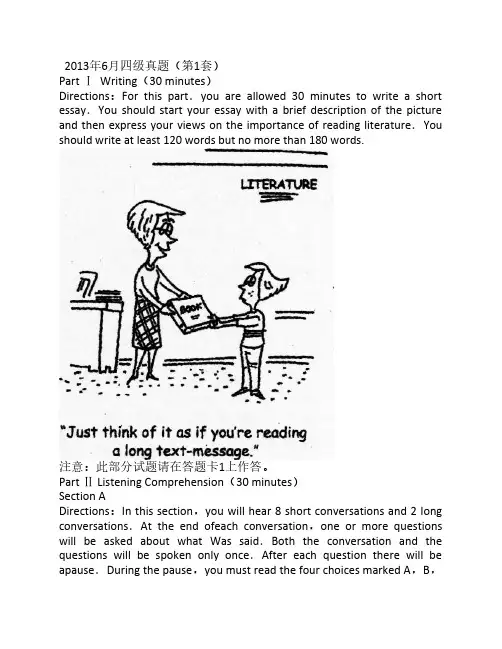
2013年6月四级真题(第1套)Part Ⅰ Writing(30 minutes)Directions:For this part.you are allowed 30 minutes to write a short essay.You should start your essay with a brief description of the picture and then express your views on the importance of reading literature.You should write at least 120 words but no more than 180 words.注意:此部分试题请在答题卡1上作答。
Part Ⅱ Listening Comprehension(30 minutes)Section ADirections:In this section,you will hear 8 short conversations and 2 long conversations.At the end ofeach conversation,one or more questions will be asked about what Was said.Both the conversation and the questions will be spoken only once.After each question there will be apause.During the pause,you must read the four choices marked A,B,C and D,anddecide which is the best answer.Then mark the corresponding letter on Answer Sheet lwith a single line through the centre.注意:此部分试题请在答题卡1上作答。
2013年6月年四级考试真题答案及详细解析(第一套)
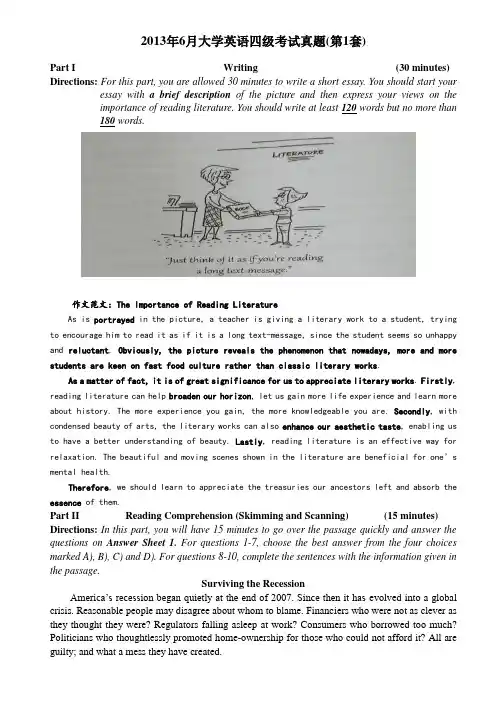
2013年6月大学英语四级考试真题(第1套)Part I Writing (30 minutes) Directions: For this part, you are allowed 30 minutes to write a short essay. You should start your essay with a brief description of the picture and then express your views on theimportance of reading literature. You should write at least 120 words but no more than180 words.作文范文:The Importance of Reading LiteratureAs is portrayed in the picture, a teacher is giving a literary work to a student, trying to encourage him to read it as if it is a long text-message, since the student seems so unhappy and reluctant. Obviously, the picture reveals the phenomenon that nowadays, more and more students are keen on fast food culture rather than classic literary works.As a matter of fact, it is of great significance for us to appreciate literary works. Firstly, reading literature can help broaden our horizon, let us gain more life experience and learn more about history. The more experience you gain, the more knowledgeable you are. Secondly, with condensed beauty of arts, the literary works can also enhance our aesthetic taste, enabling us to have a better understanding of beauty. Lastly, reading literature is an effective way for relaxation. The beautiful and moving scenes shown in the literature are beneficial for one’s mental health.Therefore, we should learn to appreciate the treasuries our ancestors left and absorb the essence of them.Part II Reading Comprehension (Skimming and Scanning) (15 minutes) Directions: In this part, you will have 15 minutes to go over the passage quickly and answer the questions on Answer Sheet 1. For questions 1-7, choose the best answer from the four choices marked A), B), C) and D). For questions 8-10, complete the sentences with the information given in the passage.Surviving the RecessionAmerica’s recession began quietly at the end of 2007. Since then it has evolved into a global crisis. Reasonable people may disagree about whom to blame. Financiers who were not as clever as they thought they were? Regulators falling asleep at work? Consumers who borrowed too much? Politicians who thoughtlessly promoted home-ownership for those who could not afford it? All are guilty; and what a mess they have created.Since 2007 America has shed 5 million jobs. More than 15% of the workforce are jobless or underemployed—roughly 25 million workers. The only industries swelling their payrolls are health care, utilities and the federal government. The value of listed shares in American firms collapsed by 57% from its peak in October 2007 to a low in March this year, though it has since bounced back somewhat. Industrial production fell by 12.8% in the year to March, the worst slide since the Second World War. Mark Zan di, an economist at Moody’s , predicts that the r ecession will shrink America’s economy by 3.5% in total. For most executives, this is the worst business environment they’ve ever seen.Times are so tough that even bosses are taking pay cuts. Median(中位数的) pay for chief executives of S&P 500 companies fell 6.8% in 2008. The overthrown business giants of Wall Street took the biggest knock, with average pay cuts of 38% and median bonuses of zero. But there was some pain for everyone: median pay for chief executives of non-financial firms in the S&P 500 fell by 2.7%.Nearly every business has a sad tale to tell. For example, Arne Sorenson, the president of Marriott hotels, likens the crisis to the downturn that hit his business after September 11th, 2001. When the twin towers fell, Americans stopped travelling. Marriott had its worst quarter ever, with revenues per room falling by 25%. This year, without a terrorist attack, the hotel industry is “putting the same numbers on the board”, says Mr Sorenson.The hotel bust(不景气), like most busts, was preceded by a breathtaking boom. Although many other big firms resisted the temptation to over-borrow, developers borrowed heavily and built bigger and fancier hotels as if the whole world were planning a holiday in Las Vegas. When the bubble burst, demand collapsed. Hotel owners found themselves with a huge number of empty rooms even as a lot of unnecessary new hotels were ready to open.Other industries have suffered even more. Large numbers of builders, property firms and retailers have gone bankrupt. And a disaster has hit Detroit. Last year the American car industry had the capacity to make 17 million vehicles. Sales in 2009 could be barely half of that. The Big Three American carmakers—General Motors, Ford and Chrysler—accumulated ruinous costs over the post-war years, such as gold-plated health plans and pensions for workers who retired as young as 48. All three are desperately restructuring. Only Ford may survive in its current form.Hard times breed hard feelings. Few Americans understand what caused the recession. Some are seeking scapegoats(替罪羊). Politicians are happy to take advantage. Bosses have been summoned to Washington to be scolded on live television. The president condemns their greed. Extravagance (奢侈) is outBusinessfolk are bending over backwards to avoid seeming extravagant. Meetings at resorts are suddenly unacceptable. Goldman Sachs, an investment bank, cancelled a conference in Las Vegas at the last minute and rebooked it in San Francisco, which cost more but sounded less fun.Anyway, the pain will eventually end. American business will regain its shine. Many firms will die, but the survivors will emerge leaner and stronger than before. The financial sector’s share of the economy will shrink, and stay shrunk for years to come. The importance of non-financial firms will accordingly rise, along with their ability to attract the best talent. America will remain the best place on earth to do business, so long as Barack Obama and the Democrats in Congress resist the temptation to interfere too much, and so long as organised labour does not overplay its hand.The crisis will prove hugely disruptive(破坏性的), however. Bad management techniques will be exposed. Necessity will force the swift adoption of more efficient ones. At the same time,technological innovation (创新) will barely pause for breath, and two big political changes seem likely.Mr Obama’s plan to curb carbon dioxide (CO₂) emissions (排放), though necessary, will be far from cost-free, whatever his sunny speeches on the subject might suggest. The shift to a low-carbon economy will help some firms, hurt others and require every organisation that uses much energy to rethink how it operates. It is harder to predict how Mr Obama’s proposed reforms to the failing health-care system will turn out. If he succeeds in curbing costs—a big if—it would be a huge gain for America. Some businesses will benefit but the vast bulk of the savings will be captured by workers, not their employers.In the next couple of years the businesses that thrive will be those that are tight with costs, careful of debt, cautious with cash flow and extremely attentive to what customers want. They will include plenty of names no one has yet heard of.Times change, and corporations change with them. In 1955 Time’s Man of the Year was H arlow Curtice, the boss of GM. His firm was leading America towards “a new economic order”, the magazine wrote. Thanks to men like Curtice, “the bonds of scarcity” had been broken and America was rolling “in an all-time high of prosperity”. Soon, Americans would need to spend “comparatively little time earning a living”.Half a century later GM is a typical example of poor management. In March its chief executive was fired by Time’s current Man of the Year, Mr Obama. The government now backs up the domestic car industry, lending it money and overseeing its turnaround plans. With luck, this will be short-lived. But there is a danger that Washington will end up micromanaging not only Detroit but also other parts of the economy. And clever as Mr Obama’s adviser s are, history suggests they will be bad at this.注意: 此部分试题请在答题卡1上作答。
2013年6月大学英语四级考试真题及答案(第2套)
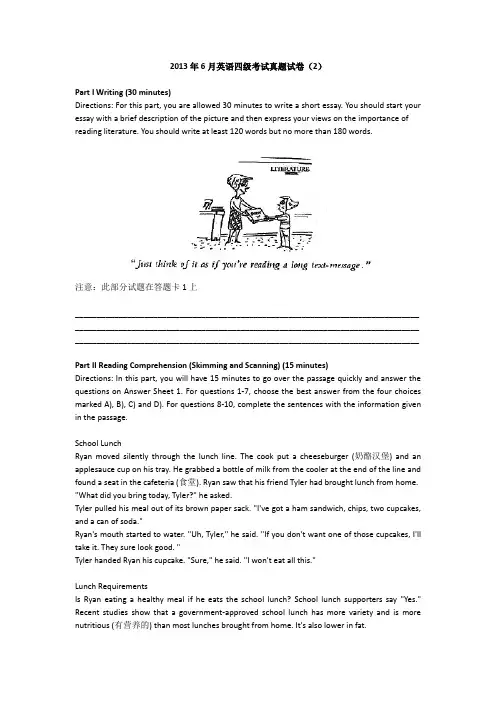
2013年6月英语四级考试真题试卷(2)Part I Writing (30 minutes)Directions: For this part, you are allowed 30 minutes to write a short essay. You should start your essay with a brief description of the picture and then express your views on the importance of reading literature. You should write at least 120 words but no more than 180 words.注意:此部分试题在答题卡1上_______________________________________________________________________________ _______________________________________________________________________________ _______________________________________________________________________________Part II Reading Comprehension (Skimming and Scanning) (15 minutes)Directions: In this part, you will have 15 minutes to go over the passage quickly and answer the questions on Answer Sheet 1. For questions 1-7, choose the best answer from the four choices marked A), B), C) and D). For questions 8-10, complete the sentences with the information given in the passage.School LunchRyan moved silently through the lunch line. The cook put a cheeseburger (奶酪汉堡) and an applesauce cup on his tray. He grabbed a bottle of milk from the cooler at the end of the line and found a seat in the cafeteria (食堂). Ryan saw that his friend Tyler had brought lunch from home. "What did you bring today, Tyler?" he asked.Tyler pulled his meal out of its brown paper sack. "I've got a ham sandwich, chips, two cupcakes, and a can of soda."Ryan's mouth started to water. "Uh, Tyler," he said. "If you don't want one of those cupcakes, I'll take it. They sure look good. "Tyler handed Ryan his cupcake. "Sure," he said. "I won't eat all this."Lunch RequirementsIs Ryan eating a healthy meal if he eats the school lunch? School lunch supporters say "Yes." Recent studies show that a government-approved school lunch has more variety and is more nutritious (有营养的) than most lunches brought from home. It's also lower in fat.The National School Lunch Act requires that school lunches go along with the Dietary Guidelines for Americans developed by the government. Meals must contain a variety of foods with plenty of grains and at least one fruit or vegetable each day. Foods must not contain too much sugar or salt.A hot lunch can contain up to 30% fat, but not more than 10% of its calories (卡路里) should come from saturated (饱和的) fat. In an average week, you should get one-third of the daily Recommended Dietary Allowances for protein, iron, calcium (钙), and vitamins A and C from your school lunch.Dare to CompareLet's compare Ryan's and Tyler's meals to sec which is healthier. Ryan's hot lunch (without the cupcake from his friend) has 577 calories, 25 grams of total fat. and 12 grams of saturated fat. He had one serving of fruit, 26 grams of protein, and 483 milligrams of calcium. Ryan ate more total fat (39%) and saturated fat (19%) than the dietary guidelines recommend. However, schools can still meet the guidelines by having the numbers average out over a week of lunches.Tyler's lunch from home (this includes both cupcakes) had 1 014 calories. 45 grams (40%) of total fat, and 10 grams (9%) of saturated fat. He ate 21 grams of protein and 155 milligrams of calcium, but no fruits or vegetables. Tyler's meal met the saturated fat guidelines, but had too much total fat.Tyler ate more calories and total fat than Ryan did. Ryan ate more protein, calcium, and fruit than Tyler did. Which meal would you say is the healthier choice?? la Carte OptionsFederal standards and most school districts forbid selling food in the cafeteria that competes with the school lunch. Many programs do, however, offer àla carte choices for students who don't want the hot meal. Foods sold àla carte separate from the main meal and are priced individually. These foods do not have to meet the same nutritional standards as the foods on the hot lunch menu. Neither do the foods sold at a snack-bar or those foods available elsewhere in the school.A study in one Texas school district compared the lunches of fourth graders who did not have food choices with those of fifth graders who could choose either a standard lunch or select from a snack-bar. The fourth graders ate 25% more fruits and vegetables than the fifth graders.Food sold as fund-raisers can also have an impact on school lunch. The money raised is important to provide needed funds for many after-class activities. But the meal's overall nutritional quality usually goes down. Many of these foods are high in fat, sugar, or both, and often come in extralarge portions. Fundraisers rarely sell fruits and vegetables.Choosing WiselySchool food-service programs are trying to please students, and still offer quality, nutritious meals at low cost. That task isn't easy. One school district in New York decided to do something about it. A student advisory board kept the food-service director up-to-date on what the kids wanted. They also worked with school snack-bars to sell smaller servings of chips and candy. You can make healthy meal choices at school even when not-so-healthy choices are available. You can be sure to get a nutritious meal when you pick foods from the Food Guide Pyramid. Forexample, always drink milk or a calcium-rich juice for lunch. Even chocolate milk is more nutritious than soda or a sports drink. Stay away from snack foods offered àla carte. They may fill you up now, but the ones that contain a lot of fat and sugar will slow you down later. Always eat the fruits and vegetables offered at the meal. They help give you the energy and vitamins you need to get you through the rest of your school day.Some people like to make fun of school lunches, but good nutrition is no laughing matter. Your school's hot lunch is based on the Food Guide Pyramid, so it's full of nutrition. Give it a try. You might be pleasantly surprised.It's a Team EffortTeam Nutrition is a program that gets schools excited about healthy eating. Schools across the nation pick a team leader who develops fun nutrition activities. The leader works with students, teachers, parents, food-service workers, and people from the community. Activities can range from running a school health fair to planting a garden.At the Jordan Community School in Chicago, Illinois, one group of fifth graders showed off their "pizza(比萨饼)garden" in a big, colorful poster showing vegetarian pizzas. The students and food-service staff planted and took care of the vegetables that they would later use as ingredients on their pizzas. The group started growing the plants in the school's cafeteria. Then they moved them outdoors to the students' demonstration garden.This is just one way to get everyone involved in making school lunch healthy and fun. Team up with your own group and see how creative you can get.注意:此部分试题请在答题卡1上作答。
2013年6月四级英语真题与听力原文及答案解析完整版

11. A) Children should be taught to be more careful.B) Children shouldn’t drink so much orange juice.C) There is no need for the man to make such a fuss.D) Timmy should learn to do things in the right way.12. A) Fitness training. B) The new job offer.C) Computer programming. D) Directorship of the club.13. A) He needs to buy a new sweater. B) He has got to save on fuel bills.C) The fuel price has skyrocketed. D) The heating system doesn’t work.14. A) Committing theft. B) Taking pictures.C) Window shopping. D) Posing for the camera.15. A) She is taking some medicine. B) She has not seen a doctor yet.C) She does not trust the man’s advice. D) She has alm ost recovered from the cough.16. A) Pamela’s report is not finished as scheduled.B) Pamela has a habit of doing things in a hurry.C) Pamela is not good at writing research papers.D) Pamela’s mistakes could have been avoided.17. A) In the left-luggage office. B) At the hotel reception.C) In a hotel room. D) At an airport.18. A) She was an excellent student at college. B) She works in the entertainment business.C) She is fond of telling stories in her speech. D) She is good at conveying her message.Passage OneQuestions 26 to 29 are based on the passage you have just heard.26. A) To give customers a wider range of choices.B) To make shoppers see as many items as possible.C) To supply as many varieties of goods as it can.D) To give space for more profitable products.27. A) On the top shelves.B) On the bottom shelves.C) On easily accessible shelves.D) On clearly marked shelves.28. A) Many of them buy things on impulse.B) A few of them are fathers with babies.C) A majority of them are young couples.D) Over 60% of them make shopping lists.29. A) Sales assistants promoting high margin goods.B) Sales assistants following customers around.C) Customers competing for good bargains.D) Customers losing all sense of time.Passage TwoQuestions 30 to 32 are based on the passage you have just heard.30. A) Teaching mathematics at a school.B) Doing research in an institute.C) Studying for a college degree.D) Working in a high-tech company.31. A) He studied the designs of various choices.B) He did experiments to different materials.C) He bought an alarm clock with a pig face.D) He asked different people for their opinions.32. A) Its automatic mechanism.B) Its manufacturing pattern.C) Its way of waking people up.D) Its funny-looking pig face.Questions 33 to 35 are based on the passage you have just heard.33. A) It’s often caused by a change of circumstances.B) It usually doesn’t require any special at tention.C) It usually appears all of a sudden.D) It usually lasts for several years.34. A) They can’t mix well with others.B) They emotionally receive their friends.C) They depend severely on family members.D) They share similar interests with friends.35. A) They lack consistent support from peers.B) They doubt their own popularity.C) They were born psychologically weak.D) They focus too much attention on themselves.Section CThere was a time when any personal information that was gathered about us was typed on a piece of paper and (36) ________ away in a file cabinet. It could remain there for years and, often (37) ________, never reach the outside world.Things have done a complete about-face since then. (38) ________ for the change has been the astonishingly (39) ________ development in recent years of the computer. Today, any data that is(40) ________ about us in one place or another — and for one reason or another — can be stored in a computer bank. It can then be easily passed to other computer banks. They are owned by (41) ________ and by private businesses and corporations, lending (42) ________, direct mailing and telemarketing firms, credit bureaus, credit card companies, and government (43) ________ at the local, state, and federal level.A growing number of Americans are seeing the accumulation and distribution of computerized date as a frightening invasion of their privacy. (44) ____________________________________________________________________ as the computer becomes increasingly efficient, easier to operate, and less costly to purchase and maintain. In 1970, a national survey showed that (45) ___________________________________________________ _________________. Seven years later, 47 percent expressed the same worry. (46) ____________________________________________________________________.Part III Listening Comprehension11.W: What are you doing in here, Sir? Didn't you see the private sign over there?M: I'm sorry. I didn't notice it when I came in. I'm looking for the manager's office.Q: What do we learn from the conversation?12.W: Mike, what's the problem? You've known from month the report is due today.M: I know, but I'm afraid I need another few days. The data is hard to interpret than I expected.Q: What does the man mean?13.W: Excuse me, Tony. Has my parcel from New York arrived?M: Unfortunately, it's been delayed due to the bad weather.Q: What is the woman waiting for?14.W: Pam said we won't have the psychology test until the end of next week.M: Ellen, you should know better than to take Pam's words for anything.Q: What doesthe man imply about Pam?15W: Tom, would you please watch my suitcase for a minute? I need to go make a quick phone call.M: Yeah, sure. Take your time. Our train doesn’t leave for another twenty minutes.Q: What does the man mean?16M: Frankly, Mary is not what I'd called easy-going.W: I see. People in our neighborhood find it hard to believe she's my twin sister.Q: What does the woman imply?17M: How soon do you think this can be cleaned?W: We have same day service, sir. You can pick up your suit after five o'clock.Q: Where does the conversation most probably take place?18W: I really enjoy that piece you just play on the piano. I bet you get a lot of requests for it.M: You said it. People just can't get enough of it.Q: What do we learn from the conversation?Passage 1Questions 26 to 29 are based on the passage you have just heard.Farmington, Utah, is a more pleasant community since a local girls' 4-H club improved Main Street. Six 4-H girls worked to clean the 72 foot curbside that was covered with weeds, rocks and trash. Each member volunteered to clean up and to dig in plot, five flats of flowers. They also took terms in watering, weeding and maintaining the plot. Participation in this project helped the girls developed a new attitude towards their parents of their own homes; they've learned how to work with tools, and improve their work habits. One mother said that before her daughter was involved in this project, she would not even pour a weed. The experience on Main Street stimulated self-improvement, and encouraged members to take pride in their home grounds and the total community. City officials cooperated with the 4-H members in planting trees, building cooking facilities, pick-me tables, swings and public rest rooms. The 4-H girls planted trees and took care of them during the early stages of growth. The total park project needed more plantings inthe following years. Members of the 4-H club agreed to follow the project through to completion, because they receive satisfaction from the results of constructive work. The project is a growing one and is spread from the park to the school and the shopping center. Trees and flowers have all been planted in the shopping center, making the atmosphere pleasant.Questions 26 to 29 are based on the passage you have just heard.26. What do we learn about Main Street in Farmington?27. What do the 4-H club members do about the curbside?28. What have the 4-H girls learned from the project?29. Why do the 4-H girls agree to follow the park project through to complete.Question 30 to 32 are based on the passage you have just heard.Passage 2According to a survey on reading conducted in 2001 by the U.S. National Education Association (NEA), young Americans say reading is important, more important than computers and science. Over 50% of the 12 to 18 years old interviewed say they enjoy reading a lot. 79% find it stimulating and interesting. And 87% think it is relaxing. About 68% of those surveyed disagreed with the opinion that reading is boring or old-fashioned.Over half teenagers interviewed said they read more than ten books a year. The results also show that middle school students read more books than high schoolers. Over 66% of teens like to read fiction, such as novels and stories. Over 26% are interested innon-fiction, such history books.64% of students listed reading stories about people my own age. That's a favorite topic. Mysteries and detective stories came second on the list at 53%. Just under 50% said they were interested in reading about their own culture in tradition. Of the teenagers who participated in the survey, 49% said that libraries are where they get most of their books. However, many complain that their school libraries do not have enough up-to-date interesting books and magazines. Even though many teenagers in the US enjoy reading, they still have other interests. When asked which activity would be the most difficult to give up for a week, 48% said listening to music. TV would be difficult to give up for 25% of those surveyed.Question 30 to 32 are based on the passage you have just heard.30. What does the survey on teenager reading show?31. What books are most popular among teenagers according to the survey?32. What activity do teenagers find the most difficult to give up for a week?Passage 2【总评】本篇文章以阅读调查报告为话题,贴近生活,容易理解。
2013年06月大学英语四级真题含答案

2013年6月大学英语四级考试试题Part Writing (30 minute)Directions: For this part ,you are allowed 30minute to write a short essay on the topic of students selecting their lectures. You should write at least 120 words following the outline when bellow:1.有些大学允许学生自由选择某些课程的任课教师2.学生选择教师时所考虑的主要因素3.学生自选任课教师的益处和可能产生的问题Part II Reading comprehension (skimming and scanning ) (15 minute)HighwayA government study recommended a national highway system of 33,920 miles, and congress passed the Federal-Aid Highway Act of 1944,which called for strict, centric controlled desert criteria.The interstate highway system was finally launched in 1956 and has been hailed as one of the greatest public works projects of the century .To build its 44,000-mile web of highways, bridge and tunnels, hundreds of unique engineering designs and solutions had to be worked out. Consider the many geographic, features of the country: mountains, steep grades, wetlands, rivers, deserts and plains. Variables included the slope of the land, the ability of the pavement to support the load. Innovative, designs of roadways, tunnels, bridges, overpasses, and interchanges that could run through or bypass urban areas soon began to weave their way across the country, forever altering the face of American.Long-span, segmented-concrete, cable-stayed bridges such as Hale Boggs in Louisiana and the Sunshine Skyway in Florida ,and remarkable tunnels like Fort Mchenry in Maryland and Mr. baker in Washington developed under the nation's physical challenges, Traffic control systems and methods of construction developed under the interstate program soon influenced highway construction around the world, and were invaluable in improving the condition of urban streets and traffic patterns.Today the interstate system links every major city in the U.S, and the U.S with Canada and Mexico. Built with safety in mind the highways have wide lanes and shoulders, dividing medians, or barriers, long entry and exit lanes, our engineered for safe turns, and limited access. The death rate on highways is half that of all other U.S roads (0.86 deaths per 100 million passenger miles compared to 1.99 deaths per 100 million on all other roads)By opening the North American continent, highways have enabled consumer goods and services to reach people in remote and rural areas of jobs, access to the growth options in terms of jobs access to cultural programs health care, and other benefits. Above all, the interstate system provides individuals with what they enrich most: personal freedom of mobility.The interstate system has been an essential element of the nation's economic growth in terms of shipping and job creation: more than 75 percent of the nation's freight deliveries arrive by truck. And most products that arrive by rail or air use interstates for the last leg of the journey by vehicle.Not only has the highway system affected the American economy by providing shipping routes, it has led to the growth of spin-off industries like service stations ,motels, restaurants, and shopping centers. It has allowed the relocation of manufacturing plants and other industries from urban areas to rural.By the end of the century there was an immense network of paved roads, residential streets, expressways, and freeways built to support millions of vehicles. The high way system was officially renamed for Eisenhower to honor his vision and leadership. The year construction began he said: "Together, the united forces of our communication and transportation systems are dynamic elements in the very name we bear -United States. Without them, we would be a mere alliance of many separate parts."1. National standards for paved roads were in place by 1921.2. General Eisenhower felt that the broad German motorways made more sense than the two-lane highways of America.3. It was in the 1950s that the American government finally took action to build a national highway system.4. Many of the problems presented by the country’s geograp hical features found solutions in innovative engineering projects.5. In spite of safety considerations, the death rate on interstate highways is still higher than that of other American roads.6. The interstate highway system provides access between major military installations in America.7. Services stations, motels and restaurants promoted the development of the interstate highway system.8. The greatest benefit brought about by the interstate system was___________9.Trucks using the interstate highways deliver more than__________________10.The interstate system was renamed after Eisenhower in recognition_____________Part Ⅲ Listening ComprehensionSection A11. A)The girls got on well with each other. B)It's understandable that girls don't get along.C)She was angry with the other young stars. D)The girls lacked the courage to fight.12. A)The woman does her own housework. B)The woman needs a housekeeper.C)The woman's house is in a mess. D)The woman works as a housekeeper.13. A)The Edwards are quite well-off.B)The Edwards should cut down on their living expenses.C)It'll be unwise for the Edwards to buy another house.D)It's too expensive for the Edwards to live in their present house.14.A)The woman didn't except it to be so warm at noon. B)The woman is sensitive to weather changes.C)The weather forecast was unreliable D)The weather turned cold all of a sudden.15. A)At a clinic. B)At a restaurant. C)In a supermarket. D)In an ice cream shop.16. A)The woman did not feel any danger growing up in the Bronx.B)The man thinks it was quite safe living in the Bronx district.C)The woman started working at an early age to support her family .D)The man doesn’t think it safe to send an 8-year-old to buy things.17. A)The man has never seen the woman before. B)The two speakers work for the same company.C)The two speakers work in the same floor. D)The woman is interested in market research.18. A)The woman can't tolerate any noise. B)The man is looking foe an apartment.C)The man has missed his appointment. D)the woman is going to take a train trip.Questions 19 to 21 are based on the conversation you have just heard.19. A)To make a business report to the woman . B)To be interviewed for a job in the woman's company.C)To resign from his position in the woman's company. D)To exchange stock market information with the woman.20. A)He is head of a small trading company. B)He works in an international insurance company.C)He leads s team of brokers in a big company. D)He is a public relations officer in a small company.21. A)The woman thinks Mr. Saunders is asking for more than they can offer.B)Mr. Saunders will share one third of the woman's responsibilities.C)Mr. Saunders believes that he deserves more paid vacations.D)The woman seems to be satisfied with Mr. Saunders' past experience.22. A)She's worried about the seminar. B)The man keeps interrupting her.C)She finds it too hard. D)She lacks interest in it.23. A)The lecturers are boring. B)The course is poorly designed.C)She prefers Philosophy to English. D)She enjoys literature more.24. A)Karen's friend. B)Karen's parents. C)Karen's lecturers. D)Karen's herself.25. A)Changing her major. B)Spending less of her parents' money.C)Getting transferred to the English Department. D)Leaving the university.Section BPassage One Question 26 to 29 are based on the passage you have just heard.26. A) Rent a grave. B) Burn the body. C) Bury the dead near a church. D)buy a piece of land for a grave.27. A) To solve the problem of lack of land. B)To see whether they have decayed.C)To follow the Greek religious practice. D)To move them to a multi-Storey28. A)They should be buried lying down . B)They should be buried standing up.C)They should be buried after being washed. D)They should be buried when partially decayed.29. A)Burning dead bodies to ashes. B)Storing dead bodies in a remote place.C)Placing dead bodies in a bone room. D)Digging up dead bodies after three years.Passage Two Question 30 to 32 are based on the passage you have just heard.30. A)Many foreign tourist visit the Unite States every year. B)Americans enjoy eating out with their friends.C)The United States is a country of immigrants. D)Americans prefer foreign foods to their own food.31. A)They can make friends with people from other countries.B)They can get to know people of other cultures and their lifestyles.C)They can practice speaking foreign languages there.D)They can meet with businessmen from all over the world.32. A)The couple cook the dishes and the children help them .B)The husband does the cooking and the wife serves as the address.C)The mother does the cooking while the famepand children within the guests.D)A hired cook prepares the dishes and the family members serve the guests.Passage Three Questions 33 to 35 are based on the passage you have just heard .33. A)He took them to watch a basketball game. B)He trained them to play European football.C)He let them compete in getting balls out of a basket. D)He taught them to play an exciting new game.34. A)The players found the basket too high to teach. B)The players had trouble getting the ball out of the basket.C)The players had difficulty understanding the complex rules. D)The players soon found the game boring.35. A)By removing the bottom of the basket. B)By lowering the position of the basket.C)By simplifying the complex rules. D)By altering the size Of the basket.Section CF or American time is money. They say, “you only get so much time in this life; you'd better use it wisely." The(36)__________without be better than the past or present. As American are (37)__________to see things, unless people use their time for constructive activity, Thus American(38)__________a "well-organized" person is punctual and is(40)__________of other people's time. They do not (41)__________people's time with conversation or other activity that has no(42)__________beneficial outcome.The American attitude toward time is not (43)__________shared by others, especially non-Europeans. They aremore likely to regard time as (44)__________.One of the more difficult things many students must adjust to in the states is the notion that time must be saved whenever possible and used wisely every day.In the contest (45)__________.McDonald’s, KFC, and eating meals. As McDonald’s restaurants(46)__________, bringing not just hamburgers but an emphasis on speed, efficiency, and shiny cleanliness.Part IV reading comprehension(reading in depth)Section AEI Nino is name given to the mysterious and often unpredictable change in the climate of the world. This strange ___47_____happens every five to eight years. It starts in the Pacific Ocean and is thought to be caused by a failure in the trade winds(信风),which affects the ocean currents driven by these winds. As the trade winds lessen in ____48____,the ocean temperatures rise causing the Peru current flowing in form the east to warm up by as much as 5`C.The warming of the ocean has far-reaching effects. The hot, humid(潮湿的)air over the ocean causes severe ___49___thunderstorms.The rainfall is increased across South American ____50____floods to Peru. In the West pacific, there are droughts affecting Australia and Indonesia. So while some parts of the world prepare for heavy rains and floods, other parts face drought, poor crops and____51____.EI Nino usually lasts for about 18 months The 1982-83 EI Nino brought the most___52____weather in modern history .Its effect was worldwide and it left more than 2,000 people dead and caused over eight billion pounds ____53___of damage. The 1990 EI Nino will ____55___,but they are still not __56___sure what leads to it or what affects how strong it will be.A)estimate B)strength C)deliberately D)notify E)tropical F)phenomenon G)stable H)attractionI)completely J)destructive K)starvation L)bringing M)exhaustion N)worth O)strikeSection BPassage OneCommunications technologies are far from equal when it comes to conveying the truth. The first study to tell lies in phone conversations as they are in emails. The fact that emails are automatically recorded-and can come back to haunt(困扰)you appears to be the key to the finding.Jeff Hancock of Cornell University in Ithaca, Mew York, asked 30 students to keep a communications diary for a week. In it they noted the number of conversations or email exchanges they had lasting more than 10 minutes, and confessed to how many lies they told. Hancock then worked out the number of lies per conversation foe each medium .He found that lies made up 14 per cent of emails, 21 per cent of instant messages,27 per cent of face-to-face interactions and an astonishing 37 per cent of phone calls.His resolves to be presented at the conference on human-computer interaction in Vienna, Austria, in April, have surprised psychologists. Some expected e-mailers to be the biggest liars, reasoning that because deception makes people uncomfortable, the detachment(非直接接触)of emailing would make it easier to lie. Others expected people to lie more in face-to-face exchanges because we are most practiced at that form of communication.But Hancock says it is also crucial whether a conversation is being recorded and could be reread, and whether it occurs in real time. People appear to be afraid to lie when they know the communication could later be used to hold them to account, he says. This is why fewer lies appear in email than on the phone.People are also more likely to lie in real time in a instant message or phone call say-than if they have time to think of a response, says Hancock. He fond many lies are spontaneous(脱口而出的)responses to an unexpected demand, such as: “Do you like my dress?"Hancock hopes his research will help companies work our the best ways for their employees to communicate. For instance, the phone might be the best medium foe sales where employees are encouraged to stretch the truth. But, given his result, work assessment where honesty is a priority, might be best done using email.57.Hancock's study focuses on ____________.A)the consequences of lying in various communications’ media.B)the success of communications technologies in conveying ideas.C)people are less likely to lie in instant messages.D)people 's honesty levels across a range of communications media.58.Hancock's research finding surprised those who believed that________________.A)people are less likely to lie in instant messages. B)people are unlikely to lie in face-to-face interactions.C)people are most likely to lie in email communication D)People are twice as likely to lie in phone conversations.59. According to the passage, why are people more likely to tell the truth through certain media of communication?A)They are afraid of leaving behind traces of their lies. B)They believe that honesty is the best policy.C)They tend to be relaxed when using those media. D)They are most practiced at those forms of communication.60. According to Hancock the telephone is a preferable medium for promoting sales because____________.A)Salesmen can talk directly to their customers. B)Salesmen may feel less restrained to exaggerate.C)Salesmen can impress customers as being trustworthy. D)Salesmen may pass on instant messages effectively.61. It can be inferred from the passage that_____________.A)Honesty should be encouraged in interpersonal communicationsB)more employers will use emails to communicate with their employeesC)suitable media should be chosen for different communication purposesD) email is now the dominant medium of communication within a company.Passage TwoIn a country that defines itself by ideals, not by shared blood, who should be allowed to come to work and live here? In the wake of the Sept.11 attacks these questions have never seemed more pressing.On December .11,2001,as part of the effort to increase homeland security ,federal and local authorities in 14 states staged "Operation Safe Travel" -raids on airports to arrest employees with false identification(身份证明).In Salt Lake City there were 69 arrests. But those captured were anything but terrorists, most of them illegal immigrants from Central or South American .Authorities said the undocumented worker's illegal status made them open to blank mall(讹诈)by terrorists Many immigrants in Salt Lake City were angered by the arrests and said they felt as if they were being treated like disposable goods.Mayor Anderson said those feelings were justified to a certain extent. “We’re saying we want you to work in these places, we’re going to look the other way in terms of what our laws are, and then when it's convenient for us, or when we can try to make a point in terms of national security, especially after Sept.11, then you’re disposable Ther e are whole families being uprooted for all of the wrong reasons,” Anderson said.If Sept.11 had never happened the airport workers would not have been arrested and could have gone on quietly living in America, probably indefinitely .Ana Castro, a ,mana ger at a Ben & Jerry’s ice cream shop at the airport had been working 10 years with the same false Social Security card when she was arrested in the December airport raid. Now she and her family are living under the threat of deportation(驱逐出境)。
2013年6月英语四级真题及答案【全】
2013年6月英语四级真题及答案【全】2013年6月英语四级真题及答案【全】Part I Writing对白:儿子: Dad, I'm a bit worried about disposing of nuclear waste(处理核废料)爸爸: If you can empty the dustbin(垃圾筒) here, you can do anything!范文:The picture shows us a dialogue between a father and a son. The son told his father, “Dad, I’m a bit worried about disposing of nuclear waste”. While his father told him, “If you can empty the dustbin here you can do anything”. It reveals the importance of doing small things well before undertaking something big. There is also an old Chinese saying to go with this that a person can’t sweep the world before he can sweep his own room.Unquestionably, doing small things is the first step of success and will layroot for doing something big. By doing something small, we are enabled to accumulate experience, master skills and train ourselves to be more patient. In other word, we can be well prepared for further challenges in the course of fulfilling small things. By contrast, those who set out to do something big will be constantly haunted by disappointment, frustrations or even failures. As when opportunity “something big” appears, they can hardly seize them because of the lack of experience and confidence stems from doing small things.Taking the picture presented above as a case in point, how can the little boy succeed in disposing of nuclear weapons if he even doesn’t know how to empty1.who take an image of the page and put it on a screen.”可知,Course Smart现在的电子课本只是对纸质课本的复制,因此,正确答案为D。
2013年6月份英语四级题目和答案
Part III Listening ComprehensionSection ADirections: In this section, you will hear 8 short conversations and2 long conversations. At the end of each conversation, one or more questions will be asked about what was said. Both the conversation and the questions will be spoken only once. After each question there will be a pause. During the pause, you must read the four choices marked A), B), C) and D), and decide which is the best answer. Then mark the corresponding letter on Answer Sheet 2 with a single line through the center.11.W: What are you doing in here, Sir? Didn't you see the private sign over there?M: I'm sorry. I didn't notice it when I came in. I'm looking for the manager's office.Q: What do we learn from the conversation?12.W: Mike, what's the problem? You've known from month the report is due today.M: I know, but I'm afraid I need another few days. The data is hard to interpret than I expected.Q: What does the man mean?13.W: Excuse me, Tony. Has my parcel from New York arrived?M: Unfortunately, it's been delayed due to the bad weather.Q: What is the woman waiting for?14.W: Pam said we won't have the psychology test until the end of next week.M: Ellen, you should know better than to take Pam's words for anything.Q: What doesthe man imply about Pam?15.W: Tom, would you please watch my suitcase for a minute? I need to go make a quick phone call.M: Yeah, sure. Take your time. Our train doesn’t leave for another twenty minutes.Q: What does the man mean?16.M: Frankly, Mary is not what I'd called easy-going.W: I see. People in our neighborhood find it hard to believe she's my twin sister.Q: What does the woman imply?17.M: How soon do you think this can be cleaned?W: We have same day service, sir. You can pick up your suit after five o'clock.Q: Where does the conversation most probably take place?18.W: I really enjoy that piece you just play on the piano. I bet you get a lot of requests for it.M: You said it. People just can't get enough of it.Q: What do we learn from the conversation?Section BQuestions 19-22 are based on the conversation you have just heard.W: Good afternoon, Mr. Jones. I am Teresa Chen, and I’ll be interviewing you. How are you today?M: I am fine, thank you. And you, Miss Chen?W: Good, Thanks. Can you tell me something about your experience in this kind of work?M: Well, for several years, I managed a department for the Brownstone Company in Detroit, Michigan. Now I work part time because I also go to school at night. I’m getting a business degree.W: Oh, how interesting. Tell me, why do you want to leave your present job?M: I’ll finish school in a few months, and I’d like a full-time position with more responsibility.W: And why would you like to work for our company?M: Because I know your company’s work and I like it.W: Could you please tell me about your special skills and interests?M: Of course, I’m good at computers and I can speak Spanish. I used to take classes in Spanish at the local college. And I like travelling a lot.W: Can you give me any references?M: Yes, certainly. You can talk to Mr. McCaw, my boss, at the Brownstone Company. I could also give you the names and numbers of several of my teachers.W: All right, Mr. Jones, and would you like to ask me any questions?M: Yes, I wonder when I’ll be informed about my application for the job.W: Well, we’ll let you know as soon as possible. Let’s stay in touch. Thank you very much for coming this afternoon.M: Thank you.Questions 19-22 are based on the conversation you have just heard.19. What does the man say about his working experience?20. Why does the man want to leave his present job?21. What is the man interested in?22. What question did the man ask the woman?Questions 23-25 are based on the conversation you have just heard.M: Lisa, Lisa! Over here, darling! It's wonderful to see you. Oh, Lisa, you look marvelous.W: Oh, Paul, you look tired. Two months away in the capital? Paul, I think you've been working too hard.M: I'm fine. The city is very hot this time of the year. It's good to get back to some fresh air. You know, Lisa, what they say about pregnant women really is true.W: What's that Paul?M: They say they look beautiful.W: Well, I had a lot of tension while you've been studying hard on your course in D.C.M: Oh?W: Oh, don't worry, all from a man over 50. Father has told all his business friends the good news about the baby. And the phone hasn't stopped ringing.M: Oh, look, darling. There's a taxi.W: Paul, tell me about the special project you mentioned on the phone. You sounded very excited about it!M: You know, I've learned a lot from the project. I'm surprised that was still in business.W: That's because we have a wonderful sales manager ——you!M: Thanks. But that's not the problem at all. Lisa, our little company, and it is little compared to the giants in the city. Our little company's in danger. We are out of date.We need to expand. If we don't, we will be swallowed up by one of the giants.Questions 23-25 are based on the conversation you have just heard.23. What do we learn about Lisa?24. What do we learn about the man from the conversation?25. What does the man say about his company?Section CPassage 1Questions 26 to 29 are based on the passage you have just heard.Farmington, Utah, is a more pleasant community since a local girls' 4-H club improved Main Street. Six 4-H girls worked to clean the 72 foot curbside that was covered with weeds, rocks and trash. Each member volunteered to clean up and to dig in plot, five flats of flowers. They also took terms in watering, weeding and maintaining the plot. Participation in this project helped the girls developed a new attitude towards their parents of their own homes; they've learned how to work with tools, and improve their work habits. One mother said that before her daughter was involved in this project, she would not even pour a weed. The experience on Main Street stimulated self-improvement, and encouraged members to take pride in their home grounds and the total community. City officials cooperated with the 4-H members in planting trees, building cooking facilities, pick-me tables, swings and public rest rooms. The 4-H girls planted trees and took care of them during the early stages of growth. The total park project needed more plantings in the following years. Members of the 4-H club agreed to follow the project through to completion, because they receive satisfaction from the results of constructive work. The project is a growing one and is spread from the park to the school and the shopping center. Trees and flowers have all been planted in the shopping center, making the atmosphere pleasant.Questions 26 to 29 are based on the passage you have just heard.26. What do we learn about Main Street in Farmington?27. What do the 4-H club members do about the curbside?28. What have the 4-H girls learned from the project?29. Why do the 4-H girls agree to follow the park project through to complete.Question 30 to 32 are based on the passage you have just heard.Passage 2According to a survey on reading conducted in 2001 by the U.S. National Education Association (NEA), young Americans say reading is important, more important than computers and science. Over 50% of the 12 to 18 years old interviewed say they enjoy reading a lot. 79% find it stimulating and interesting. And 87% think it is relaxing. About 68% of those surveyed disagreed with the opinion that reading is boring or old-fashioned.Over half teenagers interviewed said they read more than ten books a year. The results also show that middle school students read more books than high schoolers. Over 66% of teens like to read fiction, such as novels and stories. Over 26% are interested in non-fiction, such history books.64% of students listed reading stories about people my own age. That's a favorite topic. Mysteries and detective stories came second on the list at 53%. Just under 50% said they were interested in reading about their own culture in tradition. Of the teenagers who participated in the survey, 49%said that libraries are where they get most of their books. However, many complain that their school libraries do not have enough up-to-date interesting books and magazines. Even though many teenagers in the US enjoy reading, they still have other interests. When asked which activity would be the most difficult to give up for a week, 48% said listening to music. TV would be difficult to give up for 25% of those surveyed.Question 30 to 32 are based on the passage you have just heard.30. What does the survey on teenager reading show?31. What books are most popular among teenagers according to the survey?32. What activity do teenagers find the most difficult to give up for a week?Questions 33-35 are based on the passage you have just heard.Passage 3Thank you for coming, everyone. Today’s presentation will show how we see the development of the motor car in the short to medium term, and that is why we have invited all of you here today. Let’s start with power. It’s clear that petrol-driven engines have no future. Already there are many alternative fuel vehicles on the market, powered by anything from solar power to natural gas. Some independent thinkers have even produced cars that run on vegetable oil. But as we all know, of all these alternative fuel vehicles, the most practical are electric vehicles. Sure, in the past electric vehicles have their problems, namely, a limited driving range, and very few recharging points, which limited their use. Now, however, recent developments in electric vehicle technology mean they can match conventional petrol engines in terms of performance and safety. Let’s not forget that electric vehicles ar e cleaner. Plus, importantly, the power source is rechargeable, so this does not involve using any valuable resources. Moving on to communications, very soon, cars will be linked to GPS satellites, so they’ll do all the driving for you. What controls remain for the users will be audio-based, so, for example, you’ll just have to say “a bit warmer”, and the air conditioning will adjust automatically. You’ll also be able to receive email, music and movies, all via an internet link. So just type in the destination you want, sit back, sleep, watch your movie, whatever.Questions 33-35 are based on the passage you have just heard.33. What is the presentation mainly about?34. What used to restrict the use of electric vehicles?35. What does the speaker say about electric vehicles of today?2013年6月大学英语四级考试Part III Listening Comprehension长对话答案+解析Conversation 1【听力原文】W: Good afternoon, Mr. Jones. I am Teresa Chen, and I’ll be interviewing you. How are you today?M: I am fine, thank you. And you, Miss Chen?Good, Thanks.W: Can you tell me something about your experiences in this kind of work?M: Well, for several years, I managed a department for the Brownstone Company in Detroit, Michigan. Now I work part time because I also go to school at night. I’m getting a business degree.W: Oh, how interesting. Tell me, why do you want to leave your present job?M: I’ll finish school in a few months, and I’d like a full-time position with more responsibility.W: And why would you like to work for our company?M: Because I know your company’s work, and I like it.W: Could you please tell me about your special skills and interests?M: Of course, I’m good at computers and I can speak Spanish. I used to take classes in Spanish at the local college. And I like travelling a lot.W: Can you give me any references?M: Yes, certainly. You can talk to Mr. McCaw, my boss, at the Brownstone Company. I could also give you the names and numbers of several of my teachers.W: All right, Mr. Jones, and would you like to ask me any questions?M: Yes, I wonder when I’ll be informed about my application for the job?W: Well, we’ll let you know as soon as possible. Let’s stay in touch. Thank you very much for coming this afternoon.M: Thank you.Questions 19-22 are based on the conversation you have just heard.19. What does the man say about his working experience?20. Why does the man want to leave his present job?21. What is the man interested in?22. What question did the man ask the woman?【总评】这是一篇以面试为场景的听力对话。
2013年6月英语四级真题及答案详解-推荐下载
2013年6月大学英语四级考试真题及答案详解Total score: 710 Total time allowed: 125 minutes特注:2013年6月大学四级考试采用多题多卷形式,本试卷含两套写作题,考生可以任选其一。
Part I Writing (多题多卷写作题1) (30 minutes)Directions:For this part, you are allowed 30 minutes to write a short essay. You should start your essay with a brief description of the picture and then express your views on the importance of doing small things before undertaking something big. You should write at least 120 words but no more than 180 words.Part I Writing (多题多卷写作题2) (30 minutes)Directions:For this part, you are allowed 30 minutes to write a short essay. You should start your essay with a brief description of the picture and then express your views on the importance of reading literature. You should write at least 120 words but no more than 180 words.Part II Reading Comprehension (Skimming and Scanning) (15 minutes) Directions:In this part, you will have 15 minutes to go over the passage quickly and answer the questions on Answer Sheet 1. For questions 1-7, choose the best answer from the four choices marked A), B), C) and D). For questions 8-10, complete the sentences with the information given in the passage.Can Digital Textbook Truly Replace the Print Kind?The shortcomings of traditional print edition textbooks are obvious: For starters they’re heavy, with the average physics textbook weighing 3.6 pounds. They’re also expensive, especially when you factor in the average college student’s limited budget, typically costing hundreds of dollars every semester.But the worst part is that print version of textbooks are constantly undergoing revisions. Many professors require that their students use only the latest versions in the classroom, essentially rendering older texts unusable. For students, it means they’re basically stuck with a four pound paper-weight that they can’t sell back.Which is why digital textbooks, if they live up to their promise, could help ease many of these shortcomings. But till now, they’ve been something like a mirage(幻影)in the distance, more like a hazy(模糊的)dream than an actual reality. Imagine the promise: Carrying all your textbooks in a 1.3 pound iPad? It sounds almost too good to be true.But there are a few pilot schools already making the transition(过渡)over to digital books. Universities like Cornell and Brown have jumped onboard. And one medical program at the University of California, Irvine, gave their entire class iPads with which to download textbooks just last year.But not all were eager to jump aboard.“People were tired of using the iPad textbook besides using it for reading,” says Kalpit Shah, who will be going into his second year at Irvine’s medical program this fall. “They weren’t using it as a source of communication because they couldn’t read or write in it. So a third of the people in my program were using the iPad in class to take notes, the other third were using laptops and the last third were using paper and pencil.”The reason it hasn’t caught on yet, he tells me, is that the functionality of e-edition textbooks is incredibly limited, and some students just aren’t motivated to learn new study behavior.But a new application called Inkling might change all that. The company just released an updated version last week, and it’ll be utilized in over 50 undergraduate and graduate classrooms this coming school year.“Digital textbooks are not going to catch on,” says Inkling CEO Matt Maclnnis as he’s giving me a demo(演示)over coffee. “What I mean by that is the current perspective of the digital textbook is it’s an exact copy of the print book. There’s Course Smart, etc., these guys who take any image of the page and put it on a screen. If that’s how we’re defining digital textbooks, there’s no hope of that becoming a mainstream product.”He calls Inkling a platform for publishers to build rich multimedia content from the ground up, with a heavy emphasis on real-world functionality. The traditional textbook merely serves as a skeleton.At first glance Inkling is an impressive experience. After swiping(敲击)into the iPad app (应用软件), which you can get for free here, he opens up a few different types of textbooks.Up first is a chemistry book. The boot time is pretty fast, and he navigates through (浏览) afew chapters before swiping into a fully rendered 3D molecule that can be spun around to view its various building blocks. “Publishers give us all of the source media, artwork, videos,” he says, “We help them think through how to actually build something for this platform.”Next he pulls up a music composition textbook, complete with playable demos. It’s a learning experience that attacks you from multiple sensory directions. It’s clear why this would be something a music major would love.But the most exciting part about Inkling, to me, is its notation(批注)system. Here’s how it works!When you purchase a used print book, it comes with its previous owner’s highlights and notes in the margins. It uses the experience of someone who already went through the class to help improve your reading (how much you trust each notation is obviously up to you).But with lnkling, you can highlight a piece of content and make notes. Here’s where things get interesting, though: If a particularly important passage is highlighted by multiple lnkling users, that information is stored on the cloud and is available for anyone reading the same textbook to come across. That means users have access to notes from not only their classmates and Facebook friends, but anyone who purchased the book across the country. The best comments are then sorted democratically by a voting system, meaning that your social learning experience is shared with the best and brightest thinkers.As a bonus, professors can even chime in (插话) on discussions. They’ll be able to answer the questions of students who are in their class directly via the interactive book.Of course, Inkling addresses several of the other shortcomings in traditional print as well. Textbook versions are constanly updated, motivating publishers by minimizing production costs (the big ones like McGraw-Hill are already onboard). Furthermore, students will be able to purchase sections of the text instead of buying the whole thing, with individual chapters costing as little as $2.99.There are, however, challenges.“It takes efforts to build each book,” Maclnnis tells me. And it’s clear why.Each interactive textbook is a media-heavy experience built from the ground up, and you can tell that it takes a respectable amount of manpower to put together each one.For now the app is also iPad-exclusive, and though a few of these educational institutions are giving the hardware away for free, for other students who don’t have such a luxury it’s an added layer of cost — and an expensive one at that.But this much is clear. The traditional textbook model is and has been broken for quite some time. Whether digitally interactive ones like Inkling actually take off or not remains to be seen, and we probably won’t have a definite answer for the next few years.However the solution to any problem begins with a step in a direction. And at least for now, that hazy mirage in the distance? A little more tangible (可触摸的), a little less of a dream.1. The biggest problem with traditional print textbooks is that _____.A) they are not reused once a new edition comes outB) they cost hundreds of dollars every semesterC) they are too heavy to carry aroundD) they take a longer time to revise2. What does the author say about digital textbooks?A) It’s not likely they will replace traditional textbooks.B) They haven’t fixed all the shortcomings of print books.C) Very few of them are available in the market.D) Many people still have difficulty using them.3. According to Kalpit Shah, some students still use paper and pencil because _____.A) they find it troublesome to take notes with an iPadB) they are unwilling to change their study behaviorC) they have get tired of reading on the iPadD) they are not used to reading on the screen4. Inkling CEO Matt Maclnnis explains that the problem with Course Smart’s current digital textbooks is that _____.A) they have to be revised repeatedlyB) they are inconvenient to use in classC) they are different from most mainstream productsD) they are no more than print versions put on a screen5. Matt Maclnnis describes the updated version of lnkling as _____.A) a good example of the mainstream productsB) a marvelous product of many creative ideasC) a platform for building multimedia contentD) a mere skeleton of traditional textbooks6. The author is most excited about lnkling’s notation system because one can _____.A) share his learning experience with the best and brightest thinkersB) participate in discussions with classmates and Facebook friendsC) vote for the best learners democraticallyD) store information on the cloud7. One additional advantage of the interactive digital textbook is that _____.A) students can switch to different discussions at any pointB) students can download relevant critical commentsC) professors can join in students’ online discussionsD) professors can give prompt feedback to students’ homework8. One of the challenges to build an interactive digital textbook from the ground up is that is takesa great deal of _____.9. One problem for students to replace traditional textbooks with interactive digital ones is thehigh ______ of the hardware.10. According to the author, whether digital textbooks will catch on still _____.Part III Listening Comprehension (35 minutes)Section ADirections:In this section, you will hear 8 short conversations and 2 long conversations. At theend of each conversation, one or more questions will be asked about what was said. Both the conversation and the questions will be spoken only once. After each question there will be a pause. During the pause, you must read the four choices marked A), B), C) and D), and decide which isthe best answer. Then mark the corresponding letter on Answer Sheet 2 with a single line throughthe centre.11. A) Children should be taught to be more careful.B) Children shouldn’t drink so much orange juice.C) There is no need for the man to make such a fuss.D) Timmy should learn to do things in the right way.12. A) Fitness training. B) The new job offer.C) Computer programming. D) Directorship of the club.13. A) He needs to buy a new sweater. B) He has got to save on fuel bills.C) The fuel price has skyrocketed. D) The heating system doesn’t work.14. A) Committing theft. B) Taking pictures.C) Window shopping. D) Posing for the camera.15. A) She is taking some medicine. B) She has not seen a doctor yet.C) She does not trust the man’s advice. D) She has almost recovered from the cough.16. A) Pamela’s report is not finished as scheduled.B) Pamela has a habit of doing things in a hurry.C) Pamela is not good at writing research papers.D) Pamela’s mistakes could have been avoided.17. A) In the left-luggage office. B) At the hotel reception.C) In a hotel room. D) At an airport.18. A) She was an excellent student at college. B) She works in the entertainment business.C) She is fond of telling stories in her speech. D) She is good at conveying her message.Questions 19 to 21 are based on the conversation you have just heard.19. A) Arranging the woman’s appointment with Mr. Romero.B) Fixing the time for the designer’s latest fashion show.C) Talking about an important gathering on Tuesday.D) Preparing for the filming on Monday morning.20. A) Her travel to Japan.B) The awards ceremony.C) The proper hairstyle for her new role.D) When to start the makeup session.21. A) He is Mr. Romero’s agent.B) He is an entertainment journalist.C) He is the woman’s assistant.D) He is a famous movie star.Questions 22 to 25 are based on the conversation you have just heard.22. A) Make an appointment for an interview.B) Send in an application letter.C) Fill in an application form.D) Make a brief self-introduction on the phone.23. A) Someone having a college degree in advertising.B) Someone experienced in business management.C) Someone ready to take on more responsibilities.D) Someone willing to work beyond regular hours.24. A) Travel opportunities.B) Handsome pay.C) Prospects for promotion.D) Flexible working hours.25. A) It depends on the working hours.B) It’s about 500 pound a week.C) It will be set by the Human Resources.D) It is to be negotiated.Section BDirections:In this section you will hear 3 short passages. At the end of each passage, you will hear some questions. Both the passage and the questions will be spoken only once. After you hear a question, you must choose the best answer from the four choices marked A), B), C) and D). Then mark the corresponding letter on Answer Sheet 2 with a single line through the centre.Passage OneQuestions 26 to 29 are based on the passage you have just heard.26. A) To give customers a wider range of choices.B) To make shoppers see as many items as possible.C) To supply as many varieties of goods as it can.D) To give space for more profitable products.27. A) On the top shelves.B) On the bottom shelves.C) On easily accessible shelves.D) On clearly marked shelves.28. A) Many of them buy things on impulse.B) A few of them are fathers with babies.C) A majority of them are young couples.D) Over 60% of them make shopping lists.29. A) Sales assistants promoting high margin goods.B) Sales assistants following customers around.C) Customers competing for good bargains.D) Customers losing all sense of time.Passage TwoQuestions 30 to 32 are based on the passage you have just heard.30. A) Teaching mathematics at a school.B) Doing research in an institute.C) Studying for a college degree.D) Working in a high-tech company.31. A) He studied the designs of various choices.B) He did experiments to different materials.C) He bought an alarm clock with a pig face.D) He asked different people for their opinions.32. A) Its automatic mechanism.B) Its manufacturing pattern.C) Its way of waking people up.D) Its funny-looking pig face.Questions 33 to 35 are based on the passage you have just heard.33. A) It’s often caused by a change of circumstances.B) It usually doesn’t require any special attention.C) It usually appears all of a sudden.D) It usually lasts for several years.34. A) They can’t mix well with others.B) They emotionally receive their friends.C) They depend severely on family members.D) They share similar interests with friends.35. A) They lack consistent support from peers.B) They doubt their own popularity.C) They were born psychologically weak.D) They focus too much attention on themselves.Section CDirections:In this section, you will hear a passage three times. When the passage is read for the first time, you should listen carefully for its general idea. When the passage is read for the second time, you are required to fill in the blanks numbered from 36 to 43 with the exact words you have just heard. For blanks numbered from 44 to 46 you are required to fill in the missing information. For these blanks you can either use the exact words you have just heard or write down the main points in your own words. Finally when the passage is read for the third time, you should check what you have written.There was a time when any personal information that was gathered about us was typed on a piece of paper and (36) ________ away in a file cabinet. It could remain there for years and, often (37) ________, never reach the outside world.Things have done a complete about-face since then. (38) ________ for the change has been the astonishingly (39) ________ development in recent years of the computer. Today, any data that is(40) ________ about us in one place or another — and for one reason or another — can be stored in a computer bank. It can then be easily passed to other computer banks. They are owned by (41) ________ and by private businesses and corporations, lending (42) ________, direct mailing and telemarketing firms, credit bureaus, credit card companies, and government (43) ________ at the local, state, and federal level.A growing number of Americans are seeing the accumulation and distribution of computerized date as a frightening invasion of their privacy. (44) ___________ _________________________________________________________ as the computer becomesQuestions 57 to 61 are based on the following passage.Junk food is everywhere. We’re eating way too much of it. Most of us know what we’re doing and yet we do it anyway.So here’s a suggestion offered by two researchers at the Rand Corporation: Why not take a lesson from alcohol control policies and apply them to where food is sold and how it’s displayed?“Many policy measures to control obesity(肥胖症)assume that people consciously and rationally choose what and how much they eat and therefore focus on providing information and more access to healthier foods,” note the two researchers.“In contrast,” the researchers continue, “many regulations that don’t assume people make rational choices have been successfully applied to control alcohol, a substance — like food — of which immoderate consumption leads to serious health problems.”The research references studies of people’s behavior with food and alcohol and results of alcohol restrictions, and then lists five regulations that the researchers think might be promising if applied to junk foods. Among them:Density restrictions: licenses to sell alcohol aren’t handed out unplanned to all comers but are allotted(分配)based on the number of places in an area that already sell alcohol. These make alcohol less easy to get and reduce the number of psychological cues to drink.Similarly, the researchers say, being presented with junk food stimulates our desire to eat it. So why not limit the density of food outlets, particularly ones that sell food rich in empty calories? And why not limit sale of food in places that aren’t primarily food stores?Display and sales restrictions: California has a rule prohibiting alcohol displays near the cash registers in gas stations, and in most places you can’t buy alcohol at drive-through facilities. At supermarkets, food companies pay to have their wares in places where they’re easily seen. One could remove junk food to the back of the store and ban them from the shelves at checkout lines. The other measures include restricting portion sizes, taxing and prohibiting special price deals for junk foods, and placing warning labels on the products.57. What does the author say about junk food?A) People should be educated not to eat too much.B) It is widely consumed despite its ill reputation.C) Its temptation is too strong for people to resist.D) It causes more harm than is generally realized.58. What do the Rand researchers think of many of the policy measures to control obesity?A) They should be implemented effectively.B) They provide misleading information.C) They are based on wrong assumptions.D) They help people make rational choices.59. Why do policymakers of alcohol control place density restrictions?A) Few people are able to resist alcohol’s temptations.B) There are already too many stores selling alcohol.C) Drinking strong alcohol can cause social problems.D) Easy access leads to customers’ over-consumption.60. What is the purpose of California’s rule about alcohol display in gas stations?A) To effectively limit the density of alcohol outlets.B) To help drivers to give up the habit of drinking.C) To prevent possible traffic jams in nearby areas.D) To get alcohol out of drivers’ immediate sight.61. What is the general guideline the Rand researchers suggest about junk food control?A) Guiding people to make rational choices about food.B) Enhancing people’s awareness of their own health.C) Borrowing ideas from alcohol control measures.D) Resorting to economic, legal and psychological means.Passage TwoQuestions 62 to 66 are based on the following passage.Kodak’s decision to file for bankruptcy(破产)protection is a sad, though not unexpected, turning point for a leading American corporation that pioneered consumer photography and dominated the film market for decades, but ultimately failed to adapt to the digital revolution.Although many attribute Kodak’s downfall to “complacency(自满) ,” that explanation doesn’t acknow-ledge the lengths to which the company went to reinvent itself. Decades ago, Kodak anticipated that digital photography would overtake film — and in fact, Kodak invented the first digital camera in 1975 — but in a fateful decision, the company chose to shelf its new discovery to focus on its traditional film business.It wasn’t that Kodak was blind to the future, said Rebecca Henderson, a professor at Harvard Business School, but rather that it failed to execute on a strategy to confront it. By the time the company realized its mistake, it was too late.Kodak is an example of a firm that was very much aware that they had to adapt, and spent a lot of money trying to do so, but ultimately failed. Large companies have a difficult time switching into new markets because there is a temptation to put existing assets into the new businesses.Although Kodak anticipated the inevitable rise of digital photography, its corporate(企业的)culture was too rooted in the successes of the past for it to make the clean break necessary to fully embrace the future. They were a company stuck in time. Their history was so important to them. Now their history has become a liability.Kodak’s downfall over the last several decades was dramatic. In 1976, the company commanded 90% of the market for photographic film and 85% of the market for cameras. But the 1980s brought new competition from Japanese film company Fuji Photo, which undermined Kodak by offering lower prices for film and photo supplies. Kodak’s decision not to pursue the role of official film for the 1984 Los Angeles Olympics was a major miscalculation. The bid went instead to Fuji, which exploited its sponsorship to win a permanent foothold in the marketplace.62. What do we learn about Kodak?A) It went bankrupt all of a sudden.B) It is approaching its downfall.C) It initiated the digital revolution in the film industry.D) It is playing a dominant role in the film market.63. Why does the author mention Kodak’s invention of the first digital camera?A) To show its early attempt to reinvent itself.Part I Writing对白子:Dad, I'm a bit worried about disposing of nuclear waste(处理核废料)父:If you can empty the dustbin(垃圾筒) here, you can do anything范文:The picture shows us a dialogue between a father and a son. The son told his father, “Dad, I’m a bit worried about disposing of nuclear waste”. While his father told him, “If you can empty the dustbin here you can do anything”. It reveals the importance of doing small things well before undertaking something big. There is also an old Chinese saying to go with this that a person can’t sweep the world before he can sweep his own room.Unquestionably, doing small things is the first step of success and will layroot for doing something big. By doing something small, we are enabled to accumulate experience, master skills and train ourselves to be more patient. In other word, we can be well prepared for further challenges in the course of fulfilling small things. By contrast, those who set out to do something big will be constantly haunted by disappointment, frustrations or even failures. As when opportunity “something big” appears, they can hardly seize them because of the lack of experience and confidence stems from doingsmall things.Taking the picture presented above as a case in point, how can the little boy succeed in disposing of nuclear weapons if he even doesn’t know how to empty the dustbin?From my perspective, under no circumstances should we undervalue the power of doing small things. Instead, we should regard small things as the source of experience, skills and the prerequisite of success. “Great achievement only belongs to those who can do small things perfectly.” Aristotle once said.Part II Reading Comprehension (Skimming and Scanning)1. A. they are not rescued once a new edition comes out2. B. They haven’t fixed all the shortcomings of print books.3. A. they find it troublesome to take notes with an iPad.4. D. they are no more than print versions put on a screen5. C. a platform for building multimedia content6. A. share his learning experience with the best and brightest thinkers7. C. professors can join in students’ online discussions8. manpower to put together each one9. cost10. remains to be seen【整体点评】这是一篇讨论电子课本能否取代纸质课本的议论文。
2013年6月英语四级真题及问题详解
2013年 6月大学英语四级考试真题及答案详解Total score: 710 Total time allowed: 125 minutes特注: 2013年 6月大学四级考试采用多题多卷形式,本试卷含两套写作题,考生可以任选其一。
Part I Writing (多题多卷写作题 1) (30 minutes)Directions:For this part, you are allowed 30 minutes to write a short essay. You should start your essay with a brief description of the picture and then express your views on the importance of doing small things before undertaking something big. You should write at least 120 words but no more than 180 words.Part I Writing (多题多卷写作题 2) (30 minutes)Directions:For this part, you are allowed 30 minutes to write a short essay. You should start your essay with a brief description of the picture and then express your views on the importance of reading literature. You should write at least 120 words but no more than 180 words.Part II Reading Comprehension (Skimming and Scanning) (15 minutes) Directions:In this part, you will have 15 minutes to go over the passage quickly and answer the questions on Answer Sheet 1. For questions 1-7, choose the best answer from the four choices marked A), B), C) and D). For questions 8-10, complete the sentences with the information given in the passage.Can Digital Textbook Truly Replace the Print Kind?The shortcomings of traditional print edition textbooks are obvious: For starters they’re heavy, with the average physics textbook weighing 3.6 pounds. They’re also expensive, especially when you factor in the average college student’s limited budget, typically costing hundreds of dollars every semester.But the worst part is that print version of textbooks are constantly undergoing revisions. Many professors require that their students use only the latest versions in the classroom, essentially rendering older texts unusable. For students, it means they’re basically stuck with a four pound paper-weight that they can’t sell back.Which is why digital textbooks, if they live up to their promise, could help ease many of these shortcomings. But till now, they’ve been something like a mirage (幻影)in the distance, more like a hazy(模糊的)dream than an actual reality. Imagine the promise: Carrying all your textbooks in a 1.3 pound iPad? It sounds almost too good to be true.But there are a few pilot schools already making the transition(过渡)over to digital books. Universities like Cornell and Brown have jumped onboard. And one medical program at the University of California, Irvine, gave their entire class iPads with which to download textbooks just last year.But not all were eager to jump aboard.“People were tired of using the iPad textbook besides using it for reading,”says Kalpit Shah, who will be going into his second year at Irvine’s medical program this fall. “They weren’t using it as a source of communication because they couldn’t read or write in it. So a third of the people in my program were using the iPad in class to take notes, the other third were using laptops and the last third were using paper and pencil.”The reason it hasn’t caught on yet, he tells me, is that the functionality of e-edition textbooks is incredibly limited, and some students just aren’t motivated to learn new study behavior.But a new application called Inkling might change all that. The company just released an updated version last week, and it’ll be utilized in over 50 undergraduate and graduate classrooms this coming school year.“Digital textbooks are not going to catch on,” says Inkling CEO Matt Maclnnis as he’s giving me a demo(演示)over coffee. “What I mean by that is the current perspective of the digital textbook is it’s an exact copy of the print book. There’s Course Smart, etc., these guys who take any image of the page and put it on a screen. If that’s how we’re defining digital textbooks, there’s no hope of that becoming a mainstream product.”He calls Inkling a platform for publishers to build rich multimedia content fromthe ground up, with a heavy emphasis on real-world functionality. The traditional textbook merely serves as a skeleton.At first glance Inkling is an impressive experience. After swiping(敲击)into the iPad app(应用软件 ), which you can get for free here, he opens up a few different types of textbooks.Up first is a chemistry book. The boot time is pretty fast, and he navigates through(浏览 ) a few chapters before swiping into a fully rendered 3D molecule that can be spun around to view its various building blocks. “Publishers give us all of the source media, artwork, videos,” he says, “We help them think through how to actually build something for this platform.”Next he pulls up a music composition textbook, complete with playable demos. It’s a learning experience that attacks you from multiple sensory directions. It’s clear why this would be something a music major would love.But the most exciting part about Inkling, to me, is its notation(批注)system. Here’s how it works!When you purchase a used print book, it comes with its previous owner’s highlights and notes in the margins. It uses the experience of someone who already went through the class to help improve your reading (how much you trust each notation is obviously up to you).But with lnkling, you can highlight a piece of content and make notes. Here’s where things get interesting, though: If a particularly important passage is highlighted by multiple lnkling users, that information is stored on the cloud and is available for anyone reading the same textbook to come across. That means users have access to notes from not only their classmates and Facebook friends, but anyone who purchased the book across the country. The best comments are then sorted democratically by a voting system, meaning that your social learning experience is shared with the best and brightest thinkers.As a bonus, professors can even chime in (插话 ) on discussions. They’ll be able to answer the questions of students who are in their class directly via the interactive book.Of course, Inkling addresses several of the other shortcomings in traditional print as well. Textbook versions are constanly updated, motivating publishers by minimizing production costs (the big ones like McGraw-Hill are already onboard). Furthermore, students will be able to purchase sections of the text instead of buying the whole thing, with individual chapters costing as little as $2.99.There are, however, challenges.“It takes efforts to build each book,” Maclnnis tells me. And it’s clear why.Each interactive textbook is a media-heavy experience built from the ground up, and you can tell that it takes a respectable amount of manpower to put together each one.For now the app is also iPad-exclusive, and though a few of these educational institutions are giving the hardware away for free, for other students who don’t have such a luxury it’s an added layer of cost — and an expensive one at that.But this much is clear. The traditional textbook model is and has been brokenfor quite some time. Whether digitally interactive ones like Inkling actually takeoff or not remains to be seen, and we probably won’t have a definite answer forthe next few years.However the solution to any problem begins with a step in a direction. And atleast for now, that hazy mirage in the distance? A little more tangible (可触摸的 ), a little less of a dream.1. The biggest problem with traditional print textbooks is that _____.A) they are not reused once a new edition comes outB) they cost hundreds of dollars every semesterC) they are too heavy to carry aroundD) they take a longer time to revise2. What does the author say about digital textbooks?A) It’s not likely they will replace traditional textbooks.B) They haven’t fixed all the shortcomings of print books.C) Very few of them are available in the market.D) Many people still have difficulty using them.3. According to Kalpit Shah, some students still use paper and pencil because _____.A) they find it troublesome to take notes with an iPadB) they are unwilling to change their study behaviorC) they have get tired of reading on the iPadD) they are not used to reading on the screen4. Inkling CEO Matt Maclnnis explains that the problem with Course Smart’s currentdigital textbooks is that _____.A) they have to be revised repeatedlyB) they are inconvenient to use in classC) they are different from most mainstream productsD) they are no more than print versions put on a screen5. Matt Maclnnis describes the updated version of lnkling as _____.A) a good example of the mainstream productsB) a marvelous product of many creative ideasC) a platform for building multimedia contentD) a mere skeleton of traditional textbooks6. The author is most excited about lnkling’s notation system because one can _____.A) share his learning experience with the best and brightest thinkersB) participate in discussions with classmates and Facebook friendsC) vote for the best learners democraticallyD) store information on the cloud7. One additional advantage of the interactive digital textbook is that _____.A) students can switch to different discussions at any pointB) students can download relevant critical commentsC) professors can join in students’ online discussionsD) professors can give prompt feedback to students’ homework8. One of the challenges to build an interactive digital textbook from the groundup is that is takes a great deal of _____.9. One problem for students to replace traditional textbooks with interactive digital ones is the high ______ of the hardware.10. According to the author, whether digital textbooks will catch on still _____.Part III Listening Comprehension (35 minutes)Section ADirections:In this section, you will hear 8 short conversations and 2 long conversations. At the end of each conversation, one or more questions will be asked about what was said. Both the conversation and the questions will be spoken only once. After each question there will be a pause. During the pause, you must read the four choices marked A), B), C) and D), and decide which is the best answer. Then mark the corresponding letter on Answer Sheet 2with a single line through the centre.11. A) Children should be taught to be more careful.B) Children shouldn’t drink so much orange juice.C) There is no need for the man to make such a fuss.D) Timmy should learn to do things in the right way.12. A) Fitness training. B) The new job offer.C) Computer programming. D) Directorship of the club.13. A) He needs to buy a new sweater. B) He has got to save on fuel bills.C) The fuel price has skyrocketed. D) The heating system doesn’t work.14. A) Committing theft. B) Taking pictures.C) Window shopping. D) Posing for the camera.15. A) She is taking some medicine. B) She has not seen a doctor yet.C) She does not trust the man’s advice. D) She has almost recovered from the cough.16. A) Pamela’s report is not finished as scheduled.B) Pamela has a habit of doing things in a hurry.C) Pamela is not good at writing research papers.D) Pamela’s mistakes could have been avoided.17. A) In the left-luggage office. B) At the hotel reception.C) In a hotel room. D) At an airport.18. A) She was an excellent student at college. B) She works in the entertainment business.C) She is fond of telling stories in her speech. D) She is good at conveying her message.Questions 19 to 21 are based on the conversation you have just heard.19. A) Arranging the woman’s appointment with Mr. Romero.B) Fixing the time for the designer’s latest fashion show.C) Talking about an important gathering on Tuesday.D) Preparing for the filming on Monday morning.20. A) Her travel to Japan.B) The awards ceremony.C) The proper hairstyle for her new role.D) When to start the makeup session.21. A) He is Mr. Romero’s agent.B) He is an entertainment journalist.C) He is the woman’s assistant.D) He is a famous movie star.Questions 22 to 25 are based on the conversation you have just heard.22. A) Make an appointment for an interview.B) Send in an application letter.C) Fill in an application form.D) Make a brief self-introduction on the phone.23. A) Someone having a college degree in advertising.B) Someone experienced in business management.C) Someone ready to take on more responsibilities.D) Someone willing to work beyond regular hours.24. A) Travel opportunities.B) Handsome pay.C) Prospects for promotion.D) Flexible working hours.25. A) It depends on the working hours.B) It’s about 500 pound a week.C) It will be set by the Human Resources.D) It is to be negotiated.Section BDirections:In this section you will hear 3 short passages. At the end of each passage, you will hear some questions. Both the passage and the questions will be spoken only once. After you hear a question, you must choose the best answer from the four choices marked A), B), C) and D). Then mark the corresponding letter on Answer Sheet 2with a single line through the centre.Passage OneQuestions 26 to 29 are based on the passage you have just heard.26. A) To give customers a wider range of choices.B) To make shoppers see as many items as possible.C) To supply as many varieties of goods as it can.D) To give space for more profitable products.27. A) On the top shelves.B) On the bottom shelves.C) On easily accessible shelves.D) On clearly marked shelves.28. A) Many of them buy things on impulse.B) A few of them are fathers with babies.C) A majority of them are young couples.D) Over 60% of them make shopping lists.29. A) Sales assistants promoting high margin goods.B) Sales assistants following customers around.C) Customers competing for good bargains.D) Customers losing all sense of time.Passage TwoQuestions 30 to 32 are based on the passage you have just heard.30. A) Teaching mathematics at a school.B) Doing research in an institute.C) Studying for a college degree.D) Working in a high-tech company.31. A) He studied the designs of various choices.B) He did experiments to different materials.C) He bought an alarm clock with a pig face.D) He asked different people for their opinions.32. A) Its automatic mechanism.B) Its manufacturing pattern.C) Its way of waking people up.D) Its funny-looking pig face.Questions 33 to 35 are based on the passage you have just heard.33. A) It’s often caused by a change of circumstances.B) It usually doesn’t require any special attention.C) It usually appears all of a sudden.D) It usually lasts for several years.34. A) They can’t mix well with others.B) They emotionally receive their friends.C) They depend severely on family members.D) They share similar interests with friends.35. A) They lack consistent support from peers.B) They doubt their own popularity.C) They were born psychologically weak.D) They focus too much attention on themselves.Section CDirections:In this section, you will hear a passage three times. When the passage is read for the first time, you should listen carefully for its general idea. When the passage is read for the second time, you are required to fill in the blanks numbered from 36 to 43 with the exact words you have just heard. For blanks numbered from 44 to 46 you are required to fill in the missing information. For these blanksyou can either use the exact words you have just heard or write down the main points in your own words. Finally when the passage is read for the third time, you should check what you have written.There was a time when any personal information that was gathered about us was typed on a piece of paper and (36) ________ away in a file cabinet. It could remain there for years and, often (37) ________, never reach the outside world.Things have done a complete about-face since then. (38) ________ for the change has been the astonishingly (39) ________ development in recent years of the computer. Today, any data that is(40) ________ about us in one place or another — and for one reason or another — can be stored in a computer bank. It can then be easily passed to other computer banks. They are owned by (41) ________ and by private businesses and corporations, lending (42) ________, direct mailing and telemarketing firms, credit bureaus, credit card companies, and government (43) ________ at the local, state, and federal level.A growing number of Americans are seeing the accumulation and distribution of computerized date as a frightening invasion of their privacy. (44) ___________ _________________________________________________________ as the computer becomes increasingly efficient, easier to operate, and less costly to purchase and maintain. In 1970, a national survey showed that (45) ___________________________________________________ _________________. Seven years later, 47 percent expressed the same worry. (46) ____________ ________________________________________________________.Part IV Reading Comprehension (Reading in Depth) (25 minutes) Section ADirections:In this section, there is a passage with ten blanks. You are required to select one word for each blank from a list of choices given in a word bank following the passage. Read the passage through carefully before making your choices. Each choice in the bank is identified by a letter. Please mark the corresponding letter for each item on Answer Sheet 2 with a single line through the centre. You may not use any of the words in the bank more than once.Questions 47 to 56 are based on the following passage.Walking, if you do it vigorously enough, is the overall best exercise for regular physical activity. It requires no equipment, everyone knows how to do it and it carries the 47 risk of injury. The human body is designed to walk. You can walk in parks or along a river or in your neighborhood. To get 48 benefit from walking, aim for 45 minutes a day, an average of five days a week.Strength training is another important 49 of physical activity. Its purpose is to build and 50 bone and muscle mass, both of which shrink with age. In general, you will want to do strength training two or three days a week, 51 recovery daysbetween sessions.Finally, flexibility and balance training are 52 important as the body ages. Aches and pains are high on the list of complaints in old age. The result of constant muscle tension and stiffness of joints, many of them are 53 , and simple flexibility training can 54 these by making muscles stronger and keeping joints lubricated(润滑 ). Some of this you do whenever you stretch. If you watch dogs and cats, you’ll get an idea of how natural it is. The general 55 is simple: whenever the body has been in one position for a while, it is good to 56 stretch it in an opposite position.Section BDirections: There are 2 passages in this section. Each passage is followed by some questions or unfinished statements. For each of them there are four choices marked A), B), C) and D). You should decide on the best choice and mark the corresponding letter on Answer Sheet 2 with a single line through the centre.Passage OneQuestions 57 to 61 are based on the following passage.Junk food is everywhere. We’re eating way too much of it. Most of us know what we’re doing and yet we do it anyway.So here’s a suggestion offered by two researchers at the Rand Corporation: Why not take a lesson from alcohol control policies and apply them to where food is sold and how it’s displayed?“Many policy measures to control obesity(肥胖症)assume that people consciously and rationally choose what and how much they eat and therefore focus on providing information and more access to healthier foods,” note the two researchers.“In contrast,” the researchers continue, “many regulations that don’t assume people make rational choices have been successfully applied to control alcohol, a substance — like food — of which immoderate consumption leads to serious health problems.”The research references studies of people’s behavior with food and alcohol and results of alcohol restrictions, and then lists five regulations that the researchers think might be promising if applied to junk foods. Among them: Density restrictions: licenses to sell alcohol aren’t handed out unplanned to all comers but are allotted(分配)based on the number of places in an area that already sell alcohol. These make alcohol less easy to get and reduce the number of psychological cues to drink.Similarly, the researchers say, being presented with junk food stimulates ourdesire to eat it. So why not limit the density of food outlets, particularly ones that sell food rich in empty calories? And why not limit sale of food in places that aren’t primarily food stores?Display and sales restrictions: California has a rule prohibiting alcohol displays near the cash registers in gas stations, and in most places you can’t buy alcohol at drive-through facilities. At supermarkets, food companies pay to have their wares in places where they’re easily seen. One could remove junk food to the back of the store and ban them from the shelves at checkout lines. The other measures include restricting portion sizes, taxing and prohibiting special price deals for junk foods, and placing warning labels on the products.57. What does the author say about junk food?A) People should be educated not to eat too much.B) It is widely consumed despite its ill reputation.C) Its temptation is too strong for people to resist.D) It causes more harm than is generally realized.58. What do the Rand researchers think of many of the policy measures to control obesity?A) They should be implemented effectively.B) They provide misleading information.C) They are based on wrong assumptions.D) They help people make rational choices.59. Why do policymakers of alcohol control place density restrictions?A) Few people are able to resist alcohol’s temptations.B) There are already too many stores selling alcohol.C) Drinking strong alcohol can cause social problems.D) Easy access leads to customers’ over-consumption.60. What is the purpose of California’s rule about alcohol display in gas stations?A) To effectively limit the density of alcohol outlets.B) To help drivers to give up the habit of drinking.C) To prevent possible traffic jams in nearby areas.D) To get alcohol out of drivers’ immediate sight.61. What is the general guideline the Rand researchers suggest about junk food control?A) Guiding people to make rational choices about food.B) Enhancing people’s awareness of their own health.C) Borrowing ideas from alcohol control measures.D) Resorting to economic, legal and psychological means.Passage TwoQuestions 62 to 66 are based on the following passage.Kodak’s decision to file for bankruptcy(破产)protection is a sad, though not unexpected, turning point for a leading American corporation that pioneered consumer photography and dominated the film market for decades, but ultimately failed to adaptto the digital revolution.Although many attribute Kodak’s downfall to “complacency(自满) ,” that explanation doesn’t acknow-ledge the lengths to which the company went to reinvent itself. Decades ago, Kodak anticipated that digital photography would overtake film — and in fact, Kodak invented the first digital camera in 1975 — but in a fateful decision, the company chose to shelf its new discovery to focus on its traditional film business.It wasn’t that Kodak was blind to the future, said Rebecca Henderson, a professor at Harvard Business School, but rather that it failed to execute on a strategy to confront it. By the time the company realized its mistake, it was too late.Kodak is an example of a firm that was very much aware that they had to adapt, and spent a lot of money trying to do so, but ultimately failed. Large companies have a difficult time switching into new markets because there is a temptation to put existing assets into the new businesses.Although Kodak anticipated the inevitable rise of digital photography, its corporate(企业的) culture was too rooted in the successes of the past for it to make the clean break necessary to fully embrace the future. They were a company stuck in time. Their history was so important to them. Now their history has become a liability.Kodak’s downfall over the last several decades was dramatic. In 1976, the company commanded 90% of the market for photographic film and 85% of the market for cameras. But the 1980s brought new competition from Japanese film company Fuji Photo, which undermined Kodak by offering lower prices for film and photo supplies. Kodak’s decision not to pursue the role of official film for the 1984 Los Angeles Olympics was a major miscalculation. The bid went instead to Fuji, which exploited its sponsorship to win a permanent foothold in the marketplace.62. What do we learn about Kodak?A) It went bankrupt all of a sudden.B) It is approaching its downfall.C) It initiated the digital revolution in the film industry.D) It is playing a dominant role in the film market.63. Why does the author mention Kodak’s invention of the first digital camera?A) To show its early attempt to reinvent itself.B) To show its effort to overcome complacency.C) To show its quick adaptation to the digital revolution.D) To show its will to compete with Japan’s Fuji photo.64. Why do large companies have difficulty switching to new markets?A) They find it costly to give up their existing assets.B) They tend to be slow in confronting new challenges.C) They are unwilling to invest in new technology.D) They are deeply stuck in their glorious past.65. What does the author say Kodak’s history has become?A) A burden.B) A mirror.C) A joke.D) A challenge.66. What was Kodak’s fatal mistake?A) Its blind faith in traditional photography.B) Its failure to see Fuji photo’s emergence.C) Its refusal to sponsor the 1984 Olympics.D) Its overconfidence in its corporate culture.Part V Cloze (15 minutes)Directions:There are 20 blanks in the following passage. For each blank there are four choices marked A), B), C) and D). You should choose the ONE that best fits into the passage. Then mark the corresponding letter on Answer Sheet 2 with a single line through the centre.Whether you think you need daytime rest or not, picking up a nap(午睡)habit is a smart, healthy move. The Mayo Clinic says naps 67 relaxation, better mood and alertness, and a sharper working 68 . A 2008 British study found that compared to getting more nighttime sleep, a mid-day nap was the best way to cope 69 the mid-afternoon sleepiness.According to the Harvard Health Letter, several studies have shown that people 70 new information better when they take a nap shortly after learning it. And, most 71 , a 2007 study of nearly 24,000 Greek adults in the Archives of Internal Medicine found that people who napped 72 had a 37 percent reduced risk of dying 73 heart disease compared to people who didn’t nap.Of course, napping isn’t 74 for everyone. If you’re suffering from inability to sleep, naps that are too long or taken too late in the day can 75 with your ability to fall or stay asleep at night.But for most, naps can make you feel sharper and happier. Naps provide different benefits 76 on how long they are. A 20-minute nap will boost alertness and concentration; a 90-minute snooze(小睡)can 77 creativity.According to prevention., you 78 a natural dip in body temperature 79 1 p.m. and 3 p.m. A short nap at this time can boost alertness 80 several hours and, for most people, shouldn’t 81 being able to fall asleep at night.Pick a dark, cozy place that’s not too warm or too chilly. prevention. 82 snapping on the couch instead of in bed, so you’re less 83 to snooze for too long.Surprisingly, the best place to take a nap may be a hammock(吊床)if you have one. A Swiss study 84 last year found that people fell asleep faster and had deeper sleep when they napped in a hammock than in a bed. That same rocking 85 that puts babies to sleep works 86 for grown-ups, too.67. A) enforce B) promote C) operate D) support。