
人教版八年级英语上册第一单元知识点总结
环球雅思教育学科教师讲义副校长/组长签字:签字日期:年级:八年级上课次数:学员姓名:梁静如辅导科目:英语学科教师:李晓慧课题Unit1 Where did you go on vacation?课型□预习课□同步课□复习课□习题课授课日期及时段2014 年 9 月 6 日教学目的①四会短语的掌握②不定代词的用法③单词与词组的解析重难点短语的记忆方法学习教学内容Unit1 Where did you go on vacation?一、书本重要语法点梳理go on vacation去度假stay at home待在家里go to the mountains去爬山go to the beach去海滩visit museums 参观博物馆go to summer camp去参观夏令营quite a few相当多study for为……而学习go out出去most of the time大部分时间taste good尝起来很好吃have a good time玩得高兴]of course当然feel like给……的感觉;感受到go shopping去购物in the past在过去walk around四处走走because of因为one bowl of…一碗……the next day第二天drink tea喝茶find out找出;查明go on继续take photos照相something important重要的事up and down上上下下come up出来buy sth. for sb. / buy sb. sth.为某人买某物taste + adj. 尝起来……look+adj. 看起来……nothing…but+动词原形除了……之外什么都没有seem+(to be)+ adj. 看起来……arrive in+大地点/ arrive at+小地点到达某地decide to do sth.决定去做某事try doing sth.尝试做某事try to do sth.尽力去做某事forget doing sth.忘记做过某事forget to do sth.忘记做某事enjoy doing sth.喜欢做某事want to do sth.想去做某事start doing sth.开始做某事stop doing sth. 停止做某事dislike doing sth. 不喜欢做某事keep doing sth.继续做某事Why not do. sth.?为什么不做……呢?so+adj.+that+从句如此……以至于……tell sb. (not) to do sth. 告诉某人(不要)做某事1. on vacation 度假vacation意为“假期、假日”,相当于holiday,但vacation表示长的假期。
如:the long vacation 长假the summer vacation 暑假the Christmas vacation 圣诞假期而holiday(尤其美国)指“假日;休息日;休假”。
on vacation = on holiday 意为“度假”2. anything interesting 一些有趣的东西1)something,anything,nothing,everything是指物的不定代词。
somebody,someone,anybody,anyone,nobody,everybody,everyone是指人的不定代词。
somewhere,anywhere,nowhere,everywhere是指地点的不定代词。
2)当形容词修饰something, anything, nothing, everything等不定代词时,放在这些词的后面;3)这些不定代词做主语时,谓语动词用第三人称单数。
如:Is everybody here? 大家都到齐了吗?4)something,somebody,someone,somewhere用于肯定句及表示请求或建议的疑问句中,而anything,anybody,anyone,anywhere用于否定句及疑问句中。
如:Did you do anything interesting? 你做了有趣的事吗?(表疑问)Why don’t you visit someone with me? 你为什么不跟我一起去拜访下某个人呢?(表建议)3.buy sth. for sb. 或buy sb. sth如:My parents often buy some books for me. = My parents often buy me some books. 我父母经常给我买书。
4.提建议的句子:①What/ how about +doing sth.? 如:What/ How about going shopping?②Why don’t you + do sth.? 如:Why don’t you go shopping?③Why not + do sth. ? 如:Why not go shopping?④Let’s + do sth. 如:Let’s go shopping⑤Shall we/ I + do sth.? 如:Shall we/ I go shopping?5.long time no see 好久不见6.quite a few 相当多a few 与a little 的区别,few 与little 的区别⑴ a few 一些修饰可数名词a little 一些修饰不可数名词两者都表肯定意义如:He has a few friends. 他有一些朋友。
There is a little sugar in the bottle. 在瓶子里有一些糖。
⑵ few 少数的修饰可数名词little 少数的修饰不可数名词但两者都表否定意义如:He has few friends. 他没有几个朋友。
There is little sugar in the bottle.在瓶子里没有多少糖。
7.most of … …的大多数如:most of the time 大多数时间8.Still no one seemed to be bored. 仍然没有人感到烦闷。
1)seem意为“好像;似乎;看来”,是个连系动词,构成的短语有:seem to do sth. 好像做某事如:They seem to talk in class. 他们似乎上课说话。
seem(to be)+adj. 似乎...... 如:He seemed ( to be) ill yesterday. 昨天他似乎病了。
It seems that + 从句似乎...... 如:It seems that he was ill yesterday. 昨天他似乎病了。
2)bored 作形容词,意为“烦闷的;厌倦的”其主语是某人;而boring 也是形容词,其主语是某物。
如:①My parents ask me to do homework all day. I feel bored.我父母整天叫我做作业,我感到很厌倦。
②Doing homework all day is a little boring. 整天做作业有点无聊。
相类似的词语还有:interested adj. 感兴趣的interesting adj. 有趣的surprised adj. 感到惊奇的surprising adj. 惊奇的tired 累的tiring 令人疲惫的excited 兴奋的exciting 令人兴奋/激动的amazed 惊讶的amazing 令人惊讶的9. 辨析:get to/reach/arrive牢记:相同点:都是“到达“的意思不同点:get to+地点/reach+地点arrive at+小地点(车站等)/arrive in+大地点(国家等)注意:若他们后面要加地点副词here,there,home等,则不需要加介词。
10. enjoy doing sth . 喜欢做…乐意做… 如:She enjoys playing football. 她喜欢踢足球。
enjoy oneself 过得愉快如:He enjoyed himself. 他过得很愉快。
跟它意思相近的词组还有have a good \ great time , have fun。
11. decide 意为“决定”,是动词。
它的名词形式为decision。
构成的短语有:decide to do sth.decide on doing sth. 决定做某事make a decision to do sth.决定不要做某事,要用decide not to do sth.。
如:Li Lei has decided to go to Beijing . 李雷已经决定去北京。
12.nothing...but...意为“除......之外;只有”,如:I have nothing to do but watch TV all day long. 我整天除了看电视什么也没干。
13 . feel like 意为:“有什么感觉;感受到”,后跟宾语从句。
另外,构成短语feel like doing sth.意为“想做某事”。
如:I felt like I was a bird. 我感觉我是一只鸟。
I feel like eating.我想吃东西。
14. because of , because:because of + 名词/代词/名词性短语如:I had to move because of my job.因为工作的原因我得搬家。
because +从句如:I do it because I like it. 我做这件事是因为我喜欢。
15.below意为“在......下面”,其反义词为above,意为“在......上面”16. bring sth.to +地点,意为“带来”,其反义词是take。
如:Please bring your book to our school. 请把你的书带到我们学校来。
Please take your book to your school. 请把你的书带到你的学校去。
17.enough 足够形容词+enough 如:beautiful enough足够漂亮enough+名词如:enough food 足够食物enough to 足够…去做…如:I have enough money to go to Beijing. 我有足够的钱去北京。
She is old enough to go to school. 她够大去读书了。
英语人教版八年级上unit1知识点笔记
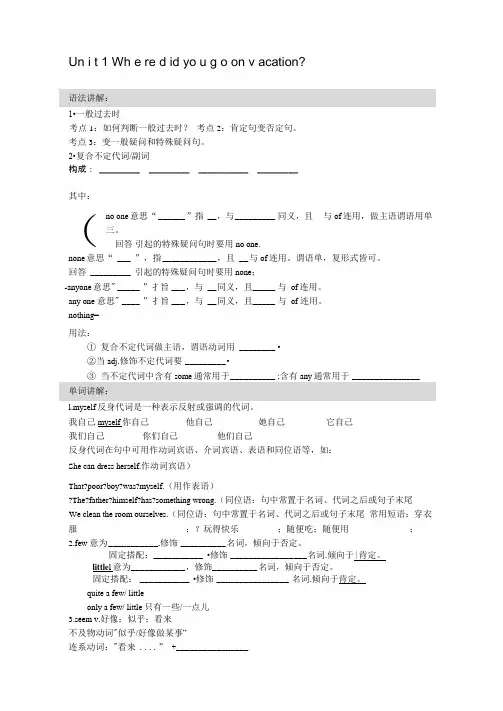
Un i t 1 Wh e re d id yo u g o on v acation?1•一般过去时考点1:如何判断一般过去时?考点2:肯定句变否定句。
考点3:变一般疑问和特殊疑问句。
2•复合不定代词/副词构成: _________ _________ ___________ _________其中:(no one意思“______ ”指 __ ,与_________ 同义,且与of连用,做主语谓语用单三。
回答引起的特殊疑问句时要用no one.none意思“ ___ ”,指____________ ,且 __ 与of连用。
谓语单,复形式皆可。
回答 _________ 引起的特殊疑问句时要用none;-anyone意思" _____ ”扌旨___ ,与 __ 同义,且_____ 与of连用。
_any one 意思" ____ ”扌旨___ ,与 __ 同义,且_____ 与of 连用。
nothing= _________________用法:① 复合不定代词做主语,谓语动词用 ________ •②当adj.修饰不定代词要_________ •③ 当不定代词中含有some通常用于__________ ;含有any通常用于_______________我自己myself你自己他自己她自己它自己我们自己你们自己他们自己反身代词在句中可用作动词宾语、介词宾语、表语和同位语等,如:She can dress herself.作动词宾语)That?poor?boy?was?myself.(用作表语)Thefatherhimselfhassomething wrong.(同位语:句中常置于名词、代词之后或句子末尾We clean the room ourselves.(同位语:句中常置于名词、代词之后或句子末尾常用短语:穿衣服;?玩得快乐;随便吃;随便用;2.few 意为___________,修饰__________ 名词,倾向于否定。
人教版八年级上册英语知识点归纳

⼈教版⼋年级上册英语知识点归纳⼋年级英语上册知识点总结Unit 1: How often do you exercise?【复习⽬标】会使⽤频率副词及短语;能描述课余时间的活动安排;会描述基本饮⾷结构。
【语⾔⽬标】● What do you usually do on weekends? I sometimes go to the beach.● How often do you eat vegetables? Every day● Most students do homework every day.【重点词汇】●always, usually , often, sometimes , hardly , ever, never.●how often, once , twice , three times a week , every day.【应掌握的词组】1. go to the movies 去看电影2. look after = take care of 照顾3. surf the internet 上⽹4. healthy lifestyle 健康的⽣活⽅式5. go skate boarding 去滑板6. keep healthy=stay healthy 保持健康7. exercise=take(much)exercise=do sports 锻炼8. eating habits 饮⾷习惯9. take more exercise 做更多的运动10. the same as与什么相同11. be different from 不同12. once a month ⼀⽉⼀次13. twice a week ⼀周两次14. make a difference to 对什么有影响15. how often 多久⼀次16. although = though 虽然17. most of the students=most students18. shop=go shopping=do some shopping 购物19. as for ⾄于20. activity survey 活动调查21. do homework 做家庭作业22. do housework 做家务事23. eat less meat吃更少的⾁24. junk food 垃圾⾷物25. be good for 对什么有益26. be bad for 对什么有害27. want to do sth 想做某事28. want sb to do sth 想某⼈做某事29. try to do sth 尽量做某事30. come home from school 放学回家31. of course = certainly = sure 当然32. get good grades 取得好成绩33. some advice34. hardly=not nearly / almost not ⼏乎不35. keep/be in good health 保持健康36. b e stressed out 紧张的,有压⼒的37. take a vacation 去度假48. g et back 回来【应掌握的句⼦】1. How often do you exercise? 你(你们)多久锻炼⼀次⾝体?How often + 助动词do(does 或did) + 主语+ do sth.? 疑问词how often 是问频率(多久⼀次),(在这⾥助动词do(does 或did) 是起帮助构成疑问的作⽤)与⼀般现在时或⼀般过去时连⽤,回答⼀般是⽤表⽰频率的副词,如:once, twice, three times , sometimes, often, quite, often, never, every day, once a week , twice a month , three times a month , three or four times a month 等。
新人教版八年级上册英语Unit1重点知识归纳
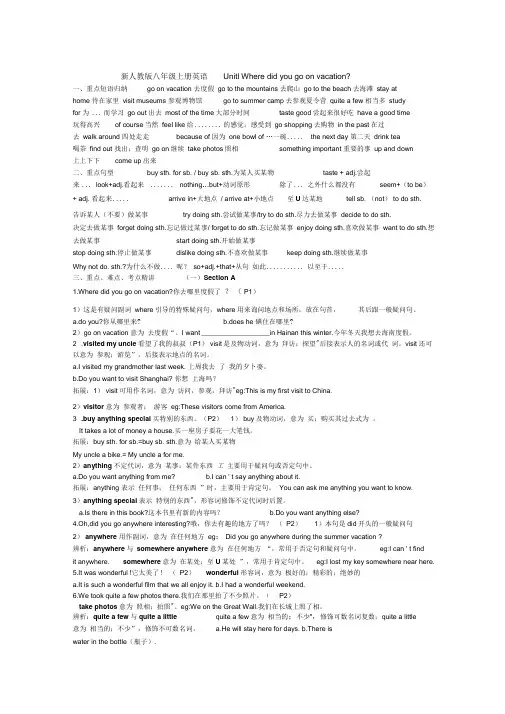
新人教版八年级上册英语Unitl Where did you go on vacation?一、重点短语归纳go on vacation 去度假go to the mountains 去爬山go to the beach去海滩stay athome 待在家里visit museums 参观博物馆go to summer camp去参观夏令营quite a few 相当多studyfor为 ... 而学习go out出去most of the time大部分时间taste good尝起来很好吃have a good time玩得高兴of course当然feel like给........ 的感觉;感受到go shopping去购物in the past在过去walk around 四处走走because of 因为one bowl of …一碗..... the next day 第二天drink tea喝茶find out 找出;查明go on继续take photos照相something important 重要的事up and down上上下下come up出来二、重点句型buy sth. for sb. / buy sb. sth.为某人买某物taste + adj.尝起来... look+adj.看起来 ....... nothing…but+动词原形除了... 之外什么都没有seem+(to be)+ adj. 看起来..... arrive in+大地点/ arrive at+小地点至U达某地tell sb. (not) to do sth.告诉某人(不要)做某事try doing sth.尝试做某事/try to do sth.尽力去做某事decide to do sth.决定去做某事forget doing sth.忘记做过某事/ forget to do sth.忘记做某事enjoy doing sth.喜欢做某事want to do sth.想去做某事start doing sth.开始做某事stop doing sth.停止做某事dislike doing sth.不喜欢做某事keep doing sth.继续做某事Why not do. sth.?为什么不做.... 呢?so+adj.+that+从句如此........... 以至于.....三、重点、难点、考点精讲(一)Section A1.Where did you go on vacation?你去哪里度假了?( P1)1)这是有疑问副词where引导的特殊疑问句,where用来询问地点和场所,放在句首,其后跟一般疑问句。
人教版英语八年级上第一单元Unit1Wheredidyougoonvacation知识点梳理

人教版英语八年级上第一单元Unit1Wheredidyougoonvacation知识点梳理Unit 1 Where did you go on vacation?知识梳理一、词型转换Section A1.wonder →(adj.) wonderful2.I →(反身代词) myself3.you →(反身代词) yourself4.yourself →(pl.) yourselves5.seem →(pt.) seemedSection B1.activity →(pl.) activities2.decide →(n.) decision3.try →(pt.) tried4.bike →(同义词) bicycle5.build →(n.) building6.difference →(adj.) different7.like →(反义词) dislike8.below →(反义词) above二、短语归纳Section A1.go to Central Park 去中央公园2.on vacation 在度假3.buy something special 买特别的东西4.meet someone interesing 遇见有趣的人5.go out with someone 和某人一起出去6.take quite a few photos 拍相当多的照片7.most of the time 大多数时间8.go shopping 去购物9.keep a diary 记日记10.of course 当然;自然Section B1.have a good time 玩得高兴;过得愉快2.go to the beach 去海滩3.feel like 感觉像4.the houses of the Chinese traders 中国商人的房子5. a lot of new buildings 许多新的建筑物6.in the past 在过去7.over an hour 一个多小时8.too many people 太多的人9.get to the top 到达顶部10.because of the bad weather 因为不好的天气11.one bowl of fish 一碗鱼肉12.another two hours 另外两个小时13.the top of the hill 山顶14.learn something important 学习重要的东西Self Check1.go to the countryside 去乡下2.in the shopping center 在购物中心3.have a fun time 玩得高兴;过得愉快4.after three hours 三个小时以后5.keep going 一直走6.twenty minutes later 20分钟后重点句子1.Where did you go on vacation?你去哪儿度假的?2.Long time no see.好久不见。
人教版英语八年级上册unit 1

人教版英语八年级上册unit 1一、重点单词。
1. anyone.- 词性:不定代词,意为“任何人”,用于否定句和疑问句中。
例如:Did you meet anyone interesting at the party?(你在聚会上遇到有趣的人了吗?)2. anywhere?- 词性:副词,意为“在任何地方;无论何处”。
例如:I can't find my keys anywhere.(我到处都找不到我的钥匙。
)3. wonderful.- 词性:形容词,意为“精彩的;绝妙的”。
例如:We had a wonderful timeat the concert.(我们在音乐会上度过了一段美妙的时光。
)4. few.- 词性:形容词,意为“不多;很少”,修饰可数名词复数,表示否定意义。
例如:There are few apples on the tree.(树上几乎没有苹果了。
)- 区别:a few表示“一些;几个”,表示肯定意义。
例如:There are a few students in the classroom.(教室里有几个学生。
)5. most.- 词性:形容词,意为“最多的;大多数的”。
例如:Most students like English.(大多数学生喜欢英语。
)- 也可作副词,意为“最;非常”。
例如:This is the most beautiful flower.(这是最漂亮的花。
)6. something.- 词性:不定代词,意为“某事;某物”,用于肯定句中。
例如:I have something important to tell you.(我有重要的事情要告诉你。
)7. nothing.- 词性:不定代词,意为“没有什么;没有一件东西”。
例如:There is nothing in the box.(盒子里什么都没有。
)8. everyone.- 词性:不定代词,意为“每人;人人;所有人”。
人教版八年级上册英语第一单元知识点整理
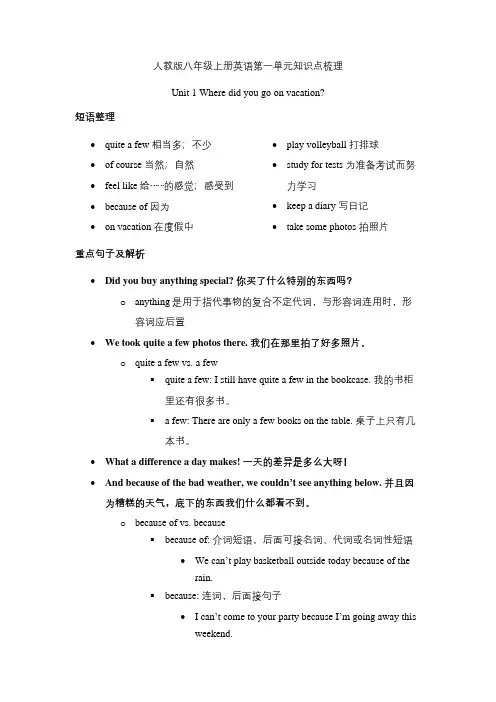
人教版八年级上册英语第一单元知识点梳理Unit 1 Where did you go on vacation?短语整理•quite a few 相当多;不少•of course 当然;自然•feel like 给……的感觉;感受到•because of 因为•on vacation 在度假中•play volleyball 打排球•study for tests 为准备考试而努力学习•keep a diary 写日记•take some photos 拍照片重点句子及解析•Did you buy anything special? 你买了什么特别的东西吗?o anything是用于指代事物的复合不定代词,与形容词连用时,形容词应后置•We took quite a few photos there. 我们在那里拍了好多照片。
o quite a few vs. a few▪quite a few: I still have quite a few in the bookcase. 我的书柜里还有很多书。
▪ a few: There are only a few books on the table. 桌子上只有几本书。
•What a difference a day makes! 一天的差异是多么大呀!•And because of the bad weather, we couldn’t see anything below. 并且因为糟糕的天气,底下的东西我们什么都看不到。
o because of vs. because▪because of: 介词短语,后面可接名词、代词或名词性短语•We can’t play basketball outside today because of therain.▪because: 连词,后面接句子•I can’t come to your party because I’m going away thisweekend.。
人教版英语初二上册Unit1笔记要点
Unit 1 知识要点1.短语搭配(1)stay at home go to summer camp go to the mountains go to the beach quite a few of coursebe different from at/on the top of wait for sb.(2)visit: n. have/pay a visit to sp.v. visit sb. 拜访某人 visit my unclevisit sp. 参观某地 visit museums(3)vacation : go on vacation = take a vacationbe on vacation The children are on vacation in the mountains.[注意vacation 的搭配](4)go + V-ing go shopping/ swimming/ fishing(5)arrive + in + 大地点arrive + at + 小地点(6)have a good/great time = have fun = enjoy oneself (+ doing sth.)(7)decide v. 决定→ n. decision 决定decide to do sth. = make a decision to do sth.decide on sth. Did you decide on the hotel tonight?(8)try n.& v. 尝试 have a try 试一试try to do sth. 尽力/设法做某事(非常努力地去做)try doing sth. 尝试做某事(只抱着去试试看的态度)(9) feel like doing sth. 想要做某事(10)forget/remember to do sth. 忘记去做某事(事情还没做)forget/remember doing sth. 忘记做了某事(事情已经做了)(11)feed v. 喂养,饲养feed sth. to ……把某物喂给…… I feed the carrots to my rabbit.feed …… on/with……用……喂…… I feed my rabbit on/with the carrots. sth. feeds on sth. else 以……为食 Pandas feed on bamboos.(12) another + 数词 = 数词 + moreWe need another five students to help us. = We need five more students to help us.(13) keep v. 保持keep doing sth. 保持(一直)做某事 Please keep reading this book.keep ( + sth.) + adj. 保持…… She keep silent all the time./ We should keep our classroom clean.(14) buy sth. for sb. I bought a present for my mother.buy sb. sth. I bought my mother a present.(15)weather n.天气(不可数) What bad weather!(16)taste v. 有……的味道;品尝The food tastes delicious.Please taste the dishes.2.语法重点(1)不定代词a.常见(复合不定代词): some bodyany + thingevery oneno whereb. [都表示“一些”的含义时] some 肯定句中any 否定句、疑问句中特殊: some 也可用于疑问句中, Would you like some coffee? (礼貌的说法)any 也可用于肯定句中,意为“任何”, If you have any question, you can ask me for help.c.复合不定代词的用法可参照 some 和any 的用法d.复合不定代词做主语时,谓语动词用单数Someone is crying in the room.Don’t worry. Nothing is serious.e.复合不定代词 + adj. something wrong something interesting anything specialf. anyone 指人any one 既可指人,又可指物;后可 + ofAnyone liked her children because any one of them was very polite.(2)How do you like……? = What do you think of ……? = How do you feel about……? 你怎么看/认为…?How do you like the weather? /What do you think of the weather? /How do you feel about the weather?(3)-ed 形容 sb.- ing 形容 sth. He is interested in the interesting movie.(4)so … that…太…以致于…not… enough…不够…too… to…太…而不能…He is too young to go to school.He is not old enough to go to school.He is so young that he can’t go to school.(5) because + 句子 I was late for school because it rained.because of + 名词短语 I was late for school because of the rain.(6) few a few + 可数名词复数little a little + 不可数名词几乎没有有一点儿(7)enough adj. 足够的 enough moneyadv. 足够地 old enough(8)as…as…和……一样not as/so … as…和……不一样She sings as well as her sister.The box is not as/so heavy as that one.(9)so + adj./adv. + that… He is so tired that he couldn’t stand.so + adj.+ a/an + 可数名词 + that… She is so polite a girl that everyone likes her.such ( + a/an) + adj.+ n.+ that … She is such a polite girl that everyone likes her.(10)seem v. 好像,似乎,看来seem to do sth. He doesn’t seem to like that lovely dog.seem (to be ) + adj. Tom seems (to be) very clever.It seems that … It seems that it will rain soon.。
完整版)人教版八年级英语上册第一单元知识点总结
完整版)人教版八年级英语上册第一单元知识点总结Grade: 8th student name: Tutoring subject: English Teaching teacher: Teacher ShaoTopic: Unit 1 Where did you go on n?Type of class: Preview class。
synchronous class。
review class。
exercise classKey points:1.Mastering key phrases2.Understanding the usage of indefinite pronouns3.Analyzing words and phrasesTeaching content:1.Important grammar pointsUnit 1 Where did you go on n。
go on nstay at homego to the mountainsgo to the beachvisit museumsquite a fewstudy formost of the timetaste goodhave a good timefeel likego shoppingwalk aroundbecause ofone bowl ofthe next dayfind outgo ontake photossomething importantup and downcome upbuy sth。
for sb。
/ buy sb。
sth。
taste + adj。
look + adj。
nothing but + verbseem + (to be) + adj。
arrive in + big place / arrive at + small place decide to do sth。
try doing sth。
人教版英语八年级上册第一单元知识点总结
Unit11. 疑问词how的用法(1)用什么手段,方法/交通工具How did he do it? / I don’t know how to swim.How do you come to school?(2) 情况如何(指身体健康状况)How are you?(3) how many,how much表示“多少”how many后接可数名词复数,how much接不可数名词。
(4) how often是对动作发生的“次数”提问,询问的是频率“多久一次”(5) How old...? 询问年龄How old are you? I am five.(6) How about…? ……如何?……怎么样?How about going to the movies?2. time表示不可数名词,意为“时间”。
What time is it?表示可数名词,意为“次数,倍数”--------注意“次数”的表达方法一次 once,两次 twice,三次或三次以上用基数词加上times:three times、five times、one hundred times.表示“……几次”的表达方法是:once a day/ a week/ a month/ a year twice a day/ a week/ a month/ a year 3.How often do you shop?/How often do you exercise?--------exercise v/n shop v/ n1)He often exercises on weekends. We often do / take exercise(做运动)on weekends.2)We often shop on weekends. There are many shops in the neighborhood.4. As for homework, most students do homework every day.------as for意为“就……而论”,“至于”5. want to do sth. 想要做某事want sb. to do sth. 想要某人干某事ask sb. to do sth. 叫某人做某事tell sb. to do sth. 告诉某人去做某事help sb. (to) do sth. 帮助某人做某事6. be good for...表示“对……有益(有好处)”be bad for... 对……有害/无益It's good for us to do more reading. 多读书对我们有好处。
初二上册英语第一单元
初二上册英语第一单元初二上册英语第一单元人教版的主要知识点总结如下:1. 自我介绍:学生学习如何用英语进行自我介绍,包括姓名、年龄、家庭成员等基本信息。
2. 问候语:学生学习常用的问候语,如"Hello!"、"Hi!"、"Good morning/afternoon/evening!"等,并学会回答这些问候语。
3. 询问个人信息:学生学习如何用英语询问他人的个人信息,如"What's your name?"、"How old are you?"、"How many people are there in your family?"等,并学会回答这些问题。
4. 家庭成员:学生学习如何用英语表达自己的家庭成员,如"father"、"mother"、"brother"、"sister"等,并学会描述家庭成员的关系。
5. 职业:学生学习如何用英语表达不同的职业,如"teacher"、"doctor"、"engineer"等,并学会描述自己或他人从事的职业。
6. 喜好:学生学习如何用英语表达自己的喜好,如"I like..."、"I don't like..."等,并学会询问他人的喜好。
7. 日常活动:学生学习如何用英语描述自己的日常活动,如"I usually go to school by bike."、"I often watch TV in the evening."等,并学会询问他人的日常活动。
8. 时间表达:学生学习如何用英语表达不同的时间,如"in the morning/afternoon/evening"、"at seven o'clock"等,并学会询问和描述具体的时间。