
外研版八年级英语上Module11 Unit1教学设计
小组通过教师提供的资源进行讨论和总结,选派一名代表到前面为大家讲解。
学生观看微课程,体会must的用法。
学生组内合作,根据教师提供的资源讲解情态动词can和need的用法。最后将成果上传给教师和大家分享。并针对该知识点做一道相应的中考链接习题。
我用平板制作了一个微课程,以第一人称must一天在学校的经历为主线,通过四个情境的巧妙创设,恰到好处地讲解了情态动词must的四种用法。这样学生很容易掌握了情态动词must的用法,突破了本节课的难点,使传统课堂无法解决的问题得到了解决。微课程系统,能让老师随时随地创建校本视频资源。根据学生学习状况分层设计、梯度推送,实现学生课外深度预习、复习,实现“翻转课堂”。
上传到大屏幕)
学习本节课重点词汇。
学生带耳机听录音材料,并排列顺序。
学生读词汇表里面的单词卡,教师纠正其发音。
教师随机选择十个词汇进行检测,查看学生的掌握情况。
学生听录音标出所听单词顺序,然后和图片相匹配。
教师没有外放而是让学生带耳机听,体现出学生学习的自主性和个体差异性。
利用电子书包里的课堂小助手,教师通过拍照或录像可以任意抓拍学生的课堂活动情况和答题情况,并迅速上传到大频幕上,相当于课堂回放,可以起到即时反馈的作用。
教师让学生填写表格。
教师让学生划出有关中国传统习俗的句子,初步体会情态动词的用法。
学生带着问题观看动画后回答老师提出的问题。
各组组长和组员核对短语后,将其拍照后上传给老师。老师和学生共同找出其中的错误。
学生通过玩连连看游戏掌握重点短语。
学生填写表格,并说出中西方接受礼物的不同习俗。
学生划出句子后试着用情态动词表达中国春节的其他习俗。
教学设计
教学环节及时间
活动目标
教学内容
活动设计
媒体功能应用及分析
I.
experiment& preparation学案导学,自主学习
( 5分钟)
1.通过拍照,对刚才教师和学生对话的情境进行回放,观察学生接受礼物的方式,导入新课,激发学生学习英语的兴趣。
2.掌握本节课重点词汇。
3.听录音排序。
课前和学生进行简单交流,询问今天星期几,多少号,是谁的生日,通过询问打开礼物的时间来引出本节课内容。(一名同学帮助拍照,将照片
充分利用电子书包里面的系统资源,打开电子课本,单词部分听、说、写、记、练,打开记里面的词汇表,学生快速读出每一个单词并说出汉语意思,针对发音不准确的教师进行即时纠正。
教师可以随机选择要检测的词汇。系统会自动生成一套试卷。学生提交后,系统自动批阅分数,教师可以立即查看每位学生的听写情况。通过电子书包统计分析系统教师可以及时了解学生课前预习掌握情况。不但大大节省了教师批阅的时间,还能将检测情况及时反馈给学生,起到了很好的督导作用。
归纳总结,评价提升
( 5分钟)
对本节课所学习的内容进行总结和回顾。
教师将本节课的主要内容通过板书呈现在学生面前。
学生总结本节课所学习的内容并进行当堂测试。
电子试卷,一键发送、快速反馈与统计分析,既减轻老师批改作业、试卷的工作量,又能当堂实时展现检测结果,对在那里、错在哪里,谁对了、谁错了一目了然,实现真正的以学定教。
II.
exploration & presentation
组内探究,合作展示
( 15分钟)
1.能够读懂并理解整个对话的大概内容。
2.根据对话内容能够回答一些简单的问题。
3.能够掌握本节课重点短语。
4.理解中西方接受礼物的不同习俗。
5. 说出中国春节的传统习俗。
教师播放本节课的flash动画。
教师在导学案上给出本节课重点短语的汉语意思,学生写出英文表达方式。
创建电子书包交互式课件,围绕单元学习主题展现图片、视频等课件资源。
组长将短语上传给老师后,大家共同进入互动讨论交流平台,教师可以对学生的成果进行即时修改和点评。利用对比功能,对四个小组进行评价。两种评价方式,一是看哪组错的更少,二是看哪组字写的更漂亮。此环节互动性很强,电子书包课堂的课堂互动形式,弥补了传统课堂举手发言等课堂互动形式。体现了课堂教育的公平性、互动性、交互性、人人参与性。
IV.
extension & practice
拓展延伸,当堂训练
( 5分钟)
掌握本节课的重要语言点。
教师对本节课的重要知识点楚的问题提出来和大家共同探讨。
电子书包系统的多种获取资源方式可以让学生的学习面从点到面、举一反三的得到拓展。
V.
evaluation & promotion
电子书包系统利用学生对游戏PK的兴趣,巧妙的把本节课的重点词汇设置成连连看游戏,游戏场景与知识点连接在一起,很好的激发了学生们的学习热情。
III.
explanation & paraphrase
交流思疑,互助解疑
( 10分钟)
1.重点掌握情态动词must的用法。
2.小组讨论情态动词can和need的用法。
2022年外研版八年级上册《Module 11 Unit1》公开课教案
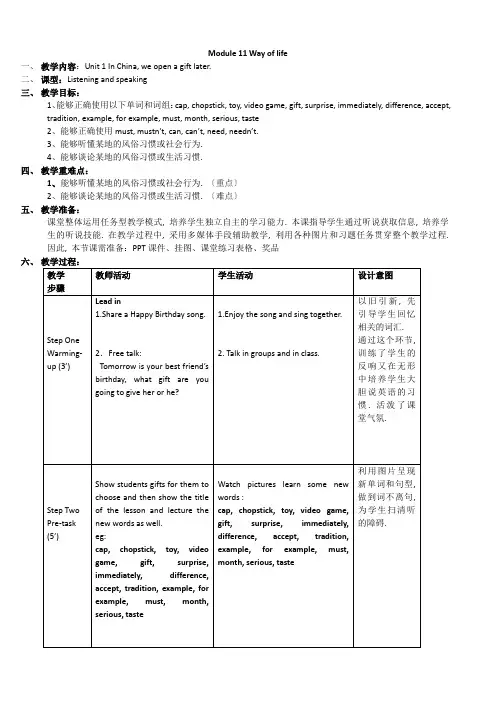
Module 11 Way of life一、教学内容:Unit 1 In China, we open a gift later.二、课型:Listening and speaking三、教学目标:1、能够正确使用以下单词和词组:cap, chopstick, toy, video game, gift, surprise, immediately, difference, accept,tradition, example, for example, must, month, serious, taste2、能够正确使用must, mustn’t, can, can’t, need, needn’t.3、能够听懂某地的风俗习惯或社会行为.4、能够谈论某地的风俗习惯或生活习惯.四、教学重难点:1、能够听懂某地的风俗习惯或社会行为. 〔重点〕2、能够谈论某地的风俗习惯或生活习惯. 〔难点〕五、教学准备:课堂整体运用任务型教学模式, 培养学生独立自主的学习能力. 本课指导学生通过听说获取信息, 培养学生的听说技能. 在教学过程中, 采用多媒体手段辅助教学, 利用各种图片和习题任务贯穿整个教学过程.因此, 本节课需准备:PPT课件、挂图、课堂练习表格、奖品六、七、板书设计:Module 11 Way of lifeUnit1 In China, we open a gift later.1. I don’t think I should open it now. In China, we open a gift later.2. …you mustn’t do any cleaning on the first day of the Spring Festival.3. You can’t be serious!达标训练题一.用所给词的适当形式填空:1. Can she __________ (do) the cleaning for me?2. Happy ___________ (birth) to you, Jim.3. It’s too difficult for me ____________ (understand) this math problem.4. I think you mustn’t _________ (open) the gift now.5. Can you use _____________ ( chopstick)?二、完成句子:1. 你必须等会儿翻开它.You ________________ and open it _________________.2. 我注意到另一个不同.I noticed _________ ______________.3. 你不能够打破这里的任何东西.You ____________ ___________ anything here.4. 请多注意交通规那么.Please ________ __________ ___________ to the traffic rules.5. 你没必要等.You ____________ _______________.Unit 1 While the lights were changing to red,a car suddenly appeared.教学目标【知识目标】1、能掌握本单元的单词和短语:bite, climb, hide, throw, fridge, pain, worse, medicine.2. 掌握本单元中的常用句型.【能力目标】1、能根据图片预测下文;能理解作者通过故事要传达的信息;能够理解语篇中故事发生的顺序.2、能够仿照范文, 用过去进行时对发生在周围的事故进行描述或报道.【情感态度目标】学习遇到突发事件时应沉着冷静, 尽量想方法自救的平安意识.教学重难点【教学重点】过去进行时, when和while引导的时间状语从句.【教学难点】能运用过去进行时就意外事故这一话题进行讨论.教学过程Step 1 Lead-inSs look the pictures and fill in the blanks.Step 2 Consolidate new wordsLook and say. The teacher shows the pictures of new words and let the students to say the new words as quickly as possible.Step 3 Say the meaning of the phrases.Work in pairs. Let Ss say the meaning of the phrases as quickly as possible.Step 4 Look at the pictures and say what’s happeningLook at the picture and use the words from the box to say what’s happening at that time.Step 5 Listen to Activity 2 and read1. The driver was/was not going fast.2. The driver was/was not looking.3. The driver was/was not talking on his mobile phone.Step 6 Listen to the dialogue and answer the questionsLet Ss listen to the dialogue and answer the two questions. Then check in groups.Step 7 Read the dialogue and answer the questions1. What was the boy doing when he was riding his bike?2. When did a car suddenly appear round the corner?3. Did the boy fall off his bike?Step 8 Read Activity 3 and complete the following advice.When you are riding a bike, think about the risk of an accident!Pay ___________ and stop at the___________.Don’t ______ too fast.Don’t ride ____________ with your friends.Don’t ______________!Step 9 Complete the passage with the correct form of the words from the box.Let Ss read the passage first and choose the words and expressions from the box. Step 10 Everyday EnglishAre you all right? That’s very dangerous!That’s too bad.Anything else?Step 11 Language pointsLet Ss master the main points of the passage.Step 12 Listen and mark when the speaker pauses1. Listen and mark when the speaker pauses.1) While the lights were changing to red, a car suddenly appeared round the corner.2) When I was waiting to cross the road, the accident happened.2. Now listen again and repeat.Step 13 Work in groups of fourStudent A: You’re a policeman at an accident scene in the street. Ask people questions. Student B, C and D: You saw the accident. Answer the policeman’s questionsStep 14 Grammer掌握过去进行时的用法.Step 15 Summary重点短语in time fall off pay attention side by side过去进行时Step 16 ExercisesDo some exercises about the main points.Step 17 中考链接Do the exercises in the entrance exam to senior high schools.课堂作业编写一个对话,介绍你亲眼目睹的一次交通事故.教学反思。
外研版八年级英语上册教案 Module11 Unit1 (1)
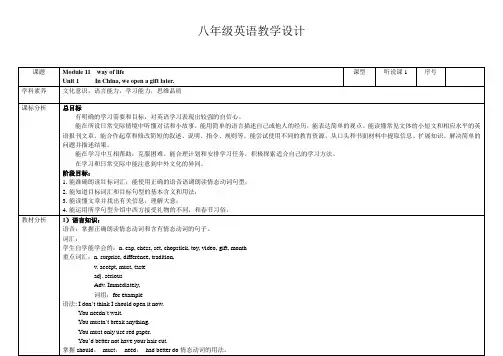
8.(v. )拒绝→__________→(反义词)______________
9.重点及易错单词:
筷子(n.)→__________视频的(adj. )→___________惊奇;意外之事(n.)→_________立刻;当即(adv. ) → ______差别;差异(n.)→_________
2.通过对应填词,明确不同单词的词性:
Exercise
1. (n. )惊奇→ _______(v. )使...惊奇→__________→ (adj. )感到惊讶的_________→(adj. )令人惊讶的________
→使某人惊讶的是___________________________
2. (adv. )立刻→ ____________ (同义词组)_____________
关于常见礼物的名词,学生在之前已经掌握。
(2)未学知识
词汇:n. surprise, difference, tradition,
v. accept, must, taste
adj. serious
Adv. Immediately
词组:for example
句型:I don’t think I should open it now.(think句型否定前置)
adj. serious
Adv. Immediately,
词组:for example
语法: I don’t think I should open it now.
You needn’t wait.
You mustn’t break anything.
外研版英语八年级上册M 11 Unit 1 教案
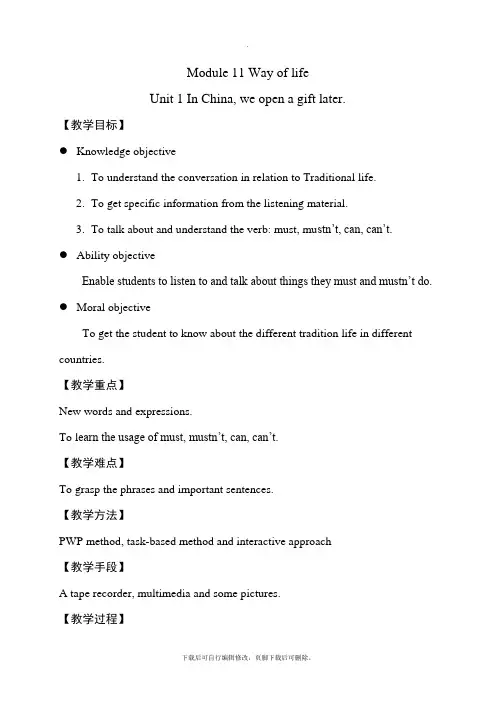
Module 11 Way of lifeUnit 1 In China, we open a gift later.【教学目标】●Knowledge objective1.To understand the conversation in relation to Traditional life.2.To get specific information from the listening material.3.To talk about and understand the verb: must, mu stn’t, can, can’t.●Ability objectiveEnable students to listen to and talk about things they must and mustn’t do.●Moral objectiveTo get the student to know about the different tradition life in different countries.【教学重点】New words and expressions.To l earn the usage of must, mustn’t, can, can’t.【教学难点】To grasp the phrases and important sentences.【教学方法】PWP method, task-based method and interactive approach【教学手段】A tape recorder, multimedia and some pictures.【教学过程】Teaching Procedures:Step 1 Lead-inSs look the pictures and guess the word according to the sentence.Step 2 Learn new wordsLook and say. The teachers shows the pictures of new words and let the students to say the new words as quickly as possible.Step 3 Listen and numberLet Ss listen to the tape and number the words and expressions. Then draw answers from the students.Step 4 Look and matchRead the words and expressions and choose the right pictures.Step 5 Listen and answerListen to Activity 1and answer the question: What present do they want to buy for Lingling?Step 6 Read the dialogue and answer the questions1.When can people open the present in China?2.Where must people open the present immediately?3.Do people accept a present with both hands in the West?Step 7 Now check (√) what you usually do in China1. Open a present immediately when you receive it.2. Accept a present with both hands.3. Use red paper for hongbao.4. Do cleaning on the first day of the Spring Festival.5. Break something during the Spring Festival.6. Have your hair cut during the Spring Festival month.Step 8 Complete the passageRead the passage and fill in the blanks with the correct form of the words. accept attention surprise taste traditionsIt is always a(n) (1) ________ to receive gifts from family members and friends. In China, we usually (2) _______ a gift with both hands and open it later. But in the West, people usually do not pay much (3) __________ to that. During the Spring Festival, there are many (4) _________. For example, people in the north of China eat lots of jiaozi. They (5) _______ great.Step 9 Everyday EnglishOh, you remembered!What a surprise!It’s a bad luck!You can’t be serious!Perfect!Step 10 Language point1. What’s a surprise!surprise表示“惊奇,意外之事〞。
八年级英语上册 Module 11 Unit 1 It may be cold tomorrow教案 外研版
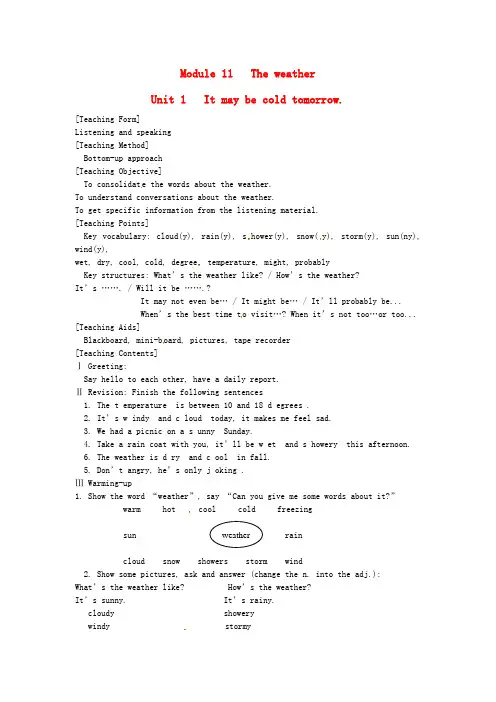
weather Module 11 The weatherUnit 1 It may be cold tomorrow.[Teaching Form]Listening and speaking[Teaching Method]Bottom-up approach[Teaching Objective]To consolidat e the words about the weather.To understand conversations about the weather.To get specific information from the listening material. [Teaching Points]Key vocabulary: cloud(y), rain(y), s hower(y), snow(y), storm(y), sun(ny), wind(y),wet, dry, cool, cold, degree , temperature, might, probablyKey structures: What’s the weather like? / How’s the weather?It’s ……. / Will it be …….?It may not even be… / It might be… / It’ll probably be... When’s the best time t o visit…? When it’s not too…or too...[Teaching Aids]Blackboard, mini-b oard, pictures, tape recorder[Teaching Contents]Ⅰ Greeting:Say hello to each other, have a daily report.Ⅱ Revision: Finish the following sentences1. The t emperature is between 10 and 18 d egrees .2. It’s w indy and c loud today, it makes me feel sad.3. We had a picnic on a s unny Sunday.4. Take a rain coat with you, it’ll be w et and s howery this afternoon.6. The weather is d ry and c ool in fall.5. Don’t angry, he’s only j oking .Ⅲ Warming-up1. Show the word “weather”, say “Can you give me some words about it?” warm hot cool cold freezingsun raincloud snow showers storm wind2. Show some pictures, ask and answer (change the n. into the adj.): What’s the weather like? How’s the weather?It’s sunny. It’s rainy.cloudy showerywindy stormysnowy3. Have the students listen to me and check the table.Good morning, here’s the weather forecast for Shantou today. It’ll be sunny and warm in the morning. And the temperature will be between 20 and 26 degrees. Because of the cold current, in the afternoon it’ll be windy and showery with the temperature of between 12 and 18. So p lease remember to take a warm coat with you. Thanks for listening. CITY TEMPER ATURE WEATHER Shanghai20~26 warm hot cloudy showery snowy stormy windy sunny rainyShantou12~18 Beijing 12~26 Ⅳ Presentation (Activity 4 5 6)1. Listen to Activity 4 and answer the two questions.Q1: What are they talking about?Q2: How many places are they talking about?PLACEWEATHER Be ijingcool freezing cold warm Englandsnowy cold wet windy Australiawarm hot rainy sunny Hong Kong cold cool cloudy dry3. Repeat after the tape.4. Finish Activity 6, correct the sentences.5. Read the conversation together.Ⅵ Summary: How to talk about the weather?(from Activity 4)1. Ask: What will the weather be like?When’s the best time to visit...?2. Answer: It’s..., isn’t it? / Will it be …….?It may not even be… / It might be… / It’ll prob ably be... When it’s not to o…or too...Ⅶ Consolidation1. Read and spell the words again2. Read the key sentences togetherⅧ Homework1. Copy the sentences about the weather2. Finish Workbook Act.23. Prepare for the new lesson。
Module11Unit1教案2022-2023学年外研版八年级英语上册
(2)语法:一般现在时态,特别是第三人称单数的动词变化规则。教师应强调动词结尾加-s或-es的规则,以及不规则动词的变化。
举例:讲解动词变化规则,如:eat -> eats, go -> goes, be -> is等。
(3)对话:学会使用一般现在时态描述动物的特征和习性。教师需引导学生运用所学词汇和语法进行口语表达。
Module 11 Unit 1教案2022-2023学年外研版八年级英语上册
一、教学内容
《Module 11 Unit 1教案2022-2023学年外研版八年级英语上册》主要包括以下内容:
1.教材章节:Module 11 Unit 1
2.词汇:学习与描述动物相关的词汇,如giraffe、zebra、elephant等。
举例:设计情景对话,让学生模拟在动物园向他人介绍动物。
(4)阅读理解:理解关于动物园的文章,获取关键信息。教师应教授学生如何快速捕捉文章主题和细节信息。
举例:指导学生通过略读、寻读等阅读策略,提高阅读效率。
(5)写作:运用一般现在时态编写一段关于动物的描述。教师需教授写作技巧,帮助学生组织语言,表达清晰。
1.理论介绍:首先,我们要了解一般现在时态的基本概念。一般现在时态是描述经常发生的事情或描述事实的时态。它在日常交流中非常重要,帮助我们描述动物的特征和习性。
2.案例分析:接下来,我们来看一个具体的案例。这个案例展示了如何使用一般现在时态描述动物园中的动物,以及它如何帮助我们更好地了解动物。
3.重点难点解析:在讲授过程中,我会特别强调一般现在时态的动词变化规则,特别是第三人称单数的变化。对于难点部分,我会通过举例和比较来帮助大家理解。
新外研版八年级上册英语 Module 11 Unit1 教案(教学设计)
Module 11 Way of lifeUnit 1 In China, we open a gift later.单词cap, chopstick, toy, video game, gift,能够听懂某地的风俗习惯或社会行为。
能够谈论某地的风俗习惯或生活习惯。
Step 1Warming uplook the pictures and guess the word according to the sentence..Step 2Work in pairs.1. Show some pictures of the weather. Ask the students to talk about the weather.2. Introduce the new words.Step 3 Listeninglisten to the tape and number the words and expressions. Then draw answers from the students.Step 4Look and match.Read the words and expressions and choose the right pictures.Step 5Check ( √ ) the true sentencesListen to Activity 1and answer the question: What present do they want to buy for Lingling?Step 6Read the dialogue and answer the questionsStep 7 Now check (√) what you usually do in ChinaStep 8 Complete the passageStep 9 Language pointStep 10Grammar一.用所给词的适当形式填空:1. Can she __________ (do) the cleaning for me?2. Happy ___________ (birth) to you, Jim.3. It’s too difficult for me ____________ (understand) this math problem.4. I think you mustn’t _________ (open)the gift now.5. Can you use _____________ ( chopstick)?二、完成句子:1. 你必须等会儿打开它。
外研版英语八年级上册:Module11 Unit 1-教案设计
Unit 1 In China, we open a gift later教材分析教学目标1. Ss master vo cab ula ry2. Ss can use them to talk about the way of life fluently.3. Ss respect and know about different cultures in differentcountries.教学重难点 1. Ss use language points to talk about their lives.教学过程我的修改Step 1 Lead-in : Warming up(复习旧识,营造氛围,导入新课) 1, Ss say something about their birthdays.2, Ss talk about what they usually do when they get presents.3, Ss guess what p eople in other countries usually do when they get presents.4, Ss listen and number the words as they hear them and then match them with the pictures.Step 2 The students can learn by themselves, and ask some questions about the study. (自主学习提出疑问)1. Listen to Part 3and find out the answers to the questions.2. Listen again and then check the true sentences.3. Listen and complete the table in Part4.4. Ss find out new words and language points.5. Ss help each other in groups.6. Ss read the dialogue aloud and practice it in pairs.7.Ss find out the sentences that have aux.v and understand their meanings. Step 3 The students can learn the main point with the help of the teacher, and solve the problems.(精讲点拨)1. Explain the following phrases to the Ss.both & all both … and…..We must use two hands when we get presents in China.All the children like birthday parties.pay attention to be interested in/ to do….for example & such as, do some cleaning on the first day of the Spring Festivaluse … to do / use… for… had better do / had better not do…2. Ss try to make up sentences with them.3. the use of can, need must.Step 4 Effective practice, consolidate the knowledge(训练巩固)1. Do Ex on PPT.2. Listen and check.3. Practice Every day English.4. Ss finish Part7,5. Ss try to find out different cultures in different countries.Step5 Summary evaluation, leak turnover(总结评价,查漏补缺) We should give the Ss more chances to train themselves.。
外研版八上module11 unit1教学设计1
Module11 Unit1学科:英语年级:八年级任课教师:天津市宝坻区大钟庄镇初级中学翻转课堂(任务单)导学案天津市宝坻区大钟庄镇初级中学英语翻转课堂达标检测内容:Grade8 (上) Module 11 Unit 1姓名:班级:分数:1. --Must I come before eight o'clock? --No, you _______.”A. can'tB. don'tC. mustn'tD. needn't2. --Must I finish all the work before I leave?--Yes, you _______ .”A. mustB. canC. mustn'tD. needn't3. You ___ be quiet when you are in a library.A. mayB. canC. willD. must4. — Could I look at your pictures? — Yes, of course you ______.A. couldB. canC. willD. might5. _____ you pass me a pen? I’d like to write down the telephone number.A. NeedB. CouldC. MustD. Should6. — May I go to the cinema, Mum?— Certainly. But you ____ be back by 11 o’clock.A. canB. mayC. mustD. need7.Must I hand in my homework now, Mr. Smith? No, you ____.A. can’tB.shouldn’tC.wouldn’tD.needn’t8.Children ____ sit in the front seat of a car. It’s too dangerous.A.needB.needn’tC.mustD.mustn’t9.Must I water the flowers now, mum? No, you ___. You ___ do it later.A.mustn’t , mustB.mustn’t , mayC.needn’t, mayD.needn’t, must10.Can I swim in the river, Grandpa? _____. It’s dangerous.A. Yes, you canB.No, you can’tC.Yes, you needD.No, you needn’t11.Must I go to law school and be a lawyer like you , Dad?No, you ___, son. You’re free to make your own decision.A.can’tB.mustn’tC.shouldn’tD.needn’t12.Lingling, can I use your e-dictionary? Sure. But you _ return it after class.A.mustB.canC.mayD.would13.Look at the “No parking” sign. You ____ park your car here.A.shouldB.mustC.needn’tD.mustn’t14.If you ___ smoke, please go outside.A.canB.mayC.mustD.might。
外研版英语八年级上册教案:module11 unit1(初二上
能够听取信息,训练和培养学生细节听力技巧
Step 4
Post-task
(8ˊ)
1.Enable the Ss retell the conversation as a short passage with the information above. Then ask some Ss to retell.
教材分析
本课处于英语《新标准》八年级上册模块11第一单元的第一课时。本模块以天气为话题,本单元把焦点放在对天气的介绍上,话题贴近学生生活;学生也比较感兴趣,便于开展活动。重点学习和天气有关的词汇以及情态动词may, might和副词probably表示可能性的用法。本节教学内容有助于提高学生综合英语运用的能力.
渲染气氛,导入新课
Step 2 Pre-task
(9ˊ)
1. Words learning. Show the Ss some pictures and let them say it quickly.
2. Give words such as:cloud﹑snow﹑rain﹑Letˊs see“Who can say more adjective about weather”?
利用图片学习新单词,再通过看谁说的越多天气的形容词训练新单词
训练学生听懂天气预报,培养学生细节听力的技巧
Step 3
While-task
(25ˊ)
1. Play the tape
2. Organize them to check their answers in pairs .
3. Organize the Ss work in group of 3to read the conversation. Then complete the table in〈学案〉125.Task3
八年级英语上册_Module 11 Unit 1 In China,we open a gift later教案 (新版)外研版
自己拼读单词,抽学生示范朗读,集体齐读
Match the words and expressions in Activity 1 with the pictures. What present do they want to buy for lingling?
Read the sentences individually and pay attention to how the speaker pronounces the words
部分 学生部分单词不会读
对听力材料不能完全听懂
All the students can match the words with their things.
Listen and read the dialogue.
Put the students in pairs to practice the dialogue.
Read through the words in the box. Check and cemonstrate their meaning. Elicit answers in full sentences.
学法指导
Listening and speaking
教学过程
教学内容
教师活动
学生活动
效果预测(可能出现的问题)
补救措施
修改意见
1 The new words
2 Warming-up
3Listen and read
4 Activity 4
5Activity 5
呈现生词,纠正学生的发音,
Talk about what do you want to buy for someone’birthday?