
将来进行时
11、你校有几位老师在你所在的课外班任教?
A、1位
B、2位
C、3位
D、没有
12、老师是否让你购买练习册或复习资料?
A、经常
B、有过
C、没有
1. 将来进行时的基本用法
将来进行时表示将来某一时间正在进行的动作:
Don't phone me between 5 and 6. We'll be having dinner then. 五点至六点之间不要给我打电话,那时我们在吃饭。
When I get home, my wife will probably be watching television. 当我到家时,我太太可能正在看电视。
2. 表示按计划或安排要发生的动作
I will be seeing you next week. 我下个星期来看你。
I'll be taking my holidays soon. 不久我将度假了。
We shall be going to London next week. 下周我们要去伦敦。
3. 将来进行时表示委婉语气
有时用将来进行时可使语气更委婉:
Will you be having some tea? 喝点茶吧。
Will you be needing anything else? 你还需要什么吗?
4. 将来进行时与一般将来时的区别
(1) 两者基本用法不一样:将来进行时表示将来某时正在进行的动作,一般将来时表示将来某时将要发生的动作:
What will you be doing this time tomorrow? 明天这个时候你会在做什么呢?
What will you do tomorrow? 你明天干什么?
(2) 两者均可表示将来,但用将来进行时语气更委婉,比较:
When will you finish these letters? 你什么什候处理完这些信件?(直接询问,如上司对下属)
When will you be seeing Mr White? 你什么时候见怀特先生?(委婉地询问,如下属对上司)
When will you pay back the money? 你什么时候还钱?(似乎在直接讨债)
When will you be paying back the money? 这钱你什么时候还呢?(委婉地商量)
(3) 有时一般将来中的will含有“愿意”的意思,而用将来进行时则只是单纯地谈未来情况:
Mary won't pay this bill. 玛丽不肯付这笔钱。
(表意愿)
Mary won't be paying this bill. 不会由玛丽来付钱。
(单纯谈未来情况)。
将来进行时

将来进行时示将来正在进行
的事件。 如:I will be swimming at 5:00 p.m. tomorrow. 明天下午5点我将正在游泳。
将来进行时的结构
主语+will be+v.ing+时间状语 如:He will be going to Zhong Shan park at 8:00 a.m. this weekend. 这个周末他将去中山公园。
She will be getting ready for the party tomorrow. 明天她将为聚会做 准备。
现在进行时变将来进行时
例:He is working in the garden. 他正在花园干活。 变成:He will be working in the garden tomorrow. 明天他将在花园工作。
She is getting ready for the party. 她正在为聚会做 准备。
将来进行时的结构
肯定句:主语+will be+v.ing+时间状 语 He will be going to Zhong Shan park at 8:00 a.m.this weekend. 否定句: 主语+will be + not+v.ing+时间状语 一般疑问句: Will+主语+be +v.ing + 时间状语
英语语法-将来进行时

The Future Continuouse
1 将来进行时的定义
1.将来进行时表示将来某一时刻或某一段时间内可能正在 进行或发生的动作。
通常句子一定会有一个“表示将来某个时间点”的状语。 如: She will be doing her homework at 8 p.m. tonight.
2. I hope scientists _w__il_l_f_in_d_ (find) a cure for cancer.
3. A Chinese astronaut _w__il_l_r_e_a_c_h(reach)
Mars by 2050.
注意: 用于将来进行时的谓语动词必须是可延 续性动词, 短暂性动词则不可, 如上面5, 6题。
2 将来进行时的结构
主语 + shall/will+be +v.-ing + 其它
肯Байду номын сангаас 形式
will + be doing
否定 形式
will + not + be doing
问句 形式
will+主+ be doing?
He will be sleeping at this time tomorrow night.
He will be playing tennis at this moment tomorrow .
1 将来进行时的定义
2.将来进行时表示已经决定或安排好的要发生的动作或事 情;表示按预测将会发生的事情。
如: She will be coming soon. I'll be meeting him sometime in the future.
将来进行时
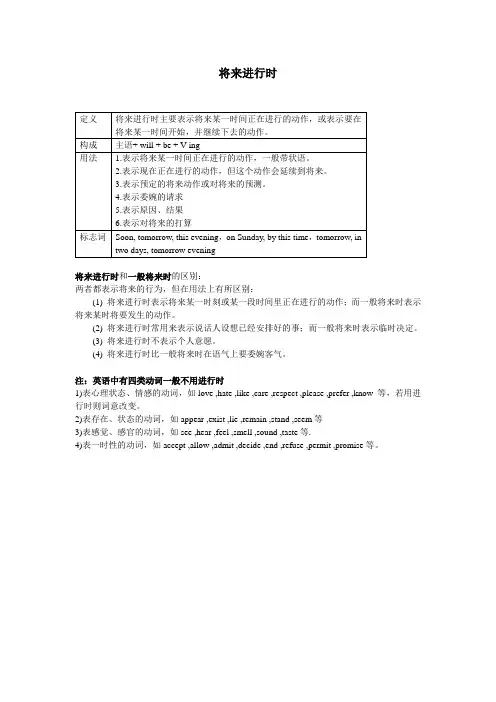
将来进行时定义将来进行时主要表示将来某一时间正在进行的动作,或表示要在将来某一时间开始,并继续下去的动作。
构成主语+ will + be + V-ing用法 1.表示将来某一时间正在进行的动作,一般带状语。
2.表示现在正在进行的动作,但这个动作会延续到将来。
3.表示预定的将来动作或对将来的预测。
4.表示委婉的请求5.表示原因、结果6.表示对将来的打算标志词Soon, tomorrow, this evening,on Sunday, by this time,tomorrow, intwo days, tomorrow evening将来进行时和一般将来时的区别:两者都表示将来的行为,但在用法上有所区别:(1) 将来进行时表示将来某一时刻或某一段时间里正在进行的动作;而一般将来时表示将来某时将要发生的动作。
(2) 将来进行时常用来表示说话人设想已经安排好的事;而一般将来时表示临时决定。
(3) 将来进行时不表示个人意愿。
(4) 将来进行时比一般将来时在语气上要委婉客气。
注:英语中有四类动词一般不用进行时1)表心理状态、情感的动词,如love ,hate ,like ,care ,respect ,please ,prefer ,know 等,若用进行时则词意改变。
2)表存在、状态的动词,如appear ,exist ,lie ,remain ,stand ,seem等3)表感觉、感官的动词,如see ,hear ,feel ,smell ,sound ,taste等.4)表一时性的动词,如accept ,allow ,admit ,decide ,end ,refuse ,permit ,promise等。
将来进行时的构成
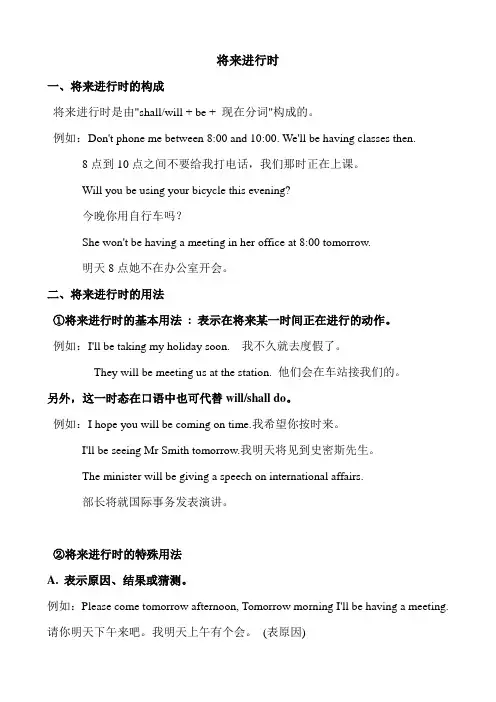
将来进行时一、将来进行时的构成将来进行时是由"shall/will + be + 现在分词"构成的。
例如:Don't phone me between 8:00 and 10:00. We'll be having classes then.8点到10点之间不要给我打电话,我们那时正在上课。
Will you be using your bicycle this evening?今晚你用自行车吗?She won't be having a meeting in her office at 8:00 tomorrow.明天8点她不在办公室开会。
二、将来进行时的用法①将来进行时的基本用法: 表示在将来某一时间正在进行的动作。
例如:I'll be taking my holiday soon. 我不久就去度假了。
They will be meeting us at the station. 他们会在车站接我们的。
另外,这一时态在口语中也可代替will/shall do。
例如:I hope you will be coming on time.我希望你按时来。
I'll be seeing Mr Smith tomorrow.我明天将见到史密斯先生。
The minister will be giving a speech on international affairs.部长将就国际事务发表演讲。
②将来进行时的特殊用法A.表示原因、结果或猜测。
例如:Please come tomorrow afternoon, Tomorrow morning I'll be having a meeting.请你明天下午来吧。
我明天上午有个会。
(表原因)Stop the child or he will be falling over. 抓住那个孩子,要不他会掉下去的。
将来进行时与将来完成时
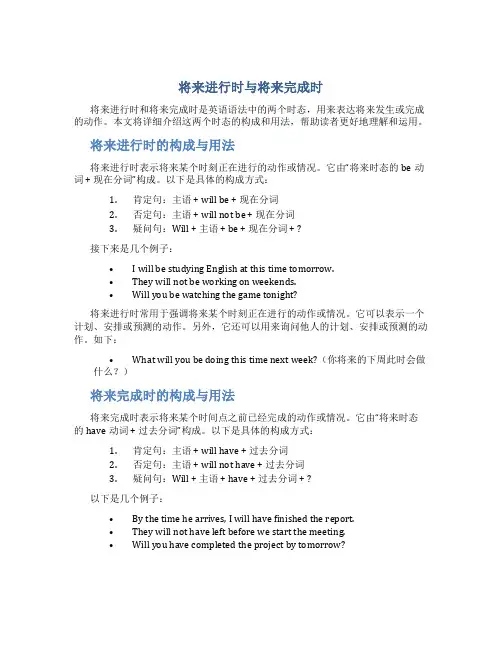
将来进行时与将来完成时将来进行时和将来完成时是英语语法中的两个时态,用来表达将来发生或完成的动作。
本文将详细介绍这两个时态的构成和用法,帮助读者更好地理解和运用。
将来进行时的构成与用法将来进行时表示将来某个时刻正在进行的动作或情况。
它由“将来时态的be动词 + 现在分词”构成。
以下是具体的构成方式:1.肯定句:主语 + will be + 现在分词2.否定句:主语 + will not be + 现在分词3.疑问句:Will + 主语 + be + 现在分词 + ?接下来是几个例子:•I will be studying English at this time tomorrow.•They will not be working on weekends.•Will you be watching the game tonight?将来进行时常用于强调将来某个时刻正在进行的动作或情况。
它可以表示一个计划、安排或预测的动作。
另外,它还可以用来询问他人的计划、安排或预测的动作。
如下:•What will you be doing this time next week?(你将来的下周此时会做什么?)将来完成时的构成与用法将来完成时表示将来某个时间点之前已经完成的动作或情况。
它由“将来时态的have动词 + 过去分词”构成。
以下是具体的构成方式:1.肯定句:主语 + will have + 过去分词2.否定句:主语 + will not have + 过去分词3.疑问句:Will + 主语 + have + 过去分词 + ?以下是几个例子:•By the time he arrives, I will have finished the report.•They will not have left before we start the meeting.•Will you have completed the project by tomorrow?将来完成时通常用于描述在将来某个时间点之前已经发生或完成的动作。
将来进行时一般将来时
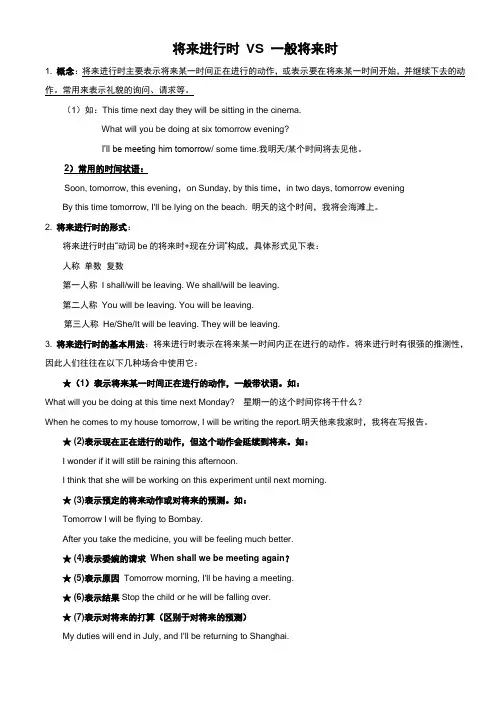
将来进行时VS 一般将来时1. 概念:将来进行时主要表示将来某一时间正在进行的动作,或表示要在将来某一时间开始,并继续下去的动作。
常用来表示礼貌的询问、请求等。
(1)如:This time next day they will be sitting in the cinema.What will you be doing at six tomorrow evening?I’ll be meeting him tomorrow/ some time.我明天/某个时间将去见他。
2)常用的时间状语:Soon, tomorrow, this evening,on Sunday, by this time,in two days, tomorrow eveningBy this time tomorrow, I'll be lying on the beach. 明天的这个时间,我将会海滩上。
2. 将来进行时的形式:将来进行时由“动词be的将来时+现在分词”构成,具体形式见下表:人称单数复数第一人称I shall/will be leaving. We shall/will be leaving.第二人称You will be leaving. You will be leaving.第三人称He/She/It will be leaving. They will be leaving.3. 将来进行时的基本用法:将来进行时表示在将来某一时间内正在进行的动作。
将来进行时有很强的推测性,因此人们往往在以下几种场合中使用它:★(1)表示将来某一时间正在进行的动作,一般带状语。
如:What will you be doing at this time next Monday? 星期一的这个时间你将干什么?When he comes to my house tomorrow, I will be writing the report.明天他来我家时,我将在写报告。
时态详解:将来进行时
时态详解:将来进行时一、将来进行时的构成将来进行时由“will be+现在分词”构成。
如:I’ll be doing jobs about the house tomorrow明天我将要干些家务活。
I’ll be staying late at the office this evening.我将在办公室里待到比较晚。
二、将来进行时的主要用法1. 将来进行时表示将来某一时间正在进行的动作Hurry up!The guests will be arriving at any minute! 快! 客人就要来了!A space vehicle will be circling Jupiter in five years’ time.航天器5年后将绕木星飞行。
Don’t phone me between 5 and 6. We’ll be having dinner then.五点至六点之间不要给我打电话,那时我们在吃饭。
When I get home, my wife will probably be watching television. 当我到家时,我太太可能正在看电视。
2. 将来进行时表示表示按时划或安排要发生的动作I will be seeing you next week. 我下个星期来看你。
I’ll be taking my holidays soon.不久我将度假了。
We shall be going to London next week. 下周我们要去伦敦。
We’ll be spending the winter in Australia. (=we are spending) 我们将在澳大利亚过冬。
Professor Craig will be giving a lecture on Etruscan pottery tomorrow evening. (=is giving) 克雷格教授明晚作关于伊特拉斯坎陶器的讲演。
将来进行时
将来进行时1.将来进行时的构成将来进行时由shall be/will be +现在分词构成.第一人称用shall/will be, 其余人称用will be 2.将来进行时的肯定,否定,一般疑问式及回答.以行为动词work为例肯定式:I (we) shall/will be working, She (he, you, we, they) will be working否定式I (we) shan’t/won’t be working He (She, You, we, they) won’t be working疑问式及回答Shall I be working? Will she be working?Yes, we shall Yes, you will No, you won’t. No, we shan’t3.将来进行时的用法1). 表示在将来某一时刻或某一段时间正在进行的动作,常常带有时间状语短语或时间状语从句.When you get to the station at nine tomorrow, your uncle will be waiting for you there.I’ll be busy this evening. I will be writing an article.2). 表示按计划将来要发生的动作I hope you will be coming on time.They will be having their holiday in June.4.一般将来时与将来进行时的区别1). 一般将来时表示将来发生的动作或情况,将来进行时则强调这种动作的持续性.I hope it won’t rain tomorrow. 我希望明天不下雨. (只表示将来的情况)It’s raining again. I hope it won’t still be raining tomorrow. 又下雨了.我希望明天不再下雨. (强调情况的持续性)2)一般将来时常带有意愿,意图等情态意义; 将来进行时只是单纯陈述即将发生的动作,不带情态意义. 用于问句中语气比较委婉.China will play an important role in the WTO. (意愿)My uncle will be driving to Nanjing tomorrow. (陈述事实)Will you go to see Li Yan soon? (意愿)Will you be leaving for Shanghai soon? (语气委婉)。
将来进行时
将来进行时
The future continuous tense
二、构成 shall/will + be + 现在分词【v.ing】 Please don't call me between 8:00 and 10:00 tomorrow. I'll be having my classes then. 明天8点到10点之间请不要给我打电话,我那时正 在上课。 Will you be using your bicycle this evening?今晚你用 自行车吗?
将来进行时
The future continuous tense
四、将来进行时和一般将来时的区别 1、一般将来时既可以表示“将来”,也可以表示“意志、意 图”,而将来进行时则表示纯粹的将来。指说话者无意图 的动作。 2、用将来进行时来询问别人的计划或打算更礼貌,也可 以表示较缓和的命令或碰巧发生的事 3、将来进行时表示委婉语气 4、有时这两种结构在意义上有所不同
过去将来进行时
The past continuous tense
一、定义 过去将来进行时表示再对过去某一时间而言的将来某一时 刻或某一段时间正在进行的动作 二、构成 1.肯定:主语+should(would)+be+现在分词 2.否定:主语+should(would)+not+be+现在分词 3.疑问:should(would)+主语+be+现在分词(+其他)
将来进行时
The future continuous tense
ቤተ መጻሕፍቲ ባይዱ
一、定义 将来进行时主要表示将来某一时间正在进行的动作,或表 示要在将来某一时间开始,并继续下去的动作。 例句:This time next day they will be sitting in the cinema. 将来进行时它表示的是一种客观的制约约束,而不是主观 意愿。 例句:By this time tomorrow, I'll be lying on the beach.
将来进行时-英语考点
考点十六将来进行时一、将来进行时的构成将来进行时由"will be + 现在分词"构成。
如:I’ll be doing jobs about the house tomorrow. 明天我将要干些家务活。
I’ll be staying late at the office this evening. 我将在办公室里待到比较晚。
二、将来进行时的主要用法1. 将来进行时表示将来某一时间正在进行的动作Hurry up! The guests will be arriving at any minute! 快!客人就要来了!A space vehicle will be circling Jupiter in five years’ time. 航天器5年后将绕木星飞行。
Don’t phone me between 5 and 6. We’ll be having dinner then.五点至六点之间不要给我打电话,那时我们在吃饭。
When I get home, my wife will probably be watching television.当我到家时,我太太可能正在看电视。
2. 将来进行时表示按计划或安排要发生的动作I will be seeing you next week. 我下个星期来看你。
I’ll be taking my holidays soon. 不久我将度假了。
We shall be going to London next week. 下周我们要去伦敦。
We’ll be spending the winter in Australia. (=we are spending) 我们将在澳大利亚过冬。
Professor Craig will be giving a lecture on Etruscan pottery tomorrow evening. (=is giving) 克雷格教授明晚作关于伊特拉斯坎陶器的讲演。