
高中-英语-北师大版-Unit 3 lesson 3
• Granny was very happy, especially with the children, despite her illness .
• Granny made great efforts to spend a happy Christmas with her family.
Homework
• Suppose you are the author, and your granny’s anniversary is coming soon, write a letter to her to memorize her.
• by the fire源自• Example : Cousin David put so much pudding in his mouth
• The writer and Cousin David raced around the garden. • Cousin David couldn't swallow the pudding. • The writer and Cousin David rolled a snowball. • Granny gave the writer a music box with a ballet
• Granny and the writer left a plate of sugar biscuits out for Father Christmas, and put a stocking at the end of bed. Granny sat on the writer's bed and sang softly.
• 1.Can you find any hints In the story that suggest Grandma was in poor health condition? Did the writer notice it at that time? How did she feel after Grandma passed away?
• Verbs or verb phrases:
• race,
swallow,
• put pudding ,
roll a snowball,
• give the writer a music box, catch Granny's eye,
open the presents,
hang decorations,
• 2.Why does the writer think of her grandma every Christmas? What can you infer after reading the story?
• 3. Read the last paragraph. Why does the writer think Christmas is “magical”?
• Granny spent most of her time on the sofa by the fire, her hand was slightly shaky and she stayed in by the fire and didn’t go outside. The writer didn't notice it at that time. The writer thinks of her often and misses her very much.
• stuff the turkey,
take a seat
• Adverbial phrases:
• in the mouth
around the garden
• on best behavior
with a ballet dancer inside
• through the window on the branches
• Granny gave the writer a music box with a ballet dancer inside.
• Granny laughed so much that her paper hat fell off
4.Careful reading
• 4 Read the story again. When did these activities
• 5 .Use the following subjects, verbs or verb phrases and adverbial phrases to make sentences about the writer's memories of the Christmas .
• The subjects: The writer, Granny , Cousin David
Lesson 3
Memories of Christmas
1.Activate and share
• What do people in the West do to celebrate Christmas?
• to make Christmas pudding • to put up a Christmas tree • to decorate the house • to give/open gifts • to sing Christmas songs • to hang a stocking • ……
• She had such a memorable Christmas because it was the last Christmas she spent with her granny before her granny passed away.
3.Careful reading
• 3.Underline the writer’s memories of her grandma and tell your partner.
Activate and share
• Look at the title and predict what was talked about in the text.
2.Read and explore
• Read the story and find out why it was such a memorable Christmas to her.
• Granny made an effort to help the writer write a letter to Father Christmas.
• Granny and the writer made sugar biscuits and stuffed the turkey.
• The writer sat on her granny’s lap and sang Christmas songs. Granny had the patience to sing it over and over.
dancer inside. • The writer caught Granny's eye through the window. • The writer opened the presents on her best behavior. • The writer hung decorations on the branches. • Granny and the writer stuffed the turkey. • Granny took a seat by the fire.
3.Read the last paragraph. Why does the writer think Christmas is “magical”?
• The writer thinks Christmas is “magical” because of the memories of her granny. Whenever Christmas comes, she thinks of her granny and the happy time they spent during that Christmas.
6. Group work : Think and share
• 1.Can you find any hints in the story that suggest Grandma was in poor health condition? Did the writer notice it at that time? How did she feel after Grandma passed away?
• 2.Why does the writer think of her grandma every Christmas? What can you infer after reading the story?
• Because she had a happy Christmas with her Granny before Granny passed away. Granny knew she was very sick and that she probably did not have much time, so she cherished every minute with the writer .
happen? Complete the timeline. Then talk about what happened based on the time line.
• a made sugar biscuits
• b Granny moved in
• c had Christmas lunch
北师大版高中英语必修第三册Lesson 3 _White Bikes_ on the Road
Unit 8 Green Living
Lesson 3 “white bikes” on the road教学设计本节课是这个单元的第三课时,主要内容是阿姆斯特丹“白单车”的历史,以及共享单车对环境保护的益处。
1.语言技能目标:
(1)能够用所学单词,句子介绍阿姆斯特丹共享单车的历史。
(2)能够完成课堂所给任务。
2. 语言知识目标:
能够正确运用以下单词短语:be known as, convenient, come up with, parking, path, therefore, disappear等。
能够完成word builder 的任务,并且能自己写出与word builder里相似的词组。
3. 文化意识目标:意识到绿色出行带给环境的益处
4. 情感态度目标:
(1)意识到绿色出行对保护环境大有益处
(2)从自身做起,绿色出行。
重点:
1. 用书中所学知识介绍“白单车”的发展史。
2.培养学生细节理解和文本分析的能力。
3.了解名词动词同形现象,并能列举出更多单词
难点:
1.能用地道的语言介绍阿姆斯特丹“白单车”的发展史。
2. 阅读理解的能力。
高中英语 Unit 3 L3教学设计 北师大版必修1 教案
第三单元教学设计Unit 3 Lesson 3 Weddings教材分析本课是第三单元第三课。
本单元围绕weddings这个话题,旨在通过学习印尼的婚礼的习俗及希腊婚礼的过程,激发学生的学习兴趣和热情,通过观看录像,了解教堂婚礼典礼的程序和氛围,感受婚礼的气氛。
学生通过学习有关婚礼过程的词汇,使用略读和细读等阅读策略,从文章中提取信息,处理信息,学生从中了解英语国家人们在行为举止和待人接物等方面与中国人的异同。
通过呈现婚礼上的誓言,提高学生的兴趣和对婚姻的理解。
并针对学生在学习过程中结合实际考虑自己或者朋友将来的婚礼,从而有效地帮助学生树立正确的人生观和世界观。
本课的语法是情态动词的使用。
学生在语境中学习、理解和运用情态动词。
本课计划按两课时完成:第一课时重点是阅读文章,让学生学习印尼的婚礼的习俗及希腊婚礼的过程,并掌握有关婚礼过程的词汇,使用略读和细读等阅读策略,从文章中提取信息,处理信息;第二课时复习巩固有关婚礼过程的词汇,从课文中发现、归纳情态动词的使用方式,并设计具体情景来完成语言的产入和产出的过程。
教学内容话题:印尼的婚礼的习俗及希腊婚礼的过程(阅读)词汇:重点词汇:Bride, bridegroom, best man, entrance, invitation, even if, ceremony,attend, indonesian, ought, contribute, Greek, crown, ribbon, link语法:情态动词的使用第一课时First Period教学目标在本课学习结束时,学生能够:1. 认读有关婚礼的相关词汇;2. 通过略读理解文章段落大意;3. 了解英语国家人们在行为举止和待人接物等方面与中国人的异同;4. 运用所学词汇设计自己或者朋友将来的婚礼;教学过程注: IP=Interactive Pattern; T=Teacher; Ss=Students; CW=Class Work; IW=Individual Work; PW= Pair Work; GW=Group Work第二课时Second Period教学目标在本课学习结束时,学生能够:1. 理解和使用情态动词;2. 运用情态动词给他人提建议;教学过程注: IP=Interactive Pattern; T=Teacher; Ss=Students; CW=Class Work; IW=IndividualWork; PW= Pair Work; GW=Group Work第一课时学案I.Brain-storming:1)Match the words to their definition:2)Some skills to memorize the wordsbride &bridegroombridesmaid &best man wedding ceremonywedding receptionIII. Wedding styles:IV. Reading:P art One: Weddings in Indonesiaart Two: Weddings in Greece --ActivitiesPMake a plan for your future wedding.(Use the modal verbs and new words we have learnt.) My future wedding第二课时学案Ⅰ:Advice for bridesmaids:1) Match the words to their definition:have to a) Not necessaryb) necessarydon’t havetocan c) not allowed/notpossiblecan’t d) allowed/possibleought to e) not advisableought not to f) advisableⅢCulture corner:complete the description of traditional weddings in Southern China with the modals: have to, don’t have to, can’t, canA week before the wedding, the groom’s family (1)__________ go to the bride’s house. They take presents in red boxes. Only the men (2)______ carry them –female members of the family (3)_____ carry the presents. One strange thing is that the bride’s family send them back if they don’t like them –they (4)_______ accept the presents. A few days later, females of the bride’s family (5)_________ take presents to the groom's family. On the morning of the wedding ceremony, the bride and groom (6)_________ serve tea to their parents. The ceremony is only for the family –friends (7)______ go to it. The reception is where friends can celebrate with the happy couple.。
新教材北师大版高中英语必修第三册全册精品教学课件(共452页)
词汇七 atmosphere n. 气氛,氛围;大气,空气 ◆要点必记 a good/happy atmosphere 好的/ 快乐的气氛 an atmosphere of... 一种……的气氛 lighten the atmosphere by doing sth. 通过做某事缓和气氛 ◆误区警示 atmosphere 如果作定语从句的先行词,且从句中缺少状语,则用where 引导。
◆单句语法填空 (1) Their youngest child is at the stage where she can say individual words but not full
sentences. (2) This is a stage which/that is prepared for the teenagers who have special talents. ◆单句写作 (3) The way children talk about or express their feelings depends on their__a_g_e_ _a_n_d__s_ta_g_e__ (年龄和阶段) of development.
◆单句语法填空 (1) She has a gift for creating an atmosphere for her students that/which allows them to communicate freely with each other. (2) Creating an atmosphere where employees feel part of a team is a big challenge. ◆单句写作 (3) A few plants in an office will__i_m_p_r_o_v_e _th_e___at_m_o_sp_h_e_r_e(改善 空气). (4) There’s ___a__ _v_e_ry__ r_e_la_x_e_d_ _a_tm__o_s_p_h_e_re_ (很放松的气氛) in our office.
新北师大版高中英语必修一Unit 3 Lesson 3 Memories of Christmas
Why:
Help
the
students learn
about Christmas
customs and its
cultural
meanings
How: In first person In time order
02.Students
Type
This lesson is intended for senior one students
Special Occassions
介绍英国聚会的注意事项和祝 贺与表达感谢的场景,了解英 美文化习俗,树立多元文化观。
Writing Workshop
An Event Description
描述作者爷爷70岁生日场景,记叙 事件的内容,了解与体会事件背后的
情感与内涵
Vewing Workshop
Paper Cutting
Module 1 Unit 3 Celebrations Lesson 3 Memories of Christmas
Period 1
XXX XX中学
Content
Theoretical basis
Analysis of teaching material& students
Teaching objectioves Teaching focuses & difficulties Teaching & learning methods
➢ Cultivate critical, divergent and creative thinking
➢ Develop independent and cooperative learning
Teaching procedures Blackboard layout&teaching reflection
Unit3CelebrationsLesson3知识点课件高中英语北师大版(2019)必修第一册

great patience .(patience)
[掌握规律 巧记单词]
frost n. 严寒天气,冰冻;霜+-y→frosty adj. 结霜的,严寒的
例如:
wealthy adj.
富有的
thirsty adj.
渴的;渴望的
salty adj.
咸的
sleepy adj.
困的
guilty adj.
caught his eyes (吸引了他的注意). 5.All his children take turns (轮流)in looking after him. 6.Her husband had moved in (搬来和某人一起居住) with a younger woman. 7.Look out! You would fall off (掉下来) the ladder. 8.I wanted to stop over in India on the way (在……的途中) to Australia.
Section Ⅴ
LESSON 3 MEMORIES OF CHRISTMAS
知识点
Ⅰ.重点单词
1. somehow get lost
不知怎么迷了路
2.find a ten-yuan note in the envelope 发现信封里装着十元钱
3.cut off a branch from the tree
2.[教材原句] When I think about what makes Christmas so magical, it's not just gifts and Father Christmas that come to mind. [句式分析] it's ...that ...为强调句型 [佳句仿写] 依我看来, 参加晚宴时你应该特别注意餐桌礼仪。 In my view, it is table manners that you should pay special attention to when attending the dinner party.
北师大版高中英语必修三单词表
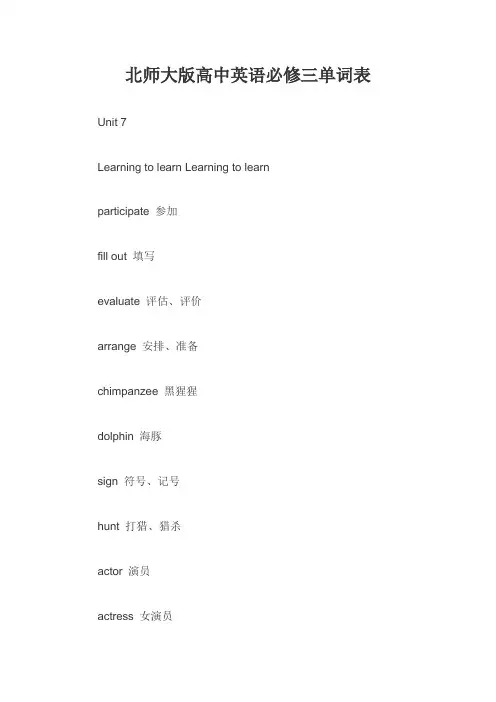
北师大版高中英语必修三单词表Unit 7Learning to learn Learning to learnparticipate 参加fill out 填写evaluate 评估、评价arrange 安排、准备chimpanzee 黑猩猩dolphin 海豚sign 符号、记号hunt 打猎、猎杀actor 演员actress 女演员writer 作者、作家collection 收集、收取boxing 拳击运动Unit 7 Unit 7Warm-up Warm upski 滑雪water skiing 滑水windsurfing 风帆滑浪frightening 骇人的underwater 在水下、供水下用的Lesson 1 Lesson 1spirit 精神explorer 探险家sailor 水手海员Viking 维京人、北欧海盗voyage 航海航空set sail 启航ancestor 祖先、祖宗AD 公元further 更远、较远according to 根据、依照get into trouble 陷入麻烦陷入困境persuade 说服、劝服make it to 到达in search of 寻找、寻求unknown 不知道的、未知的eventually 最终终于present-day 当今的现代的deed 行为、行动journey 旅行、旅程lecture 讲授、演讲brake 制动器、刹车apologise 道歉the Antarctic 南极洲Lesson 2 Lesson 2pollute 使污染pollution 污染over-fishing 过度捕捞industrial 工业的agricultural 农业的chemical 化学物ban 禁止altogether 完全handle 对付department 部、系、局、部门make a living 谋生solution 答案、解决办法port 港口、海港present 讲演、演示intelligence 智力、理解力intelligent 有才智的、理解力强的Lesson 3 Lesson 3iceberg 冰山、浮冰seal 海豹energetic 有活力的penguin 企鹅coral 珊瑚discovery 发现crab 蟹educate 教育up-to-date 现代的、新式的attraction 吸引人的地方/事物attract 吸引watch out. 注意shark 鲨鱼discount 折扣、减价trick 戏法、把戏melt 融化、熔化measure 度量、测量length 长度、长schoolboy 男生centimetre 厘米Lesson 4 Lesson 4barrel 圆桶whirlpool 漩涡horrible 可怕的令人厌恶的float 浮漂terrify 令人感到恐惧escape 逃脱、逃跑terror 恐怖、恐惧soul 灵魂survive 幸存、生存下来all at once 突然、忽然recover 痊愈、康复scream 尖声喊叫、惊呼sink 下沉、沉没pick up 取、接载unable 不能的、不会的recognise 辨认出Oceania 大洋洲opposite 对立的人(物)、反义词net 网leak 渗漏泄漏Communication Workshop Communication Workshop stadium 运动场、体育场debate 辩论、争论local 当地的地方性的shopkeeper 店主店东bay 海湾湾wildlife 野生生物disagree 意见不合不同意Unit 8Warm-up Warm upadventure 奇遇、冒险的经历desert 沙漠、荒原canoe 乘独木舟、独木舟hike 游猎、探险旅行徒步旅行take off 起飞presenter 节目主持人major 较重要的、较严重的wild 野生的、狂热的tiring 令人疲劳的Lesson 1 Lesson 1raft 木排、木筏white-water rafting 激流漂流horizon 地平线organisation 团体、组织、机构uncomfortable 不舒服的、不自在的route 路线、路程porter 行李搬运工luggage 行李accommodation 住所、住处hostel 旅社、招待所maximum 最大的、最多的altitude 高度、海拔extra 特别的、额外的optional 可选择的、非强制的right now 就在此刻differ 不同于、有区别footprint 脚印、足迹anxious 忧虑的担心的Lesson 2 Lesson 2 Extreme 极度的、极端的bungee jumping 蹦极snowboarding 单板滑雪snowrafting 动力雪橇滑降in order to 为了(某一目的) gymnastics 体操、体操训练similarity 相似性类似性upside down 颠倒地、倒置地exactly 确切地、精确地risk 冒……的危险excitement 兴奋激动various 不同的、各种各样的flow 流动涌出equipment 配备设备dull 暗淡的、迟钝的preference 较喜欢的东西、偏爱turn up 出现、到场back out 决定不履行(承诺) get across 使理解(某事)jog 慢跑Lesson 3 Lesson 3traveler 旅行者、旅客emperor 皇帝宫廷、法庭in turn 轮流amaze 使惊愕(惊奇)goods 商品、物品confuse 使困惑fuel 燃料wealthy 富有的富裕的put into prison (坏事)突然发生、爆发author 关进监狱dictation 作者口述、听写stand by 坚持(某种)说法statement 陈述quantity 量、数量professor 教授hunter 猎人skin 皮皮肤Lesson 4 Lesson 4on one's way 在途中Norwegian 挪威人、挪威的preparation 准备、预备sledge 雪车、雪橇break down 损坏、不能运转shock 震惊、惊骇goal 目的、目标ambition 志向、抱负exhausted 疲惫的ran out of 用完耗尽hopeless 没有希望的cheerful 愉快的、高兴的distant 远处的、久远的carry on 继续做某事within 在…里面sadness 悲哀、忧伤function 运转、起作用patience 耐心、忍耐力nationality 国籍aim 目标、目的Communication Workshop Communication Workshop transport 运输、运送observe 观察、观测disadvantage 不利、不利条件staff 员工、全体工作人员survival 幸存、残存、生存shelter 遮蔽、庇护所philosophy 哲学limit 边界、限度。
北师大版高中英语必修第一册Lesson 3
UNIT-1 Life ChoicesLesson-3 A volunteer teacher教学设计本节课是高中英语第一册Unit 1 Life Choices的第三课A volunteer teacher,课型是阅读课,介绍了一位叫做张天(译音)的大学毕业生,在偏僻地区做志愿者教师的故事。
通过本节课的学习,让学生学会如何描述一段成为志愿者的经历,如何表达个人感受以及如何用英语表达从事志愿者过程中的细节描写。
1.语言技能目标(1)学生能够借助关键词,在理解文章大意的基础上,找出段落主题句,完成读前问题;(2)用所学的词汇和语言的对课文进行复述。
2.语言知识目标(1)能够正确运用以下单词和短语:inspire, independently, apply for, imagine, live up to, flash, deal with, be responsible for, attractive, as well as, fist ever, satisfied, treat sb as...;(2)能掌握-ed/-ing形容词表达对物或人的修饰。
3.文化意识目标(1)了解英语交际中如何根据对方的话语作出恰当的反应;(2)了解志愿者工作的辛苦以及学生对志愿者事业的思考。
4.情感态度目标热爱志愿者活动,积极参与不同的志愿者活动,从中学会如何克服困难,如何与人际交往,在新环境中进一步树立准确的语言学习观。
1.重点(1)如何使用地道的英语介绍志愿者活动;(2)正确理解并运用-ed/-ing形容词的修饰对象。
2. 难点(1)能用得体的英语表达自己从事志愿者活动的细节、个人情感;(2)能正确识别-ed/-ing形容词的修饰对象并准确使用。
北师大版高中英语必修一 Unit 3 Celebrations Lesson 3 Memories of Christmas 课件(共30张)
Why did the writer keep Granny’ paper hat and the letter in the music box ?
In that Christmas, her Granny gave her a music box to put all her treasures she received .
Intellectually and emotionally
stimulated
decoration
presents
Christmas pudding
Christmas
turkey
stockings sugar biscuit
Activating content schemata • Introduce Christmas to the class.
race around garden
roll a big snowball to make a lovely snowman
put on silly paper hats
have big turkey with potatoes
then follow Christmas putting
• What kinds of memories does the writer have for this Christmas ?
Date
Dec. 25
Reasons for celebration the birth of Jesus Christ
Activities
put up Christmas tree sing Christmas songs hang a stocking give / open gift…
北师大版高中英语必修一第三单元教案
北师大版高中英语必修一第三单元教案全文共3篇示例,供读者参考篇1Unit 3 Travel journal1. Teaching aims:a. Enable students to master some vocabulary related to travel.b. Enable students to grasp some important sentence structures and expressions.c. Cultivate students' listening, speaking, writing and reading skills.d. Cultivate students' interest in writing travel journals.2. Teaching key pointsa. Key vocabulary related to travelb. Important sentence structures and expressionsc. Writing skills for travel journals3. Teaching difficult pointsa. How to use the vocabulary and sentence structures in practical situations.b. How to write a coherent and interesting travel journal.4. Teaching aidsa. Multimedia resourcesb. Whiteboard and markers5. Teaching proceduresStep 1: Warm-up (10 minutes)a. Show students some pictures of famous tourist attractions around the world and ask them if they have ever been to any of them.b. Discuss with students the reasons why people travel and the benefits of traveling.Step 2: Vocabulary learning (15 minutes)a. Introduce some key vocabulary related to travel, such as "destination", "sightseeing", "accommodation", "itinerary", etc.b. Have students practice using the vocabulary in sentences.Step 3: Listening and speaking practice (20 minutes)a. Play a recording of a travel journal entry and have students listen carefully.b. Ask students to discuss in pairs or small groups about their own travel experiences and share them with the class.Step 4: Writing practice (30 minutes)a. Introduce the format and structure of a travel journal entry.b. Have students write their own travel journal entry about a trip they have taken or would like to take.c. Provide feedback and corrections on students' writing.Step 5: Review and assessment (15 minutes)a. Review the key vocabulary and sentence structures learned in the lesson.b. Have students present their travel journal entries to the class for assessment.6. Homeworka. Ask students to continue their travel journal entries at home and bring them to the next class for review.b. Assign some exercises related to the vocabulary and sentence structures learned in the lesson for further practice.Through this lesson, students will not only improve their English language skills, but also develop a greater appreciation for the art of travel journal writing.篇2北师大版高中英语必修一第三单元教案Unit 3 Travel journalⅠ. Teaching aims and requirements1. Knowledge aims:(1) Get to know some news words: trek, snowcapped, spiritual, kingdom, Kingdom, camel.(2) Understand the main idea of each para., comprehend some detailed information to Mary and Mood.(3) Practice reading skills: skimming and scanning.2. Ability aim:Improve students’ abilities of listening, speaking, reading and wring. Learn how to express travel through it.3. Emotion aim:(1) Cultivate students’ travel mind and prepare their travel ideas.(2) Learn to respect, peaceful and grateful.4. Moral aim:Learn to natural world to love, to know animals and treasure life’s creatures.Ⅱ. Teaching key points1. Summary the passage: Why does Mary Bishop come to the Nepal Himalaya?2. How did she feel after leaving the snow-capped mountain?3. What about another member’s mood?Ⅲ. Teaching difficult points1. Improve students’ summarizing ability.2. Ingrain climate.Ⅳ. Teaching aidsA recorder, a computer and multi-media.Ⅴ. Teaching methodsTask-based teaching. Communicative approach.Ⅵ. Teaching proceduresStep Ⅰ: Lead-in1. Show some cards about the animals and choose the most important animal in their heart.2. Ask: Why do they feel meet?3. Listen to the tape for warming up.Step Ⅱ: Pre-reading.Predict what they may feel during trekking in the Himalayas and give their an example then scan Task1Q1.Step Ⅲ: Reading1. Students read the passage quickly and choose the answer about Mary loses while trekking.2. To teacher’s questions: What’s wrong with Mary’s friend?3. Analyze detailed information of Mood.4. Check the work and ask some questions to each other and fill in the blanks.Step Ⅳ: Comprehension1. Listen to Task2Q2 to particular. They can draw a map to explain that she arrives in Jiri and then to Sethopsar.2. Find the detailed from the passage and fill in the blanks.3. Pair works to discuss mood for 2 minutes.Step Ⅴ: Language practice1. Help student to speak: In pairs. Practice speaking these dialogues.2. To help them to translate Chinese into English.Step Ⅵ: SummaryAsk students to try their best to speak in English about their thoughts when meet animals in trekking.Step Ⅶ: Homework1. Choose another paragraph to summarize.2. Writing an essay with their parents talking about experience of trekking.Ⅶ. Blackboard designUnit 3 Travel JournalMain Idea: Why does Mary Bishop come to the Nepal Himalaya?a) ...........b)...............c)…………Task 1Fill in the blanks.1. The writer saw many ---------.2. There was a dog following the trek who tried to--------.3. In the evening, they camped in a beautiful ---------.Task 2Write down your answers in the passage.1. Travel to Tsomanthang.2. Go to Sethopsar.ConclusionImprove students' summarizing and comprehension abilities.篇3Lesson 3 One's company, two's a crowd, three's a party【Teaching Aims】1. Enable students to master the key words and expressions in the text.2. Improve students' listening, speaking, reading and writing skills.3. Develop students' ability to express their opinions and thoughts in English.4. Cultivate students' understanding of different cultures and social norms.【Teaching Key Points】1. Key words and expressions in the text.2. Listening comprehension.3. Speaking practice based on the text.4. Writing a short paragraph expressing personal opinions.【Teaching Difficult Points】1. Listening comprehension.2. Expressing personal opinions and thoughts in English.【Teaching Methods】1. Task-based teaching method.2. Group discussion.3. Pair work.4. Role play.5. Multimedia teaching.【Teaching Procedures】Step 1: Greeting and warm-up (5 minutes)- Greet the students and introduce the topic of the lesson.- Ask students to discuss in pairs: "What do you think makes a good party?"- Have a brief class discussion to share ideas.Step 2: Pre-reading task (10 minutes)- Ask students to look at the title of the text and predict what it might be about.- Play a short video clip of a party scene and ask students to describe what they see and how they feel.Step 3: Reading and listening (20 minutes)- Read the text aloud and ask students to read along silently.- Play the audio recording of the text for students to listen and follow.- Discuss the main ideas, key words, and expressions in the text.Step 4: Reading comprehension (15 minutes)- Divide students into pairs or small groups to discuss and answer the comprehension questions.- Check the answers as a class and provide feedback.Step 5: Speaking practice (20 minutes)- Divide students into groups and assign roles for a role play activity about planning a party.- Encourage students to use the key words and expressions from the text in their conversations.- Monitor and provide feedback on their speaking skills.Step 6: Writing (15 minutes)- Ask students to write a short paragraph expressing their opinions on the importance of social gatherings.- Collect and review the paragraphs for grammar and vocabulary errors.Step 7: Summarizing and homework (5 minutes)- Summarize the key points of the lesson and ask students to review the text for homework.- Assign a writing task for students to write a party invitation using the key words and expressions from the text.【Teaching Reflection】This lesson aims to engage students in a variety of activities to improve their English skills while exploring the theme of social gatherings. By focusing on listening, speaking, reading, and writing tasks, students are able to practice and consolidate their language skills in a meaningful context. The use of multimedia and interactive activities helps to create a dynamic and engaging learning environment.。
高中英语北师大版必修1课件:Unit 3 Celebration Lesson 3 Weddings
词汇二 invitation n. 请柬;邀请 【教材原句】 If a friend gets an invitation to a wedding,you can go with him/her,even if you don’t receive an invitation yourself. 如果你的朋友收到婚礼请柬,即使你没收到,也可以跟他/ 她一起去。 【要点必记】 (1)receive/get an invitation 收到邀请 accept/refuse an invitation 接受/ 拒绝邀请 an invitation to... ……的邀请 (2)invite vt. 邀请 invite sb. to do sth. 邀请某人做某事 invite sb. to some place 邀请某人去某处
4. In Greece,a long silk ribbon stands for
.
A. a long and simple life C. a happy and rich life
B. a long and rich life
○D. a log a Greek wedding reception,you can do the following EXCEPT
词汇四 contribute (1)vt. & vi. 捐助,捐赠,贡献;投稿,撰稿 (2)vi. 促成,造成
【教材原句】 But don’t worry,you don’t have to contribute a lot of money. 但别担心,你不用放很多钱。 【要点必记】 (1)contribute (...) to/towards (把……) 捐献/ 贡献给…… contribute to... 是…… 的原因之一;导致……;有助于…… contribute (sth.)(to sth.) (为……)撰稿(……);(向……)投稿(……) (2)contribution n. 捐款;贡献 make a contribution/contributions to/ towards... 为……作贡献 contributor n. 捐款人;撰稿人