
人教版(PEP)六年级英语上册知识点(修改)
人教版(PEP)六年级英语上册复习知识点Unit 1 How can I get there?主要单词:science 科学museum博物馆post office 邮局bookstore书店cinema电影院hospital医院crossing十字路口turn 转弯left向左ask 问interesting 有趣的Italian 意大利restaurant 餐馆pizza 比萨饼street 大街;街道get 到达GPS 全球卫星定位系统feature 特点follow 跟着far 较远的tell 告诉习惯搭配turn left向左转turn right 向右转go straight 直行in front of...在...前面next to挨着go straight直走near the park在公园附近on Dongfang Street在东方大街上post office邮局pet hospital宠物医院Beihai Park北海公园Italian restaurant意大利餐馆Palace Museum故宫博物院science museum科学博物馆主要句子:☆1、☆Where is the museum shop? 博物馆的商店在哪儿?☆☆2、It’s near the door.在大门附近。
☆☆3、How can we get there? 我们怎么到那儿?☆☆ 4、Turn left at the bookstore. 在书店左转。
☆5、I want to buy a postcard. 我想买一张明信片。
6、I’ll ask. 我去问问。
7、Wow, a talking robot! 哇!一个讲话机器人。
8、What a great museum! 好棒的一家博物馆!10、There is a pet hospital in my city. 在我的城市有一家宠物医院。
11、Wu Yifan and Robin are looking at some robots. 吴一凡和罗宾正在看一些机器人。
12、I know a great Italian restaurant. 我知道一家很棒的意大利餐厅。
13、Chen Jie is trying to be a tour guide for Oliver in Beijing. 陈洁正试图给奥利佛当北京的向导。
14、Wu Yinfan’s grandpa gave Rob in a new feature. 吴一凡的爷爷给罗宾增加了一个新功能。
15、My new GPS works! 我的全球定位系统起作用了。
16、My stomach hurts. 我的胃不舒服了。
知识点:1、问路时要用“excuse me”对不起,打扰一下”2、描述路时可以用顺序词:first 首先, next 接着, then 然后3、near 表示在附近,next to 表示与…相邻。
它的范围比near 小。
4、在左边,在右边介词要用on, on the left/on the right,5、乘几路车可以用by the No.301 bus, 注意No.中N要大写,后面要加点。
如果要用动词可以用take, 例如take the No.301 bus.6、表示在哪儿转时,用介词at。
如:Turn left at the bank。
在银行左转。
7、在几点前面要用介词at,如at 7p.m.9、be far from…表示离某地远. be 可以是am , is ,are。
介词要用from。
如:I am far from school now.我现在离学校很远。
My home is not far from school. 我家离学校不远。
Unit 2 Ways to go to school?主要词组:by (表示方式)乘bus 公共汽车plane 飞机ship (大)船subway地铁train 火车slow 放慢速度;慢的down 减少;降低slow down 慢下来stop停下early 早到的helmet 头盔attention 注意pay attention to 注意traffic 交通Germany德国sled 雪橇fast 快的ferry轮渡习惯搭配by plane 坐飞机by ship 坐轮船on foot步行by bike 骑自行车by bus 坐公共汽车by train 坐火车by subway 乘地铁by plane坐飞机traffic lights交通灯traffic rules交通规则Stop at a red light 红灯停Wait at a yellow light 黄灯等Go at a green light 绿灯行主要句子:☆1、How do you come to school? 你怎么来学校的?☆☆2、Usually, I come on foot. 通常我走路来。
☆☆3、Don’t go at the red light! 别闯红灯!☆☆4、I must pay attention to the traffic lights! 我必须注意交通信号灯!☆5、In the USA people on bikes must wear one. 在美国骑自行车的人必须戴(头盔)。
☆知识点:1、on foot 步行乘坐其他交通工具大都可以用介词by…, 但是步行只能用介词on 。
on foot 相当于walk,只是walk是动词。
3、go to the park前面一定要加the.如果要去的地方有具体的名字,就不能再加the , 如果要去的地方没有具体名字,一定要在前面加the。
但go to school除外,前面绝对不能加the,这里是固定搭配。
go home回家,home前不加to。
4、How do you go to …?你怎样到达某个地方?如果要问的是第三人称单数,则要用:How does he/she…go to …?5、China/ US中国和美国: the right side of the road 右边England/Australia英国和澳大利亚: the left side of the road 左边6、注意come 和go的区别例:come to school是当你在学校,然后叫别人来学校时表达的.是"来学校的意思".go to school 是你不在学校,准备去或在去的路上.是"去上学和要上学"的意思.Unit 3 My weekend plan主要单词:visit拜访film电影see a film 看电影trip旅行take a trip去旅行supermarket超市evening晚上/傍晚tonight在今晚tomorrow明天next week下周dictionary词典postcard明信片comic滑稽的comic book连环画杂志word单词word book单词本lesson 课space太空travel 旅行half一半price价格together一起get together聚会mooncake月饼poem诗moon月亮Mid—Autumn Festival中秋节习惯搭配this morning 今天上午this afternoon 今天下午this evening 今天晚上next week 下周tomorrow 明天tonight 今晚this weekend这周末next Wednesday下星期三post card 明信片word book单词本dictionary字典comic book漫画书newspaper报纸see a film 看电影get together 聚会take a trip 去短途旅行go to the supermarket去超市visit my grandparents拜访(外)祖父母go for a picnic去野餐go to the cinema去看电影learn to swim学习游泳go ice-skating去滑冰make a snowman堆雪人see a film看电影make mooncakes做月饼read a poem朗诵一首诗Renmin Park人民公园主要句子:☆1、What are you going to do tomorrow? 你明天打算做什么?☆☆2、I’m going to have an art lesson. 我要上美术课。
☆☆3、We’re going to draw some pictures in Renmin Park. 我们要到人民公园去画画。
☆☆4、Where are you going? 你们打算去哪儿?☆☆5、We’re going to the cinema. 我们打算去电影院。
☆☆6、When are you going? 你们什么时候去?☆7、I’m going to see a film. 我打算去看电影。
8、I’m going to visit my grandparents. 我打算去看望外祖父母。
9、I’m going to buy a new comic book.我打算去买一本新漫画书。
10、 What are you going to buy? 你打算买什么?11、 My aunt is going to make mooncakes. 我的阿姨将做一些月饼。
12、My grandma will tell us a story about Chang’e.我奶奶(外婆)将会给我们讲嫦娥的故事。
知识点:1、What are you going to do? 你想做什么?询问他人在未来的打算。
be going to 后面要跟动词的原形。
意思是“打算成为什么,干什么职业。
”2、this evening 和tonight的区别:this evening指的是今天晚上睡觉以前的时间,一般指晚上十二点以前。
而tonight指的是今晚,一般是指一整晚的时间,通宵。
3、部分疑问代词的意义与用法:(1)What 什么。
用来问是什么,做什么,叫什么,什么样等等。
如:What is your name? 你的名字叫什么?What is your father? 你爸爸是干什么的?What is your hobby? 你的爱好是什么?(2)Where , 在哪里,到哪里。
用来问地点。
如:Where are you from? 你从哪里来?Where are you going ? 你打算去哪里?(3)When,什么时候。
人教版(PEP)小学英语六年级上册知识点归纳

人教版(PEP)小学英语六年级上册知识点归纳Unit 1: How Can I Get There?In this unit。
we will learn some XXX.1.Key Words:Museum: a place where you can see art。
historical objects。
and other XXX.Bookstore: a shop where you can buy books.Cinema: a place where you can watch movies.XXX: to change n.Hospital: a place where people go to get medical treatment.Left: the opposite of right.Post office: a place where you can send letters and packages.Science: the study of the natural world.Right: the opposite of left.Straight: without XXX.Crossing: a place where two or XXX.eful Phrases:Post office: "Where is the post office?"Science museum: "Where is the science museum?"Pet hospital: "Where is the pet hospital?"XXX: "Where is XXX?"XXX: "Where is Beihai Park?"Palace Museum: "Where is the Palace Museum?"Go straight: "Go straight and you will see the bookstore on your left."Turn right/left: "Turn right at the crossing and you will see the hospital on your right."Next to: "The cinema is next to the bookstore."In front of: "The school is in front of the park."Near the park: "XXX is near the park."XXX: "XXX."mon ns:Excuse me: "Excuse me。
pep人教版六年级上册英语各单元知识点

一、Introduction1.1 What is PEP人教版六年级上册英语?PEP人教版六年级上册英语是我国人民教育出版社出版的一套针对六年级学生学习的英语教材。
该教材旨在提高学生的英语听说读写能力,培养他们对英语学习的兴趣,使其能够应对日常生活和学习中的英语交流。
二、Unit 1: Good morning2.1 Vocabulary2.1.1 Words related to greetingsThe unit covers vocabulary related to greetings, such as "good morning", "good afternoon", "good evening", "hello", and "hi".2.1.2 Words related to numbersIn addition to greetings, students will also learn numbers from one to ten, as well as the words for "classroom", "teacher", "student", and "desk".2.2 Grammar2.2.1 Present simple tenseThis unit introduces the present simple tense, focusing on the usage of "be" and "have" in positive and negative sentences.2.3 Activities2.3.1 Role-playingTo practice the new vocabulary and grammar, students can engage in role-playing activities, where they take on the roles of greeting each other and asking basic questions in English.三、Unit 2: I can run3.1 Vocabulary3.1.1 Words related to sports and activitiesIn this unit, students will learn vocabulary related to sports and activities, including "run", "jump", "swim", "dance", "sing", "draw", and "read".3.1.2 Words related to expressing abilityAlong with sports vocabulary, students will also be introduced to words and phrases for expressing ability, such as "can" and "can't".3.2 Grammar3.2.1 Can and can'tThe grammar focus of this unit is on the usage of "can" and "can't" to express one's ability or inability to do something.四、Unit 3: At the zoo4.1 Vocabulary4.1.1 Words related to animalsThis unit covers vocabulary related to animals, such as "elephant", "panda", "tiger", "lion", "zebra", "giraffe", and "kangaroo".4.1.2 Words related to colorsStudents will also learn words for different colors, as many animals' physical characteristics are associated with specific colors.4.2 Grammar4.2.1 There is and there areThe grammar point of this unit is on the usage of "there is" and "there are" to talk about the existence of animals and objects at the zoo.4.3 Activities4.3.1 Describing animalsTo practice the new vocabulary and grammar, students can engage in activities where they describe different animals at the zoo using the words and phrases they have learned.五、Unit 4: Our classroom5.1 Vocabulary5.1.1 Words related to classroom objectsThis unit introduces vocabulary related to classroomobjects, such as "blackboard", "book", "pen", "pencil", "ruler", "desk", and "chair".5.1.2 Words related to prepositionsAlong with classroom objects, students will also learn prepositions such as "on", "in", "under", "behind", and "next to".5.2 Grammar5.2.1 Prepositions of placeThe grammar focus of this unit is on the usage of prepositions of place to describe the location of objects within the classroom.5.3 Activities5.3.1 Classroom scavenger huntTo reinforce the new vocabulary and grammar, students can participate in a classroom scavenger hunt, where they use prepositions to describe the location of different objects in the classroom.六、Unit 5: My school day6.1 Vocabulary6.1.1 Words related to school subjectsThis unit covers vocabulary related to school subjects, such as "Chinese", "math", "English", "music", "PE", "art", and puter".6.1.2 Words related to timeAlong with school subjects, students will also learn words and phrases related to time, such as "morning", "break", "lunch", "afternoon", and "evening".6.2 Grammar6.2.1 Present continuous tenseThe grammar focus of this unit is on the usage of the present continuous tense to talk about activities happening at the present moment.6.3 Activities6.3.1 Creating a daily scheduleTo practice the new vocabulary and grammar, students can create a daily schedule, using school subjects and time-related words to describe their typical school day.七、ConclusionThe PEP人教版六年级上册英语教材 covers a wide range of vocabulary, grammar, and activities that aim to provide students with a solid foundation in English language learning. By introducing topics such as greetings, sports, animals, classroom objects, and school subjects, the textbook offers students opportunities to engage in meaningful language use and develop essential language skills. With its systematicandprehensive approach to language learning, PEP人教版六年级上册英语 helps students cultivate their interest in English and facilitates their language acquisition process.。
人教版人教版小学英语六年级上册知识点归纳
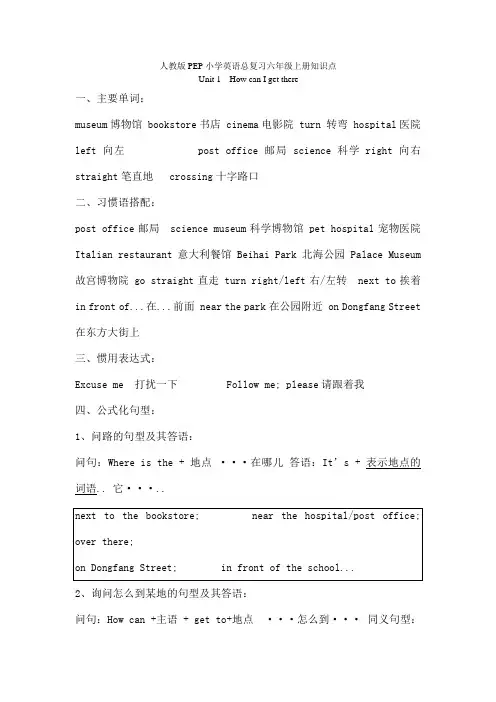
人教版PEP小学英语总复习六年级上册知识点Unit 1 How can I get there一、主要单词:museum博物馆 bookstore书店 cinema电影院 turn 转弯 hospital医院left向左 post office 邮局 science科学right向右straight笔直地 crossing十字路口二、习惯语搭配:post office邮局 science museum科学博物馆 pet hospital宠物医院Italian restaurant意大利餐馆 Beihai Park北海公园 Palace Museum 故宫博物院 go straight直走 turn right/left右/左转 next to挨着in front of...在...前面 near the park在公园附近 on Dongfang Street 在东方大街上三、惯用表达式:Excuse me 打扰一下 Follow me; please请跟着我四、公式化句型:1、问路的句型及其答语:问句:Where is the + 地点···在哪儿答语:It’s + 表示地点的词语.. 它···..2、询问怎么到某地的句型及其答语:问句:How can +主语 + get to+地点···怎么到··· 同义句型:Can you tell me the way to +地点 Where is + 地点 Which is the way to +地点答语:Turn +方向+表示地点的介词短语.. ···转..五、例句:Where is the cinema; please 请问电影院在哪里It’s next to the hospital. 它与医院相邻..Turn left at the cinema; then go straight. It’s on the left. 在电影院向左转;然后直行..它在左边..Turn left at the bank.. 在银行左转..六、主题写作:范文How to Get to the Science MuseumWe are going to the science museum tomorrow.The science museum is next to the hospital.It’s not far from our school.So we can go there on foot.First;go straight from our school.Next;turn left at the post office and walk for about five minutes.Then turn right at the bookstore.We can find the hospital on the right.Walk straight;and we’ll see the scienc e museum.Unit 2 Ways to go to school一、主要单词:by乘 bus公共汽车 on foot步行 plane飞机taxi出租车 ship大船subway地铁train火车slow慢的stop停下always 总是;一直usually 通常often经常 sometimes 有时候 never 从来不二、习惯语搭配:by bike/bus/plane/subway/train/ship/taxi/ferry骑自行车/乘公共汽车/飞机/地铁/火车/船/出租汽车/渡轮 take the No.57 bus乘57路公共汽车 on foot步行 slow down慢下来 pay attention to注意 traffic lights 交通信号灯 look right向右看 cross the road横穿马get off下车 at home在家 traffic rules交通规则 get to到达 get on 上车be far from…表示离某地远三、惯用表达式:Wait等一等 Hooray太好了 I see. 我明白了..Go at a green light 绿灯行Stop at a red light 红灯停 Wait at a yellow light 黄灯等四、公式化句型:1、如何询问对方的出行方式:How do you cometo+地点你们怎么来···的2、如何用must表示必须做某事:某人+must+动词原形+其它···必须···..3、告诫别人不要做某事的句型:Don’t +动词原形+其它 .不要/别···..五、例句:How do you go to school 你怎么去上学 Usually I go to school on foot.Sometimes I go by bus. 通常我步行去上学..有时候骑自行车去.. How can I get to Zhongshan Park 我怎么到达中山公园 You can go by the No. 15 bus. 你可以坐15路公共汽车去.. I am far from school now. 我现在离学校很远.. My home is not far from our school. My home is near our school.我家离学校不远..六、主题写作:范文Don’t Be Against the Traffic RulesI go to school from Mondays to Fridays. I go to school by bike at 7:30 in the morning.I have to cross two busy roads.I know the traffic rules well.Slow down and stop at a yellow light.Stop and wait at a red light.Go at a green light.I always ride on the right side of the road.I am never against the traffic rules.Unit 3 My weekend plan一、主要单词:tomorrow明天film电影supermarket超市trip旅行tonight在今晚evening晚上/傍晚 next week下周comic连环画杂志 dictionary词典word单词 post card明信片 visit拜访二、习惯搭配:take a trip去旅行 go for a picnic去野餐go to the cinema去看电影 learn to swim学习游泳 visit my grandparents看望我外祖父母 get together 聚会go to the supermarket去超市 go ice-skating去滑冰 make a snowman 堆雪人 see a film看电影 make mooncakes做月饼 read a poem朗诵一首诗 this weekend这周末 Renmin Park人民公园 next week下周this morning/afternoon/evening今天上午/下午/晚上 next Wednesday 下星期三三、惯用表达式:What about you你呢 Here they are它们在这儿Can I help you我能帮助你吗 Sounds great听起来很棒Have a good time玩得开心 You too.你也是四、公式化句型:1、询问对方打算做什么的句型及其答语:问句:What are you going to do +其它你/你们···打算做什么答语:I’m/We’re going to +动词短语原形+其它. 我/我们打算···..2、询问对方打算去哪儿的句型及答语:问句:Where are you going+将来时间你/你们打算···去哪儿答语:I’m/We’re going to the+地点. 我/我们打算去···..3、询问对方打算何时去做某事的句型及答语:问句:When are you going to +动词短语原形你/你们打算什么时候···答语:I’m/We’re going to +动词短语原形+将来时间. 我/我们打算···..五、例句:What are you going to do on the weekend 你周末打算做什么I’m go ing to visit my grandparents this weekend 这个周末我打算去看望我的外祖父母..Where are you going this afternoon 你今天下午打算去哪里I’m going to the bookstore. 我打算去书店.. What are you going to buy 你打算去买什么I’m going to buy a comic book.. 我打算去买一本漫画书..六、主题写作:范文Let’s Have a Nice DayToday is Saturday.Tomorrow morning I’m going to the bookstore with my friends.We are going to look for some good books.We all like reading books.We are going to have lunch in a restaurant.I like chicken;beef and vegetables.After lunch;we are going to the Summer Palace by bus.We are going to play near the Kunming Lake.Maybe we are going to row a boat on the lake.That will be greatWe are coming back at 5 in the afternoon.Unit 4 I have a pen pal一、主要单词:studies学习第三人称单数形式puzzle谜hiking远足二、习惯搭配:read stories读故事 do kungfu练功夫 fly kites放风筝 play the pipa弹琵琶play sports进行体育活动 climb mountains爬山 listen to music听音乐sing English songs唱英文歌 on a farm在一个农场里 live in...住在···write an email to...给···写一封电子邮件 on the playground 在运动场上三、惯用表达式:Me too.我也是.. Really真的吗四、公式化句型:1、询问某人爱好的句型及其答语:问句:What are sb.’s hobbies ···有什么爱好答语:主语+like/likes+动词-ing形式+其它. ···喜欢···..2、由do/does引导的一般疑问句及其答语:问句:Do/Does+主语+动词原形+其它答语:Yes;主语+do/does. /No;主语+don’t/doesn’t.五、语法:1、动词变为动名词的规则:动词变为动名词;即是动词加ing..一般要遵循以下三条规则:1一般情况下;在动词的后面直接加ing..如:play—playing read—reading do—doing go—going2以不发音的字母e结尾的动词;要去掉不发音的字母e;再加ing..如:write—writing ride—riding make—making dance—dancing3以单元音加单辅音结尾的重读闭音节;要双写最后一个辅音字母;再加ing..如:run—running swim—swimming put—putting sit—sitting2、关于第三人称单数:动词变为第三人称单数形式的规则:1在一个句子中;如果主语人称既不是你;也不是我;而是另外的一个人;这时的人称叫做第三人称单数..2在第三人称单词的句子中;动词要使用第三人称单词形式..3动词变为第三人称单数形式;要遵循以下规则:①一般情况下;在动词的后面直接加s..如:read--reads make—makes write—writes②以字母s; x; o ; sh ; ch结尾的动词;在词尾加es..如:do—does wash—washes teach—teaches go—goes pass—passes③以y结尾的动词分为两个情况;以元音字母加y结尾的动词;在词尾直接加s..如:play—plays buy--buys以辅音字母加y结尾的动词;要把y变为i;再加es.如:study--studies④以f ; fe结尾的名词;先把f;fe变为v;再加-es.⑤特殊变化:have--has4在一个第三人称单数的句子中;只要句子中出现了does或者其否定形式doesn’t.该句子中的其他动词就要使用原形..5第三人称单数的肯定句在变为否定句时;在动词的前面加doesn’t. 动词恢复原形..如:he lives in Beijing.---he doesn’t live in Beijing.(6)第三人称单数的陈述句在变为一般疑问句时;用does开头;后面的动词也要变为原形..如:he lives in Beijing.---Does he live in Beijing 3、注意几个单词的变化: hobby复数形式—hobbies have to同义词—must六、反义词或对应词:get on上车---get off下车 near近的—far远的 fast快的—slow慢的 because因为—why为什么 same相同的—different不同的 here这里---there那里 east东---west西 north北---south南left左---right右 get on 上车---get off下车近义词: see you---goodbye sure---certainly---of course 七、主题写作:范文Li Ying’s HobbiesLi Ying likes English very much.She works hard at it.She reads English every morning.She likes speaking English .She likes listening to the radio;too.She watches TV only on Saturday evening.Does she like cooking Chinese foodNo; she doesn’t.She likes doing word puzzles.She doesn’t like playing basketball.Her parents love her.All the teachers love her;too.She says her hobbies make her happy.Unit 5 What does he do一、重点单词:factory工厂 postman邮递员police officer警察 fisherman渔民scientist科学家pilot飞行员 coach教练 businessman商人;企业家 worker工人二、习惯搭配:by car/bus/bike/plane/boat乘小汽车/公共汽车/自行车/飞机/船go to work去上班 study hard 努力学习 stay healthy保持健康 go home 回家 lots of 许多 go to the camp去度假营 be good at...擅长···三、惯用表达式:Cool酷What about you你呢That’s nice.那真好.. I see.我明白了..四、公式化句型:1、询问他人的职业的句型及其答语;问句:What does+主语第三人称单数+do ···是做什么的答语:He/She is a /an+职业名称. 他/她是一位···..2、询问他人的工作地点的句型及其答语:问句:Where does+主语第三人称单数+work ···在哪儿工作答语:He/She works+表示地点的介词短语. 他/她···工作..3、询问他人的上班方式的问句及其答语:问句:How does +主语第三人称单数+go to work ···怎么去上班答语:He/She goes to work+交通方式. 他/她···去上班..by bike/bus/subway/plane/train/ship/ferry/...on foot五、一些由动词变化而来的职业名词:teach—teacher clean—cleaner sing—singer dance—dancer drive—driver write—writer TV report—TV reporter act—actor act—actress art—artist engine—engineer六、主题写作:范文I Love My FamilyHere is a photo of my family.There are four people in my family.They are my father;my mother; my brother and me.My father is a doctor.He works in a hospital.He goes to workby subway.My mother is a teacher.She works in a school near my home.She goes to work by bike.Look; the tall boy is my brother.Heis older than me.He is a pilot.He’s in Beijing now.He goes thereby plane.I am a student now.I love my family.Unit 6 How do you feel一、主要单词:angry生气的 afraid害怕 worried担心的;发愁的 happy高兴的see adoctor看病 more更多的wear穿 deep深的breath呼吸名词count数数动词 sad难过的二、习惯搭配:feel angry/ill/happy/sad感觉生气/不舒服/高兴/难过 be afraidof...害怕··· be angry with...与···生气 take a deep breath深深吸一口气 count to ten 数到十 see a doctor看病 do moreexercise做更多的运动 wear warm clothes穿暖和的衣服chase the mice追赶老鼠drink some drinks喝一些饮料 have some popcorn吃一些爆米花三、惯用表达式:Here you are.给你.. Wait for me.等我一下.. Yum太美味了四、公式化句型:1、描述某人/某物害怕什么的句型:主语+be动词+afraid of +其他. ···害怕···..2、描述某人/某物与什么生气的句型:主语+be动词+angry with+其他. ···与···生气..3、询问某人怎么了的句型及其答语:问句:What’s wrong What’s the matterwith you 怎么了答语:某人+所处的状况..4、建议某人应该做某事的句型某人+should +动词短语原形+其他. ···应该···..五、做“对句子划线部分提问”试题时;一般应该遵循三个步骤:1. 确定与句子划线部分相应的特殊疑问词;并且特殊疑问词代替相应的划线部分..2. 把特殊疑问词代替划线部分后的句子变成一般疑问句..3. 最后再把特殊疑问词提到句首..以上三个基本步骤可以用三个字来概括;即:定;问;提..例如: This is a book①This is what. ②Is this what ③What is this 注意:句①②只是一种变化过程;不必写入试题中..句③才是试题所要求的形式和结果;必须写到试题上..以上三个步骤是对句子划线部分提问最基本的过程..六、主题写作:范文What Should You DoWhen you fell sad or worried;what should you do Let me tell you.First you should take a deep breath .Then you should listen toso me music.Next you will be relaxed.You won’t be so sad or worried.When you are afraid;what should you do It’s easy.You should ask your friends for help.If you have friends with you;you won’t feel afraid.Try to be happy every day.英语疑问词what;how;who;why;where;when的用法.一、what 什么用来问是什么;叫什么;做什么等1. What’s your name 你叫什么名字2.What is in your box 你的盒子里是什么3. What’s your father=What does your father do 你爸爸是干什么的一What time 什么时间用来问时间 What time is it 几点了二What colour 什么颜色用来问颜色 What colour is your bag 你的书包是什么颜色三What about 怎么样用来征求意见或询问感受等;大多用于承接上面的同样问题..1.What bout this pair of shoes 这双鞋子怎么样2.What about you 你呢3.What about your dad 你爸爸呢四What day 星期几用来问星期几 What day is it today/tomorrow 今天/明天星期几五What date 什么日期问具体的日期1.What’s the date today 今天是几号 2. What date is tomorrow 明天是几号六What …for 为何目的用来问目的;在一定情况下可以与why互换What did you buy that for=Why did you buy that 你为什么要买那个二、when 什么时候用来问时间 When do you get up你什么时候起床三、where 哪里用来问地点1. Where is my ruler 我的尺子在哪里2. Where are you going to 你打算去哪里3.Where are you from =Where do you come from 你是哪里人四、which 哪一个用来问具体的哪一个1. Which season do you like best 你最喜欢哪个季节2.Which classare you in 你在哪一个班 3.Which one is my pen 哪一支是我的钢笔五、Who 谁用来问人物是谁1.Who is that boy那个男孩是谁2. Who are you going to with你打算和谁一起去 3. Who is that pretty lady那个漂亮的女士是谁六、whose 谁的用来问东西是谁的1. Whose bag is this 这是谁的包2.Whose bike is yellow 谁的自行车是黄色的七、 why 为什么用来问原因1.Why do you like spring 你为什么喜欢春天2. Why did you go there 你为什么去那里八、 how 怎么样用来询问身体等状况1. How are you 你好吗2. How is your mother 你妈妈好吗一How old 几岁用来问年龄 How old are you 你几岁了二How long 多长用来问长度 How long are your legs 你的腿多长三How big 多大用来问物体的大小 How big is your bedroom 你的卧室多大四How tall 多高用来问高度 How tall is your brother 你弟弟有多高五How heavy 多重用来问重量 How heavy are you 你有多重六 How far 多远用来问路程 2 How far is it from here 从这儿去有多远七How many 多少用来问数量 How many apples do you have 你有多少苹果八How much 多少钱用来问价格 how much is this dress 这个连衣裙多少钱九How about 怎么样用来征求意见或询问感受等;大多用于承接上面的同样问题;用法与what about相同1. How about you 你呢2. How about that shirt 那件衬衣怎么样。
PEP人教版小学六年级英语上册知识点
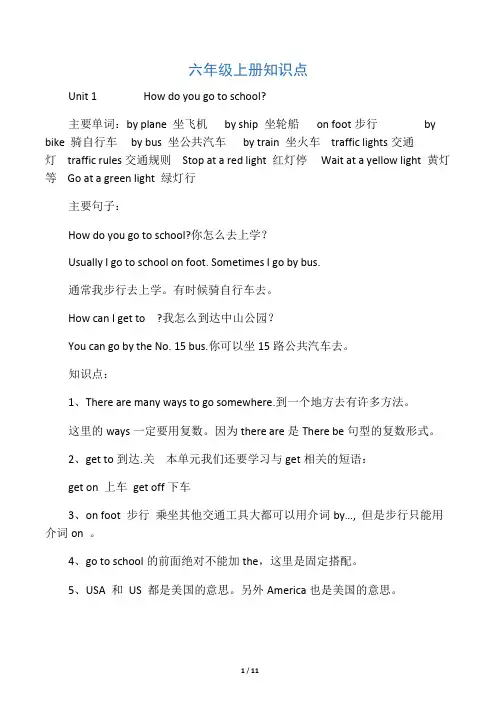
六年级上册知识点Unit 1 How do you go to school?主要单词:by plane 坐飞机by ship 坐轮船on foot步行by bike 骑自行车by bus 坐公共汽车by train 坐火车traffic lights交通灯traffic rules交通规则Stop at a red light 红灯停Wait at a yellow light 黄灯等Go at a green light 绿灯行主要句子:How do you go to school?你怎么去上学?Usually I go to school on foot. Sometimes I go by bus.通常我步行去上学。
有时候骑自行车去。
How can I get to ?我怎么到达中山公园?You can go by the No. 15 bus.你可以坐15路公共汽车去。
知识点:1、There are many ways to go somewhere.到一个地方去有许多方法。
这里的ways一定要用复数。
因为there are是There be句型的复数形式。
2、get to到达.关本单元我们还要学习与get相关的短语:get on 上车get off下车3、on foot 步行乘坐其他交通工具大都可以用介词by…, 但是步行只能用介词on 。
4、go to school的前面绝对不能加the,这里是固定搭配。
5、USA 和US 都是美国的意思。
另外America也是美国的意思。
6 go to the park前面一定要加the.如果要去的地方有具体的名字,就不能再加the , 如果要去的地方没有具体名字,由要在前面加the. go to school除外。
7、How do you go to …?你怎样到达某个地方?如果要问的是第三人称单数,则要用:How does he/she…go to …?8、反义词:get on(上车)---get off(下车) near(近的)—far(远的) fast(快的)—slow(慢的) because(因为)—why(为什么)same(相同的)—different(不同的)9、近义词:see you---goodbye sure---certainly---of course0、频度副词:always 总是,一直usually 通常often经常sometimes 有时候never 从来不Unit 2 Where is the science museum?主要单词:library 图书馆post office 邮局hospital医院cinema 电影院bookstore书店science museum科学博物馆turn left向左转turn right 向右转go straight 直行north北south南east东west西主要句子:Where is the cinema, please? 请问电影院在哪里?It’s next to the hospital. 它与医院相邻。
人教版(PEP)六年级英语上册期末复习知识点
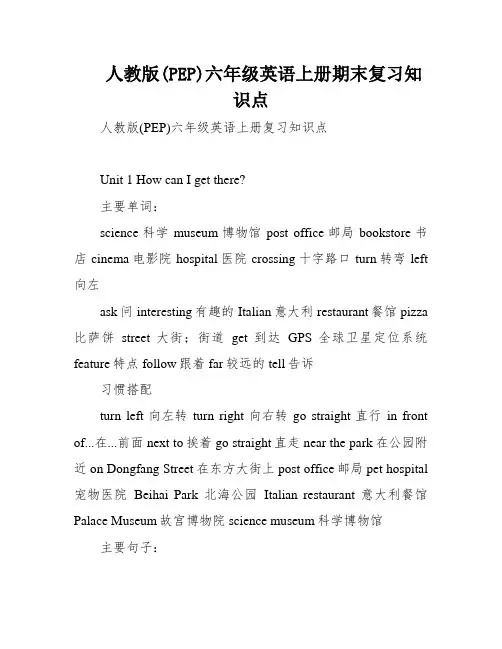
人教版(PEP)六年级英语上册期末复习知识点人教版(PEP)六年级英语上册复习知识点Unit 1 How can I get there?主要单词:science科学museum博物馆post office邮局bookstore书店cinema电影院hospital医院crossing十字路口turn转弯left 向左ask问interesting有趣的Italian意大利restaurant餐馆pizza 比萨饼street大街;街道get到达GPS全球卫星定位系统feature特点follow跟着far较远的tell告诉习惯搭配turn left向左转turn right向右转go straight直行in front of...在...前面next to挨着go straight直走near the park在公园附近on Dongfang Street在东方大街上post office邮局pet hospital 宠物医院Beihai Park北海公园Italian restaurant意大利餐馆Palace Museum故宫博物院science museum科学博物馆主要句子:☆1、☆Where is the museum shop?博物馆的市肆在哪儿?☆☆2、It’s near the door.在大门附近。
☆☆3、How can we get there?我们怎么到那儿?☆☆4、Turn left at the bookstore.在书店左转。
☆5、I want to buy a postcard.我想买一张明片。
6、I’ll ask.我去问问。
7、Wow, a talking robot!哇!一个讲话机器人。
8、What a great museum!好棒的一家博物馆!10、There is a pet hospital in my city.在我的城市有一家宠物医院。
11、Wu Yifan and Robin are looking at some robots.吴一凡和罗宾正在看一些机器人。
(完整版)新人教版英语六年级上册知识点总结
1 六年级PEP上册知识点总结Unit 1 How can I get there? 知识点归纳library 图书馆post office 邮局hospital 医院turn left 左转turn right 右转places: cinema 电影院( 地点) bookstore 书店science museum科学博物馆go straight 直行pet hospital 宠物医院school 学校supermarket 超市crossing 十字路口shoe store 鞋店Italian restaurant 意大利餐馆问路的重点句型:1.Where is the cinema, please? 请问电影院在哪儿?next to the bookstore 紧挨着书店in front of the school. 在学校的前面. behind the park 在公园的后面It’s near the zoo. 在动物园的附近. on Dongfang Street 在东方大街上over there 在那边2. Excuse me, is there a cinema near here ?请问这附近有电影院吗?Yes, there is. /No,there isn’t. 有./没有。
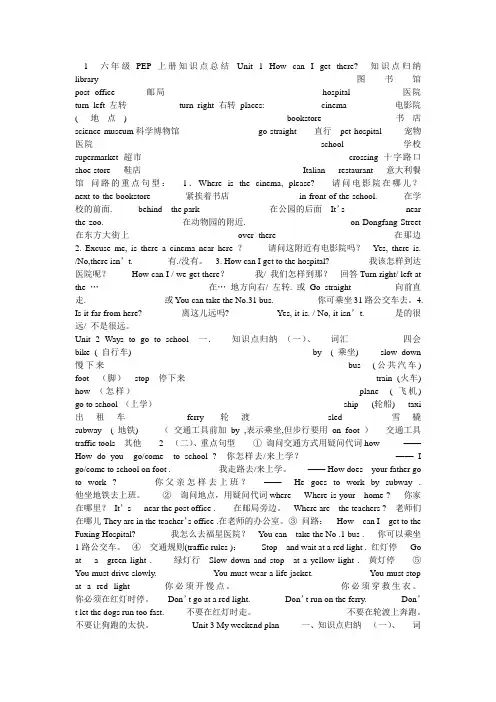
3. How can I get to the hospital? 我该怎样到达医院呢?How can I / we get there?我/ 我们怎样到那?回答Turn right/ left at the …在…地方向右/ 左转. 或Go straight 向前直走. 或You can take the No.31 bus. 你可乘坐31路公交车去。
4. Is it far from here? 离这儿远吗? Yes, it is. / No, it isn’t. 是的很远/ 不是很远。
Unit 2 Ways to go to school 一.知识点归纳(一)、词汇四会bike ( 自行车) by ( 乘坐) slow down 慢下来bus (公共汽车) foot (脚)stop 停下来train (火车) how (怎样)plane ( 飞机) go to school (上学)ship (轮船) taxi 出租车ferry 轮渡sled 雪橇subway ( 地铁) (交通工具前加by ,表示乘坐,但步行要用on foot )交通工具traffic tools 其他 2 (二)、重点句型①询问交通方式用疑问代词how ——How do you go/come to school ? 你怎样去/来上学?——I go/come to school on foot . 我走路去/来上学。
人教版PEP六年级英语上册知识点汇总
Unit 1 How can I get there ?1. Where is the …? It’s next to/ in frontof/behind/near/beside/on the left of/on the right of the …. (询问地点和方位;记住这些方位词)2.How can I/we get there? Turn right at the school. Then go straight.How can I/we get to the sci ence museum? It’s over there. You can go by/take the No.15 bus.(问路,可以有很多灵活的回答,告知怎么走或告知交通方式,前面最好加上Excuse me。
)3. 记住以下12个疑问词:what(什么)where(哪里)who(谁)which(哪一个)how(怎么样)when (什么时候)what time(什么时间)how many(多少数量)how much(多少钱)why(为什么)whose (谁的)how old(多大)4. buy a postcard(买一张明信片)send a postcard(寄一张明信片)5. I’ll = I will6.A talking robot(一个说话的机器人)7. What a great museum! (感叹句,多么伟大/棒的一个博物馆啊!)8. There is a pet hospital in my city.There are some bookstores in my city.Is there a pet hospital in y our city?Are there any bookstores in my city?(there be句型的单复数、肯定句和一般疑问句形式回忆起来)9. What an interesting film!(感叹句,多么有趣的一部电影啊!)10. Italian restaurant (意大利餐厅)11.yum=yummy12. On Dongfang Street (注意介词)13. work 有多种意思,比如工作;奏效,起作用,需根据上下文来理解。
六年级上册英语知识点
人教版(PEP)六年级(上)知识点归纳Unit 11. Where is the …?It’s next to/ in front of/behind/nea r/beside/on the left of/on the right of the ….(询问地点和方位;记住这些方位词)2.How can I/we get there? Turn right at the school. Then g o straight.How can I/we get to the science museum? It’s over there. You can go by/take the No.15 bus.(问路,可以有很多灵活的回答,告知怎么走或告知交通方式,前面最好加上Excuse me。
)3. 记住以下12个疑问词:what(什么)where(哪里)who(谁)which (哪一个)how(怎么样)when(什么时候)what time(什么时间)how many(多少数量)how much(多少钱)why(为什么)whose (谁的)how old(多大)4. buy a postcard(买一张明信片)send a postcard(寄一张明信片)5. I’ll= I will6.A talking robot(一个说话的机器人)7. What a great museum! (感叹句,多么伟大/棒的一个博物馆啊!)8. There is a pet hospital in my city.There are some bookstores in my city.Is there a pet hospital in your city?Are there any bookstores in my city?(there be句型的单复数、肯定句和一般疑问句形式回忆起来)9. What an interesting film!(感叹句,多么有趣的一部电影啊!)10. Italian restaurant (意大利餐厅)11.yum=yummy12. On Dongfang Street (注意介词)13. work 有多种意思,比如工作;奏效,起作用,需根据上下文来理解。
人教版PEP英语六年级上册知识点归纳
Unit 1 How can I get there?1. 名词: science 科学 museum 博物馆 bookstore 书店 cinema 电影院 hospital 医院 crossing 十字路口2. 动词: turn 转弯3. 副词: left 左 right 右 straight 笔直地4. 短语: post office 邮局1. 名词: sir 先生 restaurant 餐馆 pizza 比萨饼 street 大街;街道 GPS 全球(卫星)定位系统2. 动词: ask 问 feature 特点 get 到达 gave(give 的过去式) 供给;交给 follow跟着tell 告知3. 形容词: interesting 好玩的 Italian 意大利的 far 较远的1. — Where is the cinema? 电影院在哪儿?— It ’ns e xt to the bookstore. 紧挨着书店。
2. How can we get there?我们怎么到那儿?3. Turn left at the bookstore. Then turn right at the hospital.到书店左转。
然后到医院右转。
留意:要留意介词的固定搭配。
Turn left/right at the … 到……左/右转。
Get off at the … 在……下车。
一、核心词汇二、了解词汇三、核心句型It’s on the left/right.在左/右边。
Walk/Go straight for …minutes.步行/直走……分钟。
It’seast/west/south/north of the …在……东/西/南/北边。
It’sfar from the …距离……远。
四、了解句型1.Is there a …?……有……吗?拓展: there be 句型(1)主要用以表达“某处(某时)有某人(某物)”,其根本句型为“There+be 动词+名词+介词短语+其他.”There is a football under the chair. 椅子下面有一个足球。
人教版PEP 英语六年级上册 全册各单元知识点总结
人教版PEP 英语六年级上册全册各单元知识点总结Unit 1 How can I get there?一、地点词汇在问路时,掌握一些地点词汇是必要的,这些词汇包括library(图书馆)、post office(邮局)、XXX)、cinema(电影院)、bookstore(书店)、supermarket(超市)、school (学校)等等。
二、描述某地点所处位置的短语在描述某地点所处位置时,可以使用一些短语,如near (在…。
附近)、next to(与…。
相邻)、XXX(在…。
旁边)、in front of(在……前面)、behind(在…。
后面)、een(在…。
之间)等等。
三、问路当我们不知道某个地方在哪儿时,可以问路。
问路时,我们可以使用一些常用的句型,如“Where is the cinema。
please?”(请问电影院在哪儿?)、“Excuse me。
is there a cinema near here?”(请问这附近有电影院吗?)、“How can I get there?”(我怎样到那儿?)等等。
四、指引路当我们知道了某个地方的位置后,我们需要指引路。
指引路时,我们可以使用一些常用的短语,如“You can take the No.32 bus.”(你可乘坐312路公交车去那儿)、“Go straight and turn left at the bookstore.”(先直行然后在书店那儿左转弯)、“Turn right/ left at the …”(在…地方向右/左转)等等。
Unit 2: Ways to Go to SchoolDo you live far from school。
You may need to choose a XXX method to get there。
Here are some common n tools you can use: bike。