
外研版七年级英语下册教案:Module 2 Unit 3
来宾市第七中学七年级英语备课组设计课题主备人刘慧课型Language in use教学目标知识目标词汇:复习下列词语:名词:piano, tennis, club, term, board,monitor, ball, team, score, kite, game动词:ride, worry, teach, play,promise, tidy, fly, swim, start形容词:all,fast, fit, best, tidy, beautiful, ready, sure副词:then,fast, just代词:everybody短语:play the piano, play table tennis, ride a bike, worry about, would like, speak Chinese well, get on well with, do clean ing, promise to do, do well at school, work hard, get the best score, make our classroom beautiful, between lessons, be ready to do, be good at, fit and healthy, be sure语法:情态动词can表示能力的肯定、否定与疑问形式。
技能目标能够读懂关于班委竞选的文章,能描述某个班委的能力,能用英语在班中竞选班委或展示自己的特长。
情感目标能认识并肯定自己的能力,增强自信心,培养竞争意识和为班集体服务的意识。
重点掌握单词短语,恰当使用情态动词can.难点能恰当描述自己的能力,展示自己的特长。
教学关注1.To summarize and consolidate the usage of can2.Different situations when using can .教学准备教师准备Tape recorder, video, ppt 学生准备Books and notebooks.教学过程(教学环节、教师活动、学生活动、设计意图)自备补充集备补充一、课前活动,交流点评A contest. Give some notes to the students and let the do the actions and they can choose the other students to guess the meaning.二、预习检测,明确目标1.Discuss in group about the use of modal verb can, summarize the usage of it.Can you speak Chinese? Can she play the piano?Yes, I can. No, she can’t.2.Make sentences with can.三、学习新知,探究质疑Complete the sentences with can and can’t in Activity 3 on Page 12.四、评价反思,整理归纳Complete the passage with the words from the box and work in groups and check the answers.五、强化训练,布置作业Let the students introduce themselves. Then talk about their abilities and what monitor would they like to be. Finally ask some of them to give a speech in front of the class.课堂检测:导航P13—IIIHomework:Finish the exercise book and complete the speech.板书设计课后反思围绕本课达成目标、教学方式、学习方式、课程资源的开发与利用等进行反思来宾市第七中学七年级英语备课组设计课题Module 2 Revision I 主备人课型Revision 教学目标知识目标词汇:复习下列词语:名词:piano, tennis, club, term, board,monitor, ball, team, score, kite, game动词:ride, worry, teach, play,promise, tidy, fly, swim, start形容词:all,fast, fit, best, tidy, beautiful, ready, sure副词:then,fast, just代词:everybody短语:play the piano, play table tennis, ride a bike, wo rry ab out, would like, speak Chinese well, get on well with, do cleaning, promise to do, do well atschool, work hard, get the best score, make our classroom beautiful, between lessons, be ready to do, be good at, fit and healthy, be sure语法:情态动词can表示能力的肯定、否定与疑问形式。
技能目标能够读懂关于班委竞选的文章,能描述某个班委的能力,能用英语在班中竞选班委或展示自己的特长。
情感目标能认识并肯定自己的能力,增强自信心,培养竞争意识和为班集体服务的意识。
重点掌握单词短语,恰当使用情态动词can.难点能恰当描述自己的能力,展示自己的特长。
教学关注1. To s ummarize and consolidate the usage of can2. Different situations when using can .教学准备教师准备Tape recorder, video, ppt 学生准备Books and notebooks.教学过程(教学环节、教师活动、学生活动、设计意图)自备补充集备补充一、课前活动,交流点评Ask some of the students to come to the front of the classroom and give us a speech二、预习检测,明确目标I.单选1.If you get on well ______ your classmates, you’ll enjoyyour school life more. A. to B. at C. with D. in2.I have two cats. One is black, and ______ is white.A. anotherB. othersC. otherD. the other3.We want to make our city _______.A. beautifulB. cleaningC. untidyD. happy4.She often helps me ______ my English.A. to B .in C. for D. with5.--What do you want to be when you are older?-- I want to work ______ a magazine _______ a writer.A. for; asB. for; withC. in; forD. on; by6.– You can join the Chess Club. -- ______.A. That’s all.B. You are welcome.C. Sounds good.D. Not at all.II.用适当的词填空1.I can help my teacher ________(do) some things.2.My cousi n plays the piano very _______(good).3.Mary often helps her mother do ________(clean) at home.4.Are you good at ________(speak) English?5.What ______ (do) the monitors ______(do)?6.He is kind to _______(we) and we all like him.三、学习新知,探究质疑Check the answers and find different ideas.四、评价反思,整理归纳Sum up the use of different can.五、强化训练,布置作业课堂检测:Newspaper Section 7 Unit 3(练练吧)Homework:1.Finish the paper.plete the speech.板书设计 Module Two SpeechName/ Ability/ Advantages …课后反思围绕本课达成目标、教学方式、学习方式、课程资源的开发与利用等进行反思来宾市第七中学七年级英语备课组设计课题Module 1 Revision 2 主备人刘慧课型Revision教学目标知识目标词汇:复习下列词语:名词:piano, tennis, club, term, board,monitor, ball, team, score, kite, game动词:ride, worry, teach, play,promise, tidy, fly, swim, start形容词:all,fast, fit, be st, tidy, beautiful, ready, sure副词:then,fast, just代词:everybody短语:play the piano, play table tennis, ride a bike, worry about, would like, speak Chinese well, get on well with, do cleaning, promise to do, do well at school, work hard, get the best score, make our classroom beautiful, between lessons, be ready to do, be good at, fit and healthy, be sure语法:情态动词can表示能力的肯定、否定与疑问形式。
七年级英语外研版下册教案通用5篇
七年级英语外研版下册教案通用5篇七年级英语外研版下册教案通用5篇英语教师研制一份教案,是为了加强课堂教学的目的性和计划性。
下面是小编为你准备的七年级英语外研版下册教案,快来借鉴一下并自己写一篇与我们分享吧!七年级英语外研版下册教案篇1一、指导思想在本学期的英语教学中,坚持《英语课程标准》中以下教学理念,面向全体学生,关注每个学生的情感,激发他们学习英语的兴趣,帮助他们建立学习的成就感和自信心,让学生在老师的指导下通过感知、体验、实践、参与和合作等方式,实现任务的目标,感受成功;注重过程评价,促进学生发展,建立能激励学生学习兴趣和自主学习能力发展的评价体系。
总之,让学生在使用英语中学习英语,让学生成为使用者而不仅仅是学习者。
让英语成为学生学习生活中最实用的工具而非累赘,让他们在使用和学习英语的过程中,体味到轻松和成功的快乐,而不是无尽的担忧和恐惧。
二、教材分析这套教材采用任务型语言教学模式,融汇话题、交际功能和语言结构,形成了一套循序渐进的生活化的学习程序。
与原教材相比还增加了文化背景和学习策略等部分,并增加了任务型学习成份和语篇的输入。
本书每个模块都列出明确的语言目标、主要的功能项目与语法结构、需要掌握的基本词汇,并分为三个单元。
Unit1部分是基本对话内容,Unit2部分是短文,主要是阅读训练。
Unit3是扩展和综合的语言运用。
三、学生基本情况分析我所任教的是七年级1、2班英语,只有少部分学生的英语基础较好,取得了一定的成绩,大多数学生不能明确学习英语的目的,没有真正认识到学习英语的目的在于交流;没有养成良好的.学习习惯,不能做好课前预习课后复习,不善于发现和总结语言规律,不注意知识的巩固和积累。
四、具体措施1、每天背诵课文中的重点对话。
目的:要求学生背诵并默写英语句子,培养学生良好的英语语感。
2、每天听写本节课中需要用到的重点生词,常用句子或习语。
利用“互测及教师抽查”及时检查,保证效果并坚持下去。
2023年外研版七年级英语下册Module2 Unit 2 教学设计
Module2 Unit 2 教学设计一、Learning aims:A. Key words and phrases:play, tennis, piano, ride, club, term, board, would like, well, all, that’s all, worry, worry about, teach, then, monitor, start, get on well with . ready, ready to do sth. promise, fast, fit, just, ball, game, team, best, score, tidy, sure, everybody, just like, beautiful, fly, kite, swim.B. Everyday English:1. Look!2. What about you?3. Don’t worry about….4. I can play piano.5. I can’t speak Chinese very well.6. —Can you cook? —Yes, I ca n. / No, I can’t.7. —Can Betty speak English? —Yes, she can.8. —Can Tony speak Chinese well? —No, he can’t.9. I’d like to be …10. I want to be ….11. I can play the piano.12. She can dance really well.13. We can teach you Chinese!14. — Can you fly a kite?—Yes, I can. / No, I can’t.C. Teaching aims:1. Function: Finding out what people can do; asking and answering about abilities2. Structure: can / can’t3. Skills: 1)Listening and finding out about people’s abilities.2) Supplying information on p eople’s abilities.3)Reading and understanding simple passages, finding specific information4) Composing a simple passage4. Around the world: Languages5. Task: Making a poster for a club.二、Keys and Difficulties:The correct usage “can and can’t”.三、Teaching plan:Unit 2 I can run really fast.ⅠTeaching modelReading and writing.ⅡTeaching methodTop-down approachⅢTeaching keys and difficulties.The key points:a.key vocabulary and phrases: monitor, start, get on well with .ready, ready to do sth. promise, fast, fit, just, ball, game, team,best, score, tidy, sure, everybody, just like, beautiful, fly, kite,swimb.key structures:I’d like to be…I want to be….Difficulties.To write something about the monitor you would like to be.ⅣTeaching Aims1.Knowledge Aims:a.to grasp the key words and phrase.b.To get information from the reading material.2.Ability Aims:a.To get the Ss to describe the personal advantages and abilitiesb. To discuss about running for class monitorsc. To know which monitor the students would like to be for yourclass.d. To write something about the monitor you would like to be.3.Emotional Aims:To develop their awareness that we should affirm one’s ability and enhance self-confidence.ⅤTeaching aidsRecorder, PPT, videoⅥTeaching StepsStep 1 Warming-up and learn the vocabulary(3’)1. Show some pictures to review the words. .2. Read the words after the top student.4. Introduce the new words.Step 2 Discussion: work in pairs(4’)1. Show some pictures to tell the students what the class monitor, PE monitor and the cleaning monitor should do.2. Work in pairs. Ask and answer the questions.1) Which monitor would you like to be for your class?Class monitorPE monitorCleaning monitor2) What do these monitors do?Step 3 Listen and Fast Reading.(6’)1. Play the recording.2. Ask the students to read through the passage.3. Read the passage and check (√) the true sentences.1) Lingling doesn’t get on well with others.2) Lingling is kind to everyone.3) Daming is good at sport so he wants to be the PE monitor.4) Daming plays football for the school.5) Tony doesn’t like cleaning.6) Tony’s home is tidy.4. Check with a partner.5. Call back the answers from the whole class.Keys: 1. ×2. √3. √4. ×5. ×6.√6. Read the text together.Step 4 Intensive Reading (8’)1.Ask Ss to read silently and carefully, get the Ss to underline the difficulties.2..Explain the language points.Step 5 Practice(4’)1. Ask the students to read through the passage in Activity 3.How to choose your monitorsA good class monitor gets on well with (1) classmates / everybody and (2) promises likes to help you.A good PE monitor enjoys sport and is usually (3) fit / tidy. They often play (4) basketball / the piano or other sports in the school (5) team / class. They always try to get the best (6) score / help in a match.A good cleaning monitor is (7) bad / good at cleaning. They make the classroom (8) just / best like home.2. Underline the correct words.3. Check with a partner.4. Call back the answers from the whole class.Keys: 1. everybody 2. promises 3. fit 4. basketball 5. team 6. score 7. good 8. best5. Read the passage together.Step 6 Complete the sentences (4’)1. Ask the students to the words in the box in Activity 4.get on well with good at ready to2. Ask the students to read through the sentences in Activity 4.1) Lingling is a kind girl and she is always _______________ help others.2) Everybody likes her because she _____________ others.3) Daming plays football and is _____________ sports.3. Check with a partner.4. Call back the answers from the whole class.5. Read the passage together.Keys: 1. ready to 2. gets on well with 3. good atStep 7 Work in pairs(5’)1. Choose the best classmates to be the monitors in Activity 1. Say:Who they are and what job they can doWhy they can do it2. Write a passage about one of the monitors in Activity 5. Use the passage in Activity 2 to help you.3. Check with a partner.4. Call back the answers from the whole class.Step 8 Do exercises(6’)完成句子:1. 我与全班同学都相处得很好。
外研版七年级下册英语Module 2 Unit 3 Language in use (2)
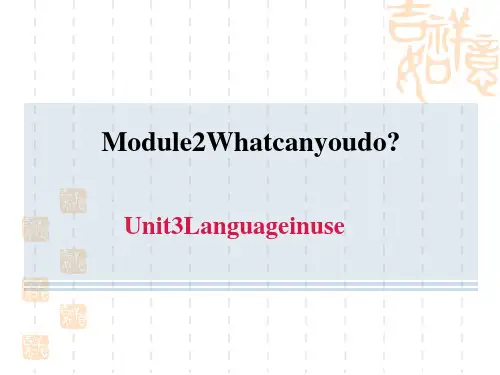
2. 你想知道对方是否会唱英文歌, 可以这样问: _____C_a_n_y_o_u_s_i_n_g__Englishsongs? 【2021·福建】
3. Look! Somekidsare__f_ly_i_n_g_k_i_te_s(放风筝)onthebeach.
4.
Theyareattheairport.
Module2Whatcanyoudo?
Unit3Languageinuse
温馨提示:点击 进入讲评
1A
题组专训
答案呈现
6 aswim
2 Canyousing
3 flyingkites
4 fly
5 swimming
1 flyakite
课后巩固 6 Club
答案呈现
11 He; cook
2 goswimming
Heiskindto________m_o_n_i2taonr disalways__________3helpot
heevrse.rybody
He_______r_ea_d__y_to____4hisclassmates.
Therearemanyclubsinhisschoolthis_____5.
Canyou____________? flyakite
2. 你想和我们一起去游泳吗? Doyouwantto______g_o_s_w_i_m_m__iwngithus?
3. 等一等!我就来。 Waitamoment! I______a_m__c_o_m__insogon.
4. 妈妈正在为我们做饭。 Mumis______c_o_o_k_in__g_fo_rus.
Hgeewtsoounlwdleilklwetiotjhoina_____6.
外研版七年级下册英语Module 2 What can you do(及答案)
最新外研版英语七年级下册Module 2 What can you do?及答案◎第1课时Unit 1 I can play the piano.一、根据句意及图画提示完成单词。
1. My sister often plays the _______after school.2. Tony __________ a bike to school every day.3. My mother __________English in a middle school.4. —Can Tom play__________?—Yes, he can play very well.5. —What’s on the__________?—Let’s go and see.二、用括号内所给词的适当形式填空。
1. Ted can_________(speak) English well.2. DaMing would like __________(join) the music club.3. What about _________(he)?4. Ling Ling teachers really___________(good).5. We can teach __________(they) Chinese.三、句型转换1. Her brother can play basketball and table tennis. (改为否定句)Her father _______ _______ basketball ________ table tennis.2. Lily can dance well. Can you dance well? (改为同义句)Lily can dance well. ________ ________ you?3. Don’t be worried about me. (改为同义句)Don’t ________ ________ me.4. Mary can play basketball well. (改为一般疑问句并作肯定回答)—________ Mary ________ basketball well?—________, she________.5. He wants to join the Dance Club. (改为同义句)He ______ _______ _______ join the Dance Club.四、根据汉语意思完成下列英语句子,每空一词。
最新外研版七年级下册英语Module 3 Making plans-Module 3 教学设计
Module3 Making Plans一、教学内容:Unit1 What are you going to do at the weekend?二、课型:Listening and speaking三、教学目标:1、能够正确使用下列单词和词组:go over, picnic, housework, on, else, nobody, at,nothing, silly, fantastic.2、能够听懂包含计划、安排的对话,并且判断出对话中人物的计划。
4、能够与人做有关计划的对话。
3、能用be going to表达自己的计划、安排,并能询问对方的计划、安排。
四、教学重难点:1、能够听懂对话中计划、安排的对话。
2、能够正确使用“ be going to” 来描述计划的相关信息。
五、教学准备:课堂整体运用任务型教学模式,培养学生独立自主的学习能力。
本课指导学生通过听说获取信息,培养学生的听说技能。
在教学过程中,采用多媒体手段辅助教学,利用各种图片和习题任务贯穿整个教学过程。
因此,本节课需准备:PPT课件、挂图、录音机、课堂练习表格、奖品六、教学过程:教学步骤教师活动学生活动设计意图Step One Warming -up (3’)Lead in1. Play a guessing game:Do actions and ask : Now,boys and girls, do you knowwhat am I doing?2.OK, you all did a goodjob. Now we are having alesson, but do you knowwhat am I going to dotomorrow?1. Guess and say the sentenceslike this: “You are sleeping…”“You are drinking…” makethe students do the actions andthe other students guess likethis: “He is fishing…She’s …”2. Students guess like this:You’re going to …以旧引新,先引导学生回顾相似的语法结构bedoing.通过这个环节,可以引导学生把一般现在进行时和一般将来时进行简单的对比了解。
外研版七年级英语下册 Module 3 Unit 2教案
课题:Module 3 Making plansUnit 2 We’re going to cheer the players.学习目标:掌握重点词及短语forward, look forward to, make friends, cheer, player, hope, win, enjoy oneself /myself during walk, take a walk, country, second, collect, litter, fun, summer holiday, camp, sightseeing , go sightseeing 学习重点:1、学习并能够准确运用fantastic,fan,nobody,myself等本课相关词汇2、能够初步运用be going to 结构3、能够读懂有关介绍假期计划的文章难点:1、描述自己的假期计划New words and phrases study读课文预习下列短语和句子并熟读。
一、New words1.迷,支持者_________2.球衣,男衬衫________3.为… 喝彩________ 4.选手___________ 5. 希望_________ 6.获胜_______ 7我自己____________8.在___期间_____________9.迟的_________10.乡下. ________11.第二_________ 12.收集______13.垃圾__________14.乐趣__________ 15.营地______16.澳大利亚的________ 17.观光______ 18.海滩____19.五月_______ 20.向前,面向未来的_________二、New phrases1.期盼做_________2.观看我们最喜爱________________3.足球迷____________4.为队员喝彩_______________5.五一假期_____________6.玩的开心__________________7.乡村散步_______________8.去游泳____________9.暑假_______________ 10.夏令营________________11.观光__________________ 12.野炊_________________13.在沙滩上________________ 14.打算做_________________【课堂互动】Task 1: Fast reading : Read the passage and match the people with thepictures.Task 2: Careful reading: Activity 3,read the passage and answer thequestions.Task 3 : Read paragraph by paragraph ,then finish the tasks.Paragraph A(Task 1): What is Martin going to do tomorrow?(Task 2):Read and fill in the blanks.【play win cheer fun】Martin and his friends are going to watch their favourite football team趁热打铁:Paul looks forward to _____his pen pal. ( meet ) 2.wear , dress, (be)in , put on 的区别 趁热打铁: I don’t like _____ hats. The boy can ____himself.Do you know the girl ___red? 4.It’s cold.________your coat. 3.cheer 意为______. 常见短语:cheer sb.___________ cheer sb. up___________cheer sb. on_____________注意:cheer up 和cheer on ,当代词为宾语的时候,要放在cheer 与 up/on 中间.We should cheer ourselves up ._____________ They beat drums to cheer on the players.______________ The children are cheering their running classmates.________ cheer 做名词,意为:欢呼声、喝彩声,复数为______. cheers 单独使用时意为“干杯”,是感叹词。
外研版七年级下册(新)英语教案Module3Makingplans教案
外研版七年级下册(新)英语教案Module3Makingplans 教案Module 3 Making plans⼀、学习⽬标:A.单词和短语:go over, picnic, housework, on, else, nobody, at, nothing, silly, fantastic, forward, look forward to, fan, make friends, shirt, cheer, player, hope, win, enjoy oneself, during, May, May Day, late, something, walk, take a walk, country, second, collect, litter, fun, summer holiday, camp, Australian, sightseeing, go sightseeing, beach, early.B.交际⽤语:1. Sure!2. Would you like to join us?3. Don’t be silly!4.— What are you going to do on Saturday morning? — I’m going to ….5. What are you looking forward to this weekend?6. What are you going to do?7. Why are you going to do it?8. I’m going to check my email.9. Lingling and I are going to have a picnic.10. Lingling is going to have a piano lesson.11. — Are we going to meet here? — No, we aren’t.C. 教学⽬标1. Function : Talking about plans; making plans2. Structure: Be going to + verb; wh-questions and answers3. Skills: 1) Listening and understanding familiar topics (plans).2) Talking about familiar topics (plans).3) Reading and understanding simple passages.4) Composing a simple passage.4. Around the world: Weekend plans.5. Task: Talking about your weekend plans.⼆、重点及难点:be going to + verb; wh-questions and answers三、教学设计:Unit 1 What are you going to do at the weekend?ⅠTeaching modelListening and speakingⅡTeaching methodBottom-up approach to listeningⅢTeaching aims1. To understand conversations.2. Ask and answer: What are you going to do at the weekend?ⅣTeaching Objectives1. Key vocabulary: go over, picnic, housework, on, else, nobody, at, nothing, silly, fantastic2. Key structures:— What are you going to do on Saturday morning?— I’m going to ….ⅤTeaching aidsTape recorder, OHP, videoⅥTeaching StepsStep 1 Warming-up1. Show some pictures of school things. Say what they are.2. Read the words after the teacher.3. Introduce the new words.Step 2 Matching.1. Ask the students to read the word and expressions in Activity 1.AB2. Play the recording and ask the students to listen to the recording carefully.3. Match the words and expression from Box A with the word and expressions from Box B.4. Play the recording again, then they can check their answer with a partner.5. Call back the answer from the whole class and check the answer.Keys:1. check my email2. go over lessons3. have a piano lesson4. see a movie5. help with the housework6. have a picnic6. Match the expressions in Activity 1 with the pictures in Activity 2.7. Read the expressions together.Step 3 Listen and read.1. Ask the students to read the conversation silently.2. Play the recording and ask the students to listen and read the conversation.3. Read the conversation.4. Act it out.5. Learn “Everyday English”Welcome back!Please be careful with…from now on.Step 4 Answer the questions.1. Read the conversation again.2. Answer the questions.1) What’s Daming going to do on Saturday morning?2) What’s Betty going to do on Saturday afternoon?3) Who is going to have a piano lesson on Saturday?4) Where are they going to have a picnic?3. Ask the students to check with a partner.4. Play the recording again .Check the answers:Keys:1. He is going to check his email, do his homework and help with the housework on Saturday morning.2. She is going to see a movie on Saturday afternoon.3. Lingling is going to have a piano lesson on Saturday.4. They are going to meet in the park.Step 5 Complete the conversation.1. Ask the students to read the words in the box in Activity 4.2. Read through the conversation.Betty: What are your plans for next weekend, Lingling?Lingling: (1)____________. I don’t have any plans.Betty: Are you going to spend it (2)____________ at home?Lingling: Well, …what are you going to do?Betty: Tony and I are going to have a picnic in the park. We’re going to have a (3)____________ time. Are you going to come?Lingling: I’m not sure.Betty: Don’t be (4)____________! What (5)____________ are you going to do?3. Complete the conversation with the correct form of the words from the box.4. Ask the students to check with a partner.5. Check the answers:Keys: 1. Nothing 2. alone 3. fantastic 4. silly 5. else6. Read the conversation loudly.Step 6 Listen and repeat.1. Play the recording once without stopping.2. Play the recording again and stop at the end of each line. Ask the whole class to repeat.3. Play the recording again and stop at the end of each line. Ask individual students to repeat.4. Ask the students to practice the sounds in pairs.Step 7 Work in pairs.Ask and answer questions about your plants at the weekend.1. Ask and answer like this:—What are you going to do on Saturday morning?—I’m going to check my email and do my homework.2. Read through the example with the class.3. Pair them to ask and answer.4. Circulate and monitor their production.5. Complete the diary.Step 8 Guessing game.1. Show some pictures of school things.2. According to the information given and ask the students to guess what it is.3. Show the pictures to check the answers.Step 9 Language points1. On Saturday morning, I’m going to check my email and do my homework.I’m going to see a movie in the afternoon.如果我们要表达“在上午、下午、晚上”,可以说in the morning / evening / afternoon 三个词也常跟介词in连⽤。
外研版英语七年级下册全册教案
Module 1 Lost and found教案Unit 1 Whose bag is this?一、教学目标:1. 语言知识目标:1) 能正确使用下列单词和短语:crayon, eraser, glove, wallet, watch, whose, first of all, lose and found box, mine, hers, be careful with, from now on...2) 掌握first of all及be careful with的用法。
2. 情感态度价值观目标:学习英语文明礼貌的询问和回答方式,拾金不昧的做人原则和助人为乐的优良品质。
二、教学重难点:1、能够听懂有关失物招领的简短对话。
2、能够正确使用特殊疑问句“Whose…is this/that? 对物品的所属进行提问及其回答。
三、教学过程Step 1 Warming-up1. Show some pictures of school things. Say what they are.2. Look at the pictures on Page 2. Match the words from the box with the pictures.3. Read the words after the teacher.Step 2 Listening practice1. Ask the students to read through the questions in Activity2.1) Is the football Tony’s?2) Are the crayons Betty’s?3) Whose gloves are these?2. Ask the students to listen to the recording carefully.Step 3 Listen and read.1. Ask the students to read the conversation.2. Act it out.3. Learn “Everyday English”Welcome back! be careful with… from now on.Step 4 Work in pairs.1. Show some pictures of school things. Say what they are.2. Ask the students to talk about the pictures.3. Ask and answer like this:—Are the crayons Betty’s?—No, they’re not hers. They’re Lingling’s.Step 5 Work in pairs.Work in groups of three or four. Put four or five school things on the desk. Ask and answer.1. The students choose the school things. Ask and answer like this:A: Is this your pen?B: Yes, it’s mine.A: Whose pencil is it?C: It’s …2. Read through the example with the class.3. Pair them to ask and answer.Step 6 Language points1. First of all, come and look in the lost and found box!First of all 是在介绍准备讲的几件事情的第一件事情。
七年级下册英语全册教案(外研版)
Module 1 School LifeUnit 1 There are fifty students in the class.Preparation在黑板上写出单词Festival,要求学生回忆并说出已学过的节日名称,如:New Year, Christmas Day等,并板书。
组织两人小组活动,内容是在节日时的对话。
如下例:Happy New Year...Happy New Year...Do you...?Yes/No. We...两人小组活动后,请几对学生上台演示,然后要求大家评价。
对演示认真又根本无语言错误的学生给予奖励。
介绍短语Spring Festival, 带读后转入第1小节的学习1.Look and listen. Then repeat.1〕先不翻开书,问学生:春节后,一些同学又见面了,他们很快乐地在一起交谈,他们谈了些什么呢〔What are they talking about ?〕?2〕要求学生听一遍录音后,答复上面的问题,然后将答案School Life 写在黑板正上方。
3〕写出以下问题,要求学生听第二遍录音后答复:How many students are there in the class?How long are the lessons?How does Feifei go to school?How long does the bus take to get to school ?学生答复上述问题后翻开书,跟录音读一遍对话。
组织四人小组操练本段对话,然后要求他们演示和评价。
第2、3、4小节的教学可参考“教师用书〞的建议进展。
Unit 2 What’s your favourite lesson?Preparation1〕教师先简单用英语介绍本班的一些情况,然后要求学生分两人小组就School life话题进展对话,也可以给出以下问题要求学生对话:Do you like your school?How many lessons do you have each day?How do you get to school?两人小组活动后,叫几对学生上台演示,然后要求大家评价。
[外研版七年级下册英语教案] 七下英语外研社课本
《[外研版七年级下册英语教案] 七下英语外研社课本》摘要:the new trees.,Then repeat.,some flowers for my mother.事物是发展的,七年级英语教案也是发展的。
这是小编整理的外研版七年级下册英语的教案,希望你能从中得到感悟!Module 5 Weekend jobsUnit 1 Im watering the new trees.Preparation1)简要提示Module 4所学内容。
2)让几位学生上台,根据自己所写的短文,介绍某一天他们家中每个人的活动。
1.Look and listen. Then repeat.1) 告诉学生说,有一位小记者采访了几位学生。
他们说了些什么呢?请大家带着下面几个问题听对话录音两遍,然后回答这些问题。
What are the teachers and students doing?What is Li Jie doing?What is Li Qing doing?What is Bai Feifei doing?2)学生在回答问题时,教师帮助学生理解对话中的生词或词语。
3)学生回答问题并纠正错误后,教师请他们打开书,先带读对话一遍。
带读过程中突出本单元第2小节内容,然后在适度讲解第2小节内容后,要求学生跟读录音带。
4)两人小组活动:操练所学对话,然后演示评价。
2.What are the children doing? ...本小节可参考教师用书的建议进行。
3. Work in groups.本小节可参考教师用书的建议进行。
4. Homework.假定你是一位小记者,采访几位同学的课余活动,然后写成一篇报道。
Unit 2 Im making some flowers for my mother.Preparation简要提示Unit 1所学的内容。
让几位学生上台,根据自己所写的报道,向全班同学汇报,然后大家评价。