
人教版必修五 unit1 great scientists- reading
The water is to blame. The source of all drinking water should be examined.
11
Para1
What is the problem? The cholera was the deadly disease of its day. Neither its cause, nor its cure was understood.
What is the method of doing this research? To gather information in two particular streets.
To collect results
16
Para5
• Finally John found the source of the water. • Where it came from?
19
Para7( Draw a conclusion)
What measures did John Snow take to prevent the disease from spreading?
..suggested that…be examined …were instructed not to expose…to…
What causes cholera?
12
More details
John Snow was an expert doctor in London who attended Queen Victoria as her personal physician and was inspired by peopleexposed _____ to cholera. Though the cause and the cure of it were unknown, he wanted to face thechallenge and solve the problem. . .
Disscusion:
• What should we pay attention to in our daily life in order not to get infected with cholera?
24
14
Para2
Which theory did John Snow suspect was correct? He suspected that the second theory was correct but he needed evidence.
15
Para3 Think of a method
13
Para2
> What was the two theories explaining how the disease killed people?
the cholera multiplied in the air, a cloud Theory1:of dangerous gas floated around until it found its victims. People absorbed it into their Theory2: bodies with their meals.
Mark information on a map to find out where people 10 died or did not died
5.Analyse results 6.Find supporting evidence 7.Make a conclusion
5 6 7
Analyze the water to see if that is the cause of the illness
21
Read the passage again and fill in the blanks: (in 5 minutes) John Snow was a well-known doctor ____ in London in the th century. He wanted to find the ______ cause of ___ 19 defeat it. In 1854 when a cholera in order to ______ cholera broke ____ out, he began to gather information. He marked _____ on a map where all the dead people had lived and he found that many people who had drunk pump died. So he the dirty water from the ______ decided that the polluted water carried cholera. He suggested that the source _____ of all water supply examined and new methods of ________ dealing with be _______ polluted water be found. Finally, “King Cholera” was defeated.
Retell the passage according to below:
John Snow was a well-known ____ in London in the ___ century. He wanted to find the ______ of cholera in order to ______ it. In 1854 when a cholera ____ out, he began to gather information. He _____ on a map where all the dead people had lived and he found that many people who had drunk the dirty water from the ______ died. So he decided that the polluted water carried cholera. He suggested that the _____ of all water supply be _______ and new methods of ________ with polluted water be found. Finally, “King Cholera” was defeated.
7.Make a conclusion
9
Steps: 1.Find a problem 2.Make up a question 3.Think of a method 4.collect results
Para What/How?
1 2 3 4
What causes cholera? Which theory is correct? Collect information
17
Para5
• At last, he proved the second theory was correct by showing that cholera was spread by germs and not in a cloud of gas.
18
Para6. What extra evidence did he find?
1.Why couldn’t cholera be under control at first?
Neither its cause, nor its cure was understood.
2. What happened in 1854?
Cholera outbreak hit London. 3. How many people died in 10 days? 500
Finally, “King Cholera” was defeated.
20
• No. The map helped John Snow organise his ideas. He was able to identify those households that had had many deaths and check their water-drinking habits. He identified those houses that had had no deaths and surveyed their drinking habits. The evidence clearly pointed to the polluted water being the cause.
6
3 John Snow finally proved the theory by ________. A. gathering information with the help of a map B. looking into the source of the water for Broad Street and Cambridge Street C. separating those who suffered cholera from those who didn’t D. both A and B
3 John Snow finally proved the theory by ________. A. gathering information with the help of a map B. looking into the source of the water for Broad Street and Cambridge Street C. Separating those who suffered cholera from those who didn’t D. Both A and B
必修五5unit1greatscientists-reading-精品课件-公开课课件
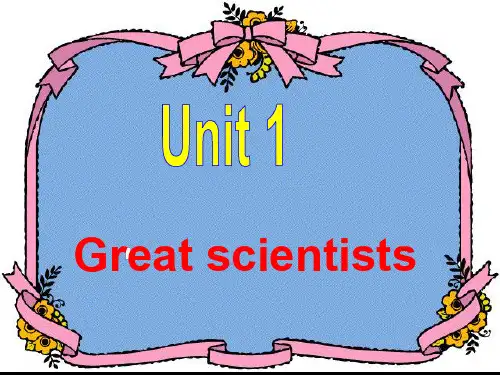
Charles Darwin
3. Who invented the first steam engine?
James Watt
4. Who used peas to show how physical characteristics are passed from parents to their children?
Paragraph 4
Collect results
What are the results?
1. Many of the deaths were near the water pump in Broad Street. 2. Some houses had no deaths. 3. The water was o blame.
7_W_i_t_h this extra evidence John Snow
announced that the polluted water was
8 _t_o_b_l_am__e_ (blame). He suggested the source of all water supplies 9_b_e_e_x_am__in_ed
Great scientists
Warming up
What do you know about great scientists? Try this quiz and find out who knows the most?
Are you ready? Let’s go!
1. Which scientist discovered that objects in water are lifted up by a force that helps them float?
人教版高中英语Book 5 Unit1 Great scientists reading 教学课件 (共27张PPT)
in no time 立刻,马上 at no time 决不,在任何时候都不
I like watching movies so much that I will go to
see it in__n_o_t_im__e__when
a new movie, like Master Hunt(捉妖记), is on.
Why should we wear school uniforms?
Dear Li Hua,
WRITING
I'm writing to share my opinions with you about wearing
school uniforms. I hold a firm belief that it really m__a_ke_s__s_en__se_(有意义) to wear school uniforms. My reasons are
lead to 通往;导致
All roads lead to Rome.
条条大路通罗马。
Persistence( 坚 持 ) leads to success, while giving up lleeaaddsto ffaaiill.ure
make sense 讲得通;有意义 make no sense 没道理;没意义 in a sense 在某种意义上说 in no sense 绝不(置于句首,句子用部分倒装)
wear school uniforms.On_l_y_i_n_t_h_is__w_a_y_c_a_n__w_e(பைடு நூலகம்有这样我们才 能)concentrate on studying and be good students.
Yours sincerely,
人教版-必修五-Unit-1-Great-Scientists-Reading-公开课-教案

Unit 1 Great scientistsTeach ing aims:1. Lear n some new words and expressi ons:Words: attend, cure, expert, handle ,Phrases: be lin ked to, be exposed to , be absorbed in to, be to blame (for sth)2. To examine a new scientific idea.3. Train the students ' r eading abilityMain poin ts: words and phrasesDifficult points: scientific researchTeach ing procedures:Step 1. Warming up1. Greeti ng the stude nts2. Show the Ss pictures of great scie ntistsStep 2. Pre-read ing1. Read the pictures and title of the book and make a prediction about the content ofthe text.2. Do the exercises on the answer sheet and let Ss analyze the words and finish Part II Step 3 fast reading.1. Ask the Ss to put them in order and get their an swers.2. Choose the right an swer to the content of the text.Step 4. Readi ng passage1. Careful Readi ng1) Para.1 Find a problem.What is the problem?John Snow was an ___________________________ doctor in London who Queen Victoria as her personal __________________ . He thought about helping ordinary people __________________ to cholera. Though the cause and theof it were unknown, he wan ted to face the ____________________ and solve the problem.What caused cholera?2) Para.2 Make a questio n:Two theories(ideas):1. Cholera multiplied in the air.2. People absorbed it into their bodies with their meals3) Para.3 Think of a method1. What happe ned in 1854?2. How many people died in 10 days?3. What did John Snow do at that time?4) Para.4 Collect resultsAsk stude nts find out the reas ons accordi ng to the map.Which house has the largest nu mber of deaths in this map?A. No. 12B. No.2C. No.38D. No. 295) Para.5 Analyse the results1.What happened to the pump water?2. What did the people do?6) Para.6 Find supporting evidenceWhat ' s the extra evidence?7) Para.7 draw a conclusionThe polluted water caused cholera.To prevent cholera from spreading again, what did John Snow do?①Suggested that the source of all water supplies be examined.②Instructed the water companies not to expose people to the polluted water any more.Step 5 Revision and summary1. review “How did John Snow defeat ‘ King Cholera '”Let students revise the procedure of the research.1. Summarize the passage.John Snow-a doctor, ___ Queen Victory as her personal ______ .But he was willing to help ordinary people _____ cholera.Many people died ____ there was an .He wanted to face the and solve the problem.Two theories caught her attention.The first suggested that cholera multiplied in theair.The second suggested that people this disease into their bodies and the disease thebody.John Snow ________ the second was right but he needed evidence.When another outbreak hit London in 1854,he was ready to begin his . ___________ and tried to get information.He found that most of the deaths were near a water and the spread of the disease was ________________________________ water.With the evidence,he was able to ________________________________ that polluted water carried the virus.After tha,the suggested the source of all the water supplies ______________ .Finally “King Cholera ” was ___________ .Step 6 Write a report:1. The question is whether too much homework is good for us.2. Use the steps to get your conclusion.Step 7. Homework1. Make sentences with the following words and phrases: challenge; announce; instruct; attend; be exposed to; absorb..into; be to blame2. Do exercise 1, 2 and 3 on page.Blackboard Design:New wordPut forwardScientific science scientist SerereBe linked to Vocabulary. TitleEnglish meaning come up withbadbe connected withI. words and meaning1. cure (para.1) a medical treatment2. victim (para.2) a person who were injured or killed as the result of a disease, etc:3. suspect (para.3) to have an idea that sth is probably true4. enquiry (para.3) the act of asking questions or collecting information about sb/stha machine that is used to force liq uid, gas or air into or 6. 7. 8. II. Circlethe answer that best matches the meaning of each bold word or phrase..9. expert: Joh n Snow was a famous doctor in London -so expert, in deed, that heattended Queen Victoria as her personal physician. (para.1)A. a person with special knowledge, skill or training in a particular fieldB. done with, having great knowledge or skill10. attend: John Snow was a famous doctor in London -so expert, indeed, that heattended Queen Victoria as her personal physician. (para.1)A. be present atB. take care of (sb); look after11. (be )exposed to: He thought about helping ordinary people exposed to cholera.(para.1)A. to leave sb/sth/oneself uncovered or unprotectedB. to tell the true facts about a person or a situation12. cure : Neither its cause nor its cure was understood.(para.1)A . to make sb healthy againB . a medicine or medical treatment13. absorb •…in to/ People absorbed it into their bodies with their meals. (para.2)A. to interest sb very much so that they pay no attention to anything elseB. to take (sth) in; suck up14. be to blame (for sth): It seemed that the water was to blame for cholera.(para.4) A.to be responsible for sth bad B. to think or say that sb/sth is responsible for sth bad15. handle :Remove the handle from the water pump so that it could not be used. (para.5)A. part of a toolB. to deal with, manage or controlIII SummaryJohn Snow - a doctor , 1. _____________ Queen Victory as her personal2. ___________ .But he was willing to help ordinary people3. ___________ cholera. Many people died4. ___________ there was an5. ____________ .He wanted to face the6. ___________ and solve the problem. Two theories caught her attention. The first suggestedthat cholera multiplied in the air. The second suggestedthat people7. ____________ this diseaseinto their bodies and the disease8. ____________ the body. John Snow9. ____________ the second was right but he needed evidence. When another outbreak hit London in 1854 , he was ready to begin his 10. and tried to get information. He found that most of the deaths werenear a water 1 1 . __________ and the spread of the disease was 12. ___________ water. With the evidence ,he was able to 1 3. _________ that polluted water carried the virus. After that , he suggested the source of all the water supplies 14. .Finally5. pump (para.4) outof sth foresee(para.4) announce (para.6) instruct (para.7) to predict; to know about sth before it happens to make (sth) known publicly give orders ordirections to sb“King Cholera ” was 15. _______________________________________ .。
人教版高二英语必修五课件:Unit 1 Great scientists readingppt版本
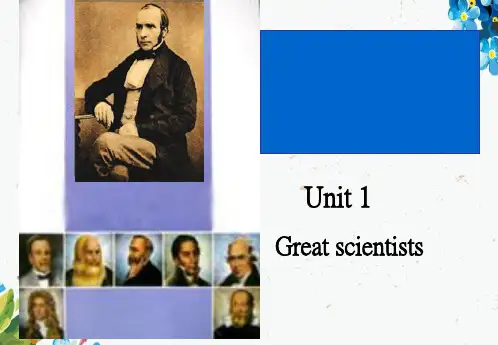
Who is he?
He made the first telescope in the world. His observations show that the earth moves around the sun.
He is … Galileo Galilei
2.How many people died in ten days? More than 500.
Para 4 Why is there no death at No.20 and 21 Broad Street as well as at No. 8 and 9 Cambridge Street? Because these people had not drunk the water from the Broad Street. Para 5
Fast reading
1.Match the main idea (or topic sentence) with
each paragraph:
Part I. (1)
Study of the outbreak in London in 1854.
Part II. (2)
Introduction of John Snow and cho invented electric bulbs. He made more than 1,000 inventions during his life. He is … Thomas Edison
Thomas Alva Edison
Who is she?
She is a woman scientist. She discovered radium(镭)and polonium(钋). In her life, she won the Nobel Prize twice.
高中英语必修五《unit1 Great Scientists》示范说课稿
《unit1 Great Scientists》说课稿各位评委老师,上午好!我是号考生,我今天说课的题目是《unit1 Great Scientists》。
我主要从教材分析、教学方法与策略、教学过程、板书设计等几个步骤向大家详细地讲解我对这节课的安排。
一.说教材1. 教材内容本节课是人教课标版必修5第一单元的第一课时的Reading部分,是该单元的主要内容,它介绍了英国著名医生John Snow是如何通过考察、分析、探究的科学方法,发现并控制“霍乱”这种传染病的。
通过阅读课文,使学生感悟科学家的周密观察、勇于探索、认真分析的科学精神,使学生了解科学方发现的全过程具有其科学的严密性。
2. 教学目标结合单元教学要求和本课特点,充分考虑学生的年龄特点、认知水平,遂将本课的教学目标确定为:知识目标1) Get students to learn the useful new words and expressions in this part.2) Let students learn about some great scientists and their contribution.3) Have students read the passage and know about John Snow and how he defeated “King Cholera”.能力目标1) Develop students’ reading ability and let them learn different reading skills.2) Enable students to talk about great scientists and tell their stories.情感目标1) Let students learn from great scientists, stimulate their love and respect for them and develop their moral qualities.2) Develop student’s sense of cooperative learning.3. 教学重点因为本组教材的重点了解项目是“John Snow 破解King Cholera难题”,所以确定本课的教学重点是:1) Let students learn about some great scientists and their contributions.2) Get students to read the passage and know about John Snow and how he defeated “ King Cholera”.3) Have students learn different reading skills.4.教学难点考虑到学生拓展阅读能力,语言输出能力等方面还需进一步努力,所以将本课的教学难点确定为:1) Develop students’ reading ability.2) Enable students to talk about great scientists and tell their stories.3) Let students learn how to organize scientific research.二.说教法和学法1. 教学方法引导学生独立思考,合作学习,进行师生、生生互动的“任务型”教学,设计了许多易于操作的任务型活动。
人教版必修5 unit 1 Great scientist P2 Reading (共52张PPT)
vt. 宣布; 通告
announce
to order or tell someone to do sth., esp. in a
formal way; to teach someone how to do sth.
vt. 命令; 指示; 教导 instruct
Match
expose … to link … to …
needing great mental or physical effort in
order to be done successfully and which
therefore tests a person's ability n. 挑战
to invite someone to compete or take part,
their attention is given completely to it
vt. 吸收; 吸引; 使专心
absorb
to think or believe sth. to be true or
probable; to not trust; to doubt
vt. 认为; 怀疑
a person believed to have committed a
n. 柄; 把手
handle
to deal with, have responsibility for, or be
in charge of; to operate or control sth.
which could be difficult or dangerous
vt. 处理; 操纵
handle
将……和……联系 或连接起来
由……组成 使显露; 暴露
Unit 1 Great Scientists Reading 课件-高中英语人教新课标必修五
People absorbed it with their meals.
2023/1/25
(3) aiming to kill or destroy 意在杀死的; 不共戴天的: a deadly enemy 不共戴天的敌人 2)deadly adv. (1) very 极度; 非常; 十分 deadly serious 十分认真 (2) like death 死一般地
John Snow was a well-known _d_o_c_to_r_ in London in the _1_9_th__ century. He wanted to find the _c_a_u_s_e_ of cholera in order to _d_e_fe_a_t_ it. In 1854 when a cholera _b_r_o_k_e_ out, he began to gather information.
He _m__a_r_k_e_d__ on a map where all the dead people had lived and he found that many people who had drunk the dirty water from the _p_u_m__p_ died. So he decided that the polluted water carried cholera. He suggested that the _s_o_u_r_ce__ of all water supply be _e_x_a_m__in_e_d__ and new methods of _d_e_a_l_in__g_ with polluted water be found. Finally, “King Cholera” was defeated.
人教版新课标英语必修五unit1_Great_Scientists_reading
Gregor Mendel
5. Who discovered radium?
radium Marie Curie
Thomas Edison
He invented the way of giving electricity to everybody in large cities.
7. Who was the painter that studied dead bodies to improve his painting of people?
What method did he use?
Public house
Many deaths happened here. A map of Broad
Street
No death happened here.
The water from the pump was to blame.
analyze the results: What happened to the pump water? The water was from the river which had been polluted by the dirty water from London.
Spread from one person to another. So it is an infectious Disease.
Broad Street
1. Skimming
What’s the main idea of the passage?
A. John Snow was a well-known doctor in London. B. The cause of Cholera was polluted water.
高中英语 Unit 1 Great scientists Reading课件 新人教版必修5
10.Who put forward a theory about black holes? A. Stephen Hawking B. Archimedes C. Copernicus
strongwilled
talented positive
A. Stephen Hawking B. Archimedes C. Thomas Edison
7.Who was the painter that studied dead bodies to improve his painting of people?
A. Gregor Mendel B. Leonardo da VinciC. Marie Curie
bright
similarities
strict
careful
Pre-reading
What should scientists do to prove a new idea in scientific research?
Draw a conclusion Collect results Find a problem Repeat if necessary
A. Thomas Edison B. Gregor Mendel C. Archimedes
5. Who discovered radium? A. Marie Curie B. Zhang Heng C. Newton
6.Who invented the way of giving electricity to everybody in large cities?
John Snow defeats “King cholera”
人教版必修五Unit1GreatScientistsReading1languagepoints
expert inexpert 不熟练的
adj. an expert driver 技术超高的驾驶员 be expert in/on/at (doing)... 擅长...
译:日本人在降低生产成本方面很在行。
注:immediately, directly, instantly, the instant, the moment等 与every time一样都可以用作连词引导时间状语从句, 意为“一……就……”
我一干完活就回家了。
I went home directly I had finished work. 他一听到那则消息就立即把它告诉了我。
John Snow Defeats “King Cholera”
Language points
defeat vt. 击败,战胜;使受挫;把(某人)难住; 阻挠 defeat the enemy a defeated army 败军 译:是考卷上的最后一道题把我难住了。 It was the last question on the paper that defeated me.
absorb
vt.吸收(液体、气体等);理解;使并入
absorb…into… 把…吸收进…;将…并入… absorb water/light/heat 吸收水/光/热 absorb oneself in=be absorbed in 全神贯注于…
译:男孩全神贯注地在看书。
The boy is absorbed in the book. The boy absorbs himself in the book.