
2019秋人教版九年级英语上册 Unit 4 Section A (1a-2d)
二、新课讲解
3. silent和silence
(1) silent是形容词,意为“沉默的;不说话的;不出声的”。在句中可 作定语、表语等。如:
Peter seems silent today. What’s the matter? (2) silence是名词,意为“沉默”,是不可数名词。in silence,是介词
二、新课讲解
词,意为“帮助”,是及物动词。如: He often helps the people who is in trouble.
(2) help作为名词,意为“帮助”,是不可数名词。如: Thanks for your help.
(3) helpful是形容词,意为“有帮助的;有用的;乐于助人的”。如: The dictionary is helpful to us.
九年级英语RJ版·上册
Unit 4
Section A (1a-2d)
授课人:XXXX
一、新课引入
What is he like?
What does he look like?
funny
short
二、新课讲解
Fill in the chart with words to describe people.
Appearance
Personality
tall
straight hair
of medium height/build heavy/ thin/ young/ old/ beautiful/ handsome curly /blonde long / short hair
outgoing funny
短语,意为“沉默地;静静地”。如: He walked back home in silence.
三、归纳小结
四、强化训练
根据所给汉语提示完成英语句子。
1. My uncle __u_se_d__to__b_e_a_d_r_i_v_e_r __(以前是个司机), but now he is an actor. 2. Tom’s father __u_s_e_d_t_o_r_e_a_d_b_o_o_k_s___(过去常常看书) after lunch. 3. Mary __u_s_e_d_t_o_r_i_d_e_a_b_i_k_e__(以前常常骑自行车) to work, but now she
helpful cute kind friendly confident
二、新课讲解
Bob is seeing some friends for the first time in four years. What did his friends use to look like?
二、新课讲解
Listen. Bob is seeing some friends for the first time in four years. What did his friends use to look like?
classmates. Alfred: It’s interesting to see how people have changed. Gina: Billy has changed so much! He used to be so shy and quiet. Alfred: Yeah, his face always turned red when he talked to girls! Gina: I used to see him reading in the library every day. Alfred: That’s because he was a really good student. He studied hard and got good scores on
was also good in__m_u_s_i_c_c_la_s_s_. She time to time.
used to play the__p_ia_n_o__.
二、新课讲解
Make conversations about Paula using the information in 2b.
used to “过去常常;曾经”,后加动词原形。
二、新课讲解 Look at the picture in 1a and make conversations.
二、新课讲解
Listen and check (√) the words you hear.
___ friendly
___ outgoing
a. so+形容词/ 副词(+that+从句) b. so+形容词+a/ an+可数名词单数(+that+从句)
二、新课讲解
1. This party is such a great idea!
(3)当名词前有many,much,few或little等词修饰时,要用so而不用such。如: There are so many / few people in the hall. 大厅有这么多/这么少的人。 You have so much / little homework today. 你今天有这么多/这么少的作业。
Paula used to be really quiet.
I know. She was always silent in class.
二、新课讲解
Alfred: This party is such a great idea! Gina: I agree. It’s been three years since we last saw our primary school
二、新课讲解
1. This party is such a great idea!
such与so (1) such为形容词,意为“这(那)样的”;主要修饰名词。其用法是: such+a/an +形容词+可数名词单数 (+that+从句)。 (2) so是副词,意为“这(那)么;如此地”,主要修饰形容词、副词和 分词。其用法有:
__is_u_s_e_d__to__w_a_l_k_in_g__(习惯步行) to work. 4. The pencil _i_s_u_s_e_d_t_o_w__ri_te__(被用来书写).
五、布置作业
1. Write down 3-5 sentences with “used to do” and “used to be”.
very_o_u_t_g_o_in_g__. She was never brave almost every day. She’s also on a
enough to ask questions.
__s_w_i_m__ team.
2. She got good grades in_s_c_i_en_c_e_. She 2. She still plays the __p_ia_n_o__from
2. Preview the words and expressions in 3a.
1. Mario used to be__s_h_o_r_t___. He used to wear__g_l_as_s_e_s___. 2. Amy used to be___t_a_ll____. She used to have_s_h_o_r_t____ hair. 3. Tina used to have___r_ed____ and __c_u_r_ly___ hair.
Now
1. Paula used to be really__q_u_i_e_t _. She 1.Now she's more interested
was always silent in class. She wasn't in__s_p_o_rt_s_. She plays _s_o_cc_e_r_____
___ humorous ___ silent
___ brave
___ quiet
___ serious ___ active ___ helpful
二、新课讲解
Listen again and complete the chart about how Paula has changed.
In the past
his exams. Gina: Did he use to wear glasses? Alfred: Yes, and he used to be thin, too. But look how big and strong he is now! Gina: He's so popular now. Look at all the girls around him!
人教版英语九年级上册Unit4 Section A(1a-2d)课件

He/ She is…
quiet outgoing
funny
1a
Fill in the chart with words to describe people.
Appearance tall straight hair beautiful thin Personality outgoing funny quiet serious / strict
He was short in the past.
Now,he is tall.
He used to be short, but now he is strong.
He had straight hair in the past.
Now,he has curly hair.
He used to have straight hair, but now he has curly hair.
fat
strong short curly hair
kind
hard-working strange friendly
He wore glasses.
Now,he doesn’t wear glasses.
He used to wear glasses, but now he doesn’t wear glasses.
2d
Role-play the conversation.
Alfred: This party is such a great idea! Gina: I agree. It’s been three years since we last saw our primary school classmates. Alfred: It’s interesting to see how people have changed. Gina: Billy has changed so much! He used to be so shy and quiet. Alfred: Yeah, his face always turned red when he talked to girls! Gina: I used to see him reading in the library every day. Alfred: That’s because he was a really good student. He studied hard and got good scores on his exams. Gina: Did he use to wear glasses? Alfred: Yes, and he used to be thin, too. But look how big and strong he is now! Gina: He’s so popular now. Look at all the girls around him!
初中英语 人教版九年级上册Unit4 Section A 1a-2c练习题(有答案)
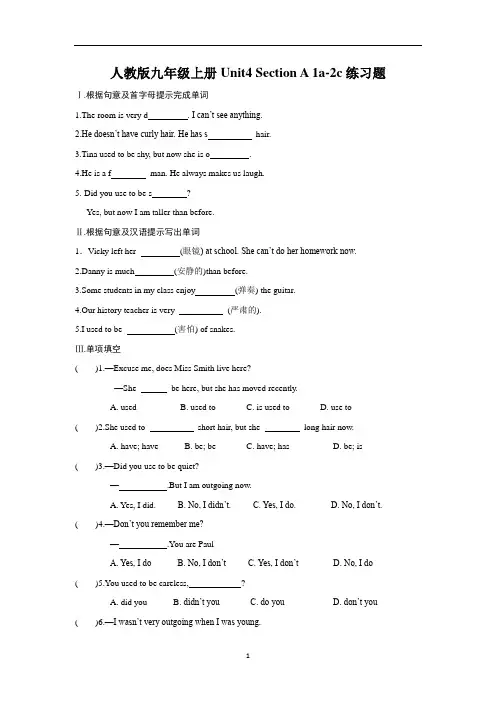
人教版九年级上册Unit4 Section A 1a-2c练习题Ⅰ.根据句意及首字母提示完成单词1.The room is very d . I can’t see anything.2.He doesn’t have curly hair. He has s hair.3.Tina used to be shy, but now she is o .4.He is a f man. He always makes us laugh.5.-Did you use to be s ?-Yes, but now I am taller than before.Ⅱ.根据句意及汉语提示写出单词1.Vicky left her (眼镜) at school. She can’t do her homework now.2.Danny is much (安静的)than before.3.Some students in my class enjoy (弹奏) the guitar.4.Our history teacher is very (严肃的).5.I used to be (害怕) of snakes.Ⅲ.单项填空( )1.—Excuse me, does Miss Smith live here?—She be here, but she has moved recently.A. usedB. used toC. is used toD. use to( )2.She used to short hair, but she long hair now.A. have; haveB. be; beC. have; hasD. be; is ( )3.—Did you use to be quiet?—.But I am outgoing now.A. Yes, I did.B. No, I didn’t.C. Yes, I do.D. No, I don’t. ( )4.—Don’t you remember me?—.You are PaulA. Yes, I doB. No, I don’tC. Yes, I don’tD. No, I do ( )5.You used to be careless, ?A. did youB. didn’t youC. do youD. don’t you ( )6.—I wasn’t very outgoing when I was young.—.You didn’t like talking with others in the past.A. Yes, you wereB. No, you weren’tC. Yes, you weren’tD. No, you were( )7.I used to play the piano, but now I’m in sports.A. interestingB. interestC. interestedD. interests ( )8.Peter enjoys playing football. He is a football team.A. inB. onC. forD. at ( )9.I’m that you can win the game, and you should believe in yourself.A. sorryB. sureC. happyD. afraid ( )10.—You come from England, don’t you?—.How do you know that?A. No, I doB. No, I don’tC. Yes, I amD. Yes, I do ( )11.Young people are interested in pop music.A. listen toB. listening toC. hearD. hearing( )12.—How does Jack usually go to school?—He ride a bike, but now he there to lose weight.A. used to; is used to walkB. was used to; is used to walkingC. was used to; is used to walkD. used to; is used to walking ( )13.Some girls are of spiders.A. terrifyB. terrorC. terrifyingD. terrified( )14.I always go to sleep the light on.A. inB. withC. toD. and( )15.Don’t about things so much. It will make you stressed out.A. afraidB. terrifyC. terrifiedD. worryⅣ.按要求完成下列各题,每空一词1.I used to be lazy.(对画线部分提问)What did you use to ?2.I used to be serious.(改为否定句)I to be serious.3.I took interest in collecting stamps when I was young.(改为同义句)I in collecting stamps when I was young.4.Mr.Zhao goes fishing every weekend.(改为反意疑问句)Mr. Zhao goes fishing every weekend ?5.Lisa used to play the piano.(改为一般疑问句)Lisa play the piano?Ⅴ.根据汉语意思完成句子,每空一词1.我过去不喜欢弹吉他。
秋新目标九年级上Unit4SectionA1a-2d课件

课文练习
01 02 03 04
总结词:口语练习
详细描述:设计多种形式的口语练习,如朗读、角色扮演、小组讨论 等,帮助学生锻炼口语表达能力和交际能力。
总结词:写作训练
详细描述:根据课文内容设计写作任务,引导学生运用所学词汇和句 型进行写作练习,提高他们的写作水平。
03
教学方法
讲授法
总结词
系统传授知识
通过了解不同国家的文化和风俗 习惯,学生能够增强对不同文化 的尊重和包容,培养跨文化交流
的能力。
激发学习兴趣
通过设计有趣的学习活动和情境, 激发学生的学习兴趣和积极性,培 养自主学习能力。
培养团队合作精神
通过小组合作学习和讨论,学生能 够学会与人合作、沟通和协调,培 养团队合作精神。
02
教学内容
课文导入
任务驱动法
总结词
实践与应用
详细描述
任务驱动法是一种以任务为核心的教学方法。教师设计实际的任务,让学生通过完成任务来学习知识、技能和应 用。这种方法可以培养学生的实践能力、解决问题能力和创新能力。
04
教学过程
课堂导入
01
02
03
提问导入
教师向学生提问关于单元 主题的问题,引发学生的 思考和讨论。
教师反思与总结
教学内容的合理性
反思课件内容是否符合教学大 纲和课程要求,是否具有科学
性和合理性。
教学方法的有效性
评估教学方法是否能够激发学 生的学习兴趣和积极性,是否 有助于学生理解和掌握知识。
教学过程的流畅性
反思教学过程是否流畅,各环 节之间的衔接是否自然,以及 时间安排是否合理。
教学效果的达成度
根据学生的表现和成绩,评估 教学效果的达成度,并分析原 因,以便改进教学方法和课件
九年级英语人教版全册 Unit4_SectionA(1a-2c)精品原创课件

1b Listen. Bob is seeing some friends for the first time in four
years. What did his friends use to look like?
1.Mario used to be _s_h_o_r_t . He used to wear _g_la_s_s_e_s. 2. Amy used to be _t_a_ll_. She used to have __s_h_o_r_t_h_a_i_r.
Listen and check (√) the words you hear.
__√__friendly __√___ outgoing _____ serious ____humorous __√___ silent __√___ active __√__ brave ___√__ quiet _____ helpful
Homework
1.结合课堂反思情况和学习目标,熟练掌握本课 的语言结构。 2.用本课所学的句型来谈论你家人的变化。
Bob Mario Amy Tina
A: Did Amy /Tina use to____ ? B: Yes, she did. She used to be really_______. A: What’s she like now? B: She’s _____ now.
How to describle people?
2. She got good grades in _s_c_ie_n_c_e_. She was also good in _m__u_s_ic_. She used to play the _p_i_a_n_o__.
1. Now she’s more interested in _s_p_o_r_t_s_. She plays _s_o_c_c_er__almost every day. She’s also on a _s_w_i_m__ team.
人教版九年级英语上册Unit4 Section A 1a-2d三

1b
Listen. Bob is seeing some friends for the first time in four years. What did his friends use to look like?
1. Mario used to be __s_h_o_r_t__.He used to wear __g_la_s_s_e_s_. 2. Amy used to be r_e_a_l_ly__ta_l_l.She used to have __s_h_o_r_t_ hair. 3. Tina used to have ___r_e_d___ and __c_u_r_l_y__ hair.
1b
Conversation 1 Bob: Mario, is that you? Mario: Yeah, it is. It’s Bob! Hey guys, it’s Bob!
I haven’t seen you for four years! Bob: Yeah. I’m here with my parents. We’re
Appearance tall straight hair
Personality outgoing funny
short fat thin a round face
friendly silent active humorous
Mario, you used to be short, didn’t you? ❶ Yes, I did.
Conversation 3
Tina: Hiya, Bob. Bob: Hi, Tina. You’ve changed, too. Tina: Oh, yeah? Bob: You have blonde hair! Tina: Yeah, it used to be red, didn’t it? Bob: And it’s straight! Tina: Yeah, it used to be curly.
人教版九年级英语上册教学课件:Unit4 Section A 1a-2d(共15张PPT)

(续表)
2.Paula used to be really quiet. 葆拉过去很安静。 3.She was never brave enough to ask questions. 重点句型 她从来都不够勇敢地提问题。 4.He studied hard and got good scores on his exams. 他学习很努力,考试时取得了好成绩。 5.Did he use to wear glasses? 他过去戴眼镜吗?
知识拓展 (1)interested作形容词,意为“感兴趣的”,指某人 对某事物感兴趣。 (2)interesting作形容词,意为“使人感兴趣的,有趣 的”,指某事物具有趣味。 (3)interest作名词时,意为“兴趣”;作动词时,意 为“使……感兴趣”。
即学即练
用interest的适当形式填空。 (1)This book is the most interesting one. I like it best. (2)He almost lost interest in physics. (3)He was interested in the interesting news.
课堂同步
一、阅读课本第26页2d,回答问题。
1.How was the party? Great.
2.How long since Alfred and Gina last saw their primary school classmates?
Three years.
二、阅读课本第26页2d,选择正确答案。 ( C )1.What did Billy use to be like?
课前导学
话题目标 我们所发生的变化
humorous adj. 有幽默感的;滑稽有趣的 silent adj. 不说话的;沉默的
人教版英语九年级全册-Unit 4 Section A (1a—2d)教案
Unit 4I used to be afraid of the dark.Section A (1a—2d)一、教学目标1. 熟练掌握下列词汇和短语:humorous, silent, helpful, score, from time to time, used to…2. 掌握并运用下列句型:Did Mario use to be short?Yes, he did. He used to be really short.What’s he like now?He’s tall n ow.Paula used to be really quiet.I know. She was always silent in class.3. 能够听懂关于人们今昔变化的对话,运用used to结构描述自己和同学曾经的性格特点和相貌。
4. 能够准确描述自己或他人在外表、性格、兴趣等方面所发生的变化。
5. 培养学生积极健康的心态,学会谈论事情的发展和变化。
二、教学重点及难点重点:1. 掌握本单元出现的与性格和外貌相关的词汇、短语及目标语言。
2. 学会用used to描述自己或他人的变化。
难点:准确运用used to准确描述自己或他人在外表、性格、兴趣等方面所发生的变化。
三、教学准备教师:教学课件;多媒体设备学生:课前预习四、教学过程Task 1Step 1 Warming-upFree talkT show some pictures, and ask Ss to describe his/her appearance.T: What is he/she like?Ss: He / She is…【设计意图】利用图片复习描述人物外貌和性格的词汇和句型,温故知新。
Step 2 Pre-listeningWork on 1a1. Fill in the chart with words to describe people2. Look at the pictures and compare the differences.【设计意图】学习有关人物外貌特征和性格的单词和短语,为下面的听力教学做铺垫。
2019秋人教版九年级英语上册课件:unit4 Section A(1a-2d)(共12张PPT)
B. used to
C. ought to
Ⅲ.根据句意完成句子,每空一词。
1. 如果在实际考试中我得到好分数,那会是个奇迹。
It will be a miracle if I get
good
scores on the real test.
2. 这里过去常有很多树,但现在已经变成沙漠了。
There used to be a lot of trees here, but now it has become desert.
3. 作为一名登山者,Alex习惯于冒险。
As a mountain climber, Alex is used
to
taking risks.
4. 我们已经好多年没见面了,但是我们时常保持联系。
We haven't seen each other for many years,but we keep in touch with each other
Martin, Paris, France Ah, yes, I do. I'm about as tall as I was in high school, and I have the same
hairstyle(发型). I'm probably a little bit heavier but not very much. But one thing has changed. I've got some gray hair.
点击进入word链接
参考答案
点击进入答案PPT链接
点击进入答案word链接
B. He is much taller.
C. He has got some gray hair.
初中英语九年级 Unit 4 第1课时 (Section A 1a-2d)(说课稿)
初中英语九年级 Unit 4 第1课时 (Section A 1a-2d)(说课稿)一. 教材分析《初中英语九年级 Unit 4 第1课时 (Section A 1a-2d)》是人教版初中英语教材九年级上册的一篇文章。
本节课主要讲述了一对夫妇在业余时间如何安排他们的生活。
通过本节课的学习,学生可以掌握一般现在时态的用法,学会描述日常生活中的活动和安排。
教材内容贴近学生的生活,有利于激发学生的学习兴趣和积极性。
二. 学情分析九年级的学生已经掌握了英语学习的基本语法和词汇,具备一定的听、说、读、写能力。
但部分学生对一般现在时态的用法还不够熟练,需要在课堂上进行针对性的训练。
此外,学生的学习动机、学习习惯和学习方法等方面存在差异,教师需要关注每个学生的个体差异,因材施教。
三. 说教学目标1.知识目标:学生能够掌握一般现在时态的构成和用法,正确运用一般现在时态描述自己和别人的日常生活。
2.能力目标:学生能够听懂、会说、会读、会写本节课的重点单词和句型,提高英语表达能力。
3.情感目标:学生能够培养良好的学习习惯,积极参与课堂活动,增强自信心。
四. 说教学重难点1.教学重点:一般现在时态的构成和用法,以及如何运用一般现在时态描述日常生活。
2.教学难点:一般现在时态的用法,尤其是如何正确运用一般现在时态描述生活习惯和安排。
五. 说教学方法与手段1.教学方法:采用任务型教学法、情境教学法和交际法,引导学生通过完成任务、参与情境和互动交流来学习英语。
2.教学手段:利用多媒体课件、图片、卡片等辅助教学,激发学生的学习兴趣和积极性。
六. 说教学过程1.导入:通过提问学生日常生活中的活动和安排,引出本节课的主题。
2.新课呈现:展示教材中的1a-2d部分,让学生听懂对话内容,并回答相关问题。
3.语法讲解:讲解一般现在时态的构成和用法,让学生对比过去时态,加深对一般现在时态的理解。
4.实践环节:学生分组进行角色扮演,运用一般现在时态描述自己和别人的日常生活。
人教版九年级英语 Unit 4 I used to be afraid of the dark Section A 1a-2d 课件(共33张PPT)
意义
过去常常做某 事 用……做……
to的作用
不定式符号
be used to do sth.
被用来做……
be used to doing sth. 习惯于做某事 介词
根据所给汉语提示完成英语句子。 1. My uncle u_s_e_d__t_o_b_e__a_d_r_i_v_e_r _ (以前是
个司机), but now he is an actor. 2. Tom’s father u_s_e_d__to__r_e_a_d_(_b_o_o_k_s_)_ (过
Few people know about it,do they? 几乎没有人知道有关这件事情,是吗? He was seldom late,was he? 他很少迟到,是吗?
★特殊:祈使句+ will you Stop talking,will you? 停止讲话,好吗?
Don’t make any noise,will you? 不要吵闹, 好吗? Let us go home together,will you? 让我们 一起回家,好吗?
to.
A.has, Yes
B. hasn't, Yes C. has, No D. hasn't, No
2.(2019黑龙江龙东地区)Your partner always gets up early on
school days. He’s seldom been late for school ,__C____?
去常常看书) after lunch. 3. Mary _u_s_e_d_t_o__ri_d_e_a__b_i_k_e_ (以前常常骑
自行车) to work, but now she _is__u_s_e_d_t_o__w_a_l_k_in_g_ (习惯步行) to work. 4. The pencil _i_s_u_s_e_d__to__w_r_i_te(被用来书 写).