
最新人教版八年级英语上册Unit7 Will people have robots教案
Unit 7Will people have robots?第一课时Section A (1a~1c)§自主学习案根据句意及汉语提示完成单词。
1.People won't use(使用) money in 100 years.2.We will have robots(机器人)in our homes.3.Please write your names on this piece of paper(纸).4.Everything here is free(免费的)now.5.—Will people use m oney (钱) in 100 years?—No, everything will be free.§课堂导学案Step 1准备与热身(Preparation)Hello, everyone!Now turn to page 51,and look at the grammar focus.—What will the future be like?—Cities will be more polluted. And there will be fewer trees.—Will people use money in 100 years?—No, they won't.Everything will be free.—Will there be world peace?—Yes,I hope so.Kids will study at home on computers.They won't go to school.Now give attention to the blacken words. “Will” is used here to express futureevent.More examples:I will have English classes this afternoon.He won't go to school tomorrow.The form of the usage is: will +verb.Now let's have a game to make sentences with “will” to see who will say the most sentences with “will”.Step 2呈现与输入(Presentation)Now let's go to page 49.There are 6 statements here. Read them and check A if you agree with the prediction. If you disagree with any of them check D.What is a prediction?A statement foretelling the possible outcome(s) of an event, process, or experiment.In meteorology, a prediction is also called a forecast. A prediction is based on observations, experience, and scientific reasoning.A guess, on the other hand, is based on conjecture (speculation), chance, and intuition.Step 3练习与体验(Practice)Listen and circle the predictions you hear in 1a.Next you are to read the tapescript to blacken the predictions you hear in 1a. While reading you may try to find out the pauses between the thought groups.Do you predict? Now in pairs ask and answer questions about the predictions in 1a.A:Will people use money in 100 years?B:No, they won't.Everything will be free. Will people live to be 200 years old?A:Yes, they will.B:Will people have robots in their homes?B:Yes, they will.A:Will books be only on computers?B:No, they won't.There will be still paper books in the future.A:Won't kids go to school?B:Yes, they will. But they will have robot teacher teaching them English!Step 4运用与生成(Production)1.Get some students to sum up what they have learned in this period (Grammar Focus). The teacher makes a brief comment.2.Have the class read through the sentences in the table and raise questions if they don't understand any of the sentences.3.Change the following into the indefinite future tense:(1)There are many robots in the school.(2)The kids go to school by car.(3)Did Mr. Smith come to see you this morning?(4)We are having a good time at the party.4.Check the answers with the whole class.Answers:1)There will be many robots in the school.2)The kids will go to school by car.3)Will Mr. Smith come to see you this morning?4)We will have a good time at the party.Step 5巩固与提高(Progress)【探究点】Do you think there will be robots in people's homes?你认为人们家里都会有机器人吗?①这是一个主从复合句。
Do you think…?“你认为……?”其后常接宾语从句(陈述句句式)。
②There be句型:一般将来时的肯定形式为:There will be…;否定形式为:There won't be…;一般疑问句形式为:Will there be…?肯定回答是:Yes, there will.否定回答是:No, there won't.【注意】There be句型的一个重要用法是要遵守“就近原则”,即谓语动词be要和最靠近的名词,在数上保持一致。
【针对训练】明天将有一场大雨。
There_will_be_a_heavy_rain tomorrow.【探究点】Will people use money in 100 years?100年后人们会使用钱吗?“in+一段时间”意为“在……以后”,常用于一般将来时。
对此短语提问应用how soon。
【针对训练】我将在2天后离开上海。
I will leave Shanghai in_2_days.—__B__ will your father be back?—In two months.A. How longB. How soonC. How oftenD. How many【探究点】People will live to be 200 years old.人们将会活到200岁。
live to be+基数词+years old意为“活到……岁”。
【针对训练】在这个故事中,人们将会活到500岁。
In the story, people will live_to_be 500 years old.Step 6家庭作业(Homework)完成本单元学生用书第一课时的练习。
第二课时Section A (2a~2d)§自主学习案根据汉语提示写出句子中的单词。
1.Everyone will have a computer in the future(未来).2.I don't know the books on the table are free(免费的).3.The Mars is one of the nine planets(行星) of the sun.4.We should do something from now to keep the environment (环境) clean.5.I believe there will be less and less pollution(污染) in the future.§课堂导学案Step 1准备与热身(Preparation)Show a picture to the students.This is our earth in 100 years. What will the earth be like? Now please say some sentences according to the picture.eg. There will be more cars. There will be fewer people. There will be less water …Step 2呈现与输入(Presentation)1.Have the students read the sentences in 2a first, teaching the new word pollution using a picture of a factory producing a lot of black smoke and make sure they know what they are asked to listen for.Tell the students that less is the comparative degree of little, which is used to modify an uncountable noun, and that fewer is the comparative degree of few, which is used to modify a countable noun.2.Play the record for the students to listen and circle the words they hear.3.Play the record again for them to check their answers.4.Deal with 2b in the same way.Step 3练习与体验(Practice)Look at activity 2b. You are to make conversations about the predictions.A:What's your prediction about the future?B:I think there will be more pollution.A:Really? I don't think so. But I think there will be fewer trees.A:What's your prediction about the future?B:I think there will be less free time.A:Really? I don't think so.But I think there will be fewer subways.A:What's your prediction about the future?B:I think there will be more water.A:Really? I don't think so. But I think there will be fewer boats and ships.Step 4运用与生成(Production)Ask some students to role-play the conversation in 2d.Step 5巩固与提高(Progress)【探究点】There will be more pollution.将会有更多的污染。
人教版英语八年级上册Unit 7《Will people have robots》教学设计

人教版英语八年级上册Unit 7《Will people have robots》教学设计一. 教材分析人教版英语八年级上册Unit 7 “Will people have robots” 主要围绕未来科技的发展,特别是机器人的应用进行展开。
本节课主要通过一个关于未来世界的对话,让学生掌握一般将来时的用法,以及如何谈论未来的一些预测。
教材还包括一些阅读材料和任务,旨在提高学生的阅读理解和口语表达能力。
二. 学情分析八年级的学生已经掌握了基本的英语语法和词汇,对一般现在时和一般过去时已经有了初步的了解。
但是,对于一般将来时的用法和如何准确地谈论未来的预测还需要进一步的讲解和练习。
此外,学生在阅读理解和口语表达方面还需要加强。
三. 教学目标1.学生能够理解和运用一般将来时。
2.学生能够通过阅读材料和对话,了解未来科技的发展趋势。
3.学生能够提高自己的阅读理解和口语表达能力。
四. 教学重难点1.一般将来时的用法。
2.如何准确地谈论未来的预测。
3.阅读理解和口语表达能力的提高。
五. 教学方法1.任务驱动法:通过设定一些与学生生活息息相关的情景,让学生在完成任务的过程中学习和运用语言。
2.交际法:通过模拟真实的交流场景,让学生在实际的语言环境中学习和运用语言。
3.合作学习法:通过小组讨论和合作,让学生相互学习,共同提高。
六. 教学准备1.教材和教学参考书。
2.多媒体教学设备。
3.与课程内容相关的网络资源。
七. 教学过程1.导入(5分钟)通过向学生展示一些机器人的图片,引起学生的兴趣,然后提问:“你们认为未来的人们会拥有机器人吗?”,让学生发表自己的看法。
2.呈现(10分钟)老师通过讲解和示范,向学生介绍一般将来时的用法,并举例说明如何准确地谈论未来的预测。
3.操练(10分钟)学生分组进行角色扮演,模拟真实的交流场景,运用一般将来时进行对话。
老师对学生的表现进行指导和评价。
4.巩固(10分钟)学生阅读教材中的阅读材料,理解并回答相关问题。
人教版八年级(上 )英语Unit 7 Will people have robots(含答案)
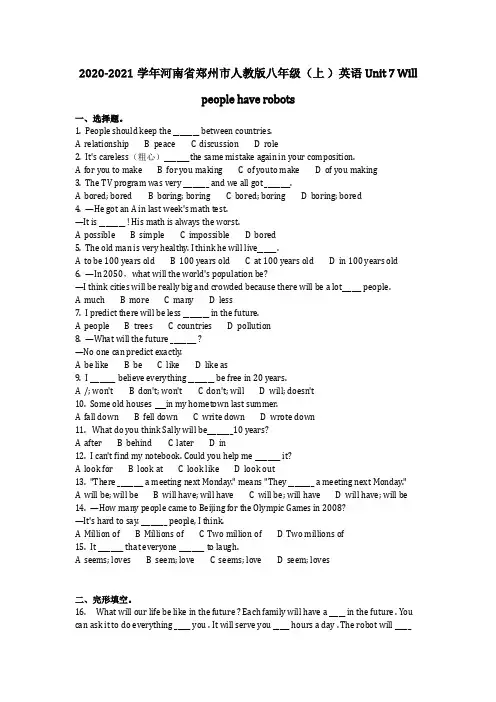
2020-2021学年河南省郑州市人教版八年级(上)英语Unit 7 Willpeople have robots一、选择题。
1. People should keep the ________ between countries.A relationshipB peaceC discussionD role2. It's careless(粗心)________the same mistake again in your composition.A for you to makeB for you makingC of youto makeD of you making3. The TV program was very ________ and we all got ________.A bored; boredB boring; boringC bored; boringD boring; bored4. —He got an A in last week's math test.—It is ________ ! His math is always the worst.A possibleB simpleC impossibleD bored5. The old man is very healthy. I think he will live______.A to be 100 years oldB 100 years oldC at 100 years oldD in 100 years old6. —In 2050,what will the world's population be?—I think cities will be really big and crowded because there will be a lot______ people.A muchB moreC manyD less7. I predict there will be less ________ in the future.A peopleB treesC countriesD pollution8. —What will the future ________ ?—No one can predict exactly.A be likeB beC likeD like as9. I ________ believe everything ________ be free in 20 years.A /; won'tB don't; won'tC don't; willD will; doesn't10. Some old houses in my hometown last summer.A fall downB fell downC write downD wrote down11. What do you think Sally will be________10 years?A afterB behindC laterD in12. I can't find my notebook. Could you help me ________ it?A look forB look atC look likeD look out13. "There ________ a meeting next Monday." means "They ________ a meeting next Monday."A will be; will beB will have; will haveC will be; will haveD will have; will be14. —How many people came to Beijing for the Olympic Games in 2008?—It's hard to say. ________ people, I think.A Million ofB Millions ofC Two million ofD Two millions of15. It ________ that everyone ________ to laugh.A seems; lovesB seem; loveC seems; loveD seem; loves二、完形填空。
八年级英语上册-Unit-7-Will-people-have-robots备课教案-(新版)人教新

一、教材分析
单元教材分析:will + 动词原形 来表达一般将来时态。 学会表达自己对未来的看法;学会谈论自己未来的打算。
二、学情分析
1.八年级处于思维活跃期,对学习本单元有好处,可以进一步开阔学生视野。
2.本单元总体知识结构比较单一,内容相对比较简单。
教学重点:
教学重点:
1)学习掌握一般将来时态的意义和结构。
2) 掌握There be句型的一般将来时态的结构。
(含教法学法、媒体应用等)
教学难点
教学难点:
掌握more/fewer;more/less的用法。
情态动词will + 动词原形来表达一般将来时态。
(同属教学重难点的,在本栏书写)
五、课时安排
三、教学目标
(结合课标)
知识技能
学会表达自己对未来的看法;学会谈论自己未来的打算。。
过程方法
首先进行集中识字,为本单元的学习作好铺垫。其次,采用情景交际法和任务型教学法并充分利用听力材料和阅读材料,训练和提高学生的听力和阅读水平。在听读的基础上创设语言情景和合作探究的方式加强读写训练。培养学生的听、说、读、写综合能力。
Period 1 Se-2d 听说课
Period 3 Section A Grammar Focus-3c语法课
Period 4 Section B1a-1e 听说课
Period 5 Section B2a-2e 阅读课
Period 6 Section B3a-3c阅读课
Period 7 self check and unit review
六、知识结构
七、其它补充
情感态度价值观
人教版英语八年级上册Unit7Willpeoplehaverobots
八年级上Unit7 Will people have robots?on computer在电脑上on paper在纸上live to do 200 years old活动200岁free time空闲时间in danger处于危险之中on the earth在地球上play a part in sth.参与某事space station太空站look for寻找computer programmer电脑编程员in the future在未来hundreds of许多;成百上千the same…as…与……一样over and over again多次;反复地get bored感到厌烦的wake up醒来fall down倒塌will+动词原形将要做……fewer/more+可数名词复数更少/更多……less/more+不可数名词更少/更多……have to do sth.不得不做某事agree with sb.同意某人的意见such+名词(词组)如此……play a part in doing sth. 参与做某事There will be + 主语+其他将会有……There is/are +sb./sth.+doing sth.有……正在做某事ake sb. do sth. help sb. with sth.帮助某人做某事try to do sth. 尽力做某事It’s+ adj.+for sb. to do sth. 对某人来说,做某事……的。
( )1.The students in our school learn English computers .A. atB. in C .on D.to( )2.I hope there will be pollution in the future .A.moreB.manyC.fewerD.less( )3. People visit Mount Tai every day .A.Two hundredsB.Hundred ofC.Hundreds D,Hundreds of( )4.People will make robots the housework in the future .A.doB.to doC.doingD.to doing( )5.Everyone in our class world peace .A.loveB.lovingC.lovesD.to love( )6. A football match next month .A.There isB.There hasC.There will beD.There will have( )7.How long will dogs live ? A.be B.to be C.on D.for( )8.There are some girls in the room .A.dancingB.danceC.dancesD.danced( )9.The child isn’t old enough to himself . A.wear B.dress C.put on D.be in( )10.It’s important the piano well .A.of him to playB. For him to playC.of him playingD.for him playing11. 预测未来可能很难。
人教版英语八年级上册全册教材全解:人教版英语八年级上册 Unit 7 Will people hav
人教版英语八年级上册Unit 7 Will people have robots?教材全解【教材内容解析】Section A1.Do you think there will be robots in people’s homes? (P. 49)本句是主从复合句,从句为宾语从句,如果do you think放在句中,则为插入语,放在特殊疑问词后面,结构为:疑问词+do you think+主语+谓语+其它。
Which do you think is the best movie theatre?2.People will l ive to be 200 years old. (P. 49)live to be+基数词+years old意为“活到……岁”。
In the story, people will live to be 500 years old.3.Will people use money in 100 years? (P. 49)“in+一段时间”表示“在……之后”或“在……之内”,通常用于一般将来时,常用来回答how soon的提问;“for+一段时间”则表示持续多长时间,用来回答how long的提问。
The film will begin in two minutes.They have lived here for three years.4.What’s your prediction about the future?(P. 50)future作名词,表示“将来、未来”,in the future表示“在将来”。
Who knows what will happen in the future.5.I don’t think so.(P. 50)I don’t think so表示“我不这么认为”,肯定形式为I think so。
---Look at the cloud. It is going to rain.---I don’t think so. It will be sunny soon.【拓展】类似的结构还有:I hope so“我希望如此”,I hope not“我希望不是这样”,I’m afraid so“恐怕如此”,I’m afraid not“恐怕不是这样的”。
2024年人教版八年级上册英语主题阅读Unit 7 Will people have robots?
Unit 7Will people have robots?Passage1(传统文化)中华传统文化, 博大精深!一起来感受吧!2023 is the Year of the Rabbit in China. Many people think this is a really good year. Why? Maybe it’s connected with the animal rabbit. What do people in different 1think about the animal? Let’s have a look.In Chinese people’s eyes, rabbits are quiet, gentle and smart. They are also very quick. A Chinese expression dongru tuotu is used to 2people who are smart and quick like a rabbit. * In a fairy story, there is a Jade Rabbit living on the 3. It’s the pet of Chang’e who is a goddess (女神)4known in China. This may explain 5rabbits are considered as a symbol of good luck.Also, in ancient China, the more children you had, the luckier and 6you would be. It made the rabbit a lucky sign as well because rabbits are full of 7and fertile (繁殖力强的) in nature.Similarly in the West, rabbits are well-known because they can 8in difficult and surprising conditions, with populations growing fast in a short time. Rabbits are also considered to be very 9in the West. They also think the rabbit’s foot is able to bring good luck.Another 10for good luck found in North America and the UK is to say the word “rabbit”on the first morning of every month.So, maybe the Year of the Rabbit can bring you some good luck, too.1. A. periods B. culturesC. brainsD. situations2. A. require B. check C. praise D. believe3. A. farm B. earth C. desert D. moon4. A. softly B. wisely C. widely D. silently5. A. why B. which C. when D. what6. A. happier B. smarterC. youngerD. noisier7. A. custom B. energy C. danger D. heat8. A. jump B. live C. climb D. dream9. A. moving B. curious C. lucky D. strange10. A. cause B. power C. voice D. traditionPassage2(文化习俗)骑着耕牛, 踏着立春的步伐, 唱着小燕子的歌谣, 来了解立春的文化习俗吧!Beginning of Spring comes. Everything turns green and becomes full of vigor. People can clearly notice that daytime becomes longer and the weather gets warmer. The traditional Chinese lunar calendar divides the year into 24 solar term. Beginning of Spring (立春) is the first solar term of the year. Here are some spring customs (习俗).Flying a kite. Spring is the best season for kite-flying.Erecting the egg (立鸡蛋). In China, it is said that the egg can be set upright on the first day of Beginning of Spring.Wearing fabric swallows (佩燕子). Wearing fabric swallows is a custom in some regions in Shanxi. The swallow is a harbinger of spring and a symbol of prosperity and happiness.Biting the spring. In many parts of China, people observe the custom of “biting the spring” on the first day of Beginning of Spring. They eat spring pancakes, spring rolls, or a few carrots.Making a Spring Ox. This custom in Shanxi is practiced right before Beginning of Spring. When spring comes, many people love spring and they do kinds of activities.Here is the survey about 200 people from different places who love customs.根据短文与图表内容, 选择最佳答案。
八年级英语上册Unit7Willpeoplehaverobots短语语法知识点汇总新版人教新目标版
Unit 7 Will people have robots一、必背短语。
二、重点结构1.will+动词原形将要做……2.fewer/more+可数名词复数更少/更多……less/more+不可数名词更少/更多……3.have to do sth.不得不做某事(客观)must 必须(主观)4.agree with sb. 同意某人的意见5.There will be + 主语+其他将会有……=There be going to be…6.There is/are +sb./sth.+doing sth. 有……正在做某事7.make sb. do sth. 使某人做某事8.help sb. with sth. 帮助某人做某事9.What will the future be like ? 未来将会是什么样子?10.Which side do you agree with ? 你同意哪一方的观点?【教材内容解析】Section A1.Do you think there will be robots in people’s homes? (P. 49)本句是主从复合句,从句为宾语从句,如果do you think放在句中,则为插入语,放在特殊疑问词后面,结构为:疑问词+do you think+主语+谓语+其它。
例句:Which do you think is the best movie theatre?2.People will l ive to be 200 years old. (P. 49)live to be+基数词+years old意为“活到……岁”。
例句:In the story, people will live to be 500 years old.3.Will people use money in 100 years? (P. 49)“in+一段时间”表示“在……之后”或“在……之内”,通常用于一般将来时,常用来回答how soon的提问;“for+一段时间”则表示持续多长时间,用来回答how long的提问。
英语人教版八年级上册Unit-7Will-people-have-robots
Unit 7 Will people have robots?(Section A 1a-2c)一、教材分析:(一)、本节教材的地位和作用本课是新目标英语八年级上册的第七单元的Section A 的第一部分,本节教材所涉及内容在中考中占有相当重要的地位。
本节教材围绕着“将来发生的事”展开,要求学生学习和运用“will+v(原)”构成的一般将来时态。
本课教学内容与学生的实际生活相关,可以利用学生的想象,引导学生运用简单的英语来描述将来的生活和事物。
在学习活动中,学生通过对将来发生的事情的描述,促进学生对美好未来的憧憬。
(二)、教学目标:(1)知识与技能1.指导学生学习有关将来要发生的事情的表达及语法知识点“一般将来时” 。
2.培养学生的口头表达能力、阅读理解能力和写作能力。
1. 学习有关的单词及词组:robot, paper, pollution, tree, subway, computer, will, won ’ t ,they’ll, fewer, be free, on paper, live to be, in 100 years, etc. 2. 学习重要句型:(1)People will have robots in their homes. (2)Will people have robots?. (3)Kids won’ t go to school. (4) There will be less pollution. 3. 掌握语法点:The Simple Future Tense ( 一般将来时) (1)教师自制的多媒体课件;(2)上课环境为多环境。
(2)情感目标:通过学生对自己in five years 的展望,设想自己五年,十年,甚至是二十年后的生活,贴近学生生活实际,符合学生好奇的心理,激发学生浓厚的学习兴趣。
(3) 学习策略:通过任务型的教学,让学生学会自主学习,归纳总结,培养主动学习的能力。
英语人教版八年级上册Unit-7-Will-people-have-robots
Yes,…will./No,…won’t.
There will/won’t be( more/fewer/less)…
小组评价
教
学
后
记
该教学设计非常贴近学生的生活实际,条理清晰。在引入和课程进行中充分考虑到学生对英语学习感兴趣不浓,运用了许多更直观,更引人入胜的设计,让学生在游戏中巩固新知识,激发学生的学习兴趣使学生乐于学习、乐于探究。在教学过程的设计中充分体现了老师引导,学生自主学习和合作探究学习的观点。设计过程详细但又不受书本内容的局限,把听力归纳在一起来,让学生集中练习。在教学活动中通过预测地球进行德育教育的渗透,增强环保意识。在重点语法教学方面,采用给出实例,让学生归纳总结的方法,不仅教给学生本课的重要语法,同样也交给学生自学的有效方法。
过程与方法
通过师生互动、小组活动、小组竞争等多种形式学习英语,培养自主学习和合作学习的能力,并
能用英语预测未来。
情感态度与价值观
培养合作意识和集体荣誉感,增强环保意识。
教学重点
学习will一般将来时态的构成方式。
单词more、fewer、less的用法,能熟练运用一般将来时态
预测未来。
教学难点
用will一般将来时态表达未来。
Step7.Exercise and homework.
设计理念:复习巩固本堂课所学的知识。
板
书
设
计
Unit 7 Will people have robots? --- Section A
一般将来时:will
1.肯定句:主+will +V(原形)+其他.
2.否定句:主+won’t +V(原形)+其他.
人教版英语八年级上册 Unit 7 Will people have robots教材全解
人教版英语八年级上册Unit 7 Will people have robots?教材全解【教材内容解析】Section A1.Do you think there will be robots in people’s homes? (P. 49)本句是主从复合句,从句为宾语从句,如果do you think放在句中,则为插入语,放在特殊疑问词后面,结构为:疑问词+do you think+主语+谓语+其它。
Which do you think is the best movie theatre?2.People will l ive to be 200 years old. (P. 49)live to be+基数词+years old意为“活到……岁”。
In the story, people will live to be 500 years old.3.Will people use money in 100 years? (P. 49)“in+一段时间”表示“在……之后”或“在……之内”,通常用于一般将来时,常用来回答how soon的提问;“for+一段时间”则表示持续多长时间,用来回答how long的提问。
The film will begin in two minutes.They have lived here for three years.4.What’s your prediction about the future?(P. 50)future作名词,表示“将来、未来”,in the future表示“在将来”。
Who knows what will happen in the future.5.I don’t think so.(P. 50)I don’t think so表示“我不这么认为”,肯定形式为I think so。
---Look at the cloud. It is going to rain.---I don’t think so. It will be sunny soon.【拓展】类似的结构还有:I hope so“我希望如此”,I hope not“我希望不是这样”,I’m afraid so“恐怕如此”,I’m afraid not“恐怕不是这样的”。