
七年级英语下册Unit2Neighbours知识点归纳
七年级英语下册Unit2Neighbours知识点归纳下 Unit 2 知识点归
纳
1 Where are you going? 你要去哪儿?
2 visit our new neighbours 拜访我们的新邻居
3 meet them 见见他们
4 I’m afraid…恐怕……
5 be afraid to do sth/be afraid of doing sth 害怕做某事
6 欢迎像你一样的拜访者
7 in Ninth Street 在九号大街
8 most of them 他们中的大多数人
9 around your neighbourhood 在你的街区四周
10 live in a neighbourhood like that 住在像那样的街区里
Reading (P. 20~22)
1 What are your neighbours like? 你的邻居们怎么样?
2 They’re kind and helpful.他们友好又乐于助人。
3 some of them 他们中的一些人
4 在社区中心见面
5 share their different skills 分享他们的不同技能
6 help us with all kinds of problems 帮助我们解决各种的问题
7 have a “helping hands” meeting举行“援助之手”见面会
8我的电脑出毛病了。
9 ask sb. (not) to do 要某人(不要)做某事
10 请一个电脑工程师检查它
11 ask someone to fix it 请某人修理它
12 My cousin Annie’s bicycle is broken. 我表妹安妮的自行车坏了。
13 Can you find anyone to help you with your homework?
你能找到任何人帮你解决作业问题吗?
14 some college students 一些大学生
15 be ready to help 乐意帮忙
16 really nice 真好
17 help visit the old people 帮助看望老人
18 do some shopping for them 为他们购物
19 help the old people clean their flats 帮助老人打扫他们的公寓
20 help the boy with his homework 帮助这个男孩做家庭作业
21 检查电脑
22 fix things like broken bicycles 修理像坏了的自行车那样的物品
23 need help with one’s problem 某人遇到问题需要帮助
24 get help with one’s homework某人作业得到帮助
25 among the volunteers 在志愿者中
26 People here are like a big family. 这儿的人们像个大家庭。
Grammar (P. 23~24)
1 this afternoon/evening 今天下午/今天晚上
2 take an umbrella with me 带把伞在我身边
3 ask for help 寻求帮助
4 call him first 首先打电话给他
5 wait for us to cal! back 等我们回电话
6 It’s so cloudy.天这么阴沉。
7 I think it’s going to rain. 我认为天要下雨。
8 plan a day out 计划外出一天
9 the day after tomorrow 后天
10 make a fire 取火
11 buy some plates and forks 买些盘子和叉儿
12 bring some water 带些水来
13 cook some food 做一些吃的
Integrated Skills (P. 25~26)
1 an office worker 一个办公室工作人员
2 her elder brother/ her elder sister 她的哥哥/她的姐姐
3 work in a police station/post office/restaurant 在警察局/邮局/饭店工作
4 There are five people in Wendy’ family. 温迪家里有五个人。
5 in the town centre = in the centre of the town 在镇中心
6 work at night 在夜里工作
7 be busy with sth / be busy doing sth 忙于某事/做某事
8 go to work by bike/by train 骑自行车/乘火车上班
9 love his job 热爱他的工作
10在离他家很远的公司工作
11 in the future 在将来
12 一个电脑工程师
13 I’m sure…. 我确信……。
14 be good at drawing 擅长画画儿
15 That sou nds like a good idea. 那听起来像个好主意。
16 help sick people 帮助病人
17 an artist 一个画家
18 a football player 一个足球运动员
Task (P. 28~29)
1 help each other 互相帮助
2 on the afternoon of 5 March 在五月五日下午
3 have problems with.../have problems doing …有问题/做某事有问题
4 look at the information below 看下面的信息
5 feel well 感觉好
6 these days 这些天
7 There are good doctors and nurses here. 这儿有好的医生和护士。
8 make you feel better 使你感觉更好
9 health centre 健康中心
10 worry about sth = be worried about sth 担心某事
11 be here to help with your problems 在这儿帮你们解决问题
12 a group of students 一群学生
13 be happy to do 很高兴做某事
14 give you some ideas 给你一些看法
15 Is there anything wrong with your fridge? 你的冰箱坏了吗?
16 all our group members 我们所有的小组成员
17 have some artists to help 有一些艺术家来帮忙
18 know a lot about styles and colours 对样式和颜色懂很多
19 know what to wear to a party 知道穿什么去参加聚会。
译林英语七年级下册期末复习第二单元知识点梳理:Neighbours
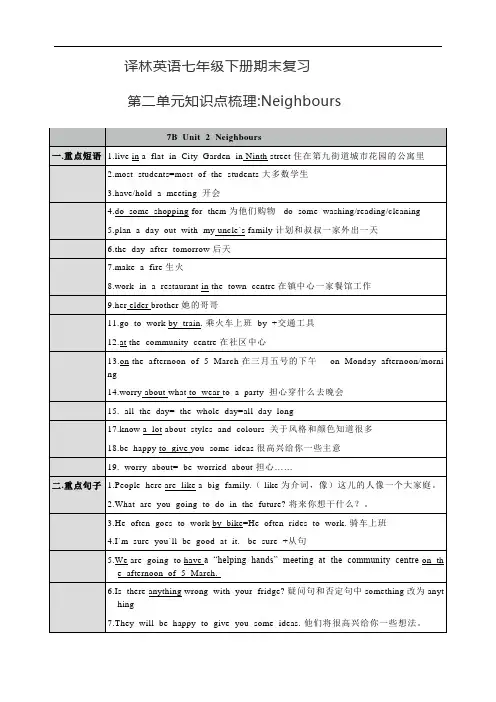
8.work in a restaurantinthe town centre在镇中心一家餐馆工作
9.herelderbrother她的哥哥
11.go to workby train.乘火车上班by +交通工具
12.atthe community centre在社区中心
18.be happyto giveyou some ideas很高兴给你一些主意
19. worry about= be worried about担心……
二.重点句子
1.People hereare likea big family.(like为介词,像)这儿的人像一个大家庭。
2.What are you going to do in the future?将来你想干什么?。
3.He often goes to workby bike=He often rides to work.骑车上班
4.I`m sure you`ll be good at it. be sure +从句
5.Weare going tohavea “helping hands” meeting at the community centreon the afternoon of 5 March.
13.onthe afternoon of 5 March在三月五号的下午on Monday afternoon/morning
14.worryaboutwhatto wearto a party担心穿什么去晚会
15. all the day= the whole day=all day long
17.knowa lotabout styles and colours关于风格和颜色知道很多
七年级英语下册 Unit 2 Neighbours知识点精讲(下)(新版)牛津版

U2基础知识梳理(下)一、词汇Words1. fix 安装,使固定fix 用作及物动词,表示“安装,使固定”之意,其后直接跟名词、代词作宾语。
(1)fix 用作“安装”,指安装门窗,电灯,机器等。
例:他正在房间里安灯。
(2)fix 用作“使固定”,指把某物固定在另一物体上。
例:我们要把图画贴在墙上。
(3)fix 也可以表示“修理”之意,与repair 可互换。
例:我可以为你修理苹果手机。
2. job 工作job,可数名词,意为某一具体的“工作”,复数形式是 .work不可数名词名词,意为职位之内具体的工作例:他能在城市里能找到一份工作。
问职业:1) ----What are you________?--- I am a woman doctor.A. doingB. jobC. workingD. \2) I don’t like my_______. Because I have a lot of ______ to do.A. work; workB. job; jobC. job; workD. work; job3) One of the _________ there ______ my mother.A, woman doctors; is B. woman doctors; are C. women doctors; is D. women doctors; are(1)below,用作介词,表示位置、数字、职业等“在…下面”之意例:这位年轻人不到20岁。
(2) below 用作副词,表示“在下,向下”之意。
例:瞧!迈克正站在下面。
4. fire n. 火fire用作不可数名词,意为“火”,常用“”着火了;set something on fire“引火烧某物”;“着火了”等固定搭配。
例1 当我们到那时,房子着火了。
例2 我们想知道是谁引火烧了这辆车。
批注:fire也可用作可数名词,意为“火灾,燃料”,意为“生火”5.policeman n.警察postman n.邮递员(男) post woman(女)policeman 男警察 policewoman 女警察复数形式例:这个生病的人需要我们的帮助。
牛津英语七年级下册 Unit 2 Neighbours知识汇总

牛津英语七年级下册Unit 2 Neighbours 一、单元重点词组二、重点句型1.I'm afraid they won't welcome visitors like you. 恐怕他们不会欢迎像你这样的客人。
(1)I'm afraid 译为“恐怕”,是一种口语表达习惯,通常不用he's afraid, she's afraid.例:I'm afraid it is going to rain tomorrow. 恐怕明天要下雨了。
翻译:恐怕他下个星期不能去上学了因为他得了感冒。
补充:be afraid of sth 害怕某物我害怕蛇I'm afraid so. 我恐怕是这样的。
I‘m afraid not. 我恐怕不是这样的。
I think so. 我如此认为。
I don't think so. 我不这样认为。
★ be afraid of doing sth★ be afraid to do sth 表示“怕….. ”之意---Can I have dinner with you?我能与你共进晚餐吗?--- Sorry, I'm afraid not.这里的意思是:对不起,不能(2)visitor 派生词有visit演变(3)like 介词像与…一样/ 动词喜欢做某事2.Most of them have 14 floors.大多数楼有14层。
most的用法表示“数量上最多,最大”,为many或much 的最高级。
例:She had the most money of all of them.在这些人中,她最有钱。
most of + the/this/these/that/those/物主代词+名词,指某一范围内的多数。
(名词前面一定要有修饰词)例:Most of the students come from China. most of my booksmost of +可数名词复数+ V复most of +不可数名词+V单★most 与most of 的区别1 most+名词表泛指,无范围如:most young peopleII most of + 名词指某一范围的多数III most of +人称代词,of 不能少如:most of them两者有时可互换:Most teachers in this school are women.= Most of the teachers in this school are women.3. It’s good to live in a neighbourhood like that. 住在那样的居民区里真好。
Unit 2 Neighbours 知识点大总结
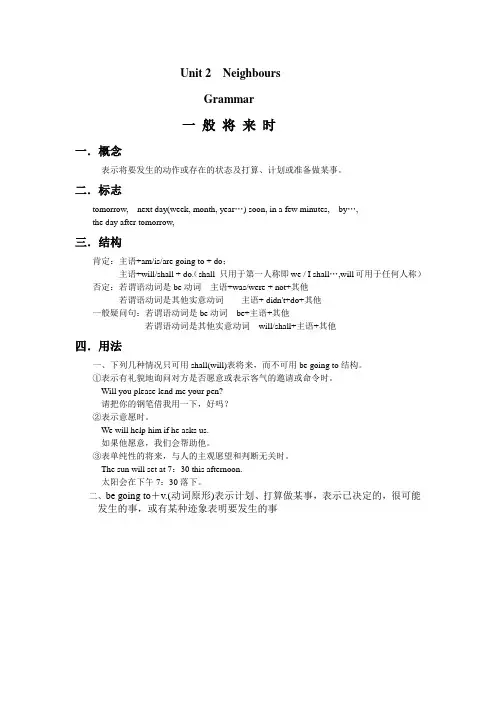
Unit 2 NeighboursGrammar一般将来时一.概念表示将要发生的动作或存在的状态及打算、计划或准备做某事。
二.标志tomorrow, next day(week, month, year…) soon, in a few minutes, by…,the day after tomorrow,三.结构肯定:主语+am/is/are going to + do;主语+will/shall + do.(shall 只用于第一人称即we / I shall…,will可用于任何人称)否定:若谓语动词是be动词主语+was/were + not+其他若谓语动词是其他实意动词主语+ didn't+do+其他一般疑问句:若谓语动词是be动词be+主语+其他若谓语动词是其他实意动词will/shall+主语+其他四.用法一、下列几种情况只可用shall(will)表将来,而不可用be going to结构。
①表示有礼貌地询问对方是否愿意或表示客气的邀请或命令时。
Will you please lend me your pen?请把你的钢笔借我用一下,好吗?②表示意愿时。
We will help him if he asks us.如果他愿意,我们会帮助他。
③表单纯性的将来,与人的主观愿望和判断无关时。
The sun will set at 7:30 this afternoon.太阳会在下午7:30落下。
二、be going to+v.(动词原形)表示计划、打算做某事,表示已决定的,很可能发生的事,或有某种迹象表明要发生的事词组1. in your neighbourhood在你们社区/邻里2. a community centre一个社区中心3. share their different skills分享他们的一技之长4. help sb. with sth.帮助某人(做)某事5. be ready to do sth.准备好做某事6. do some shopping购物7. wait for one’s call等某人的电话8. the day after tomorrow后天9. plan a day out计划一日出行10. make a fire生火11. her elder brother/ sister 她的哥哥/姐姐12. in the future在将来13. help sick people帮助病人14. look at the information below看下面的信息15. make you feel better让你感觉身体更好16. worry about担心17. all our group members我们组的所有成员18. give sb. some ideas给某人出些主意19. by train/bus/ship/bike乘火车/公共汽车/船/骑自行车20. know a lot about非常了解选择题( ) 1. There __________ a meeting tomorrow afternoon.A. will be going toB. will going to beC. is going to beD. will go to be( ) 2. Charlie ________ here next month.A. is n’t workingB. doesn’t workingC. isn’t going to workingD. won’t work ( ) 3. He ________ very busy this week, he ________ free next week.A. will be; isB. is; isC. will be; will beD. is; will be( ) 4. There ________ a dolphin show in the zoo tomorrow evening.A. wasB. is going to haveC. will haveD. is going to be( ) 5. –________ you ________ free tomorrow?– No. I ________ free the day after tomorrow.A. Are; going to; willB. Are; going to be; willC. Are; going to; will beD. Are; going to be; will be( ) 6. Mother ________ me a nice present on my next birthday.A. will givesB. will giveC. givesD. give( ) 7. – Shall I buy a cup of tea for you?–________. (不,不要。
牛津译林英语七年级英语下册unit2neighbours知识点归纳 (2).docx

一、知要点1. Where are you going?你打算去哪里?be going 此“ 在行表将来”。
在行表将来主要用于表示按划或安排将要生的作,常有“意”“安排”或“打算”的含。
种在行比生,人一种期待感。
go, come, leave 等表示位移的,都可以用于在行表将来。
例如: He is going.他要走了。
I ’m coming. 我要来了。
Tom is leaving.姆要走了。
2. I’m going to vi sit our new neighbours.我打算拜我的新居。
be going to意“ 划,打算”,后接原形,用于表将来。
例如: I ’m going to wash the car if I have time.若有我想洗洗。
Where are we going to stay tonight?我今晚住哪里?3. I ’m afraid they won’t welcome visitors like you.恐怕他不会迎像你一的拜者。
(1)welcome作及物,意“ 迎’’,可与介‘to用;也可作形容,意“受迎的 " 。
如:Welcome you to our school!迎到我学校来!You’re welcome .不用。
(2)句中like是介,意“像,相似’’,其反是unlike;作,意“喜’’,后可接名或不定式作。
如:What is Jim like?吉姆个人怎么?They like playing football on Sunday.他喜在星期天踢足球。
(3)won ’t是 will与not的略形式。
“ will+原形"也是一般将来的构成之一。
如:We will take a bus to work.我将乘公共汽上班。
4. Most of them have 14 floors.most of 意“⋯⋯中的大多数”,后面接可数名复数作主,用复数形式;也可接不可数名,此用数形式。
Unit2Neighbours知识讲义牛津译林版英语七年级下册
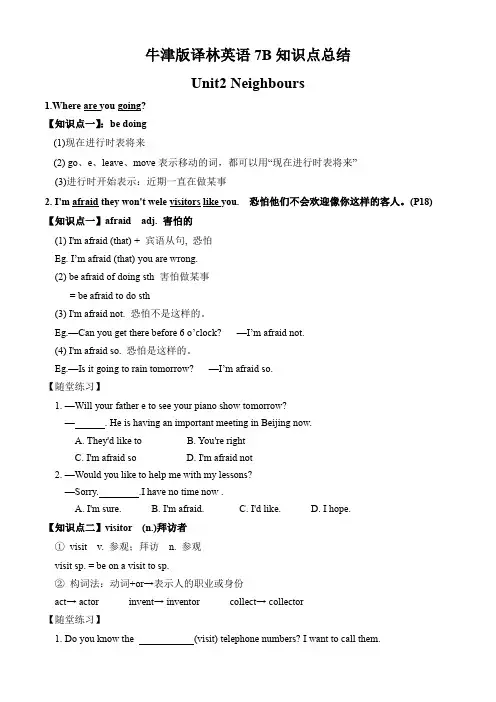
牛津版译林英语7B知识点总结Unit2 Neighbours1.Where are you going?【知识点一】:be doing(1)现在进行时表将来(2) go、e、leave、move表示移动的词,都可以用“现在进行时表将来”(3)进行时开始表示:近期一直在做某事2. I'm afraid they won't wele visitors like you. 恐怕他们不会欢迎像你这样的客人。
(P18)【知识点一】afraid adj. 害怕的(1) I'm afraid (that) + 宾语从句, 恐怕Eg. I’m afraid (that) you are wrong.(2) be afraid of doing sth 害怕做某事= be afraid to do sth(3) I'm afraid not. 恐怕不是这样的。
Eg.—Can you get there before 6 o’clock? —I’m afraid not.(4) I'm afraid so. 恐怕是这样的。
Eg.—Is it going to rain tomorrow? —I’m afraid so.【随堂练习】1. —Will your father e to see your piano show tomorrow?— . He is having an important meeting in Beijing now.A. They'd like toB. You're rightC. I'm afraid soD. I'm afraid not2. —Would you like to help me with my lessons?—Sorry. .I have no time now .A. I'm sure.B. I'm afraid.C. I'd like.D. I hope.【知识点二】visitor (n.)拜访者①visit v. 参观;拜访n. 参观visit sp. = be on a visit to sp.②构词法:动词+or→表示人的职业或身份act→ actor invent→ inventor collect→ collector【随堂练习】1. Do you know the (visit) telephone numbers? I want to call them.【知识点三】like(1) v. 喜欢like doing sth./ like to do sth. 反义词:dislike = hate(2) prep. 像反义词:unlikebe like/look like①问性格,品质What be sb. like?Eg.—What is he like? —He is kind and helpful.②问外貌:What does sb. look like? = How does sb. look?Eg.—What does he look like? = How does he look?—He looks tall and strong.区别:What does sb like (doing)? 问爱好(3)不能单独作谓语: be like 像…look like 看起来像… sound like听起来像【随堂练习】1.The boy, his father, playing football.A. like;likesB. likes;likeC. liked;likeD. like; will like2.— __________ your hometown like? —It’s a good place ___________.A. How is; to liveB. How does; to liveC. What is; livingD. What is; to live3. What is your father like?A. He likes history best.B. He likes eating meat.B. He is kind and friendly. D. He is forty years old.补: 问职业①What be sb? ②What be sb’s job? ③What do/does sb do?3. How many buildings are there in your neighbours? 在你居民区有多少幢楼?【知识点一】how often, how many times, how soon, how long 与how far的区别【随堂练习】1. — ______ do you help your parents do housework? — Every evening.A. How oftenB. How longC. How soonD. How far2. — ______ music do you listen to every day? —One hour.A. How manyB. How longC. How soonD. How much3. — ______ hours of music do you listen to every day? —One.A. How manyB. How longC. How soonD. How much4. — ______ will you e back? —In two days.A. How oftenB. How longC. How soonD. What time4. Most of them have 14 floors. 它们大多数有14层。
牛津译林英语七年级英语下册unit2neighbours知识点归纳
一、知识要点1.Where are you going?你打算去哪里?be going此处为“现在进行时表将来”。
现在进行时表将来主要用于表示按计划或安排将要发生的动作,常有“意图”“安排”或“打算”的含义。
这种现在进行时比较生动,给人一种期待感。
go, come, leave等表示位移的动词,都可以用于现在进行时表将来。
例如:He is going. 他要走了。
I’m coming. 我要来了。
Tom is leaving. 汤姆要走了。
2. I’m going to vi sit our new neighbours.我打算拜访我们的新邻居。
be going to意为“计划,打算”,后接动词原形,用于表将来。
例如:I’m going to wash the car if I have time. 若有时间我想洗洗车。
Where are we going to stay tonight? 我们今晚住哪里?3. I’m afraid they won’t welcome visitors like you.恐怕他们不会欢迎像你一样的拜访者。
(1)welcome作及物动词,意为“欢迎’’,可与介‘词to连用;也可作形容词,意为“受欢迎的"。
如:Welcome you to our school! 欢迎到我们学校来!You’re welcome.不用谢。
(2)句中like是介词,意为“像,相似’’,其反义词是unlike;作动词时,意为“喜欢’’,后可接动名词或不定式作宾语。
如:What is Jim like? 吉姆这个人怎么样?They like playing football on Sunday.他们喜欢在星期天踢足球。
(3)won’t是will与not的缩略形式。
“will+动词原形"也是一般将来时的构成之一。
如:We will take a bus to work.我们将乘公共汽车上班。
初一下册英语unit2neighbours一般将来时
初一下册英语unit2neighbours一般将来时Unit2知识点一:一般将来时(1)定义:表示将来某个时间要发生的动作或存在的状态,常与等时间状语连用(2)构成:①will+v.原,适用各种人称及单复数的主语否定式:疑问式:简略回答:;②shall+v.原,用于主语为第一人称(I和we)时注:疑问句形式表示提建议或征询意见,如:will not=;shall not=③be going to+v.原,表示主观方面“打算,准备”去做什么事情的时候;或根据目前情况推测某事可能发生如:下周我们将举行运动会看天上的乌云!要下雨了否定式:疑问式:简略回答:;知识点二 there be句型的一般将来时(1)定义:表示将来某地会有某人或某物(2)构成:there will be +n+介词短语如:明天在我们学校将有一场足球比赛否定式:疑问式:注:there will be句型中不能出现表示拥有关系的have或has 知识点三 need(1)实义动词①need to do sth②need doing=need to be done 主动形式,被动意义如:门需要油漆一下(2)情态动词(无人称和数的变化)知识点四不定代词指代人:每个人/人人某人/有人某人/任何人没有人/无人指代物:每件事,一切事物某事、某物任何事情、任何东西没什么、什么也没有注:①不定代词作主语,谓语动词用第三人称单数形式②adj修饰不定代词时,做后置定语知识点五 like(1)prep 像,相似,类似,要与动词连用be like 像...... look like 看起来像..... Seem like 仿佛,似乎(2)v 喜欢课堂练习1、I’m busy now.Ito you after school this afternoon.A.talkB.talkedC.will talkD.have talked2、-----Why are you in such a hurry,Mike?-----Therean NBA basketball game in ten minutes.A.will haveB.will beC.is going to haveD.are going to be3、Robotsmore heavy work for us in the future.A.will doB.didC.have doneD.were doing4、Jane(move)to another city with her family next month.5、It’s cold today,but the radio says that it(be)colder tomorrow.6、Eddie with Hobo(climb)rocks when they get everything ready.7、There(be)a heavy rain this afternoon.8、-----Joan,you are late!-----Sorry,Inext time.A.don’tB.won’tC.am notD.haven’t9、There ________ a dolphin show in the zoo tomorrow evening.A. WasB. is going to haveC. will haveD. is going to be10、Tomorrow he ________ a kite in the open air first, and then ________ boating in the park.A. will fly; will goB. will fly; goesC. is going to fly; will goesD. flies; will go11、-----Must I do my homework now?-----No,you.You may have a rest.A.mustn’tB.needn’tC.can’tD.wouldn’t12、Weuse mobile phones when the plane takes off.A.may notB.shouldn’tC.needn’tD.mustn’t13、Don’t throw away the waste paper.It needs.A.to recycleB.recyclingC.recycleD.recycles14、-----Morning,class.Ishere today?-----No,sir.T om is absent.He is ill at home.A.anybodyB.everybodyC.nobodyD.somebody15、-----Who helped you sweep the classroom yesterday?-----.I did it all by myself.A.somebodyB.anybodyC.nobodyD.everybody16、-----That mountain in Guilinan elephant.-----So it does.It’s amazing!A.looks upB.looks likeC.looks forD.looks after。
2022年七年级英语下册Unit2Neighours知识点和练习牛津版!
Unit 2 Neighbours 一、知识点详解A:词汇及词组词组C:词汇精讲及几句一、词汇精讲1. likelike 作介词,意为“像;与……相似”,对应旳反义词为unlike。
短语look like表达“看起来像……”。
例如:Draw it like this! 照这样画!She looks like her mother. 她长得像她妈妈。
【拓展】like与aslike与as作介词,均有“像”旳意思。
但有一定区别。
(1)like意为“像……同样”。
用于相似关系,即两者在形态上或性质上有相似之处,但并不等于。
(2)as意为“作为;以……身份”。
用于阐明同一关系,即两者实为一体。
例如:She talks to me like my mother. 她像我妈妈那样跟我说话。
(她不是我妈妈)She talks to me as a mother. 她以妈妈旳身份跟我说话。
(她是我妈妈)2. most ofmost of意为“……中旳大多数”,背面接可数名词复数作主语时,谓语动词用复数形式;也可接不可数名词,此时谓语动词用单数形式。
例如:Most of them are going off to Guangzhou next week.他们中旳多数人都准备下星期去广州。
Most of the water is clean. 大部分水是洁净旳。
【注意】most of 后旳名词是单数时,谓语动词也用单数形式。
例如:Most of the apple is red. 这个苹果大部分是红旳。
3. something与anythingsomething作不定代词,意为“某事,某物”,多用于肯定句中。
在疑问句和否认句中常用anything;否认句中常用nothing。
作主语时谓语动词用单数形式。
anything尚有“任何事物”旳意思。
例如:Something happens. 有事发生了。
I’d like something to eat. 我想吃点东西。
牛津译林版七年级英语下册Unit 2 Neighbours 重难点知识归纳总结
17.on the afternoon of 5 March在三月五号的下午
18.all the day整天
19.know a lot about styles and colours对风格和颜色很了解
20.be happy to give you some ideas很高兴给你一些主意
牛津译林版七年级英语下册
Unit 2 Neighbours重难点知识归纳总结
【重点单词】
1.neighbour ['neɪbə] n.邻居
2.will [wɪl] modal v.将;将会
3.visitor ['vɪzɪtə] n.访问者,参观者
4.like [laɪk] prep.像,类似;……怎么样
【重点句型】
1.I am afraid they won’t welcome visitors like you.
我恐怕他们不会欢迎像你这样的客人。
2.It’s good to live in a neighbourhood like that.
住在那样一个小区很好。
3.What are your neighbours like?
34.artist ['ɑːtɪst] n.艺术家
35.sound [saʊnd] linking v.听起来
36.sick [sɪk] adj.生病的;恶心的
37.notice ['nəʊtɪs] n.布告,通知
rmation [ˌɪnfΒιβλιοθήκη 'meɪʃən] n.信息
39.below [bɪ'ləʊ] adv.下面
5.waiter ['weɪtə] n.(餐馆等的)服务员