
《Unit 2 What time is it Part B let's talk》ppt课件
‹日期/时间›
‹页脚›
‹日期/时间›
‹页脚›
‹日期/时间›
‹页脚›
What time is it? It’s 7:05. It’s time to go to school.
= It’s time for school.
‹日期/时间› ‹页脚›
What time is it?
It’s 8:00. It’s time for = It’s time to have English. English.
‹日期/时间›
‹页脚›
Helen
‹日期/时间›
‹页脚›
What time is it? It’s 6:30. It’s time to ge time does Mike get up? It’s 8 o’clock.
√
It’s 7:05. It’s 6:30.
‹日期/时间›
get up go to school English class Chinese class music class P.E. class go home go to bed
It’s 9:00.It ’ s time to go to ‹页脚› bed.
√
‹日期/时间›
√
‹页脚›
√
‹日期/时间› ‹页脚›
‹日期/时间›
‹页脚›
‹日期/时间›
‹页脚›
‹日期/时间›
‹页脚›
1.不看书表演出来。 2.声音响亮,发音正确。 3.加上适当的动作和表情。
‹日期/时间›
‹页脚›
Talk about the timetable
6:30a.m. 7:05a.m. 8:00a.m. 9:40a.m. 2:30p.m. 3:50p.m. 4:30p.m. 9:00p.m.
该是做什么的时候了.
It ’s time to +做的事情.
例如:睡觉 It ’s time to go to bed .
Time is gold,
money can’t buy time. 一寸光阴一寸金,
寸金难买寸光阴
‹日期/时间› ‹页脚›
1.Read and act the dialogue. 将本课时对话读给同伴、朋友或家长听。 2.Introduce your timetable. 用英语向好朋友介绍自己的作息时间表。
√
同学们,4月1日愚人节快到了, 请不要开过分的玩笑愚弄别人!
April Fool: 傻瓜
naughty: 顽皮的,淘气的
‹日期/时间›
‹页脚›
总结
假如你在街上碰到一个外国人,想问他现在几点, 该怎么问?
What time is it?
如果你是那个外国人,那你怎么回答?(假如5:00)
It ’s 5:00( 注:am早上 pm 下午)
Unit2Whattimeisit(讲义)-人教PEP版英语四年级下册
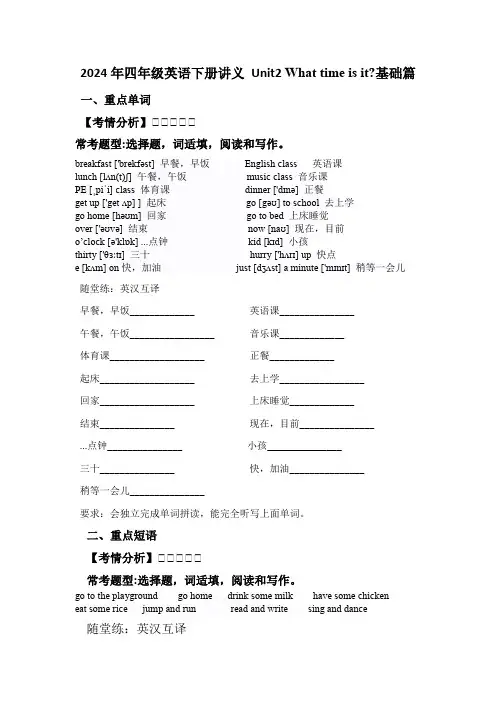
2024年四年级英语下册讲义Unit2 What time is it?基础篇一、重点单词【考情分析】★★★★★常考题型:选择题,词适填,阅读和写作。
breakfast['brekfəst] 早餐,早饭English class 英语课lunch [lʌn(t)ʃ] 午餐,午饭music class 音乐课PE [ˌpiˈi] class 体育课dinner ['dɪnə] 正餐get up ['get ʌp]] 起床go [gəʊ] to school 去上学go home [həʊm] 回家go to bed 上床睡觉over ['əʊvə] 结束now [naʊ] 现在,目前o’clock [ə'klɒk] ...点钟kid [kɪd] 小孩thirty ['θɜːtɪ] 三十hurry ['hʌrɪ] up 快点e [kʌm] on快,加油just [dʒʌst] a minute ['mɪnɪt] 稍等一会儿随堂练:英汉互译早餐,早饭_____________ 英语课_______________午餐,午饭_________________ 音乐课_____________体育课___________________ 正餐_____________起床___________________ 去上学_________________回家___________________ 上床睡觉_____________结束_______________ 现在,目前_______________...点钟_______________ 小孩_______________三十_______________ 快,加油_______________稍等一会儿_______________要求:会独立完成单词拼读,能完全听写上面单词。
二、重点短语【考情分析】★★★★★常考题型:选择题,词适填,阅读和写作。
Unit 2 What time is it t(课件)-四年级英语下学期(人教PEP版)

It’s time for PE class. It’s time for lunch. …
How about “It’s time to ….”? Can you?
It’s time to …
It’s time to get up. It’s time to go to school. ….
Language point
2. It is 8 o’clock. (对划线部分提问) _W_h_a_t_t_im__e_is__it_?____________________
3. It is time to have English class. (同义句转换) _I_t_is__ti_m_e__fo_r_E_n_g_l_is_h_c_la_s_s_. ___________
2. It is time to get up/….
3. It is time for English class.
询问并回答时 间,及做的
Байду номын сангаас事情
a. It’s time for …,表示“到该做某事的时候了”, for后接表示物的名词。
b. It’s time to ….表示“到该做某事的时 候了” ,to 后接表示动作的词或短语。
It’s time for English class.
It’s time to get up.
c.上述句型可以相互转化。
S1: What time is it? S2: It is …. It’s time to/for … S2: What time is it? S3: It is …. It’s time to/for … …
Read and write
1. time, get, it, up, is, to (.)(连词成句) _I_t_’s_t_im__e_t_o_g_e_t_u_p_. _________________
人教版四年级英语下册Unit-2-What-Time-Is-It-B-Let’s-talk教案

人教版四年级英语下册Unit 2 What Time Is It? B Let’s talk教案教学目标:1.能够听,说,读,理解“Hurry! Oops, I'm ready."等单词和短句.2。
能够理解,认读句子“It’s 。
.. o'clock.It’s time for..。
/ It’s time to。
.。
;”能在现实生活中灵活运用并力求做到语调自然,语音准确。
3。
能够比较熟练地吟唱本单元的歌谣。
教学重难点1. 句型:It’s .。
o’clock.It’s time for。
.。
/ It’s time to。
... 2。
“It’s time to .。
”和“It’s time for。
.。
.”的区别。
3。
教师还需要介绍一下oops是表示惊讶、狼狈时发出的喊声.教具准备1。
教师准备与本课时相关的教学图片和录音带。
2.教师准备 Ready、I'm ready. 、Oops、Hurry!等的卡片。
教学过程Step1、Warm-up/Revision1. Greeting.2.Let’s chant.3.Revision:点击课件,运用句型What time is it?来提问,用It's .。
说出时间。
同样用问答的方法复习句型What time is it? It’s …。
/It's time for/to……Step2.Presentation1.情景导入(1).T(点击课件时钟):What time is it? Ss: It's 8:00。
(点击课件英语课)Ss:It’s time for English。
T:Are you ready?引导学生用I’m ready。
回答,解释:准备好了.(2)。
出示ready、I'm ready卡片.领读-组读—开火车读:当学生读得特别出色时用Oops!You are super good! 表示惊讶,。
人教版英语四年级下册:Unit 2 What time is it B Let’s learn-教案
人教版英语四年级下册:Unit 2 What time is it B Let’s learn-教案一. 教材分析人教版英语四年级下册Unit 2 What time is it B Let’s learn部分,主要让学生掌握日常生活中的时间表达方式,学会用英语询问和回答现在的时间。
本部分通过展示不同场景下的活动,让学生在实际情境中学习并运用时间词汇。
教材内容丰富,具有实用性,有利于激发学生的学习兴趣。
二. 学情分析四年级的学生已经掌握了基本的英语语法和词汇,具备一定的听说读写能力。
他们对日常生活中的一些时间概念有所了解,但可能对具体的时间表达方式还不够熟悉。
因此,在教学过程中,教师需要关注学生的个体差异,引导他们积极参与课堂活动,提高他们的英语实际运用能力。
三. 教学目标1.知识目标:让学生掌握日常生活中的时间表达方式,学会用英语询问和回答现在的时间。
2.能力目标:培养学生具备在实际情境中运用时间词汇进行交流的能力。
3.情感目标:激发学生学习英语的兴趣,培养他们积极向上的学习态度。
四. 教学重难点1.重点:让学生学会用英语询问和回答现在的时间。
2.难点:引导学生正确运用时间词汇在实际情境中进行交流。
五. 教学方法1.情境教学法:通过展示不同场景下的活动,让学生在实际情境中学习并运用时间词汇。
2.交际教学法:引导学生进行角色扮演,培养他们在实际交流中运用英语的能力。
3.任务型教学法:设计具有实际意义的学习任务,让学生在完成任务的过程中巩固所学知识。
六. 教学准备1.教学课件:制作含有不同场景和时间词汇的课件,以便在课堂上进行展示。
2.教学道具:准备一些与时间相关的道具,如手表、闹钟等,以便在课堂上进行演示。
3.练习题:准备一些关于时间词汇的练习题,以便在课堂上进行巩固练习。
七. 教学过程1.导入(5分钟)利用课件展示不同场景下的活动,如学校、家庭、公园等,引导学生猜测这些场景下的时间。
例如,展示学校场景,让学生猜测现在是上课时间还是下课时间。
Unit 2 What time is it PA Let's learn 教案
语言点学习,帮助巩固句型
情景表演能提高学生的参与性,更好的掌握新授内容
在游戏中巩固句型和短语
Summary andHomework
summary
词汇:breakfast,English class,lunch
music class, PE class, dinner
句型:What time is it?
人教PEP英语四年级Unit 2 What time is itPA Let's learn课时教案
课题
PA Let’slearn
单元
Unit2
学科
英语
年级
三下
学习
目标
1.能听说读写breakfast,English class,lunch, music class, PE class, dinner等单词或词组。
难点
能正确运用句型What time is it?It's ...o'clock. It's time for...等句型对时间和对应活动进行简单问答。
教学过程
教学环节
教师活动
学生活动
设计意图
Warm-up
Let’ssing.What time is itsong!
Listen andchant
由听唱活动引入学习话题。
Presentation and practice
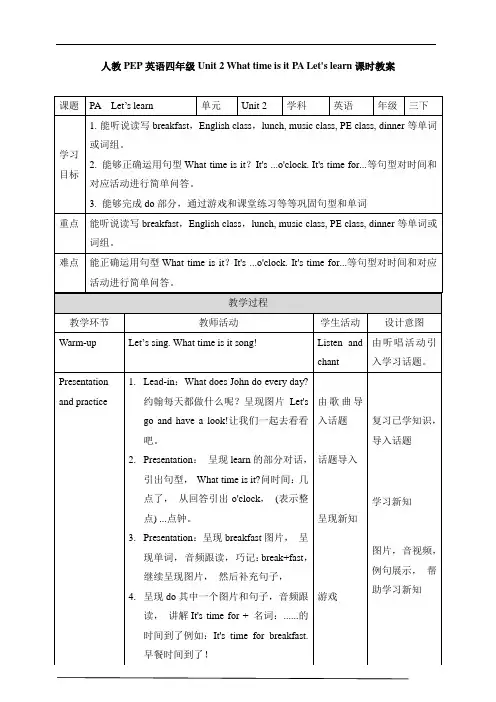
1.Lead-in:What does John do every day?约翰每天都做什么呢?呈现图片Let's go and have a look!让我们一起去看看吧。
2.Presentation:呈现learn的部分对话,引出句型,What time is it?问时间:几点了,从回答引出o'clock,(表示整点) ...点钟。
Unit 2 What time is it- 教案(优秀5篇)-最新

Unit 2 What time is it? 教案(优秀5篇)Unit 2 What time is it? 教案篇一a read and write c good to knowaims:1. master the writing of the words: 1-10, and “what time is it? it’s two o’clock.2. know “read and write”3. at the same time understanding of the countries in the time to express the difference. analysis of the teachingimportant points:master the writing of the words: 1-10, and “what time is it? it’s two o’clock.difficult points:at the same time understanding of the countries in the time to express the difference. knowledge points:write the four skill wordsanalysis of the students:the students can read the words before, so it will be easy for them to write the words. but they don’t know the sentences,so write the sentences are very difficult.teaching aids1.the pictures of the words.2.a map of the world.3.a tape recorder, a tape.step one warm-up1. review the part of let’s do and sing and do it2. listen and draw.1.the teacher says the time and the students draw.3. the daily talk and the free-talk.t: good morning. how do you do?s: how do you do?t: what time is it now?s: it’s nine o’clock. it’s time for english class.(teaching intention: firstly ,the ss can be interested in english by singing and set up a good english atmosphere. secondly, ss can be confident in english studying.)step two presentation1. what time is it? it’s … o’clock.a. t: look at the map of the world. what time is it in beijing?s: it’s two o’clock.teacher shows a map of the world so that students observe beijing and other cities the time to answer questions. and put the sentences on the blackboard.b. guide the students to remember the spelling of sentence.2. write the words: 1—10a. t: it’s two o’clock in beijing, which one is two?s: that one is two.t: who can e here and write down the word?s: i can.in the same way, teach the other words.b. then look at the map. then tell me, what time is it in london\ new york\ sydney?s: it’s six \ one\ four.c. listen, read and point.d. spelling the words.step three practice1. after the listening of the tape, the ss will practice the four-skilled words:pay attention to the good habits of the handwriting.(teaching intention:firstly: make the students grasp the new lesson.secondly: revise the old knowledge. )2. gameswhen the ss master the words, the teacher can use some games to practice the four-skilled words. such as: read the words quickly. pass over the words. listen and then find the words. guess the words. make a choice.(teaching intention: make the students use the new lesson . secondly: foster the students’ ability to study on their own. assess them fairly.)step four consolidation and extension1. do the wb of this part: a read and write2. know “good to know”simple on the question of the time difference, through observation of students in four different cities map at the same time as the time difference, figure out the four cities of the time difference betweendifferent cities.3. read and write cross. ( 根据实际情况,填写。
人教PEP版四年级英语下册Unit 2 What time is it 单元教案
Unit 2 What time is it第一课时一、课时内容A. Let’s learn A. let’s do二、课时分析本课时是义务教育灵通版(pep)小学英语教科书四年级下册的第二单元第一课时,本课时围绕“时间”这个话题展开内容,包括A. Let’s learn A. let’s do 两个板块。
本课时的A Let’s learn.部分通过张鹏和John 讨论John 的一天来呈现有关课程和三餐的单词及词组的词形及意义。
A Let’s do 部分则是通过活动来操练A Let’s learn. 中的词汇及词组。
本活动训练孩子们手脑眼的配合,强烈训练单词的音义匹配,提高课堂的趣味性,从而培养学生惜时、守时的优秀品质。
培养学生按时作息的良好习惯。
三、课时目标1. 能够听、说、认、读A Let’s learn.部分关于课程和三餐的单词及词组:English class ,music room ,PE room ,breakfast ,lunch ,dinner 。
2. 能够熟练运用句型“What time is it ? It’s…o’clock. ”来问答时间。
3. 能够运用It’s time for…来描述不同时间即将要做的活动。
4. 能够听懂指示语,并按照指令做出相应的动作。
5. 培养学生按时作息的良好习惯。
四、课时重难点1. 课时重点能够听、说、认、读关于课程和三餐的单词及词组:English class ,music room ,PE room ,breakfast ,lunch ,dinner 并能习得句子“What time is it ? It’s 9 o’clock. ”来问答时间。
It’stime for English class.来描述不同时间即将要做的活动。
2. 课时难点正确使用句子:It’s time for …五、教学准备1.本课时的单词卡片2. 教学挂图及配套PPT3.录音机及配套磁带4. 自制小时钟5.用作评价奖励的小礼物六、教学过程Step 1 Warm up师生问好,导入新课。
小学英语四年级下册《Unit2Whattimeisit?(PartBLet'slearn)》教学设计
小学英语四年级下册《Unit 2 What time is it?(Part B Let’s learn)》教学设计一. 教材分析《Unit 2 What time is it?(Part B Let’s learn)》是人教版小学英语四年级下册的一篇课文。
本节课主要让学生掌握询问时间的基本句型“What time is it?” 和回答句型“It’s … o’clock.” 或“It’s … minutes past … o’clock.”,同时学习一些常用的时间表达法,如“eight o’clock”,“nine o’clock”,“ten o’clock”,“half past eight”,“half past nine”,“ten o’clock”,等。
通过本节课的学习,学生能够用英语询问和回答时间,提高他们的日常英语交流能力。
二. 学情分析四年级的学生已经具备了一定的英语基础,能够听、说、读、写一些简单的英语句子。
他们对学习英语充满热情,愿意积极参与课堂活动。
然而,部分学生可能对时间的表达法还不够熟悉,因此在教学中需要加强对这部分学生的辅导。
三. 教学目标1.知识目标:学生能够听懂、会说、会读、会写关于时间的表达法,如“eight o’clock”,“nine o’clock”,“ten o’clock”,“half past eight”,“half pastnine”,“ten o’clock”,等。
2.能力目标:学生能够用英语询问和回答时间,提高他们的日常英语交流能力。
3.情感目标:通过本节课的学习,激发学生学习英语的兴趣,培养他们积极向上的学习态度。
四. 教学重难点1.重点:学生能够掌握关于时间的表达法,并用英语询问和回答时间。
2.难点:学生能够正确理解并运用时间表达法进行实际交流。
五. 教学方法1.任务型教学法:通过设定各种实际场景,让学生在完成任务的过程中运用所学知识。
2.情境教学法:创设生活情境,让学生在真实的环境中学习、运用英语。
人教版(PEP)四年级下册 Unit 2 Let’s talk; Let’s play(教案)
Unit 2 What time is it?Part A Let’s talk; Let’s play第1课时一、教学目标1.学生能够在具体语境中理解It’s time for …中介词for的用法,能准确运用到实际交流中。
2. 学生能够在图片的帮助下,理解对话大意,能够用正确的语音、语调朗读对话。
3. 学生能够在具体的情景中,运用核心句型What time is it? It’s … o’clock. 询问时间并回答;能够运用It’s time for …描述即将要做的事情。
4. 学生在课堂交流中,注意倾听,积极思考,主动参与。
5. 学生能够了解不同时区的不同时刻,并能通过世界地图感知各国、各城市的时差。
二、教学重点1. 学生能够运用核心句型进行对话交流。
2. 学生能够理解It’s time for …的含义,并准确应用到实际交流中。
三、教学难点1. 学生能够在语境中理解新词的意思,并能正确读出新词汇。
2. 学生能够准确问答时间。
四、教学准备挂图,地球仪,钟表,教学课件,课堂检测题。
五、教学过程Step 1. Warm-up1. L et’s sing播放歌曲Tick Tock Time,之后Review the numbers from 1 to 12,让学生说出英文。
设计意图:歌曲创设轻松愉悦的氛围。
2. 根据课件里的钟表Let the students say the time.引导学生说出7:00等时间。
Step 2. Presentation1. 播放视频,初步感知What time is it?句型,引入新知识。
复习完数字后,用学生熟悉的时钟自然、直观地呈现新词o’clock.教师板书第一种询问时间的句型,及其答语。
询问时间:What time is it?回答:It’s + 数字+ o’clock(整点). It’s + 数字(非整点).设计意图:从上面的环节自然过渡呈现新对话,让学生带着问题看视频,初步理解对话大意。
小学英语四年级下册《Unit2Whattimeisit?(PartBLet'slearn)》说课稿
小学英语四年级下册《Unit 2 What time is it?(Part B Let’s learn)》说课稿一. 教材分析《Unit 2 What time is it?(Part B Let’s learn)》是人教版小学英语四年级下册的一篇课文。
本节课主要围绕时间展开,让学生学习如何用英语询问和回答现在的时间。
本节课的主要内容包括:学习表示时间的单词如:one, two, three, four, five等;学习询问时间的句型What time is it?;学习用英语回答现在的时间。
通过本节课的学习,学生能够掌握询问和回答现在时间的基本句型,并能够用英语进行简单的交流。
二. 学情分析四年级的学生已经具备了一定的英语基础,能够听懂并能够简单地使用英语进行交流。
但是对于时间的表达,学生可能还存在着一些困难,如对时间的认识不够准确,对时间的表达方式不够熟悉等。
因此,在教学过程中,教师需要注重对学生时间观念的培养,并通过大量的练习,让学生熟练掌握询问和回答时间的方法。
三. 说教学目标1.知识目标:学生能够掌握表示时间的单词,如one, two, three, four,five等;学生能够学会用英语询问和回答现在的时间。
2.能力目标:学生能够用英语进行简单的交流,能够准确地询问和回答现在的时间。
3.情感目标:通过本节课的学习,学生能够对英语产生更浓厚的兴趣,提高学生学习英语的积极性。
四. 说教学重难点1.重点:学生能够掌握表示时间的单词,如one, two, three, four, five等;学生能够学会用英语询问和回答现在的时间。
2.难点:学生能够准确地用英语表达现在的时间,如1:25, 2:30等。
五. 说教学方法与手段1.教学方法:采用情境教学法,通过创设情境,让学生在实际情境中学习英语,提高学生的学习兴趣和积极性。
2.教学手段:利用多媒体课件,图片,卡片等辅助教学,帮助学生更好地理解和掌握知识。