
高中英语Unit1Foodforthought单元重点知识回顾教学案外研版必修第二册
Unit 1 Food for thoughtⅠ.重点词汇1.typical adj. 典型的,有代表性的→typically adv. 一般,典型地,具有代表性地;不出所料,果然be typical of 具有……的特点;是……的典型It is typical of sb. to do sth. 某人一向……;……是某人的特点2.suffer v. (身体或精神上) 受苦→suffering n. 痛苦;苦恼;让人痛苦的事→sufferer n. 受难者;患病者suffer from 苦于……;患……病;因……而受罚3.horrible adj. 糟糕的;可怕的;粗鲁的→horribly adv. 可怕地;非常地→horror n. 惊恐;令人惊恐的事be horrible to sb. 对某人很粗鲁to sb.'s horror 让某人大为惊恐in/with horror 惊恐;震惊4.poison n. 毒素,毒物,毒药v. 毒害;危害→poisoning n. 中毒→poisonous adj. 中毒的;充满敌意的→poisonously adv. 恶毒地;恶意地poison sb. with sth. 用……毒害……food poisoning 食物中毒5.opinion n. 意见,看法;(群体的)观点,信仰;专业意见give/express an opinion 表达观点public opinion 舆论,民意in my opinion 依我看opinion of sb. 关于某人的意见/看法opinion about/on sth. 关于某事的意见/看法be of the opinion (that) 认为,主张6.related adj. 有关系的,相关的→relate v. 联系,使有联系be related to=be connected with 与……有关系/关联relate to 涉及;与……相关relate ... to ... 把……和……联系起来7.diet n. 日常饮食vi. 节食;进规定饮食keep a balanced diet 保持均衡的饮食be on a diet 节食(表状态)go on a diet 节食(表动作)8.addict n. 对……着迷的人vt. 使上瘾→addicted adj. 上瘾的;沉迷于某种嗜好的→addictive adj. 使人上瘾的→addiction n. 瘾,入迷,嗜好addict oneself to 沉溺于……;醉心于……be/become/get addicted_to ... 沉迷于……;热爱……9.differ v. 不同,不一样,有区别→different adj. 不同的;相异的→difference n. 不同;区别differ from 与……不同differ in 在……方面不同be different from ... in ... 在……与……不同tell the difference between ... and ... 分辨……和……的不同make_a_difference 有影响;起(重要)作用10.recommend v. 推荐recommend doing sth. 建议做某事recommend sb. to_do sth. 建议某人做某事recommend sth. to sb. 向某人推荐某物recommend sb. as 推荐某人为……recommend that ... 建议……(that从句应用should+动词原形,其中should可以省略)It is recommended that ... 建议……(It作形式主语,that从句为真正的主语)11.belong v. 属于→belongings n. 财产;所有物belong to 属于,是……的成员12.satisfying adj. 令人高兴的,令人满意的→satisfy vt. 使满意,使满足→satisfied adj. 满意的,满足的→satisfaction n. 满意;满足,达到be satisfied with 对……感到满意to sb.'s satisfaction=to the satisfaction of sb. 令某人满意的是13.convenient adj. 方便的,便利的→convenience n. 方便,便利if it is convenient to sb. 如果某人方便的话It is/was convenient for sb. to do sth. 某人方便做某事for convenience 为方便起见at one's convenience 在某人方便的时候14.resist v. 忍住,按捺→resistant adj. 对……有抵抗力的,抵制的,反抗的,抗拒的→resistance n. 反抗,抵制;抵抗力(性);阻力resist (doing) sth. 反对(做)某事can't_resist_(doing)_sth. 无法抗拒/忍不住(做)某事be_resistant_to 对……有抵抗力/抵制/抗拒15.adapt v. (使)适应,(使)适合;改编adapt (oneself) to sth.(使自己)适应某事be adapted from sth. 由……改编adapt ... for 改编成;使……适应或适合……16.in case以防万一in_case_of 以防万一(后跟名词)in_that_case 如果那样的话in_this_case 在这种情况下in_most_cases 在大多数情况下in_any_case 无论如何,不管怎样in_no_case 决不(位于句首时句子用部分倒装)that's_not_the_case 情况并非如此as_is_often_the_case 情况常常如此,常有的事17.end up (尤指经历一系列意外后)最终处于,到头来end up doing sth. 结果做某事end up with ... 以……结束(后接表具体事物的名词)end up in ... 以……结束(后接抽象名词或表示地点的名词)end up as ... 最终成为/变成……(后接表示身份、职务的名词)end up+adj. 以……(状况)而告终18.pick up 买,购买;拾起,捡起;(无意中)学会;接收(信号);(开车)接(人);好转;恢复pick_up speed 加速pick_out 挑选;辨认出pick_off 摘掉Ⅱ.教材原句1.Growing_up in England with a British father and a Chinese mother, I've enjoyed food from both countries ever since I was able to hold a knife and fork—and chopsticks! (P2)我在英国长大,父亲是英国人,母亲是中国人,自从能拿刀叉和筷子起我就享用两国的食物。
2.He must_have_thought I was joking. (P3)他一定以为我在开玩笑。
3.To me, there's nothing_better_than a crosscultural afternoon tea of English biscuits and a cup of Chinese oolong tea in a fine china cup! (P3) 对我来说,没有什么比一份英式饼干配一杯精致陶瓷茶杯盛放的中国乌龙茶的跨文化下午茶更好的了!4.My fridge is usually half empty and I'm often too_tired_to_eat much anyway. (P9)我的冰箱通常是半空的,而且我总是很累,吃不下太多东西。
Ⅲ.单句语法填空1.They dare not ________ (tell) the news to him.答案:tell2.He ________ (bite) by a poisonous snake yesterday.答案:was bitten3.The heart attack could be related ________ his car crash last year.答案:to4.It's considered good ________ (manner) to leave a little food on your plate in some societies.答案:manners5.The factory ________ (typical) produces 500 chairs a week.答案:typically6.Dogs differ ________ wolves in shape.答案:from7.In case ________ urgency, call the police.答案:of8.A new highway is under ________ (construct) between the two cities.答案:construction9.I highly recommend ________ (do) some kind of exercise in the morning.答案:doing10.The results of his test seemed to be ________ (satisfy) because he had a big smile on his face.答案:satisfyingⅣ.开放型任务中国有句名言,民以食为天,西方也有句俗语,We are what we eat,由此可见,吃是一件令人不可小觑的事情。
谈论起“吃”,是俗事,是雅事,更是乐事。
结合本单元中我们所学的词汇和句式,制作一份英文食谱向同学们介绍传统中国菜(如过桥米线)吧!最好能将这背后的饮食文化和小故事一并道来。
外研版高中英语必修第2册 Unit 1 Food for thought 单元重点回顾
4.The sugar in soft drinks forms acid and attacks our teeth for about 20
minutes each time
we drink them.
5.My fridge is usually half empty and I’m often too tired to
tell the difference between A and B 分清A和B
be different from...in...在……方面与……不同
7.recommend v.推荐 recommend doing sth建议做某事
recommend sb to do sth建议某人做某事
recommend that sb (should) do sth建议某人做某事
gather together聚集在一起
4.remind... of ...使……想起
5.addict n.对……着迷的人
addict vt.使沉溺;使……上瘾
addict oneself to
(doing) sth=be/become addicted to (doing) sth沉溺
于某种嗜好;醉心于某种活动 (to为介词)
单元重点回顾
Unit 1
英语
主题语境
人与自我 生活与学习
重点词汇
1.suffer vi.(身体或精神上)受苦,受难 vt.遭受;蒙受
suffer from 遭受;患病
suffer pain/defeat/hardship/damage遭受痛苦/失败/艰难/破坏
suffering n.痛苦;苦恼;让人痛苦的事
本课结束
新外研社高中英语必修二Unit1Food for thought整单元教案

新外研社(19)高中英语必修二Unit 1Food for thought--Starting out&Key words教案Teaching objectives:1.Students can learn about the representative food in China and representative food in different countries and their English expressions, activate their existing language and background knowledge, and become interested in the topic.2.Students can describe and evaluate different kinds of food and different counties based on their own life experience.3.Lead students to master the words and expressions about the topic.4.Raise students’ love of food culture.Evaluation objectives:1.Ask students to enjoy the video and know about different types of food in it.2.Ask students to tell if they have tried any of the food in the pictures and tell the reason.3.Ask students to do some exercises related to key words to find out whether they have mastered them.Teaching key and difficult points:1.Lead students to learn about typical Chinese food through video materials.2.Guide students to complete the matching activities between food and countries, so as to understand the representative food of different countries in the world.3.Enable students to get to know the meanings of key words in the language context and describe and evaluate different food, and trigger their thinking on Chinese and English food culture.Teaching methods:Cooperative Teaching Method, Task-based Approach, Communicative Approach Teaching procedures:Step1 Lead-inT:Hello! Boys and girls.As the saying goes,“People regard food as their heaven”,so food plays an important part in our daily life,right? Today, we will study the topicabout food. First, let us enjoy the video and answer the following questions.1.What different types of food are introduced in the video?2.Have you ever tried any of the food in the video? What did you think of it? Suggested answers:A.1.Students’ answers are various.2.Students’ answers are variousT:Match the food to the countries on the map and answer the questions in Activity2 on Page 1.1.Have you ever tried any of the food in the pictures? Which would you most like to try?2.What food from other countries have you tried?Suggested answers:1.Students’ answers are various.2.Students’ answers are various.Step 2: Exchange ideas with each other in groupsStep 3: BrainstormingPlease make a list of the words related to various food.Suggested answers:刀削面sliced noodles、米粉rice noodles、紫菜汤seaweed soup、春卷spring rolls、豆干dried tofu、煎饼pancake、锅贴fried dumpling、汤圆glue pudding Step 4: Remember the following wordsMatch the words with meanings(1)maple A.n.婚礼(2)pudding B.adj.(食物)加有香料的,辛辣的(3)snack C.n.种,类(4)spicy D.n.布丁(5)wedding E.adj.难闻的,有臭味的(6)sort F.n.枫树,槭树(7)super G.n.黄油,牛油(8)butter H.n.象征,标志(9)stinky I.n.(正餐以外的)小吃,点心(10)symbol J.adj.极好的,了不起的Suggested answers:(1)F(2)D(3)I(4)B(5)A(6)C(7)J(8)G(9)E(10)HStep 5: Learn the key words1.dare v.敢;胆敢【短语搭配】dare to do /do sth.敢于做某事【即学即练】(1)Let your imagination run wild,and dare to dream.(英译汉)_______________________________________________________________(2)我不敢独自一人去冬泳。
Food+for+Thought+Presenting+ideas+教学设计 高一英语外研版

外研版(2019)必修第二册Unit 1 Food for ThoughtPresenting ideas本节课的教材分析:《外研版(2019)必修第二册Unit 1 Food for Thought Presenting ideas》是高一英语教材中的一节课,主要讲述了如何表达和展示观点。
课文内容涵盖了观点的表达方式、经典观点的引述以及对比对立观点的提供。
通过学习这节课,学生可以提高自己的语言表达和创新思维能力,培养形成自己观点并进行有效表达的能力。
教学目标:1. 知识目标:学习并掌握观点的表达方式、经典观点的引述以及对比对立观点的提供。
2. 能力目标:培养学生分析问题和展示观点的能力,提高学生的英语口头表达能力和思维逻辑能力。
3. 情感目标:激发学生对英语学习的兴趣,培养学生积极参与讨论、表达观点的意愿。
教学重点:观点的表达方式、经典观点的引述、对比对立观点的提供。
教学难点:如何提高学生的表达能力和思维逻辑能力,引导学生形成独立观点并进行有效表达。
学情分析:学生是高一年级的学生,已经掌握了一定的英语基础知识,但对于观点的表达和创新思维能力还存在一定的不足。
此外,学生可能对于课文中的经典观点引述和对比对立观点的提供不够熟悉,需要进行针对性的讲解和实践。
教学策略:1. 激发学生的学习兴趣:通过引入具有争议性的话题、案例和活动,激发学生的学习兴趣。
2. 合作学习:通过小组合作、角色扮演等方式,培养学生的合作意识和团队精神,促进学生思维的交流和碰撞。
3. 创新思维培养:引导学生借鉴他人观点的同时,注重培养学生独立思考、创新思维的能力。
教学方法:1. 演示法:通过师生互动、教师示范等方式,演示如何进行观点表达。
2. 任务型教学法:结合具体任务,引导学生进行实践和合作,培养学生的分析和表达能力。
3. 讨论法:组织学生进行小组讨论,引导他们表达自己的观点,并进行观点的分析和讨论。
通过合理运用这些教学策略和方法,相信可以有效帮助学生提高英语口头表达能力和思维逻辑能力,培养他们的创新思维能力。
高中英语外研版(2019)必修第二册-Unit 1 Food for thought-Developing ideas-教案

Unit 1 Food for thoughtDeveloping ideas【教材分析】本课时学生将学习一篇记叙文,了解五个不同职业的人各自的饮食方式。
通过对这些饮食方式利弊的思考及提出建议,培养学生改善自己不良饮食习惯,健康饮食的思想。
在练习设置上,本课时的练习倾向于培养学生的思维,比如读图、释义等。
本课时的语言相对比较简单,但是还是有许多比较重要的单词、词组或句型等,深入挖掘还是可以挖出很多需要掌握的东西。
一方面要注意学生对于基础知识的掌握,采用各种方式培养学生的自主学习能力。
另一方面也可以联系前面reading部分出现的语言点进行适当的深入拓展。
【教学目标】1. 语言能力目标(1)学习本课时下的重点单词和词组,要求会读、会写、掌握意义及灵活运用。
(2)阅读能力培养:Paraphrase。
(3)能够根据提示对某种饮食方式进行口头或书面说明。
2. 思维品质目标:(1)能够进行直观图片与抽象文字之间的对应。
(2)能够按照一定的顺序组织文章:what→why→how.3. 学习能力目标(1)能够充分利用字典和小组合作学习等方式探究英语中的语言现象和语法,培养自主学习能力。
(2)能够在小组和班级中积极交流自己的观点和想法,培养自信心和合作学习能力。
4. 文化意识目标:培养改善不良饮食习惯,健康合理饮食的思想。
【教学重难点】1. 重点:本课时的重点单词和词组2. 难点(1)Paraphrase。
(2)按照一定的顺序组织文章:what→why→how.【教学过程】Step 1 Warm-up1. Look at the pictures and decide whether the food is healthy or not.2. Work in pairs. Talk about what you usually eat for dinner and decide who eats more healthily.(Before deciding who eats more healthily, students should think the question: what is a healthy diet?)Step 2. Learning to learnVisual information, such as photos and illustrations, can support reading and help you identify the theme and content of a text. Make the most of these images to look for clues to help you understand the text.1. Now read the passage and match the pictures of the fridges to their owners.(a--Jenny, b--Mike, c--Ted, d--Max, e--Ellie.)2. Try to find information from the passage to support your answer.(This step is designed to train students’ skills of finding detailed information andbuilding connection between images and words.)Ellie: My fridge is usually half empty...toast...yogurt with honey.Jenny: We don’t eat meat...We like cooking at home and make our meals from fresh, seasonal fruit and vegetables.Ted: I don’t think that anything can beat my mum’s homemade sausages.Mike: I bring home from the restaurant...buy a lot of frozen food.Max: I daren’t let my mum see this photo.Step 3. Paraphrase.1. Find out who might say the sentences below.(1--Mike, 2--Jenny, 3--Max, 4--Ellie, 5--Ted)2. Find sentences from the passage to support your answer.Ellie: My fridge is usually half empty and I’m often too tired to eat much.Jenny: We don’t eat meat, and any milk or cheese had better be dairy-free...We like cooking at home and make our meals from fresh, seasonal fruit and vegetables.Ted: I guess I’ve always been a meat eater and in this house, no family meal is complete without some form of meat.Mike: I bring home from the restaurant where I work.Max: I’m too busy studying and meeting friends. I suppose the fridge could be kind of cleaner. I daren’t let my mum see this photo.Step 4. Think and share1. What do you think the saying “You are what you eat” means?2. Do you know of any Chinese sayings about food and health? What is your understanding of them?3. Which person’s eating habits are most similar to yours?4. What can you do to improve your eating habits from now on?Discuss the questions in groups and then share your opinion with the class.. Step 5. Group workMake comments and suggestions about the lifestyle of each person in the passage.1. Discuss the lifestyle of each person. Use the table to make notes.2. Organize your ideas follow the steps below.▪ Describe the lifestyle of each person in the passage.(What is each person’s lifestyle?)▪ Explain the possible problems with their lifestyle.(Why may their lifestyles cause problems?)▪ Make suggestions about how they can improve their lifestyles.(How to solve the problems and improve their lifestyles?)3. Share your ideas with the class.Step 6 Homework课后练习。
高中英语外研版(2019)必修第二册-Unit 1 Food for thought-Using language-教案
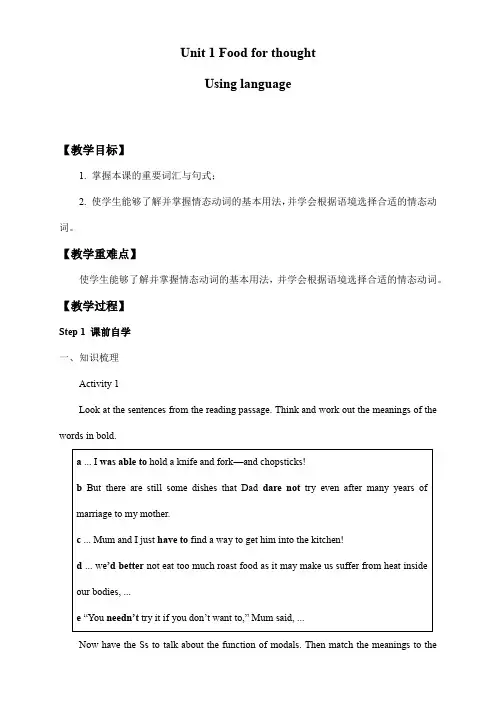
Unit 1 Food for thoughtUsing language【教学目标】1. 掌握本课的重要词汇与句式;2. 使学生能够了解并掌握情态动词的基本用法,并学会根据语境选择合适的情态动词。
【教学重难点】使学生能够了解并掌握情态动词的基本用法,并学会根据语境选择合适的情态动词。
【教学过程】Step 1 课前自学一、知识梳理Activity 1Look at the sentences from the reading passage. Think and work out the meanings of the words in bold.Now have the Ss to talk about the function of modals. Then match the meanings to thewords in bold above. And check the answers in whole class.1. be afraid to do something2. not be necessary to do something3. give advice to do or not to do something4. be necessary or give strong advice to do something5. have the ability to do something(Answer: a-5; b-1; c-4; d-3; e-2)Now get the Ss to look for more sentences with modals in the reading passage.二、主要用法精讲情态动词(Modals)本身具有一定的词义,不能独立作谓语,必须和动词原形一起构成谓语。
情态动词虽然数量不多,但用途广泛。
常用的情态动词包括can (could), may (might), will (would), shall (should), must, need, dare, had better, ought to, used to等。
高中英语Unit1FoodforthoughtSection写一种食物的烹饪方法学案外研版必修第二册
Section ⅣWriting——写一种食物的烹饪方法Step Ⅰ文本研读Ⅰ.框架建构:整体理解Skim the passage and you'll learn ______________________ the famous dish—Gong Bao Chicken.Ⅱ.文本剖析:特色表达Gong Bao ChickenOriginIt was a family dish of 1.________, a highranking courtofficial of 2.________.FeaturesThe dish combines 3.________, ________, ________ and________ flavours together, which makes it hard to resist.InstructionsStep 1Heat the oil over a high heat.Step 2Add the ingredients step by step and4.________.Step 3Add the 5.________ and enjoy the delicious food.Step Ⅱ知识点1.originally adv.原先,最初❶The valley was originally bridged by the Romans.那条峡谷上的桥最初是古罗马人修建的。
❷I would like to thank them for allowing me to develop their original idea. 我想感谢他们允许我完善他们最初的想法。
[归纳探究]by origin 出身,血统in origin 在来源上an original idea 独到的见解[归纳拓展]original adj.最初的,原始的origin n.起源,由来;起因[即学即练] 单句语法填空①Our school was ________ (original) very small.②Many buildings on the campus are ________ (original).2.official n.官员;高级职员adj.官方的;正式的;公务的officially adv.官方地;正式地❶An official announcement is expected in the next few days.预计过几天会发布一项正式声明。
2019_2020学年新教材高中英语Unit1Foodforthought单元要点回扣课件外研版必修第二册
Unit 1 Food for thought
会书写 幸亏,多亏,由于 喜欢做…… 偶遇 提醒某人…… 以防万一 属于 最后终于,到头来 培育,养育;提出 或多或少 买,购买
Unit 1 Food for thought
会应用 1.We’ve collected $50,000 for the poor, __t_h_a_n_k_s_t_o____ the generosity of the public. 2.I _c_a_m__e_a_c_r_o_s_s__ Jackie Chan at the airport the day before yesterday. 3.I was lucky to ____p_i_c_k_u_p____ some used stamps. 4.As a child, he wished to become a singer, but he _e_n_d_e_d__u_p__ as a driver. 5.The Pyramid, which dates from thousands of years ago, ___b_e_l_o_n_g_s_t_o__ Egypt.
重 3.①Teenagers _a_d_d_i_ct_e_d_ (addict) to the Internet are more 点 likely to suffer from depression. 词 ②As far as I’m concerned, it’s not wise for us to be 汇 addicted to _p_l_a_y_i_n_g_ (play) with smart phones because we 夯 may ignore other things in life. 实 ③You should stop taking this medicine because it is 练 _a_d_d_i_ct_i_v_e (addict).
高中英语 Unit 1 Food for thought 英美文化欣赏教案 外研版必修第二册-外研版
Unit 1 Food for thought【导读】《我的生活》是海伦·凯勒的处女作。
作品一发表,立即在美国引起了轰动,被称为“世界文学史上无与伦比的杰作”。
The Story of My Life(Excerpt)It is with a kind of fear that I begin to write the history of my life.I have,as it were,a superstitious hesitation in lifting the veil that clings about my childhood like a golden mist.The task of writing an autobiography is a difficult one.When I try to classify my earliest impressions,I find that fact and fancy look alike across the years that link the past with the present.The woman paints the child's experiences in her own fantasy.A few impressions stand out vividly from the first years of my life;but“the shadows of the prisonhouse are on the rest”.Besides,many of the joys and sorrows of childhood have lost their poignancy;and many incidents of vital importance in my early education have been forgotten in the excitement of great discoveries.In order,therefore,not to be tedious I shall try to present in a series of sketches only the episodes that seem to me to be the most interesting and important.I was born on June 27,1880,in Tuscumbia,a little town of northern Alabama.The family on my father's side is descended from Caspar Keller,a native of Switzerland,who settled in Maryland.One of my Swiss ancestors was the first teacher of the deaf in Zurich and wrote a book on the subject of their education—rather a singular coincidence;though it is true that there is no king who has not had a slave among his ancestors,and no slave who has not had a king among his.My grandfather,Caspar Keller's son,“entered”large tracts of land in Alabama and finally settled there.I have been told that once a year he went from Tuscumbia to Philadelphia on horseback to purchase supplies for the plantation,and my aunt has in her possession many of the letters to his family,which give charming and vivid accounts of these trips.我的生活(节选)我是怀着惴惴不安的心情书写我生活的历史的。
Food+for+Thought+Understanding+ideas+教学设计 高一英语外研版
外研版(2019)必修第二册Unit 1 Food for ThoughtUnderstanding ideas本节课的教材分析:本节课是外研版(2019)必修第二册Unit 1的第一课,名为"Food for Thought Understanding ideas"。
教材主要包括一个关于食物的对话,一篇介绍食物与健康关系的文章以及相关的阅读和听力练习。
教学目标:1. 提高学生的阅读理解能力,培养学生对食物与健康的相关知识的理解和掌握。
2. 培养学生的听力能力,使其能够听懂关于食物和健康的对话和文章。
3. 增加学生的词汇量,学习并掌握与食物和健康相关的词汇。
4. 培养学生的思辨能力,使其能够根据所学内容进行简单的讨论和表达。
5. 培养学生的学习策略,使其能够通过阅读和听力来获取所需信息。
教学重点:1. 学习并掌握与食物和健康相关的词汇2. 学习并理解关于食物与健康的对话和文章的内容3. 提高学生的阅读和听力能力教学难点:1. 帮助学生理解和运用文章中的生词和短语2. 培养学生对文章内涵与主旨的理解能力学情分析:学生属于高一年级,对英语的学习具有一定的基础。
虽然学生掌握了一些基本的词汇和语法知识,但在阅读理解和听力方面可能存在一定的困难。
学生对食物和健康的相关知识可能了解有限,需通过本节课的学习来提高相关知识。
教学策略:1. 激发学生对食物和健康的兴趣,树立良好的学习态度。
2. 通过展示食物的图片和视频来激发学生的思考与讨论。
3. 利用简单明了的语言和图片来帮助学生理解和运用生词和短语。
教学方法:1. 教师主导+学生互动的教学方法。
通过师生互动的问答、讨论、小组合作等活动来激发学生的学习兴趣。
2. 合作学习方法。
将学生分为小组进行合作,共同完成阅读和听力任务,并在小组内进行互助和讨论来促进学习效果的提高。
3. 多媒体教学方法。
利用多媒体资源(图片、视频等)来增强学生对课文内容的理解和记忆。
高中英语Unit1Foodforthoughtperiod1学案含解析外研版必修第二册
Unit 1 Food for thoughtPeriod 1 Starting out & Key words学案设计学习目标1.Get the main information of the video by watching and thinking.2.Simply describe and evaluate different kinds of food and different countries in English based on their existing life experience.3.Get the meanings and usages of key words in the language context.课堂探究Step 1: Lead-inA.Enjoy the video and answer the questions1.What different types of food are introduced in the video?2.Have you ever tried any of the food in the video? What did you think of it?B.Match the food to the countries on the map and answer the questions.1.Have you ever tried any of the food in the pictures? Which would you most like to try?2.What food from other countries have you tried?Step 2: Exchange ideas with each other in groupsStep 3: BrainstormingPlease make a list of the words related to various food.Step 4: Remember the following wordsMatch the words with meanings(1)maple A.n.婚礼(2)pudding B.adj.(食物)加有香料的,辛辣的(3)snack C.n.种,类(4)spicy D.n.布丁(5)wedding E.adj.难闻的,有臭味的(6)sort F.n.枫树,槭树(7)super G.n.黄油,牛油(8)butter H.n.象征,标志(9)stinky I.n.(正餐以外的)小吃,点心(10)symbol J.adj.极好的,了不起的Step 5: Learn the key words1.dare v.敢;胆敢【短语搭配】【即学即练】(1)Let your imagination run wild,and dare to dream.(英译汉)(2)我不敢独自一人去冬泳。