
There's_Chinese_dancing
Module2 Unit1 There’s Chinese dancing
There be 结构
可数名词单数 is + There 不可数名词
are + 可数名ቤተ መጻሕፍቲ ባይዱ复数
Talk about the things in the classroom.
There is a TV in the classroom. There is a clock in the classroom. There is a teacher in the classroom. There are two doors .
There are six windows.
There are many students.
There are many desks and chairs.
I Can do
1.There___ is a picture on the wall. 2.There___ are some books under the table. 3.There___ are lots of shoes on the floor. 4.There___ is a TV and some balls in the room. 5.There___ is some meat ,many apples and bananas on the table.
1.There’s a Chinatown in New York.
2.There’s Chinese dancing.
3.There are lots of Chinese shops and restaurants there .
send an email miss china in New York lots of Chinese dancing go to Chinatown nine o’clock
America, America, there are lots of things to see. From New York to Tennessee, it’s such a big country. China, China , there are lots of things to see. From Beijing to Sanya, it’s such a big country.
发电子邮件 想念中国 在纽约 许多 中国舞蹈 去唐人街 九点钟
重 点 短 语
回家仔细观察自己
bedroom,然后写一篇
小作文。用上带有There is/There are的句型。
六年级上英语教案-Module2Unit1There’sChinesedancing

六年级上英语教案Module 2 Unit 1 There’s Chinese dancing.外研社(三起)教学内容本单元的主题是“中国文化”,教学内容围绕中国的传统舞蹈展开。
学生将学习如何用英语描述中国的舞蹈,包括舞蹈的特点、舞者的服饰以及舞蹈的意义。
学生还将学习如何用英语表达对中国文化的热爱和尊重。
教学目标1. 知识与技能:学生能够理解并运用本单元的核心词汇和句型,如“dance”, “traditional”, “costume”, “perform”等,以及“There is/are”的句型结构。
2. 过程与方法:通过小组讨论、角色扮演等活动,学生能够提高英语听说能力,并学会如何用英语介绍中国文化。
3. 情感态度价值观:培养学生对中国传统文化的兴趣和热爱,增强民族自豪感。
教学难点1. 正确运用“There is/are”句型描述场景。
2. 理解并运用与中国文化相关的词汇和表达方式。
教具学具准备1. 多媒体设备:用于播放与中国舞蹈相关的视频和图片。
2. 教学卡片:包含本单元的核心词汇和句型。
3. 小组活动道具:用于角色扮演和小组讨论。
教学过程1. 导入:通过播放一段中国舞蹈视频,引起学生的兴趣,导入本单元主题。
2. 新课呈现:介绍本单元的核心词汇和句型,通过例句和练习帮助学生理解和掌握。
3. 小组活动:学生分组,用英语讨论和介绍中国的舞蹈,提高听说能力。
4. 角色扮演:学生扮演舞者和观众,用英语进行对话,巩固所学知识。
板书设计1. 核心词汇:dance, traditional, costume, perform等。
2. 句型结构:There is/are,用于描述场景。
作业设计1. 写一篇关于中国舞蹈的短文,使用本单元的核心词汇和句型。
2. 收集关于中国其他传统文化的资料,准备下节课的分享。
课后反思本节课通过多种教学方法,如视频导入、小组讨论、角色扮演等,有效地提高了学生的英语听说能力。
最新外研英语六上Module 2 Unit 1 There’s Chinese dancing教案

Unit 1 There’s Chinese dancing. 教案一、课文分析本课围绕唐人街和中国传统舞蹈这两大点重点教授There be 句型。
学生在四年级有过初步的学习,所以教师通过创设情景,实物举例,让学生能快速了解该句型是“有、存在”的意思。
纽约唐人街这一文化背景的铺垫,能够激发学生学习的乐趣,从而快速进入本课知识点的学习中。
本课的课堂教学能够带领学生走入西方国家,了解居住在外国华人的生活,通过精讲巧练、由浅入深、由易到难、由已知到未知、循序渐进的方法深化课堂教学内容。
二、导学目标1、导学分析:学生在理解There be 结构的基础上用There be句型描述事物,老师用大量的事物引导学生运用句型。
2、学习任务:There is a Chinatown in New York!There are lots of Chinese shops and restaurants there.三、教学目标1、知识目标:能掌握新授单词dancing, sometimes, shop, then。
能听说、认读句型“There is/ are…”。
2、能力目标:能熟练掌握并运用句型“There is/ are…”。
3、情感、态度目标:培养学生在各种任务中积极与他人合作的良好学习习惯,加深学生对唐人街的了解,培养学生热爱祖国的情感。
四、教学重点和难点重点:1、单词:dancing, sometimes, shop, then等。
2、句型:“There is/ are…”难点:用本课所学的基本句型“There is/ are…”等描述某个地方或某事物情况。
五、教学方法情景教学法、任务型教学法、小组合作学习法。
六、教学过程1、复习上一模块所学知识。
1)让学生说出:长江、黄河、长城的英语名称。
2)复习句型:How long is the Changjiang River?(6300km)Great Wall? (6700km)Yellow River? (5464km)引导学生用It’s ...来回答。
There’s Chinese dancing.教学设计

We’ve learnt something about Chinatown.Now. let’s listen to a recording about it, finish the dialogue and then read after it.教师组织学生听录音、完成练习并跟读。
2. Read in roles.
通过观看动画,回答问题,为课文导入做铺垫。
了解本课要谈及的话题是 Chinatown,引出课文中关于Chinatown的特征描述。
新知呈现
1. Watch and answer.
学生观看课文动画,了解课文内容,获取信息:Daming正在做什么?之后,Daming和Simon又在谈论什么?
2. Listen and answer.
3. Watch, read and answer.
Ask students to watch and read the text. Then think about a question. Does Daming miss China now?
让学生看动画并跟读课文。通过此问题进行情感的升华,引发学生爱国主义情感。
Let’s read the dialogues in roles.教师引导学生分角色朗读对话。
进一步训练如何用句型 There are....和
There is...."来表达某个地方有什么特征。
尝试应用
1. Talk about the picture.学生观察图片并描述图片。
2. Make a show.准备并上台展示。
引导学生听录音,了解课文细节内容,并回答问题。同时,练习本课重点句型:There are lots of….和 There’s Chinese dancing.让学生回答:
外研版六年级英语上册There's Chinese dancing课件
1. Recite the dialogues. 2. Make three sentences with”There is/are...”.
外研版·英语·六年级上册
Module 2 Unit 1
There’s Chinese dancing.
第一课时
第二课时
第一课时
Let’s chant:
There's a Great Wall in China. It is very, very long. There's a Great Wall in China. It is very, very strong. There are many, many people and they like to sing this song. There's a Great Wall in China. It is very, very long. In China there's a Great Wall. a Great Wall, a Great Wall. It is very, very, very big and it's a very famous wall.
Module 2
Unit 1 There's Chinese dancing.
外研版 三起点 英语 六年级 上册
Learning goals
✔ 能听、说、认读单词:
dancing, Chinatown, sometimes, shop, then
✔ 能够运用句型:
1.There's Chinese dancing. 2.There are lots of Chinese shops and restaurants there.
Module2Unit1There’sChinesedancing
教案:Module 2 Unit 1 There’s Chinese dancing.一、教学目标1. 知识目标(1)能够听懂、会说、会读本课的生词和重点句子。
(2)能够用英语简单描述所学校或社区的活动。
2. 能力目标(1)能够通过图片和情景,正确使用There be句型描述事物的存在。
(2)能够通过合作交流,提高自己的口语表达能力。
3. 情感目标培养学生的团队精神,增强他们对中华文化的自豪感。
二、教学内容1. 单词:cake, game, Chinese dancing, play, basketball, have a party。
2. 句子:—What’s in the room/classroom/school? —There’s a cake/game/Chinese dancing/play/basketball/a party.三、教学重点与难点1. 重点:能够听懂、会说、会读本课的生词和重点句子,能够用英语简单描述所学校或社区的活动。
2. 难点:能够正确使用There be句型描述事物的存在。
四、教具与学具准备1. 教具:PPT、图片、实物等。
2. 学具:课本、练习册、笔等。
五、教学过程1. 热身(5分钟)(1)教师与学生用英语进行简单的交流,提问学生关于学校或社区的活动。
(2)学生自由讨论,回答问题。
2. 导入(10分钟)(1)教师出示图片,引导学生用英语描述图片中的事物。
(2)学生用英语描述图片中的事物。
3. 呈现(10分钟)(1)教师出示实物,引导学生用英语描述实物的存在。
(2)学生用英语描述实物的存在。
4. Practice (10分钟)(1)教师出示情景,引导学生用英语描述情景中的事物。
(2)学生用英语描述情景中的事物。
5. 巩固(10分钟)(1)教师出示图片,引导学生用英语描述图片中的事物。
(2)学生用英语描述图片中的事物。
6. 拓展(5分钟)(1)教师出示图片,引导学生用英语描述图片中的事物。
六上M2U1There's-Chinese-dancing教学设计
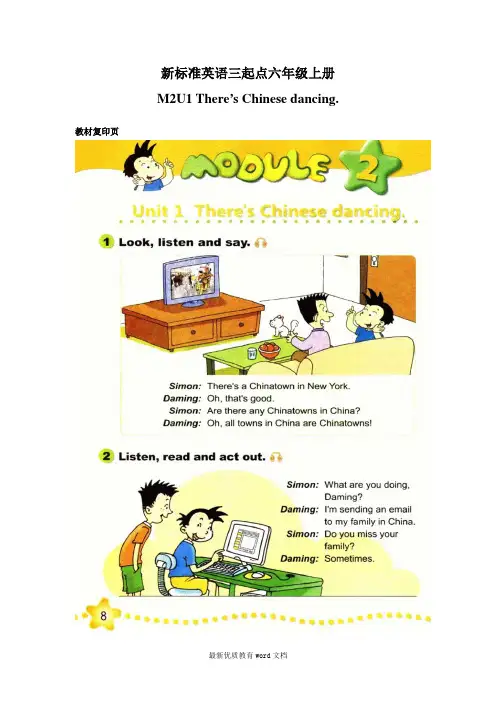
新标准英语三起点六年级上册M2U1 There’s Chinese dancing.教材复印页教学背景分析1.教材分析本单元是外研社三年级起点第七册第二模块第一单元。
话题是“Chinatown” ,语言结构是“There’s\are…”。
本课内容是:Daming 现在在美国表兄的家里,他正在给家人发送email,他很想念中国,于是Simon就给他介绍了唐人街的情况。
2. 学生分析六年级的学生已经对英语熟悉三年了。
但是有一部分学生不是很喜欢上英语课,学习兴趣不是很高,个别学生甚至有厌恶感,同时,有些学生还是为学习而学习,谈不上兴趣问题;另一方面,学生有一定的两级分化。
本课的There be 句型在五年级时已经学过,学生学习压力不是很大,学习兴趣必然高涨。
教学目标(含重、难点)1、知识与技能目标:There’s a Chinatown in New York!There are lots of Chinese shops and restaurants there..2、过程与方法目标:1.Teach the text with the task-based method.2.Cooperative learning.3、情感、态度和价值观:用“There be”句型描述事物【重点】:用"There be “句型描述事物。
【难点】:“there is”和“there are”的用法。
【课时安排】:1课时教学准备多媒体设备、电子课本、PPT教学过程(以下内容中,“T”表示Teacher,“S”表示Student。
)Step1. Warm-up and Lead-in上课铃之前播放The farmer in the dell英文歌曲设计意图:热身,给学生创造英语语言环境,并提醒大家准备好英语上课所用的课本、文具。
师生互相问候T: Cla ss begins!Ss: Stand up!T: Good morning, class !Ss: Good morning, Miss Lu!T:Sit down, please !Ss: Thank you!T:How are you today?Ss: We are fine.T:What’s the weather like today?Ss: It’s so hot.Ss: It’ cloudy.展示课件T: What’s this?Ss: The Great Wall!T: What can you see in this picture?Ss:I can see a long wall, a lot of people, many trees.T: So, there is a long wall, and there are a lot of people and many trees, right?T: Then what’ this?Ss: Chinatown!设计意图:建立良好的师生关系。
六年上册英语课件-2.1 There's Chinese dancing | 外研社(三起) (共19张PPT)
then 既然是这样,那么
Then let’s go tomorrow.
然后
Then he went back to his seat.
然后他回到了自己的座位。
strong 坚固的
The Great Wall is strong.
长城是坚固的。
· Look, listen and say.
Simon: There’s a Chinatown in New York. Daming: Oh, that’s good. Simon: Are there any Chinatown in China?
Questions: 1. Does Daming want to go to Chinatown? Yes, he does. 2. What are there in Chinatown? There are lots of Chinese shops and restaurants.
Daming: Really? Simon: Yes, and there’s Chinese dancing. Daming: Let’s go to Chinatown now! Simon: We can’t go now. It’s too late. Daming: Then let’s to tomorrow. Simon: Ah! You do miss China!
Daming: Oh, all towns in China are Chinatowns.
· Listen, read and act out.
Simon: What are you doing, Daming? Daming: I’m sending an email to my family in China. Simon: Do you miss your family? Daming: Sometimes.
六年级上册英语教案-Module2Unit1There’sChinesedancing
六年级上册英语教案Module 2 Unit 1 There’s Chinese dancing.外研社(三起)教学内容本节课将教授外研社(三起)六年级上册英语Module 2 Unit 1 "There’s Chinese dancing."的内容。
教学内容主要包括词汇学习、句型练习以及相关文化背景的介绍。
学生将通过学习,掌握如何描述不同的舞蹈,并能够用英语进行简单的交流。
教学目标1. 知识与技能:学生能够听懂、会说、会读本节课的重点词汇和句型,如dance, Chinese dancing, Indian dancing等,并能够运用这些词汇和句型进行简单的英语交流。
2. 过程与方法:通过图片展示、小组讨论等形式,激发学生的学习兴趣,提高学生的英语听说能力。
3. 情感态度价值观:通过学习不同国家的舞蹈,增强学生对多元文化的认识和理解,培养学生的跨文化交际意识。
教学难点1. 正确发音和记忆本节课的重点词汇。
2. 理解和运用There be句型描述舞蹈。
3. 了解不同国家的舞蹈文化。
教具学具准备1. 多媒体设备:用于展示舞蹈图片和视频。
2. 教学卡片:用于展示和复习重点词汇。
3. 小组讨论表格:用于学生进行小组讨论和记录。
教学过程1. 导入:通过展示不同国家的舞蹈视频,引起学生的兴趣,导入本节课的主题。
2. 新课内容展示:通过图片和教学卡片,教授本节课的重点词汇和句型。
3. 小组讨论:学生分组,根据教师提供的问题,用英语进行讨论,练习本节课的重点句型。
4. 全班交流:每个小组派代表向全班分享他们的讨论成果。
板书设计1. 课程Module 2 Unit 1 There’s Chinese dancing.2. 重点词汇:dance, Chinese dancing, Indian dancing等。
3. 重点句型:There be句型。
作业设计1. 完成课后练习题。
2. 用英语写一篇关于自己喜欢的舞蹈的短文。
Module2Unit1There'sChinesedancing.(教学设计)外研版英语六年级上册
Unit 1 There's Chinese dancing.教学设计一、教材分析:本节课是外研版小学英语六年级上册Module2 Unit 1的教学内容,主题为"There's Chinese dancing." 本单元主要围绕介绍中国传统舞蹈展开,通过听、说、读、写等多种方式,培养学生的英语听说能力和文化意识。
二、教学目标:1. 听:能听懂并理解有关中国传统舞蹈的基本信息。
2. 说:能运用所学句型和词汇进行简单的口头表达,描述中国传统舞蹈。
3. 读:能读懂并理解与中国传统舞蹈相关的简短文章。
4. 写:能根据所学内容,用简单的句子描述中国传统舞蹈。
5. 文化意识:了解中国传统舞蹈的特点和重要性,培养对不同文化的尊重和欣赏能力。
三、教学重点和教学难点:教学重点:学习和掌握与中国传统舞蹈相关的词汇和句型,培养听说读写的综合能力。
教学难点:运用所学知识进行简单的口头表达和书面表达。
四、学情分析:学生是六年级的学生,已经具备一定的英语基础,能够进行基本的英语交流。
他们对中国传统文化可能有一定的了解,但对中国传统舞蹈的具体内容和特点可能还不太清楚。
他们具备一定的学习能力和接受新知识的能力。
五、教学过程:Step 1: Warmup (热身)1. Greeting and daily checkin (问候和日常签到)Greet the students and do a quick checkin to see how they are doing.Example dialogue:Teacher: Good morning, everyone! How are you today?Students: Good morning, teacher! We're fine, thank you!2. Review of previous knowledge (复习)Review the vocabulary and sentence patterns related to describing places and activities.Use flashcards or pictures to review the words and ask questions to check their understanding.Example:Teacher: Let's review some words we learned before. What's this? (Showing a picture of a park)Student: It's a park.Teacher: Great! And what do we say when we want to describe a park?Student: There is a park.Step 2: Presentation (呈现)1. Introduce the topic (介绍话题)Show pictures or videos of Chinese traditional dancing, such as the dragon dance or the lion dance.Example dialogue:Teacher: Today, we are going to learn about Chinese traditional dancing. Look at these pictures. Have you ever seen Chinese traditional dancing before?Students: Yes/No.Teacher: Chinese traditional dancing is very colorful and lively. It's an important part of Chinese culture.2. Present new vocabulary (呈现新词汇)Introduce new vocabulary related to Chinese traditional dancing, such as "Chinese dancing," "dragon dance," "lion dance," etc.Use real objects, pictures, or gestures to help students understand the meanings of the words.Example:Teacher: This is a dragon. In Chinese traditional dancing, people perform the dragon dance. Can you repeat "dragon dance"?Students: Dragon dance.3. Introduce the sentence pattern (介绍句型)Introduce the sentence pattern "There's Chinese dancing."Explain the meaning and structure of the sentence pattern.Model the sentence pattern and ask students to repeat.Example:Teacher: Now, let's learn a sentence pattern. Repeat after me: "There's Chinese dancing."Students: There's Chinese dancing.Step 3: Practice (练习)1. Listening practice (听力练习)Play an audio recording or video about Chinese traditional dancing.Ask students to listen and answer questions related to the audio or video.Example:Teacher: Listen to the audio and answer this question: What kind of dancing did you hear/see?Students: Dragon dance.2. Speaking practice (口语练习)Divide the class into pairs or small groups.Ask students to discuss and share their thoughts about Chinese traditional dancing.Encourage them to use the sentence pattern and new vocabulary they have learned.Example:Teacher: Now, I want you to work in pairs and talk about Chinese traditional dancing. Use the sentence pattern "There's Chinese dancing" and the vocabulary we learned. Take turns to ask and answer questions.Student A: Is there Chinese dancing in your country?Student B: No, there isn't. But I've seen the dragon dance during Chinese New Year celebrations.3. Reading practice (阅读练习)Distribute reading passages or worksheets about Chinese traditional dancing.Ask students to read the passages individually or in pairs.Guide them to identify key information and answer prehension questions.Example:Teacher: Read the passage silently and answer the questions on your own. Then, discuss your answers with your partner.Students: Read the passage and answer the questions. 4. Writing practice (写作练习)Ask students to write a short paragraph or a few sentences to describe Chinese traditional dancing.Provide a writing prompt or a template to guide their writing.Encourage them to use the sentence pattern and vocabulary they have learned.Example:Teacher: Imagine you are writing a postcard to your friend. Write a few sentences to describe Chinese traditional dancing. Start with "There's Chinese dancing" and include some details about the dragon dance or the lion dance.Step 4: Consolidation (巩固)1. Class discussion (课堂讨论)Lead a class discussion about Chinese traditional dancing.Encourage students to share their opinions, experiences, and what they have learned.Ask openended questions to stimulate their thinking and encourage active participation.Example:Teacher: Who would like to share their thoughts on Chinese traditional dancing? What do you find interesting about it?2. Cultural awareness (文化意识)Discuss the importance of preserving and appreciating traditional dances in different cultures.pare Chinese traditional dancing with traditional dances from other countries.Encourage students to respect and appreciate cultural diversity.Example:Teacher: Chinese traditional dancing is an important part of Chinese culture. Can you think of any traditional dances from other countries? How are they similar or different from Chinese traditional dancing?Step 5: Wrapup (总结)1. Review the key points (复习要点)Summarize the key vocabulary, sentence patterns, and cultural knowledge covered in the lesson.Ask students to repeat the words and sentence patterns.Example:Teacher: Let's review what we have learned today. Repeat after me: Chinese dancing, dragon dance, lion dance, There's Chinese dancing.2. Homework assignment (布置作业)Assign homework tasks, such as writing a short essay about their favorite traditional dance or researching more about Chinese traditional dancing.Provide clear instructions and deadlines for the homework.Example:Teacher: For homework, I want you to write a short essay about your favorite traditional dance. You can choose Chinese traditional dancing or a traditional dance from your own culture. Include some details about the dance and why you like it. The essay should be at least 100 words.六、板书设计:Title: Module 2 Unit 1 There's Chinese dancing. Vocabulary: Chinese dancing, dragon dance, lion dance, etc. Sentence Pattern: There's Chinese dancing.七、教学反思:以上教学过程中,通过多种方式(如图片、视频、听力、口语、阅读、写作)让学生全方位地了解和学习中国传统舞蹈。
There is Chinesedancing.教案
《There is Chinese dancing.》教案一、教学目标知识与能力1.能正确的理解、掌握课文对话内容,并能朗读初步表演对话。
2.正确听说读写单词“dancing,Chinatown,sometimes,shop,then,ah”和句子“There’s a Chinatown in New York.”,“There are lots of Chinese shops and restaurants there.”,“There’s Chinese dancing.”3.在掌握重点句型“There be”的基础上,通过本课学习培养学生的语言实际运用能力。
过程与方法1.运用游戏等方式熟练掌握新单词“dancing,Chinatown,sometimes,shop,then,ah”。
2.熟悉了解句型“There be”,并在活动中不断运用、操练。
3.进行课文的学习。
4. 当学生熟悉课文后,分组对课文对话进行表演。
情感态度与价值观1.培养学生开口说英语的好习惯。
2.将英语和日常生活紧密的联系起来,让学生热爱说英语,热爱交流。
二、重难点1.习本节课的新词“dancing,Chinatown,sometimes,shop,then,ah”,能够将词汇灵活地运用到实际的语言表达中。
2. 学习和巩固句型“There be”的用法。
三、教具准备课件、录音机、卡片四、教学过程Step1.Warming up1.Sing an English song .2.Free talk.Step2.Presentation1.Review the new words.Read one by one.read in groups.1.Show the PPT,and then teach the new sentences“There be”,teach the structure,then practice.Step3.New lesson1.Show the pictures of New York and Chinatown,then introduce Chinatown.2.Show the PPT,then play the tape,and let the students find out the new words and the new sentences what we have learned.3.Translate the new lesson in groups ,pick out someone to translate it to all the students,check and teach it.4.Play the tape again,read follow by it.5.teach the students to read it.6.Read the lesson by themselves ,then act it out in roles.Step4.PracticePick out sometime to act the passage.Finish Activity 4.Step5.SummaryWhat have we learnt today?Step6.Homework1.Read the passage two times .e“There be”to make five sentences.五、板书设计Unit 1 There’s Chinese dancing.Dancing,Chinatown,sometimes,shop,then,ahThere be ...There are lots of Chinese shops and restaurants there.There’s Chinese dancing.。