
牛津译林版五年级上册英语(5A)Unit6 My e-friend(第三课时)课件
…
2 10000
address
从大到小
中国江苏省南京市鼓楼江东北路421号
Tip: We write Cnhamineese address武e星s 睿li收ke this.
美国纽约曼哈顿区华尔街3号 琳达
Linda Brown
从小到大 3WWhaaltl SdtoreIet need?
New York, NY 在信封上1,00需0要5写一些和使用些什么呢?
Friends, friends, we are friends
Friends, friends, we are friends He likes swimming, she likes dancing
I like climbing We are happy
Friends, friends, we are friends He lives in Canada, she lives in Australia
Learning aims
I know the differences between Chinese and English addresses in envelopes.
I know the sound of the letter “w”. I can understand and act the cartoon.
/w/穿暖和 的衣服
/w/
watch
week
……
woman
/w/
walk
win
wood
Try to read …the new words.
根据发音规则,试着读一读这些新单词吧!
What do they like doing? 他们喜欢一起做什么事情呢?
What do they like doing? 他们喜欢一起做什么事情呢?
You’re really good at fishing, Sam.
Bobby and Sam eat fish at a snack bar. Let’s go fishing tomorrow.
Tip: 注意揣摩人物的心情,OK, but I’m not
使用合适的语气来朗读g哦oo!d at fishing.
四人小组, 根据自己的思维导图,把好朋友介绍给其他同学吧!
Tip:注意要使用“三单”进行介绍哦
? hobbies
My friend
? subjects
? family
name, age, country,food
…
Without a friend the world is a wilderness.
Unit 6 My e-friend
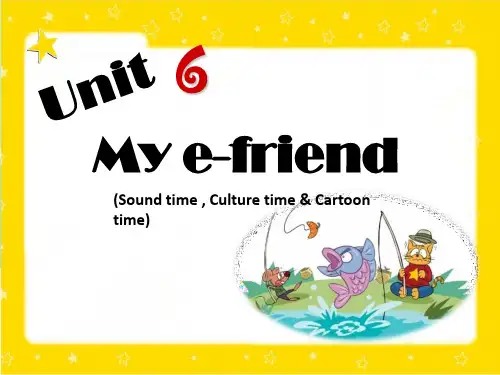
(Sound time & Culture time & Cartoon time)
What can we do with our friends?
Name: Linda Age: 12 years old Home: New York(纽约) Subjects: Music Season : winter Hobbies: skating
能正确、流利地朗读课文。
能正确、流利地表演课文。
能正确、流利、有感情地表演课文。 可以加上自己的语言哦!
你的好朋友是谁呢?你也试着根据好朋友的信息, 画一幅漂亮的思维导图吧!
? hobbies ? family
My friend
? subjects
name, age, country,food
…
Bobby and Sam sit by the river. What do fish eat Sam?
They eat apples. Do they eat oranges too?
Yes, they do.
Now, Sam has many fish, but Bobby does not have any.
Don’t worry, Bobby. I can teach you.
Bobby and Sam sit by the river.坐在河边 They eat apples.
What do fish eat ,Sam?
Do they eat oranges too?
Yes, they do.
Now, Sam has many fish, but Bobby does not have any.
Sam is my best friend. He is 3 years old. He lives in the US. He likes PE. He can skate very well. We often go fishing together. Sam is really good at fishing. We have a lot of fun every day!
I live in China We are happy
Friends, friends, we are friends
Friends, friends, we are friends He likes _______, she likes _______
I like _______ We are happy
You’re really good at fishing, Sam.
Yes! Look! I don’t have any fish.
Bobby waits and waits. 等了又等
Bobby and Sam eat fish at a snack bar. Let’s go fishing tomorrow. OK, but I’m not good at fishing. Don’t worry Bobby. I can teach you.
USA
Tip: We write English aNdamder(e姓s名s)es like this. Address (地址)
Post Code (邮编)
Stamp (邮票)
Dear Linda,
In winter, water turns to ice, And sometimes it snows. So when the winter weather comes, We always wear warm clothes!
In winter, …wa. ter turns to ice, 水结成了冰
In winter, water turns to ice, And sometimes it snows.
So when the winter weather comes.
冷空气 We always wea来r 临warm clothes.
Who is good aand find the answer. 自己大声朗读课文,找一找答案,划出关键句吧!
Don’t worry, Bobby. I can teach you.
Now, Sam has many fish, but Bobby does not have any.
Friends, friends, we are friends He lives in _______, she lives in _______
I live in _______ We are happy
亲爱的读者: 春去春又回,新桃换旧符。在那桃花盛开 的地方,在这醉人芬芳的季节,愿你生活像 春天一样阳光,心情像桃花一样美丽,感谢 你的阅读。
You’re really good at fishing, Sam.
I don’t have any fish.
Yes! Look!
Bobby waits and waits.
I don’t eat oranges!
Read or act the story.
四人小组合作,用喜欢的方式读一读或者表演卡通。
Learning aims
I know the differences between Chinese and English addresses in envelopes.
I know the sound of the letter “w”. I can understand and act the cartoon.
牛津译林版小学英语五年级上册Unit6 My e-friend Period3
But what do they use to fish? (但是他们用什么来钓鱼?)
A.Apples. B.Oranges. C.Worms(虫子).
Sam’s joke!
玩笑
Bobby and Sam sit by the river.坐在河边
Yours Shen
Tips:在介绍时一 定注意第三人称 单数的表达哦!
Dear Peter, I have a good friend. He/She is _______ years old. He/She lives in ______________ He/She likes_________________ He/She _____________________ We usually _______________ after school. … Do you like him/her?
wWe alwways wwear wwarm clothes!
Tips: 停顿 , 更长停顿 。
I can read this rhyme.
Think and say
W-/w/
Can you say more word like this(像这样)? 你还知道哪些含字母w并发/w/的单词?
I can say more words.
2、Read together. (齐读)
3、Act in roles.(分 角色演)
A life without a friend is a life without a sun!
Name: Jack Willson
Age: 12 years old
最新牛津译林版五年级英语上册(5A)Unit6 My e-friend Period3课件

Is Bobby good at fishing?
Bobby and Sam eat fish at a snack bar.
OK, but I’m not good at fishing.
Don’t worry, Bobby. I can teach you. 别担心
What do fish eat? A.Apples. B.Oranges. C.Worms(虫子).
Look and say
So when the winter weather comes,
We always wear
.
总是
牛津译林版2020-2021学年五年级英语上册Unit6 My e-friend Period3课件
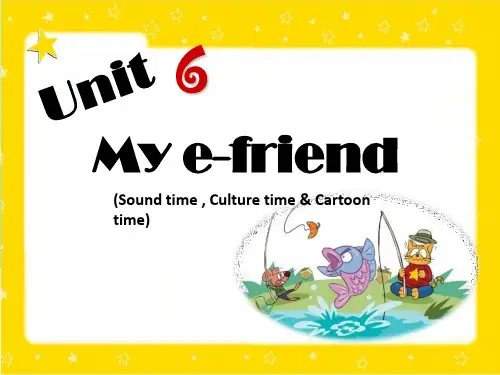
(Sound time , Culture time & Cartoon time)
Learning aims
1. I know the sound of letter "w". 我知道字母w的发音。
2. I can understand Cartoon time and try to act it. 我能理解卡通部分并且能试着表演出来。
向Peter写封信,介绍一下你的 好朋友吧!
128 Oxford St. London, the UK
Peter Brown
A
注:Oxford St. 牛津街
London 伦敦市
Peter Brown
128 Oxford St.
B
London , the UK
Peter Brown
The UK
C
花一样美丽,感谢你的阅读。 87、人放勇生眼气就前通像方往卫,天生只堂纸要,,我怯没们懦事继通的续往时,地候收狱尽获。量的20少季:33扯节2。就0:3在230前:2353方72.。01:432.302:.02724.1074T.12u40e.s27d0.1a24y02,T0Juu.e7lys.1d14a4。y,,2J0u2ly0年147, 月201240日星期二二〇二〇年七月十 四日 8、拥有梦想只是一种智力,实现梦想才是一种能力。20:3320:33:257.14.2020Tuesday, July 14, 2020
Yours ________
亲爱的亲读爱者的:读者:
1、人生盛生活年如不逆相重旅信来,眼我泪一亦,日是眼难行泪再人并晨。不代及20表时.7.软宜14弱自7.。勉14,2.02岁.072.月1042不70.:待1343人.220。0:23。032:22004:.3J7u3.1l2-4027:03.21304:2:.32430J2u0l-20:2303:2303:33:25Jul-2020:33
最新牛津译林版五年级英语上册(5A)Unit6 My e-friend A课件
以小组为单位,选择一 种喜欢的方式读一读课文。
Read together.
(齐读)
Read in roles.
(分角色读)
Read one by one (一个接 一个读)
…
自根己据试提着示说,说完,成使表格。
LEangnlgisuhagaen(d C语hi言ne)se: Peter 的信息完整
write an email
send 发送 friend
电子邮件
你想知道Peter的哪些 情况,能问一问吗?
e-friend
HoHwowold
Can he
oisldh…e?
Csapnea…k? Chines
WhW at hat
e?
ssuubbjejecctts…?
DDlikooeeessp…lha?eying football?
…?
does he like?
Wwhere…? does he
live?
Country 1.Where does he live?
Age 2. How old is he?
1. He lives in _C___U_K__. 英国
A. the US
B. Canada C. the UK
2. He is ___B…__y_e_aryesarosldold.……岁
We can see bald eagles in
the US . 美国
We can see panads in
China .
中国
We are from China.
我们来自中国。
We are Chinese.
我们是中国人。
We speak Chinese.
译林版小学英语五年级上册(5A)《Unit 6 My e-friend》第三课时PPT4
想成为 是一个
I want to be a ……
I want to be a wolf .
olf
olf wolf
Want to be a wolf
I want to be a wolf
What happened then?
(接着发生了什么?)
What else does the witch want to be? (这个女巫还想成为?) 你可以猜测哟! She wants to be a/an ______ .
Unit 6 My e-friend
winter
What can we do in winter?
We can make snowmen. We can go skating. water turns to ice结冰
In winter, it is cold. We need... warm clothes
/w/
说一说t
等待
windy
有风的
wet
潮湿的
wake
唤醒
Witch
女巫
Reading time
a witch
Which
读音相同
Tip : 快速浏览整个绘本故事,找出你最喜欢 的地方(图画或语言)
What does she want to be?她想......? Listen and guess 听并猜
1 2
I can read the new word. I can understand and read the story .
Homework 1.熟练拼读课文中出现的单词。 2.给爸爸妈妈或者朋友讲一下这个故 事吧。
let us go on !!
牛津译林苏教版五年级英语上册Unit6 My e-friend(英汉互译)优质课件.ppt
在冬天,水变成冰。
10. Sometimes it snows.
有时会下雪。
11. So when the winter weather comes, we always wear warm clothes!
所以当冬天来临,我们总是穿暖和的衣服。
5. It’s to my e-friend.
是写给我网友的。
6. He’s 11 years old.
他11岁。
7. Does he have Chinese lessons at school?
他在学校上中文课吗?
8.He studies Chinese after school.
他放学后学中文。
12. We write Chinese addresses like this.
我们像这样写中国地址。
13. Bobby and Sam eat fish at a snack bar.
波比和山姆在小吃店吃鱼。
14. Let’s go fishing tomorrow.
让我们明天去钓鱼。
15. I can tell you at once. 我能立刻告诉你。
让我先发出这封邮件。
5. It’s to my e-friend.
是写给我网友的。
6. He’s 11 years old.
他11岁。
7. Does he have Chinese lessons at school?
他在学校上中文课吗?
8.He.
山姆有许多鱼,但是波比没有。
1. Let’s go and play football in the playground.
译林牛津英语五年级上册5A Unit6 My freind
playing football?
Q: What subject do you like?
Can you play well? /Are you good at it?
Q: What colour/ animals do you like? T-Ss
Q: What do you like doing?
do you do? Do you do house work?
in …?
Ss
Q: Where do you live? Do you live in …?
2. T: I know more about you, would you
want to know more about me? You can ask
Period 1 Date:
STAGE
POCEDURE (What will the teacher do)
TASKS (What will the students do)
INTERACTI ON
AIMS
Pre-reading (Free talk)
Greeting
Greeting
1. Enjoy a song.
information?
总结问句: Who’s your e-friend? What’s
his name?
Where does he live?
How old is he?
Can he speak …? (What can he speak?)
What subjects does he like?
2. T: What does the song talk about?.
T: Do you have any friends? What does he/she like doing? What subjects does Ss: Friends.
5A英语五年级上册(牛津译林版)Unit6 My e-friend A课件
does he like?
Wwhere…? does he
live?
Country 1.Where does he live?
Age 2. How old is he?
1. He lives in _C___U_K__. 英国
A. the US
B. Canada C. the UK
2. He is ___B…__y_e_aryesarosldold.……岁
中国人, 中文
Wang Bing
What is Wang Bing doing?
王兵正在干什么?
写信
发送 Who does hePeter How are you?How about your Chinese learning? Please write to me quickly. Yours Wang Bing
No, he doesn’t. He studies Chinese after school.
What subjects does he like? He likes Maths and PE. Does he like playing football?
Yes, he does. He likes swimming too.
420、:2敏67而.1好4.学20,20不20耻:2下67问.1。4.。2072.1042.02:02260270.:1246.:2002270.1240.:220622002:206:22607:2.164:0.2202200:26:02
这醉人芬春芳去的春季又节回,,愿新你桃生换活旧像符春。天在一那样桃阳花光盛,开心的情地像方桃,在 54、海不内要存为知它已的,结天束涯而若哭比,邻应。当为Tu它es的da开y,始Ju而ly笑1。4, 72.01240.2J0u2ly0270.1T4u.2e0sd2a0y2,0J:2u6ly2104:2,622002:0276/:1042/2200:206:02 花一这样醉美人丽芬,芳感的谢季你节的,阅愿读你。生活像春天一样阳光,心情像桃 65莫、愁生前命路的无成知长已,,需天要下吃谁饭人,不还识需君要。吃苦8时,2吃6分亏8。时T2u6e分sd1a4y-J, uJlu-l2y0174.1,42.022002J0uly 20Tuesday, July 14, 20207/14/2020
Unit 6 My e-friend(单元解读)五年级英语上册(译林版三起)
五年级上册Unit 6 My e-friend单元解读一、单元内容体现的课标理念本单元在英语核心素养的育人价值下进行,围绕单元主题“人与朋友”展开教学。
本单元学习的主题主要是学习描述自己朋友的特征和爱好等。
二、单元信息三、单元内容分析单元分为Story time、Grammar time、Fun time、Sound time、Culture time、Cartoon time、Checkout time、Ticking time八部分组成。
主要学习“描述朋友的状态或者特征”这个话题。
在教学上,对本单元内容进行整合以及重组,分为四个课时进行教授。
1.Story time,这一部分是一篇文章,主要是Liu Tao和Wang Bing 的对话。
两人讨论了Wang Bing的网友,Wang Bing向Liu Tao介绍了自己网友的姓名、年龄、住址、喜欢的科目以及爱好等。
在设计教学时,可以设置成一节阅读课,通过回答问题学习本节课对话,并使用思维导图让学们对对话内容进行概括。
2.Grammar time&Fun time, 这两个部分作为一课时按照语法课进行教授,依然是学习一般现在时的相关内容,学习一般现在时的一般疑问句以及如何回答,肯定句以及特殊疑问句。
3.Culture time&Cartoon time,这两个部分作为一课时按照对话课进行教授。
Culture time主要是讲述关于中英书写书信地址的不同点。
Cartoon time是一篇对话,主要讲述了Sam和Bobby在钓鱼的小故事,非常有趣。
4.Sound time,Checkout time&Ticking time这三个部分作为一课时按照语音和复习课进行教授。
Sound time主要教授字母w在单词中的发音,让学生学习w字母在单词中的一种自然拼读发音规则。
Checkout time属于复习,复习如何询问描述朋友的特点。
译林版小学英语5a教案(全册)
Unit1 Goldilocks and three bears第一课时(总第1课时)教学目标:1.learn the vocabulary: Goldilocks, forest, soup, just right, hard, soft, afraid, bears, in front of.2.Learn the sentences: There is/are ….3.Train Ss enjoy the fun of this story.教学重难点:1.learn the vocabulary: Goldilocks, forest, soup, just right, hard, soft, afraid, bears, in front of.2.Learn the sentences: There is/are ….教学具准备:录音机、课件教学过程:Step1:引(Free talk)T: Boys and girls, welcome back to school. Nice to see you again! S: Nice to see you, too. Thank youT: What’s this?S: It’s a box. S: It’s on the desk.T: There is a box on the desk.T: What are these? S: They’re pencilsT: Where re they? S: They’re in the pencil case.T: There are some pencils in the pencil case.Step2:探(Presentation)T: Look at the picture, who are they?They’re goldilocks and three bears.1.Learn the words: goldilocks, bearsa.T: What are they doing? Let’s watch the cartoon.b.Ask some questions and show the forms:Name-Goldilocks-in the forest, in a house-hungry and thirsty-some soup-on the table-too hot, too cold, just right-tired-three beds-too hard, too soft, just right-afraid-three bears in front of her2.Show the words: forest, soup, just right, afraid, hard, soft, in front of her and teach them3.Learn the new wordsT: What happened at the end? Please guess!3.Practicea.Read the new words.b.Listen to the tape and notice the pronunciations and intonationsc.Listen to the tape and noticed.Read after the tape.e.Try to read the text.Step3:测1.Read the text together.2.Choose one kind of reading and act it.Step4:迁Describe the classroom: There is/are … on/in/ ….Step5:Homework1. Copy the new words and sentences.2. Read, recite and act this story.板书设计:练习设计:教学后记:第二课时(总第2课时)教学目标:1. learn the vocabulary: beside, between.2. Learn the grammar of sentences: There is/are ….3.Train Ss can use the sentences: There is/are … correctly4. Review the words about feelings教学重难点:1. learn the vocabulary: beside, between.2. Learn the grammar of sentences: There is/are ….3.Train Ss can use the sentences: There is/are … correctly教学具准备:录音机、课件教学过程:Step1:引(Warming-up)1.T: At first, let’s read the story together.T: Read this story in roles.T: Act this dialogue, please.2.Talk about the learning tip.Step2:探(Presentation)1.T: What’s this? S: It’s a bag.T: Where is it? You may say “It’s between the desks.”(Teach: between)Learn the vocabulary.2.T: What are these?S: They’re apples.T: Where are they? You may say “They’re beside the bag. Teach: beside Learn the vocabulary3.Read the new words.4.Look at these pictures.a.Talk about these pictures and repeat this storyCheck the answers.(b, c, f, d, a, e)b.Look and talk about the pictures.Try to say them: There’s a house in the forest. There’s some soup in the table. There are three beds in the room. There are three bears in front of me.c.Check and write these sentences.d.Say the rules about it.5.Read and act the story6.Check and write these sentences.Step3:测(Consolidation)Describe my bedroom: There is/are … on/in/ ….Step4:迁1.Copy the new sentences.2.Describe my bedroom by oneself..板书设计:练习设计:教学后记:第三课时(总第3课时)教学目标:1.Learn the word: tool, doctor, says, put on, cannot, find, their, really.2.Learn the sentences: There aren’t any …. Here are …. XX can ….3.Learn the phonetic of the letter “c”.4.Enjoy this cartoon story.教学重难点:1.Learn the words: tool, doctor, say, put on, cannot, find, their, really.2.Learn the sentences: There aren’t any …. Here are …. XX can ….3.Learn the phonetic of the letter “c”.教学具准备:录音机、课件教学过程:Step1:引(Warming-up)1.T: Let’s describe our classrooms or our schoolbags, OK?2.Write some sentences.3.Read and recite the new words.4.Write some sentences about places.Step2:探(Presentation)1.T: Look at the picture, please.2.Listen to the tape.3.Teach the new words: tool, doctor, says, put onFind the same letter “c”.Read the phonetic /k/.4.Read the short text.5.Find the other words.6.Act the short text.Read the short text.7.T: Look at the picture, who are they?(Watch the cartoon.)T: What are they saying? Let’s watch the cartoon, please.S: They’re Bobby and Tina.8.Ask and answer, then fill in the forms.a.Teach the new words: cannot, find, their, really,Bobby-hungry-some cakes-in the kitchen, in the fridgeb.Teach the new sentences: There aren’t…any …. Here are ….c.T: Read the new words and sentences, please.9.Listen to the tape and read after it, then notice the pronunciations and intonations.10.Act the dialogue.Step3:测(Consolidation)Make some sentences: There isn’t/aren’t …. Here is/are ….Step4:迁1.Copy the new sentences.2.Read, recite and act this cartoon story.板书设计:练习设计:教学后记:第四课时(总第4课时)教学目标:1.Review the vocabulary and patterns of this unit.2.Learn the different drinks culture in western countries and China.3.Learn how to describe the places correctly.4.Appraise the harvest about this unit.教学重难点:1.Review the vocabulary and patterns of this unit.2.Learn the different drinks culture in western countries and China.3.Learn how to describe the places correctly.教学过程:Step1:引(Warming-up)1.Greetings and free talk.2.Read, recite and act this cartoon story.3.Do some exercises about the phonetic /k/4.Enjoy and act the cartoon story.Step2:探(Presentation)1.T: What’s this? S: Coffee.T: What’s that? S: Tea.Guess: Who is it for? Guess.2.Ask and answer:Coffee is popular in western countries. Tea is popular in China.3.Teach the new words: popular, western countries, culture, China4.Read the sentences.5.Say the different drinks culture.6.Look at the picture.a.T: Talk about the picture in groups, please.b.Check and write the sentences:I’m in the living room. There is a table. There are some books on the table. There are some toy cars under the table. There is a chair beside the table. There are three umbrellas in front of the window. Oh, there is a bear on the chair.There are some apples on the table. There is some orange juice in the glass. There is a bird in the tree. There are some sweets in the box.7.Review this unit.8.Appraise the harvest of this unit.Step3:测(Consolidation)1.Finish the exercise on notebook.2.Teach: There be ….(就近原则)Step4:迁1. Copy the new sentences.2. Read, recite and act this cartoon story.Unit2 A new student教学目标:1.Learn the vocabulary: classroom, table tennis room, computer room, music room, on the first/second/third floor, show her around2.Learn the patterns: How many are there …? Is/Are there any…? Yes, there is/are.教学重难点:Learn the vocabulary: classroom, table tennis room, computer room, music room, on the first/second/third floor, show her around and patterns: How many are there …? Is/Are there any…? Yes, there …. 教学过程:Step1:引(Warming-up)1.Greetings and free talk.T: What’s in our classroom? S: There is/are ….2.Recite some vocabulary.Check the answers.Step2:探(Presentation)1.T: Look, who are they? S: Yang Ling and Miss Li.T: This is Nancy Black. She’s Yang Ling’s friend. She’s a new student.2.Learn: Nancy Black, a new studentT: Can you show her around? S: Yes!Teach: show her around3.T: What happened? Let’s watch the cartoon, please.Watch the cartoon.4.Ask and answer the questions, then fill the forms.classrooms-24-our classroom-on the second floor two computer rooms, a library-on the third floor a music room, a table tennis room-on the first floor5.Listen to the tape and notice the pronunciations and intonations.a.Listen and notice.b.Try to read the dialogue.c.Read the story together.d.Choose one kind of reading and read in groups.e.Read this story in roles.f.Act the dialogue.Step3:测(Consolidation)1.Read the new words and sentences.T: Is there a blackboard in our classroom? S: Yes.T: Are there any pencils in your pencil case? S: YesTeach: Is/Are there …?2.Describe something: Is there …? Yes, there is.Are there any …? Yes, there are.Step4:迁1.Copy the new vocabulary.2.Read, recite and act this story.板书设计:练习设计:教学后记:第二课时(总第7课时)教学目标:1.Learn the vocabulary: Art room, library, playground.2.Learn the patterns: How many are there …? Is/Are there any…? Yes, there is/are.3.Train Ss can use the ordinal numbers and “Is/Are there …?教学重难点:1. Learn the patterns: How many are there …? Is/Are there any…? Yes, there is/are.2. Train Ss can use the ordinal numbers and “Is/Are there …?教学具准备:光盘,课件教学过程:Step1:引(Warming-up)1.Greetings and free talk.2.Read this story.3.Recite some vocabulary.4.Act this story in roles.Step2:探(Presentation)1.T: Look, what’s this? You may say “Art room”….Teach: art room, playground, library2.Look at the pictures. Read the words.3.Ask and answer:a.Where’s the …? It’s on the … floor.Check and write the sentences.There is/are … in our school. It’s/They’re on the … floor. Teach the new words: one-first, two-second, three-thirdb.Is/Are there …? Yes/No, ….Look at the sentences.Teach words: isn’t=is not, aren’t=are not,It’s=It is, They’re=They arec.How many … are there? There is/are … in our school.Read the sentences.plete the grammar of “there”.Look at the picture.Talk about the picture, then ask and answer: How many … are there? Is/Are there …? It’s/They’re on the … floor.4.Check the answers.Step3:测(Consolidation)1.Make some dialogues: This is our school. There is/are …in our school. It’s/They’re on the … floor.2.Teach: Is/Are there …? Yes/No, there is/isn’t/are/aren’t.Step4:迁1.Copy the new vocabulary.2.Describe our school to parents and friends.板书设计:练习设计:教学后记:第三课时(总第8课时)教学目标:1.Learn the vocabulary: sing and dance, then, go to the cinema, swing, push, heavy, high, stop2.Learn the patterns: XX is/are too/so ….3.Learn the phonetics of the letter “c”.教学重难点:1. Learn the vocabulary: sing and dance, then, go to the cinema, swing, push, heavy, high, stop2. Learn the phonetics of the letter “c”.教学具准备:教学光盘,练习册教学过程:Step1:引(Warming-up)1.Greetings and free talk.2.Listen and write some sentences.3.Describe our school.Step2:探(Presentation)1.Look at the picture.Listen to the tape.2.Find the same letter “c”.Say the phonetic /s/ about “c”.3.Teach the new words: sing and dance, then, go to the cinema Read the sentences.4.Act the short text.Find the other words.Do some exercises.5.Check the answers.T: Look, who are they? S: Sam and Bobby.T: Please watch the cartoon story.Teach the new words: on the swing, heavy, push, stop6.Ask and answer, then fill the forms:Sam and Bobby-on the swing, Sam-push-so heavy-happy, Bobby-stop-too high-afraid7.Listen and read after the tape, notice the pronunciations and intonations.a.Try to read this story.b.Read this story together.c.Read in roles.8.Act this story.T: What about this story? S: Great fun./….9.Enjoy this story again.Step3:测(Consolidation)1.Make some dialogues: This is our playground. There is/are …. It’s/They’re so/too …. Push/Stop!2.Make some sentences: Is/Are there …? Yes/No, there is/isn’t/are/aren’t.Step4:迁1.Write the new sentences.2.Read, recite and act this cartoon story.板书设计:练习设计:教学后记:第四课时(总第9课时)教学目标:1.Learn the vocabulary: UK, ground floor, US2.Learn the patterns: There is/are (not)… in my school.3.Learn the different floors in UK and in US.4.Appraise the harvest of this unit.教学重难点:1.Learn the vocabulary: UK, ground floor, US2.Learn the patterns: There is/are (not)… in my school.3.Learn the different floors in UK and in US.教学具准备:教学光盘、录音机教学过程:Step1:引(Warming-up)1.Greetings and free talk.2.Read the cartoon story.3.Act the cartoon story in roles.4.Do some exercises about the letter “c”.Step2:探(Presentation)1.Teach the new words: UK, ground floor, USa.Look at the picture and talk about the pictures.b.Listen to the tape.c.Read the sentences.d.Act the sentences.2.Say the different floors in UK and in US.a.Show the learning tip.b.Look at the picture.c.Talk about the picture.d.Think and write the sentences.This is my school. There are thirty-one classrooms in my school. There is/are … in my school. There is/are not … in my school.3.Read and write the sentences.4.Listen and number.5.Review the vocabulary and patterns of this unit.a.Say the rules of it.b.Appraise the harvest of this unit.c.Total the stars.Step3:测(Consolidation)Describe and write my school: There is/are … in my school. Step4:迁1.Write some sentences.2.Finish the workbooks.Unit3 Our animal friends第一课时(总第11课时)教学目标:1.Learn the vocabulary: animal, leg, body, arm, other, tail, wing.2.Learn the patterns: I have animal friends. It’s/They’re ….It/They can .... It has/They have ….3.Train Ss can feel the great fun of the animal friends.教学重难点:1.Learn the vocabulary: animal, leg, body, arm, other, tail, wing.2.Learn the patterns: I have animal friends. It’s/They’re ….It/They can .... It has/They have ….教学具准备:cards, pictures, tape, recorder教学过程:Step1:引(Warming-up)1.Greetings and free talk.2.Describe the classroom and our school correctly.3.Listen and write some sentences.4.Check the answers.Step2:探(Presentation)1.T: Look at me, what’s this? S: It’s a mouth.T: This is my body, these are my arms.2.Teach the new words: body, armsT: Please introduce your body and arms.3.Teach the other words by the same way: leg-legs, tail, wing-wings T: Please introduce yourself each other.4.T: Let’s watch the cartoon, please.a.Ask and answer, then fill the forms:⑴Nancy-red, black-big eyes and bodies-no legs or arms-big tails-swim⑵Mike-white-four legs, a short tail-big ears-run and jump⑶Liu Tao-white-red eyes, long ears-four legs, a short tail-run⑷Su Hai-yellow and green-two legs and wings-a big mouth, a long tail-talk and flyb.Listen to the tape and notice the pronunciations and intonations.5.Read after the tape.6.Try to read this story.7.Choose one kind of reading and read in groups.a.Read this story together.b.Read this story in roles.8.Act this story.Step3:测(Consolidation)1.Teach the words about the singular and plural variants: arm-arms, leg-legs, tail-tails, wing-wings, body-bodies2.Teach the verb tense forms: I/They have …. It has …. (notice: have-has)3.Make some dialogues: I have … animal friend(s). They …. It …. Step4:迁(Homework)1.Write the new vocabulary.2.Read, recite and act this story, then introduce the animal friends. 板书设计:练习设计:教学后记:第二课时(总第12课时)教学目标:1.Learn the vocabulary: foot-feet, have-has, doesn’t=does not, rabbit.2.Learn the patterns: Do … have …? Yes, … do./No, … don’t. Does he/she have …? Yes, he/she does./No, he/she doesn’t.3.Train Ss notice the verb tense forms.教学重难点:1.Learn the patterns: Do … have …? Yes, … do./No, … don’t. Does he/she have …? Yes, he/she does./No, he/she doesn’t.2.Train Ss notice the verb tense forms.教学具准备:pictures, tape, recorder教学过程:Step1:引(Warming-up)1.Greetings and free talk.2.Listen and write the vocabulary.3.Read ,act and teach the learning tipStep2:探(Presentation)1.Look at the pictures.Talk about the pictures.T: What animal friends do they have? Let’s have a match.Check the answers.2.Teach the word: rabbit, foot-feetRepeat this story.Look at the sentences.3.Talk about the sentences.Think and write.Check the answers:Nancy’s fish have big eyes, bodies and tails. Mike’s dog has big ears and a short tail. Liu Tao’s rabbit has long ears and a short tail. Su Hai’s parrot has a big mouth, a long tail and two legs/wings.4.Read and write the sentences.Read these sentences.5.Teach the new words: have-has, don’t=do not, doesn’t=does not6.Teach the grammar of the verb tense forms.7.Do some exercises.Check the answers.Look at the pictures.Talk about the pictures.Ask and answer.Fill in the blanks.Check the answers.8.Read and write some new sentences.Step3:测(Consolidation)Teach: have对应的是:I, you, we they, has对应的是:it, he, she Step4:迁1.Write the some sentences.2.Describe your animal friends.板书设计:练习设计:教学后记:第三课时(总第13课时)教学目标:1.Learn the vocabulary: rain, sunny weather, come out, carry, give, finger, its.2.Learn the phonetic of the letter “u”.3.Train Ss enjoy the great fun of this cartoon story.教学重难点:1.Learn the vocabulary: rain, sunny weather, come out, carry, give, finger, its.2.Learn the phonetic of the letter “u”.教学具准备:cards, pictures, tape, recorder教学过程:Step1:(Warming-up)1.Greetings and free talk.2.Listen and write some sentences.3.Check the answers.Step2:探(Presentation)1.Look at the pictures.Listen to the tape.Find the same letter “u”.Say the phonetic /Λ/ of the letter “u”.2.Teach the new words: rain, sunny weather, come out, carryRead the sentences.Act the sentences.Find the other words.Do some exercises.Check the answers.3.T: Look at the pictures, who are they? S: Bobby, Sam and ….T: What are they doing? Please watch the cartoon.Ask and answer, then fill in the forms:Bobby and Sam’s new friends-ten legs-eight legs, two arms-it’s afraid-a big and hard body.4.Teach the new words: give, finger, its.Listen to the tape and notice the pronunciations and intonations. Read after the tape.Choose one kind of reading and read in groups.Read this cartoon story together.Read in roles.5.Act the dialogue.T: What about this cartoon story? S: ….Step3:测(Consolidation)Make some dialogues: Do …? Yes, …do./No, …don’t. Does …? Yes, …does./No, … doesn’t.Step4:迁1.Copy the new vocabulary.2.Read, recite and act this cartoon story.板书设计:练习设计:教学后记:第四课时(总第14课时)教学目标:1.Learn the vocabulary: bald eagle, polar bear, Canada, kangaroo, Australia.2.Learn the different animals in different countries.3.Appraise the harvest of this unit.教学重难点:1.Learn the vocabulary: bald eagle, polar bear, Canada, kangaroo, Australia.2.Learn the different animals in different countries.教学具准备:cards, pictures, tape, recorder教学过程:Step1:Warming-up1.Greetings and free talk.2.Listen and write the sentences.3.Check the answers.4.Read and act the cartoon story in roles.Step2:Presentation1.Look at the pictures.Talk about the pictures.2.Teach the new words: bald eagle, polar bear, Canada, kangaroo, Australia.Read the sentences.Act the sentences.3.Teach the different animals in different countries.Talk about the other animals.Look at the pictures.Talk about the pictures.4.Ask and answer, then fill the forms:There is/are … on the farm. It has/They have ….Describe the animals on the farm.Look at the picture.Talk about the sentences.Draw and write.Check the answers:This is my animal friend. It is …. It has …. It can ….Read and write the sentences.5.Review the vocabulary and patterns of this unit. Say the rules of it.Appraise the harvest of this unit.Step3:ConsolidationDescribe the animal friends.Step4:Homework1. Describe and write the animal friends.2. Finish the workbooks.Unit4 Hobbies第一课时(总第16课时)教学目标:1.Learn the vocabulary: draw, read stories, also, be good at, lots of, dance, play the piano, watch films, both, hobbies.2.Learn the patterns: I/They like …. He/She likes ….3.Train Ss feel the different people’s different hobbies.教学重难点:1.Learn the vocabulary: draw, read stories, also, be good at, lots of, dance, play the piano, watch films, both, hobbies.2.Learn the patterns: I/They like …. He/She likes ….教学具准备:pictures, tape, recorder教学过程:Step1:引(Warming-up)1.Greetings and free talk.2.Describe the animal friends to others.Step2:探(Presentation)1.T: Look at the pictures, guess, who are they?S: They’re Mike, Liu Tao, Tim, Yang Ling, Su Hai and Su Yang.2.T: What are hobbies? Please watch the cartoon.a.Teach the new word: hobbiesb.Ask and answer the questions, then fill the forms:Mike, Tim-playing basketball and football, drawingLiu Tao-playing basketball and table tennisYang Ling-reading stories, play the pianoSu Hai, Su Yang-dancing, watching films, swimmingc.Teach the new words: be good at, draw, also, read stories, lots of,play the piano, dance, watch films, bothd.Read the new vocabulary.3.Listen to the tape and notice the pronunciations and intonations.4.Read after the tape.5.Try to read this story.6.Choose one kind of reading and read in groups.7.Read this story together.8.Act this story.9.Read in roles.Step3:测(Consolidation)Introduce your hobbies: I’m XX. I have some hobbies, I like …. I’m good at …. I like …, too. I also like …. I’m very happy.Step4:迁1.Write the new vocabulary.2.Read, recite and act this story.板书设计:练习设计:教学后记:第二课时(总第17课时)教学目标:1.Learn the vocabulary: sing, do-does, like-likes,group.2.Learn the patterns: What do/does …like doing?XX like/likes …+ing ….3.Train Ss notice the verb present participle.教学重难点:1.Learn the patterns: What do/does … like doing?XX like/likes …+ing ….2.Train Ss notice the verb present participle.教学具准备:cards, tape, recorder教学过程:Step1:引(Warming-up)1.Greetings and free talk.2.Listen and write the vocabulary.3.Check the answers.4.Read this story in roles.Step2:探(Presentation)1.Look at the pictures.a.Talk about the pictures.b.Think and write.c.Check the answers:Mike likes basketball, football and drawing. Tim likes drawing. Liu Tao likes basketball. Yang Ling likes reading stories. Su Hai likes dancing and swimming. Su Yang likes swimming.d.Read and write the sentences.2.T: I like singing. What about you? S: Me too.a.Teach the new word: sing-singingb.Look at the sentences.c.Talk about the sentences.3.Teach the new words: like(s), do(es)a.Read the sentences.b.Teach the grammar of the verb present participle.c.Read the words of the verb present participle: draw-drawing, ….4.Teach: like/likes …+ing ….Read and write some sentences.5.Look at the pictures.6.Talk about the pictures.7.Say the rules of the survey.a.Ask and answer the questions.b.Teach the new word: groupc.Read and write the sentences.Step3:测(Consolidation)Make some dialogues: What do/does … like doing? XX like/likes …. Step4:迁1.Copy and recite the new vocabulary and patterns.2.Write the hobbies.板书设计:练习设计:教学后记:第三课时(总第18课时)教学目标:1.Learn the vocabulary: wear, hat, young, year, talk about, hole, look out, wet.2.Learn the phonetic of the letter “y”.3.Train Ss enjoy the cartoon story.教学重难点:1.Learn the vocabulary: wear, hat, young, year, talk about, hole, look out, wet.2.Learn the phonetic of the letter “y”.教学具准备:课件,录音机,磁带教学过程:Step1:引(Warming-up)1.Greetings and free talk.2.Listen and write the sentences.3.Check the answers.4.Introduce your hobbies.Step2:探(Presentation)1.Look at the pictures.a.Talk about the pictures.b.Listen to the tape.2.Find the same letter “y”.Say the phonetic /j/ of the letter “y”.3.Teach the new words: wear, hat, young, year.4.Read the short text.a.Act the short text.b.Find the other words.c.Do some exercises.5.Check the answers.T: Look at the pictures, who are they?S: They’re Sam, Billy, ….6.T: What happened? Watch the cartoon.Ask and answer the questions, then fill the forms:Sam and Billy-in winter-skating-go skating-a hole behind Billy in the ice-cold and wet7.Teach the new words: talk about, hole, look out, wet.8.Listen to the tape and notice the pronunciations and intonations.a.Read after the tape.b.Try to read this cartoon story.c.Read this cartoon story together.d.Act this cartoon story.9.Read in roles or groups.T: What about this cartoon story? S: ….Step3:测ConsolidationIntroduce the hobbies.Step4:迁1.Copy and recite the new vocabulary and patterns.2.Write the hobbies.板书设计:练习设计:教学后记:第四课时(总第19课时)教学目标:1.Learn the vocabulary: very much.2.Learn the English song “We all like climbing.”3.Review the words and sentences of this unit.4.Appraise the harvest of this unit.教学重难点:1.Learn the vocabulary: very much.2.Learn the English song “We all like climbing.”3.Review the words and sentences of this unit.教学具准备:课件,录音机,磁带教学过程:Step1:引(Warming-up)1.Greetings and free talk.2.Read the cartoon story in roles.3.Do some exercises of the letters “u, y”.4.Read the cartoon story in roles.5.Act this story cartoon.Step2:探(Presentation)1.Look at the pictures.2.Teach the new word: very much.a.Read the words of the song.b.Listen to the tape.c.Sing after the song.d.Try to sing the song.e.Sing the song together.3.Look at the pictures.a.Talk about the pictures.b.Listen and judge.c.Look and say.d.Read and write the sentences.4.Look at the pictures.a.Talk about the pictures and sentences.b.Think and write.c.Check the answers: My hobbies-I like …. I like …, too. My friends’hobbies-… likes …. … likes … and …. … and … like ….d.Read and write the sentences.e.Say the rules of it.Step3:测(Consolidation)Make the hobbies cards.Step4:迁1.Make the hobbies cards.2.Finish the workbook.Project1 An animal school第一课时(总第21课时)教学目标:1.Review the words and sentences from Unit1 to Unit4.2.Learn how to make an animal school.3.Prepare something for the making.4.Learn the vocabulary: teachers, students.教学重难点:1.Review the words and sentences from Unit1 to Unit4.2.Learn how to make an animal school.3.Prepare something for the making.教学具准备:录音机,磁带,课件,练习纸教学过程:Step1:Warming-up1.Greetings and free talk.2.Read the main words from Unit1 to Unit4 correctly.3.Read the main sentences from Unit1 to Unit4 correctly.Step2:Presentation1.Look at the pictures.2.Teach the new word: teachers, students.a.Say the rules of this game.plete the words.c.Check the answers.d.Listen and write some words.3.Match and choose some sentences.a.Check the answers.b.Listen and write some sentences.4.Look at the pictures.a.Talk about the pictures.b.Fill in the blanks.c.Check the answers.d.Read and write some sentences.5.Discuss how to make an animal school correctly.a.Say the rules of them.plete something for the making.Step3:Consolidation1.Read the “Story time” from Unit1 to Unit4.2.Act the “Story time” from Unit1 to Unit4 in roles or in groups. Step4:Homework1.Recite some words and sentences.2.Prepare something for the making.Project1 An animal school第二课时(总第22课时)教学目标:1.Review the vocabulary and patterns from Unit1 to Unit4.2.Learn to make an animal school.3.Train Ss can use the oral communication.4.Enjoy the great fun of the making.教学重难点:1.Review the vocabulary and patterns from Unit1 to Unit4.2.Learn to make an animal school.3.Train Ss can use the oral communication.教学具准备:录音机,磁带,练习纸教学过程:Step1:Warming-up1.Greetings and free talk.2.Read the main vocabulary from Unit1 to Unit4 correctly.3.Read the main patterns from Unit1 to Unit4 correctly. Step2:Presentation1.Look at the pictures.2.Say the rules of this game.plete the vocabulary.b.Check the answers.c.Say the rules of this game.3.Match and choose some patterns.a.Check the answers.b.Say the rules of the making.T: What do you need to help now? S: ….c.Show something for the making.T: At first, please think all of them.Draw, make, mark and stick.T: Please show us your making works.4.Appraise the making works.5.Make some dialogues with the making works.Step3:Consolidation1.Finish the making works.2.Show the final making works.。