
【人教新目标版】七年级英语上册备课资料:Unit3IsthisyourpencilSectionA
Unit 3 Is this your pencil?
Section A
1.eraser/ɪˈreɪzə(r)/ n.橡皮可数名词。
eg:This is an eraser.这是一块橡皮。
2.schoolbag /ˈskuːlbæɡ/ n.书包可数名词。
eg:It’s a nice schoolbag.它是一个好看的书包。
拓展schoolbag是一个合成词,由两个独立的单词school(学校)和bag(包)组成。
再如afternoon(下午),grandfather(祖父),classroom(教室)等。
3.dictionary/ˈdɪkʃənerɪ/ n.词典;字典
eg:That’s my English dictionary.那是我的英语词典。
归纳:dictionary dictionaries (辅音字母+y结尾,改y为i,加
es)
拓展:an e-dictionary 一部电子词典;a living dictionary 一部活字
典;Chinese-English dictionary 汉英词典;English-Chinese dic tionary 英汉词
典;English-English dictionary 英英词典
4.A: Is this your pencil?这是你的铅笔吗?
B: Y es, it is.It’s mine.是的,它是。
它是我的铅笔。
使用语境询问单数物品的所属,确认物主关系,常用“Is this your/her/his/my...?”询问离说话人较近的物品。
肯定回答用“Yes,it is.”,否定回答用“No,it isn’t.”。
isn’t 是is与not的缩写。
mine /maɪn/ pron.我的
eg:These are your erasers.And those are mine(my erasers).这些是你的橡皮。
那些是我的。
5. A: Is that your schoolbag?那是你的书包吗?
B:No, it isn’t.It’s his.不,它不是。
它是他的。
使用语境“Is that your...?”的用法和答语与“Is this your...?”相同,但询问离说话人较远的物品。
his /hɪz/ pron.他的
eg:This is my schoolbag.That is his (his schoolbag).
这是我的书包。
那是他的。
6.A:Are these your books?这些是你的书吗?
B:No,they aren’t.They’re hers.不,它们不是。
它们是她的。
使用语境:“Are these your...?”适用于询问复数物品的所属,确认物主关系。
询问离说话人较近的物品。
肯定回答用“Yes,they are.”否定回答用“No,they aren’t.aren’t”是are与not的缩写。
指代离说话人较远的物品时用those,用法同these。
hers /hɜː(r)/ pron.她的
eg:Here is my dictionary.That’s hers(her dictionar y).
这是我的词典。
那是她的。
My name is Eric.Hers is Helen.我的名字是埃里克。
她的是海伦。
7.Tom:Excuse me,Grace.Is this your pencil?汤姆:打扰了,格雷丝。
这是你的铅笔吗? Grace:Yes,thank you.格雷丝:是的,谢谢你。
(1)excuse /Ik‘skjuːz/ v.原谅,宽恕
归纳:Excuse me.意思为“打扰一下。
”在自己的询问或请求有可能给对方带来一定的麻烦时使用。
(易混点)
eg:—Excuse me.Are you Mr Smith? 请问,你是史密斯先生吗?
—No, I’m not.不,我不是。
(2)me /miː/ pron.(I的宾格)我
eg:Help(帮助)me,please.请帮助我一下。
That girl can see me.那个女孩能看见我。
辨析:excuse me与sorry
excuse me可以在要说或要做可能令人不悦的事情之前使用或要打扰别人时使用,也可以在要打断别人谈话或要引起别人注意时使用,有“打扰一下,请问”的意思。
而“sorry”则是对说了或做了的事情表示歉意。
8.Teacher:What about this dictionary?老师:这本词典呢?
Anna:It’s Helen’s.安娜:它是海伦的。
使用语境:What about...?用于征求对方意见或在上文的基础上,问相同的问题以避免重复。
eg:—Is this your pen?这是你的钢笔吗?
—Yes,it is.是的,它是。
—What about the ruler?这把尺子呢?—Is this your ruler,too?这把尺子也是你的吗? —No,it isn’t.不,它不是。
(1) what about相当于how about,后接名词(短语)或动词-ing形式。
(2)Helen’s.“海伦的”,是,名词所有格,表示所属关系。
其基本构成是在人名或单数、复数名词后加’或’s。
eg:This is John’s jacket.这是约翰的夹克衫。
Those are your father’s books.那些是你爸爸的书。
Are these your grandparents’books?这些是你祖父母的书吗? 9.Is that yours?那是你的吗?
yours /jɔ(r)z/ pron.你的;你们的eg:My pencil box is red.Yours is green.我的文具盒是红色的,你的是绿色的。
10.Teacher:Thank you for your help,Anna.老师:谢谢你的帮助,安娜。
Anna:You’re welcome.安娜:不客气。
使用语境:此对话用于受帮助后的客套寒暄。
thank you for...“因……而感谢”,后接名词或动词-ing形式。
原句可以说成:Thank you for helping me,Anna.谢谢你帮助了我,安娜。
归纳thank you 在英美人的日常生活中使用频率颇高,几乎成了一帮忙、让路,送给你礼物以及赞扬你之后,你都应说句“Thank you.”来表示感谢。
演讲者演讲结束,老师讲完课也常用此语作为最后的结束语。
eg:—Amy, is this your book?
埃米,这是你的书吗?
—Yes, it is.Thank you.
是的,它是。
谢谢。
—How are you?你好吗?
—Fine,thank you.很好,谢谢。
例1 —David,is this your sister’s bike?
—No,it’s not.It’s my brother’s.
A.your
B.his
C.hers
D.mine 解析:考查名词性物主代词。
答案:C
例2 我喜欢北京的秋天,你呢?
I like the autumn in Beijing. you?
解析:考查短语。
答案:What about
例3—I can’t find my new dictionary.
—Is the one on Gary’s desk?
A.ours(我们的)
B.yours
C.his
D.mine
解析:考查名词性代词。
答案:B
在中国,如果我们在街上拾到一些有价值的东西,我们通常将它交给警方。
在美国,它总是取决于你在哪里找到它。
一般的规则是要在丢失东西的地方找到该项目的权威人士。
权威的人(如商店职员)将按照适当的程序,失物招领(商店的)。
在商店:联系商店店员。
在街上:联系警方,如果该东西是有价值的。
在餐馆:联系服务员。
在公共汽车上:联系司机。
在教室:联系老师。
在酒店,联系酒店职员。
如铁路车站或机场的一些地方,有一个失物招领处,所有
失物都被保留。
如果你已经在车站或机场丢失了东西,你可以到失物招领处先看看。
最新人教新目标版初一英语上册教案Unit3 Is this your pencil

Unit 3 Is this your pencil?Period 1 (Section A 1a–2d)【教学目标】●知识目标1. Master the new words and useful expressions.2. Master the target language.3. Master the use of “Is this/ that your...? Yes, it is. / No, it isn’t.”●能力目标1. Be able to make conversations using the target language.2. Be able to identify the ownership.●情感目标Lead students to be interested in identifying ownership.【教学重难点】●重点1. Master the new words and useful expressions.Words: pencil, book, eraser, box, pencil box, schoolbag, dictionary, his, hers, mine, yours, teacher, excuse me, You're welcome2. Master the target language:①—Excuse me. Is this/that…? —Yes, it is. / No, it isn’t.②—Excuse me. Are these/those…? — Yes, they are. / No, they aren't.③What about …?3. Improve students’ listening and speaking skills.●难点Be able to make conversations using “Is this/ that your...? Yes, it is. / No, it isn’t.”【教学准备】A tape recorder, some pictures, some school things and handouts.【教学方法】任务型教学法、情景交际法、自主学习与合作学习相结合【课时安排】One period【教学过程】Step 1: Greetings and revisions1. Greeting the students.T: Good morning! /Hello!/ Hi! ...Ss: Good morning! /Hello!/ Hi! ...2. RevisionLet some some students show their family photos and ask:—Is this your…? —Yes, she/he is. /No, she/he isn’t.—Are these/those your…? — Yes, they are./ No, they aren’t.Step 2: Lead-inCollect some items (pen, ruler, cup, book, pencil…) from the students and ask:What’s this in English?What’s that in English?(Help them answer like this: It’s a/an …)Have them work in pairs to practice the questions.Step 3: Presentation1. Teach activity 1a(1) Ask students to look at the picture in 1a and see how many words they know. Have a competition in groups.(2)Ask some groups to make a report to see which group can say the most words.At the same time, teacher writes some easy and important words on the blackboard.(3)Give students a few minutes to read and the words. Offer them some help if needed.(4)T:Now, you need to look at the picture in 1a. Find out the things. Then match the words with the things.(5) Ask them to do it individually.(6) Check the answers.Answers: 1.pencil e 2.pen g 3.book b 4.eraser h 5.ruler c 6.pencil box f 7.schoolbag a 8.dictionary d(7) Ask the students to read the conversation in the picture together. Explain some language points.2. Teach activity 1b(1) Ask students to look at 1b and ask some pairs to read the conversations.(2) Play the recording for the first time. Students only listen and get the main idea.(3) Play the recording for the second time. Ask students to write answers by themselves.(4) Invite some students to check the answers. Then play the recording for the third time. Havestudents listen and repeat, pay attention to the pronunciation and intonation.3. Teach activity 1c(1) Invite two students to practice the sample conversation in 1b in pairs.(2) Ask students to make new conversations in pairs. Move around the classroom to check the progress and give some help if necessary.(3) Invite some pairs to act out their conversations.Step 4: Practice1. Teach activities 2a & 2b(1) Go through the instruction in 2a with the class.(2) Look at the pictures in 2a.(3) Play the recording for the first time. Let students check the questions they hear, then checkthe answers.(4) Go through the instruction in 2b with the class.(5) Read the words in the box in 2b. Help students read the them correctly in 2b and tell students to only listen to them carefully.(6) Play the recording for the second time. Ask students to write letters in the blanks in 2a.Then check the answers.(7) Play the recording for the third time. And let students listen and repeat.2. Teach activity 2c(1) Ask the students to read through the conversations in pairs.(2) Give them three minutes to practice reading it.As students work, walk around the room, offering help if necessary. Correct pronunciation mistakes if any.(3) Ask several pairs to act out their conversations.Step 5: ConsolidationTeach activity 2d1. Ask students to read the conversation by themselves to get the main idea.2. Lead students to read the conversation sentence by sentence, and explain some languagepoints at the same time.3. Play the recording, and ask students to listen and repeat. Then ask them to role-play theconversation in pairs. Move around the classroom to check the progress.4. Invite several pairs to role-play the conversation for the whole class.【课堂小结】In this period, we’ve learned how to identify ownership. And we’ve also learned the use of possessive pron ouns. 【课后作业】1. Review the new words and useful expressions in this period.2. Practice the conversation in 2d in pairs and recite it.3. Finish the exercises in the workbook.4. Preview the next period.Unit 3 Is this your pencil?Period 2 (Grammar Focus–3c)【教学目标】●知识目标Consolidate the target language learned in the last period.●能力目标1. Be able to identify the ownership using the target language.2. Develop students’ listening skills and communicative co mpetence.●情感目标Try to improve students’ teamwork spirit.【教学重难点】●重点1. Consolidate the target language learned in the last period.①—Excuse me. Is this/that…? —Yes, it is. / No, it isn’t.②— Excuse me. Are th ese/those…? — Yes, they are. / No, they aren't.2. Be able to identify the ownership using the target language.●难点1. Improve students’ listening and speaking skills.2. The usage of target language.【教学准备】Textbook, a box, some school things.【教学方法】任务型教学法、情景交际法、自主学习与合作学习相结合【课时安排】One period【教学过程】Step 1: Greetings and revision1.Greetings.T: Good morning/ afternoon, boys and girls.Ss: Good morning/ afternoon, teacher. How are you?T: Fine, thanks. And you?Ss: I’m OK....2.Revision.(1) Check their homework.(2) Have a dictation of the words the words learned in the last period.Step 2: Lead-in1. Ask students to put some school things on their desks.2. Let some students stand up and say what school things they have.3. T walks around the classroom, pick up the things and ask about them.T: Is this your pen?S1: Yes, it is. It’s mine.T: Is this your eraser?S2: No, it isn’t. It’s hers.T: Are these your books?S3: Yes, they are.T: Are those your rulers?S4: No, they aren’t. They are his.Step 3: PresentationTeach Grammar Focus(1)T:First, look at the sentences and short forms in the boxes of Grammar Focus.(2)Ask students to read them together.(3)Ask some students to read the sentences. Correct their pronunciation mistakes if there is any.(4) Collect their answers. Correct mistakes if there is any.(5) Ask students to read the short forms in the box. Pay attention to the pronunciation.Step 4: Practice1. Teach activity 3a(1) T: Let’s work on 3a. Look at the pictures in 3a. We can see the first picture is close to us, but the second picture is a little far from us. When we ask about them, we must pay attention to the use of this, that, these and those.(2) Ask students to complete the questions and answers about each picture.(3) Check the answers with the class.2. Teach activities 3b(1) Look at 3b. Tell Ss to complete conversation. Pay attention to the right sentence structure. Ss work withtheir partners. Try to make conversation.(2) Check the answers. Encourage some pairs to act out the conversations. See if their answers are right.Answers: 1.Is this her ruler? Yes, it is. It’s hers.2.Is that Eric’s schoolbag? No, it isn’t. It’s Sally’s.3.Are these his pencils? Yes, they are. They’re his.4.Are those Anna’s books? No, they aren’t. They’re mine.(3) Ss read the conversations aloud after the teacher. Then try to practice the conversations with their partners.(4) Let some pairs to act out the conversations in front of the class.Step 5: ConsolidationTeach activity 3c1. Divide the students into five or six groups. Each group has six to eight students. All the students in a group put some of their school things into a box.2. T makes a model for the students.T: I have many things in this box. But I’m sorry I don’t know whose these are. Could you help me find the owners? Let’s see who can find all the owners first and write the owners’ names in the chart. You only have two guesses.Language used for the task:T: Is this your math book?S1: Yes, it is. It’s mine.T: Is that your ruler?S2: No, it isn’t. It’s hers. My ruler is blue.T: Kim, is this your dictionary?S3: No, it isn’t. It’s his.T: Jim, are these your erasers?S4: Yes, they are. They are mine.T: Here you are.S4: Thank you.【课堂小结】In this period, we’ve consolidated what we’ve learned in the last period through some practice a nd games.【课后作业】1. Read the sentences in Grammar Focus.2. Make some conversations by yourself.Unit 3 Is this your pencil?Period 3 (Section B 1a–1e)【教学目标】●知识目标1. Master the new words and useful expressions.2. Master the target language.●能力目标1. Be able to identify things and spell words.2. Develop students’ listening skills and communicative competence.●情感目标Try to cultivate students to form the good habit of cooperation.【教学重难点】●重点1. Master the new words and useful expressions.Words: baseball, watch, computer, game, card, notebook, ring, bagPhrases: ID card, computer game2. Master the target language:—What’s this? —It’s a watch.— How do you spell it? — W-A-T-C-H.3. Be able to identify things and spell words.4. Improve students’ listening and speaking skills.●难点1. Improve students’ listening and speaking skills.2. The usage of target language.【教学准备】A projector, a tape recorder, some things, handouts.【教学方法】任务型教学法、情景交际法、自主学习与合作学习相结合【课时安排】One period【教学过程】Step 1: Greetings and revision1. Greeting the Ss. Check the homework.2. Review the school things we learned in Section A. Let Ss say the school things they have.3. Pick up some school things from the students’ desk and ask about them. (Using this, that, these, those) Let other students answer the questions. They must say the owner the things.T: Is this Li Mei’s ruler?Ss: Yes, it is. It’s hers.T: Is that Li Mei’s pencil?Ss: No, it isn’t. It’s Wu Ming’s.T: Are these Li Mei’s pens?Ss: Yes, they are. They’re hers.T: Are those Li Tao’s boo ks?Ss: No, they aren’t. They’re Zhang Bin’s.…Step 2: Lead-inShow a pen, ask and answer like this:T: What’s this in English?Ss: It’s a pen.T: How do you spell it?Ss: P-E-N, pen.T: Yes, thank you.Show some other things, and have students work in pairs to make conversations like this....Step 3: Presentation1. Teach activity 1a(1) Teach the new words.(2) Ask the students to read the words and expressions in 1a one by one.Correct mistakes if there is any.(3) Ask them to look at the picture carefully so that they can see how many things there are in the picture. Match the words with the things in the picture.(4) Check the answers.Answers: 1.baseball e 2.watch b puter game h 4.ID card a 5.key i8.pen d 6.notebook g 7.ring c 9.bag f2. Teach activity 1b(1) T: Now please work with your partner, practice the conversation in 1b. Use the pictures in 1a.(2) Students practice the conversation. As students work, the teacher moves around and offer some help if needed.(3) Invite some pairs to act out the conversation.Step 4: Practice1. Teach activities 1c(1) T: Listen to the conversation. Pay special attention to the names of objects. You will hear some of the names, not all of them. Circle on the picture each item whose name is mentioned in the conversations.(2) Play the recording for the first time. Ask students to listen carefully and circle the items.(3) Play the recording for the second time. Ask them to check the answers themselves.(4) Collect the answers and correct mistakes with the class.2. Teach activity 1d(1) T: Please look at the two pictures in 1d. One is Linda, and the other is Mike. Listen to the conversations again. This time you will pay attention to the things Linda and Mike are looking for. Then write down the names of the things under each person’s picture.(2) Play the recording for the students to write down the words.T: Well, what is Linda looking for?S3: …T: What about Mike? What is he looking for?S4: …(3) Check the answers with the class.Step 5: ConsolidationTeach activity 1f(1) Ask students to read through the instruction so that they can know how to play this game.(2) Follow the instruction. Ask students to make conversations using the things in 1d in pairs.(3) Leave the students several minutes to do this task.(4) Move around the room, offering help as needed.(5) Invite some pairs to act out their conversations for the whole class.【课堂小结】In this period, we’ve mainly consolidated how to identify things and spell words. And we’ve also improved ourlistening and speaking skills.【课后作业】1. Practice the target language.2. Preview the next period.Unit 3 Is this your pencil?Period 4 (Section B 2a–Self Check)【教学目标】●知识目标1. Master the new words and useful expressions.2. Master the target language.●能力目标1. Be able to read and write lost and found notice.2. Develop students’ writing competence.●情感目标Lead students to be honest and not to pocket the money that he/she has picked up. 【教学重难点】●重点1. Master the new words and useful expressions.Words: in, library, ask, some, find, lost classroom, e-mail, at, call, must, setPhrases: a set of2. Be able to read and write lost and found notice.3. Develop students’ writing competence.●难点Be able to read and write lost and found notice.【教学准备】Some lost and found notices, text book and handouts.【教学方法】任务型教学法、情景交际法、自主学习与合作学习相结合【课时安排】One period【教学过程】Step 1: Greetings and revision1. GreetingsT: Good morning, everyone.Ss: Good morning, teacher. How are you?T: Fine, thanks. And you?Ss: I’m OK.2. RevisionReview what we learned in the last period.Step 2: Lead-inT: Did you lose anything before?Ss: Yes.T: What things did you lose easily?S1: Keys.S2: Wallets.S3: Cell phones....T: Have you ever got back the things you lost?S1: Sometimes.S2: Never.T: OK. If we lose something, how can we get them back?S1: We can ask the police for help.S2: We can look for them in the place where they were missing.T: Anything else?S3: We can write lost notice to look for them.T: Good idea. Have you ever picked up anything?Ss: Yes.T: How can we return these things to the loser?Ss: We can take them to the police or write found notice.T: You are right. Today, we’ll learn how to write lost and found notice. Let’s begin.Step 3: Presentation1. Teach activity 2a(1) T: We all have many school things. We always lose some school things easily. Now discuss the school things you lose easily with your partner. Write them down on your workbook. Then report them to the class.(2) Students work with their partners.(3) Let some students report their things to the class.2. Teach activity 2b(1) T: Now. Read through the instruction so that you can know how to do this activity.(2) Ask students look at the pictures and read the notices on the board.(3) T: Tell me which ones are lost notice and which ones are found notice.Ss: The last one is a lost notice, and the other three are found notices.T: You are right.(4) Ask students to circle the lost things.(5) Check the answers.(6) Read the notices, and ask students to repeat sentence by sentence. Then explain the way of writing lost and found notice.3. Teach activity 2c(1) Ask students to read through the instruction of this activity so that they can know how to do it.(2) Leave students two minutes to do this task individually. Move around the classroom to check the progress and give some help if necessary.(3) Invite some pairs to check their answers.Step 4: Practice1. Teach activities 3a(1) T: Let’s work on 3a. Here are two notices but some words in the notes are missing. Read the notices and complete the notices with the words or phone number in the box.(2) Ask some students to read the words in the box. One read them in English. The other read them in Chinese.(3) Students read and complete the notices.(4) Check the answers.Answers: Lost; name; callFound; your; 284-54862. Teach activity 3b(1) T: As you have learned how to write lost and found notice. Now, let’s have a try. Write your own lost or found notice with your name and phone number.(2) Leave students several minutes to do this task.(3) As they work, move around the room, checking progress and offering help as needed.(4) Collect students’ notices. Choose the best ones to present to the whole class.Step 5: ConsolidationTeach Self Check1. Self Check 1(1) T: We’ve learned many school things. Now first review all the school things in three minutes. Then let’s have a competition. We’ll write the school things you can remember in a piece of paper. Let’s see who can remember the most.(2) Students review the words of the school things quickly. Then have a competition.(3) Check the numbers of the words on their paper to see who does the best.Answers: pen, ruler, pencil, pencil box, schoolbag, book, eraser, pencil, sharpener...2. Self Check 2(1)T: This part aims to help students to review the difference of pronounces.(2) Ask students to complete the chart individually. Do peer-correction with deskmates first.(3) Check the answers.3. Self Check 3(1) T: Look at the picture please. What are they talking about in the picture? Who would like to read it?S1: Is that your schoolbag?S2: No, it isn’t.T: OK, now what may other people (S2, S3 and S4) talk about in Picture? Write the conversation using Is this/that…? Yes, it is./ No, it isn’t. Are these/those …? Yes, they are. / No, they aren’t.(Students write the conversations with their partners.)(2) T: Now please read the conversation with your partner.S3: Is that your notebook?S4: Yes, it is.S5: Are those your keys?S6: No, they aren’t.…(3) Now practice the conversations with your partners.【课堂小结】In this period, we’ve mainly learned how to read and write lost and found notice. And we’ve also consolidated how to identify ownership.【课后作业】1. Review the new words and useful expressions in this period.2. Read the messages again and again in 2b.3. Write two notices using the target language in this unit.4. Preview the next unit.。
人教新目标版七年级英语上册Unit3Isthisyourpencil教案

Unit 3 Is this your pencil?教学目标1.Teach the new words baseball, computer game,watch and ring.2.Get the students to use the sentences freely.What’s this in English? It’s a watch. How do you spell it? W-A-T-C-H.3.Have the students know the meaning of some wordsand expressions like: lost, found, case, pieces, in order, message, etc.2.Get the students to learn to write their own bulletin board messages.教学内容 New words: baseball, computer, game, watch, ID card, notebook.What’s this in English? It’s a watch. How do you spell it? W-A-T-C-H.Call Allen at 495-8536. Is that your computer game in the lost and found case? Please call Mary. A set of keys.重点难点What’s this in English? It’s a watch. How do you spell it? W-A-T-C-H.Call Allen at 495-8536. Is that your computer game in the lost and found case? Please call Mary.A set of keys. 学情分析教学方法任务型教学、分级评价法、直观教学法、模仿示范法、情景教学和合作学习法学习方法课前预习、课堂内外练习、听说读写结合教学过程设计备注课题引入I. Warming-up and revisionTask: Students’ activities Teacher’s activitiesGame: throw the ball while asking and answering the question. In gro ups, one student throws the ball and asks: What’s this in English? The other one answers it ,then throw the ball again. Do this game first as an example. T: How do you spell it? “P-E-N-C-I-L”.教学步骤及主要内容II. PresentationT: What’s this in English? (show the Ss the baseball of the slide) Ss: It’s a baseball.Ss read the words after the teacher one by2. Play the recording. Competition between two groups. Students listen and try to remember the conversation. Conversation1: fill in the blanks. Conversation 2: the teacher says the key words in one sentence of this conversation. Students say the sentence as quickly as possible.课堂练习VI.Task of the period1. Show the bulletin board and bulletin board notice on the screen. T: what’s this? It’s a bulletin board. What’s this? It’s a bulletin board notice. Show a board with Chinese like “通知”.2. Put these pieces in order to make a message. Show them on the screen. Point out the four lines to the students. Explain that they are in the wrong order. When they are in the right order, they will make a clear message. Point out the number 1 in the first part of the message. Write numbers 2,3, and 4 in the boxes to complete the message.3. Competition Give two students some piecesUnit 3 Is this your pencil? 1.人称代词和物主代词人称代词主格I我you你he他she她it它we我们you你们they他们宾格me 我 you你him他her她it它us我们you你们them他们物主代词形容词性my我的your你的his他的her她的its它的our我们的your你们的their他们的名词性 mine我的yours你的his他的hers她的i ts它的ours我们的yours你们的theirs他们的或宾格,但在口语中常用宾格。
人教新目标版七年级英语上册教案:Unit 3 Is this you
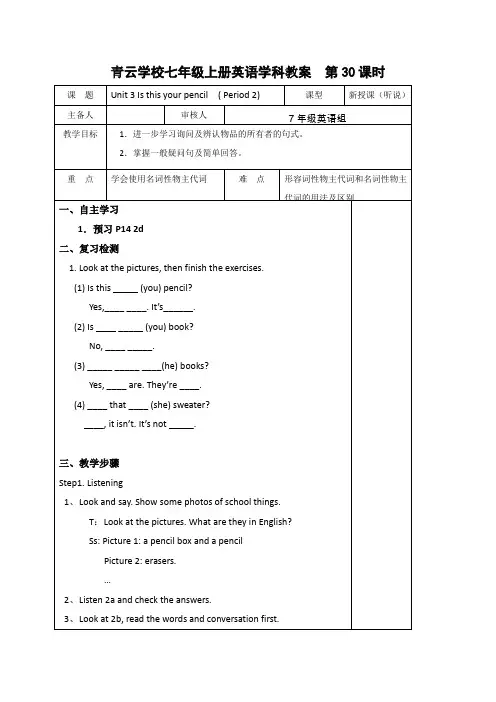
青云学校七年级上册英语学科教案第30课时课题Unit 3 Is this your pencil ( Period 2) 课型新授课(听说)主备人审核人7年级英语组教学目标1.进一步学习询问及辨认物品的所有者的句式。
2.掌握一般疑问句及简单回答。
重点学会使用名词性物主代词难点形容词性物主代词和名词性物主代词的用法及区别一、自主学习1.预习P14 2d二、复习检测1. Look at the pictures, then finish the exercises.(1) Is this _____ (you) pencil?Yes,____ ____. It’s______.(2) Is ____ _____ (you) book?No, ____ _____.(3) _____ _____ ____(he) books?Yes, ____ are. They’re ____.(4) ____ that ____ (she) sweater?____, i t isn’t. It’s not _____.三、教学步骤Step1. Listening1、Look and say. Show some photos of school things.T:Look at the pictures. What are they in English?Ss: Picture 1: a pencil box and a pencilPicture 2: erasers.…2、Listen 2a and check the answers.3、Look at 2b, read the words and conversation first.4、Listen 2b, then check the answers.Step2. Role-play the conversation (P14,2d)1. Read 2d, then finish the excises:Eg: Bob’s= Bob’s pencilhis= Helen’s=hers= yours=2. Read 2d again, the answer the questions:(1). Whose pencils are they?Bob’s.(2). Is this Helen’s green pen?Yes, it is. It is hers.(3).Is this Bob’s eraser?No, it isn’t. It’s Anna’s.3. Listen and repeat. Try to imitate the pronunciation andintonation.4. Practice and act out the conversation.Explanation1、Excuse me 意为“劳驾,请原谅”,是打扰别人时常用的客套用语,常用于请求帮助、询问问题、打断谈话等场合。
七年级英语上册 Unit 3 Is this your pencil讲义+习题 (新版)人教新目标版
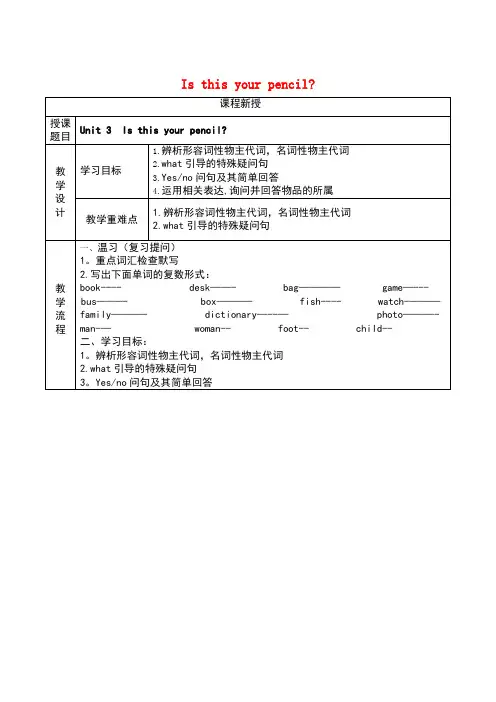
We us ours our
It it its its
They them theirs their
人称代词主格:作主语,表示“谁”怎么样了,干什么了。
人称代词宾格作宾语,表示动作行为的对象。
形容词性物主代词 (my/your/his/her/its/our/their)+名词,而名词性物主代词 (mine/yours/his/hers/its/ours/theirs)则相当于形容词性物主代词+名词,故其后不必加名词。名词性物主代词=形容词性物主代词+名词。如:
10. I like(你的)better than(她的)。
二、用所给词的适当形式填空
1. That is not ______ kite。 That kite is very small, but ______ is very big。 ( I )
2. The dress is _______. Give it to _________。 ( she )
5.Emma has two d, Alice and Mary.
6.My uncle’s son is my c.
7.This is Paul’s family p.
8.Those are my two b.
9.Your mother’s mother is g。
10。 Are these ______ tickets? No, ______ are not _______。 _______ aren’t here. ( they )
11。 Shall ________ have a look at that classroom? That is _________ classroom。 ( we )
人教版新目标版七年级英语上册 Unit 3 Is this your pencil全单元教案
Unit3 Is this your pencil?一、单元分析本单元的标题为 Is this your pencil? 话题为 Things in the classroom.。
本单元与第二单元衔接紧密:由this,that的学习过渡到these, those的学习,由指示一个人、物过渡到指示多个人、物,使学生学会区分远近单复数。
本单元围绕“识别物品的所属”,使学生学会询问物品的主人的基本句型“Is this/that your/her/his pencil? Yes, it is. No, it isn’t.”,体会一般疑问句的用法;学习如何写“失物招领、寻物启事”,巩固所学单词的拼写“How do you spell pen? P-E-N.”。
通过以上几个方面的学习,既能提高学生解决问题的能力,又能巩固所学知识。
根据教材内容我把该单元的教学目标定为:1语言知识⑴语言结构:复习指示代词this, that,these,those和What 引导的特殊疑问句用法学习Yes/No问句及其简单回答学习句型How do you spell pencil?的用法⑵语言功能:学会辨认物品的所有者询问物品的所属,对物品的所属进行提问和回答能够使用目标语言写失物招领和寻物启事2语言技能:听:能识别不同句式的语调,并能根据语调变化,判断句子意义的变化;能听懂本课学习活动中的问题,作出较得体的回答。
说:能在本课的任务型活动如:失物招领、制作海报、编写谜语等中进行简单有效的交流。
读:能正确朗读本单元课文;能查阅工具书为完成任务做准备;能阅读有关外国学校简单的背景材料。
写:能使用简单的句子和短语参照范例写出“寻物启示”、“失物招领”等语言材料。
3学习策略目标:•使学生明确自己学习的需要,自觉完成课前任务。
•通过Contest Guessing 和Role playing,使他们能主动积极地参与课堂活动。
·通过完成任务, 培养一种群体意识, 自主学习及合作学习的意识.※跨学科学习:·艺术:画出所学物品并依此支持完成失物招领和寻物启事。
人教新目标版七年级英语上册 Unit 3 Is this your pencil?单元教案
人教新目标版七年级英语上册Unit 3 Is this your pencil?单元教案Unit 3 Is this your pencil?一、教材分析本单元以school things为话题,设计了三个部分的内容。
旨在通过单元教学使学生学会辨认物品的所有者,学会根据场景询问物品的所属,以及英语中对应的表达法,学会写寻物启事和招领启事。
Section A学会询问物品的所属。
1a, 1b, 1c 重点学习一些表示学习用具的词,学会询问物品的所属。
二、三维目标语言目标Target language1. Words & expressions生词和短语 this, pencil, pe n, book, eraser, ruler, dictionary, that, yes, no, not, case, pencil case, pencil sharpener, isn’t=is not2. Key sentences重点句子(1) Is this your pencil? Yes, it is. It’s my pencil. No, it isn’t. It’s his backpack.(2) What’s this/that in English? This/That/It is… Abi lity goals能力目标 Enable the students to learn to identify ownership Learning ability goals 学能目标 Help the students learn how to identify ownership.三、教学重点How to identify ownersh ip.四、教学难点How to identify ownership.五、教学策略1.对初学者应注重兴趣的培养,宜采用游戏、唱歌、竞赛、小组合作等多种活动方式。
七年级英语上册Unit3Isthisyourpencil教案(新版)人教新目标版.docx
Unit 3 Is this your pencil?The First PeriodSection A (la-2d)I •Teaching aims:1.Knowledge aims:(1)Keywords :pe nci 1, book, eraser, box, school bag, dictionary, his, mine, hers, excuse, mo, tha nk ,teacher,about, yours, for, help, welcome(2)Key phrases:excuse me,thank you for...,pencil box(3)Important sentences:①一Is that your school bag?—No, it isn,t. It" s his.②一Are these your book?一No, they aren" t・They" re hers.2.Ability aims:Learn to identify ownership of the things in the classroom.3.Emotion aims:Make students guess the owners of the things in the classroom.IL Important points:Train students, listening skills.III.Difficult points:Grasp some new words about their school things.IV.Teaching processStep 1 Warming up1.Show some pictures or objects about school things like pen, ruler, cup, schoolbag, pencil...—What? s this in English?—It' s...2・ Work on la.©Read the words in la.②Let students look at the picture in la.(3)Ask students to find out the things in the picture, then match the things withwords・ Tcachot checks the answers with students.④ Let the students read the new words aloud after the teacher .Then remember the new words. Step 2 ListeningWork on lb, 2a and 2b.1・Listen and number the conversations [1-3].2.Listen and check(/) the things you hear.3.Listen again .Complete the conversation with the words in the box.4・Check the answers in lb,2a and 2b・Step 3 PairworkWork on lc and 2c.1.Practice the conversations above with your partner. Then greet your classmates.2.Practice the conversation in 2b. Then make your own conversations using the things in yourclassroom.e.g.—Ts this your school bag?一No, it isn,t.Step 4 Role-playWork on 2d.Let students read the conversation. Then let students role-play the conversation and give them 5minutes to recite it.Language points1.penc订box文具盒pencil box二pencil case注意:box的复数形式是boxeso2.eraser橡皮;橡皮擦;黑板擦The eraser is white.这块橡皮是白色的。
人教新目标版七年级英语上册Unit3IsthisyourpencilPeriod4教案
Unit 3 Is this your pencil Period 4目标一、教学目标:1. 语言知识目标:1)总结复习所学过的有关学习用品的英语词汇。
2)总结复习形容词性物主代词与名词性物主代词,并了解它们的用法。
3) 能够使用目标语言询问东西的所属,或者寻找物品的主人。
4) 在老师的指点帮助下能够写一些简单的招领和寻物启示。
2. 情感态度价值观目标:通过学习“询问物品所属”及写作“寻物启事和失物招领”。
既可以提高学生遇到类似挫折时的解决问题的能力,激发学生的主动性和学习兴趣。
又能培养学生拾金不昧的精神和助人为乐、团结友爱的品德。
重点难点1. 教学重点:1)总结复习有关学习用品的词汇。
2)通过读、写的训练来让学生熟练掌握询问物品的所属或寻找物品的主人。
3)写作一些简单的招领和寻物启示。
2. 教学难点:指导学生写作一些简单的招领和寻物启示教学环节与内容师生活动白板应用用时Ⅰ. Warming- up and revision1. G reeting the Ss. Check the homework.2. Review the schoo l things we learned in Section B. Let Ss say the school things they have.3. Pick up some school things (learned in Section B) from the students’desk and ask about them.T: Is thisLi Mei’sschoolbag?S1: Yes,it is. It’shers.T: Is thatLi Me i’snotebook?Ss: No, itisn’t. It’sWu Ming’s.T: Arethese LiMei’s IDcard?Ss: Yes,1010(Using this, that, these, those) Let other students answer thequestions.They must say the owner the things.Ⅱ. Presentation(Show a set of keys to the Ss.)T: These are some key s. This is a set of keys.(Write on the blackboard.) a set of 一套;一幅;一组 a set of stamps 一套邮票 a bag of 一袋子…… a bag of rice 一袋大米 a bag of applesthey are. They ’re hers.T:Are thoseLiTao ’s computer games? Ss:No,they aren ’t. They ’reZhang Bin ’s. …1010一袋苹果Ⅲ. Writing1. Let’s work on 3a. Here are two notices but some words in the notes are missing. Read the notices and complete the notices with thewords or phone number in the box.2. Ask some Ss read the words in the box. One read them in English. The other read them in Chinese.3. Ss read and complete the notices.4. Check the answers. 1. 写作指导:T: Have youever picked upothers’things or lostanything?What are they?S1: I lost adictionary.S2: I pickedup a watch.T: Good. Whatwill you do55Ⅴ. Self Check 1 1. T: We’ve learned many school things. Now first review all the school things in three minutes. Then let’s have a competition. We’ll write the school things you can remember in a piece of paper. Let’s see who can remember the most.2. Ss review the words of the school things quickly. Then have a competition.3. Check the numbers of the words on their paper to see with these things?Ss: …Write a notice and put up in the lost and found.T: All of you are right. Today we are going to learn how to write “Lost”and “Found”notices. Look at the “Lost”and “Found”notices in 3a and find out the important informat ion about it.Ⅶ. Self Check 3 1. T: Look at the picture please. What are they talking about in the picture? Who would like to read it?S1: Is that your schoolbag?S2: No, it isn’t. T: OK, now what may other people (S2, S3 and S4) talk about in Picture? Write the conversation using Is this/that…? Yes, it i s./ No, it isn’t. Are these/those …? Yes, they are. / No, they aren’t. (Students write the color, we can also put a picture of the thing on it.2. T: OK. Now let’s try to write it. You may use the one in 2b or the one in 3a as a model. (Studen ts wr ite their bulletin board notices and the teacher moves around the room offering language support as needed.)T: Let’s readconversations with their partners.)2. T: Now please read the conversation with your partner.S3: Is that your notebook?S4: Yes, it is.S5: Are those your keys?S6: No, they aren’t. some of your notices. (Ask some students read their message aloud. And others to help correct their work.)板书设计Section B 3a-Self Checka set of 一套;一幅;一组 a set of stamps 一套邮票a bag of 一袋子…… a bag of rice 一袋大米a bag of apples 一袋苹果教。
七年级英语上册 Unit 3 Is this your pencil?教案(1)(新版)人教新目标版
Unit 3 Is this your pencil?Ⅰ.Teaching AimsKnowledge ObjectsKey vocabulary: pencil, pen, book, eraser, ruler, pencil box, schoolbag,dictionaryTarget language: Is this your pencil?Yes, it is. It’s mine.Is that your backpack?No, it isn’t. It’s his.Are these your books?No, they aren’t. They’re hers.Ability ObjectsTrain students’ listening skill.Train students’ communicative competence using key vocabulary and target language. Moral ObjectIf something doesn’t belong to you, give it back to its owner.Ⅱ.Key PointsThe names of some common personal possessions.How to identify ownership.Ⅲ.Difficult PointStudents can communicate with others using the key vocabulary and the target language learned in this class in everyday situations.Ⅳ.Teaching MethodsScene teaching method.Singing method.PairworkⅤ.Teaching AidsMultimediaⅥ.Teaching Procedures.Step1 RevisionListen to a song “Hi, hello, what’s your name?”Students listen to the song and try to sing it, and then answer with “my name is…”Point at a boy who has said his name and ask other students “What’s his name?” The other students may use “His name is…” to answer.Point at a girl and ask the students “What’s her name?” Students may use “Her name is…” to answer.Step2 Lead-inShow a pencil, ask st udents “What’s its name?”——“Pencil”“Is this your pencil?” …Step3 New words learningAsk the students “Where do you put your pencil in?” students must think about “pencil box”. Then learn this word.Ask students to take out the things in their pencil box. Learn the words: pen, eraser, ruler.“Where do you put your pencil box in?” Lead to the learning of “schoolbag”.“What are the other things in you schoolbag except the pencil box?” This sentence will lead to the learning of “book”, “dictionary”.Read the words for several times. Pay attention to the pronunciations.Give each pair of students an object. Ask them to make conversations using the words they have learned just now.(What’s this/that/these?---This is/That is/These are…Match the words with the things in the picture, and then check the answers (e g b h c f a d )Listen to a song “show me”.Get the students to sing the song and show their things.Step54Practice the target language.Show several pictures and ask the students to make conversations according to the pictures by themselves. Support following target language:Is this your … ? ——Yes, it is. It’s mine.——No, it isn’t. It’s his/hers.Is that your… ? ——Yes, it is. It’s mine.——No, it isn’t, It’s his/hers.Are these your… ?——Yes, they’re mine——No, they aren’t. They’re his/hers. Read the conversations. Girls ask and boys answer.Step6 listeningListen to the conversations carefully.Listen to the conversations again, and number the conversations.Check the answers (3.2.1.)Listen for the third time and repeat the conversations.Teaching aims学完本课后,学生应能:学生应能掌握关于文具用品的单词(听和写)。
人教版英语七年级上册Unit 3 Is this your pencil教案
人教版英语七年级上册Unit 3 Is this your pencil教案一. 教材分析人教版英语七年级上册Unit 3的主题是“Is this your pencil?”,主要学习如何询问和描述物品的归属。
本节课通过一个关于物品归属的故事情境,引导学生掌握一般疑问句的构成和用法,以及如何用Yes/No回答一般疑问句。
教材内容丰富,插图生动,有助于激发学生的学习兴趣和积极性。
二. 学情分析七年级的学生已经掌握了基本的英语语法和词汇,具备一定的听说读写能力。
但部分学生在发音和听力方面还存在困难,需要重点关注和指导。
此外,学生们的学习兴趣和积极性较高,课堂参与度较好。
三. 教学目标1.知识目标:学生能够掌握一般疑问句的构成和用法,学会用Yes/No回答一般疑问句;能够听懂、会说、会读本节课的重点词汇和句型。
2.能力目标:学生能够在真实情境中运用所学知识进行简单的交流,提高语言运用能力。
3.情感目标:培养学生热爱生活、关爱物品的良好品质。
四. 教学重难点1.重点:一般疑问句的构成和用法,用Yes/No回答一般疑问句。
2.难点:一般疑问句的听力理解,以及在不同情境下的运用。
五. 教学方法1.情境教学法:通过设置真实的生活情境,让学生在实践中学习和运用语言。
2.交际法:引导学生进行小组合作,开展角色扮演、对话等活动,提高口语表达能力。
3.游戏教学法:运用趣味游戏,激发学生的学习兴趣,巩固所学知识。
六. 教学准备1.教师准备:教材、教案、多媒体教学设备、实物物品等。
2.学生准备:预习教材,了解本节课的学习内容。
七. 教学过程1.导入(5分钟)利用歌曲、游戏等趣味方式,引导学生进入学习状态。
2.呈现(10分钟)展示教材中的插图,引导学生观察并描述图片内容。
引入一般疑问句的概念,展示一般疑问句的构成和用法。
3.操练(15分钟)开展小组活动,让学生相互提问并回答,巩固一般疑问句的用法。
4.巩固(5分钟)设计听力练习,让学生听懂、会答一般疑问句。