
外研版六上英语M8U1教案
Activity 1: Look, listen and say.
1.学生先翻开Page44,自主阅读第一部分。教师播放录音,学生跟读。(教师可视学生情况多放几遍)
2.教师播放第一部分的动画视频,学生观看视频并尝试跟读。
3.讲解第一部分课文
张寨镇联校六年级英语上册教学设计
(2019—2020学年第一学期)
课题
Module8 unit1 Do you often play with dolls?
主备人
姚亚军
使用人
知识点
学情分析
本模块以Habits(习惯)为话题,第一单元围绕Lingling和Amy看照片展开,谈论自己的喜好和经常行为习惯。本单元的语言结构学习内容是学习Do you often…?和Do you like doing…?以及回答Not really. Yes, of course. Not very often.并引导学生理解句型I often read stories. She often reads stories.中人称与动词的变化。
----Not very often.不经常做某事。
3. I often … .我经常做(某事)。
Step 5: Homework
1.能独立完整地朗读故事对话。
2.完成配套教辅相应的练习。
巩固与拓展训练:
连词成句。
1、you Do want to see photos my (?)
2、reads English books always She(.)
◇◇◇◇◇◇◇◇◇◇◇◇◇◇◇◇◇◇◇◇◇◇◇◇◇◇◇◇◇◇◇◇◇◇◇◇◇◇◇◇◇◇◇◇◇◇◇◇◇◇◇◇◇◇◇◇◇◇◇◇◇◇◇◇
教学程序
关注点修改补充
Step 1: Warming up
1. Greetings.(师生间进行愉快的问候。)
2. Free talk:what doyou do on weekends ? .
Step4: Summary
总结今天所学的内容。
1.单词:often频率副词,表经常。
2.句型:询问对方是否经常做……(某事)?
Do you often ….?
---- Yes, of course = Yes,(I do)表示肯定,经常做某事。
---- No .I don’t .= Not really.表示否定,事实上没有。
4.Situational dialogue.
学生在小组中分角色朗读故事。
Step 3: Consolidation
1.游戏,火眼金睛。
全班抢答竞赛,单词和词组知识一闪而过,看谁记得快记得牢。
2.句型操练。
Activity 4 Practise(Follow and say)
小组合作,仿照例子,利用新学句型Do you often…?,尝试用不同动词替换来造句。
2.,学生翻开书自助朗读对话四个部分,然后回答问题。
T: Does Amy often play with dolls?
---Not really (不全是,事实上没有).
T: Does Amy often like reading books now ?
---Yes, of course.(是的,当然)
3、Do often clean you your room(?)
板书
教学反思
备课,是时时刻刻的反思和一生的准备。
a)It's interesting.它很有趣。“interesting”形容词,有趣的。
b)Who took it?谁拍的?“took”原形take ,在这里是拍照的意思,是指这张照片是谁拍的?
c)It's old。它很古老。“old”在这里是指时间久远的。
Activity 2 Listen, read and act out
T: Does Amy often clean her room?
---Not very often. (不经常打扫) .
T: Does Amy often take photos?
---Yes, she does. (是的,她经常)
3.Follow the tape
回顾对话内容,再次完整播放录音动画,学生集体跟读录音。老师可以在每句话后停顿,请学生模仿跟读,并注意人物所使用的语言。
老师热情地问候学生们后,可以询问学生们周末都干什么,为导入“often”做垫。
T:What do you do on weekends?
Ioftenread books, Ioftendo some housework. What about you?
(板书“often”---经常)
出示其他做运动的图片,让学生尝试用“often”造句。
重点、难点
重点:复习现在进行时,新授单词:often,clean,always等。
难点:正确使用Do you often……?句型,正确区分现在进行时,一般过去时和一般现在时。
目标定位
1.知识目标:(1)动词短语和频率副词often的掌握及使用。(2)能在实际生活中正确运用句型:Do you often….?---- Yes, of course. / Not really. / Not very often.2.技能目标:能通过Do you often….?的问句以及回答,讨论行为习惯和喜好。3.情感目标:养学生对英语学习的兴趣。培养学生大胆开口、积极合作、主动学习,增强沟通能力,增进彼此了解,改善人际关系。
1.谈话导入.
Amy和Lingling在看一些照片,到底是什么照片呢?他们又聊了一些什么?我们大家一起来看一下。
教师播放对话录音或动画,呈现对话情景,目的让学生了解对话的大概内容。
教师提问,学生看完光盘回答问题。
T:How many photos are there in the story? ---Four.
外研版小学英语六年级上册单元教案-Module1教案

外研版小学英语单元教案Module 1知识与技能:全体学生能朗读课文,阅读相关短文,并能按要求完成语句书写。
过程与方法:对所学内容主动复习和归纳。
情感态度与价值观:乐于接触外国文化,增强祖国意识。
第一课时Unit 1 It’s more than twenty thousand kilometers long.【教学目标】:知识与技能:1. These postcards are great .2. It’s a picture of the Great Wall .3. How long is the Great Wall ?It’s about six thousand seven hundred kilometers .过程与方法:讲述关于某个地方或某件事物的情况。
情感、态度和价值观:【重点】: words and phrase: postcard more thousand kilometer million Mexico Canada【难点】:Sentences: Tell me more about the Great Wall. It’s a picture of great wall.【课时安排】:1课时【教学过程】:(一)导入:老师热情地问候学生们,欢迎他们在暑假过后回到学校。
老师可以询问学生们在假期里都去了哪些地方,做了哪些事情,有没有特别有趣的经历。
建议他们通过展示图片和照片介绍相关的情况,可以使用句型“It’s a picture of.__It's very…”等。
(二)探究新知:1.将本课的挂图贴在黑板上,播放录音,呈现SB活动1,让学生看书,听听Daming 和Simon的对话,听完之后,让学生说一说:Who is Simon ? Where is Daming ? What are they doing ?2.让学生打开书,放录音,学生边听边看书,勾画出课文中的生词。
小学英语六年级上册M8U1教案
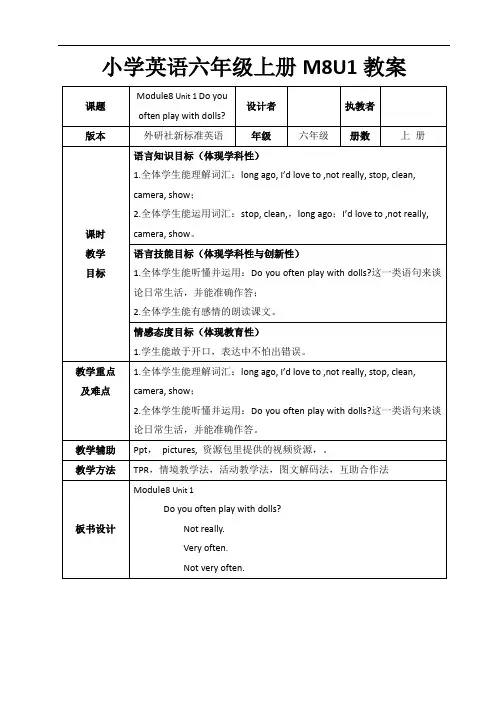
语言技能目标(体现学科性与创新性)
1.全体学生能听懂并运用:Do you often play with dolls?这一类语句来谈论日常生活,并能准确作答;
Do you like picture book?(拓展story book,comic book)
2.Let’s ask Amy.
Amy,Do you like reading books now?
listen to P2.
3.How does Amy say?
Let’s read together.
Listen and follow.
学生先猜测,再带着问题听音证实答案。
Step 3
Text
ቤተ መጻሕፍቲ ባይዱLearning
Before reading:
1.T:Do you want to see more photos?
2.Listen to the first time with a question.
First time:listen
我有两个地方使用了助学单:一是课前,请学生写出你以前学过的动词或动词短语,这一部分设计目的是让学生复习旧知,并且全班孩子都能够独立完成,达到了助学单有效运用的目的。二是课中,在学习第四幅图时,我结合助学单,先让学生自学并勾画生词,在全班说出不认识的单词,由会读的同学帮助他。接着让学生补充下列表格,让他们自己梳理信息,理清思路;最后每人提出1—2个问题,先在小组内回答,最后在全班范围内解决。
小学英语六年级上册M8U1教案
课题
Module8Unit 1Do you often play with dolls?
六年级上册英语教案-Module 8 Unit 1外研版三起

Period 2本课时为第八模块第一单元的第二课时,主要学习教材第46页的内容。
本课时为一节复习课,活动3通过对话的形式呈现上一课时的重点词汇stop、clean、not really和重点句型“Do you often+动词原形(+其他)?”,让学生进一步复习所学词汇和句型。
活动4再次对句型“Do you often+动词原形(+其他)?”进行反复操练。
知识目标能够用句型“Do you often+动词原形(+其他)?”询问对方的行为习惯并作答。
能力目标能够在实际情景中运用核心词汇和句型询问对方的行为习惯和爱好。
情感目标通过小组合作增加学生之间的了解,帮助学生建立更加深厚的友谊。
教学重难点能灵活运用句型“Do you often+动词原形(+其他)?”。
教师让学生反复朗读对话,熟悉该句型。
然后教师通过一些日常活动的图片,让学生与同桌之间用图片所表达的短语进行关键词替换,反复操练句型。
多媒体课件、录音机、图片、磁钉、小红花。
Step 1:Warm-up师生进行日常对话,如:T:Do you often play with dolls?S1:Yes,I like dolls.T:Do you often read books?S2:Yes,I like reading stories.T:Do you often clean your room?S3:Not very often.T:Do you often take photos?S4:Yes,I love taking photos.通过师生日常对话,复习上一课时所学重点词汇和句型,同时为新课的学习做准备。
Step 2:Presentation1.Activity 3·教材意图本部分是为复习句型“Do you often+动词原形(+其他)?”而设计的对话活动。
·教学建议(1)教师让学生观察活动3中的两幅图片,预测对话内容。
最新外研版小学英语六年级上册M8U1公开课教学设计
最新外研版小学英语六年级上册M8U1公开课教学设计Module 8总备课知识与技能:全体学生能朗读课文,阅读相关短文,并能按要求完成语句书写。
过程与方法:运用已学语言谈论日常生活习惯。
情感态度与价值观:在学习和日常交际中,能初步注意到中外生活习惯的异同。
第一课时Unit 1 Do you often play with dolls ?【教学目标】:知识与技能:How many photos are there in the story ?What can you see in them ?Does Amy often play with dolls /read stories / clean her room?过程与方法:探究式学习方法,小组合作交流法,情景教学法,任务型教学法情感、态度和价值观:谈论行为习惯和喜好。
【重点】:本模块的单词及句型【难点】:现在进行时的用法【课时安排】:1课时【教学过程】:(一)导入:一.复习:1.老师向学生展示自己的一些照片,让学生对照片进行描述。
2.让学生几个人一组讨论各自在星期天都喜欢干什么,引导大家关注自己和同伴的日常生活。
二.任务呈现与课文导入:1.拿着自己的照片,询问学生是否经常去公园或经常做与你相同的事情:Do you often ?出示一些表现各种活动的单词卡片,让学生说出相应动词或词组。
例如:help your mum ,eat fast food , readstories 等。
出示单词卡片,向学生提问:Do you often help your mum?引导学生作出回答。
2.带领学生温习often 的意思。
在黑板上写出星期一到星期日的单词,一边说句子,一边在相应的位置上打勾号I watch TV on Friday , Saturday and Sunday . I often watch TV.3.告诉学生:在今天的课文中,我们要了解到Amy 和Lingling 的一些爱好和习惯。
外研版小学英语六年级上册单元教案-Module1教案
外研版小学英语单元教案Module 1知识与技能:全体学生能朗读课文,阅读相关短文,并能按要求完成语句书写。
过程与方法:对所学内容主动复习和归纳。
情感态度与价值观:乐于接触外国文化,增强祖国意识。
第一课时Unit 1 It’s more than twenty thousand kilometers long.【教学目标】:知识与技能:1. These postcards are great .2. It’s a picture of the Great Wall .3. How long is the Great Wall ?It’s about six thousand seven hundred kilometers .过程与方法:讲述关于某个地方或某件事物的情况。
情感、态度和价值观:【重点】: words and phrase: postcard more thousand kilometer million Mexico Canada【难点】:Sentences: Tell me more about the Great Wall. It’s a picture of great wall.【课时安排】:1课时【教学过程】:(一)导入:老师热情地问候学生们,欢迎他们在暑假过后回到学校。
老师可以询问学生们在假期里都去了哪些地方,做了哪些事情,有没有特别有趣的经历。
建议他们通过展示图片和照片介绍相关的情况,可以使用句型“It’s a picture of.__It's very…”等。
(二)探究新知:1.将本课的挂图贴在黑板上,播放录音,呈现SB活动1,让学生看书,听听Daming 和Simon的对话,听完之后,让学生说一说:Who is Simon ? Where is Daming ? What are they doing ?2.让学生打开书,放录音,学生边听边看书,勾画出课文中的生词。
外研版(一起)六年级英语上册全册教案
Module 1Unit 1 How Long is the Great Wall?本单元是外研英语(一起)六年级上册第一模块的第一单元。
通过大明和其堂兄弟的对话介绍了长城的长度和年龄,引出了句型How long is the Great Wall? It's forty thousand li long. How old is the Great Wall? It's more than two thousand years old.通过对本单元的学习,让学生可以用新的知识点来进行简单的对话并描述不同的事物或地点,并通过对国家名胜古迹的了解来增强他们的民族自豪感。
【知识目标】1、学习新单词:thousand, kilometre, might, million, place, building;2、掌握新句型并知道该如何正确地使用:How long is the Great Wall? It's forty thousand li long. How old is the Great Wall? It's more than two thousand years old.【能力目标】让学生可以用新的知识点来进行简单的对话并描述不同的事物或地点。
【情感目标】激发学生关于本课的学习兴趣,并通过对国家名胜古迹的了解来增强他们的民族自豪感。
【教学重点】1、词汇:thousand, kilometre, might, million, place, building2、句型:How long/old...?It’s...Tell me more about...【教学难点】Kilometres, metres, li等长度单位的使用以及数字的辨读。
Tape recorder, Multimedia1. Free talkT: Hi. My class, did you have a good holiday?What did you do in your holiday?2. Lead-inT: Where did you go?Can you tell me some about...?Oh, it’s great! Our old friend Daming also had a good holiday, do you want to know what Daming did in his summer holiday? Let’s begin our class and see what Daming did in his holiday.Step2. Preview1. Listen to the tape, and let students read the song together.2. Show some pictures of the Great Wall, and introduce it.3. Let the students talk about the Great Wall or other places of interests.Step3. Presentation1、带着问题听课文:T: Now, let’s listen to the text and I want some students can tell me some about Daming’s holiday, OK?T: OK, does anyone can tell me what Daming did in his holiday? And what they said about?(叫一些学生来回答)T: You are so good! Let’s listen again and read it together, OK?2、朗读课文并解释知识点:老师一句接一句地带领全班同学进行朗读,并在朗读的时候适时地通过板书或者幻灯片来讲授知识点。
小学英语外研版六上M8模块备课设计(完整版)
Uint 1 教学设计1.(Show some pictures in the song.)What do you like doing?Ss: I like…(running、painting、reading…)…can help you…2.I like collecting dolls. I often play with dolls.3.Do you often play with dolls?Yes, I do. /No, I don’t.4.Girls may like it. And today we’re going to learn M8U1. Together.1.Look,Amy and Lingling are talking about Amy’s photos.Let’s listen and order the photos.出示课本中的图片,听录音并排序。
2.Look at this picture. Little Amy is playing with dolls.Lingling asks her—Listen and repeat. 展示板书Together.How does Amy answer. Listen!展示板书Together.“Not really”means Little Amy often played with dolls. But Amy doesn’t play with dolls now.So Amy says:…(Listen) 学习单词: stop.3.Listen and repeat these sentences.4.Let’s practice in pairs.5.We talked about the first picture. How do they talk about the other pictures? Please read part 2&3&4 silently and carefully. And complete the mind map.6.Who wants to show?学生展示思维导图7. Listen and repeat these sentences. Pay attention to your pronunciation andintonation. Try to read emotionally.8.Role playin pairs by the mind map.9.Read the text by yourself. If you have any questions, you can ask for help.10.Talk about your habbits.(两人一组,用Do you often…? I often…一问一答的形式进行对话练习。
【六年级】外研版英语六上MODULE8Unit1Lookingatphotosword教案2篇
【关键字】六年级外研版六年级英语上册教案Module 8 Unit 1 Looking at Photos教学内容:Unit one Looking at Photos学习任务:Do you often play with dolls?功能:谈论行为习惯和喜好教学程序:1.WarmerHave the students look at activity 1. They should number the pictures1, 2,and 3 respectively. Make sure they do this very lightly in pencil so that they can erase it later.Now tell the students that you are you are going to say things about the story and they have to say which pictures you are talking about.2. Listen, point and find ‘often”.Have the students close their books.Tell the students that you are going to play the tape and stop after each utterance. The students have to tell you who the speaker was: Lingling or Amy.No w play the tape a second time and tell the students to call out ‘stop’ each time they hear the word ‘often’.3. Ask and answer.Get two pieces of large paper.On one piece write ‘very often’ and on the other piece write ‘not very often’.Put the pieces of paper on the walls around the classroom.Now tell the students that you are going to ask them questions and they have to point to the relevant responses.Example: T: do you often go to see films?Ss:(point to the response that is relevant for them)T: do you often play computer games?Ss (point to the response that is relevant for them)4. homework: read the text板书设计:Unit one Looking at PhotosDo you often play with dolls?Do you often go to see films?Do you often play computer games?教学札记:Learning and EnjoyingModule 8 Unit 1 Looking at Photos.预习提纲只看课文插图,听录音一遍。
外研版(一起)六年级英语上册教案Module8Unit1(1)
MODULE 8Unit 1 Do you often tidy your room?
学科
英语
班级
六年级
单元
Module 8
课题
Do you often tidy your room?
磨教材
教材简析
玲玲想知道艾米在干什么,艾米告诉她自己在整理房间。玲玲发现艾米的书橱比较乱就主动帮她一起整理,收拾完后两人高兴地一起读书。
教学目标
能力目标:用一般现在时态对日常行为进行问答。
知识目标:四会单词tidy bookshelf week often room stories story
四会句子:Do you often tidy your room? Nories to my little brother.
2.预习(Preview)
板书课题,引出词组tidy your room,告诉学生tidy可以当动词用,意思是整理、收
磨
教
学
过
程
拾;也可以当形容词用,意思是整齐的、整洁的。带领学生朗读该词组,然后教师进行提问。T: Do you often tidy your room? S:Yes, I do. / No, I don’t.对于做肯定回答的学生,教师予以表扬。并告诉学生,在日常生活中要养成良好的习惯。今天我们就去Amy家看看Amy和Lingling有哪些好习惯值得我们学习。
⑵看书听录音,回答下列问题。
①What is Amy doing?
②What can’t Amy find in her room?
③Does she often tidy her bookshelf?
④What will Lingling do for Amy?
2023外研社小学英语课件(一起点)M8U1课时备课
Beijing is in the ____ of China.
前置
测评 Shanghai is in the _____ of China.
教学过程
课堂 导入
Show the learning aims . 1.会正确认读、听说单词 best rest country speak capital map maybe Los Angeles Washington DC 2.能准确朗读课文。 3.会使用…is in the…of… 和 He lives in the…of....句型描述某一地点或某人居住的具 体位置。
一.Listen and chant.
1. Let’s listen together and try to find out the answer. Which is the best?
2. OK! Let’s chant together. (用活动一的 chant 引出方位词,导入今天的新课)
----It’s Washington DC.
----It’s in the east of the US.
核心问题:Where is Los Angeles?
What’s the capital of the US?
Where is Washington DC?
4. Learn to say the new word New York Washington DC east west speak。
A:能使用 It is in the…
描述某个城市的方位。
Where is New York?
(通过借助指南针,学生能简单感知美国城市的方位,能
使用 It is in the…描述某个城市的方位。)