
【人教pep版】五年级下册英语 第1-6单元知识点梳理大全
第一单元:一、重点词汇。
eat breakfast吃早餐have·class 上··课play sports 进行体育运动exercise 活动,运动。
do morning exercises早锻炼eat dinner吃晚饭clean my room 打扫我的房间go for a walk 散步go shopping 去购物take学习,上(课)dancing 舞蹈take a dancing class 上舞蹈课a.m上午p.m.下午usually 通常地一、其他日常活动。
get up起床eat lunch吃午饭go to bed 上床睡觉wash my face洗脸wash my clothes 洗我的衣服watch TV看电视play ping-pong打乒乓球play the pipa弹琵琶go swimming 去游泳go running去跑步do homework 做作业do kung fu练武术play football踢足球play basketball打篮球二、频度副词。
always总是,一直(100%)usually通常(80%)often 经常(60%)sometimes (30%)有时三、疑问词。
when什么时候why 为什么四、重点句型。
1、询问别人什么时候做某事的句型及回答。
句型结构:问:When do you+动词短语原形+其他?(你/你们什么时候做某事?)答:I/we(+频度副词)+动词短语原形+at+具体时间(我/我们通常在几点做某事。
)例:问:When do you go to bed?(你什么时候上床睡觉?)答:I go to bed at 9:00p.m (我晚上9点上床睡觉。
)注意:当主语是第三人称单数(he,she,it,单个人名或单数名词)时,助动词do要变成does,句型结构是:whendoes+主语(第三人称单数)+动词短语原形+其他?2、询问别人周末做什么的句型及回答。
句型结构:问:What do you do on the weekend?(你周末做什么?)答:I(+频度副词)+动词(短语)+其他。
例:问:What do you do on the weekend?(你周末做什么?)答:I usually read books. (我通常看书。
)注意:当主语是第三人称单数(he,she,it,单个人名或单数名词)时,助动词do要变成does,句型结构是:whatdoes+主语(第三人称单数)+do+on the weekend?第二单元:一、重点词汇spring 春天summer 夏天autumn秋天winter 冬天season季节picnic 野餐go on a picnic 去野餐pick摘pick apples摘苹果snowman雪人make a snowman 堆雪人go swimming去游泳which 哪一个best最because 因为vacation 假期一、其他1、形容天气的形容词rainy多雨的windy 多风的sunny晴朗的cold 寒冷的warm 暖和的cool凉爽的hot 炎热的cloudy 多云的snowy下雪的foggy有雾的2、由go构成的活动短语go swimming去游泳go shopping去购物go boating去划船go skating去滑冰go hiking 去远足go fishing去钓鱼三、重点句型1、询问别人天气怎么样的句型及回答。
句型结构:问:What’s the weather like+时间+地点?(··天气怎么样?)答:It’s+表示天气的形容词例:问:What’s the weather like in winter in Beijing?(北京冬天的天气怎么样)It’s cold and windy(有风而且寒冷。
)2、询问别人最喜欢的季节句型及回答。
句型结构:问:which season do you like best? (你最喜欢的季节是哪一个?)答:I like+季节+best或直接说季节名称。
同义句还有:What’s your favourite season?3、询问别人喜欢某个季节的原因的句型及回答。
句型结构:问:Why do you like+季节名称?或直接用“Why”来提问。
答:一般要用“because”引导的句子来说明理由,可以从天气、相关的活动等方面来说。
例:问:Why do you like spring?(你为什么喜欢春天?)答:Because I can fly kites.(因为我能放风筝。
)问:Why do you like summer?(你为什么喜欢夏天?)答:Because I can go swimming everyday.(因为我每天都能去游泳。
)问:Why do you like autumn?(你为什么喜欢秋天?)答:Because the weather is cool.(因为天气凉爽。
)问:Why do you like winter?(你为什么喜欢冬天?)答:Because I can make a snowman.(因为我能堆雪人。
)第三单元:一、重点词汇January一月February二月March三月April四月May五月June六月July七月August 八月September 九月October十月November 十一月December十二月注意:1、月份的首字母一定要大写。
2、May没有缩写形式,September的缩写形式是“Sept”,其他月份单词的缩写形式都是有单词的前三个字母加“·”构成。
3、月份的缩写形式不用在句子中,只能单独使用。
4、表示“在几月”时,要在月份单词前面加介词in。
二、常用节假日名称。
New Year’s Day元旦Tree Planting Day 植树节Easter 复活节April Fool’s Day愚人节May Day 劳动节Mother’s Day 母亲节Children’s Day 儿童节Father’s Day父亲节Teacher’s Day教师节National Day国庆节Mid-Autumn Day 中秋节Thanksgiving Day 感恩节Christmas圣诞节summer vacation暑假winter vacation寒假三、活动名称sports meet 运动会Easter party 复活节聚会school trip 学校旅行Chinese test 语文测试singing contest歌咏比赛birthday party生日聚会四、介词in 、on、at的用法。
1、in的用法。
in后面+上午/下午/晚上/月份/季节/年份。
如:in the morning, in April, in winter, in 2015.2、on的用法。
on的后面+具体的某一天。
如:on Monday, on April 3rd, on Friday morning.3、at的用法。
at后面+具体的时间点或与其他词构成固定搭配。
如:at six o’clock, at 12:30,at noon。
五、重点句型。
1、问答某个活动或节日在几月份的句型及回答。
句型结构:问:When is+活动或节日名称?答:It’s in+月份。
例:问:when is Christmas?(圣诞节在什么时候?)It’s in December.(在十二月。
)2、询问别人将要做什么的句型及回答。
句型结构:问:What will you do+其他?答:I will·=I’ll·例:问:what will you do for your mum on Mother’s Day?(母亲节你将为你妈妈做什么?)答:I’ll give her some flowers.(我将送给她一些花。
)3、表达“我们将要··”的句型。
We’ll·=We will 后面+动词原形,这是一个一般将来时的句子,表示将来某个时间要发生的动作或事情。
例:We’ll have a school trip.(我们将有一次学校旅行。
)We’ll have a singing contest.(我们将有一次歌咏比赛。
)We’ll take a dancing class.(我们将要上一节舞蹈课。
)第四单元:一、重点词汇first(1st) 第一second (2nd) 第二third (3rd) 第三fourth (4th) 第四fifth(5th)第五sixth(6th) 第六seventh(7th)第七eighth(8th)第八ninth(9th)第九tenth(10th) 第十eleventh(11th) 第十一twelfth(12th)第十二thirteenth(13th) 第十三fourteenth(14th) 第十四fifteenth(15th)第十五sixteenth(16th)第十六seventeenth(17th) 第十七eighteenth(18th) 第十八nineteenth(19th)第十九twentieth(20th)第二十twentieth-first(21th)第二十一twentieth-second(22nd)第二是二twentieth-third(23rd)第二十三thirtieth(30th)第三十special特殊的fool 傻瓜二、用序数词表示具体的日期在英语中,“几月几日”可以先说“月”,再说“日”,其中“日”要用序数词,书写时序数词前可以有“the”,也可以没有。
但读日期时,the必须读出来。
如果要表示某年某月某日,通常按照“月、日、年”的顺序。
例如:March 3rd 读法是:March the third 翻译是:3月3日。
June 1st,2014 读法是:June the first,two thousand and fourteen 翻译是:2014年6月1日。
三、基数词变序数词的口诀记忆基变序有规律,结尾加上th;一二三特殊记,结尾各是t,d,d;八减t九去e,f 来把ve替;y改为ie,结尾仍有th;若是遇到几十几,只变个位就可以。
四、重点句型1、询问别人具体日期的句型及回答。
句型结构:问:When is+节日/活动?(··是哪天?)答:It’s on+月份+序数词。
·(·月··日)例:When is Children’s Day?(儿童节是哪天?)答:It’s on June 1st. (6月1日)2、询问生日的句型及回答句型结构:问:When is +某人的+birthday? (··生日是哪天?)答:It’s on+具体的日期。
小学英语人教版PEP五年级下册1-6单元知识点总结
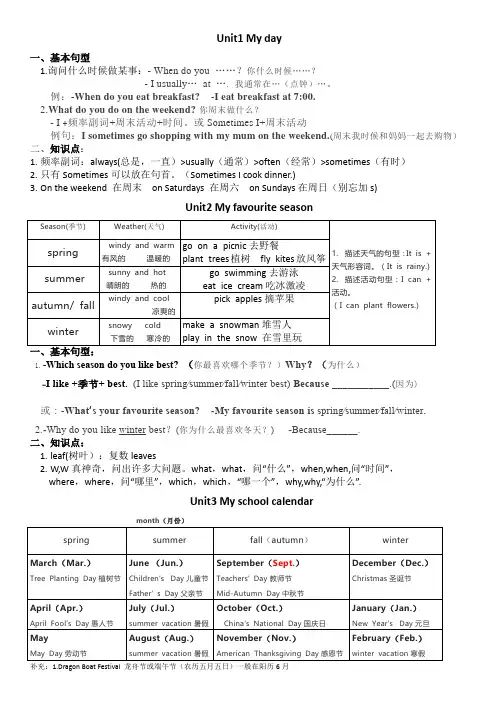
Unit1 My day一、基本句型1.询问什么时候做某事:- When do you ……?你什么时候……?- I usually…at …. 我通常在…(点钟)…。
例:-When do you eat breakfast?-I eat breakfast at 7:00.2.What do you do on the weekend?你周末做什么?- I +频率副词+周末活动+时间。
或Sometimes I+周末活动例句:I sometimes go shopping with my mum on the weekend.(周末我时候和妈妈一起去购物)二、知识点:1.频率副词:always(总是,一直)>usually(通常)>often(经常)>sometimes(有时)2.只有Sometimes可以放在句首。
(Sometimes I cook dinner.)3.On the weekend 在周末on Saturdays 在周六on Sundays在周日(别忘加s)Unit2 My favourite season1.-Which season do you like best? (你最喜欢哪个季节?)Why?(为什么)-I like +季节+ best.(I like spring∕summer∕fall∕winter best) Because ___________.(因为)或:-What‘s your favourite season? -My favourite season is spring∕summer∕fall∕winter.2.-Why do you like winter best?(你为什么最喜欢冬天?) -Because______.二、知识点:1.leaf(树叶):复数leaves2.W,W真神奇,问出许多大问题。
what,what,问“什么”,when,when,问“时间”,where,where,问“哪里”,which,which,“哪一个”,why,why,“为什么”.Unit3 My school calendar补充:1.Dragon Boat Festival 龙舟节或端午节(农历五月五日)一般在阳历6月2.月份首字母大写。
最新PEP人教版小学英语五年级下册单元知识清单总结(全册)
英语 人教PEP版 五年级下册 Unit 1
【重点释疑】 ☆此句型是由why引导的特殊疑问句。why用来
询问事情的原因,意为“为什么”。 ☆其答语用because来陈述原因。because意为
“因为”。例如: —Why do you lBecause I can swim in the river. 因为我可以在河里游泳。
秋天。/我最喜欢秋天。 ☆“What’s your favourite season?”也可以用 来询问对方最喜欢的季节是什么。可用“My favourite season is+季节.”来回答,也可直接用 所喜欢的季节名称回答。
英语 人教PEP版 五年级下册 Unit 1
例如: —What’s your favourite season?
英语 人教PEP版 五年级下册 Unit 1
☆此句型还可以用来询问最喜欢别的事物的原 因,如科目、食品、动物等。当主语是第三人称单 数时,应将其中的do改为does。
英语 人教PEP版 五年级下册 Unit 1
【情景再现】 课堂上,格林老师在进行一项调查,调查孩子
们最喜欢的季节及其原因。我们看看她是怎么问 约翰的吧! Miss Green:What’s your favourite season? John:Summer. Miss Green:Why do you like summer? John:Because I can swim.
你最喜欢什么季节? —My favourite season is winter. /Winter.
我最喜欢的季节是冬季。/冬季。
英语 人教PEP版 五年级下册 Unit 1
2.【原文呈现】 Why do you like spring best? 你为什么最喜欢春季? 【句型结构】 “Why do you like +季节+best?” 用来询问对方最喜欢某个季节的原因。
人教版PEP五年级英语下册各单元知识点

PEP五年级英语下册各单元知识点Unit1My day一、重点词汇。
1.四会词汇:eat breakfast吃早饭have···class上······课play sports进行体育运动exercise活动;运动domorning exercises做早操eat dinner吃晚饭clean my room打扫我的房间go for a walk散步go shopping去买东西;购物take学习;上(课)dancing跳舞;舞蹈take a dancing class上舞蹈课2.三会词汇:when什么时候after在(时间)后start开始usually通常地;惯常地Spain西班牙late晚;迟 a.m.午前;上午p.m.午后;下午why为什么shop去买东西;购物work工作last上一个的;刚过去的sound听起来好像also还;也busy忙的need需要play戏剧;剧本letter信live居住island岛always总是;一直cave山洞;洞穴go swimming去游泳win获胜二、其他日常活动。
get up起床eat lunch吃午饭go to bed上床睡觉wash my face洗脸wash my clothes洗我的衣服watch TV看电视play ping-pong打乒乓球playthe pipa弹琵琶go swimming去游泳go running去跑步do homework做作业do kung fu练武术play football踢足球play basketball打篮球三、频度副词。
always总是,一直(100%)usually通常(80%)often经常(60%)sometimes(30%)有时四、疑问词。
when什么时候why为什么五、重点句型。
1、询问别人什么时候做某事的句型及回答。
新人教版五年级下册英语知识点汇总
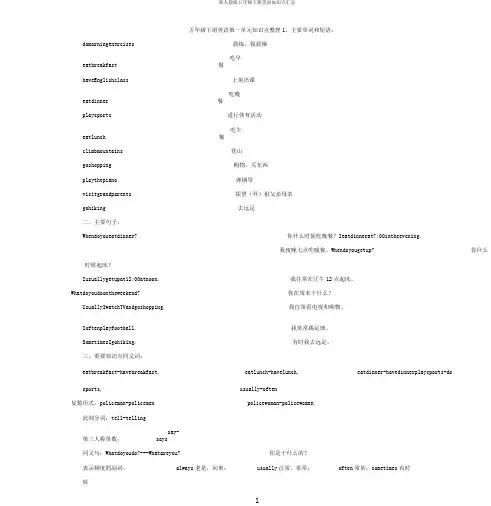
五年级下册英语第一单元知识点整理1、主要单词和短语:domorningexercises晨练,做晨操eatbreakfast吃早餐haveEnglishclass上英语课eatdinner吃晚餐playsports进行体育活动eatlunch吃午餐climbmountains登山goshopping购物,买东西playthepiano弹钢琴visitgrandparents探望(外)祖父亲母亲gohiking去远足二、主要句子:Whendoyoueatdinner?你什么时候吃晚餐?Ieatdinnerat7:00intheevening.我夜晚七点吃晚餐。
Whendoyougetup?你什么时候起床?Iusuallygetupat12:00atnoon.我往常在正午12点起床。
Whatdoyoudoontheweekend?你在周末干什么?UsuallyIwatchTVandgoshopping.我往常看电视和购物。
Ioftenplayfootball.我常常踢足球。
SometimesIgohiking.有时我去远足。
三、重要知识点同义词:eatbreakfast-havebreakfast,eatlunch-havelunch,eatdinner-havedinnerplaysports-dosports,usually-often复数形式:policeman-policemen policewoman-policewomen此刻分词:tell-telling第三人称单数:say-says同义句:Whatdoyoudo?---Whatareyou?你是干什么的?表示频度的副词:always老是,向来;usually往常,常常;often常常;sometimes有时候以复数形式出现的词组:visitgrandparents,planttrees介词后跟表示时间的词语时,表示在某年、某月、某个季节,某个时候(在上午,在下午,在夜晚)用in;表示在某一天,在礼拜几用on,在详细的几点几分用at.too和either的用法差别:too和either都是“也”的意思,但too用于必定句,either用于否认句。
新人教版PEP五年级英语下册各单元知识点总结

新人教版PEP五年级英语下册各单元知识点总结Unit 1: Our Classroom- Classroom objects and their names- Sentences to describe classroom objects and their locationsUnit 2: Our Clothes- Clothing items and their names- Describing clothing using colors and patterns- How to ask and answer questions about what someone is wearingUnit 3: I Love Sports- Sports vocabulary and their names- Describing sports using adjectives (e.g., fun, exciting, tiring)- Expressing preferences for certain sportsUnit 4: My Birthday Party- Vocabulary related to birthdays and celebrations- Describing activities at a birthday party- Expressing likes and dislikes about different party elementsUnit 5: At the Farm- Vocabulary related to farm animals and their names- Describing farm animals using adjectives (e.g., big, small, noisy) - Describing activities at a farm (e.g., feeding animals, milking cows)Unit 6: A Fun Day Out- Vocabulary related to amusement park rides and activities- Describing activities and experiences at an amusement park- Expressing likes and dislikes about different rides and activitiesUnit 7: A Friendly Letter- Vocabulary related to writing a letter (e.g., greeting, closing, signature)- Structure of a friendly letter- Writing a letter to a friend, describing personal experiences or activitiesUnit 8: Our Pets- Vocabulary related to pets and their names- Describing pets using adjectives (e.g., cute, friendly, playful)- Talking about responsibilities and caring for petsUnit 9: Our Earth- Vocabulary related to the environment and nature- Describing different natural elements (e.g., mountains, rivers, plants)- Expressing concerns and suggesting actions to protect the environmentUnit 10: Fun with Art- Vocabulary related to art and artistic activities- Describing different art forms (e.g., drawing, painting, sculpting) - Talking about personal preferences for different art activitiesUnit 11: Let's Travel- Vocabulary related to travel and transportation- Describing different modes of transportation (e.g., car, train, airplane)- Talking about travel experiences and preferences for different destinationsUnit 12: Healthy Habits- Vocabulary related to health and healthy habits- Describing different healthy habits (e.g., exercise, balanced diet, enough sleep)- Talking about personal choices and habits for a healthy lifestyle。
(完整版)人教版PEP五年级下册英语知识点复习总结
五年级英语下册知识点复习总结
Unit1Myday
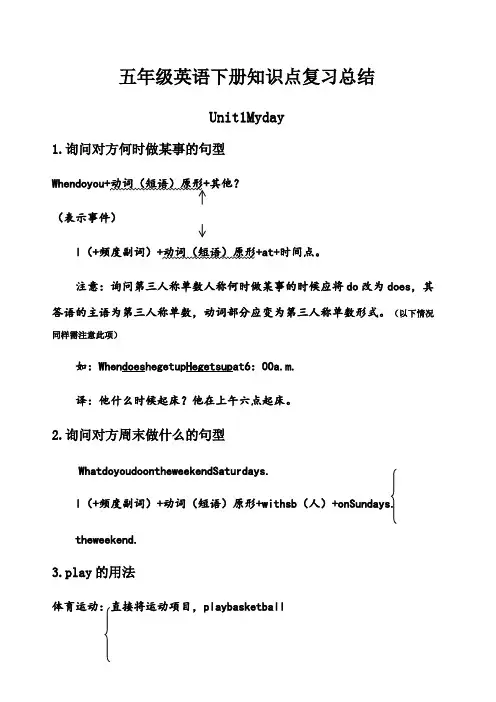
1.询问对方何时做某事的句型
Whendoyou+动词(短语)原形+其他? (表示事件)
I(+频度副词)+动词(短语)原形+at+时间点。 注意:询问第三人称单数人称何时做某事的时候应将 do 改为 does,其 答语的主语为第三人称单数,动词部分应变为第三人称单数形式。(以下情况
同样需注意此项)
如:WhendoeshegetupHegetsupat6:00a.m. 译:他什么时候起床?他在上午六点起床。
2.询问对方周末做什么的句型
WhatdoyoudoontheweekendSaturdays. I(+频度副词)+动词(短语)原形+withsb(人)+onSundays. theweekend.
(2)在基数词后加 th:除去 first,second,third,其他基数词变序数词一般 直接在其后加 th。注意 five 与 twelve 要先把 ve 变 f,再加 th;eight 直接加 h;nine 去 e 再加 th。
(3)整十序数词以 ieth 结尾:整十位的序数词先将十位整数词尾的 y 变为 i, 再加 eth。如:twenty-twentieth。
The
注意:play-plays 因为 a 是元音 3)以 ch,sh,s,x 或 o 结尾的动词,在后面加-es; 例如 teach-teacheswash-washesdo-doesgo-goesfix-fixes
4)不规则的; 例如 have-has
5.by 的用法
PEP人教版小学英语五年级下册单元知识梳理总结(全套)
Unit 1知识梳理【重点单词】1.exercise 活动;运动2.take 学习;上(课)3.dancing 跳舞;舞蹈4.when 什么时候;何时5.after 在(时间)后6.start 开始ually 通常地;惯常地te 晚;迟9.a.m. 午前;上午10.p.m. 午后;下午11.why 为什么12.busy 忙的13.always 总是;一直【重点词组】1.eat breakfast 吃早饭2.have … class 上……课3.play sports 进行体育运动4.do morning exercises 做早操5.eat dinner 吃晚饭6.clean my room 打扫我的房间7.go for a walk 散步8.go shopping 去买东西;购物9.take a dancing class 上舞蹈课【重点句子】1.I get up at 5 o’clock.我五点钟起床。
2.That sounds like a lot of fun.听起来很有趣。
3.I usually wash my clothes.我通常洗我的衣服。
4.Sometimes I cook dinner.有时候我做晚饭。
5.I often go shopping.我经常去购物。
【重点对话】1.—When do you finish class in the morning? 你们上午的课到几点结束? —We finish class at 1 o’clock.我们一点钟结束上午的课。
2.—When do you eat dinner? 你几点钟吃晚饭?—At 6:00 p.m.下午六点钟。
3.—What do you do on the weekend ? 你周末做什么?—I often watch TV and play ping-pong with my father.我经常看电视,也常和我爸爸一起打乒乓球。
[全]pep五年级英语下册:1~6单元知识点归纳
pep五年级英语下册:1~6单元知识点归纳小学五年级英语语法:现在完成时构成:主语+助动词have, has+过去分词用法:2) 表示过去发生的和现在有某种联系的动作,常和just, usually, already, since等时间副词连用I have just had lunch. (饱了,不用再吃了)He has had a cup of tea.(不渴了,不用再喝)They have already had their holiday. (不能再度假了)The boy has already read the book. (已经知道书的内容了,不用再看了) 3) 询问别人是否做过某事一般用现在完成时:Have you finished your homework?Have you been to Beijing?Have he seen the film?4) 表示开始于过去并持续到现在的动作I have lived in Beijing for twenty years.I have worked for this school for 1 year.5) 表示一种经历,经验:去过…地方,做过…事情,经历过…事情I have never had a bath.I have never seen a film.I have never been to cinema.I have ever been to Paris.Have been to表示去过,have gone to 表示去了I have been to London.(人已经回来)He has gone to London.(人还在那里)6) 表示一种结果,一般不和时间副词联用I have lost my pen.I have hurt myself.He has become a teacher.She has broken my heart.句型变化:★变疑问句将助动词移到句首,变否定句在助动词后面加not.e.g. Have you lost your pen? I have not lost my pen.★肯定回答及否定回答Yes, I have. No, I have not.★特殊疑问句:What have you done?What has he done?一般过去时与现在完成时的区别:凡是有明确的表示过去的时间状语的句子为过去时注意:有些动词表示的动作有一个终点,不能再延续,因此不能和表示一段时间状语连用错:I’ve left Beijing for 3 days.对:I left Beijing 3 days ago. I have been away from being for 3 days.。
人教PEP五年级英语下册知识汇总
人教PEP五年级下册Unit1知识汇总一、词汇eat breakfast 吃早饭have…class 上……课exercise 活动;运动play sports 进行体育活动do morning exercises 做早操eat dinner 吃晚饭clean my room 打扫我的房间go for a walk 散步go shopping 去买东西;购物take 学习;上(课)dancing 跳舞;舞蹈take a dancing class 上舞蹈课when 什么时候;何时after 在(时间)后start 开始usually 通常地;惯常的Spain 西班牙late 晚;迟a.m. 午前;上午p.m. 午后;下午why 为什么shop 去买东西;购物work 工作last 上一个的;刚过去的sound 听起来好像also 还;也busy 忙的need 需要play 戏剧;剧本letter 信live 居住island 岛always 总是;一直cave 山洞;洞穴go swimming 去游泳win 获胜二、句子1. -- When do you get up? 你什么时候起床?-- I often get up at 7 o’clock. 我经常在七点钟起床。
2. -- When do you finish class in the morning?你们上午的课什么时候结束?-- We finish class at 1 o’clock. 我们一点钟课程结束。
3. Classes start at 3 o’clock. 三点钟开始上课。
4. -- When do you usually eat dinner in Spain?你在西班牙通常什么时候吃晚饭?-- Usually at 9:30 or 10 o’clock. 通常在九点三十分或十点钟。
5. That’s too late! 那太晚了!6. -- When do you do morning exercises? 你什么时候做早操?-- At 7 o’clock. 在七点钟。
最新PEP人教版小学英语五年级下册单元知识清单总结(全册)
五、第八、第九、 第十二变化不规则外,其 余均在基数词后加上-th即可。 ② 20~90的序数词的构成方法是将基数词的词 尾 -y 变成i再加-eth. ③ 几十几的序数词,只需把个位数变成序数词, 十位数不变。
英语 人教PEP版 五年级下册 Unit 1
英语 人教PEP版 五年级下册 Unit 1
例如: —When does he do sports?
他什么时候做运动? —He usually plays sports after school.
他通常放学后做运动。 ☆询问时间的其他句型: What time+do/does+主语+动词原形+其他? 例如:What time do you read English?
单元知识清单课件
人教PEP版
五年级 下册
英语 人教PEP版 五年级下册 Unit 1
Unit 1 单元重难点
1.【原文呈现】 When do you finish class in the morning? 你们上午的课到几点结束? 【句型结构】 “When+助动词+sb+动词原形+其他?” 用来询问某(些)人做某事的时间。
—I usually climb mountains. 我通常爬山。
英语 人教PEP版 五年级下册 Unit 1
【情景再现】 每个人都有自己的周末安排。来看一下Mike和
Amy的周末计划吧! Mike:Hello, Amy! What do you do on the weekend? Amy:I usually play the piano. Mike:Oh, that’s good. When do you usually play