
浙江省2019届中考英语总复习第一篇教材梳理篇第19课时Modules1_4九下课件新版外研版
Now
the number of
family cars is much larger than before.
is about seven million now.
(3)现在这个城市的人口大约是七百万。 The number of people in the city
核心考点突破
【词义辨析】 词条 a number of 意义 意为“一些”,相当于 some 用法 后接可数 名词复数 后接可数 名词复数 谓语动词 复数
24. generally speaking 通常来说;总的说来
25. above all 26. in one go 最重要的是 一口气;一下子
归
纳
基础自主梳理
· 学校生活 to 1.There’s nothing as long as you work hard. 写 只要你努力,没什么好担心的。 worry about 4.But people don’t take exercise as they as much . !She’s used to
Children shouldn't
be allowed
to
hang out
all day in the streets.
核心考点突破
【归纳拓展】
(1)hang 作动词,意为“悬挂;绞死”。注意:当含义不同时,其过去式和过去分词也不同。 原形 hang 过去式 过去分词 hung hung 意义 悬挂 绞死
hang hanged hanged
We wanted to hang up the photo of our family.我们想把全家福挂起来。 (2)hang out 在外消遣;闲逛 hang on 不挂断(电话);坚持住
核心考点突破
❷ set off 动身;出发
【题3】 用take off, set off, see off, get off的适当形式填空 (1)Don't get off the bus until it stops.
核心考点突破
❶ hang v.悬挂;吊
【题1】 用hang的正确形式填空
(1)The man will be hanged as a spy(间谍) early tomorrow morning. (2)Don't hang your overcoat here, Mike. (3)A blue coat was hung on the wall. (4)Please hang the wet clothes near a fire. 【题2】 根据汉语意思完成句子 孩子们不应被允许一天都在大街上闲逛。
A number of visitors are visiting (正在参观) the West Lake and the number of the visitors is increasing (正在增加). 【题8】 根据汉语意思完成句子 (1)每年都有一些人来参观我们的学校。 a number of Every year people come to visit our school. (2)现在家用汽车的数量比以前多了很多。
11. speak up
大点声说
12. used to do sth. 过去常常做某事 13. succeed in doing sth. 成功地做成某事 14. set off go off put up 动身;出发
纳
· 动词短语 5. take care
6. 7. 9. take place take off
【题10】 根据汉语意思完成句子
(1)这个刀子是用来切水果的。 The knife is used for cutting fruit. (2)卡车是用来运载东西的。 A truck is used to carry things.
核心考点突破
【词义辨析】 词条 used to do sth. be/get used to (doing) sth. be used to do sth. be used as 意义 过去常常做某事 to 为不定式符号 习惯于(做)某事 to 为介词,可用于现在时、过去时、将来时等多 种时态 是 use sth. to do sth.的被动语态,相当于 be used for doing sth. 介词 as 表示“作为……”,后面常接名词 用法
postmen
officer exactly suddenly
hung
fell fallen flight
· 形容词
5.exact→ 6.sudden→
→
11.fly→ · 代词
(过去分词)
(n.)
12.you→ yourself/yourselves (反身代词)
基础自主梳理
· 介词短语 1. because of 因为;由于 2. at the end of… 在……末尾 短 语 归 3. in one's spare time 在某人的闲暇时间 4. on one's own 独自地 10. have a break 休息
the housework.
核心考点突破
【归纳拓展】 1.set off 意为“出发”;set off for sp.表示“动身去某地”。 If you want to catch the train, we'd better set off immediately. 你要是想赶上火车,咱们最好马上出发。 He is going to set off for Shanghai.他将动身去上海。
第 19 课时
Modules 1-4 (九下)
基础自主梳理
· 名词 1.success→ → 词 汇 拓 展 2.wealth → 3.postman→ 4.office→ succeed (adj.) (adj.) (复数) (n.)军官;官员;警察 (adv.) (adv.) wealthy (v.) successful · 动词 7.direct→ director/direction (n.) cate→ 9.hang→ → 10.fall→ education hung (n.) (过去式) (过去分词) (过去式)
15.
多保重 发生 16.
离开
搭建
17. lead the way 带路 · 形容词短语 18. be full of 装满 19. be careful of 当心……
脱去 8. say goodbye to… 向……告别 see sb. off 为某人送行
基础自主梳理
短 语 · 其他短语 20. rock climbing 攀岩 21. as long as 只要 22. what's more 而且 23. once a week 一周一次
【题5】 用适当的频度副词填空
(1)Jack is always the first one to get to school and he is never late for school. (2)Lucy is so kind that she is always ready to help others. 【题6】 对画线部分提问 Emma helped the old lady with her housework once a week last year. How often did Emma help the old lady with her housework?
2.有关off的动词短语:
cut off 切断;剪下 get off 下车 show off 炫耀 see off 送行 go off 离开;(闹钟)响起 take off 脱下;起飞
keep off 远离;不靠近 put off 推迟;延期 turn off 关掉(水、电等)
核心考点突破
❸ always/usually/often/sometimes/seldom/never
核心考点突破
【归纳拓展】
(1)表达频率还有其他方式,如once a week 一周一次; hardly ever几乎不。
(2)提问频率用how often。
(3)频度副词要放在行为动词之前,系动词、助动词或情态动词之后。
核心考点突破
❹ the number of/a number of
【题7】 根据汉语提示完成句子
但是人们做的运动没有过去多。 5.Remember to speak up
作
积 累
2.In the afternoon, we have two more lessons
before school finishes. 下午放学前我们还有两节课。 · 日常生活
a bit
deaf now.
记得说话大点儿声,她现在有点儿耳背。 6. Whenever you go walking in the hills, you should always wear proper clothes.
3.But the pilot succeeded in landing on time.
不过飞行员成功地按时着陆了。
无论何时在山里行走,你都应该一直穿着合适的衣
服。
基础自主梳理
写 作 积 累 7.Today, with the Internet, people can communicate the world. 如今,有了网络人们可以很容易和世界各地的朋友交 easily with 8.I suppose that's because more people less. 我觉得那是因为有车的人更多了,他们步行或骑自
the number of 意为“……的数量、数目”
单数
核心考点突破
❺ used to do sth./be used to do sth./be/get used to doing sth./be used as 【题9】 根据汉语提示完成句子 (1)She used to play tennis (打网球) in the school team. Now she is a professional tennis player. (2)I used to climb hills (爬山), but now I seldom do that.
(完整版)浙江省2019版中考英语总复习第一篇教材梳理篇课时训练19Modules1_4九下试题新版外研版
课时训练(十九) Modules 1-4(九下)(限时:30分钟)Ⅰ.[2018·金华]完形填空One morning, when I was leaving for my business, a middle-aged man came up and asked me for help. He said he had no 1 to get food for his large family.“You look 2 . Why don't you work?” I asked. “Simply because I cannot get work, sir.”“If I give you work, what pay do you want?”“ 3 I can get bread for my family, sir.” he answered.I decided to find out if he 4 meant what he said. “OK. I'll give you one pound an hour, if you5 a brick(砖) under your arm and walk around the square for five hours without stopping.”“Thank you, sir. I will.”I found a brick and started him on his walk before I went to my 6 . I never thought he would do what he had 7 .When I came back five hours later, I saw him 8 walking, with the brick under his arm.I stopped him and gave him 9 pounds. He thanked me and told me that some people had 10 to help him when they knew why he was doing all this. He would go and ask 11 for work. Before leaving, he asked if I would give him the 12 . I did.Several years later, a well-dressed man greeted me on a train. Seeing I was not sure who he was, he 13 that he was the brick man and had his own business now. “You know, I still keep that brick and always value it as the most 14 thing I have as it has brought me luck and success.”15 , it was not the brick that made the man successful, but his faithfulness(坚定) in doing evena very little thing.1.A.courage B.money C.plan D.time2.A.funny B.sick C.serious D.strong3.A.As long as B.As soon as C.Even if D.Ever since4.A.certainly B.simply C.really ually5.A.break B.carry C.fix D.hide6.A.business B.lesson C.programme D.research7.A.planned B.prepared C.promised D.suggested8.A.also B.already C.even D.still9.A.four B.five C.six D.seven10.A.continued B.forgotten C.offered D.refused11.A.him B.them C.me D.her12.A.brick B.chance C.job D.bread13.A.explained B.imagined C.realised D.supposed14.A.beautiful B.expensive C.important D.interesting15.A.As a result B.At last C.In a word D.In factⅡ.[2018·金华]阅读理解Shyness can be an unhappy feeling. But the good news is you're not alone. Scientists say that more than 40 percent of teenagers and adults consider themselves shy. Shyness is feeling a little nervous or as if you want to hide when you're around other people or in a new situation.▲ Scientists say such things as genetics(遗传基因), life experiences, and environment can influence whether a person is shy. For example, in some families, everybody seems to be shy.What happens if you are shy? Well, being shy may cause you to avoid or miss opportunities you would enjoy.How do people overcome(克服) shyness? This is what Gilbert tells us,“When I started off trying to get over being shy, I decided to do little steps at a time, including practising smiling and saying hi to people. And it works for me.”But shyness is not the kind of thing that most people can get over overnight. Overcoming shyness takestime and needs practice.Here are some tips given by scientists.Think of what to talk before you leave home. Prepare things to talk about before you're in a social situation. For example, if you know your classmates are interested in an upcoming(即将发生的) event, learn about it so you can join in the conversations.Let people know you're shy. If you're shy, just show it. Instead of letting people guess, tell them the truth. Explain that you are shy and feel nervous but enjoy talking to people.Make things easy for the other person. Remember, you're not the only shy person around. Do what you think might help others feel good—for example, say hello or smile.Pick one social skill to practise at a time. Start simply. For example, smile or be the first person to say hi. Choose skills you feel comfortable enough with to practise for a day, a week, a month, or evena year.16.Which of the following can be put in the blank in Paragraph 2?A.What is shyness?B.What makes people shy?C.Can shyness be good for us?D.Can we overcome shyness?17.The example of Gilbert in Paragraph 4 is given to .A.show how people overcome shynessB.introduce a shy girl called GilbertC.tell the right time to practise smilingD.explain the steps of overcoming shyness18.What does the underlined word “overnight” in Paragraph 5 most probably mean?A.Correctly.B.Suddenly.C.Slowly.D.Finally.19.Which of the following is the right way to overcome shyness?A.Don't let others know that you are shy.B.Wait for others to say hello to you first.C.Choose several skills to practise at a time.D.Get ready before you join in a social situation.Ⅲ.词汇运用(ⅰ)用方框中所给词语的适当形式填空。
浙江省2019届中考英语总复习教材知识梳理
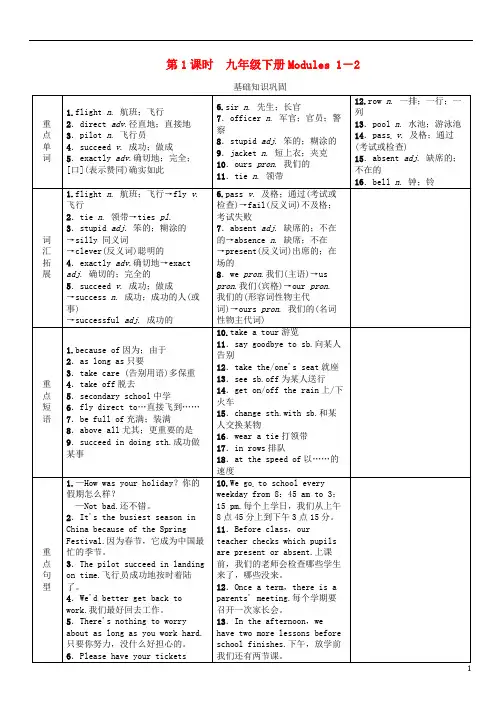
第1课时九年级下册Modules 1-2基础知识巩固We go飞行员成功地按时着陆重难词句选析1.succeed v. 成功;做成(教材P2)【点拨】succeed作动词,意为“成功;做成”。
常构成短语succeed in doing sth.,意为“成功做某事”,相当于manage to do sth.或do sth.successfully。
如:My sister finally succeed in passing the driving test.我的妹妹最后成功地通过了驾照考试。
【拓展】success是其名词形式,既可作可数名词,也可作不可数名词,意为“成功;成功的人或事”。
如:Confidence is the key to success.自信是成功的关键。
The party was a big success.这次聚会很成功。
【即时训练】第(1)题用所给词的适当形式填空;第(2)题句型转换。
(1)My friend Jack succeed in __climbing__(climb) onto the top of the mountain.(2)All the students succeeded in passing the exam.(改为同义句)①All the students__managed__ __to__ __pass__the exam.② All the students __passed__ the exam __successfully__.2.because of 因为;由于(教材P2)【辨析】because of与becausebecause of是介词短语,表示原因。
后跟名词或代词。
because也表示原因,但它是一个连词,后面跟从句。
如:They didn't go to the park because it snowed heavily.=They didn't go to the park because of the heavy snow.由于大雪,他们没去公园。
浙江省2019届中学考试英语总复习教材知识梳理

第1课时八年级下册Modules 1-2基础知识巩固15.4续表befo re? n to many interesting重难词句选析1.smell v . 有……的气味;闻;闻出(教材P2) 【点拨】(1)smell 用作连系动词,意为“发出……气味;闻起来”,一般不用于被动语态和进行时态。
但有时态变化,过去式是smelt/smelled ,过去分词是smelt/smelled 。
常见结构为:“主语+smell +形容词”或“主语+smell +of +名词”。
如:This blue rose smells very sweet.这支蓝玫瑰闻起来很香。
The water smelt of earth.水闻起来有泥土味。
(2)smell 还可用作实义动词,意为“闻到”,后可直接接宾语,也可以接复合宾语。
如: I smelt something burning.我闻到了东西烧焦的味道。
【拓展】相似用法还有feel(感觉,摸起来),taste(品尝,尝起来),sound(听起来),look(看起来)这些动词。
【即时训练】第(1)题根据汉语意思完成句子;第(2)题根据汉语提示补全句子。
(1)这瓶牛奶闻起来有点酸。
The bottle of milk __smelt__ a little __sour__.(2)These clothes look __good__(好)and sell __well__(好). 2. afford v . (有财力)买得起,付得起(教材P10)【点拨】afford常与can,could,be able to连用,意为“负担得起(费用);经受得住(损失、后果);抽得出(时间)”。
后面一般接名词、代词或不定式,多用于否定句或疑问句中。
如:We can't afford a new house.我们负担不起一个新房子。
He couldn't afford to lose his fortune entirely.他经不起倾家荡产。
浙江省2019届中考英语总复习教材知识梳理
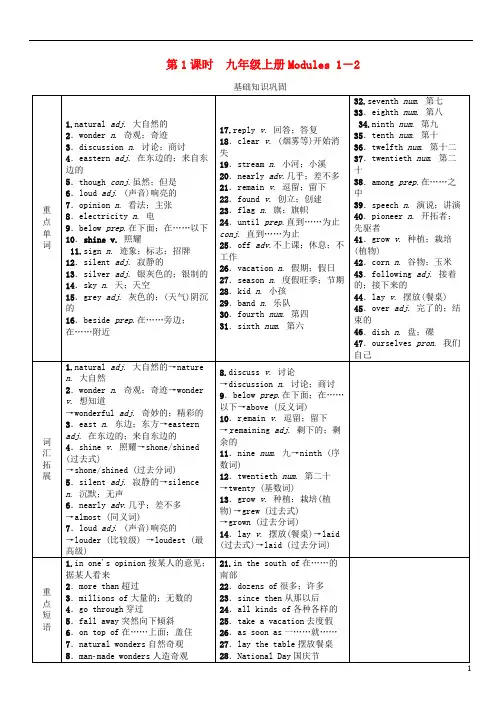
第1课时九年级上册Modules 1-2基础知识巩固emain续表o.g the right way重难词句选析1.wonder n . 奇观;奇迹(教材P2)【点拨】wonder 既可以作可数名词,也可以作不可数名词。
表示“奇观;奇迹”时是可数名词,表示“惊奇;惊叹”时是不可数名词。
如:Victoria Falls in Africa are one of the natural wonders of the world.非洲的维多利亚瀑布是世界自然奇观之一。
The sight of Taj Mahal filled us with wonder.看见泰姬陵,我们充满了惊叹之情。
【拓展】(1)wonder 还可以作及物动词,意为“想知道;对……感到怀疑”。
常见用法有:①后接who,what,why等疑问词引导的宾语从句或“疑问词+不定式”结构,表示“想知道”。
如:The teacher wondered why she was late for the class.老师想知道她为什么上课迟到。
②后接that引导的宾语从句或不定式短语时,表示“对……感到惊奇或惊讶”。
that常可以省略。
如:I wonder (that) he has won the race.我对他赢得比赛感到惊讶。
I wonder to see you here.在这儿见到你,我感到惊讶。
③后接if或whether引导的宾语从句,用于有礼貌地询问。
如:I wonder if you would mind giving me a hand.我想知道你是否介意帮助我。
(2)wonderful为wonder的形容词形式,意为“奇妙的;精彩的”。
其副词形式为wonderfully。
如:It's such a wonderful story that I want to read it again.这是一个如此精彩的故事,以至于我想再读一遍。
浙江省2019届中考英语总复习教材知识梳理

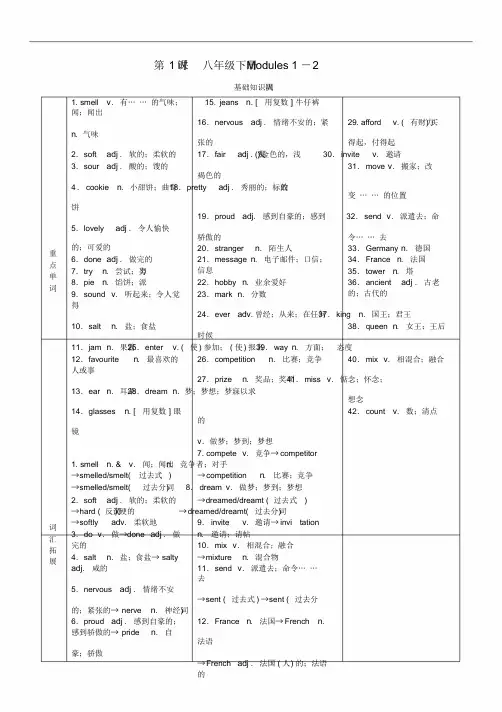
第1课时八年级下册M odules 1 -2基础知识巩固1. smell v. 有⋯⋯的气味;15. jeans n. [ 用复数] 牛仔裤闻;闻出16.nervous adj . 情绪不安的;紧29. afford v. ( 有财力)买n.气味张的得起,付得起2.soft adj . 软的;柔软的17.fair adj . (头发)金色的,浅30.invite v. 邀请3.sour adj . 酸的;馊的31.move v. 搬家;改褐色的4.cookie n. 小甜饼;曲奇18.pretty adj . 秀丽的;标致的变⋯⋯的位置饼19.proud adj. 感到自豪的;感到32.send v. 派遣去;命5.lovely adj . 令人愉快骄傲的令⋯⋯去重点单词的;可爱的6.done adj . 做完的7.try n. 尝试;努力8.pie n. 馅饼;派9.sound v. 听起来;令人觉20.stranger n. 陌生人21.message n. 电子邮件;口信;信息22.hobby n. 业余爱好23.mark n. 分数33.Germany n. 德国34.France n. 法国35.tower n. 塔36.ancient adj . 古老的;古代的得24.ever adv. 曾经;从来;在任何37.king n. 国王;君王10.salt n. 盐;食盐38.queen n. 女王;王后时候11.jam n. 果酱25.enter v. ( 使) 参加;( 使) 报名39.way n. 方面;态度12.favourite n. 最喜欢的26.competition n. 比赛;竞争40.mix v. 相混合;融合人或事27.prize n. 奖品;奖项41.miss v. 惦念;怀念;13.ear n. 耳朵28.dream n.梦;梦想;梦寐以求想念14.glasses n. [ 用复数] 眼42.count v. 数;清点的镜v.做梦;梦到;梦想7. compete v. 竞争→competitor1. smell n. & v. 闻;闻出n. 竞争者;对手→smelled/smelt( 过去式) →competition n. 比赛;竞争→smelled/smelt( 过去分词)8.dream v. 做梦;梦到;梦想2.soft adj . 软的;柔软的→dreamed/dreamt ( 过去式)→hard ( 反义词) 硬的→dreamed/dreamt( 过去分词)词汇拓展→softly adv. 柔软地3.do v. 做→done adj . 做完的4.salt n. 盐;食盐→saltyadj. 咸的9.invite v. 邀请→invi tationn. 邀请;请帖10.mix v. 相混合;融合→mixture n. 混合物11.send v. 派遣去;命令⋯⋯去5.nervous adj . 情绪不安→sent ( 过去式) →sent ( 过去分的;紧张的→nerve n. 神经词)6.proud adj . 感到自豪的;12.France n. 法国→French n. 感到骄傲的→pride n. 自法语豪;骄傲2.sweet tooth 对甜食的爱式重点短语好3.be proud of ⋯为⋯⋯而感到骄傲4.sb.can't wait 某人等不及了13.be excited about ⋯对⋯⋯感到兴奋14.shake hands with 跟⋯⋯握手15.enter a competition 参加比赛5.at school 在学校;上学16.win a prize/some prizes 获6.first prize 一等奖奖7.write about 编写;写作17.at the moment 此刻18.make up 编写;创作18.be different from 不同于,9.count down 倒数;倒计时与⋯⋯不同10.a bit 有点儿19.so far 到目前为止20.have a Western meal 吃西餐续表1. It tastes good. 它尝起来很好吃。
浙江省2019届中考英语总复习教材知识梳理
第1课时八年级下册M odules 1 -2基础知识巩固1. smell v. 有⋯⋯的气味;15. jeans n. [ 用复数] 牛仔裤闻;闻出16.nervous adj . 情绪不安的;紧29. afford v. ( 有财力)买n.气味张的得起,付得起2.soft adj . 软的;柔软的17.fair adj . (头发)金色的,浅30.invite v. 邀请3.sour adj . 酸的;馊的31.move v. 搬家;改褐色的4.cookie n. 小甜饼;曲奇18.pretty adj . 秀丽的;标致的变⋯⋯的位置饼19.proud adj. 感到自豪的;感到32.send v. 派遣去;命5.lovely adj . 令人愉快骄傲的令⋯⋯去重点单词的;可爱的6.done adj . 做完的7.try n. 尝试;努力8.pie n. 馅饼;派9.sound v. 听起来;令人觉20.stranger n. 陌生人21.message n. 电子邮件;口信;信息22.hobby n. 业余爱好23.mark n. 分数33.Germany n. 德国34.France n. 法国35.tower n. 塔36.ancient adj . 古老的;古代的得24.ever adv. 曾经;从来;在任何37.king n. 国王;君王10.salt n. 盐;食盐38.queen n. 女王;王后时候11.jam n. 果酱25.enter v. ( 使) 参加;( 使) 报名39.way n. 方面;态度12.favourite n. 最喜欢的26.competition n. 比赛;竞争40.mix v. 相混合;融合人或事27.prize n. 奖品;奖项41.miss v. 惦念;怀念;13.ear n. 耳朵28.dream n.梦;梦想;梦寐以求想念14.glasses n. [ 用复数] 眼42.count v. 数;清点的镜v.做梦;梦到;梦想7. compete v. 竞争→competitor1. smell n. & v. 闻;闻出n. 竞争者;对手→smelled/smelt( 过去式) →competition n. 比赛;竞争→smelled/smelt( 过去分词)8.dream v. 做梦;梦到;梦想2.soft adj . 软的;柔软的→dreamed/dreamt ( 过去式)→hard ( 反义词) 硬的→dreamed/dreamt( 过去分词)词汇拓展→softly adv. 柔软地3.do v. 做→done adj . 做完的4.salt n. 盐;食盐→saltyadj. 咸的9.invite v. 邀请→invi tationn. 邀请;请帖10.mix v. 相混合;融合→mixture n. 混合物11.send v. 派遣去;命令⋯⋯去5.nervous adj . 情绪不安→sent ( 过去式) →sent ( 过去分的;紧张的→nerve n. 神经词)6.proud adj . 感到自豪的;12.France n. 法国→French n. 感到骄傲的→pride n. 自法语豪;骄傲→French adj . 法国( 人) 的;法语1. have a try 尝一尝;试试11. hear from 收到⋯⋯的来信看12.in the right way 以正确的方2.sweet tooth 对甜食的爱式重点短语好3.be proud of ⋯为⋯⋯而感到骄傲4.sb.can't wait 某人等不及了13.be excited about ⋯对⋯⋯感到兴奋14.shake hands with 跟⋯⋯握手15.enter a competition 参加比赛5.at school 在学校;上学16.win a prize/some prizes 获6.first prize 一等奖奖7.write about 编写;写作17.at the moment 此刻18.make up 编写;创作18.be different from 不同于,9.count down 倒数;倒计时与⋯⋯不同10.a bit 有点儿19.so far 到目前为止20.have a Western meal 吃西餐续表1. It tastes good. 它尝起来很好吃。
(浙江专版)2020中考英语复习方案第一篇教材考点梳理第19课时Modules1_4(九下)课件
4.fear → fearful (adj.)可怕的; 担心的 5.wood→wooden(adj.)木制的; 呆板的 ·形容词 6.absent→ absence(n.)缺席 →present (反义词)出席的;在现 场的 *be absent from 缺席
7.full-time 专职的;全日制的 →part-time (反义词) 8.soft→ softly (adv.)软地;柔 软地 词 → hard (反义词) 汇 9.smooth→ smoothly (adv.) 拓 平稳地;平滑地;流畅地;流利地 展 10.straight→straight(adv.)笔 直地;直接地
考
(1)hang作动词,意为“悬挂;绞死”。注意:当含义不同时,其过去式和过去分
点
聚
词也不同。
焦
原形
过去式
过去分词
意义
随 堂
hang
hung
hung
悬挂
达
hang
hanged
hanged
绞死
标
小 测
We wanted to hang up the photo of our family.
5.Remember to speak up! She's a bit deaf now. 记得说话大点儿声, 她现在有点儿耳背。 6.Whenever you go walking in the hills, you should always wear 金 proper clothes. 无论何时在山里行走, 你都应该一直穿着合适的衣服。 句 7.Today, with the Internet, people can communicate easily with 诵 friends all over the world. 读 如今, 有了网络人们可以很容易地和世界各地的朋友交流。 8.I suppose that's because more people have cars, and they walk or use their bikes less. 我觉得那是因为有车的人更多了, 他们步行或骑自行车更少了。
浙江专版2020中考英语复习方案第一篇教材考点梳理第19课时Modules1_4九下课件20200319120
take off 脱下;起飞 turn off 关掉(水、电等)
核
心 考
❸ the number of/a number of
点 聚
【题4】根据汉语提示完成句子。
焦
A number of visitors are visiting (正在参观) the West Lake and the
随
number of the visitors is increasing (正在增加).
5.Remember to speak up! She's a bit deaf now. 记得说话大点儿声, 她现在有点儿耳背。 6.Whenever you go walking in the hills, you should always wear 金 proper clothes. 无论何时在山里行走, 你都应该一直穿着合适的衣服。 句 7.Today, with the Internet, people can communicate easily with 诵 friends all over the world. 读 如今, 有了网络人们可以很容易地和世界各地的朋友交流。 8.I suppose that's because more people have cars, and they walk or use their bikes less. 我觉得那是因为有车的人更多了, 他们步行或骑自行车更少了。
核 心
【归纳拓展】
考
(1)two more lessons意为“还有两节课”,相当于another two lessons。
点
聚
(2)英语中表达“再……;又……”的方式如下:
焦
①another+some/several/基数词+名词复数=some/several/基数词